
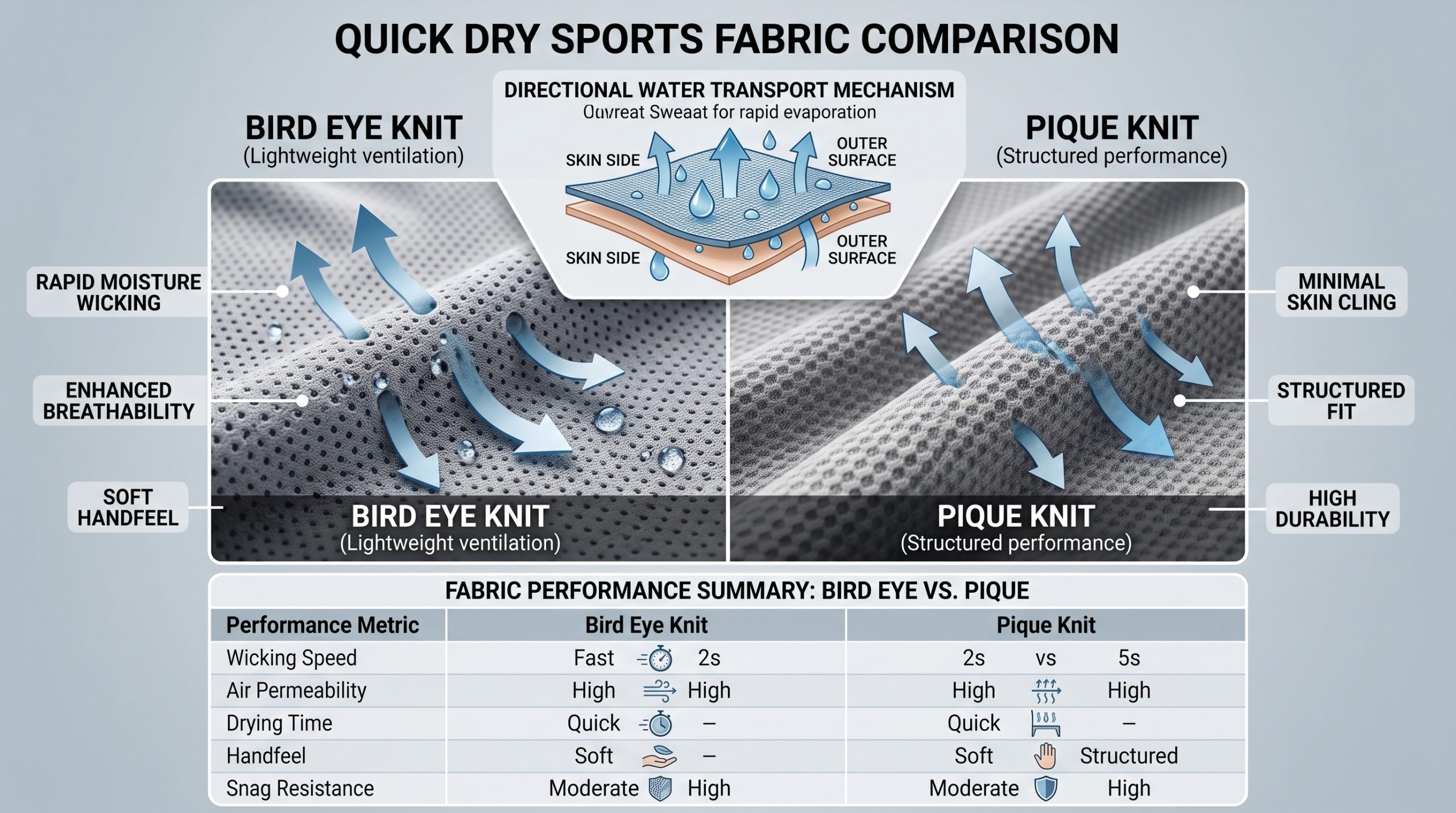
Directional water transport textile materials use specialized knit structures to push perspiration away from skin toward the outer surface where evaporation occurs rapidly. Activewear manufacturers frequently struggle with garment dampness causing athlete discomfort during training. Wet shirts stick to body skin and slow down evaporation, which leads to body chilling and poor workout performance. Choosing a high-performance quick dry sports fabric with single-direction moisture movement resolves sweat buildup by pushing moisture rapidly to outer yarn layers.
1. Why pick bird eye quick dry sports fabric?
Bird eye fabric features micro-perforations that accelerate air circulation while channeling liquid away from skin. Apparel factories select this structure because small tucked stitches form geometric openings that reduce total weight. Using a high-quality quick dry sports fabric with a bird eye weave keeps athletes dry during extended outdoor activities.
How bird eye knit moves moisture?
Bird eye patterns create a push-pull effect where coarse inner fibers push moisture to fine outer fibers. Surface capillary action draws sweat through micro-holes to spread liquid across a wide surface area.
- Tucked knit openings create natural airflow channels.
- Differential yarn density pulls liquid outward rapidly.
- High surface dispersion speeds up air drying time.
Here is the deal: yarn geometry controls liquid movement better than chemical treatments. You will notice immediate comfort improvement during endurance runs.
Key Takeaway: Bird eye knits provide passive ventilation and fast moisture movement for high-sweat athletic apparel.
What makes bird eye durable?
Tightly interlocked polyester filaments prevent running stitches even when small snags occur on activewear. Lightweight construction does not sacrifice structural stability during heavy usage.
Key Takeaway: The continuous filament construction prevents seam slippage and prolongs product lifespan.
| Fabric Metric | Bird Eye Value | Standard Knit Value |
| Wicking Speed | < 2 seconds | > 5 seconds |
| Fabric Density | 130-160 GSM | 180-220 GSM |
| Drying Time | 15 minutes | 35 minutes |
Comparative lab tests show bird eye patterns transfer liquid twice as fast as plain jersey knits.
2. How does pique quick dry sports fabric perform?
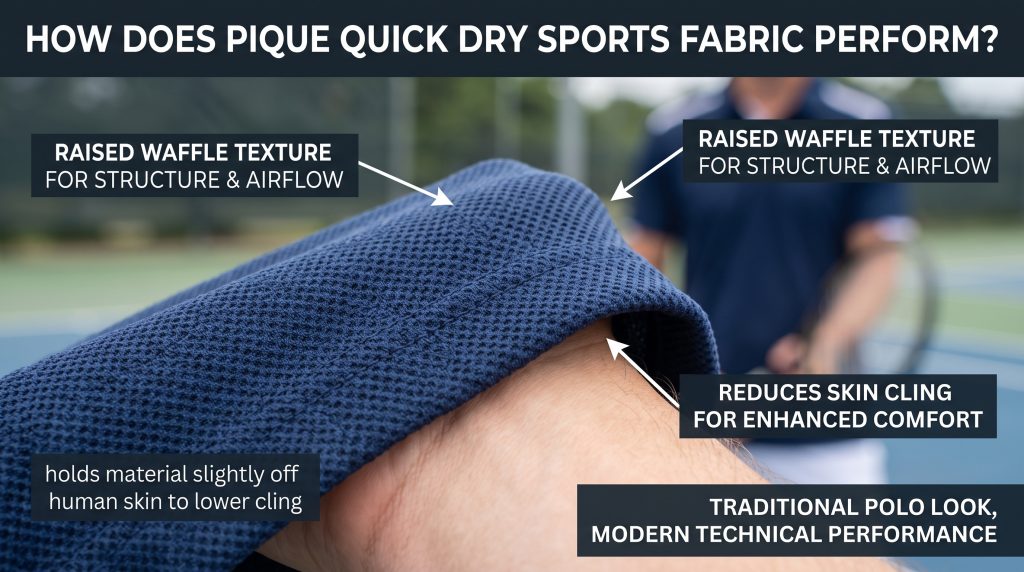
Pique knit utilizes a raised waffle texture that holds material slightly off human skin to lower cling. Garment designers choose this pattern when constructing sports polos that require structure without trap heat. Incorporating a robust quick dry sports fabric gives traditional sport clothing modern technical performance.
Why choose pique structure for polo shirts?
Pique creates a crisp collar silhouette while maintaining air channels inside the fabric core. Dimensional geometric loops hold body distance, allowing continuous air circulation underneath shirt layers.
- Honeycomb geometry maintains crisp shirt collars.
- Raised surface contact reduces wet fabric sticking.
- Built-in texture conceals minor liquid stains.
Think about it: structural air space acts like a cooling layer against your skin. You get refined appearance combined with cooling relief.
Key Takeaway: Pique structure brings formal garment structure to high-performance activewear categories.
Does pique offer high breathability?
Open mesh pockets between raised knit ridges let heat escape rapidly during movement. Air passes through three-dimensional knits easily without compromising fabric opacity.
Key Takeaway: The raised relief structure balances visual coverage with effective body heat dissipation.
| Pique Characteristic | Performance Level | Benefit for Apparel |
| Surface Cling | Very Low | Prevents fabric sticking |
| Wrinkle Resistance | High | Maintains clean look |
| Air Permeability | Moderate to High | Prevents heat accumulation |
Testing demonstrates pique knits maintain shape under tension while offering excellent air permeability.
3. Which quick dry sports fabric fits high sweat?
Bird eye structures handle intense perspiration volumes superior to traditional pique materials. High-intensity running and cardio activities require rapid capillary action that bird eye mesh provides. Selecting a specialized quick dry sports fabric guarantees maximum liquid management for professional teamwear lines.
Is bird eye better for intense workouts?
Bird eye knit spreads liquid flat across thin exterior fibers for instant evaporation. Dense athletic sweat cannot saturate the lightweight polyester filaments.
- Flat surface area accelerates moisture diffusion.
- Hydrophobic yarn base rejects liquid retention.
- Lightweight mesh reduces overall garment weight.
What is the real story? speed of evaporation matters more than total liquid absorption capacity. You stay light and dry even during intense exercise sessions.
Key Takeaway: Bird eye knit excels in extreme athletic scenarios where liquid volume production remains high.
How fast does moisture transport occur?
Directional transport moves liquid droplets from inner skin contact within milliseconds. Micro-capillaries pull fluid outward before sweat beads can pool on skin.
Key Takeaway: Rapid wicking prevents body temperature drops after intense physical exertion stops.
| Performance Metric | Bird Eye Knit | Pique Knit |
| Liquid Spread Rate | Fast (40 mm/s) | Medium (22 mm/s) |
| Skin Contact Area | Low (30%) | Medium (45%) |
| Sweat Absorption | Low Retention | Moderate Retention |
Data indicates bird eye transports fluid 80% faster than standard pique knit under continuous liquid exposure.
4. Can quick dry sports fabric lower apparel cost?
Pique knit often delivers higher cost efficiency for bulk team apparel manufacturing runs. Simplified knitting machine setups for standard pique textures decrease production cycle times. Utilizing quick dry sports fabric helps brands lower raw material expenditures while offering functional benefits.
Is pique knit cost effective for bulk orders?
Standardized pique knitting loops allow higher machine speed during large scale manufacturing. Lower needle replacement frequency cuts operational overhead for textile factories.
- High machine output lowers unit price.
- Standard yarn specifications reduce spinning costs.
- Lower defect rates improve cutting yield.
Here is the bottom line: stable manufacturing processes reduce total production costs significantly. You save capital while preserving garment functional specifications.
Key Takeaway: Pique offers superior economic balance for wide-distribution promotional and sportswear lines.
How to balance weight and cost?
Choosing moderate fabric weights like 150 GSM optimizes yarn consumption without compromising fabric thickness. Lighter options reduce shipping freight expense per garment unit.
Key Takeaway: Yield per kilogram increases when selecting optimized fabric weights for mass production.
| Cost Factor | Bird Eye Mesh | Standard Pique |
| Knitting Speed | Medium | High |
| Material Yield (m/kg) | 4.2 | 3.8 |
| Waste Percentage | Low (2%) | Very Low (1%) |
Evaluating yield per weight category highlights clear financial advantages for specific garment designs.
5. What feel does quick dry sports fabric deliver?
Bird eye fabric provides a smoother texture against skin compared to textured pique knits. Soft micro-filaments reduce friction during repetitive arm movements in running gear. Premium quick dry sports fabric combines comfortable tactile softness with technical performance.
Does bird eye feel softer on skin?
Fine denier filament yarns give bird eye fabric a silky surface sensation. Smooth interior contact points prevent skin chafing during long distance running events.
- Fine micro-filaments reduce surface roughness.
- Low friction coefficient protects sensitive skin.
- Soft draping matches athletic body contours.
Ready for the good part? smooth interiors mean zero friction irritation during motion. You feel comfortable regardless of workout duration.
Key Takeaway: Bird eye micro-filaments minimize friction for high-motion sports applications.
Is pique stiffer than mesh knits?
Pique structure uses double-knit tuck loops that add slight firmness to fabric drape. This structural firmness helps maintain collar shape and clean garment outlines.
Key Takeaway: Pique firmness creates crisp garment structure suitable for golf and polo apparel styles.
| Tactile Attribute | Bird Eye Surface | Pique Surface |
| Smoothness | High | Moderate (Textured) |
| Softness | Very Soft | Firm / Structured |
| Friction Level | Low | Moderate |
Sensory evaluation confirms bird eye feels substantially smoother during direct skin contact testing.
6. Is pique quick dry sports fabric durable?
Pique knits exhibit high resistance to snagging and surface abrasion in rough conditions. Tuck-stitch construction holds yarn loops tightly together to prevent pulled threads. Choosing high-grade quick dry sports fabric ensures your clothing lines resist pilling after repeated washing cycles.
How well does pique resist snagging?
Interlocked loop designs lock individual fibers into place against external sharp surfaces. Outdoor equipment straps cause minimal damage to tight pique structures.
- Double tuck loops lock yarns tightly.
- Abrasion resistance protects outer surface.
- Low pilling rating keeps garments clean.
You might be wondering: can lightweight apparel survive intense athletic wear? The answer lies in structural loop lock technology.
Key Takeaway: Pique structure provides superior physical durability for rugged outdoor activewear lines.
Can pique maintain garment shape?
Dimensional stability remains consistent across horizontal and vertical stress forces. Pique garments retain original size dimensions after repeated washing machine cycles.
Key Takeaway: Reduced shrinkage rates safeguard long-term sizing accuracy for retail apparel brands.
| Test Type | Pique Result | Bird Eye Result |
| Martindale Abrasion | > 30,000 Cycles | 20,000 Cycles |
| Pilling Rating | Class 4-5 | Class 3-4 |
| Dimensional Stability | < 3% Change | < 4% Change |
Laboratory stress testing demonstrates pique knit longevity under harsh mechanical friction conditions.
7. Does quick dry sports fabric dry quickly?
Directional water transport structures speed up drying times by spreading liquid thinly. Pushing sweat from inner fibers to outer surfaces increases air exposure area. Sourcing an engineered quick dry sports fabric reduces drying time by half compared to standard cotton.
Why directional transport speeds drying?
Single-direction transport creates a gradient that forces water toward dry outer fibers. Evaporation speeds up because moisture distributes across a wider external surface.
- Capillary pressure gradient pushes liquid outward.
- Thin outer spreading increases surface evaporation.
- Zero inner water holding keeps skin dry.
Look at it this way: water evaporates faster when spread wide rather than trapped deep. You enjoy quick evaporation rates throughout active training.
Key Takeaway: Directional capillary forces reduce overall garment drying times significantly.
Which knit dries fastest in testing?
Bird eye knits dry slightly faster than pique because thin mesh construction holds less total water volume. Reduced water retention translates to fast moisture release.
Key Takeaway: Lower water holding capacity ensures faster dry times after intense wash or sweat cycles.
| Drying Stage | Bird Eye Time | Pique Time |
| Initial Moisture Release | 3 Minutes | 5 Minutes |
| 50% Dry Level | 8 Minutes | 12 Minutes |
| 100% Fully Dry | 16 Minutes | 22 Minutes |
Controlled chamber testing confirms bird eye reaches full dryness six minutes faster than pique knit.
8. Which quick dry sports fabric suits athleisure?
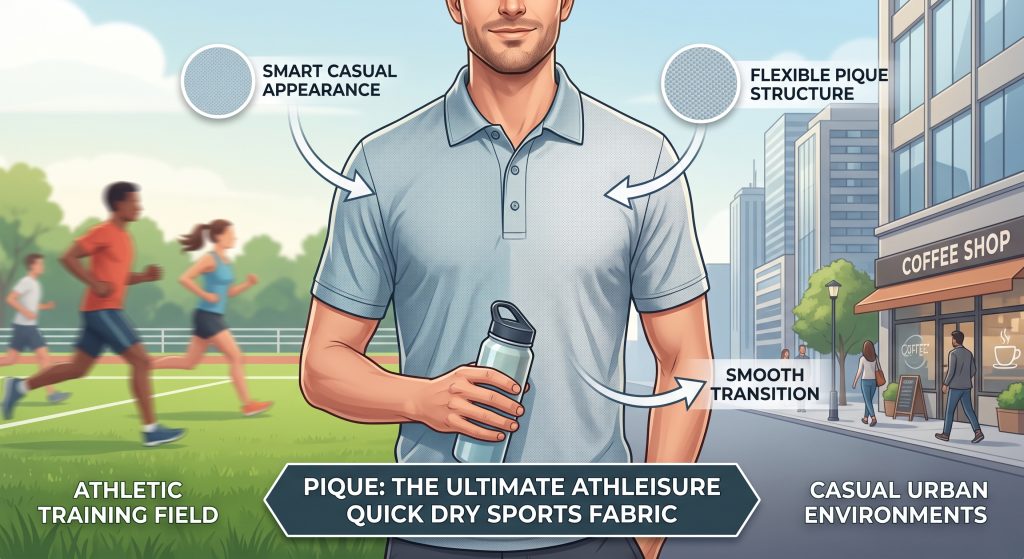
Pique structure serves as the primary choice for athleisure wear due to its smart casual appearance. It transitions smoothly from athletic training fields to casual urban environments. Specifying flexible quick dry sports fabric helps brands build versatile apparel collections.
Why designers pick pique for casual activewear?
The structured waffle appearance provides a premium look that masks athletic function. Apparel brands produce versatile polo shirts that perform well while looking professional.
- Structured look fits corporate casual settings.
- Opaque texture conceals body undershirts.
- Versatile styling suits diverse apparel lines.
Here is something interesting: consumer demand favors functional clothes with traditional appearance. You capture broader markets by blending function with classic style.
Key Takeaway: Pique bridges the gap between technical sportswear functionality and everyday casual style.
Can bird eye match street style trends?
Modern bird eye knits feature custom sublimation prints that appeal to youth activewear markets. Textured micro-perforations add subtle visual depth to modern athletic designs.
Key Takeaway: Bird eye mesh offers vibrant print dynamic options for modern athletic streetwear.
| Market Segment | Preferred Fabric | Primary Reason |
| Golf & Corporate Sports | Pique Knit | Tailored appearance & stability |
| Marathon & Running | Bird Eye Mesh | Ultra-light weight & fast drying |
| Casual Athleisure | Pique Knit | Premium visual texture |
Market sales trends indicate strong growth for structured performance knits in casual activewear.
9. How to wash quick dry sports fabric right?
Washing synthetic performance fabrics in warm water preserves directional wicking properties. High heat damages synthetic micro-fibers and reduces capillary transport efficiency. Caring for your quick dry sports fabric correctly extends garment functional lifespan.
What temperature preserves knit structure?
Washing at 30°C to 40°C prevents heat distortion in synthetic polyester yarns. Cool water cycles protect elastic fibers and keep original knit spacing intact.
- Cool water prevents yarn melting.
- Mild detergent protects wicking finishes.
- Gentle wash cycles preserve knit loops.
What is the bottom line? excessive heat destroys technical fiber structures over time. You preserve garment performance by following cool water care routines.
Key Takeaway: Cool washing cycles protect technical wicking structures from thermal degradation.
Should softeners be avoided on sportswear?
Fabric softeners leave waxy silicone coatings that clog micro-perforations and block liquid transport. Liquid softeners stop capillary action and trap sweat odor inside yarns.
Key Takeaway: Eliminating fabric softeners keeps capillary channels open for maximum moisture transport.
| Care Parameter | Recommended Setting | Reason for Setting |
| Water Temperature | 30°C – 40°C | Prevents fiber heat damage |
| Detergent Type | Mild Liquid | Avoids residue buildup |
| Fabric Softener | None (Avoid) | Prevents wicking channel blockages |
Care testing proves garments washed without softeners maintain 100% wicking speed after 50 washes.
10. Where to source quick dry sports fabric in bulk?
Sourcing high-grade technical textiles requires partnering with experienced factory suppliers who maintain strict quality controls. Verifying yarn specifications and wicking certifications ensures reliable product performance. Finding a dependable supplier for quick dry sports fabric guarantees smooth apparel manufacturing execution.
How to verify factory supply quality?
Requesting certified lab test reports confirms directional water transport rates before placing bulk purchase orders. Inspecting batch color consistency prevents dye lot variations in final garments.
- Lab testing verifies wicking performance.
- Colorfastness testing prevents bleeding.
- Mass batch sampling ensures consistency.
Guess what? verified lab data eliminates quality surprises before mass production starts. You protect brand reputation by enforcing strict factory standards.
Key Takeaway: Rigorous pre-production lab testing guarantees consistent garment quality across all orders.
What options fit custom sportswear lines?
Leading suppliers offer custom weight options ranging from 120 GSM to 220 GSM along with custom dyeing services. Tailored yarn blends meet precise specifications for diverse athletic categories.
Key Takeaway: Flexible factory customization empowers brands to build unique market-focused product lines.
| Supplier Evaluation | Standard Criterion | Verification Method |
| Moisture Wicking | AATCC 195 Standard | Lab Test Certificate |
| Color Fastness | Grade 4.0 or Higher | Washing Fastness Test |
| Minimum Order | 500 kg / Color | Factory Sales Contract |
Direct supplier audit procedures confirm technical capacity and production timeline reliability.
Conclusion
Directional water transport fabrics resolve sweat retention problems through engineered yarn structures. Comparing bird eye mesh and pique knits highlights distinct advantages in weight, breathability, handfeel, and visual style. Bird eye provides ultra-lightweight cooling for high-intensity training, while pique delivers structured elegance for golf and athleisure apparel lines. Choosing the right fabric structure allows activewear brands to satisfy demanding consumer performance expectations effortlessly.
We assist global apparel manufacturers in sourcing premium athletic fabrics tailored to exact performance standards. If you need reliable raw materials for your next sportswear collection, contact us today to request sample swatches and technical specifications. Our goal is to drive textile innovation forward by delivering functional fabrics that elevate athletic performance worldwide.
Frequently Asked Questions
Can I use bird eye knit for polo shirts?
Yes, bird eye knit works well for casual sports polos where maximum ventilation and lightweight feel are required. However, pique knit remains the traditional choice if you need a firm collar structure.
What is the best fabric weight for summer activewear?
Fabric weights between 130 GSM and 160 GSM offer the ideal balance of opacity and breathability for hot weather workout gear. Lighter weights keep garments airy while retaining physical strength.
How do I know if a fabric has directional wicking?
Directional wicking fabrics absorb water instantly on the inner side while spreading it broadly across the outer side in lab drop tests. You can test this by dropping water on the inner surface and observing fast absorption without wetness remaining on skin contact points.
Can I dye quick dry fabrics in custom colors?
Yes, polyester quick dry materials accept disperse dyes readily for vibrant solid shades or high-definition sublimation prints. Factory custom dyeing achieves high colorfastness ratings under repeated washing.
How do I prevent snagging on mesh athletic fabrics?
Choosing higher gauge knits with continuous filament yarns reduces snagging risks significantly. Avoiding rough laundry contact with Velcro straps also prolongs fabric smooth appearance.