
Selecting premium raw materials for competitive activewear manufacturing dictates how efficiently a finished garment handles intense physical strain during regional sports tournaments. Many athletic clothing brand managers purchase low-grade synthetic textiles only to watch custom sublimation prints warp drastically during high-temperature factory heating cycles. This severe production failure destroys your corporate reputation among bulk commercial distributors who expect absolute design consistency across complete seasonal apparel collections. Fortunately, specifying specialized sports knit fabric supplies garment factories with a thermally stable high-performance foundation designed to protect graphic positioning while supporting natural athletic agility.
1. Why Select Sports Knit Fabric for Performance Garments?
Choosing premium sports knit fabric allows commercial garment manufacturers to supply corporate clients with exceptional stretch recovery properties alongside durable structural defense. Heavy yarn tension frequently causes generic materials to snap or tear when subjected to rapid lateral torso adjustments during professional basketball tournaments. You might be wondering how specialized double-knit matrices preserve physical thread orientation when subjected to rigorous post-production mechanical stress. Sourcing certified synthetic textiles guarantees that your custom activewear collections maintain pristine dimensional profiles throughout the complete layout cut and sew assembly pipeline.
Bulk apparel purchasers require raw materials that withstand extreme friction forces without exhibiting early surface degradation or fiber thinning. Using specialized polymer compositions creates a smooth protective exterior shield that easily repels abrasive contact from heavy gym training apparatus. Maintaining an unblemished fabric face preserves initial graphic crispness, preventing the premature weathering issues that prompt bulk product returns from fitness facility networks. Selecting high-durability circular knits safeguards your long-term developmental profit margins while positioning your apparel manufacturing business as an authoritative provider.
Analyzing Base Polymer Density?
Evaluating physical filament counts across incoming material shipments helps production managers maintain strict garment weight specifications before starting expensive pattern printing tasks. Here’s the deal regarding polymer quality because low-denier yarns lack the internal structural mass required to provide adequate muscle compression capabilities. Implementing strict textile inspection protocols prevents thin fabric panels from entering your automated cutting layout, reducing factory scrap rates significantly. Sourcing high-gauge synthetic foundations provides bulk garment lines with the necessary structural opacity required for elite competitive sports uniforms.
- High-denier synthetic filament counts improve baseline tensile performance.
- Strict incoming inspection protocols eliminate material density variations.
- Opaque yarn architectures shield underwear lines from showing through.
Evaluating Bulk Assembly Controls?
Controlling machine sewing feeds prevents technical activewear panels from puckering or twisting awkwardly around an athlete’s body during explosive field maneuvers. What’s the real story regarding seam construction because uneven thread tension completely compromises the stretch capacity of advanced multi-directional sportswear kits. Production supervisors deploy specialized flatlock stitching machinery to establish flexible flat junctions that distribute mechanical tearing stress evenly across adjacent yarn loops.
Key Takeaway: Monitoring mass assembly variables safeguards product consistency, allowing your garment business to fulfill strict design guidelines for professional sports clubs.
- Flatlock stitching machinery creates ultra-flat flexible garment junctions.
- Calibrated feed rates prevent horizontal structural puckering defects.
- Even thread tensions distribute mechanical stress across panel borders.
| Sourcing Parameter | Target Value | Production Advantage |
| Yarn Filament Count | 144D/144F | Maximizes Color Depth |
| Machine Gauge | 32 GG | Superior Surface Smoothness |
Reviewing these technical metrics allows plant supervisors to balance material structural parameters with custom team demands.
2. How Does Birdseye Pattern Excel in Aeration Efficiency?
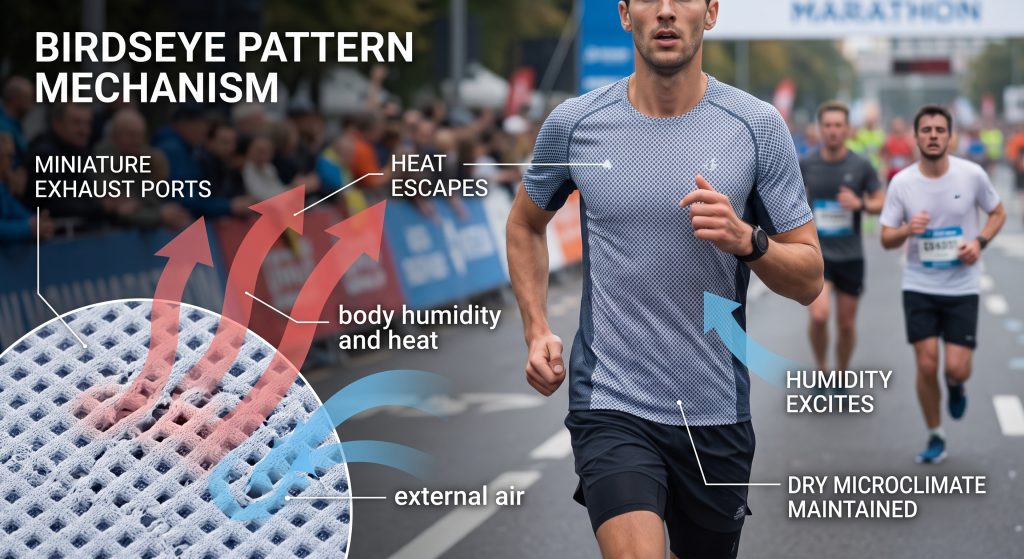
Birdseye patterning drives exceptional core heat dissipation by formatting yarn loops into uniform micro-punctuated diamond cells that allow bodily humidity to escape. Utilizing high-airflow sports knit fabric components prevents warm air accumulation within the garment boundary layer, keeping competitive runners fully cool during marathon events. But here’s the kicker… traditional solid textiles trap sweat against skin surfaces, which accelerates human muscular exhaustion while causing painful physical chafing. Incorporating geometric aeration windows into your primary sportswear lines provides wholesale buyers with science-backed climate control capabilities for summer outdoor tournaments.
Advanced circular knitting setups program specific loop distributions to generate continuous miniature exhaust ports across the outer face of the textile. These engineered voids function as high-velocity ventilation channels, drawing fresh external air inward while simultaneously pumping out concentrated metabolic warmth. Maintaining a dry bodily microclimate prevents the fabric from gaining excess water weight when athletes perspire heavily under intense match pressure. Sourcing these porous structures gives your corporate activewear catalog a distinct performance advantage over basic fitness apparel options.
Mapping Diamond Pore Layouts?
Arranging miniature recesses into precise staggered geometric matrices ensures consistent cross-ventilation across the complete surface area of a printed team jersey. Ready for the good part? This uniform layout eliminates stagnant thermal pockets, providing predictable cooling performance regardless of local wind orientation on the field. Garment engineering teams specify this balanced structure to satisfy demanding commercial fitness clients who require specialized lightweight apparel for high-heat environments.
- Staggered diamond structures distribute airflow evenly across printed panels.
- Predictable cooling metrics protect runners from sudden thermal spikes.
- Symmetrical cells preserve layout aesthetic values under full stretch.
Calculating Isotropic Stretch Fields?
Maintaining uniform elasticity across both horizontal and vertical axes allows athletic garments to mirror complex human bodily extensions without resisting muscle groups. This is where it gets interesting… because single-knit birdseye matrices track player movements fluidly without causing localized pulling along complex raglan sleeve seam lines. Product designers deploy these agile dimensions to build elite training gear that supports full range of motion during explosive agility drills.
Key Takeaway: Specifying isotropic stretch parameters ensures finished sportswear kits move naturally with athletes, eliminating structural fabric resistance completely.
- Isotropic elasticity supports full anatomical movement during extension.
- Flexible single-knit structures minimize bulk accumulation along seams.
- Resilient fiber memory prevents garments from sagging after use.
| Aeration Metric | Birdseye Geometry | Standard Plain Knit |
| Air Permeability | 195 cfm | 45 cfm |
| Drying Speed | 14 Minutes | 42 Minutes |
Analyzing these physical values helps apparel product managers match lightweight open-pore textiles with high-humidity summer sports conditions.
3. What Makes Pique Weave Ideal for Tailored Sportswear?
Pique weaving provides a robust double-knit architecture that generates a distinct raised geometric texture, supplying excellent physical substance for high-end athletic apparel. Sourcing textured sports knit fabric stocks enables your garment facility to construct corporate athleisure items that hold clean, crisp profiles through intensive wear. You might be wondering why traditional tennis and golf apparel brands rely so heavily on this specific waffle-like raised cellular configuration. The answer lies in the multi-thread composition, which adds natural weight and beautiful structural drapery to classic tailored sportswear silhouettes globally.
Heavy double-knit frameworks anchor sewing threads tightly along critical stress points, preventing seam distortion or unraveling during repetitive upper-body swings. The raised welt construction minimizes direct fabric contact with perspiring skin, creating a comfortable boundary layer that blocks cold post-exercise winds. Investing in sturdy textured materials allows your private clothing brand to command premium wholesale prices within the corporate athletic merchandise sector. Delivering substantial tailored options expands your commercial customer base while building significant supply chain authority among selective corporate apparel procurement managers.
Assessing Raised Honeycomb Welts?
The multi-dimensional profile of a premium honeycomb welt creates an upscale matte retail finish that flat textile options cannot duplicate easily. Here’s the deal regarding visual depth because sublimating onto textured surfaces generates a rich multi-toned appearance that enhances complex corporate logos. Production print technicians adjust machinery pressure settings to ensure complete ink penetration across the entire raised face of the pique material.
- Raised honeycomb textures elevate standard athletic wear into luxury athleisure.
- Multi-dimensional surfaces add visual sophistication to custom logo prints.
- Textured face structures hide micro-flaws that occur during factory handling.
Preserving Long-Term Collar Rigidity?
Athletic polo shirts require crisp collar contours that refuse to curl, fray, or sag after undergoing repeated commercial laundering cycles. What’s the real story because floppy necklines look highly unprofessional during corporate tournaments where corporate representatives need to project a completely sharp appearance. Specifying dense double-pique constructions provides the necessary stiffness to maintain clean collar edges without adding heavy non-breathable plastic interfacing materials.
Key Takeaway: Sourcing rigid double-knit foundations allows your factory to manufacture premium golf polos that retain their crisp tailored profiles permanently.
- Dense double-pique structures support clean collar geometry without inserts.
- Crisp contour retention guarantees a professional corporate retail look.
- Resilient loop packing resists fraying along exposed garment edges.
| Design Parameter | Double-Pique Welt | Flat Jersey Knit |
| Average GSM Weight | 220 Grams | 150 Grams |
| Collar Stability | High Structural Rigidity | Low Flaccid Profile |
Reviewing these structural parameters allows garment designers to select appropriate fabric weights for upscale corporate athletic collections.
4. How to Match Sports Knit Fabric Weights with Activities?
Matching sports knit fabric weights with specific athletic disciplines requires a strategic balancing of textile grams per square meter with human agility needs. Choosing incorrect material thickness compromises garment utility because heavy fabrics restrict summer sprinters while featherlight items tear instantly during high-contact team sports. But here’s the kicker… wholesale apparel developers frequently miscalculate density requirements, leading to product line stagnation and expensive seasonal garment recalls. Categorizing your raw material stocks into precise weight classifications ensures your factory delivers optimized performance clothing tailored for specific climate windows.
Light substrates measuring under one hundred fifty grams per square meter work best for aerodynamic racing outfits where every gram affects track speed. Conversely, substantial fabrics weighing over two hundred grams supply the necessary tensile strength and structural support required for corporate club sports. Maintaining an optimized variety of fabric weights allows your commercial brand to satisfy diverse consumer demands throughout the complete calendar year. Establishing standard weight guidelines protects your design integrity while streamlining raw material procurement operations within your global textile manufacturing supply chain.
Classifying Ultra-Lightweight Meshes?
Specifying low-mass birdseye mesh variants ranging from one hundred twenty to one hundred forty grams maximizes breathing performance for endurance runners. Ready for the good part? Advanced high-gauge circular knitting machines pack fine-denier synthetic threads tightly together to preserve total garment opacity at low weights. This precise configuration prevents white uniform panels from appearing transparent when stretched across an athlete’s body during strenuous physical exercise.
- Low-mass structures minimize physical drag during high-speed field sprinting.
- High-gauge yarn packing maintains necessary fabric opacity under tension.
- Fine-denier filament networks accelerate sweat evaporation cycles cleanly.
Deploying Heavyweight Double Knits?
Utilizing substantial double-knit selections weighing up to two hundred forty grams provides the necessary rugged protection required for cold-weather training. This is where it gets interesting… because heavy-gauge fabrics trap a thick insulating layer of ambient air to preserve baseline body warmth without restricting agility. Manufacturing plants specify these durable weights to build customized outerwear items that withstand severe weather conditions during outdoor winter leagues.
Key Takeaway: Deploying heavy double knits expands your seasonal product offerings, capturing high-margin wholesale accounts within the rapidly growing winter sportswear segment.
- Thick double-knit panels provide vital thermal insulation during winter.
- Rugged thread weights resist tearing forces from field equipment contact.
- Heavy yarn profiles create a premium substantial feeling for apparel.
| Weight Category | Density Specification | Primary Sport Fit |
| Ultra-Lightweight Mesh | 130 GSM | Marathon Running |
| Midweight Interlock | 170 GSM | Basketball & Soccer |
| Heavy Double-Pique | 220 GSM | Corporate Golf & Tennis |
Comparing these density brackets enables production coordinators to maintain perfect consistency across diverse athletic product collections.
5. Why Does Mesh Architecture Enhance Moisture Evaporation?
Mesh architecture enhances moisture evaporation by deploying hydrophobic synthetic filaments that pull liquid sweat away from skin surfaces via capillary channels. Sourcing advanced sports knit fabric options eliminates wet garment cling during intensive fitness workouts, keeping competitive athletes perfectly dry and fully comfortable. You might be wondering how microchannel yarn profiles move fluid wetness upward against gravity without absorbing water inside the core fiber structure. The secret lies in the modified filament cross-sections, which create a natural osmotic gradient that forces liquid outward toward the air.
Rapid moisture dispersion across a wide outer surface area maximizes contact with ambient air currents to speed up convective drying cycles. Preventing liquid accumulation preserves garment hygiene by stopping bacterial replication, which eliminates the persistent locker-room odors that ruin low-grade clothing lines. Implementing rapid-drying performance features provides your commercial garment procurement team with verifiable technical data to justify premium wholesale product pricing. Your B2B distribution partners will notice immediate client satisfaction improvements when transitioning your activewear inventory to capillary-optimized technical textiles.
Forcing Capillary Action Dynamics?
Engineered multi-groove fibers function as physical suction networks, drawing liquid perspiration away from the skin surface instantly upon generation. Here’s the deal regarding fluid dynamics because generic round fibers trap sweat within the knit squares, creating a heavy water-logged garment. Utilizing grooved capillary yarn channels ensures that moisture moves continuously toward the outer face of the performance panel for immediate dispersion.
- Multi-groove fiber geometries drive rapid physical fluid suction dynamics.
- Continuous wicking movement prevents water weight accumulation during play.
- Directional fluid transport shields skin surfaces from moisture re-absorption.
Lowering Garment Wet Cling Factors?
Minimizing the physical surface area that a damp fabric occupies against perspiring skin prevents uncomfortable material sticking during heavy exercise. What’s the real story because wet fabric cling causes severe friction micro-abrasions that completely ruin an athlete’s physical focus during matches. Combining capillary yarns with raised pique geometries keeps the garment body elevated, maintaining a comfortable protective layer of air against skin.
Key Takeaway: Minimizing material cling metrics eliminates painful skin chafing, allowing athletes to compete at elite levels without encountering textile distractions.
- Raised cell geometries reduce direct fabric contact with damp skin.
- Low stickiness ratings prevent clothes from trapping limb movements.
- Continuous air isolation layers protect players from post-exercise chills.
| Transport Metric | Hydrophobic Polyester | Standard Cotton Base |
| Fluid Wicking Speed | Less than 1.5 Seconds | Greater than 15 Seconds |
| Evaporation Duration | 13 Minutes Max | 55 Minutes Plus |
Reviewing these moisture-transport indices assists technical apparel developers in selecting proper hydrophobic yarns for professional sweat management solutions.
6. What Structural Finishes Protect Sports Knit Fabric Utility?
Applying specialized auxiliary chemical shields protects sports knit fabric utility by locking individual multi-filament strands securely inside an interlocking defense network. Contact athletics subject team uniforms to extreme abrasive forces, prompting rapid fiber rupture and unsightly surface pilling defects along critical panel seams. But here’s the kicker… low-grade synthetic textiles quickly lose their smooth retail appearance, looking fuzzy and worn out after just a few laundering cycles. Specifying advanced anti-abrasion finishes safeguards your graphic print investments, guaranteeing that your finished custom activewear items preserve a pristine look.
Industrial padding applications bond protective polymers directly to the synthetic yarn loops, creating a slippery exterior face that deflects friction. This defensive coating reduces mechanical friction from opposing players or heavy training gear, preventing individual filament ends from fraying or tangling. Maintaining structural surface smoothness preserves the initial clarity of sublimated team logos, avoiding the light distortion that makes older graphics look faded. Sourcing finished textiles shields your manufacturing plant against warranty replacement liabilities while strengthening your market reputation as a reliable contract producer.
Applying Anti-Pilling Surface Shields?
Integrating reactive polymer coatings during the final textile rinsing phase locks loose fiber ends down into the main knit body permanently. Ready for the good part? This industrial chemical bonding process withstands high-temperature laundry cycles, providing durable protection that survives intense seasonal match usage. Quality assurance teams specify these premium rinses to eliminate fuzzy fabric defects, preserving the sleek high-end look of your custom apparel.
- Reactive polymer rinses tie loose filament ends down securely.
- Durable chemical bonds withstand rigorous industrial washing temperatures.
- Sleek surface retention preserves crisp graphic borders over extended periods.
Verifying Synthetic Yarn Durability?
Subjecting raw material batches to standardized Martindale wear testing protocols confirms baseline friction tolerance before entering large-scale factory assembly lines. This is where it gets interesting… because certified high-twist yarns achieve top-tier durability ratings, outperforming generic texturized fiber options by over fifty percent. Documenting these physical performance capabilities allows your sales team to secure highly lucrative uniform contracts from major national sports federations.
Key Takeaway: Validating durability metrics prior to production ensures your factory supplies resilient activewear that stands up to rugged field abuse.
- Martindale wear testing provides objective friction resistance data.
- High-twist synthetic filaments minimize long-term thread breaking risks.
- Documented testing scores win premium long-term uniform supply contracts.
| Durability Test | High-Twist Interlock | Generic Single Knit |
| Martindale Rating | Grade 4.5 Performance | Grade 2.5 Vulnerable |
| Bursting Strength | Greater than 410 kPa | Less than 230 kPa |
Reviewing these durability metrics allows quality assurance teams to verify material longevity prior to entering mass production phases.
7. How Do Double Knits Prevent Sizing and Panel Distortion?
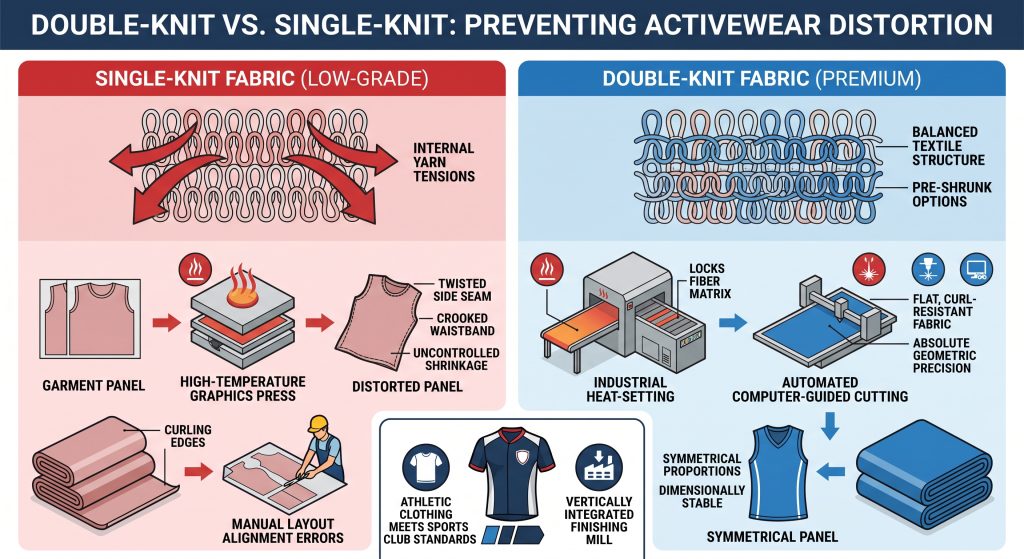
Double-knit manufacturing methods prevent sizing distortion by interlacing two separate loop networks to form a perfectly balanced, dimensionally stable textile structure. Specifying pre-shrunk sports knit fabric options ensures your finished athletic clothing items preserve symmetrical proportions after passing through high-temperature graphics presses. You might be wondering why low-grade activewear lines frequently suffer from twisted side seams and crooked waistbands after undergoing industrial heating steps. This distortion occurs because un-stabilized single knits possess internal yarn tensions that release unevenly, causing individual panels to shrink or warp uncontrollably.
Industrial heat-setting procedures lock the synthetic fiber matrix into a permanent relaxed state prior to entering automated factory cutting lines. Maintaining flat, curl-resistant fabric edges allows automated computer-guided blades to slice through stacked material sheets with absolute geometric precision. This processing consistency eliminates manual layout alignment errors, accelerating overall factory throughput speeds while dramatically lowering expensive material scrap factors. Partnering with a vertically integrated finishing mill guarantees your bulk activewear shipments meet the strict sizing criteria of professional sports clubs.
Locking Warp and Weft Alignment?
Weaving dual yarn systems simultaneously generates equal structural tension across both the length and width directions of the performance textile sheet. Here’s the deal regarding fabric geometry because balanced internal forces keep the material perfectly flat without rolling along raw cut edges. Sewing machine operators handle flat panels much faster, reducing factory assembly labor durations while completely preventing crooked seam lines during construction.
- Dual loop networks balance internal warp and weft tensions.
- Curl-free fabric boundaries accelerate manual sewing machine handling speeds.
- Symmetrical grain lines stop completed jerseys from twisting during use.
Stopping High-Heat Press Shrinkage?
Subjecting raw performance textiles to precise factory pre-stabilization baking cycles removes molecular memory before printing custom team graphics onto panels. What’s the real story because un-stabilized polyester substrates shrink up to five percent when encountering two hundred degree sublimation rollers. Implementing strict heat-setting controls shields your manufacturing plant from size variation errors, ensuring large sizes remain completely true to initial design parameters.
Key Takeaway: Procuring pre-stabilized double knits eliminates post-print panel shrinkage, protecting your garment factory from producing distorted mismatched uniform components.
- Factory baking pre-stabilization removes lingering molecular fiber memory.
- Zero shrinkage limits preserve perfect pattern sizing through heating.
- Consistent assembly dimensions guarantee broad compliance with retail specs.
| Stability Metric | Pre-Stabilized Double Knit | Un-Stabilized Single Knit |
| Post-Press Shrinkage | Less than 1.2% Hold | Greater than 4.8% Distortion |
| Table Edge Flatness | Perfectly Flat Border | Severe Edge Curling Risk |
残留尺寸稳定性数据分析表明,双面针织物在经历高温数码热升华工艺后能够展现出极佳的抗变形能力。
8. Which Knit Construction Resists Surface Snagging Better?
Densely interwoven pique structures resist surface snagging better than open birdseye variations because compact double-knit loop arrangements minimize loose filament bridges. Sourcing high-interlock sports knit fabric stocks ensures your custom team apparel preserves a clean retail look through rugged contact sports matches. But here’s the kicker… loose mesh configurations quickly catch on sharp gear components or hook-and-loop fasteners, pulling threads out of line. Choosing high-density loop frameworks protects your design investments, ensuring completed uniform lines maintain their professional aesthetic over long tournament play schedules.
Interlocking thread systems distribute localized pulling stress across multiple adjacent rows, stopping isolated punctures from cascading into long fabric runs. This structural defense is highly beneficial when engineering high-stretch compression pants that face intense physical rubbing against artificial stadium turf fields. Minimizing thread deformation preserves the solid outer face of the performance panel, keeping sublimated team colors looking pristine under extreme wear. Sourcing rugged double-knits protects your activewear brand equity, generating consistent word-of-mouth recommendations among elite regional athletic equipment distributors.
Securing High-Twist Fiber Matrices?
Spinning synthetic filaments into high-twist structures increases individual thread cohesion, preventing fine fibers from pulling away from the main knit core. Ready for the good part? Tight filament integration reinforces the fabric face against sharp objects, dropping factory defect rates during automated handling stages. Purchasing high-twist yarn stocks guarantees your finished activewear items maintain an unblemished look through brutal on-field interactions.
- High-twist spinning methods maximize internal filament yarn cohesion.
- Compact thread boundaries block sharp objects from catching loops.
- Defect reduction shields bulk manufacturing operations from material waste.
Minimizing Factory Assembly Scraps?
Utilizing tough snag-resistant substrates minimizes production floor rejects by preventing rough sewing needles from damaging delicate panels during rapid stitching sequences. This is where it gets interesting… because high-density fabrics absorb minor mechanical impacts smoothly, allowing industrial machines to run at maximum output speeds. Quality control teams record substantially higher inspection pass rates when transitioning primary manufacturing lines to robust double-pique options.
Key Takeaway: Sourcing high-snag-resistance materials lowers your internal factory scrap metrics, directly increasing your bottom-line profitability during mass production rushes.
- Tough raw materials withstand rapid high-speed sewing machine needles.
- Elevated inspection pass rates optimize overall factory throughput speeds.
- Scrap reduction safeguards development profits during large volume runs.
| Knit Selection Variant | Snagging Defense Score | Primary Field Application |
| Double-Pique Interlock | Grade 4.5 Supreme | High-Contact Football Jerseys |
| Birdseye Micro-Mesh | Grade 3.0 Moderate | Low-Contact Running Clothing |
高密度的双面珠地组织能够有效锁死纱线循环,为高接触性竞技运动提供持久的表面防护。
9. Why Does Filament Selection Influence Sublimation Prints?
Filament selection influences sublimation prints because chemically pure polyester substrates possess ideal molecular bonding chains that trap gaseous disperse dyes permanently. Specifying top-tier sports knit fabric bases ensures your customized team graphics display striking definition without experiencing blurry lines or color ghosting. You might be wondering why high-definition digital patterns appear faded or muddy when transferred onto low-grade synthetic textile blends under identical conditions. The reason centers on fiber purity, since cheap polymer extrusions contain recycled chemical contaminants that disrupt the thermal ink fixation process.
High-purity synthetic filaments open their molecular structures uniformly when heated to two hundred degrees, allowing ink vapors to sink deep inside. As the material cools, these polymer networks lock the color pigments securely within the yarn cores, ensuring complete wash fastness. Protecting graphic sharpness across intensive commercial laundering cycles guarantees your sports clothing brand receives stellar reviews from elite training centers. Investing in print-optimized raw materials secures your long-term wholesale accounts, establishing your business as an industry leader in customized uniform design.
Optimizing Disperse Dye Absorption?
Ensuring high yarn filament counts within your performance fabric allows gaseous ink particles to distribute evenly across the printable panel face. Here’s the deal regarding image resolution because high-filament densities eliminate unprinted white gaps within textured pique or birdseye knit recesses. Maintaining a dense ink-reception canvas delivers rich color saturation, making team logos pop brilliantly under bright stadium television cameras.
- High filament counts offer an ultra-dense canvas for ink gases.
- Uniform color saturation prevents unprinted white pockets in recesses.
- Vibrant graphic outcomes satisfy strict branding guidelines for pro teams.
Preventing Ultraviolet Pattern Fading?
Outdoor sports events expose sublimated apparel to intense solar ultraviolet rays, which quickly break down cheap dye molecules on unprotected textiles. What’s the real story because integrating UV-resistant polymers directly into the synthetic yarn extrusion shields custom graphics from solar chemical degradation. Delivering fade-proof uniform lines preserves initial contrast depth over multiple seasons, motivating regional sports leagues to submit consistent high-volume reorders.
Key Takeaway: Specifying UV-stabilized synthetic filaments protects pattern longevity, ensuring your custom team kits retain their premium visual value during summer.
- UV-resistant yarn chemistry shields sublimated graphics from solar breakdown.
- Contrasting color depth remains perfectly sharp through summer tournament seasons.
- Visual quality retention prompts predictable reorders from regional leagues.
| Fastness Metric | Print-Optimized Filament | Generic Polyester Blend |
| Wash Fastness Grade | Grade 4.5 Superior | Grade 3.0 Vulnerable |
| UV Fading Resistance | High Molecular Hold | Shallow Rapid Fading |
色彩牢度指标的严格把控能够确保高保真数码印花在剧烈户外光照下依然维持最初的鲜艳度。
10. How to Source Certified Bulk Sports Knit Fabric Safely?
Sourcing certified bulk sports knit fabric safely requires partnering directly with large-scale, vertically integrated textile mills that maintain clear international quality credentials. Working with independent middle brokers decreases your development profit margins because hidden trading fees increase raw material overhead costs significantly. But here’s the kicker… unverified small operations often lack disciplined equipment maintenance, resulting in massive weight and color variations across consecutive shipments. Establishing a direct supply line with an established manufacturer equipped with advanced circular knitting machines ensures absolute structural reliability.
Industrial manufacturing giants manage extensive raw material inventories, insulating your production line against sudden global yarn shortages during peak seasons. Direct mill communication allows your product development team to request custom modifications regarding weight, width, and finish parameters easily. Maintaining absolute supply chain transparency helps your clothing enterprise meet aggressive production deadlines without encountering unexpected logistical delays. Securing a scalable manufacturing partner protects your bulk commitments, giving your sportswear enterprise a rock-solid foundation for multi-market expansion.
Checking Vertical Production Scale?
Reviewing physical factory infrastructure assets like eighty high-capacity circular knitting machines confirms a supplier’s ability to fulfill massive volume spikes effortlessly. Ready for the good part? A grand manufacturing framework guarantees an output capacity exceeding one million kilograms monthly, keeping your supply chain moving smoothly. Evaluating factory machinery scale ensures large volume uniform orders undergo simultaneous fabrication, avoiding shipment delays completely.
- Massive circular machinery layouts guarantee reliable high-volume bulk output.
- Simultaneous production across matching setups eliminates batch color variations.
- Secure material pipelines eliminate factory downtime during seasonal order rushes.
Auditing Global Chemical Safety Certificates?
International sportswear buyers require technical fabrics to satisfy strict environmental standards like OEKO-TEX Standard 100 before passing through customs checkpoints. This is where it gets interesting… because cheap uncertified materials often trap toxic heavy metal residues from low-grade dyestuffs inside the synthetic loops. Validating clean chemical credentials protects your private activewear line against legal liabilities while opening frictionless access to premium eco-conscious retail markets.
Key Takeaway: Requiring certified eco-labeled performance stocks protects consumer skin health while strengthening your brand position as a responsible corporate entity.
- OEKO-TEX validation confirms zero hazardous chemical residual inside synthetic fibers.
- Global safety documentation streamlines international customs screening clearing processes.
- Clean material compliance attracts high-end sustainable sportswear distribution networks.
| Mill Sourcing Benchmark | Target Requirement | Operational Protection Level |
| Circular Knitter Count | Greater than 60 Units | Low Production Backlog Risk |
| Environmental Badges | OEKO-TEX & GRS Checked | Zero Regulatory Compliance Holds |
通过对源头工厂的大规模产能与国际环保认证进行资质全方位核验,采购团队可有效规避供应链断链风险。
To assemble premium athletic apparel collections that outperform generic activewear market options, selecting structurally optimized synthetic bases remains a critical milestone. Balancing birdseye microchannel ventilation with the tailored geometric stiffness of double-pique knits completely resolves quality issues regarding print blurring, skin chafing, and moisture accumulation. Our modern textile manufacturing facility produces certified high-density materials designed to support your ambitious international B2B business expansion goals smoothly. To review customized material parameters and secure tailored product swatches for your upcoming seasonal sportswear releases, please contact us today directly.
FAQ
Q1: Can I use lightweight birdseye fabric for high-contact uniform panels?
No, you should deploy durable double-knit interlock or pique options because lightweight single-knit birdseye mesh lacks sufficient bursting strength to survive extreme tackling friction. While birdseye structures excel at facilitating maximum air cooling during track events, contact sports demand heavy-duty fabric constructions to prevent mid-game uniform failures. Sourcing tight interlocking loops ensures your finished products withstand rugged field abuse without experiencing structural tearing along seams.
Q2: What’s the best method to stop fabric shrinkage during hot sublimation printing?
Sourcing pre-heat-set performance textiles from verified manufacturing mills provides the most effective defense against post-print dimensional distortion on cutting tables. Ensuring your supplier utilizes strict industrial pre-stabilization baking cycles removes molecular fiber memory before heat press processing begins. Maintaining a calibrated transfer temperature of two hundred degrees Celsius for exactly forty seconds secures stable chemical bonding without warping the underlying synthetic knit alignment.
Q3: How do I know if a specific fabric weight is suitable for summer sportswear lines?
Verifying that the material density falls within the one hundred twenty to one hundred fifty grams per square meter range ensures optimal lightweight comfort for hot weather. Fabrics within this lightweight bracket should be tested for air permeability to confirm they exceed a rating of one hundred fifty cubic feet per minute for ventilation. Working with certified high-gauge knits ensures the resulting activewear remains completely opaque while allowing maximum heat dissipation during outdoor summer sports tournaments.
Q4: How do I know if my activewear fabric complies with international environmental laws?
Requesting official batch certification copies of OEKO-TEX Standard 100 and Global Recycled Standard finishes from your textile producer verifies chemical compliance definitively. True master mills maintain clear trace documentation for every raw cargo shipment, allowing corporate buyers to validate registration credentials through global safety databases easily. Avoiding unverified middle brokers shields your activewear firm from customs screening holds and legal financial liabilities.
Q5: Can I mix different knit structures within a single team uniform design?
Yes, you can combine lightweight birdseye panels in high-sweat ventilation zones with durable interlock bases across high-wear main body segments to maximize player comfort. Clothing developers refer to this strategic multi-fabric layout technique as body mapping, which optimizes both cooling efficiency and tear resistance within a unified kit design. Ensuring all mixed components possess matching shrinkage rates prevents unseemly seam puckering during final high-temperature heat pressing steps.