
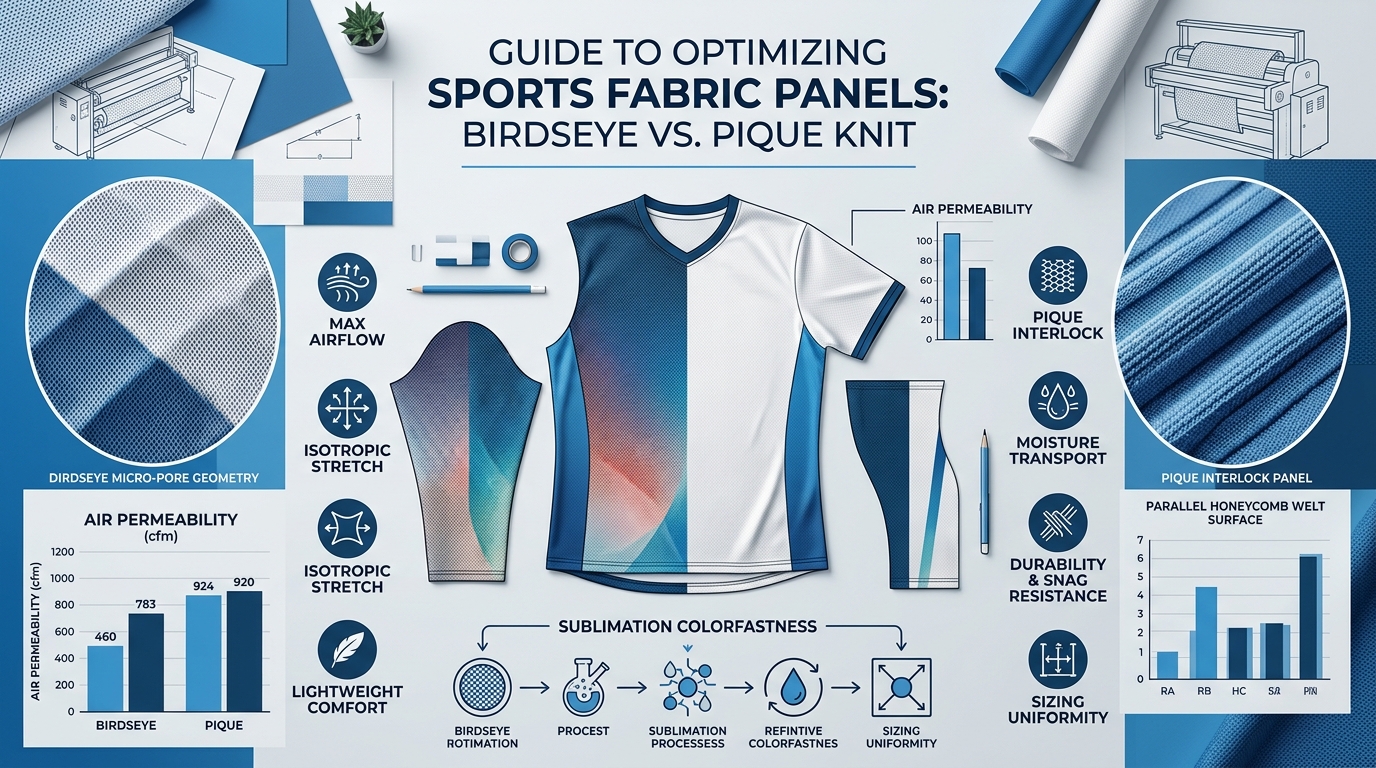
Designing elite team uniforms with sports fabric panels requires a comprehensive understanding of advanced circular knit geometries to ensure long-lasting athletic movement utility. Many sportswear brand managers select substandard fabrics that shrink drastically during high-temperature sublimation press processing, leaving structural garment panels completely misaligned. This manufacturing flaw frustrates professional sports teams while destroying your corporate reputation among bulk apparel distributors who demand flawless dimensional accuracy. Fortunately, utilizing premium engineered athletic materials provides apparel factories with a stable substrate that locks sublimated graphic designs perfectly into the synthetic yarn fibers. Professional sportswear design houses routinely deploy these specialized substrates to establish retail trust through documented structural fabric reliability during heavy regional sports tournament cycles.
1. What Are Technical Sports Fabric Panels?
Technical sports fabric panels are precision-cut pieces of engineered performance textiles configured to match specific athletic movement zones for elite activewear production workflows. Sourcing premium sports fabric panels supplies global garment manufacturers with an incredibly resilient synthetic base that maintains absolute structural form during complex industrial assembly phases. Commercial clothing designers select these advanced geometric substrates to satisfy demanding commercial fitness clients who require uniform durability across multiple competitive athletic seasons. Investing in top-tier performance textiles guarantees your finished team garments retain exact panel alignment without stretching unevenly over extended usage periods.
What Is the Difference Between Knits?
Understanding how specific yarn looping combinations alter finished garment drape properties represents a foundational skill for procurement managers buying wholesale garment components globally. Here’s the deal regarding textile engineering because choosing between flat-knit styles and textured weaves dictates how a uniform performs under heavy athletic stress. High-gauge production machinery configures pure polyester filaments into balanced structures that remain perfectly flat on industrial cutting tables during mass assembly tasks.
- Warp knit configurations eliminate fraying along raw panel edges cleanly.
- Double-knit interlock methods provide isotropic stretch fields for natural agility.
- Single-mesh systems maximize air passage through designated heat zones safely.
Key Takeaway: Evaluating structural knit variations protects your initial development investments while allowing your design team to construct highly functional garments for professional teams.
| Structural Feature | Warp Knit Panels | Circular Knit Panels |
| Edge Curl Resistance | Excellent Stability | Moderate Risk |
| Multi-Directional Stretch | Structured Tension | Fluid Adaptability |
Reviewing these structural parameters allows assembly line managers to optimize automatic sewing speeds for flawless garment construction.
2. How Do Sports Fabric Panels Improve Ventilation?
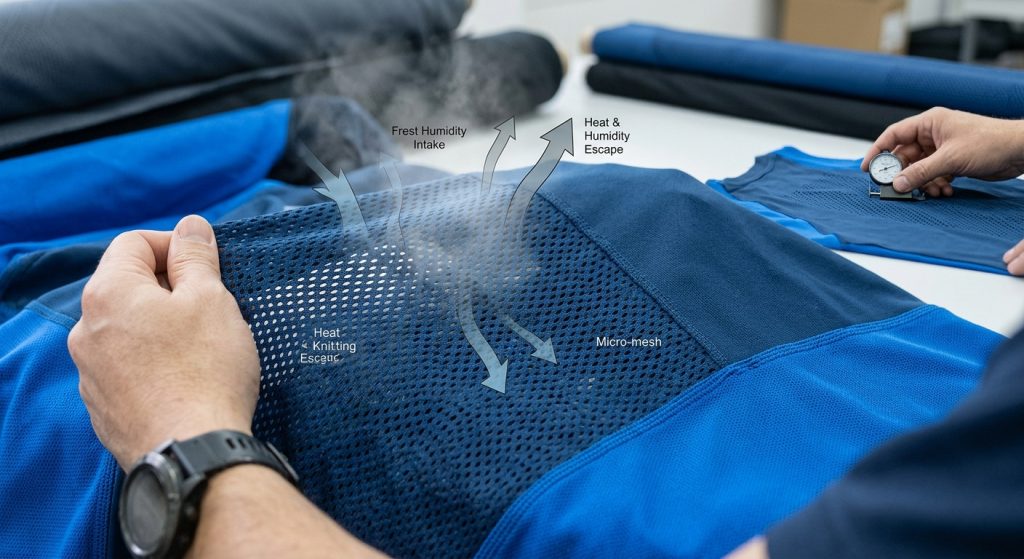
Advanced sports fabric panels increase core bodily heat dissipation by creating physical airflow channels through specialized open-loop knitting techniques that allow humid vapor to escape rapidly. Incorporating breathable sports fabric panels into high-exertion apparel lines prevents metabolic heat accumulation against skin, reducing overall player fatigue during demanding outdoor endurance tournaments. Wholesale garment buyers prefer these well-ventilated technical selections because they maintain physical cooling properties without sacrificing the underlying opacity needed for corporate athletic uniforms. Supplying technically superior breathable solutions safely elevates your manufacturing business profile, securing continuous bulk orders from professional athletic leagues globally.
Why Does Pore Geometry Matter?
Adjusting the physical arrangement of micro-apertures within synthetic yarn matrices changes how wind velocity cools moving muscle groups during active field sports matches. You might be wondering how different geometric patterns alter evaporation efficiency when professional athletes push their physical limits during summer training sessions. Circular knitting systems format cooling windows into strategic regional zones to optimize thermal regulation dynamics during high-speed field running maneuvers.
- Staggered diamond cells accelerate multi-directional ambient air intake efficiently.
- Parallel vertical vents guide warm air upward away from torso skins.
- Square micro-mesh openings maximize absolute air volume passage under pressure.
Key Takeaway: Integrating open-pore cooling patterns into performance activewear directly drives client satisfaction by maintaining a comfortable bodily microclimate during extreme exertion.
| Ventilation Style | Air Permeability | Evaporation Rate |
| Diamond Mesh Openings | High Volume Airflow | Rapid Vapor Release |
| Rectangular Air Vents | Directional Passage | Moderate Drying Cycles |
Analyzing these ventilation values helps product development teams match specific open-knit textiles with severe high-temperature regional sporting environments.
3. Which Sports Fabric Panels Resist Snagging Best?
Densely constructed pique sports fabric panels resist aggressive thread pulls and surface fiber ruptures much better than open-mesh alternatives due to their compact dual-knit thread architecture. Sourcing interlocking sports fabric panels ensures your wholesale apparel collection maintains a pristine retail look even after surviving intense physical contact during competitive football matches. Low-grade textiles often experience rapid filament disintegration when coming into close contact with protective plastic equipment padding or rough synthetic stadium turf fields. Specifying robust, high-twist yarn configurations prevents unsightly surface pilling defects, safeguarding your corporate manufacturing profits against expensive post-sale product recalls.
What Makes Structures Snag-Resistant?
The secret to enduring extreme field friction lies in how tightly individual synthetic strands intertwine during the initial circular machine manufacturing process. This is where it gets interesting… loose yarn loops get caught easily on hook-and-loop fasteners, whereas interlocked double-knits distribute tearing forces across adjacent rows seamlessly. This structural defense mechanism protects print patterns from looking scratched or worn down after rigorous industrial laundering treatments.
- High-twist multi-filaments eliminate loose surface bridges that catch objects.
- Double-face knitting structures anchor loops from both sides safely.
- Chemical anti-pilling finishes coat fibers to reduce frictional abrasion damage.
Key Takeaway: Purchasing high-twist interlocking performance textiles minimizes garment face damage while extending uniform utility lifespans for commercial athletic programs.
| Fabric Weave Class | Snag Resistance Rating | Primary Activity Match |
| Double-Pique Interlock | Grade 4.5 Exceptional | High-Impact Rugby & Football |
| Flat Birdseye Mesh | Grade 3.0 Moderate | Low-Contact Track & Field |
Comparing these durability ratings assists corporate procurement officers in choosing tough substrates that withstand intense physical friction on courts.
4. How Do Birdseye Sports Fabric Panels Feel?
Engineered birdseye sports fabric panels feel remarkably smooth against human skin because the flat geometry of their diamond-knit cell structures minimizes surface friction damage. Utilizing soft sports fabric panels prevents painful skin chafing during repetitive upper-body movements, allowing competitive athletes to maintain absolute focus on executing winning strategies. Activewear designers choose this lightweight, low-friction material to fulfill lucrative supply contracts for elite national running teams that demand high-performance utility combined with premium tactile luxury. Adding this supple textile choice to your primary garment assembly lines eliminates physical distractions while elevating user wear satisfaction scores.
Why Does Texture Impact Agility?
Coarse or heavy materials irritate moving limbs during prolonged cardiovascular training, creating psychological friction that diminishes an athlete’s field endurance over time. What’s the real story regarding tactile comfort because micro-roughness triggers skin redness when mixed with salty perspiration during intense workouts. The bare-skin sensation provided by advanced fine-gauge polyester knits maintains player comfort throughout long multi-day tournament schedules effortlessly.
- Flat diamond points reduce direct textile contact with sensitive skin layers.
- Featherlight yarn weights prevent heavy fabric drag during high-speed movements.
- Supple fiber finishes remain soft after repeated industrial laundry exposure.
Key Takeaway: Specifying flat-knit birdseye substrates delivers an ultra-smooth skin profile that keeps athletes agile while providing a pristine canvas for detailed printing.
| Tactile Parameter | Birdseye Mesh Profile | Athlete Comfort Impact |
| Friction Coefficient | Extremely Low | Eliminates Track Chafing |
| Fabric Hand Style | Silk-Like Fluidity | Barely-There Sensation |
Reviewing these tactile profiles helps apparel product managers pick lightweight components for premium sprint and endurance clothing lines.
5. Why Buy Pique Sports Fabric Panels For Polos?
Purchasing pique sports fabric panels for custom golf polo assembly ensures superior garment collar stiffness alongside an upscale, textured appearance that commands high retail price points. Sourcing double-knit sports fabric panels allows clothing factories to deliver substantial athleisure products that maintain clean, tailored lines through extensive daily wear cycles. The distinctive parallel welt formations characteristic of pique knits provide natural structural drapery, preventing finished shirts from sagging loosely around the shoulders. Wholesale apparel brands utilize this heavy-duty textile to target premium country club merchandise contracts and executive corporate apparel accounts successfully.
How Does Stitch Density Support Tailoring?
The multi-thread architecture of a premium pique weave provides a rigid foundation that supports crisp stitching along plackets, pockets, and button lines cleanly. But here’s the kicker… flimsy lightweight materials cause collars to curl awkwardly after washing, giving corporate uniforms an unprofessional appearance during high-profile business tournaments. Heavy double-knit frameworks anchor sewing threads firmly, preserving sharp garment geometry through multiple seasons of active outdoor use.
- Raised honeycomb patterns add visual depth to sublimated corporate branding.
- Thicker fabric profiles mask undergarment lines completely for professional looks.
- Firm yarn loops resist horizontal stretching to protect tailored silhouettes.
Key Takeaway: Choosing structured pique panels supplies the dimensional stability needed for executive sportswear lines while maintaining broad compatibility with industrial sewing equipment.
| Design Attribute | Pique Polo Structure | Commercial Product Value |
| Fabric Weight Range | 190 – 230 GSM | Premium Substantial Body |
| Collar Shape Retention | High Rigidity | Maintains Crisp Outlines |
Evaluating these structural design attributes helps factory layout teams optimize pressing processes for premium retail-ready corporate activewear shipments.
6. Can Sports Fabric Panels Manage Moisture Better?
![A candid laboratory photograph taken inside a modern textile engineering lab, displaying a specialized wicking testing jig with two distinct [sports fabric panels] samples. On the left, a traditional cotton blend is visibly saturated and dark with applied water, while the high-performance technical knit on the right is vibrant and dry, with tiny water beads rapidly dispersing and vanishing along intricate microscopic capillary action grooves, clearly demonstrating moisture wicking. A magnified inset with fine arrows marks the outward movement, emphasized by two pointing fingers of a hand. Soft natural daylight illuminates the practical test setup and the process. Other technical equipment and binders are blurred in the background.](http://makitapefabric.com/wp-content/uploads/2026/07/Moisture-Management-Demonstration-of-Technical-Sports-Fabric-Panels.jpg)
Advanced sports fabric panels manage liquid sweat efficiently by employing hydrophobic synthetic fibers that draw wetness away from skin surfaces through rapid capillary action channels. Deploying high-performance sports fabric panels eliminates wet garment cling during intense fitness workouts, keeping athletes dry and comfortable when sweat production reaches maximum capacity. Sourcing moisture-wicking substrates prevents clothing from absorbing heavy water weight, which can drain muscular energy during long-distance endurance running events. Integrating rapid-drying fiber technology into your wholesale manufacturing lines provides a distinct technical performance advantage over basic cotton activewear collections globally.
How Do Capillary Channels Function?
Specially extruded polyester filaments feature microscopic surface grooves that pull moisture forward toward the outer face of the garment via physical suction dynamics. Ready for the good part? Standard fabrics trap water inside the core weave structure, creating a damp environment that fosters bacterial growth and persistent locker-room odors. High-tech capillary pathways spread moisture across a broad outer surface area to maximize contact with ambient air currents for instantaneous drying.
- Hydrophobic fiber cores reject liquid retention to maintain low fabric mass.
- Grooved filament cross-sections accelerate directional sweat movement outward.
- Rapid evaporation logic minimizes post-exercise cooling shocks for players.
Key Takeaway: Implementing specialized moisture-transport networks keeps activewear light during high-output sports while protecting users from cold post-workout garment stickiness.
| Hydro-Transport Index | Synthetic Wicking Fiber | Low-Grade Textile Blend |
| Fluid Absorption Speed | Less than 1.8 Seconds | Greater than 12 Seconds |
| Core Drying Duration | 12 – 15 Minutes Max | 45 – 60 Minutes Plus |
Reviewing these moisture-transport indices assists technical apparel developers in selecting proper hydrophobic yarns for professional sweat management solutions.
7. How to Choose Sports Fabric Panels by Weight?
Selecting the ideal weight for sports fabric panels requires a strategic calculation of material grams per square meter to match specific seasonal athletic movement profiles. Utilizing proper weight sports fabric panels ensures your activewear line avoids product stagnation, since heavy items restrict summer sprinters while overly light materials fail contact sports. Bulk apparel procurers carefully divide performance textiles into distinct weight classifications to target precise market sectors within the international sportswear distribution network. Establishing an organized material weight matrix guides your purchasing department to buy correct raw components for targeted athletic uses confidently.
When to Use Lightweight Components?
Featherlight fabrics measuring between one hundred twenty and one hundred forty grams per square meter work best for high-aeration competitive racing shirts. Ready for the good part? Elite marathon runners require zero weight resistance when competing, as extra clothing mass accumulates sweat and slows split-second finishes on tracks. Sourcing fine-denier birdseye mesh structures allows your factory to build breathable summer jerseys that satisfy demanding professional athletes globally.
- Low GSM profiles maximize absolute body heat dissipation during track events.
- Tight yarn counting maintains excellent fabric opacity under maximum stretch conditions.
- Minimal fiber volume accelerates evaporation cycles to prevent water logging.
Where to Apply Midweight Options?
Substantial textiles ranging from one hundred eighty to two hundred forty grams per square meter supply the necessary structural foundation for tennis uniforms. This is where it gets interesting… Sublimating heavier double-knit fabric blocks requires adjusted transfer press dwell configurations because thick synthetic layers absorb more heat before ink molecules fuse permanently. Specifying midweight pique selections ensures your finished athleisure catalog features durable apparel items that maintain structural grace through repeated laundry cycles.
- Increased fabric thickness handles heavy industrial emblem stitching without puckering seams.
- Dense loop weaving provides reliable muscle compression support for active players.
- Sturdy material profiles withstand continuous abrasive rubbing against heavy gear.
Key Takeaway: Balancing physical material weights based on specific sports disciplines protects garment functionality while ensuring maximum consumer satisfaction across seasonal releases.
| Weight Classification | Metric GSM Range | Primary Target Sport |
| Featherlight Micro-Mesh | 120 – 140 GSM | Aerodynamic Track & Field Sprinting |
| Substantial Midweight | 180 – 240 GSM | Structured Country Club Tennis & Golf |
Comparing these weight brackets helps production coordinators select the best raw textile baselines for upcoming athletic product lines.
8. Do Sports Fabric Panels Hold Sublimation Colors?
Premium polyester sports fabric panels hold sublimation chemistry vividly because synthetic polymer chains form permanent molecular bonds with gaseous disperse dyes under industrial heat pressures. Utilizing high-colorfastness sports fabric panels ensures your custom team uniforms maintain bright logo graphics across multiple competitive sports seasons without experiencing premature color fading. Industrial transfer machinery forces heated dye molecules deep inside the expanded fiber structures where pigments remain locked tightly after ambient factory cooling cycles conclude. Selecting print-ready performance substrates protects your manufacturing company from producing blurry or washed-out team kits that fail strict retail evaluations.
How Does Molecular Bonding Work?
Thermal press processing transitions solid ink pigments directly into a gaseous state, allowing dye particles to permeate open polyester fiber strings seamlessly. What’s the real story? Natural fibers like organic cotton reject disperse inks completely, which causes custom patterns to bleed or wash away during initial laundry tests. Pure synthetic materials provide excellent chemical affinity for high-definition sublimation ink, resulting in crisp graphic borders that withstand intense sunlight exposure on fields.
- Chemical purity within yarn filaments prevents post-print color bleeding artifacts.
- High-temperature stabilization stops fabric shrinkage during graphic transfer phases.
- Deep ink saturation ensures designs remain solid when garments stretch fully.
Key Takeaway: Sourcing high-purity polyester substrates guarantees your sublimation prints achieve maximum chemical integration, keeping team kits vibrant through outdoor usage.
| Colorfastness Metric | Pure Polyester Panel | Low-Grade Fiber Blend |
| Industrial Wash Fastness | Grade 4.5 Perfect Hold | Grade 2.5 Rapid Fading |
| UV Solar Fade Resistance | High Stability Profile | Vulnerable to Sun Bleaching |
Reviewing these chemical performance traits assists printing floor managers in calibrating transfer machinery for flawless graphic output across large production runs.
9. How Do Sports Fabric Panels Ensure Sizing Uniformity?
Heat-set sports fabric panels ensure absolute sizing uniformity across mass manufacturing runs by undergoing industrial pre-stabilization treatments that eliminate residual yarn tensions prior to cutting. Specifying pre-shrunk sports fabric panels guarantees your finished athletic garments maintain symmetrical panel proportions after passing through intense high-heat graphic transfer presses. Factory cutting lines often suffer severe panel distortion when utilizing low-grade materials that lack professional heat-setting processing within the finishing mill. Investing in structurally uniform performance fabrics protects your garment factory from experiencing expensive sizing defects that disrupt international commercial supply contracts.
Why Is Dimensional Stability Vital?
Assembling multi-panel athletic jerseys requires each component to align perfectly along flatlock stitched seams to prevent twisting around an athlete’s moving limbs. Here’s the deal regarding garment symmetry because uneven fabric shrinkage causes left and right panels to mismatch awkwardly after heating stages finish. Stabilized double-knit frameworks maintain straight warp and weft lines, allowing automated cutting blades to slice through stacked textile layers with absolute geometric precision.
- Pre-stabilized yarn matrices limit post-processing shrinkage to less than two percent.
- Balanced loop structures prevent edge curling during automated piece-rate assembly.
- Consistent cross-width tension ensures uniform fabric stretch properties across sizes.
Key Takeaway: Procuring dimensionally stable fabric stocks eliminates garment fit errors while boosting factory throughput speeds during compressed production schedules.
| Stability Indicator | Pre-Stabilized Panel | Non-Heat-Set Substrate |
| Post-Press Shrinkage Rate | Under 1.5% Sizing Hold | Greater than 4.5% Distortion |
| Cutting Table Edge Flatness | Perfectly Flat Edges | High Curling Vulnerability |
Analyzing these dimensional stability metrics enables plant supervisors to minimize pattern adjustment waste while maintaining strict quality control parameters.
10. Where to Buy Custom Sports Fabric Panels Bulk?
Buying premium sports fabric panels bulk directly from large-scale certified textile manufacturing mills ensures reliable material supply continuity alongside highly competitive wholesale price structures. Establishing direct mill partnerships for sports fabric panels eliminates hidden middle-trader markups, allowing your apparel brand to maximize development profit margins during heavy production seasons. Vertically integrated factories equipped with advanced high-speed circular knitting machinery maintain strict quality control oversight across every yarn extrusion and dye batch. Securing a reliable industrial supply foundation protects your delivery commitments while providing the massive output scaling support your activewear business needs to expand.
How to Verify Factory Capacity?
Apparel sourcing directors must evaluate physical mill infrastructure to ensure a production partner can handle sudden volume spikes without compromising technical quality standards. Ready for the good part? Partnering with an enterprise operating extensive manufacturing setups guarantees your bulk textile orders bypass unexpected seasonal machinery backlogs smoothly. Verifying robust factory assets like eighty circular knitting machines confirms a dependable monthly output capacity of one million kilograms to sustain global distribution.
- Substantial machinery scale guarantees consistent fabric weights across massive bulk orders.
- In-house testing laboratories validate colorfastness properties before shipping cargo rolls.
- Ample raw yarn warehouses insulate your production line against sudden supply shortages.
Why Require Global Certifications?
International athletic apparel markets enforce strict chemical safety regulations that raw materials must satisfy prior to passing through regional customs checkpoints cleanly. But here’s the kicker… uncertified fabrics often contain hazardous heavy metal residues from cheap dyestuffs, which can spark skin irritation and trigger costly regulatory compliance holds. Validating elite global credentials like OEKO-TEX Standard one hundred and Global Recycled Standard finishes ensures your product line gains frictionless entry into premium retail spaces worldwide.
- International eco-certifications guarantee zero toxic chemical retention inside fibers.
- GRS tracking documentation satisfies growing corporate demands for sustainable textiles.
- Verified compliance metrics shield your private clothing brand from legal liabilities.
Key Takeaway: Sourcing performance fabrics from accredited multi-certified mills safeguards your supply chain investments while validating your brand’s commitment to high international safety standards.
| Mill Credential | Industry Compliance Target | Sourcing Advantage |
| OEKO-TEX Standard 100 | Zero Hazardous Chemical Residuals | Safe Skin-Contact Verification |
| GRS (Global Recycled Standard) | Verified Post-Consumer Polyester Content | Sustainable Retail Market Access |
Reviewing these structural mill verification benchmarks enables corporate procurement managers to eliminate supply chain vulnerabilities while building secure material pipelines directly with master textile producers.
To complete your upcoming team sportswear release successfully, selecting advanced performance textiles that align with precise athlete movement criteria determines long-term commercial victory. Sourcing dimensionally stable, highly breathable materials completely resolves production issues regarding print distortion, skin friction, and moisture accumulation across your garment lines. Our state-of-the-art textile manufacturing facility produces certified high-density circular knits engineered to satisfy your most demanding wholesale activewear design needs. To review your custom technical textile parameters and request tailored fabric swatches for upcoming garment collections, please contact us today directly.
FAQ
Q1: Can I use lightweight birdseye panels for contact team sports jerseys?
No, you should choose heavier double-knit interlock options because single-knit birdseye mesh lacks the high bursting strength required to survive intense tackling friction. While birdseye structures excel at facilitating maximum air cooling during track and field sprinting, their exposed loop fibers face an elevated risk of snagging when scraping against rough equipment hardware or artificial stadium turf fields. Balancing ventilation properties with mechanical durability ensures your activewear collection remains intact through grueling multi-game athletic schedules.
Q2: What’s the best method to eliminate fabric shrinkage during industrial sublimation printing?
Sourcing pre-heat-set polyester substrates from verified manufacturing mills provides the most effective defense against post-print dimensional distortion on your cutting tables. Maintaining a calibrated transfer temperature of two hundred degrees Celsius for exactly forty seconds secures permanent dye bonding without warping the underlying synthetic knit alignment. Utilizing stabilized textiles ensures left and right garment panels match symmetrically during final flatlock stitching phases.
Q3: How do I know if my performance sports fabric complies with international environmental laws?
Requesting official batch certification copies of OEKO-TEX Standard 100 and Global Recycled Standard finishes from your textile producer verifies chemical compliance definitively. True master mills maintain clear trace documentation for every raw cargo shipment, allowing corporate buyers to validate registration credentials through global safety databases easily. Avoiding unverified middle brokers shields your activewear firm from customs screening holds and legal financial liabilities.
Q4: How do I know what fabric density is correct for custom corporate polo shirts?
Specifying substantial double-pique textures measuring between one hundred eighty and two hundred forty grams per square meter ensures an upscale tailored drape that holds crisp collar contours. Lightweight options under one hundred fifty grams per square meter lack the necessary structural body, causing polo necklines to curl lazily after passing through commercial laundry systems. Midweight pique substrates provide the optimal canvas weight for holding heavy embroidered company logos cleanly.
Q5: Can I mix different knit panel structures within a single athletic garment design?
Yes, you can combine lightweight birdseye panels in high-sweat ventilation zones with durable interlock bases across high-wear main body segments to maximize player comfort. Clothing developers refer to this strategic multi-fabric layout technique as body mapping, which optimizes both cooling efficiency and tear resistance within a unified kit design. Ensuring all mixed components possess matching shrinkage rates prevents unseemly seam puckering during final high-temperature heat pressing steps.