
Sourcing premium textiles for athletic uniform decoration demands a deep technical understanding of structural knit configurations to satisfy the performance requirements of professional athletic organizations. Activewear brand managers frequently design ambitious team apparel lines only to witness vibrant sublimation prints experience severe ghosting or blurring during industrial heat press operations. This structural failure ruins your hard-earned corporate reputation among selective bulk apparel buyers who expect pristine graphic registration across full production runs. Fortunately, specifying high-density hobby lobby sports fabric options resolves these manufacturing issues by providing a thermally stable synthetic substrate engineered specifically for crisp ink fixation.
1. Why Choose Hobby Lobby Sports Fabric For Team Uniforms?
![A realistic close-up view of a technical polyester sports fabric panel (suitable for [hobby lobby sports fabric]) with a vibrant blue and orange custom team logo and mesh structure, showing sharp graphic clarity in a practical manufacturing facility with industrial heat press platen.](http://makitapefabric.com/wp-content/uploads/2026/07/Technical-Polyester-Sports-Fabric-with-Custom-Team-Sublimation-Print-1024x559.jpg)
Selecting technical hobby lobby sports fabric supplies global garment manufacturers with an incredibly resilient polyester base that maintains absolute dimensional stability during demanding high-temperature printing cycles. Commercial apparel factories frequently face costly textile shrinkage during graphic application when using low-grade synthetic materials that lack heat stabilization processing. Investing in professionally engineered performance textiles guarantees that your finished athletic garments preserve their exact intended measurements and panel alignments throughout the cutting and sewing stages. This industrial reliability allows your manufacturing business to deliver premium customized team apparel that consistently meets the strict sizing guidelines of elite sports organizations.
Maximizing Graphic Color Saturation
Achieving deep color reproduction on team jerseys depends entirely on how effectively individual polyester filaments absorb disperse dyes under heat. You might be wondering why some sublimated designs appear noticeably muted or washed out after undergoing standard post-production laundry testing. The answer lies in the molecular density of the yarn extrusion because high-quality polyester bases feature tightly packed polymer chains that trap ink molecules securely.
- High-density fiber construction prevents dye migration across sharp graphic boundaries.
- Superior yarn purity minimizes chemical interference during the thermal gas transition phase.
- Balanced textile weaving supports uniform ink penetration throughout the face of the fabric.
Protecting Structural Panel Alignment
Maintaining straight grain lines during automated cutting operations prevents finished sports garments from twisting uncomfortably around an athlete’s torso during rapid lateral movements. Here’s the deal regarding structural distortion because loose construction allows fabric panels to stretch unevenly under the tension of industrial sewing machines. Experienced apparel production managers prefer working with heat-set technical substrates because these premium selections lie perfectly flat on factory assembly tables. Utilizing stable yardage reduces material waste factors while accelerating your overall manufacturing throughput during peak seasonal team uniform ordering rushes.
Key Takeaway: Specifying heat-stabilized polyester substrates safeguards print crispness while providing clients with durable garments that maintain their correct shape through rugged game play.
| Substrate Property | Technical Target | Production Advantage |
| Thermal Shrinkage | Less than 1.5% | Preserves Sizing Integrity |
| Filament Count | 144D/144F | Maximizes Color Brilliance |
| Interlocking Type | Warp Knit | Prevents Edge Curling |
Reviewing these material parameters helps production supervisors calibrate heat press equipment for optimal sublimation yields.
2. How Does Hobby Lobby Sports Fabric Manage Aeration?
Engineered hobby lobby sports fabric manages body heat accumulation by utilizing specialized knit micro-apertures that form an active ventilation network across the garment surface. Heavy sweat retention degrades player stamina because damp activewear clings tightly to the skin while increasing friction against moving muscle groups. Sourcing advanced porous performance fabrics allows garment brands to offer lightweight sportswear apparel that facilitates continuous ambient airflow during high-intensity training. Integrating open-knit cooling structures into your product catalog satisfies the technical demands of fitness center buyers who require garments optimized for extreme metabolic output.
Engineering Microchannel Airflow Dynamics
Advanced circular knitting machines regulate air permeability by arranging yarn loops into geometric matrices that function as miniature exhaust ports. But here’s the kicker… Traditional dense weaves block natural heat dissipation because tightly packed fibers trap warm moisture vapor within the clothing boundary layer. Incorporating structural ventilation windows pulls fresh air inward while expelling accumulated body humidity during explosive athletic maneuvers. Choosing porous technical knits gives your private label clothing company a distinct performance advantage over mainstream activewear competitors globally.
Balancing Air Flow With Opacity
Apparel designers must carefully calibrate the diameter of fabric micro-holes to optimize cross-ventilation without causing the material to appear overly sheer when stretched. This is where it gets interesting… High-performance engineering solves this challenge by implementing staggered multi-layered loop structures that obscure visibility while permitting free air passage. This technical configuration allows sports teams to wear white or light-colored jerseys confidently under bright stadium lighting conditions. Procuring balanced open-knit fabrics ensures your finished product line delivers elite thermal comfort alongside necessary garment opacity.
Key Takeaway: Integrating geometric ventilation networks into sportswear lines satisfies corporate buyers who demand science-backed thermal regulation for professional athletes.
| Fabric Geometry | Air Permeability Rating | Primary Climatological Target |
| Diamond Micro-Mesh | Greater than 180 cfm | Hot Humid Summer Tournaments |
| Textured Pique Knit | Moderate 90 cfm | Transitional Autumn Outdoor Sports |
| Closed Interlock | Less than 40 cfm | Cool Weather Athletic Training |
Analyzing these air flow values guides product development teams in selecting appropriate fabric structures for targeted regional climates.
3. Is Birdseye Better Than Pique Hobby Lobby Sports Fabric?
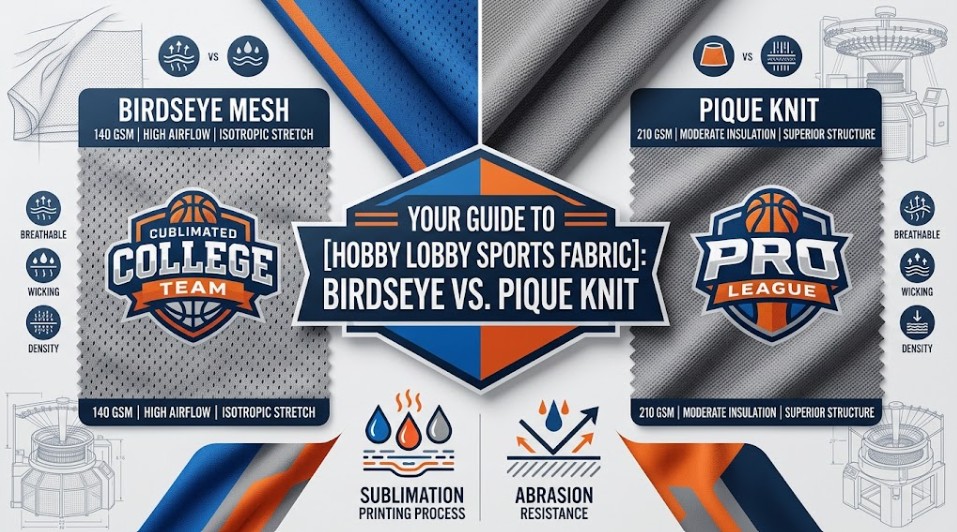
Birdseye knit delivers superior multidirectional surface breathability compared to pique structures because its uniform diamond-patterned recesses facilitate immediate moisture evaporation. Selecting the correct hobby lobby sports fabric pattern requires a careful calculation of how specific tactile surface profiles interact with an athlete’s skin under heavy sweat conditions. While birdseye fabric provides a flat, lightweight canvas ideal for detailed sublimation graphics, pique knit features raised parallel welts that supply structural substance. Understanding these structural differences enables your bulk textile purchasing department to source optimal raw materials tailored for specific garment applications.
Examining Birdseye Mesh Architecture
The recurring diamond cavities characteristic of birdseye material function as high-velocity wicking channels that accelerate liquid dispersion across the fabric surface. What’s the real story? Slow moisture transport causes athletic apparel to gain water weight during long endurance competitions which increases physical exhaustion for runners. Specifiers select this uniform circular layout because it maintains isotropic stretch characteristics across both the warp and weft directions. Utilizing this consistent cell structure allows your garment factory to manufacture ergonomic racing jerseys that move naturally with an athlete.
- Isotropic stretch profiling minimizes mechanical resistance during shoulder extension.
- Flat surface geometry prevents print alignment distortion across large graphic panels.
- Low fabric thickness reduces total garment mass for aerodynamic efficiency.
Analyzing Pique Knit Weight Distribution
Pique fabric utilizes a heavy double-knit manufacturing technique that builds a dimensional geometric texture with excellent structural body for corporate sportswear. Ready for the good part? This multi-thread composition forms a thicker boundary layer that offers light insulation making it highly suitable for outdoor golf apparel. The raised cellular construction keeps the bulk of the fabric lifted away from wet skin to prevent uncomfortable garment cling. Sourcing robust pique substrates allows your activewear brand to manufacture classic athleisure garments that command premium wholesale prices.
- Raised welt patterns minimize direct fabric contact with perspiring skin surfaces.
- Heavy yarn arrangement provides excellent structural support for tailored polo collars.
- Double-knit logic enhances dimensional stability against horizontal pulling forces.
Key Takeaway: Deploying lightweight birdseye for high-aeration racing gear or selecting heavy pique for structured corporate polo shirts allows brands to compile a balanced apparel catalog.
| Fabric Pattern Style | Average Material Weight | Recommended Apparel Type |
| Diamond Birdseye Mesh | 140 Grams Per Square Meter | Elite Marathon Running Singlets |
| Textured Pique Knit | 210 Grams Per Square Meter | Premium Corporate Golf Polos |
| Smooth Interlock Knit | 160 Grams Per Square Meter | Full-Print Team Basketball Jerseys |
Comparing these structural properties helps procurement managers align fabric purchases with specific sport performance criteria.
4. Can Hobby Lobby Sports Fabric Resist Intense Friction?
Densely constructed hobby lobby sports fabric resists surface snagging and yarn rupture by utilizing high-twist multi-filament synthetic threads that lock securely within an interlocking matrix. Contact athletics like football subject apparel to continuous abrasive forces when players collide on rough artificial turf fields or brush past protective equipment pads. Low-grade fabrics suffer rapid filament breakage under these conditions which leads to fuzzy pilling defects that ruin the professional look of team uniforms. Specifying high-friction resistance parameters ensures your customized sports apparel maintains its clean, professional aesthetic throughout long tournament schedules.
Understanding Interlocking Knit Defense
Double-knit manufacturing methods interlace two distinct yarn systems to build a unified textile barrier that distributes localized tearing stress across adjacent loops. Here’s the deal regarding structural durability because interlocking knit formations prevent single broken threads from cascading into long running runs down a uniform panel. This mechanical security is particularly advantageous when sewing complex flatlock seams that undergo high physical tension during tackling maneuvers. Using robust interlocking materials protects your garment brand from experiencing embarrassing mid-season product structural failures.
- Dual-loop integration neutralizes sharp puncture forces from external sports hardware.
- Balanced internal tension prevents structural edge curling during automated sewing.
- High filament cohesion eliminates yarn shedding inside industrial washing machines.
Extending Garment Service Life
Wholesale uniform buyers measure the return on their apparel investment by tracking how many competitive matches a kit survives before showing wear. But here’s the kicker… Surface abrasion alters how light reflects off sublimated graphics which makes older uniforms appear prematurely faded even if the ink remains intact. Utilizing high-twist long-staple synthetic fibers preserves the smooth face of the textile to maintain original print sharpness over multiple seasons. Securing abrasion-resistant fabrics helps your manufacturing operation secure lucrative long-term supply agreements with major regional sports associations.
Key Takeaway: Sourcing high-twist interlocking performance textiles safeguards uniform graphic quality while driving down warranty replacement costs for apparel brands.
| Abrasion Test Method | High-Twist Interlock | Standard Single Jersey |
| Martindale Pilling Test | Grade 4.5 Performance | Grade 2.5 Performance |
| Snagging Resistance | Excellent Structural Hold | High Risk of Thread Pulls |
| Bursting Strength | Greater than 400 kPa | Less than 220 kPa |
Reviewing these durability metrics allows quality assurance teams to verify material longevity prior to entering mass production phases.
5. How to Select Hobby Lobby Sports Fabric By Density?
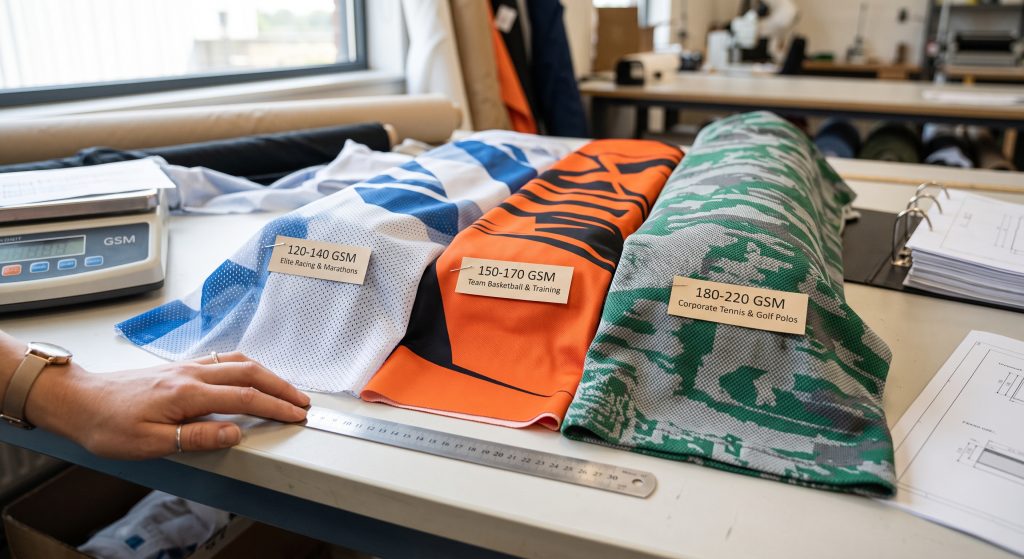
Selecting premium hobby lobby sports fabric by density requires a precise calculation of material weight to align garment drape properties with specific athletic motion profiles. Choosing inappropriate fabric thickness compromises athlete focus because overly heavy items restrict agility while ultra-lightweight selections lack the tensile strength needed for contact sports. Bulk clothing developers divide performance knits into strict weight categories to target specific seasonal climate windows within the international activewear market. Establishing a clear density matrix guides your corporate procurement department to purchase ideal raw materials for your upcoming manufacturing runs.
Deploying Lightweight Fabrics
Lightweight textiles ranging from one hundred twenty to one hundred fifty grams per square meter provide maximum agility for high-speed track events. You might be wondering how featherlight fabrics manage to support rich sublimation prints without allowing backing colors to bleed through the material. Specialized high-gauge knitting machines achieve this balance by packing fine-denier filaments tightly together to create an opaque face with minimal physical mass. Utilizing these nimble substrates allows your apparel brand to engineer premium summer racing gear that helps athletes shave critical seconds off their performance times.
- Low mass construction reduces physical drag during explosive sprinting movements.
- Fine-denier loop packing maintains excellent print opacity under full extension.
- Rapid drying characteristics prevent the fabric from absorbing excess player sweat.
Specifying Midweight Substrates
Midweight performance fabrics weighing between one hundred eighty and two hundred forty grams per square meter deliver the structural support needed for structured garments. This is where it gets interesting… Sublimating dense double-knit materials requires adjusted heat press dwell times because thick yarn structures absorb more thermal energy before ink fixation occurs. Garment development teams specify these robust densities to manufacture custom training hoodies and athletic polo lines that hold their shape through intensive wear. Sourcing stable midweight stocks ensures your factory delivers substantial garments that meet international premium sportswear standards.
- Substantial fabric thickness creates a professional tailored drape on corporate athleisure.
- Increased yarn mass provides reliable thermal protection during cool weather workouts.
- Enhanced tensile strength supports the installation of heavy industrial zippers and hardware.
Key Takeaway: Categorizing incoming fabric stocks by precise density values prevents sizing inconsistencies while ensuring each athletic discipline receives optimized garment hardware.
| Density Classification | Weight Range (GSM) | Target Athletic Discipline |
| Ultra-Lightweight Mesh | 120 – 145 GSM | Long-Distance Marathon Running |
| Performance Interlock | 150 – 175 GSM | Competitive Team Basketball Kits |
| Heavy Double-Pique | 180 – 240 GSM | Elite Corporate Golf & Tennis Apparel |
Evaluating these density brackets enables production coordinators to maintain perfect consistency across diverse product collections.
To finalize your corporate athletic collection development successfully, matching advanced knit properties with specific player movement demands determines your market success. Sourcing chemically pure, heat-stabilized substrates resolves manufacturing defects related to pattern distortion, premature fading, and moisture retention. Our state-of-the-art textile manufacturing facility produces certified high-density circular knits engineered to support your ambitious international commercial expansion goals. To review customized technical fabric specifications and request tailored product samples for your upcoming seasonal sportswear releases, please contact us today directly.
FAQ
Q1: Can I use lightweight birdseye fabric for competitive rugby jerseys?
No, you should avoid using ultra-lightweight single-knit birdseye mesh for high-impact contact sports because its thin filament bridges lack sufficient bursting strength to survive intense tackling forces. Densely woven double-knit interlock or heavy pique substrates provide vastly superior resistance against structural yarn tearing under extreme physical pulling. While birdseye fabric delivers exceptional cooling performance during hot weather track events, contact sports demand heavy-duty fabric constructions to prevent mid-game uniform failures.
Q2: What’s the best method to prevent sublimation ink bleeding on sports fabrics?
Using pure, heat-set polyester substrates combined with high-quality anti-migration disperse inks provides the most effective defense against post-print color bleeding. Ensuring your fabric supplier utilizes strict thermal stabilization processes during fabric finishing guarantees that the synthetic fibers will not shift or shrink when subjected to industrial heat presses. Maintaining a calibrated transfer temperature of two hundred degrees Celsius for exactly forty seconds secures stable chemical bonding without damaging the textile structure.
Q3: How do I know if a specific fabric weight is suitable for summer activewear collections?
Verifying that the material density falls within the one hundred twenty to one hundred fifty grams per square meter range ensures optimal lightweight comfort for hot weather environments. Fabrics within this lightweight bracket should be tested for air permeability to confirm they exceed a rating of one hundred fifty cubic feet per minute for ventilation. Working with certified high-gauge knits ensures the resulting activewear remains completely opaque while allowing maximum heat dissipation during outdoor summer sports tournaments.