
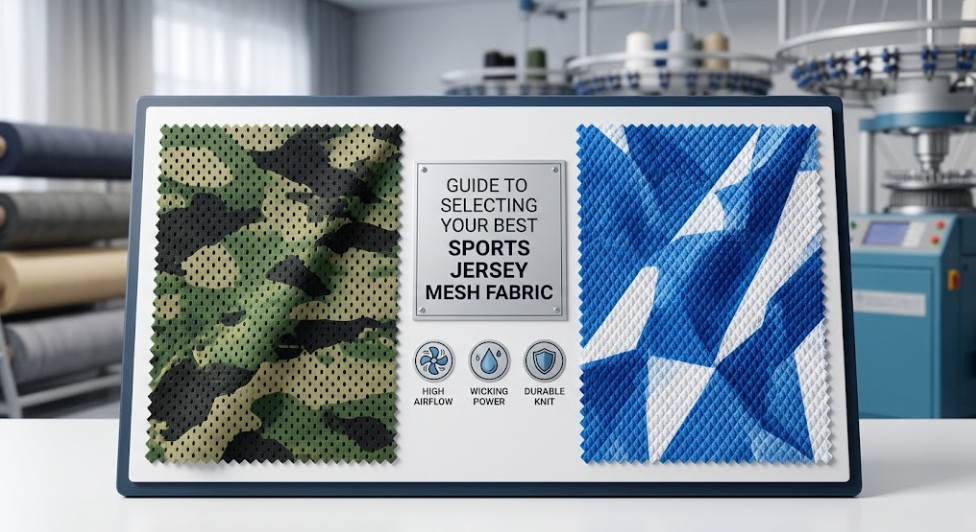
Selecting premium polyester circular knits provides the ultimate sportswear material solution because these specific technical textiles balance high airflow with exceptional design sublimation clarity across competitive leagues. Imagine your custom apparel manufacturing brand delivering bulk athletic uniform orders that accumulate heavy moisture during critical championship matches, causing active players extreme physical discomfort while destroying corporate consumer brand loyalty. Utilizing premium engineered sports jersey mesh fabric completely resolves these structural manufacturing defects through advanced moisture-wicking technology that provides permanent physical climate control alongside exceptional tensile strength. Industrial sportswear engineering enterprises consistently trust specialized double-knit configurations to maintain corporate production reliability across demanding long-form athletic apparel lines.
1. What Defines Premium Sports Jersey Mesh Fabric Quality?
Does Birdseye Geometry Optimize Uniform Airflow?
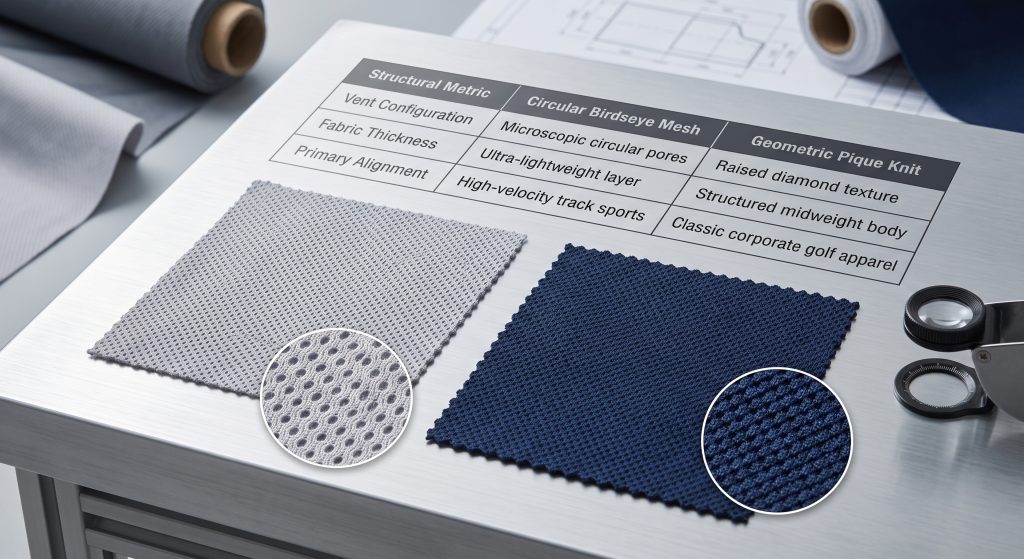
Premium technical apparel quality depends on specific high-tenacity filament density combined with precise structural pore distribution that prevents thermal retention during active match play. Sourcing high-grade sports jersey mesh fabric ensures your clothing manufacturing factory constructs lightweight garments that maintain structural thickness across multiple playing seasons. Here’s the deal… specialized knit selections create distinct performance metrics for custom team outfits:
- Birdseye mesh provides miniature circular pores for rapid moisture dispersion.
- Pique knit yields raised geometric patterns for structured uniform body.
Apparel production directors consistently demand these precise engineering configurations because advanced manufacturing techniques protect player on-field performance capabilities.
Evaluating custom material geometry allows corporate procurement directors to optimize wholesale garment catalogs based on regional climate variables and specific athletic sports categories. Choosing open circular pattern holes delivers unmatched thermal cooling efficiency during high-intensity summer games where maximizing continuous convective airflow remains a primary clothing design objective for active players. Alternatively, selecting dense diamond double-knits provides a premium structural textile weight perfectly suited for high-end school athletic team corporate branding apparel collections. A clear Key Takeaway demonstrates that matching technical fabric structure geometry to specific athlete movement patterns reduces custom clothing product return rates while successfully securing long-term uniform manufacturing distribution contracts.
| Structural Metric | Circular Birdseye Mesh | Geometric Pique Knit |
| Vent Configuration | Microscopic circular pores | Raised diamond texture |
| Fabric Thickness | Ultra-lightweight layer | Structured midweight body |
| Primary Alignment | High-velocity track sports | Classic corporate golf apparel |
Analyzing these physical dimensions allows garment enterprises to select the optimal structural base for their custom team sublimation lines.
2. How Does Sports Jersey Mesh Fabric Manage Intense Sweat?
Can Capillary Action Accelerate Evaporation?
Advanced performance polyesters manage liquid sweat by using non-absorbent synthetic filaments that transport moisture away from player skin instantly. Incorporating premium sports jersey mesh fabric ensures that active garments do not gain water weight during intense physical matches. What’s the real story? The structural capillary setup works mechanically to keep competitors dry under harsh outdoor climate conditions:
- Hydrophobic polymer threads repel liquid water to prevent skin cling.
- Maximized surface cross-sections distribute sweat across outer layers quickly.
Apparel brand procurement teams select these engineered textiles to guarantee permanent moisture protection that never washes away over extended laundering schedules.
Delivering functional team activewear with rapid drying speeds provides a significant commercial competitive advantage for international B2B clothing distributors serving major regional school athletic leagues. Active field players maintain superior on-field acceleration velocity when their performance sportswear stays exceptionally light and dry throughout long competitive championship tournaments. Minimizing heavy moisture saturation protects competitive athletes from rapid body temperature drops during sudden seasonal weather shifts across open outdoor playing fields. This valuable Key Takeaway firmly establishes that integrating rapid-drying synthetic polymers directly enhances overall finished garment utility while successfully strengthening your custom active apparel factory’s commercial wholesale market authority among professional high school sports coaches.
| Performance Variable | Hydrophobic Polyester Mesh | Absorbent Organic Fiber |
| Liquid Accumulation | Minimal moisture retention | High moisture saturation |
| Wicking Velocity | Immediate capillary movement | Delayed localized absorption |
| Weight Shift in Rain | Stays lightweight and nimble | Doubles total garment mass |
This data demonstrates that synthetic wicking paths keep sportswear light while organic weaves compromise player acceleration.
3. Why Select Sports Jersey Mesh Fabric for Sublimation?
How Do Polymer Chains Lock Sublimation Dyes?
Dye sublimation print processing requires high-purity synthetic bases because thermal printing inks bond permanently with polyester fibers at molecular levels under high production temperatures. Sourcing premium sports jersey mesh fabric ensures your custom apparel designs maintain exceptional color sharpness without experiencing annoying surface print cracking defects. Ready for the good part? This permanent molecular fusion process guarantees excellent aesthetic pattern presentation over multiple intense playing seasons:
- Thermally fused dyes resist liquid bleeding during intense player sweating.
- Complex multi-colored tactical patterns show off clean graphic panel borders.
Industrial apparel buyers consistently select print-ready synthetics to manufacture elite uniform collections that retain high commercial retail value.
Investing in colorfast premium performance textiles successfully shields custom sportswear brands from early institutional client complaints regarding dull colors or faded team emblems. Institutional school districts highly appreciate technical athletic garments that preserve a professional uniform squad appearance during long outdoor tournaments under direct solar heat exposure. Eliminating annoying graphic peeling issues reduces factory product replacement costs while building strong customer loyalty relationships with major national sports organizations. This distinct Key Takeaway clearly notes that utilizing high-stability print substrates allows global sportswear clothing manufacturers to offer extended garment durability guarantees that successfully attract premium wholesale team apparel accounts across competitive markets.
| Printing Technique | Dye Sublimation Transfer | Traditional Screen Printing |
| Graphic Durability | Permanent molecular fusion | Surface paint layer prone to peeling |
| Breathability Impact | Zero pore blockage recorded | Heavy plastic deposits clog holes |
| Texture Alteration | Stays completely soft and flexible | Leaves rough, rigid uniform sections |
This print comparison details why modern sublimation workflows protect the native ventilation characteristics of performance textiles.
4. Which Sports Jersey Mesh Fabric Weight Suits Your Team?
Should Teams Select Lightweight 140 GSM Panels?
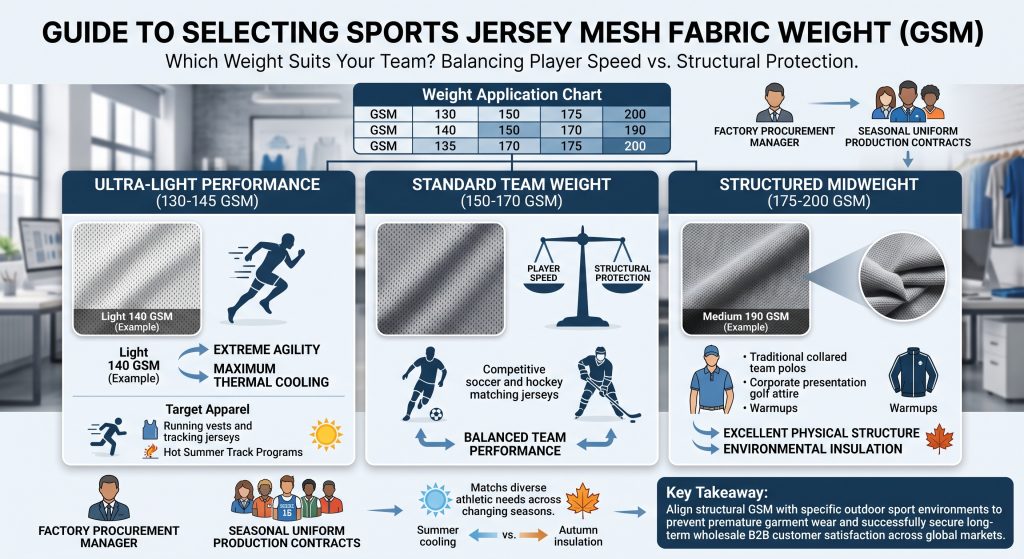
Selecting proper technical fabric thickness requires matching athlete contact levels with specific material weights ranging between lightweight circular mesh and midweight structured pique. Utilizing optimal sports jersey mesh fabric configurations allows garment manufacturing factories to balance player speed against structural clothing protection during games. This is where it gets interesting… because diverse fabric weights dictate the mechanical movement comfort of your custom activewear collections:
- Light 140 GSM panels provide extreme player agility for hot outdoor tracking sports.
- Medium 190 GSM textiles offer excellent physical structure for traditional collared team polos.
Factory procurement managers carefully track these weight specifications to fulfill specific seasonal uniform production contracts accurately.
Offering multiple technical textile thickness options successfully helps your custom apparel manufacturing enterprise satisfy diverse school athletic departments throughout the changing competition calendar. Recommending ultra-lightweight flexible knits for hot summer track programs ensures maximum thermal cooling while heavy double-knits fit autumn transitional team training gear perfectly. This smart material allocation strategy directly increases finished product utility by giving active players appropriate environmental insulation during intense physical play. An operational Key Takeaway firmly underlines that aligning structural material grams per square meter with specific outdoor sport environments prevents premature custom garment wear while successfully securing long-term wholesale B2B customer satisfaction across global markets.
| Weight Application Chart | Recommended GSM Range | Target Athletic Apparel |
| Ultra-Light Performance | 130 GSM – 145 GSM | Running vests and tracking jerseys |
| Standard Team Weight | 150 GSM – 170 GSM | Competitive soccer and hockey matching jerseys |
| Structured Midweight | 175 GSM – 200 GSM | Corporate presentation golf attire and warmups |
This operational chart helps factory managers select the appropriate fabric thickness based on specific commercial apparel uses.
5. How Does Sports Jersey Mesh Fabric Resist On-Field Tears?
Does Filament Strength Stop Sudden Seam Rips?
Engineered athletic knits resist physical tearing by utilizing high-tenacity polyester filament fibers that endure aggressive pulling forces on outdoor playing fields. Sourcing high-grade sports jersey mesh fabric ensures your clothing brand builds rugged equipment uniforms that survive severe friction against rough stadium turf surfaces. But here’s the kicker… unique interlocking loop matrices successfully prevent accidental yarn catches from turning into extensive garment damage:
- Multi-filament strands absorb high tensile shock without snapping under sudden pressure.
- Flexible stitch connections stretch along with player movement to protect seams.
Garment manufacturing companies specifically specify these durable polyesters to deliver dependable sportswear that meets tough institutional buyer utility parameters.
Providing rip-resistant team uniforms successfully shields custom apparel manufacturing factories from expensive wholesale product return claims filed by disappointed league managers during intense tournament months. Active teams gain massive psychological confidence when their game uniforms maintain clean structural presentation despite aggressive physical contact with rival players on the playing field. Choosing robust interlocking loop configurations guarantees that customized printing details survive tough game scrambles without cracking apart during sudden high-velocity movements. This clear Key Takeaway firmly reveals that utilizing high-tenacity synthetic filament yarns lowers overall brand replacement expenses while successfully establishing an excellent manufacturing factory reputation for building indestructible custom sportswear garment gear across international leagues.
| Strength Metric | Filament Polyester Knit | Carded Cotton Blend |
| Tensile Stress Limit | High resistance under loading | Low threshold before breaking |
| Bursting Capacity | Superior elastomeric extension | Limited yarn flexibility points |
| Abrasion Performance | Grade 4.5 unmarred surface | Grade 2.0 early pilling damage |
This data shows why filament polymers are required for contact uniforms while organic fibers degrade under minimal physical stress.
6. Can Sports Jersey Mesh Fabric Eliminate Athletic Chafing?
Why Do Soft Interior Loops Reduce Skin Friction?
Premium active polyesters eliminate painful skin chafing by engineering smooth interior loop faces that reduce rubbing drag against moving body joints. Selecting high-performance sports jersey mesh fabric ensures that athletes maintain full focus on tactical plays without suffering from painful physical fabric friction. What’s the real story? Specialized circular texturizing methods create a soft interior shield that feels gentle during high-speed athletic movements:
- Flat inner stitches lie smooth against skin surfaces to stop rashes.
- Textured filament groupings mimic organic cotton feel without holding moisture.
Clothing brand managers select these skin-friendly textiles to satisfy high comfort expectations across demanding youth soccer training academies.
Prioritizing internal garment comfort successfully allows your sportswear manufacturing business to win lucrative wholesale uniform supply agreements with elite private school athletic organizations. Players execute field movements with greater athletic flexibility when their inner jersey panels glide smoothly across their shoulders during high-cardio tournament matches. Reducing skin irritation effectively prevents premature player performance drop-offs, making physical comfort a major marketing highlight when pitching new apparel clothing lines to corporate procurement buyers. This strategic Key Takeaway firmly points out that matching interior yarn smoothness to specific player movement demands directly elevates finished product brand value while successfully securing consistent bulk uniform manufacturing contract renewals across highly competitive international sports markets.
| Comfort Element | Premium Textured Knit | Basic Open Mesh Weave |
| Friction Coefficient | Low surface drag recorded | High abrasive rubbing contact |
| Interior Loop Style | Flat flatlock yarn alignment | Rough exposed stitch edges |
| Chafing Protection | Complete continuous barrier | Intermittent localized skin irritation |
This ergonomic breakdown illustrates how advanced inner finishing prevents skin friction while rougher entry-level meshes trigger athletic chafing.
7. Where Should Sports Jersey Mesh Fabric Stitches Be Placed?
Which Machine Needles Avoid Early Stitch Runs?
Garment seam placement must target low-stress layout zones across active moving muscle groups to optimize overall uniform flexibility during aggressive physical matches. Sourcing high-quality sports jersey mesh fabric allows your production floor to execute clean flatlock seam stitches that do not burst under intense tension forces. This is where it gets interesting… because proper fabric thread alignment strategies prevent common stretch defects during high-speed factory apparel manufacturing operations:
- Ballpoint needle configurations slip between knit loops smoothly without cutting synthetic filaments.
- Flexible texturized threads stretch alongside elastic panels to maintain exceptionally strong joints.
Production factory managers follow these machine calibrations to eliminate expensive material wastage while hitting tight wholesale corporate client shipment deadlines.
Standardizing on advanced flatlock sewing setups successfully protects custom team apparel lines from premature seam failures when uniforms undergo severe on-field competitive game pulling. Factory machine operators maintain excellent assembly throughput speeds when handling dimensionally stable technical knit rolls that resist annoying edge curling on automated fabric cutting tables. Providing clean flatlock stitch line construction ensures that finished custom technical sportswear fits comfortably without irritating active field players during sudden field movements. This direct Key Takeaway firmly establishes that matching factory assembly sewing specifications to specific elastic textile characteristics directly lowers industrial production error counts while successfully reinforcing overall structural performance product durability across large bulk production runs.
| Assembly Parameter | Flatlock Stitching Setup | Standard Overlock Stitching |
| Seam Profile Thickness | Completely flat connection | Raised interior ridge pattern |
| Stretch Capacity Limit | Maximum elastomeric recovery | Limited stretch allowance point |
| Production Security | Prevents thread snapping | High frequency of stitch breaks |
This manufacturing grid shows how choosing flatlock techniques ensures flexible garment links while standard overlock styles compromise seam survival.
8. Why Does Sports Jersey Mesh Fabric Retain Vivid Colors?
Does UV Radiation Break Down Polymeric Pigments?
Sublimation-optimized synthetic bases retain brilliant print tones because dye molecules physically transform into a permanent part of the internal polyester fiber core. Utilizing premium sports jersey mesh fabric prevents complex camo configurations or multi-colored team insignias from turning dull after continuous solar heat exposure on outdoor fields. What’s the real story? High thermal processing stability ensures that color graphics remain locked deep inside the synthetic polymer chain without fading away over time:
- Ink fusion methods protect custom colors from acidic player sweat erosion.
- Purity-tested synthetic yarns ensure exceptional contrast across multi-tonal geometric prints.
Corporate uniform distributors firmly rely on colorfast polyesters to supply high-end garments that stay attractive over multiple challenging tournament seasons.
Maintaining excellent color quality successfully protects your custom clothing active apparel brand from early wholesale team merchandise returns while driving continuous customer recommendations from regional league clients. Athletic teams look highly unified and confident when their custom team game outfits display sharp design contrast from initial season matches until a final championship event. Avoiding dull color fading issues preserves sponsor logo graphic details perfectly, adding premium commercial value that traditional surface screen printing methods cannot deliver to professional buyers. This definitive Key Takeaway firmly highlights that sourcing UV-stable technical polyesters successfully safeguards your bulk wholesale textile investments while building strong commercial market authority among school athletic clubs across competitive international sports markets.
| Colorfastness Test Types | Sublimated Performance | Surface Printed Cotton |
| UV Light Exposure Test | Grade 4.5 stable rating | Grade 2.0 rapid fading |
| Perspiration Resistance | No visible dye bleeding | High color loss recorded |
| Commercial Laundry Test | Zero color transfer observed | Noticeable fading after washes |
This longevity chart proves why sublimated polyester maintains design integrity under direct solar heat while traditional dye methods experience rapid breakdown.
9. How Do You Clean Sports Jersey Mesh Fabric Safely?
Can Waxy Chemical Residues Block Wicking Pores?
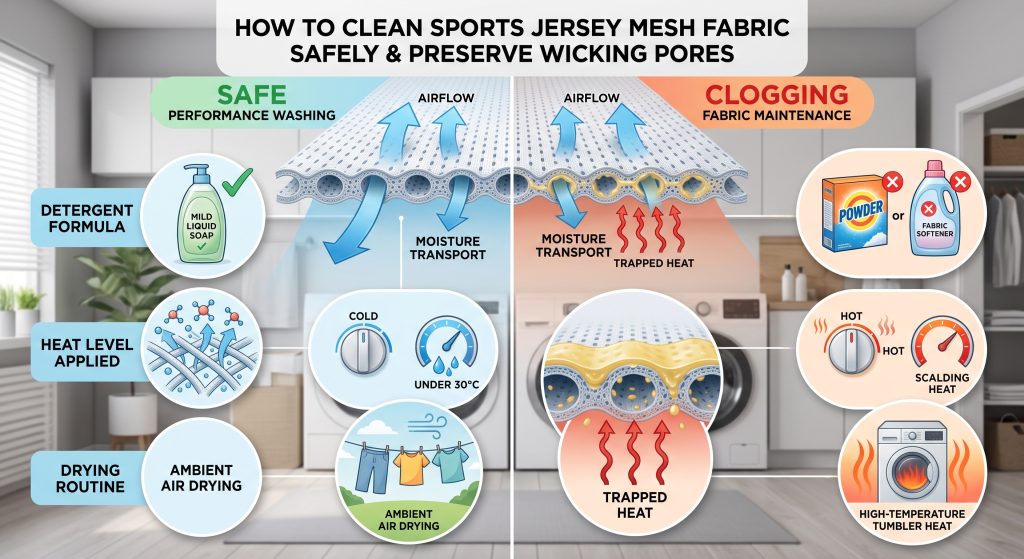
Laundering technical garments safely requires using cool wash cycles combined with mild liquid soaps to shield engineered wicking pathways from permanent chemical damage. Sourcing high-quality sports jersey mesh fabric ensures your uniform products survive hundreds of institutional laundry rounds without losing structural breathability features. But here’s the kicker… avoiding commercial fabric softeners represents the absolute most critical rule for preserving overall athletic garment utility over time:
- Silicone fabric coatings clog microscopic pore paths to trap body heat.
- Pure liquid detergents rinse away completely to keep ventilation paths free.
School team managers successfully implement these clean handling procedures to preserve custom activewear performance for multiple consecutive play seasons.
Educating your commercial wholesale procurement clients on correct laundry care steps successfully avoids early performance drop-off complaints and directly enhances customer trust in your custom garment manufacturing capabilities. Providing explicit care instruction textile labels on custom team collections helps high school athletic coaches protect their uniform investments from improper high-heat laundry machine handling errors. Maintaining completely clear open wicking channels ensures that active field players stay cool and dry during stressful tournament playoff matches where high ventilation is needed most. This instructive Key Takeaway firmly demonstrates that implementing simple cold-water wash routines successfully protects active fabric performance properties while directly boosting wholesale client brand loyalty across multiple seasonal tournament cycles.
| Laundry Parameter | Safe Performance Washing | Clogging Fabric Maintenance |
| Detergent Formula | Mild liquid soap varieties | Heavy powders with softeners |
| Heat Level Applied | Cool cycle under 30°C | Scalding commercial wash temps |
| Drying Routine | Ambient air line drying | High-temperature tumbler heat |
This laundry protocol grid highlights how cool-water processes sustain synthetic wicking performance while standard high-heat maintenance routines damage polymer structures.
10. Who Supplies Bulk Sports Jersey Mesh Fabric Globally?
How Do Direct Mill Orders Maximize Factory Profits?
Sourcing premium materials directly from automated manufacturing mills provides international activewear brands with direct access to advanced circular-knitting technologies and certified colorfast sublimation polyesters. Partnering with a specialized factory ensures your business secures consistent fabric weights alongside competitive wholesale pricing models. This is where it gets interesting… because avoiding expensive intermediary trading firms helps garment enterprises expand commercial profit margins on large corporate custom outfit contracts:
- Direct communication paths streamline custom color matching tasks.
- Stable mill capacity guarantees timely shipping for major seasonal tournaments.
Apparel production enterprises establish long-term mill partnerships to access premium sports jersey mesh fabric rolls that consistently pass rigorous performance quality assessments.
Testing physical technical textile swatches successfully allows your procurement division to evaluate material stretch recovery and pore layout accuracy before signing large commercial volume purchase agreements. Having direct factory access to customized thickness adjustments gives your clothing design group massive flexibility to create specialized sportswear lines tailored for distinct regional athletic climate markets. Establishing a direct mill manufacturing alliance keeps your clothing production setup highly agile and efficient against volatile textile marketplace competition across international textile supply distribution channels. This fundamental final Key Takeaway firmly clarifies that direct mill supply procurement gives custom apparel manufacturers complete quality control over technical textiles while successfully optimizing operational raw material procurement expenses across bulk garment production cycles.
| Sourcing Channel | Direct Knitting Mill Supply | Middleman Trading Enterprise |
| Wholesale Material Cost | Low direct factory pricing | High added commission rates |
| Specification Adjustments | Fully custom GSM weights available | Limited stock options offered |
| Quality Control Link | Direct verification with operators | Split communication channels |
This sourcing table details why ordering from direct fabric plants protects commercial margins while third-party traders inflate unit costs and delay production timelines.
Choosing premium synthetic knits remains imperative for building highly successful sports uniform lines that offer superb mechanical ventilation along with crisp graphic sublimation presentation during intense athletic seasons. Matching structural birdseye mesh patterns or stable double pique configurations to specific player movement environments effectively protects custom clothing brands from premature garment item wear and frequent customer return claims. Your manufacturing business can secure an elite marketplace performance advantage by sourcing high-tenacity polyesters engineered to elevate wholesale sportswear collections into highly competitive active apparel choices across global markets. We warmly welcome international garment enterprises to contact us today to examine our comprehensive technical performance swatches and partner with a dedicated textile manufacturing factory committed toward advancing international athletic uniform standards through superior textile engineering.
Q1: What’s the best structural knit choice for high-intensity tracking sports?
Birdseye mesh constitutes the absolute ultimate textile choice for high-aerobic sports like basketball or soccer due to its open circular pore distribution. This structural texturizing knitting technique establishes a continuous thermal cooling barrier that sweeps humid moisture vapor away from active player skin surfaces during fast field sprints. Sourcing this specialized technical performance polyester ensures that finished custom team clothing lines stay exceptionally light, preventing heavy liquid water saturation from dragging down overall athlete field agility during critical league matches. Custom uniform manufacturing builders consistently choose this micro-pore material because permanent mechanical ventilation successfully handles heavy sweat production without relying on chemical cooling coatings that quickly wear off over standard laundry cycles.
Q2: Can I utilize structured pique knit panels for print-ready baseball apparel?
Yes, you can absolutely utilize geometric pique double-knits to successfully construct premium sublimated uniform jerseys that require excellent shape retention and rugged on-field durability. This substantial technical performance material provides an executive textured aesthetic that holds a clean tailored uniform profile despite aggressive sliding maneuvers on rough field dirt stadium surfaces. Custom active apparel factory owners highly appreciate this double-knit yarn stability because it supports complex multi-colored tactical camouflage print designs perfectly without showing any unsightly fabric pattern distortion when pulled tightly during active tournament play. Sourcing midweight pique variations directly gives your custom activewear product catalog a high-end physical fabric impression that successfully satisfies strict institutional team uniform quality standards across competitive regional school leagues.
Q3: How do I know if fabric softeners have compromised my performance mesh?
You can easily verify this physical performance degradation by dropping small liquid water droplets onto the inner face of your custom sublimated synthetic activewear jersey panels. Safe technical garments absorb liquid sweat instantly, whereas contaminated polyesters cause water droplets to bead up and roll off the technical fabric surface completely unabsorbed. This annoying mechanical blockage happens because commercial fabric conditioning chemical agents leave a thin waxy layer over the micro-pore ventilation knit channels during home wash cycles. Laundering your team uniform clothing collections with pure liquid soap safely rinses away these problematic waxy deposits completely, successfully restoring original high-velocity moisture-wicking capillary power across technical mesh garment elements over consecutive washings.
Q4: Can I request customized material thickness for my seasonal apparel collections?
Yes, custom weight configurations are fully accessible when purchasing your bulk wholesale materials directly from an established athletic circular knitting textile mill facility. Having direct access to specialized grams per square meter options allows your clothing manufacturing brand to engineer appropriate garment thickness levels tailored for specific regional outdoor playing climates. Thinner 140 GSM panels provide maximum thermal cooling during high-heat summer tournaments, while thicker 190 GSM double-knit structures deliver excellent wind protection for autumn transitional team sports activities. Partnering with a flexible performance fabric production plant successfully enables global clothing manufacturing enterprises to request custom synthetic filament blends that satisfy precise institutional uniform contract specifications perfectly across multi-season schedules.
Q5: How do I know if a performance fabric stands ready for dye sublimation processing?
You must verify this industrial textile printing readiness by checking that the structural material contains pure synthetic filament polyester fibers without organic cotton blends. High-temperature dye sublimation transfer printing relies entirely on clean polymer filaments that expand under intense factory heat to lock gaseous ink molecules permanently inside the fiber matrix. Organic materials like organic cotton fail completely to form this chemical link, resulting in blurry graphic panel definitions and rapid design pattern fading after initial domestic laundry wash cycles. Choosing purity-tested synthetic polyesters successfully guarantees that your custom team design print variations remain exceptionally sharp and highly vibrant throughout multiple competitive playing seasons across international sports leagues.