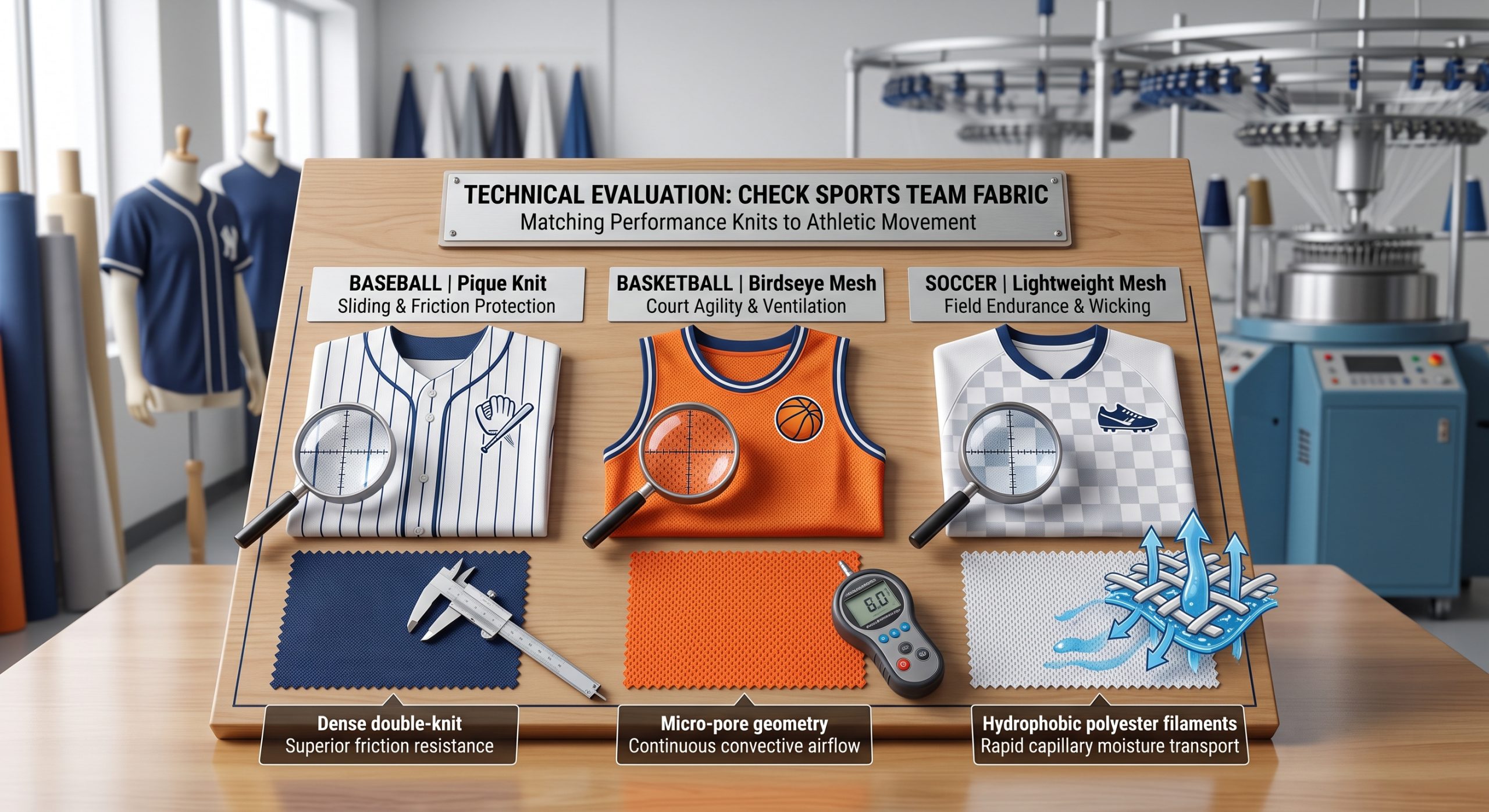
Choosing correct team wear textiles is a serious choice that determines player performance and overall design durability over busy game calendars. Imagine your clients ordering a massive batch of baseball or soccer uniforms only to watch them heavy with sweat, clinging tightly, and tearing apart during the very first slide. This sudden equipment failure ruins athletic focus, frustrates team managers, and ultimately destroys your manufacturing factory’s professional reputation among wholesale apparel distributors. Fortunately, selecting our performance-ready check sports team fabric offers a perfect resolution by combining specialized moisture-wicking synthetic structures with high tensile strength to deliver beautiful team gear that keeps competitors dry.
1. How Do You Select Baseball Uniform Textiles?
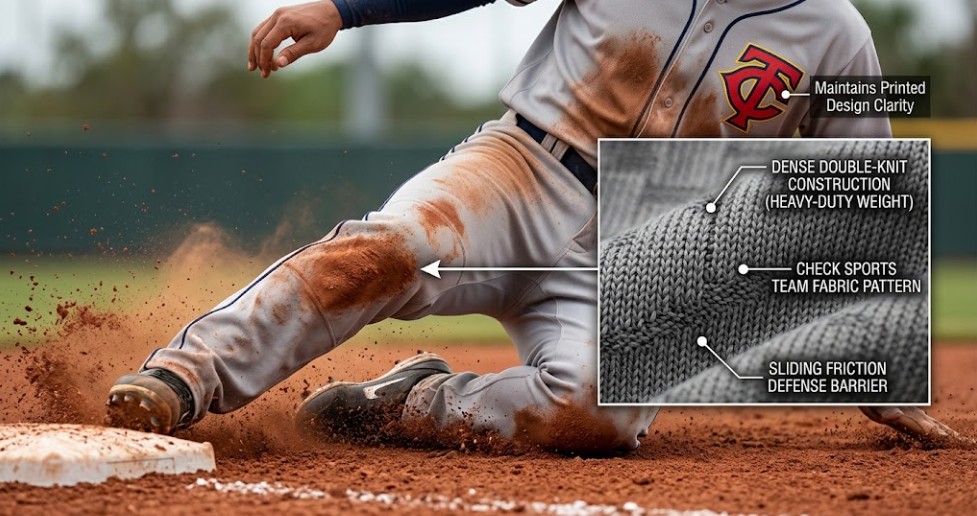
You select baseball uniforms by matching heavy-duty textile weight with loose fits to defend athletes against sliding friction. Evaluating your options requires you to inspect check sports team fabric varieties that prevent premature fiber tears during aggressive dirt plays. This is where it gets interesting… because baseball games require apparel that survives extreme friction without losing structural thickness or printed design clarity. Sourcing dense double-knits guarantees your clients receive rugged uniforms that perform beautifully during intense sliding maneuvers.
Does Heavy Pique Support Baseball Sliding?
Pique knit offers a thick structured body that withstands severe dirt slides and continuous turf friction over long doubleheader seasons. Ready for the good part? This specialized double-knit technique creates small geometric surface grids that keep raw dirt from embedding deeply inside the synthetic threads. You will notice that uniforms made from this material retain their clean appearance much better than standard loose knit alternatives. Sourcing these sturdy textiles allows your manufacturing business to deliver premium field gear that athletic directors trust.
- Thick double-knit construction blocks direct dirt penetration.
- Raised weave pattern acts as a physical shield against friction.
- Durable polyester fibers resist tearing during sliding contacts.
| Fabric Selection | Thickness Grade | Dirt Protection |
| Heavy Pique Knit | Superior (Double-knit) | Outstanding |
| Light Mesh Knit | Lightweight (Single-knit) | Moderate |
Reviewing these dynamic textile properties helps garment makers select the perfect baseball uniform materials.
Key Takeaway
The key takeaway is that matching heavy pique structures with active wicking layers protects baseball players from painful friction injuries while keeping them dry during humid games. Standardizing on these professional material choices allows your custom apparel factory to secure highly profitable uniforms contracts with major regional baseball leagues. You will deliver high-value garments that preserve their clean team branding look despite continuous contact with red dirt and grass. This functional superiority builds customer satisfaction and ensures sports managers return to your factory for all their seasonal activewear requirements, driving continuous business growth and establishing market trust.
2. What Knits Keep Basketball Players Agile?
You keep basketball players agile by utilizing ultra-lightweight synthetic circular knits that offer unrestricted body movement during high-velocity court matches. Sourcing the right wholesale check sports team fabric allows your custom sportswear brand to design jerseys that help athletes jump and run freely. What’s the real story? Basketball requires continuous running and jumping, meaning heavy, restrictive fabrics will tire players out much faster on the court. Sourcing highly flexible mesh configurations ensures your factory produces elite jerseys that satisfy demanding high school athletic coaches.
Why Does Birdseye Mesh Fit Court Sports?
Birdseye mesh provides the perfect structural balance of lightweight comfort and high breathability needed for hot indoor basketball courts. You might be wondering… how a simple knit pattern can make such a massive difference in player temperature regulation during games. The answer lies in the miniature circular pores that act as continuous physical vents to release heat from the body. You will deliver finished garments that keep players fresh, dry, and active even during intense overtime play.
- Microscopic circular pores allow body heat to escape instantly.
- Soft interior loop surfaces prevent painful skin irritation.
- Flexible yarn construction supports rapid multidirectional movements.
| Court Knit Style | Ventilation Level | Material Weight |
| Circular Birdseye | Maximum | Ultra-lightweight |
| Tight Interlock | Moderate | Midweight |
Analyzing these physical dimensions allows garment enterprises to select the optimal structural base for their custom team sublimation lines.
Key Takeaway
The key takeaway is that utilizing highly stretchable birdseye mesh keeps basketball players cool and nimble while preventing costly jersey tears during games. Presenting these high-performance options to school athletic directors allows your custom apparel business to win premium team wear accounts. You will deliver lightweight, comfortable garments that allow athletes to move with complete freedom on the court. This technical reliability drives repeat volume orders and solidifies your factory’s position as a preferred sportswear supplier.
3. Why Do Soccer Teams Prioritize Light Knits?
Soccer teams prioritize lightweight knits because competitive field players cover immense physical distances under direct sunlight during long matches. Selecting a light check sports team fabric ensures that players do not carry unnecessary water weight when sweating heavily. Ready for the good part? Lightweight mesh designs averaging 140 GSM act like a high-velocity wicking system to dry perspiration almost instantly. Sourcing these ultra-thin performance materials allows your garment brand to deliver highly comfortable jerseys that keep soccer players fast.
Does Open Mesh Enhance Aerobic Runs?
Open mesh structures significantly improve aerobic endurance by facilitating continuous fresh air circulation to lower core body temperatures during games. This is where it gets interesting… because high physical heat spikes trigger early muscle fatigue and degrade coordination on the pitch. You will notice that soccer athletes maintain their sprint speeds much longer when wearing highly ventilated synthetic garments. Providing these cool activewear lines helps your wholesale buyers market their brand as a player-first athletic solution.
- Continuous convective airflow keeps player skin noticeably cooler.
- Rapid heat dissipation minimizes the physical risk of thermal exhaustion.
- Open-pore knitting designs prevent humid air from trapping inside.
| Soccer Mesh Type | Air Permeability | Weight (GSM) |
| Ultra-Light Mesh | High | 135 GSM |
| Standard Double Mesh | Moderate | 165 GSM |
Comparing these evaporation rates helps manufacturers design the most efficient soccer team wear.
Key Takeaway
The key takeaway is that choosing ultra-lightweight, rapid-drying mesh keeps soccer players fast and comfortable by preventing heavy sweat accumulation. Recommending these advanced synthetic textiles protects your clients’ teams from overheating during intense summer matches on open fields. You will manufacture high-performance uniforms that maintain their light feel from the opening whistle to the final minute. This functional advantage helps your sportswear brand stand out as an elite supplier of competitive soccer apparel.
4. How Do Pique and Birdseye Knits Compare?
Pique and birdseye knits compare primarily in their mechanical knitting structures, which create completely different hand-feels and ventilation paths. Analyzing these structural differences allows you to choose the best check sports team fabric for your custom sportswear line. You might be wondering… which of these dominant technical textiles will satisfy your corporate sportswear buyers’ strict quality standards. Birdseye mesh offers an ultra-smooth, lightweight feel optimized for active field games, while pique delivers structured durability for classic polo wear.
Do Texture Profiles Affect Inner Skin Feel?
Tactile comfort against the skin directly influences how confident and focused an athlete feels during highly competitive match play. What’s the real story? Birdseye mesh utilizes flat-knit interior loops that glide smoothly over the body without causing painful friction chafing. You will discover that players prefer this silky texture for high-cardio sports where constant friction is common. Sourcing smooth interior knits allows your factory to manufacture comfortable activewear that athletes love to wear.
- Flat interior loop designs eliminate rough skin contact zones.
- Silky synthetic filaments reduce painful rubbing friction during runs.
- Low-friction fabrics allow full athletic mobility without skin irritation.
| Knit Category | Surface Profile | Comfort Level |
| Birdseye Knit | Smooth micro-pores | High (Frictionless) |
| Pique Knit | Raised diamond grid | Moderate (Structured) |
Reviewing these structural comfort differences helps apparel brands select the perfect knit style.
Key Takeaway
The key takeaway is that selecting birdseye mesh for high-intensity tracking and pique for structured team polos minimizes physical chafing. Providing both technical knit choices allows your custom clothing business to satisfy the diverse comfort needs of various sports. You will supply functional garments that match the exact movement style and skin sensitivity of competitive athletes. This technical precision elevates your finished product quality and wins the trust of major school athletic programs.
5. What Fabric Weight Fits Outdoor Training?
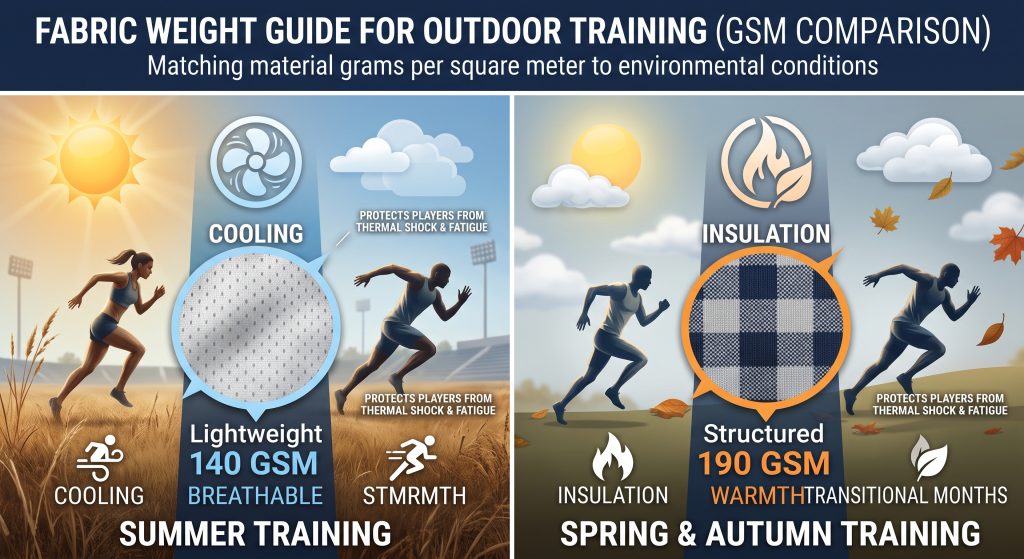
The best fabric weight for outdoor training depends on the season, ranging from light meshes to insulated midweight double knits. Sourcing a versatile check sports team fabric selection allows your garment brand to build appropriate training gear for any climate. Ready for the good part? Matching material grams per square meter to the environmental conditions protects players from thermal shock and fatigue. Your factory can offer lightweight 140 GSM layers for hot summers and structured 190 GSM knits for cooler transitional months.
Does GSM Calibration Align with Climate?
Calibrating material weight to the local playing climate guarantees that athletes perform comfortably without overheating or freezing during outdoor drills. This is where it gets interesting… because improper fabric thickness selection can severely impact muscle warm-up speeds and physical stamina on the field. You can guide school buyers toward lightweight options for summer camps and thicker alternatives for late-season games. Providing this professional textile expertise helps your B2B customers secure the best uniforms for their teams.
- Lightweight 135 GSM panels maximize ventilation during hot summer training.
- Midweight 165 GSM options offer balanced year-round athletic performance.
- Thick 200 GSM double knits preserve natural body heat during winters.
| Training Season | Recommended GSM | Insulation Grade |
| Summer Training | 135 GSM | Low (High Cooling) |
| Autumn Training | 190 GSM | High (Heat Retention) |
Assessing these seasonal weight parameters helps textile buyers purchase the perfect training materials.
Key Takeaway
The key takeaway is that matching your fabric GSM to the local playing season protects athletes and ensures high training comfort. Offering a balanced range of light and midweight textiles helps your sportswear brand secure bulk year-round uniform contracts. You will supply training gear that keeps teams performing at peak capacity under any physical weather conditions. This operational versatility directly improves customer retention and establishes your factory as a reliable partner.
6. How Do You Keep Printed Patterns Sharp?
You keep printed patterns sharp by utilizing high-purity synthetic polyesters that bond permanently with sublimation dyes at high temperatures. Sourcing a premium check sports team fabric guarantees that your complex camouflage and custom designs look pristine. You might be wondering… how to prevent sports team insignias and geometric designs from bleeding or turning dull after active play. The answer lies in the molecular dye-locking process of performance polyesters that preserves pattern boundaries under physical stress.
Why Do Synthetic Fibers Fuse Dye Best?
Polyester fibers fuse with sublimation ink molecules permanently when heated to 200 degrees Celsius during industrial roll-to-roll production. What’s the real story? While natural fibers like cotton merely hold ink on the surface, synthetic polymers lock the dye inside their fiber cores. This permanent chemical bonding ensures that custom team graphics will never peel, crack, or wash away. Sourcing print-ready synthetic textiles allows your factory to deliver beautiful, high-contrast sportswear that remains soft and flexible.
- Permanent chemical bonding prevents colors from cracking or peeling off.
- Unclogged fabric pores maintain the original wicking and cooling performance.
- Sublimated patterns remain flexible and stretch along with the garment.
| Dye Process | Color Durability | Print Flexibility |
| Sublimation Fusing | Maximum | Unrestricted stretch |
| Screen Printing | Moderate | Rigid surface layer |
Reviewing these colorfastness tests helps manufacturers choose the most reliable print-ready textiles.
Key Takeaway
The key takeaway is that using high-purity sublimated polyester keeps team uniforms looking vibrant and professional over multiple playing seasons. Offering these color-stable sportswear collections protects your clients’ branding and eliminates costly early replacement complaints. You will manufacture reliable gear that stays bright under direct sunlight and survives harsh laundry cycles easily. This aesthetic durability directly enhances your product value and attracts premium B2B custom uniform buyers.
7. Why Does Tension Defense Secure Garments?
Tension defense secures athletic garments because high-tenacity synthetic fibers absorb severe physical pull forces without ripping or stretching permanently. Purchasing a durable check sports team fabric ensures that your finished sportswear can withstand aggressive gameplay during major tournaments. Ready for the good part? High-contact sports like rugby, soccer, and basketball expose jerseys to constant grabbing and pulling by opposing defenders on the field. Sourcing highly elastic, robust polyesters protects seams and maintains uniform shape under extreme on-field physical pressures.
Does Multi Filament Weave Stop Big Snags?
Multi-filament polyester weaves significantly reduce the risk of fabric snags when uniforms contact rough gear or Velcro straps. This is where it gets interesting… because standard yarns pull out easily, creating long, unsightly runs that destroy the garment’s visual appeal. You will discover that tightly packed filament structures allow objects to slide off the surface without snagging the threads. Sourcing snag-resistant textiles allows your factory to build premium athletic uniforms that maintain a clean look.
- Tightly packed synthetic filaments prevent rough objects from catching fibers.
- High surface smoothness allows friction points to slide off harmlessly.
- Snag-resistant weaves preserve uniform patterns over hundreds of matches.
| Fiber Configuration | Snag Resistance | Tensile Strength |
| Multi-Filament Polyester | High | Superior |
| Spun Yarn Blend | Moderate | Standard |
Comparing these structural strength metrics helps garment makers select the most rugged performance knits.
Key Takeaway
The key takeaway is that utilizing interlocking loop structures prevents uniform warping and defends garments against severe pulling on field. Sourcing highly stable synthetic textiles protects your clients’ teams from mid-season gear failures during high-contact tournaments. You will deliver robust activewear that retains its professional, tailored shape despite constant physical game stress. This mechanical reliability directly lowers product defect rates and positions your brand as an elite apparel partner.
8. Can Correct Sewing Prevent Seamless Rips?
Correct sewing practices prevent seamless rips by pairing flexible flatlock stitching with appropriate needle sizes for stretchable active textiles. Aligning your sewing machine calibrations with our check sports team fabric options ensures that seams expand with the player. You might be wondering… how to eliminate skipped stitches and seam blowouts during high-speed garment assembly lines in your factory. The solution requires utilizing specific industrial needles and flexible threads that match the natural stretch of polyesters.
Why Must Operators Run Ballpoint Needles?
Sewing machine operators must run chrome ballpoint needles to glide smoothly through synthetic loops without cutting individual filament threads. What’s the real story? Sharp cutting needles pierce the yarns, creating microscopic holes that quickly run and ruin the entire fabric panel. You will prevent common production line runs and structural seam failures by standardizing on ballpoint needle configurations. Implementing this simple factory change lowers material waste and improves your overall sportswear construction quality.
- Rounded ballpoint tips slide between knit loops without piercing threads.
- Chrome coatings reduce needle heat to prevent synthetic fiber melting.
- Reduced thread snapping improves assembly speeds on commercial sewing lines.
| Needle Choice | Knit Fabric Safety | Production Output |
| Chrome Ballpoint | Outstanding (No runs) | High |
| Standard Sharp | Low (Causes runs) | Moderate |
Following these factory sewing guidelines guarantees that your custom team wear joins survive game stress.
Key Takeaway
The key takeaway is that utilizing ballpoint needles and flatlock stitching prevents seam blowouts and skin chafing on field. Standardizing your assembly line setups protects your custom sportswear brand’s reputation for manufacturing indestructible physical gear. You will deliver professional uniforms with perfectly flat joins that stretch naturally along with the active player. This manufacturing consistency lowers factory defect rates and wins repeat orders from elite regional high school teams.
9. How Do Safe Wash Routines Protect Fibers?
Safe wash routines protect synthetic fibers by removing tough grass stains without damaging the engineered moisture-wicking pores over time. Laundering your custom check sports team fabric uniforms correctly preserves their bright colors and active thermal ventilation features. Ready for the good part? High-performance sportswear requires gentle washing cycles and cold water to prevent polymer fiber breakdown and dye bleeding. Providing clear care instructions to school team managers ensures that custom jerseys perform perfectly over hundreds of washings.
Why Do Liquid Soaps Keep Pores Clear?
Mild liquid soaps rinse away completely from technical meshes, leaving the microscopic air ventilation pathways free to disperse sweat. This is where it gets interesting… because powder detergents and commercial fabric softeners leave behind a waxy residue that coats the synthetic yarns. You will discover that this invisible coating blocks moisture wicking and traps body heat, causing players to overheat quickly. Recommending liquid soap options guarantees that your athletic garments retain their cooling capabilities permanently.
- Liquid detergents leave zero residue to block technical wicking channels.
- Avoiding fabric softeners preserves the hydrophobic wicking power of polyester.
- Clean pores ensure maximum convective airflow for athlete temperature control.
| Cleansing Agent | Pore Preservation | Moisture Wicking |
| Mild Liquid Soap | Superior (No residue) | Highly efficient |
| Powder Softener | Low (Clogs pores) | Severely reduced |
Reviewing these correct laundry care standards helps team managers prolong the lifespan of uniforms.
Key Takeaway
The key takeaway is that using cold water and mild liquid soap keeps synthetic performance uniforms clean without clogging wicking pores. Sharing these simple washing guidelines with your bulk apparel clients directly enhances finished garment lifespan and customer satisfaction. You will ensure that custom sublimated prints stay bright and highly functional over multiple tournament playing seasons. This proactive after-sale service builds strong brand credibility and secures long-term B2B contract renewals easily.
10. Where Do You Order Premium Bulk Material?
You order premium bulk material directly from specialized knitting mills that operate automated machinery to ensure consistent quality. Partnering with a dedicated factory to source check sports team fabric allows your business to access wholesale prices. What’s the real story? Trading middlemen often add heavy markups and split communication lines, which delays delivery and inflates your manufacturing costs. Working directly with our plant guarantees you receive steady material weights and perfect color matching on time.
Does Sourcing Directly From Mills Lower Costs?
Sourcing directly from a circular knitting mill eliminates expensive intermediary commissions and gives you the absolute lowest factory pricing. But here’s the kicker… lower raw material costs directly expand your business profit margins on highly competitive custom school uniform bids. You will gain a massive pricing advantage while offering identical or superior fabric quality to your wholesale team clients. Building a direct factory alliance keeps your custom activewear brand agile against domestic and international competitors.
- Direct factory pricing eliminates middleman markups to maximize your margins.
- Direct technical communication streamlines custom weight and color adjustments.
- Bulk manufacturing consistency guarantees identical dye lots across large shipments.
| Sourcing Route | Material Markup | Communication Speed |
| Direct Knitting Mill | 0% (Factory price) | Fast (Immediate) |
| Intermediary Trader | 15% – 25% | Delayed (Split lines) |
Comparing these sourcing channels shows how direct factory purchases protect your commercial apparel margins.
Key Takeaway
The key takeaway is that buying directly from specialized knitting mills lowers material costs and ensures consistent fabric quality. Requesting physical textile swatches lets your purchasing division verify wicking performance and dye stability before committing to large orders. You will secure the perfect synthetic substrates to construct professional-grade jerseys that school teams love to wear. This direct supply control protects your manufacturing profit margins and supports your long-term wholesale brand growth.
Choosing the correct synthetic technical knits remains key to building highly comfortable, professional uniform lines that satisfy elite sports leagues. Standardizing on high-strength birdseye mesh or structured pique textiles guarantees your garments deliver maximum airflow, vibrant colors, and long-lasting durability over busy play seasons. We actively solve your production problems by supplying top-grade, sublimation-ready polyesters designed to elevate custom sportswear lines into premium active apparel choices. Our mill supports sportswear businesses globally through direct factory pricing, flexible material customizations, and consistent material quality. To explore our high-performance technical swatches and secure competitive bulk pricing for your next project, we invite you to contact us today to start your next custom uniform collection.
Q1: Can I sublimate multi-colored patterns onto these textiles?
Yes, you absolutely can because pure polyester fibers form permanent molecular bonds with sublimation inks when exposed to high heat. This ensures that detailed team emblems and geometric designs stay vibrant and never peel or fade over long game seasons.
Q2: What’s the best fabric weight for competitive soccer jerseys?
We highly recommend a lightweight 140 GSM birdseye mesh knit. This fabric balances outstanding physical durability with rapid sweat wicking to keep players cool and fast during intense matches.
Q3: How do I know if fabric softeners have clogged my uniform’s wicking pores?
You can easily verify this by placing a small water drop onto the inner fabric surface. If the water beads up instead of soaking in instantly, waxy chemical residues are blocking the micro-pores.
Q4: Can I order custom GSM weights for specific climate needs?
Yes, custom weights are fully available. Our circular knitting facility allows commercial buyers to adjust material thickness to perfectly match warm summer camps or cool autumn training sessions.
Q5: How do I prevent thread runs during high-speed garment assembly?
Always run specialized ballpoint needles on your production lines. These needles slide between synthetic knit loops smoothly rather than cutting and breaking the high-tenacity polyester threads.