
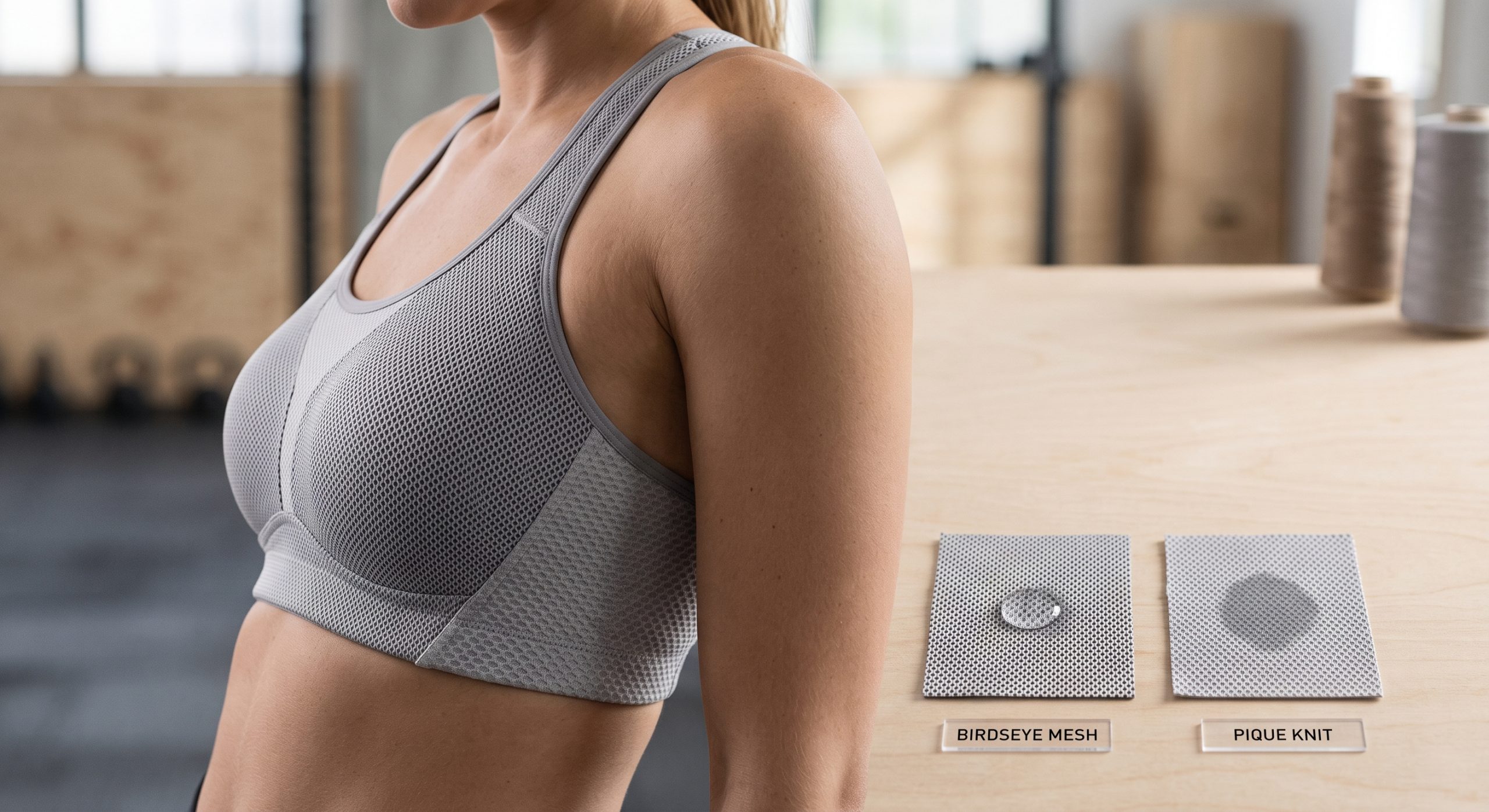
Sports bra wicking fabric performance refers to a technical material’s capacity to pull liquid perspiration away from human skin through engineered micro-channels while maintaining firm elastic support during physical activity. Female athletes routinely face uncomfortable wetness and severe skin chafing during intense workout routines when inner bra cup linings hold onto sweat. When moisture remains trapped against active body areas, sports garments rapidly lose structural tension, creating heavy friction and thermal distress for wearers. Sourcing advanced bird’s eye mesh or structured pique textiles offers activewear brands rapid moisture movement alongside strong elastic recovery for modern athletic apparel lines. You can easily integrate specialized sports bra wicking fabric solutions to resolve persistent humidity build-up and deliver long-lasting dry comfort across all workout intensity levels.
What Is Sports Bra Wicking Fabric Mechanics?
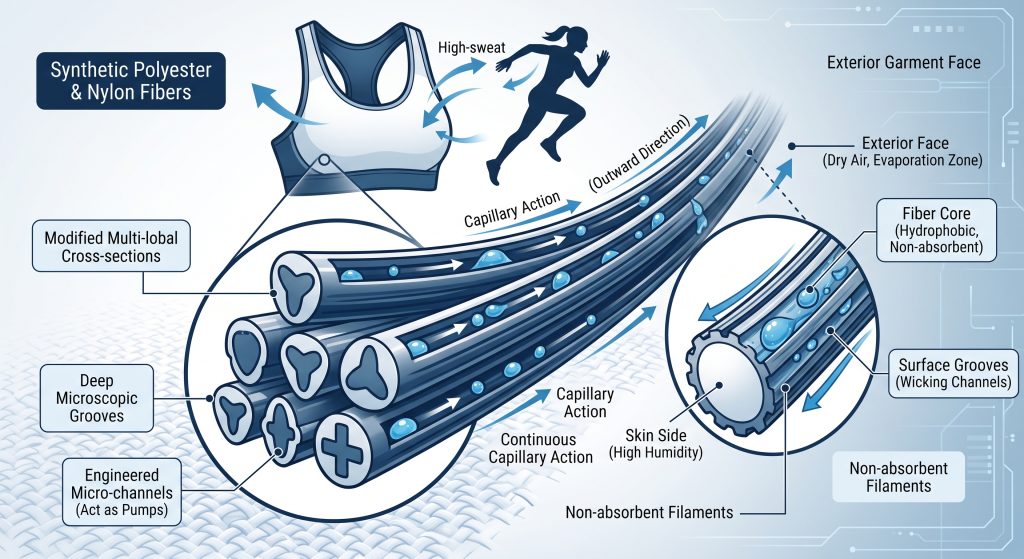
Sports bra wicking fabric mechanics rely on continuous physical forces known as capillary action to transport moisture across synthetic fiber surfaces without absorbing water into core filaments. Synthetic polyester and nylon threads are specifically modified with multi-lobal cross-sections like cross or trilobal shapes that create deep microscopic grooves along every strand. These engineered micro-channels act as miniature pumps, continuously drawing liquid away from high-sweat chest areas toward the exterior face of active garments. You will notice that garments engineered with this physical structure keep athletes noticeably drier during vigorous physical motion.
How Do Capillary Channels Transport Moisture?
Capillary channels function by using small surface gaps between fine filament yarns to overcome gravitational resistance and pull liquid outward. Here is the kicker: liquid sweat naturally migrates from high-density moisture zones against human skin toward dry outer zones with high air exposure.
- Filament denier directly determines channel diameter and fluid transfer velocity.
- Hydrophobic synthetic polymers prevent water absorption within yarn interiors.
- Specialized hydrophilic surface treatments accelerate initial liquid absorption speed.
You can observe how smaller capillary spaces generate stronger hydrostatic pressure, ensuring sweat moves instantly away from skin during intense workouts.
Why Does Yarn Structure Drive Performance?
Yarn cross-section geometry transforms basic synthetic threads into high-performance moisture transport systems that resist liquid saturation during long wear periods. Think about it: round yarn filaments pack tightly together and restrict fluid movement, whereas modified multi-groove filaments expand overall surface exposure significantly.
Key Takeaway: Selecting engineered multi-lobal yarns ensures your sports apparel moves sweat rapidly across garment surfaces while preserving structural recovery under heavy tension.
| Yarn Feature | Round Cross-Section | Multi-Lobal (Trilobal) Cross-Section |
| Liquid Transport Rate | Slow capillary movement | Rapid fluid channeling |
| Surface Contact Area | Minimal surface exposure | Expanded evaporation zone |
| Moisture Retention | High internal entrapment | Near-zero fiber retention |
Selecting multi-grooved filament yarns provides superior moisture movement compared to traditional round fibers during high-sweat activities.
How Does Birdseye Sports Bra Wicking Fabric Work?
Birdseye sports bra wicking fabric works through a specialized circular knitting technique that creates tiny tuck stitches resembling small diamond or eye patterns across the material surface. These repeating micro-holes increase natural ventilation while preserving smooth face contact against delicate skin tissue. Synthetic threads knitted in this geometric pattern maintain consistent dimensional stability without sacrificing breathability across high-sweat chest zones. Activewear manufacturers favor this lightweight construction because it provides effective cooling without adding unnecessary bulk to internal bra cup linings.
What Makes Geometric Tuck Stitching Unique?
Geometric tuck stitching creates raised and recessed points across the knitted textile, establishing miniature air pockets that prevent complete material flatline against sweating skin. What is the real story? These recessed tuck stitches produce micro-apertures that dramatically boost air velocity through active bra panels.
- Open diamond pores accelerate air movement across inner garment linings.
- Smooth face loops reduce mechanical friction during repetitive arm movements.
- Balanced elastane integration provides uniform four-way stretch capabilities.
You will find that this unique geometric arrangement maintains maximum structural flexibility without collapsing under heavy tension.
Why Choose Birdseye For High Sweat Areas?
Birdseye mesh provides exceptional localized ventilation across central sternum and under-bust zones where sweat accumulation peaks during intense exercise. Look closer: the open aperture network allows body heat to vent outward while simultaneously spreading sweat across a broad outer surface area for rapid dissipation.
Key Takeaway: Incorporating birdseye knits into high-perspiration zones protects athletes from sweat pooling while maintaining a smooth, non-irritating tactile feel against sensitive body parts.
| Fabric Metric | Birdseye Knit Specification | Standard Flat Jersey Specification |
| Aperture Density | 120-180 pores per square inch | Zero engineered pores |
| Air Permeability | 180-240 CFM | 60-90 CFM |
| Dry Time Index | Under 15 minutes | Exceeds 35 minutes |
Integrating geometric birdseye knits yields significantly higher airflow parameters and faster evaporation cycles than traditional flat jersey constructions.
Why Choose Pique Sports Bra Wicking Fabric Types?
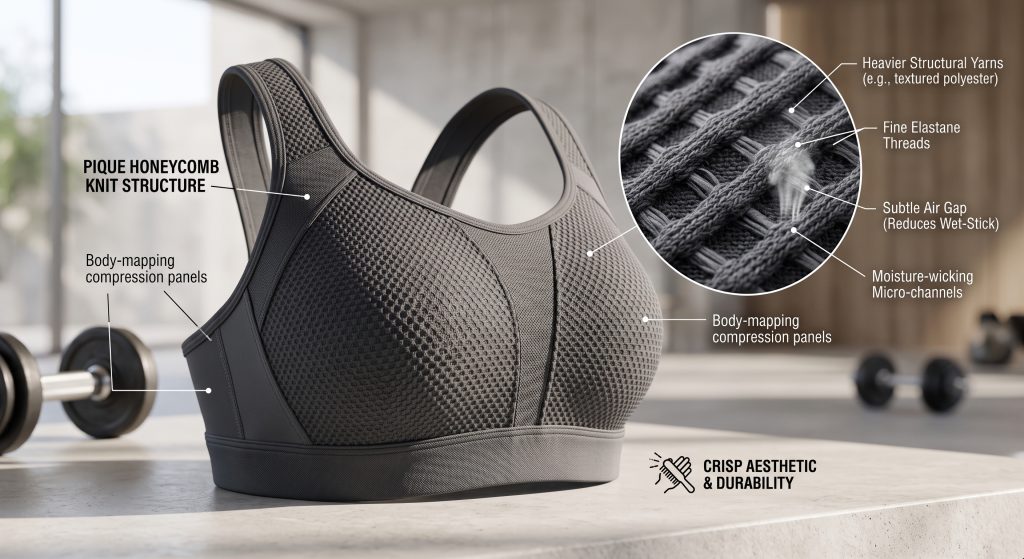
Choosing pique sports bra wicking fabric types gives activewear designers a robust, textured material featuring a distinctive waffle or honeycomb weave structure. This classic raised pattern creates subtle space between human skin and the garment inner surface, reducing full wet-stick phenomena during heavy exertion. Pique knits incorporate heavier structural yarns alongside fine elastane threads, delivering superior body-mapping compression alongside efficient moisture movement. Your production team can utilize pique materials for exterior sports bra panels that require firm support, high abrasion resistance, and crisp aesthetic appeal.
How Does Waffle Geometry Enhance Grip?
Waffle geometry creates raised ridges that anchor sports bra bands firmly against body contours without restricting underlying muscle movement. You might be wondering: how does a textured face improve sweat management during intense physical workouts?
- Raised knit nodes hold garment structure away from wet skin surfaces.
- Recessed channels direct liquid lateral movement away from friction points.
- Sturdy structural knits prevent garment rolling along lower chest bands.
You can rely on textured pique geometries to maintain precise garment positioning during dynamic multi-directional training movements.
Does Pique Provide Superior Support Integrity?
Pique constructions incorporate dual-tuck knit cycles that reinforce structural resistance against vertical chest displacement during high-impact activities. Here is why that matters: high-impact athletic bras demand firm tensile resistance to minimize breast movement and protect Cooper’s ligaments from excessive strain.
Key Takeaway: Utilizing pique structures for exterior supportive panels ensures long-term shape retention while actively preventing wet garment collapse during intense workouts.
| Property Comparison | Pique Mesh Structure | Smooth Interlock Structure |
| Tensile Support Rating | High structural firmness | Moderate tensile resistance |
| Surface Texture | Raised honeycomb relief | Completely flat surface |
| Wet-Cling Resistance | Superior non-stick gap | Prone to surface cling |
Pique fabric offers increased structural firmness and superior non-stick performance under high sweat conditions compared to smooth interlock fabrics.
Which Sports Bra Wicking Fabric Offers Airflow?
Birdseye sports bra wicking fabric offers significantly higher natural airflow compared to pique fabrics due to its open geometric aperture layout. The small diamond tuck holes in birdseye mesh create direct pathways for atmospheric air to pass through garment layers and cool damp skin underneath. While pique fabrics feature raised surfaces that prevent direct skin contact, their denser underlying knit construction creates greater wind resistance. Activewear designers must evaluate these distinct ventilation profiles when selecting raw materials for high-impact versus low-impact athletic garments.
How Does Permeability Differ Under Stretch?
Permeability alters dramatically when technical elastic materials undergo multi-axis tension during dynamic bodily movements. Ready for the good part? Birdseye aperture pores expand proportionally under tension, increasing overall air volume transport precisely when an athlete works hardest.
- Radial tension expands open pore diameters up to thirty percent.
- Elastane recovery contracts open apertures when tension relaxes.
- Variable airflow dynamics keep skin microclimates balanced during rest intervals.
You will see that birdseye materials adapt dynamically to physical exertion by opening ventilation paths under heavy stretch conditions.
Which Pattern Ventilates Sweat Faster?
Birdseye pattern knits process liquid sweat evaporation noticeably faster because surrounding air streams directly touch liquid trapped within capillary yarns. Believe it or not: open mesh geometries increase heat dissipation by promoting steady convective cooling directly across wet skin surfaces.
Key Takeaway: Specifying open birdseye patterns for inner bra cup linings accelerates cooling air circulation and minimizes moisture accumulation during high-heat workout sessions.
| Ventilation Test Parameter | Birdseye Mesh | Pique Texture |
| Air Permeability (Unstretched) | 210 CFM | 110 CFM |
| Air Permeability (50% Stretch) | 285 CFM | 145 CFM |
| Thermal Dissipation Rate | High cooling transfer | Moderate cooling transfer |
Birdseye mesh maintains substantially higher air volume exchange across both static and stretched conditions than textured pique knits.
How Do Textures In Sports Bra Wicking Fabric Feel?
Textures in birdseye sports bra wicking fabric feel exceptionally soft and smooth against sensitive body zones due to their fine, flat face loop construction. Pique fabrics present a distinctly textured, semi-rigid handfeel that feels substantial and durable, though potentially abrasive if placed directly over sensitive skin areas without protective linings. Touch preferences vary among athletes based on individual skin sensitivity, exercise duration, and personal sensory expectations. Brand developers must carefully select internal lining textures versus exterior structural textiles to maximize tactile comfort across activewear collections.
Does Birdseye Feel Softer Against Skin?
Birdseye mesh presents a uniform, silky surface against human tissue because micro-filaments are knitted tightly to eliminate rough structural ridges. The truth is simple: smooth internal bra linings prevent painful epidermal chafing during long-distance running or repetitive athletic movements.
- Fine-denier micro-filaments create a plush, low-friction handfeel.
- Flat seam integration minimizes pressure point development under tight fit.
- Soft interior touch enhances long-term wearing comfort for active consumers.
You can safeguard sensitive wearers from exercise-induced skin abrasion by choosing flat birdseye linings for internal garment construction.
Can Pique Cause Friction During High Motion?
Pique textiles feature pronounced structural nodes that can create localized skin friction if worn tightly against sensitive, unlined body parts during long workouts. Want to know more? The raised waffle crests that provide structural grip can act as mild irritants under wet, high-compression conditions.
Key Takeaway: Reserving textured pique fabrics for outer structural panels while lining internal cups with smooth birdseye mesh yields ideal tactile comfort alongside durable exterior support.
| Comfort Attribute | Birdseye Micro-Mesh | Pique Honeycomb |
| Skin Friction Coefficient | Low surface friction | Moderate surface friction |
| Internal Lining Suitability | Ideal for sensitive contact | Recommended for outer panels |
| Tactile Softness Index | Extremely soft handfeel | Crisp, firm handfeel |
Birdseye mesh provides lower skin friction and superior tactile softness, making it the preferred choice for internal bra cup linings.
Does Density In Sports Bra Wicking Fabric Support?
Fabric density directly determines the structural support capabilities of sports bra wicking fabric materials across different garment zones. Heavier fabric weights ranging from 220 to 280 grams per square meter (GSM) provide firm mechanical tension that stabilizes breast tissue during high-impact athletic activities. Lighter fabrics between 120 and 160 GSM offer superior breathability and flexibility but lack the tensile stiffness required to prevent high-velocity chest displacement. Apparel engineers balance material weight, elastane percentage, and knit structure to construct supportive sports garments that resist sagging over extended periods.
How Do GSM Ratings Impact Cup Structure?
GSM ratings establish the structural mass and compressive force that knitted fabrics exert over underlying body tissue during movement. This is where it gets interesting: high-density knits lock elastane filaments into tight matrix loops, generating firm multidirectional rebound force.
- Lightweight knits (120-160 GSM) excel in flexible, low-impact bralettes.
- Midweight knits (170-210 GSM) deliver balanced medium-impact support.
- Heavyweight knits (220-280 GSM) provide rigid high-impact chest control.
You can tailor support performance accurately across product lines by matching fabric GSM parameters to intended workout impact levels.
Which Fabric Prevents Sagging Over Time?
Pique knits resist longitudinal stretching and sagging more effectively than light open meshes due to their dense, dual-tuck structural yarn interlock. Here is the secret: structural tuck loops lock vertical warp threads, maintaining consistent garment shape through repeated wash cycles.
Key Takeaway: Combining high-density pique outer bands with high-percentage elastane blends preserves garment shape and structural compression throughout extended commercial lifespans.
| Weight & Support Category | Low Density (140 GSM) | High Density (250 GSM) |
| Vertical Bounce Reduction | 25% displacement control | 70% displacement control |
| Shape Retention (50 Washes) | Moderate loss of tension | High tension retention |
| Primary Application | Light yoga & lounging | Running & high-impact cardio |
Higher density fabric structures provide substantially greater bounce reduction and long-term tension retention for demanding athletic applications.
Which Sports Bra Wicking Fabric Dries Faster?
Birdseye sports bra wicking fabric dries faster than pique knitted materials due to its open mesh structure and thinner overall material volume. The combination of open diamond ventilation pores and low fabric weight allows ambient air to strip moisture rapidly from fine synthetic threads. Denser pique fabrics retain higher water volume within their thick waffle ridges, requiring additional time and air velocity to achieve complete dry states. Selecting fast-drying birdseye materials helps activewear brands create garments that remain lightweight and comfortable throughout intense, sweat-heavy training sessions.
What Drives Evaporation Speeds In Synthetics?
Evaporation speeds in technical textiles depend heavily on atmospheric air access, ambient humidity, and fluid spreading area across outer fiber faces. You might be wondering: why do synthetic fibers dry dramatically faster than natural cotton threads under identical environmental conditions?
- Hydrophobic synthetic cores refuse internal water storage.
- High surface area spreads moisture into micro-droplets for fast evaporation.
- Unobstructed airflow strips surface humidity continuously.
You can dramatically shorten garment dry times by selecting synthetic knit constructions that maximize moisture spreading across exposed outer surfaces.
How Does Surface Area Speed Up Drying?
Surface area expansion allows liquid sweat to disperse across a broad planar zone rather than concentrating within thick, dense material pockets. Here is the kicker: spreading a single sweat droplet across ten square centimeters of micro-mesh speeds up liquid evaporation exponentially.
Key Takeaway: Utilizing thin, high-surface-area birdseye knits accelerates moisture evaporation, preventing heavy, water-logged fabric build-up during long athletic training sessions.
| Evaporation Metric | Birdseye Light Mesh | Pique Heavy Texture |
| Initial Water Absorption Time | Under 1.5 seconds | Under 3.0 seconds |
| Evaporation Rate (g/m²/hr) | Exceeds 85 g/m²/hr | Approximates 55 g/m²/hr |
| Residual Moisture at 20 Mins | Less than 5% | Exceeds 18% |
Birdseye micro-mesh exhibits significantly faster evaporation rates and lower residual moisture retention than heavier pique fabrics over identical timeframes.
How Can You Test Sports Bra Wicking Fabric Quality?
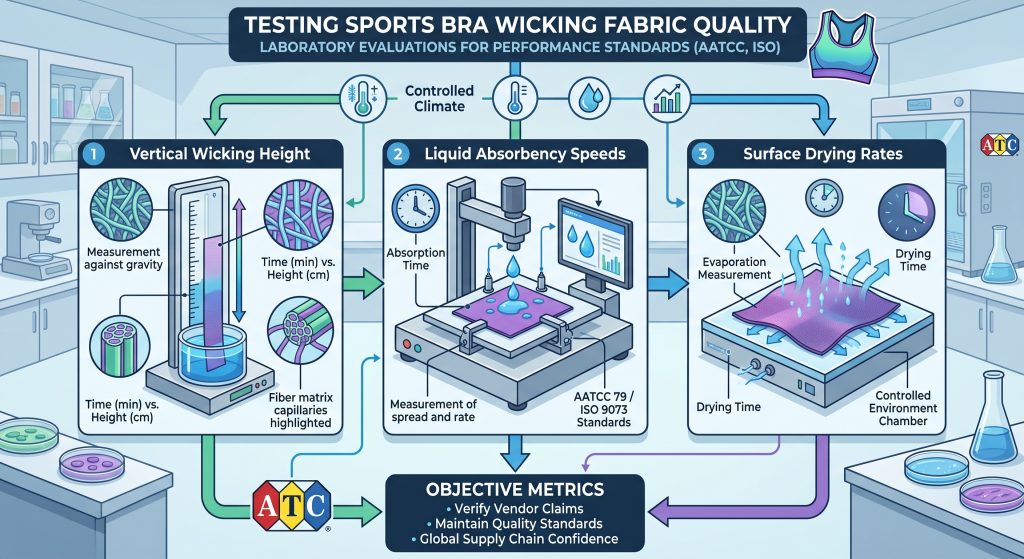
Testing sports bra wicking fabric quality involves standardized laboratory evaluations that measure vertical wicking height, liquid absorbency speeds, and surface drying rates. Standardized protocols established by organizations like AATCC and ISO ensure that raw textile materials meet strict international performance criteria before entering commercial mass production. Testing facilities utilize specialized equipment to record precisely how far and fast moisture travels through knitted fiber matrices under controlled climate conditions. You can rely on these objective laboratory metrics to verify vendor performance claims and maintain strict quality standards across global apparel supply chains.
What Standards Measure Vertical Wicking?
Vertical wicking tests measure a fabric strip’s ability to draw liquid upward against gravity within specified time increments using standard saline solutions. What is the real story? The AATCC 195 and AATCC 197 standards quantify capillary force strength across both warp and weft fabric directions.
- Standardized sample strips immerse in liquid reservoirs for ten minutes.
- Vertical liquid migration height is recorded at regular minute intervals.
- High-performance technical fabrics must achieve at least 100mm vertical lift.
You should require raw material suppliers to furnish certified vertical wicking test reports verifying capillary transport power prior to bulk fabric purchasing.
How Do Lab Tests Rate Absorbency Times?
Absorbency tests measure the exact time in seconds required for a drop of water placed on the fabric surface to absorb completely into the textile matrix. Look closer: premium performance fabrics must absorb liquid droplets in under two seconds to ensure sweat doesn’t puddle against skin.
Key Takeaway: Enforcing strict AATCC testing standards guarantees that your sports apparel line delivers verified moisture transport capabilities and consistent quality across all production runs.
| Standardized Test Protocol | Minimum Passing Threshold | Top-Tier Performance Level |
| AATCC 79 Absorbency Speed | Under 5.0 seconds | Under 1.0 second |
| AATCC 197 Vertical Wicking (10 min) | Minimum 75 mm height | Exceeds 120 mm height |
| ISO 11092 Thermal Resistance | Low evaporative resistance | Minimal moisture barrier |
Certified testing standards establish clear performance baselines, separating premium wicking textiles from low-grade commercial knits.
Can Brands Customise Sports Bra Wicking Fabric Mesh?
Brands can fully customize sports bra wicking fabric mesh by altering yarn composition, adjusting elastane ratios, modifying knit hole geometries, and applying specialized functional chemical finishes. Textile mills can adjust circular knitting machinery parameters to produce proprietary mesh patterns that align with brand design aesthetics while optimizing functional breathability. Additionally, functional finishes like hydrophilic silicone softeners or durable anti-odor treatments can be permanently bound to synthetic fibers during dye processes. Partnering directly with experienced knitting manufacturers allows activewear brands to develop exclusive technical fabrics that deliver distinct competitive advantages in saturated athletic markets.
Can You Adjust Elastane Content For Stretch?
Adjusting elastane content between eight and twenty-eight percent allows textile engineers to fine-tune garment elasticity, compression levels, and structural power. Believe it or not: fine-tuning elastane ratios drastically alters how tightly a sports bra compresses body tissue during high-motion exercises.
- 8-12% elastane provides gentle stretch suitable for low-impact yoga garments.
- 14-18% elastane yields balanced elasticity for versatile medium-impact training.
- 20-28% elastane delivers firm, high-impact compression for intense running.
You can customize garment support profiles across distinct product tiers simply by modifying elastane yarn proportions within the knit matrix.
How Do Finishes Improve Moisture Transport?
Durable hydrophilic chemical finishes coat synthetic fibers with moisture-attracting molecules that accelerate initial sweat absorption speeds across smooth yarn faces. Here is the secret: applying durable hydrophilic finishes transforms naturally hydrophobic synthetic threads into rapid liquid-absorbing networks.
Key Takeaway: Combining custom mesh knit structures with advanced hydrophilic bath finishes produces custom technical fabrics that combine distinctive visual appeal with fast moisture transport.
| Customization Option | Standard Off-The-Shelf Fabric | Fully Customized Technical Fabric |
| Elastane Ratio Range | Fixed (typically 12-15%) | Tailored (8% to 28% dynamic range) |
| Functional Finishes | Basic wash finish | Hydrophilic + Anti-odor + UV shield |
| Pattern Exclusivity | Generic commercial mesh | Proprietary brand-exclusive knit |
Developing custom technical knits enables activewear brands to create exclusive functional textiles tailored to exact performance specifications.
How Do You Source Sports Bra Wicking Fabric Needs?
Sourcing sports bra wicking fabric needs effectively requires establishing clear technical specifications, evaluating vendor manufacturing capacities, and verifying strict quality control protocols across bulk production batches. B2B apparel buyers must verify that textile suppliers maintain consistent yarn quality, precise color dyeing accuracy, and stable physical stretch properties from batch to batch. Establishing clear communication regarding minimum order quantities (MOQs), production lead times, and international eco-certifications helps prevent costly manufacturing delays and material defects. Working with established technical fabric manufacturers ensures reliable raw material delivery and consistent product quality for growing athletic apparel lines.
What Minimum Orders Apply To Technical Knits?
Minimum order quantities for technical activewear knits typically range from 300 to 1,000 kilograms per color depending on dyeing machinery capacities and custom yarn requirements. This is where it gets interesting: specialized custom mesh knits often require higher MOQs to offset technical machinery setup time and yarn threading labor.
- Stock color programs allow lower MOQs starting around 100 meters per order.
- Custom lab-dip color matching requires minimum dye-vat loading weights.
- Proprietary custom knit patterns require larger mill production runs.
You can optimize raw material procurement costs by consolidating color palettes across multiple garment styles to satisfy mill dyeing minimums efficiently.
How Do Supply Chains Maintain Quality?
Maintaining consistent quality across bulk fabric shipments requires rigorous inspection protocols covering GSM weight consistency, color fastness, shade matching, and stretch recovery. Want to know more? Leading textile mills utilize automated Four-Point System inspection frames to identify and flag physical knit flaws prior to roll packaging.
Key Takeaway: Partnering with certified fabric mills that implement rigorous batch inspection procedures protects your brand from costly garment defects and returns.
| Procurement Factor | Standard Commercial Mill | Premium Technical Mill |
| Quality Inspection System | Basic visual spot-check | Automated 4-Point System (100% roll audit) |
| Color Fastness Rating | Grade 3-4 standard | Grade 4-5 high fastness guarantee |
| Lab Testing Documentation | Provided upon special request | Included automatically with every batch |
Partnering with technical fabric suppliers that enforce automated inspection protocols guarantees consistent material quality for high-volume garment manufacturing.
Solving complex activewear moisture management challenges demands a thorough understanding of structural textile engineering, yarn geometry, and performance testing standards. By carefully pairing breathable bird’s eye mesh inner linings with firm, supportive pique exterior structures, athletic apparel brands can eliminate sweat entrapment while delivering robust elastic compression. We are committed to engineering top-tier functional textiles that empower activewear brands to build high-performance athletic apparel with complete confidence. If you are ready to elevate your activewear collection with superior moisture-wicking materials, please contact us today to request technical fabric swatches and discuss your custom manufacturing requirements with our engineering team.
FAQ Section
Q1: Can I use bird’s eye mesh for high-impact sports bra cups?
Yes, you can use bird’s eye mesh for high-impact bra cups, provided you laminate it to a structural high-GSM backing or pair it with firm elastane support layers. While bird’s eye mesh offers excellent moisture movement, its open structure requires supplementary tensile support to control high-impact breast displacement.
Q2: What’s the best synthetic fiber blend for moisture management?
The most effective blend is a high-multi-filament polyester or nylon combined with 15% to 22% spandex/elastane treated with a durable hydrophilic finish. Synthetic fibers resist water retention within their cores, allowing surface capillary grooves to transport sweat rapidly across the fabric face.
Q3: How do I know if pique fabric is breathable enough for activewear?
You can evaluate pique fabric breathability by reviewing its certified CFM (Cubic Feet per Minute) air permeability rating in lab test reports. Look for pique textiles that maintain an air permeability rating of at least 100 CFM to ensure adequate ventilation during exercise.
Q4: Can I add custom anti-odor treatments to wicking fabrics?
Yes, custom silver-ion or plant-based anti-odor treatments can be permanently applied during the fabric dyeing and finishing bath stage. These treatments inhibit odor-causing bacterial growth without interfering with capillary moisture-wicking channels.
Q5: What’s the best GSM range for sports bra wing panels?
The ideal weight range for supportive sports bra wing panels is 210 to 260 GSM with 20% or higher elastane content. This weight density provides firm side compression and stabilizes the garment against body contours during dynamic physical movements.