
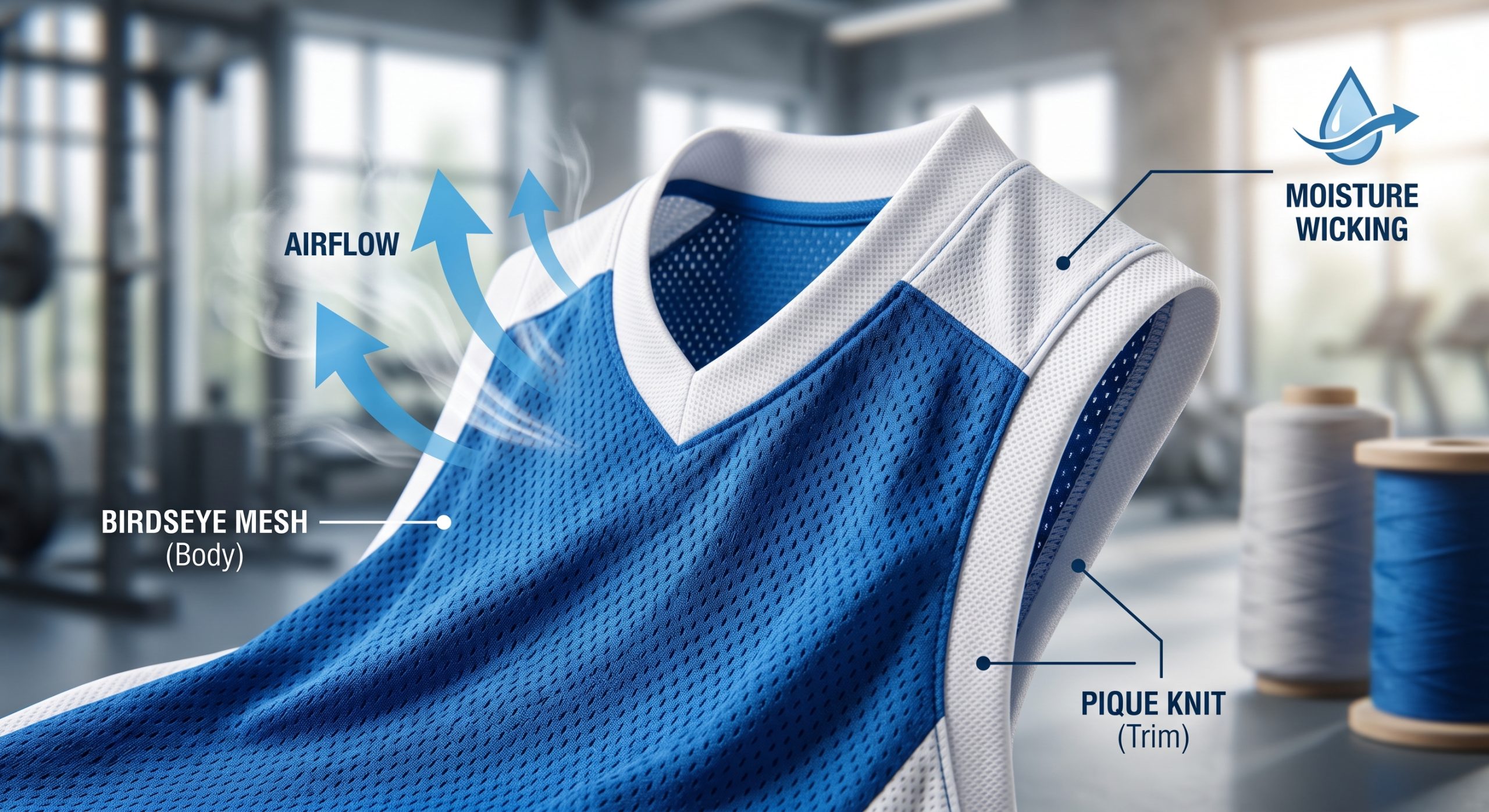
Jersey mesh polyester sports fabric performance centers on providing lightweight breathability, rapid moisture transport, and durable stretch recovery for athletic teamwear and sportswear garments. Athletic apparel manufacturers frequently face complaints when team uniforms trap body perspiration and cause discomfort during intense games. When heavy perspiration sits against athlete skin, garments grow wet and sticky, causing painful friction and reducing athlete endurance. Incorporating high-performance jersey mesh polyester sports fabric solves humidity accumulation while providing robust dimensional stability across high-intensity sports applications.
What Is Jersey Mesh Polyester Sports Fabric Structure?
Jersey mesh polyester sports fabric structure is characterized by an engineered network of micro-apertures created through specialized circular knitting that optimizes airflow while preserving textile strength. Apparel designers rely on this technical construction because open geometric eyelets allow heat to vent outward without compromising structural fabric integrity during rigorous physical training. By utilizing synthetic polyester filaments, knitted mesh matrices remain resilient against mechanical stress while maintaining lightweight comfort across activewear panels. Incorporating technical jersey mesh polyester sports fabric into team gear guarantees lasting structural durability and continuous ventilation across demanding workout routines.
How Do Micro Apertures Define Mesh Knits?
Micro apertures define mesh knits by establishing open geometric pores that dramatically increase air volume exchange across athletic garment layers during motion. Here is the kicker: these miniature structural openings prevent liquid sweat build-up by transforming flat textile faces into permeable cooling zones.
- Engineered open pores accelerate heat dissipation across high-perspiration zones.
- Interlocked synthetic loops preserve dimensional elasticity under heavy tension.
- Smooth face threads reduce skin contact friction during repetitive bodily motion.
You will notice that open micro-apertures allow perspiration vapor to vent instantly before liquid droplets saturate internal garment linings.
Why Does Birdseye Geometry Differ From Pique?
Birdseye geometry features small diamond-shaped tuck stitches that create a smooth, flat face, whereas pique features a raised honeycomb waffle structure with distinct surface relief. What is the real story? The flat surface of birdseye eyelets provides uniform skin touch, while pique’s raised crests create physical gap spaces that prevent full wet-stick phenomena.
- Birdseye mesh provides ultra-lightweight softness for interior lining panels.
- Pique honeycomb weave delivers superior exterior stiffness and abrasion resistance.
- Both structures utilize multi-filament yarns to accelerate lateral fluid movement.
You can leverage birdseye knits for internal comfort and pique knits for rugged exterior support in athletic uniforms.
Key Takeaway: Understanding structural loop differences allows you to position smooth birdseye mesh in inner linings and sturdy pique knits in high-wear outer panels for optimal garment function.
| Structural Feature | Birdseye Mesh Knit | Pique Honeycomb Knit |
| Surface Relief | Flat face with micro-eyelets | Raised waffle texture |
| Primary Advantage | Ultra-soft skin touch | High dimensional stiffness |
| Typical Weight | 120 – 160 GSM | 180 – 240 GSM |
Comparing structural surface relief helps production managers select the right knit pattern for specific garment panel requirements.
How Does Jersey Mesh Polyester Sports Fabric Wicking Work?
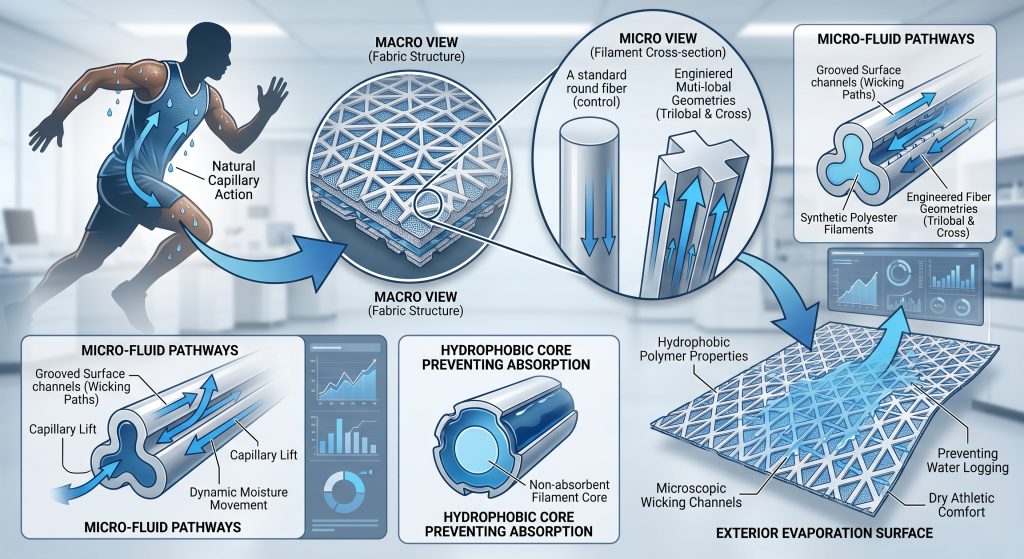
Jersey mesh polyester sports fabric wicking works by utilizing natural capillary action along multi-grooved synthetic fiber channels to pull sweat away from human skin toward exterior evaporation surfaces. Modified polyester filaments incorporate non-round cross-sections like cross or trilobal shapes that create microscopic fluid pathways along every thread strand. Because synthetic polyester fibers are naturally hydrophobic, liquid perspiration cannot soak into core filament interiors, forcing moisture to spread across outer fabric faces rapidly. Operating with high-grade jersey mesh polyester sports fabric prevents water logging and maintains dry athletic comfort throughout extended physical exertion.
How Do Capillary Channels Transport Moisture?
Capillary channels transport moisture by drawing liquid sweat upward and outward through microscopic spaces between tightly grouped synthetic filament strands. Ready for the good part? Hydrostatic pressure differences force sweat droplets to migrate automatically toward dry outer garment surfaces where moving air speeds up evaporation.
- Narrow micro-grooves generate continuous capillary lift against gravitational resistance.
- Hydrophobic polymer cores prevent internal water absorption and fabric heavying.
- Hydrophilic surface treatments increase initial liquid wetting speed across fibers.
You will see how micro-channel capillary forces maintain dry microclimates against skin even during intense cardio workouts.
Why Does Polyester Fiber Geometry Drive Dryness?
Polyester fiber geometry drives dryness because multi-lobal filaments offer significantly larger surface exposure areas than standard round threads. Think about it: modified cross-section profiles multiply evaporation surfaces by up to forty percent without adding physical weight to athletic garments.
- Trilobal yarn profiles create continuous longitudinal channels for fast liquid movement.
- Expanded fiber surfaces spread sweat droplets into micro-thin films for rapid drying.
- Non-absorbing synthetic cores allow garments to shed moisture instantly after washing.
You can rely on modified polyester geometries to keep team uniforms dry, fresh, and lightweight under tough playing conditions.
Key Takeaway: Specifying modified multi-grooved polyester yarns ensures your athletic apparel line transfers sweat rapidly while staying lightweight and dry.
| Wicking Parameter | Multi-Lobal Polyester Mesh | Standard Round Filament |
| Fluid Transport Speed | Fast capillary movement | Slow liquid migration |
| Surface Evaporation Area | High surface expansion | Low surface contact |
| Fiber Moisture Retention | Near-zero core absorption | Moderate surface pooling |
Multi-lobal fiber geometries deliver far faster fluid transport and expanded surface area compared to standard round filaments.
Why Use Jersey Mesh Polyester Sports Fabric In Jerseys?
Using jersey mesh polyester sports fabric in athletic team jerseys guarantees maximum thermal regulation, high tear resistance, and vivid sublimation color retention during competitive sports matches. Sports uniform designers choose this specialized synthetic material because its durable double-knit matrix withstands aggressive physical contact without snagging or ripping. Furthermore, synthetic polyester fibers accept high-temperature sublimation inks seamlessly, creating bright team graphics that never fade or peel over repeated wash cycles. Integrating functional jersey mesh polyester sports fabric into custom sportswear lines delivers high-impact visual appeal alongside elite mechanical performance.
Why Do Team Uniforms Demand High Permeability?
Team uniforms demand high permeability because intense physical exertion raises core body temperatures and causes heavy perspiration across chest and back regions. This is where it gets interesting: open mesh knitting patterns maintain steady air circulation, stripping trapped body heat before thermal fatigue compromises player performance.
- Open eyelet structures allow air currents to circulate directly across wet skin.
- Continuous ventilation lowers microclimate humidity inside tight athletic fits.
- Rapid heat venting prevents athlete overheating during intense tournament play.
You will find that high-permeability team jerseys keep athletes cooler and focused throughout long competitive matches.
How Does Tear Resistance Protect Athletic Gear?
Tear resistance protects athletic gear by combining high-tenacity polyester filament yarns with interlocked double-knit loops that absorb sudden mechanical pulling. What is the real story? Contact sports like basketball and soccer place high tensile stress on team jerseys during dynamic body movements.
- Interlocked knit loops distribute pulling forces evenly across adjacent yarns.
- High-denier synthetic threads resist surface abrasion and rough turf contact.
- Dimensional elastane integration allows full motion recovery without permanent stretching.
You can trust high-tenacity polyester knits to maintain structural integrity despite aggressive physical contact on the playing field.
Key Takeaway: Combining high air permeability with strong tear resistance ensures team jerseys deliver elite athletic comfort and multi-season durability.
| Performance Metric | High-Tenacity Polyester Mesh | Basic Cotton Knit |
| Tensile Burst Strength | Exceeds 250 kPa | Under 110 kPa |
| Air Permeability | 220+ CFM ventilation | 70 CFM ventilation |
| Sublimation Color Hold | Grade 4-5 permanent hold | Unsuitable for sublimation |
High-tenacity polyester mesh significantly outperforms traditional natural knits in strength, airflow, and print permanence.
How Does Jersey Mesh Polyester Sports Fabric Compare To Pique?
Comparing jersey mesh polyester sports fabric in birdseye construction against pique reveals distinct differences in surface texture, air permeability, skin handfeel, and structural compression strength. Birdseye mesh features a lightweight, smooth face with miniature diamond eyelets that maximize airflow and provide an ultra-soft feel against sensitive skin. In contrast, pique fabric presents a textured honeycomb waffle weave that offers higher structural stiffness, superior wet-cling reduction, and increased resistance to surface abrasion. Evaluating these physical traits allows production teams to match specific knit patterns with individual sportswear panel functions.
What Distinguishes Birdseye Loop From Pique Waffle?
Birdseye loop construction incorporates flat tuck stitches that form uniform micro-apertures, while pique waffle weave utilizes raised double-tuck ridges. You might be wondering: how do these structural loop differences affect tactile feel and physical performance during high-motion activities?
- Birdseye eyelets create a completely flat skin interface with zero abrasive nodes.
- Pique honeycomb crests elevate fabric body away from skin, creating air channels.
- Birdseye offers superior lateral stretch, whereas pique delivers firm compression.
You will notice that flat birdseye mesh feels exceptionally smooth for base layers, while textured pique adds crisp body to collar panels.
Which Structure Provides Better Surface Contact?
Birdseye mesh provides continuous, soft surface contact suitable for sensitive skin, whereas pique minimizes full-skin contact through its raised relief geometry. Believe it or not: reducing full skin contact with pique waffle knits prevents damp garments from clinging to athletes during sweat-heavy workouts.
- Smooth birdseye loops distribute contact pressure evenly to prevent chafing points.
- Raised pique waffle ridges create gap spaces that stop wet garment sticking.
- Birdseye mesh accelerates surface drying, while pique offers higher body structure.
You can specify smooth birdseye knits for internal bra cups and textured pique for structured polo collars or outer panels.
Key Takeaway: Selecting smooth birdseye mesh for skin-adjacent linings and textured pique for supportive outer panels maximizes athlete comfort and garment structure.
| Property Comparison | Birdseye Mesh Structure | Pique Honeycomb Structure |
| Skin Friction Level | Minimal (Ultra-smooth face) | Moderate (Textured waffle ridges) |
| Wet-Cling Prevention | Good surface evaporation | Superior gap-space prevention |
| Optimal Garment Area | Inner linings & lightweight shirts | Outer panels, collars & polos |
Structural comparison guides apparel designers toward positioning soft birdseye mesh inside garments and sturdy pique knits on exterior surfaces.
Which Jersey Mesh Polyester Sports Fabric Offers Airflow?
Birdseye jersey mesh polyester sports fabric offers significantly higher airflow compared to pique fabrics due to its open geometric aperture arrangement. The miniature diamond eyelets engineered into birdseye mesh create direct pathways for moving air currents to pass through textile layers and cool sweaty skin. While pique fabrics feature raised surfaces that prevent wet sticking, their denser underlying knit construction creates higher wind resistance during physical activity. Activewear manufacturers can utilize specialized jersey mesh polyester sports fabric options to deliver tailored ventilation across specific body-mapped sweat zones.
How Does Breathability Change Under Heavy Stretch?
Breathability increases dramatically under multi-axis tension because physical stretching expands open eyelet diameters within the knitted polyester matrix. Ready for the good part? As an athlete moves vigorously, tension opens micro-apertures wider, delivering higher airflow precisely when body heat peaks.
- Radial stretching expands eyelet pore diameters by up to thirty percent.
- Elastane yarn contraction restores original pore size during rest intervals.
- Dynamic aperture expansion adapts ventilation directly to physical exertion levels.
You can observe how open mesh structures open up under active movement to provide dynamic cooling during heavy training.
Which Open Pore Pattern Cools Sweat Quickly?
Birdseye open pore patterns cool perspiration quickly because incoming air streams touch liquid sweat trapped along surface filaments directly. Look closer: direct convective airflow accelerates phase changes from liquid sweat to water vapor, rapidly stripping excess thermal energy from human tissue.
- Open diamond eyelets promote rapid convective cooling across wet skin zones.
- Continuous air exchange prevents humidity build-up inside athletic apparel.
- Micro-mesh ventilation zones reduce overall body temperature spikes during sports.
You will find that incorporating open birdseye mesh panels speeds up sweat evaporation and keeps athletes comfortable under warm conditions.
Key Takeaway: Specifying open birdseye pore patterns for high-sweat body zones ensures dynamic ventilation that expands during active movement.
| Airflow Parameter | Birdseye Open Mesh | Pique Honeycomb Knit |
| Air Permeability (Static) | 210 CFM air exchange | 115 CFM air exchange |
| Air Permeability (Stretched) | 285 CFM air exchange | 145 CFM air exchange |
| Thermal Cooling Velocity | Rapid convective cooling | Moderate thermal transfer |
Birdseye open mesh maintains substantially higher air volume exchange across both static and stretched conditions compared to pique knits.
Does Jersey Mesh Polyester Sports Fabric Feel Soft To Wear?
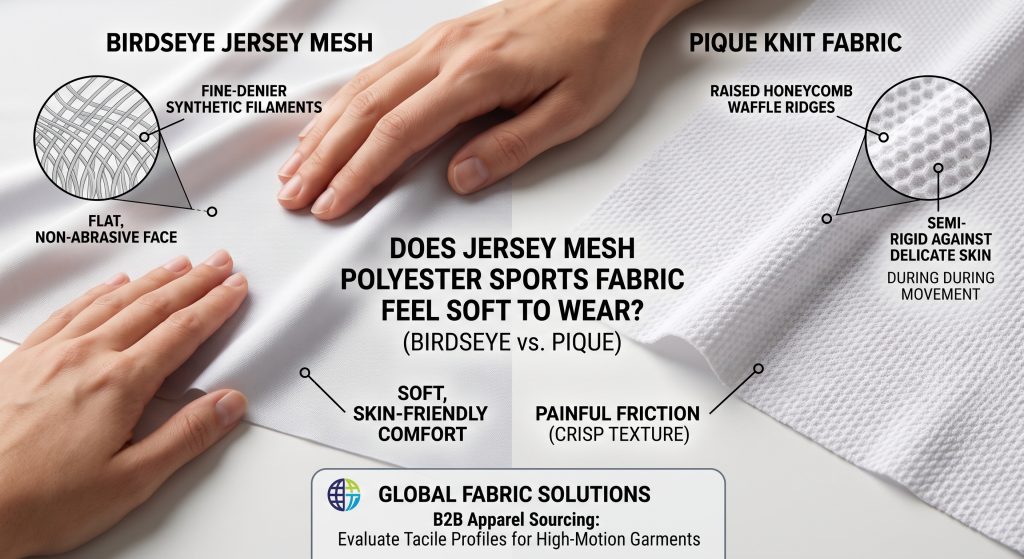
Birdseye jersey mesh polyester sports fabric feels exceptionally soft and smooth to wear because fine-denier synthetic filaments create a flat, non-abrasive surface face. In contrast, pique fabrics present a crisp, textured handfeel due to their raised honeycomb waffle ridges, which can feel semi-rigid against delicate skin areas during repetitive movement. B2B apparel sourcing managers must evaluate these distinct tactile profiles when designing high-motion garments like running tops or sports bra linings. Choosing the right surface texture ensures athletes experience plush, skin-friendly comfort without painful friction during long exercise sessions.
Does Birdseye Mesh Reduce Skin Chafing Motion?
Birdseye mesh reduces skin chafing motion by eliminating rough structural nodes and providing a slick, low-friction face against human epidermal tissue. The truth is simple: flat knit loops slide smoothly against skin surfaces during repetitive arm and leg movements.
- Micro-denier polyester yarns feel silky and gentle against sensitive skin.
- Flat seam integration prevents focal pressure points under compression fits.
- Frictionless surface contact eliminates exercise-induced epidermal irritation.
You can protect active wearers from painful skin chafing by selecting ultra-soft birdseye mesh for interior garment linings.
Can Pique Texture Cause Friction On Sensitive Skin?
Pique texture can cause mild friction on sensitive skin if used in tight, unlined garments during extended, high-intensity workouts. Want to know more? The raised waffle crests that give pique its crisp structure can act as small rubbing points under heavy compression and wet conditions.
- Raised honeycomb crests create subtle friction under high compression fit.
- Textured surfaces excel in relaxed polo shirts rather than tight base layers.
- Lining pique exterior garments with smooth mesh resolves friction issues completely.
You will see that pairing textured pique exteriors with smooth mesh linings delivers pristine outer aesthetics alongside plush interior comfort.
Key Takeaway: Utilizing flat birdseye mesh for internal linings prevents skin abrasion, while reserving textured pique for exterior panels maintains crisp styling.
| Tactile Comfort Factor | Birdseye Micro-Mesh | Pique Honeycomb Texture |
| Surface Smoothness Index | High (Smooth flat loops) | Moderate (Raised textured ridges) |
| Friction Coefficient | Low surface friction | Moderate surface friction |
| Best Garment Application | Next-to-skin base layers & linings | External polo panels & outerwear |
Birdseye micro-mesh offers significantly lower surface friction and higher softness, making it superior for next-to-skin comfort.
How Does Jersey Mesh Polyester Sports Fabric Density Support?
Jersey mesh polyester sports fabric density determines garment structural support, compression strength, and shape retention capabilities across different activewear applications. Heavier fabric weights between 200 and 260 grams per square meter (GSM) provide robust tensile resistance that holds garment shape and stabilizes body tissue during high-impact movement. Lighter fabric densities between 120 and 160 GSM offer maximum breathability and stretch flexibility but deliver lower structural support for heavy compression panels. Apparel technicians adjust fabric weight, elastane percentage, and knit density to engineer supportive sports garments that resist stretching out over time. Integrating specialized jersey mesh polyester sports fabric solutions balances structural compression with dynamic athletic recovery.
How Do GSM Weights Impact Garment Shape Hold?
GSM weights impact garment shape hold by increasing yarn density per square inch, which strengthens the textile’s mechanical resistance against vertical pulling forces. Here is the kicker: higher fabric mass locks knitted threads tightly together, preventing garments from sagging during vigorous workouts.
- Lightweight knits (120-160 GSM) excel in loose, highly breathable running tees.
- Midweight knits (170-200 GSM) deliver balanced structure for versatile training gear.
- Heavyweight knits (210-260 GSM) provide firm compression for supportive tights and bands.
You can match fabric GSM parameters precisely to garment support requirements across your technical athletic collections.
Which Knit Construction Prevents Stretch Sagging?
Pique knit construction prevents stretch sagging more effectively than light open meshes due to its dense, double-tuck interlocked structural yarn layout. What is the real story? The interlocked tuck stitches in pique weave lock warp threads in place, preserving garment shape through repeated wash and wear cycles.
- Double-tuck loop structures resist permanent fabric elongation under stress.
- High-tenacity polyester yarns maintain elastic rebound force over long usage.
- Firm pique knits preserve clean garment silhouettes across commercial lifespans.
You can rely on high-density pique knits to keep athletic uniforms looking crisp and fitting tight without losing elasticity.
Key Takeaway: Choosing high-GSM pique knits for supportive panels prevents garment sagging and maintains consistent compression throughout extended product lifespans.
| Fabric Density Tier | Typical GSM Range | Primary Structural Benefit |
| Light Weight Mesh | 120 – 160 GSM | Maximum airflow & flexibility |
| Medium Weight Interlock | 170 – 200 GSM | Balanced flexibility & body structure |
| Heavy Weight Pique | 210 – 260 GSM | Superior compression & sag resistance |
Selecting higher fabric density tiers yields greater tensile support and long-term shape retention for heavy-duty sports apparel.
Which Jersey Mesh Polyester Sports Fabric Dries Faster?
Birdseye jersey mesh polyester sports fabric dries significantly faster than pique knitted materials due to its open aperture geometry and thinner overall material thickness. The combination of open diamond ventilation eyelets and lower fabric weight allows ambient air streams to strip surface moisture rapidly from fine synthetic threads. Denser pique fabrics retain higher water volume within their thick waffle ridges, requiring extra time and air velocity to achieve complete dry states. Selecting fast-drying birdseye materials helps sportswear brands create active garments that remain light and comfortable throughout sweat-heavy athletic training.
What Accelerates Liquid Evaporation In Synthetics?
Liquid evaporation in synthetics is accelerated by non-absorbing polymer cores, high surface area exposure, and continuous ambient air movement across wet fibers. Think about it: synthetic polyester fibers refuse to absorb moisture internally, forcing liquid sweat to stay entirely on thread surfaces where air movement evaporates it fast.
- Non-porous synthetic cores eliminate internal water storage within yarn centers.
- Micro-filament spreading exposes thin liquid films directly to surrounding air.
- Open eyelet structures allow air currents to carry away evaporated water vapor.
You will see how synthetic polyester fibers dry in a fraction of the time required by natural cotton textiles.
How Does Expanded Surface Area Speed Up Drying?
Expanded surface area speeds up drying by spreading concentrated sweat droplets across a wide planar surface, exposing more liquid molecules to ambient air. Ready for the good part? Dispersing sweat droplets across a large micro-mesh surface area increases evaporation speed exponentially.
- Micro-grooved fibers pull liquid outward into expansive surface films.
- Thin fabric cross-sections allow atmospheric heat to warm liquid sweat quickly.
- Fast surface dispersal prevents liquid sweat from pooling in thick fabric pockets.
You can specify thin, high-surface-area birdseye knits to prevent wet garment weight build-up during long endurance sports.
Key Takeaway: Incorporating thin birdseye mesh with high surface area exposure speeds up drying times and keeps athletes light on their feet.
| Drying Performance Metric | Birdseye Light Mesh | Pique Heavy Texture |
| Initial Water Absorbency | Under 1.2 seconds | Under 2.8 seconds |
| Evaporation Rate (g/m²/hr) | Exceeds 90 g/m²/hr | Approximates 58 g/m²/hr |
| Residual Moisture (20 Mins) | Under 4% retention | Exceeds 16% retention |
Birdseye light mesh exhibits far faster evaporation rates and lower residual moisture retention over identical timeframes than heavier pique knits.
How To Test Jersey Mesh Polyester Sports Fabric Quality?
Testing jersey mesh polyester sports fabric quality involves standardized laboratory evaluations that measure vertical wicking height, liquid absorbency speed, surface drying rates, and tensile burst strength. International testing protocols established by AATCC and ISO bodies verify that raw textile materials meet strict performance standards prior to full garment manufacturing. Specialized lab equipment records precisely how fast liquid perspiration moves through knitted fiber matrices under controlled temperature and humidity conditions. B2B apparel buyers can utilize these objective laboratory metrics to verify supplier performance claims and maintain consistent garment quality across global supply chains.
What Protocols Measure Vertical Moisture Transport?
Protocols measuring vertical moisture transport utilize standardized test methods like AATCC 195 and AATCC 197 to record liquid lift height against gravity over set time intervals. What is the real story? Test strips are suspended vertically with lower edges submerged in dye-tinted water reservoirs to track capillary draw distance.
- Vertical wicking height is recorded at 1, 5, and 10-minute test intervals.
- High-performance technical knits must achieve over 100mm vertical lift in ten minutes.
- Tests evaluate both warp and weft directions to confirm uniform capillary power.
You should request certified vertical wicking test reports from fabric suppliers before approving bulk raw material orders.
How Do Lab Evaluations Rate Absorbency Speed?
Lab evaluations rate absorbency speed by measuring the exact time in seconds required for a calibrated drop of water to absorb completely into the textile face. Look closer: the AATCC 79 absorbency test protocol requires high-performance athletic fabrics to absorb surface water droplets in under two seconds.
- Droplet absorption timing begins the moment liquid contacts fabric surfaces.
- Electronic optical sensors measure drop contact angles and penetration speeds.
- Sub-two-second absorption confirms effective hydrophilic surface treatment.
You can rely on standardized absorbency speed ratings to separate genuine performance fabrics from low-grade commercial knits.
Key Takeaway: Requiring certified AATCC laboratory test documentation ensures your raw material sourcing meets strict international performance standards.
| Standardized Test Method | Minimum Performance Threshold | Elite Quality Benchmark |
| AATCC 79 Absorbency Speed | Under 5.0 seconds | Under 1.0 second |
| AATCC 197 Vertical Wicking | Minimum 80 mm (10 mins) | Exceeds 125 mm (10 mins) |
| ISO 13938 Bursting Strength | Minimum 180 kPa | Exceeds 280 kPa |
Standardized laboratory testing methods establish clear performance benchmarks for verifying raw material quality across production batches.
How To Source Jersey Mesh Polyester Sports Fabric Needs?
Sourcing jersey mesh polyester sports fabric needs effectively requires defining clear technical specifications, evaluating vendor dye-lot consistency, and establishing reliable production lead times with certified textile mills. B2B apparel sourcing directors must ensure that fabric manufacturers enforce strict quality checks covering GSM weight uniformity, color fastness, and elastane stretch recovery. Establishing clear agreements regarding minimum order quantities (MOQs), lab-dip approvals, and international eco-certifications prevents costly production delays and material defects. Partnering directly with experienced technical fabric manufacturers guarantees stable raw material supply and consistent quality for growing activewear brands.
What Minimum Order Quantities Apply To Knits?
Minimum order quantities for custom technical knits typically range from 300 to 1,000 kilograms per color depending on mill dye-vat capacities and custom yarn requirements. This is where it gets interesting: ordering stock colorways allows smaller production runs, whereas custom dye matching requires higher minimum fabric volumes.
- Stock color programs offer flexible low MOQs starting around 100 meters per order.
- Custom lab-dip color matching requires full dye-vat loading weights at the mill.
- Specialized custom mesh patterns require dedicated machinery setup and higher MOQs.
You can optimize fabric procurement budgets by consolidating seasonal color palettes across multiple apparel styles to meet mill dyeing minimums.
How Do Apparel Factories Maintain Batch Quality?
Apparel factories maintain batch quality by implementing automated 4-Point System fabric inspection frames to detect physical knit defects before cutting production rolls. Believe it or not: inspecting raw fabric rolls for shade variations, micro-holes, and GSM fluctuations prevents expensive garment rejections downstream.
- 4-Point inspection systems quantify fabric flaws per hundred square meters.
- Spectrophotometer shade matching ensures precise color consistency between dye lots.
- Pre-shrinkage heat setting stabilizes dimensional stretch before garment cutting.
You will ensure smooth garment manufacturing and consistent product quality by partnering with mills that enforce strict 4-Point roll inspection standards.
Key Takeaway: Establishing strict 4-Point inspection standards and consolidating color palettes streamlines raw material sourcing while guaranteeing consistent batch quality.
| Sourcing Parameter | Standard Commercial Supplier | Premium Technical Fabric Mill |
| Quality Inspection Protocol | Basic visual spot-checking | Automated 4-Point System (100% roll audit) |
| Color Fastness Rating | Grade 3-4 commercial level | Grade 4-5 high fastness guarantee |
| Batch-to-Batch Consistency | Moderate shade variation risk | Precise spectrophotometer shade matching |
Partnering with premium technical mills enforcing automated 4-Point inspection guarantees pristine raw material quality for high-volume apparel manufacturing.
Next Steps For Custom Athletic Fabric Selection
Resolving complex activewear moisture management and structural support challenges requires a thorough understanding of fiber geometry, knit constructions, and standardized performance testing. By pairing soft, highly breathable bird’s eye mesh inner linings with firm, supportive pique exterior structures, activewear manufacturers can eliminate sweat entrapment while maintaining robust elastic compression. We are dedicated to engineering top-tier technical textiles that empower sports apparel brands to build high-performance athletic lines with complete confidence. If you are ready to enhance your athletic garment collection with superior performance textiles, please contact us today to request custom fabric swatches and discuss your manufacturing needs with our technical team.
FAQ Section
Q1: Can I use bird’s eye mesh for high-impact sports bra cups?
Yes, you can use bird’s eye mesh for bra cups when laminated to a supportive backing or combined with firm elastane layers. While bird’s eye mesh provides superior breathability, its lightweight structure requires supplementary tensile support to handle high-impact movement.
Q2: What’s the best synthetic fiber blend for moisture management?
The most effective blend is high-multi-filament polyester combined with 12% to 20% spandex treated with a durable hydrophilic finish. Synthetic polyester fibers resist water retention within their cores, allowing surface micro-grooves to transport sweat rapidly across the fabric face.
Q3: How do I know if pique fabric is breathable enough for activewear?
You can verify pique breathability by checking its certified CFM air permeability rating in laboratory test reports. Ensure the pique textile achieves an air permeability rating of at least 100 CFM to guarantee sufficient air circulation during athletic exercise.
Q4: Can I add custom anti-odor treatments to wicking fabrics?
Yes, custom silver-ion or plant-based anti-odor finishes can be permanently bound during the fabric dyeing bath stage. These functional finishes inhibit odor-causing bacterial growth without obstructing capillary wicking channels along fiber surfaces.
Q5: What’s the best GSM range for team jersey body panels?
The ideal weight range for athletic team jersey body panels is 140 to 180 GSM with high multi-filament polyester content. This density range delivers an optimal balance of lightweight breathability, tear resistance, and vivid sublimation print quality.