
Balancing waterproof protection and breathability requires synthetic membranes with microscopic pores small enough to block liquid water drops while expanding wide enough for moisture vapor evacuation. Imagine leading an alpine expedition up a freezing glacier peak when sudden freezing rain strikes your team. Sweat gets trapped inside heavy gear, leaving climbers drenched from within while cold wind chilled outer layers turn garments into icy weights. You can avoid dangerous hypothermia risks by sourcing technical mountain sports fabric designed specifically to vent internal body steam while blocking harsh external precipitation.
What Defines Quality Waterproof Mountain Sports Fabric?
High quality waterproof textiles rely on specialized hydrophobic coatings or laminated membranes capable of resisting high hydrostatic pressure from driving rain. Selecting high performance mountain sports fabric guarantees that outdoor garments remain completely dry during heavy alpine storms. Synthetic backing layers reinforce these protective barriers against mechanical friction. Sealant tapes applied over stitched seams maintain absolute water resistance across all garment panel joints.
How Do Waterproof Ratings Protect Athletes?
Hydrostatic head tests measure the millimeter height of a water column material withstands before liquid penetrates through fibers. Heavy rain demanding severe weather protection requires ratings exceeding 15,000 millimeters.
Here is the deal. Higher ratings ensure safety during long outdoor assignments:
- 10,000 mm handles moderate rain showers during light hiking.
- 15,000 mm shields against heavy downpours under weighted backpack straps.
- 20,000 mm withstands extreme pressure from alpine blizzards.
You must match rating specifications directly to intended expedition environments.
What Makes Laminated Membranes Impermeable?
Laminated membranes feature solid or microporous structures bonded directly beneath tough outer face fabrics. Micropores measure thousands of times smaller than rain drops yet significantly larger than sweat molecules.
You might be wondering. These layers work together through specific physical properties:
- Polyurethane coatings offer cost-effective liquid resistance.
- Expanded PTFE membranes deliver premium durability in harsh conditions.
- Monolithic films utilize chemical absorption for silent motion.
You gain reliable protection without adding stiff bulky weight to modern outerwear silhouettes.
Key Takeaway: Understanding hydrostatic ratings helps you specify correct membrane technologies that keep users dry during extreme mountain storms.
| Waterproof Rating | Water Column Resistance | Optimal Activity Level |
| 5,000 mm | Light Rain Pressure | Mild Day Walks |
| 15,000 mm | Heavy Rain & Snow | Trekking & Mountaineering |
| 20,000+ mm | Extreme Torrential Storms | High-Altitude Expeditions |
Matching rating metrics to weather exposure prevents garment saturation and extends apparel usability in rugged terrains.
How Does Breathability Function in Mountain Sports Fabric?
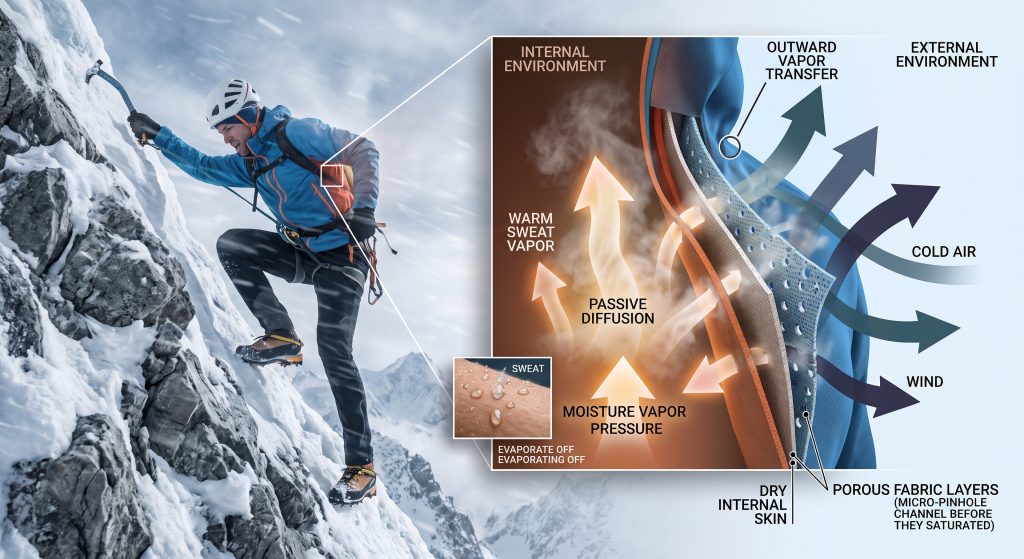
Breathability functions through passive diffusion where moisture vapor pressure pushes warm sweat vapor outward across porous fabric layers. Specifying a breathable mountain sports fabric prevents internal humidity build-up during energetic climbing sessions. High vapor transfer rates maintain dry internal skin environments. Proper air exchange balances body temperature during intense physical exertion.
Why Does Moisture Vapor Transmission Rate Matter?
Moisture vapor transmission rate measures how many grams of water vapor pass through a square meter of texturing material within twenty-four hours. Higher numerical values indicate superior sweat dissipation capabilities.
What is the real story? Test standards determine vapor transfer speed:
- 10,000 g/m²/24h suits low-intensity aerobic hiking activities.
- 20,000 g/m²/24h maintains comfort during steep uphill ascents.
- 30,000 g/m²/24h prevents sweat pooling during intense backcountry skiing.
You keep athletes dry from internal perspiration by maximizing vapor passage ratings.
How Do Air-Permeable Structures Improve Cooling?
Air-permeable fabrics allow tiny amounts of ambient air to pass directly through structural weave openings. This passive airflow accelerates evaporation without compromising wind resistance.
Ready for the good part? Dynamic airflow offers distinct advantages:
- Instant thermal regulation during sudden physical surges.
- Reduced dependence on mechanical pit zippers for venting.
- Continuous cooling across high-heat back zones.
You can design lighter garments that naturally regulate core body warmth during activity.
Key Takeaway: Selecting high transmission fabrics ensures interior perspiration escapes rapidly before chilling body skin.
| Transmission Rate | Vapor Volume Dispersal | Recommended Sport Application |
| 10,000 g/m²/24h | Moderate Vapor Flow | Resort Skiing & Hiking |
| 20,000 g/m²/24h | High Vapor Evacuation | Alpine Climbing |
| 30,000 g/m²/24h | Maximum Vapor Release | Trail Running & Fastpacking |
Prioritizing higher transmission metrics guarantees optimal thermoregulation during high-exertion mountain activities.
Why Is DWR Coating Vital for Mountain Sports Fabric?
Durable water repellent coatings alter surface tension so liquid water forms beads and rolls off outer face fabrics without soaking into structural yarns. Treating every mountain sports fabric with quality repellents stops surface wetting that severely blocks membrane breathability. Untreated face fabrics absorb water weight and chill wearers quickly. Durable chemical treatments maintain surface shedding performance over long operational periods.
How Does Durable Water Repellent Prevent Bead Saturation?
Hydrophobic chemistry creates microscopic spikes on individual fibers that prevent liquid droplets from spreading out flat. Water retains high surface tension and slides away easily.
Look at it this way. Proper repellent application delivers clear benefits:
- Prevents outer face fabric from becoming heavy and wet.
- Preserves breathability channels by keeping outer pores open.
- Reduces wind chill effects caused by damp exterior layers.
You protect activewear performance by maintaining strong surface water bead formation.
What Is the Environmental Shift in DWR Finishes?
Textile mills are rapidly transitioning from fluorocarbon-based chemistries toward fluorine-free alternative formulations. Modern eco-friendly repellents deliver excellent liquid shedding without persistent environmental accumulation.
Here is the kicker. Modern finishes balance ecology with protection:
- C0 chemistries eliminate toxic perfluorinated compound runoff completely.
- Plant-based repellents offer bio-based water resistance options.
- Advanced polymers maintain washing durability through multiple laundry cycles.
You can meet strict eco-compliance goals without sacrificing essential storm shedding capabilities.
Key Takeaway: Eco-friendly water repellent finishes protect outerwear from saturation while fulfilling modern environmental sustainability demands.
| Finish Chemistry | Environmental Footprint | Water Shedding Longevity |
| Legacy Fluorocarbon (C8) | High Environmental Impact | Very Long Lasting |
| Short-Chain Fluorocarbon (C6) | Moderate Environmental Impact | Moderate Lasting |
| Fluorine-Free (C0) | Eco-Friendly Formulation | High Wash Durability |
Transitioning toward C0 chemistries satisfies eco-conscious market demands while ensuring reliable moisture resistance.
Which Weave Construction Suits Mountain Sports Fabric Best?
Dense ripstop woven structures suit protective outer shells best, while textured knits excel in flexible insulating mid-layers. Choosing the appropriate weave structure for a mountain sports fabric balances physical abrasion resistance with dynamic bodily movement. Interwoven grid patterns restrict fabric tears from spreading across garment panels. Structural knit variations dictate stretch recovery rates under heavy physical tension.
How Does Pique Weave Compare to Bird’s Eye Mesh?
Pique knit features a raised waffle texture offering high dimensional stability, whereas bird’s eye mesh utilizes micro-pinhole perforations for maximum airflow. Pique creates durable outer surfaces, while mesh provides silky next-to-skin ventilation.
This is where it gets interesting. Structural differences dictate garment placement:
- Pique waffle knits resist surface snagging from gear straps.
- Bird’s eye micro-mesh channels sweat rapidly away from skin.
- Combined hybrid paneling optimizes both hold and ventilation.
You can combine both fabric constructions to engineer high-performance athletic garments.
Which Knit Offers Greater Tear Strength Under Tension?
Interlocked woven structures offer superior tensile tear strength compared to open mesh patterns under extreme directional force. Reinforced grid yarns snap shut around punctures to prevent structural garment failure.
What’s the bottom line? Tensile strength varies by weave type:
- Ripstop weaves stop tears from expanding under tension.
- Tight pique knits hold structural shape after repeated stretch.
- Light mesh requires synthetic blending for tear resistance.
You ensure garment longevity in rocky mountain environments by selecting high-density weaves.
Key Takeaway: Combining textured pique outer shells with ventilated bird’s eye mesh linings creates balanced activewear pieces.
| Weave Architecture | Primary Structural Benefit | Recommended Apparel Zone |
| Ripstop Grid Woven | High Tear Resistance | Outer Shell & Knee Panels |
| Pique Tuck-Stitch Knit | Dimensional Stability | Outer Collar & Chest |
| Bird’s Eye Micro-Mesh | Maximum Air Circulation | Interior Lining & Back |
Strategic weave placement optimizes total durability without adding unnecessary weight to activewear garments.
How Does Moisture Wicking Impact Mountain Sports Fabric?
Moisture wicking impacts activewear by pulling sweat off skin surfaces via capillary action and spreading liquid across wide areas for quick evaporation. Integrating efficient wicking properties in your mountain sports fabric keeps athletes dry during strenuous outdoor activities. Hydrophilic synthetic treatments accelerate liquid transport away from body heat zones. Fast drying times prevent wet garments from chilling wearers during resting breaks.
How Do Micro-Pinhole Channels Accelerate Evaporation?
Open pinhole channels create continuous air passageways that drive rapid surface drying. Moisture spreads along fine fiber filaments where atmospheric airflow dissipates liquid instantly.
Check this out. Micro-perforations enhance drying performance significantly:
- Multi-channel yarns pull sweat outward through capillary force.
- Increased surface exposure speeds up evaporation time.
- Lightweight construction holds minimal water volume within fibers.
You keep wearers comfortable during high-intensity training by utilizing open channel knits.
Why Does Next-To-Skin Comfort Stop Chafing?
Ultra-smooth inner fabric faces glide easily across sensitive skin zones during continuous athletic motion. Soft synthetic finishes eliminate abrasive friction points that cause painful skin burns during long treks.
Believe it or not. Soft interior linings prevent athlete irritation:
- Silky filaments reduce skin contact friction coefficients.
- Flat seams prevent pressure marks under heavy backpack straps.
- Quick drying properties eliminate damp skin sticking.
You preserve athlete endurance by selecting friction-free interior fabrics.
Key Takeaway: Effective capillary moisture transport keeps skin dry, preventing friction chafing and dangerous post-exercise hypothermia.
| Wicking Metric | Capillary Travel Speed | Evaporation Time |
| Basic Polyester Knit | 5 cm in 10 Mins | 25 Minutes |
| Micro-Channel Synthetic | 12 cm in 10 Mins | 14 Minutes |
| Pinhole Mesh Structure | 15 cm in 10 Mins | 10 Minutes |
Micro-channel fiber structures dramatically accelerate sweat spreading and reduce overall fabric drying duration.
Can Softshell Outperform Hardshell Mountain Sports Fabric?
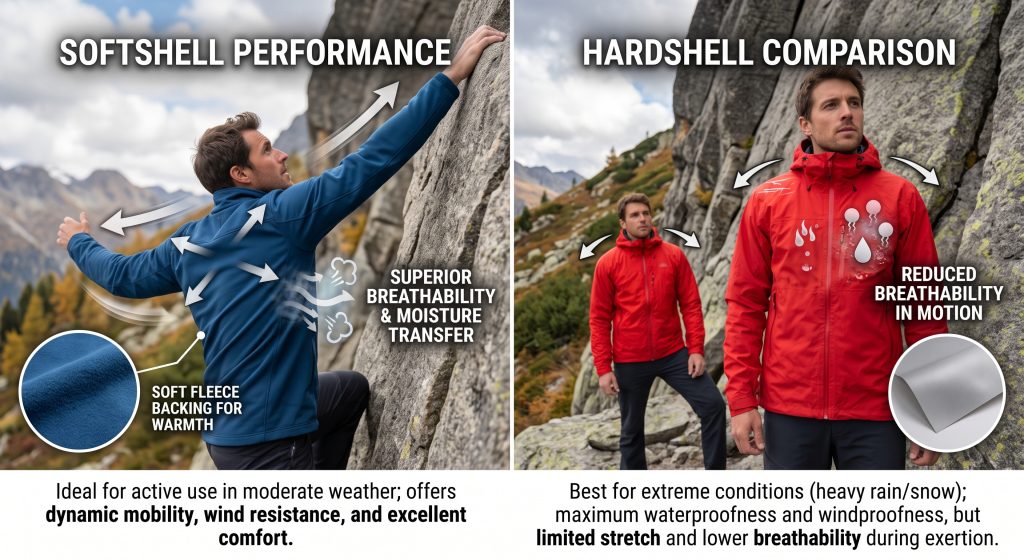
Softshell materials outperform hardshell alternatives in moderate weather because they offer superior breathability, softer hand feel, and four-way elastic mobility. Choosing a flexible softshell mountain sports fabric enhances athletic freedom during dynamic mountain climbing. Woven outer faces resist cold winds while soft fleece backings trap warmth. Stretch elastane integration allows unhindered arm extension across steep rock faces.
When Should You Opt for Softshell Flexibility?
You should choose softshell textiles for aerobic activities conducted in dry or light precipitation conditions where mobility matters most. Unrestricted four-way stretch enables natural body extension during technical ascents.
Here is the deal. Softshells excel in specific alpine scenarios:
- Spring ski touring requiring high breathability and movement.
- Technical alpine climbing demanding limb flexibility.
- High-speed trail running in cold windy weather.
You maximize movement efficiency by wearing stretch-woven outerwear during active ascents.
What Are the Severe Weather Limits of Softshells?
Softshells lack fully taped seams and completely waterproof membranes, making them vulnerable during prolonged torrential downpours. Extreme mountain storms eventually saturate woven face yarns despite durable water repellent treatments.
You might be wondering. Environmental exposure highlights softshell limitations:
- Heavy driving rain penetrates woven needle punctures over time.
- Sustained gale winds slowly force cold air through open knits.
- Added fabric weight reduces packability in emergency situations.
You must switch to impermeable hardshell garments when facing severe hurricane-force mountain rain.
Key Takeaway: Softshells provide superior comfort and mobility during high-exertion climbing, but hardshells remain necessary for extreme rainstorms.
| Fabric Classification | Wind Resistance Level | Waterproof Capability | Stretch Flexibility |
| Softshell Woven | 80% – 95% Wind Block | Water-Resistant (DWR) | Exceptional 4-Way |
| Hardshell Laminated | 100% Total Wind Block | 100% Waterproof Taped | Rigid / Limited Stretch |
| Hybrid Composite | 90% Targeted Shield | Regional Waterproofing | Strategic Zone Flex |
Selecting between softshell and hardshell options depends on balancing weather severity against required athletic mobility.
What Role Does Thermal Retention Play in Mountain Sports Fabric?
Thermal retention keeps athletes safe by trapping warm still air inside brushed interior fibers while venting excess body heat out through breathable channels. Selecting insulated mountain sports fabric shields climbers against freezing high-altitude ambient temperatures. High loft fleece backings store body warmth without adding heavy weight. Moisture managing insulation prevents sweat condensation from freezing inside inner garment layers.
How Do Hollow Fibers Trap Insulating Air?
Synthetic hollow core fibers feature central air cavities that lock warm thermal air inside individual filaments. This dead air barrier slows conductive heat loss dramatically while keeping total fabric mass light.
What’s the real story? Hollow fiber technology maximizes warmth efficiency:
- Traps radiant body heat within internal fiber voids.
- Reduces overall garment weight compared to solid yarns.
- Retains thermal insulation properties even when damp with sweat.
You can construct lightweight winter garments that insulate effectively without bulk.
Why Is Breathable Warmth Essential for Alpine Climbing?
Alpine athletes switch rapidly between intense climbing physical exertion and cold static belay periods. Active insulation fabrics allow excess heat steam to vent during movement while trapping core warmth during rest.
Ready for the good part? Active insulation solves classic layering dilemmas:
- Eliminates constant garment swapping during changing activity levels.
- Prevents inner garment sweat condensation build-up.
- Maintains consistent core body temperatures across variable conditions.
You protect climbers from chilling temperature drops during unexpected mountain delays.
Key Takeaway: Utilizing hollow fibers and active insulation maintains thermal comfort without causing overheating during high-exertion ascents.
| Insulation Technology | Thermal Retention Ratio | Moisture Resistance | Weight Efficiency |
| Standard Fleece | Moderate Heat Holding | Retains Moisture | Heavy Mass |
| Brushed Grid Fleece | High Heat Retention | Quick Evaporation | Medium Mass |
| Hollow-Core Synthetic | Maximum Heat Retention | Hydrophobic Resistance | Ultra-Light Mass |
Advanced hollow-core synthetics offer the highest warmth-to-weight ratio for cold weather alpine operations.
How Do You Test Abrasion in Mountain Sports Fabric?
Abrasion testing evaluates fabric durability by rubbing abrasive surface wheels against textile samples under controlled mechanical pressure until yarn breakage occurs. Testing every protective mountain sports fabric ensures outerwear survives continuous friction against sharp granite rock surfaces. High Martindale rub counts verify long operational fabric lifespans. High-tenacity nylon yarns resist surface pilling from heavy backpack harness friction.
How Does Martindale Testing Measure Surface Friction?
Martindale testing machines rub wool or abrasive paper in expanding Lissajous figures across fabric samples under standardized weights. Technicians record the total cycle number completed before threads break or show noticeable surface wear.
Look at it this way. Rub counts define durability thresholds:
- 20,000 cycles suits lightweight trekking apparel.
- 35,000 cycles withstands frequent alpine climbing use.
- 50,000+ cycles guarantees heavy-duty mountaineering reinforcement strength.
You verify long-term product durability by specifying high Martindale rating thresholds.
What Makes High-Tenacity Synthetics Abrasion Resistant?
High-tenacity Nylon 6,6 polymers feature tightly aligned molecular chains that resist physical shearing forces. Interweaving these tough filaments into ripstop structures prevents rough rock edges from cutting through garment panels.
Here is the kicker. Tough synthetic polymers protect high-wear zones:
- Resists surface snagging from sharp ice axes and rock edges.
- Prevents pilling caused by shoulder strap friction.
- Maintains seam strength under extreme mechanical loads.
You ensure gear reliability in rugged terrains by integrating high-tenacity nylon weaves.
Key Takeaway: Specifying high-tenacity nylon fabrics tested over 35,000 Martindale cycles prevents premature gear failure on rough granite rock.
| Fabric Composition | Martindale Abrasion Cycles | Primary Durability Application |
| Standard Polyester Knit | 15,000 – 20,000 Rubs | Light Inner Linings |
| High-Tenacity Nylon 6 | 30,000 – 40,000 Rubs | Main Outerwear Shells |
| Cordura Nylon 6,6 Blend | 50,000+ Rubs | Reinforced Knee & Seat Panels |
High-tenacity nylon blends dramatically improve tear and abrasion resistance across high-impact garment zones.
Why Is Weight Efficiency Key in Mountain Sports Fabric?
Weight efficiency is crucial because lightweight fabrics reduce physical energy expenditure during long multi-day alpine expeditions. Sourcing a lightweight mountain sports fabric enables athletes to move faster across technical mountain terrain. Low GSM synthetic weaves compress tightly inside expedition backpacks. Advanced micro-yarns maintain high tear strength despite paper-thin fabric mass.
How Does Fabric GSM Affect Alpine Mobility?
Grams per square meter measures total weight density per fabric area. Lower GSM textiles reduce fatigue across long ascents, allowing mountain athletes to conserve energy during technical climbs.
This is where it gets interesting. Weight metrics guide apparel design:
- Under 100 GSM creates ultra-light windbreakers and linings.
- 100 to 200 GSM suits flexible softshells and base layers.
- 200 to 300 GSM provides heavy-duty hardshell protection.
You boost athlete speed and comfort by selecting low GSM technical textiles.
Why Is Compressibility Important for Mountaineering Gear?
Technical mountaineering requires packing emergency outer layers into small pack spaces. Fine denier micro-fibers fold flat without losing memory, allowing garments to unpack instantly without deep wrinkles.
What’s the bottom line? Compact packability offers real advantages:
- Frees up valuable internal backpack storage volume.
- Reduces total gear weight on long wilderness ascents.
- Allows easy stowing in harness pockets during climbing.
You improve user convenience by manufacturing highly compressible technical outerwear.
Key Takeaway: Optimizing fabric GSM and packable compressibility reduces physical fatigue and maximizes available gear storage space.
| Fabric Weight Category | GSM Range | Packability & Compressibility |
| Featherweight Shell | 50 – 90 GSM | Ultra-Compact (Pocket Sized) |
| Midweight Performance | 120 – 180 GSM | Moderate Compression |
| Heavyweight Armor | 220 – 300 GSM | Low Compression / Rigid |
Selecting featherweight GSM fabrics significantly lowers backpack weight while preserving essential weather protection.
How Do You Choose Sustainable Mountain Sports Fabric?
You choose sustainable performance fabrics by specifying recycled synthetic polymers, GRS-certified textile mills, and non-toxic fluorine-free water repellent finishes. Integrating eco-friendly mountain sports fabric reduces environmental impacts while preserving high functional performance standards. Recycled polyester yarn derived from post-consumer plastic bottles cuts raw oil consumption. Sustainable dyeing methods minimize water pollution across textile manufacturing regions.
Are Recycled Synthetic Fibers Durable Enough?
Modern recycled polyester and nylon polymers match virgin synthetics in tensile strength, colorfastness, and abrasion resistance. Advanced mechanical recycling processes yield pure fiber filaments that withstand extreme alpine abuse.
Check this out. Recycled materials deliver equal performance:
- Matches virgin synthetic tensile tear strength completely.
- Reduces carbon emissions during yarn spinning processes.
- Supports circular textile economy initiatives globally.
You can meet strict sustainability targets without compromising garment physical durability.
How Do Eco-Friendly Chemical Finishes Perform?
Bio-based finishes and C0 water repellents achieve excellent liquid repellency ratings while meeting global chemical safety compliance standards. These green chemistry solutions protect aquatic environments near manufacturing hubs.
Believe it or not. Sustainable chemistries protect natural ecosystems:
- Eliminates hazardous chemical accumulation in wilderness watersheds.
- Complies with international environmental trade regulations.
- Maintains water shedding through repeated home washings.
You align your activewear brand with consumer environmental values through green sourcing.
Key Takeaway: Recycled synthetics and fluorine-free coatings offer uncompromising durability while protecting fragile mountain ecosystems.
| Sustainability Standard | Resource Reduction Impact | Physical Performance Parity |
| Recycled PET (GRS) | 75% Less Petroleum Use | 100% Equivalent Tensile Strength |
| Recycled Nylon 6,6 | 50% Energy Savings | High Abrasion Resistance |
| Solution-Dyeing Tech | 80% Less Water Pollution | Superior UV Color Fastness |
Adopting certified recycled synthetics allows brands to achieve ambitious environmental targets without sacrificing physical fabric strength.
Conclusion
Selecting the right outdoor materials requires balancing waterproof barrier protection, breathability vapor exchange, surface DWR repellency, and physical weave durability. By understanding how microporous membranes, bird’s eye ventilation linings, and structured pique shells interact, activewear manufacturers can engineer high-altitude collections that shield athletes from harsh weather while preventing internal moisture build-up. We provide advanced synthetic knit and woven solutions tailored specifically to meet your brand’s strict technical manufacturing standards. If you are ready to elevate your outdoor apparel line with high-performance weather-resistant textiles, contact us today to request technical swatches and specifications. We believe true outdoor innovation begins at the fiber level, empowering mountain explorers everywhere through superior material engineering.
Frequently Asked Questions
Can I use softshell fabric for heavy rainstorms?
No, softshell fabric cannot withstand prolonged torrential rain because it lacks fully taped seams and completely impermeable membranes. You should reserve softshells for dry conditions or light showers and switch to a taped hardshell during extreme downpours.
What’s the best waterproof rating for alpine climbing?
The best waterproof rating for alpine climbing is 20,000 mm or higher. This level of hydrostatic pressure resistance keeps climbers completely dry under heavy downpours and driving mountain snowstorms.
How do I know if DWR coating needs reapplication?
You know your DWR coating needs reapplication when water stops forming round beads and begins soaking into outer face yarns. Spritzing water onto the fabric surface reveals whether liquid beads roll off or absorb into fibers.
Can recycled outdoor fabric match virgin synthetic durability?
Yes, recycled synthetic fabrics deliver tensile strength and abrasion resistance equal to virgin polymers. Modern mechanical recycling yields pure filaments that satisfy demanding mountain performance standards.
How do I clean technical mountain apparel safely?
You clean technical apparel safely by washing garments in cold water on a gentle cycle using liquid detergent and line drying. Avoiding heat dryers and fabric softeners preserves membrane breathability and durable water repellent coatings.