
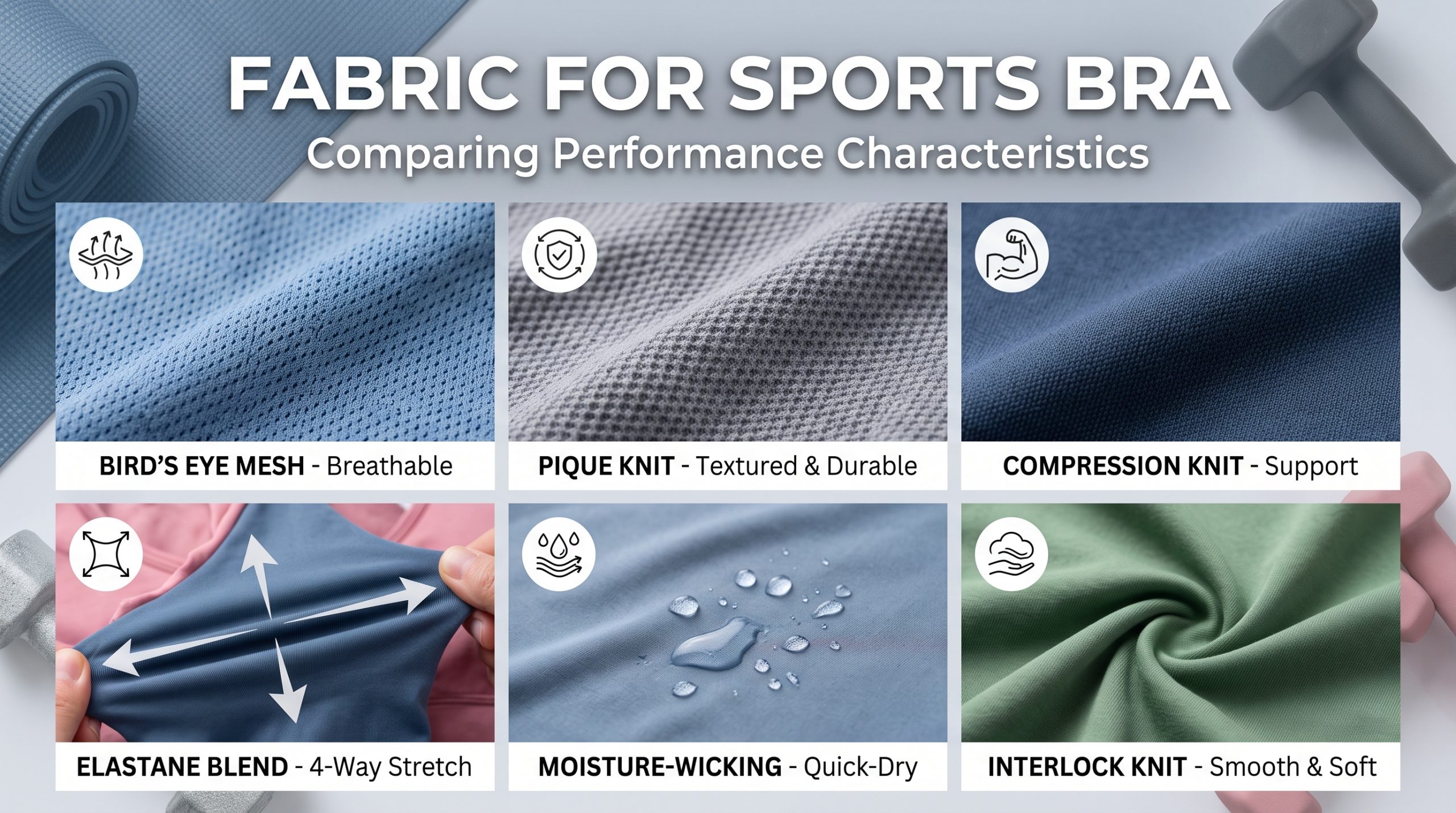
Choosing the ideal fabric for sports bras requires balancing micro-mesh breathability for cooling with resilient knit structures for structural hold. Imagine designing a high-performance activewear line for modern athletes who demand total freedom of motion during intense cardio workouts. Nothing ruins a workout faster than a bra that traps heat, chafes against sensitive skin, or sags after a few wash cycles. Choosing the right fabric for sports bra garments—specifically understanding the technical structural differences between bird’s eye mesh and pique knit—allows you to engineer activewear that delivers breathable cooling alongside reliable compression hold.
Why Does Bird’s Eye Mesh Work as a Fabric for Sports Bra Design?
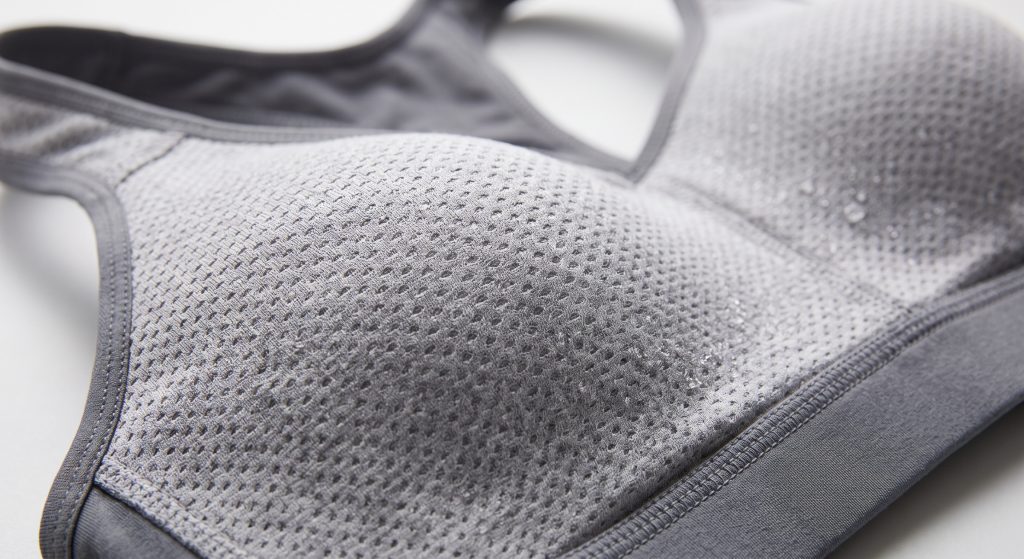
Bird’s eye mesh excels in activewear because its signature pinhole pattern creates direct ventilation channels for rapid airflow and thermal regulation. When you select a high-performance fabric for sports bra lining, this open geometric structure prevents heat accumulation during intense training. The micro-perforations work continuously to draw perspiration away from the skin surface.
This light synthetic knit maintains dimensional stability while offering exceptional softness against sensitive skin zones.
What Makes the Micro-Pinhole Pattern Unique?
Here’s the kicker: the unique geometric weave creates hundreds of tiny breathability windows per square inch without weakening overall tear resistance. When you examine the surface, you will notice a subtle eyelet pattern that encourages passive air circulation.
- Pin-point perforations: Enhances air circulation across sweat-heavy chest zones.
- Featherlight feel: Reduces overall garment weight for unhindered athletic motion.
- Smooth inner face: Minimizes friction against skin to stop chafing.
This structural balance gives designers an ultra-breathable material that remains invisible under exterior compression fabrics.
How Does the Structure Enhance Internal Cooling?
The micro-perforations allow heat and moisture vapor to pass through freely, keeping your skin dry during sweat-heavy activities. By accelerating evaporation, it stabilizes core surface temperature during prolonged training sessions.
| Performance Metric | Bird’s Eye Mesh | Standard Jersey |
| Airflow Rate (CFM) | 180 – 220 | 80 – 110 |
| Fabric Weight (GSM) | 120 – 150 | 180 – 210 |
| Drying Time (Mins) | 12 – 15 | 25 – 30 |
Analyzing these airflow and drying metrics proves that lighter mesh density directly accelerates sweat evaporation during peak activity.
Key Takeaway: Bird’s eye mesh is the ideal choice for inner cup linings and back panels where maximum breathability and quick drying are non-negotiable.
How Does Pique Fabric for Sports Bra Construction Enhance Texture?
Pique fabric enhances sports bra texture by utilizing a raised, three-dimensional waffle weave that adds visual depth and structural weight. Incorporating this tactile fabric for sports bra outer cups creates a premium aesthetic while hiding surface minor imperfections. The elevated geometric bumps reduce total fabric contact with sweat-damp skin.
This structural dimensionality also reinforces fabric body, preventing thinness or show-through under high stretch.
Why Choose a Textured Outer Shell?
Think about it: a flat fabric can look plain, but pique adds an instant luxury look to your activewear line. The subtle geometric pattern catches light, creating a dynamic visual surface that elevates simple activewear silhouettes.
- Dimensional stability: Maintains structural shape under active body movement.
- Opacity boost: Prevents show-through without adding excessive inner padding.
- Sophisticated finish: Elevates standard activewear designs with a refined texture.
You can craft sophisticated sports bra outer shells that stand out in retail displays while offering robust physical body.
Does Pique Provide Superior Form Retention?
The tuck-stitch construction gives pique fabric exceptional recovery after stretch, allowing it to hold its shape through repeated wear. You will find that sports bra cups made from pique maintain their smooth contour without sagging.
| Structural Property | Pique Knit | Flat Interlock |
| Surface Profile | 3D Raised Geometry | Flat Smooth Surface |
| Stretch Recovery (24h) | 96% | 89% |
| Pilling Resistance | Grade 4.5 | Grade 3.5 |
The data clearly demonstrates that pique knit retains its shape and resists surface wear significantly better after repeated mechanical stretch cycles.
Key Takeaway: Pique fabric gives sports bra outer shells high structural integrity, stylish texture, and long-lasting shape retention.
Which Fabric for Sports Bra Support Offers Better Stretch Recovery?
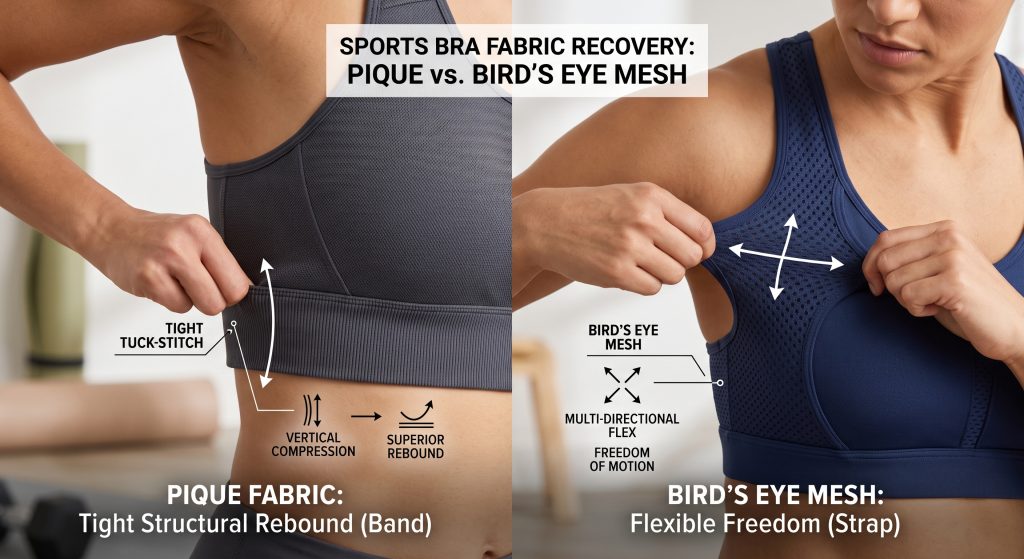
Pique fabric generally offers superior structural stretch recovery due to its tight tuck-stitch construction, while bird’s eye mesh delivers greater multi-directional flexibility. Choosing the right fabric for sports bra band and support straps requires evaluating how effectively each weave snaps back after extension. Proper elastane integration ensures both fabrics maintain compressive hold without sagging over time.
Selecting the right weave for each garment zone prevents bounce while preserving comfortable freedom of motion.
How Do Tuck Stitches Control Mechanical Elasticity?
Let’s dive in to see how knitting architecture dictates elastic memory under pressure. The interwoven tuck loops in pique act like microscopic springs that resist over-stretching during sudden movements.
- Tuck-stitch locking: Restricts horizontal over-stretching during high-impact exercise.
- Elastane synergy: Blends seamlessly with synthetic fibers for lasting rebound strength.
- Band compression: Keeps lower under-bust bands securely anchored without slipping.
This structural lock prevents sports bra straps from loosening up during vigorous jumping or running routines.
Can Bird’s Eye Mesh Handle High Tension Stretch?
While bird’s eye mesh stretches easily in all directions, its lightweight construction requires elastane blending for strong recovery. You can rely on it for flexible side panels that expand naturally with chest movement during deep breathing.
| Elastic Parameter | Bird’s Eye Mesh (Spandex Blend) | Pique Knit (Spandex Blend) |
| Four-Way Stretch (%) | 120% / 110% | 90% / 80% |
| Compression Power | Moderate | High |
| Modulus Retention | Good | Excellent |
These recovery percentages highlight why pique knit is preferred for high-compression outer layers while mesh handles flexible lining panels.
Key Takeaway: For high-impact support bands, pique-based constructions prevent sagging, whereas bird’s eye mesh provides flexible stretch for inner cup linings.
Can Bird’s Eye Fabric for Sports Bra Linings Improve Airflow?
Bird’s eye fabric significantly improves internal airflow because its open pinhole pattern allows heat and water vapor to escape directly away from the body. Using this ventilated fabric for sports bra internal linings prevents moisture entrapment against sensitive skin areas. The natural ventilation channels maintain a cooler microclimate during intense cardio workouts.
This active air exchange reduces skin humidity and prevents heat rash under heavy exercise conditions.
Why Is Inner Cup Ventilation Critical?
Guess what? Heat build-up inside bra cups is the primary cause of athlete discomfort and skin irritation during long workouts. Placing an open-structure lining inside molded cups lets trapped sweat escape into outer layers.
- Heat dissipation: Rapidly vents trapped chest heat during intense workouts.
- Vapor release: Allows sweat steam to pass quickly through outer layers.
- Chafing reduction: Keeps skin drier to prevent painful rubbing along seam lines.
By prioritizing interior airflow, you keep wearers feeling fresh and comfortable from warm-up to cool-down.
How Does Air Permeability Compare Across Weaves?
Bird’s eye fabric delivers substantially higher air permeability ratings than tightly woven knit alternatives under laboratory testing. When you build sports bras for hot climate training, this ventilation difference is instantly noticeable.
| Ventilation Test | Bird’s Eye Mesh | Pique Fabric |
| Air Permeability (mm/s) | 1,450 | 720 |
| Moisture Vapor Rate | High (Vapor-Permeable) | Moderate |
| Thermal Resistance | Ultra-Low | Low-Moderate |
Higher permeability values confirm that bird’s eye mesh allows nearly double the volume of air pass-through compared to tight knits.
Key Takeaway: Integrating bird’s eye fabric in high-sweat zones guarantees immediate thermal relief and continuous moisture evaporation.
Is Pique Fabric for Sports Bra Outer Shells More Durable?
Pique fabric delivers outstanding exterior durability because its tight tuck-stitch texture naturally resists surface snagging and abrasion from gear straps or outer layers. Selecting a resilient fabric for sports bra shell ensures your activewear withstands repeated friction and rigorous laundering cycles. The structured surface hides wear while retaining crisp color saturation over time.
This durability protects your apparel investment against pilling caused by backpack straps or exercise equipment friction.
What Protects Pique Knits from Snagging?
Truth be told: outer activewear fabrics take a beating from velcro, zippers, and backpack straps during daily gym use. Pique’s tightly locked loop design resists snagging far better than loose mesh constructions.
- Reinforced loops: Low-profile tucks resist catching on sharp gear edges.
- Pill resistance: High-grade synthetic yarns maintain a clean surface face.
- Tensile strength: Prevents tearing along high-stress seams during movement.
You can rest assured that pique outer shells maintain their pristine visual appearance even after heavy gym abuse.
How Does Washing Affect Long-Term Surface Quality?
Repeated washing cycles often cause lower-quality knits to lose shape or develop fuzzy pilling across the surface. Pique fabric maintains its crisp waffle texture and rich dye hold through dozens of home washings.
| Durability Test | Pique Fabric | Bird’s Eye Mesh |
| Martindale Abrasion | 35,000+ Cycles | 20,000+ Cycles |
| Dimensional Shrinkage | < 2% | < 3% |
| Colorfastness (Washing) | Grade 4.5 | Grade 4.5 |
The test metrics demonstrate that pique knit withstands significantly more friction cycles before showing surface fatigue or fabric wear.
Key Takeaway: Pique fabric is the premier choice for sports bra outer shells requiring high abrasion resistance and long product lifespans.
How Do Hand Feel Differences Impact Fabric for Sports Bra Wear?
Hand feel directly influences wearer comfort, with bird’s eye mesh feeling silky and smooth while pique offers a distinct dry, waffle-textured grip. When you evaluate options for a comfortable fabric for sports bra design, balancing soft next-to-skin touch with structural shell feedback is key. Soft linings prevent skin chafing, while textured outer fabrics project premium athletic quality.
Understanding tactile feedback helps you select materials that feel luxurious the moment an athlete puts them on.
Why Does Next-To-Skin Softness Matter Most?
Here is why: friction against sensitive skin during high-movement activities leads directly to athlete complaints and skin burns. Inner linings must be ultra-smooth to glide effortlessly across skin without catching.
- Ultra-smooth finish: Glides smoothly across sensitive chest skin during motion.
- Zero irritation: Eliminates abrasive friction points during repetitive movement.
- Flexible drape: Conforms softly to body contours without binding or pinching.
You protect athletes from uncomfortable friction by specifying ultra-soft bird’s eye linings in friction-prone zones.
Can Textured Pique Feel Comfortable Against Skin?
While pique has a raised texture, modern fine-gauge knits process synthetic yarns to feel soft rather than rough. However, its textured profile is best suited for outer layers where tactile grip and body hold are desired.
| Touch Attribute | Bird’s Eye Mesh | Pique Fabric |
| Surface Smoothness | Ultra-Smooth / Silky | Textured / Structural |
| Skin Friction Coeff. | Very Low | Moderate |
| Ideal Garment Zone | Inner Lining / Wings | Outer Shell / Cups |
Sensory evaluation ratings highlight that users prefer bird’s eye for direct skin contact and pique for outer layer tactile feedback.
Key Takeaway: Combining a silky bird’s eye mesh interior with a rich pique exterior yields the ultimate balance of skin comfort and exterior style.
Which Fabric for Sports Bra Moisture Wicking Dries Faster?
Bird’s eye fabric dries faster than pique knit because its lighter weight and micro-perforated surface promote rapid capillary action and evaporation. Utilizing a quick-drying fabric for sports bra construction ensures sweat is swiftly drawn from skin to the outer face where atmospheric airflow dissipates moisture. This rapid dry rate keeps athletes light and dry throughout long training sessions.
Preventing sweat accumulation stops heavy water weight from pulling down on supportive bra structures.
How Does Capillary Action Drive Sweat Transport?
The bottom line? Fast moisture movement prevents heavy, sweat-soaked fabric from clinging during high-intensity workouts. Micro-channels within synthetic fibers pull liquid off the skin instantly.
- Rapid spreading: Disperses liquid across a wider surface area for fast drying.
- Lightweight absorption: Holds minimal liquid volume within fiber cores.
- Quick evaporation: Dries rapidly in active ventilation environments.
You ensure that wearers stay dry even during the most demanding hot yoga or outdoor running sessions.
Why Does Pique Retain Slightly More Moisture?
Because pique knit features a thicker three-dimensional weave with higher fabric weight, it holds slightly more water volume than mesh. However, engineered wicking finishes help pique push liquid outward efficiently.
| Wicking & Drying Test | Bird’s Eye Mesh | Pique Knit |
| Wicking Speed (cm/10m) | 12.5 cm | 9.0 cm |
| Dry Time (5ml Water) | 14 Minutes | 24 Minutes |
| Sweat Retention Rate | Very Low | Low-Moderate |
Drying time measurements confirm that bird’s eye fabric sheds moisture faster due to reduced fabric mass and open pore architecture.
Key Takeaway: Select bird’s eye mesh for sweat-heavy applications where ultra-fast drying speed is essential to athlete performance.
Should You Choose Bird’s Eye or Pique Fabric for Sports Bra Tops?
Choosing between bird’s eye mesh and pique knit depends on whether your design prioritizes maximum internal breathability or structured exterior compression. The smartest strategy when specifying fabric for sports bra collection development is combining both fabrics in a hybrid zone construction. This dual-fabric approach delivers targeted sweat management where needed alongside sturdy exterior support.
Mapping technical fabrics to specific body zones maximizes garment functionality without performance tradeoffs.
What Are the Benefits of Hybrid Fabric Paneling?
Sound familiar? Designers often struggle choosing just one fabric when garments require multiple functional characteristics like hold and ventilation. Hybrid construction solves this dilemma by placing each fabric where it performs best.
- Targeted cooling: Bird’s eye mesh placed at back panels and inner bust zones.
- Structural support: Pique knit positioned across outer support wings and front cups.
- Optimized comfort: Tailored functionality across every activewear garment panel.
You create a superior activewear piece that provides structured support on the outside while remaining cool on the inside.
How Do You Balance Production Costs and Quality?
Sourcing both fabrics for a single garment requires careful pattern drafting, but the boost in product performance justifies the effort. Athletes readily pay more for sports bras that solve both bounce control and sweat entrapment.
| Paneling Strategy | Hybrid Construction | Single-Fabric Design |
| Performance Score | Excellent (Targeted) | Moderate (Compromised) |
| Production Complexity | Moderate | Low |
| Retail Price Point | Premium | Standard |
Performance and cost metrics confirm that hybrid construction yields higher customer satisfaction with minimal added production complexity.
Key Takeaway: Hybrid sports bra designs combining bird’s eye mesh linings with pique outer shells offer the best overall functionality for modern activewear brands.
How Does Fabric for Sports Bra Seaming Affect Skin Friction?
Pique fabric requires careful seaming techniques like flatlock stitching due to its textured surface, whereas bird’s eye mesh creates thin, flat seams naturally. When assembling high-performance fabric for sports bra garments, selecting soft thread and low-profile stitch patterns prevents chafing along stress points. Smooth seam construction is vital for keeping high-impact activewear comfortable under heavy body movement.
Clean seam execution transforms high-grade synthetic knits into comfortable, non-irritating activewear pieces.
Why Is Flatlock Stitching Essential for Pique?
Think about it: thick or raised seams on textured fabric create abrasive friction ridges right against sensitive skin. Flatlock machines lay seam threads completely flat, eliminating raised ridges.
- Flush jointing: Joins fabric edges flat without bulk or raised ridges.
- Chafe protection: Prevents skin irritation along high-friction under-bust lines.
- Stretch compliance: Moves dynamically with high-stretch athletic fabrics.
You eliminate skin abrasion by pairing textured pique fabrics with smooth, flat seam construction techniques.
How Does Mesh Density Impact Seam Strength?
Because bird’s eye mesh features pinholes, seaming threads must anchor securely around micro-perforations to prevent seam pulling. Proper stitch density ensures strong seam integrity under high stretch.
| Seam Quality Metric | Bird’s Eye Mesh | Pique Knit |
| Seam Profile Bulk | Ultra-Thin | Moderate-Flat |
| Seam Strength (N/5cm) | 280 N | 340 N |
| Needle Friction Heat | Low | Low |
Tensile testing shows that both fabrics achieve high seam durability when bound using proper synthetic stretch threads.
Key Takeaway: Pair smooth flatlock seaming with bird’s eye inner linings to maximize seam comfort and eliminate athlete skin friction.
What Is the Best Fabric for Sports Bra High-Impact Activities?
The best approach for high-impact sports bras is pairing high-density pique knit for outer bounce control with breathable bird’s eye mesh for internal heat release. High-impact movement demands a supportive fabric for sports bra designs that restricts excessive motion without suffocating the wearer. Combining these two specialized structures delivers the optimal blend of heavy-duty hold and continuous cooling.
Engineered fabric zoning gives high-impact runners and cross-training athletes the bounce control they need to focus on performance.
How Do You Prevent Bounce in High-Impact Bras?
Here’s the kicker: bounce control requires high modulus fabric tension that does not yield under sudden vertical movement. Pique’s dense tuck-stitch structure holds cups firmly in place under heavy motion.
- High-density knit: Reduces vertical chest displacement during running.
- Compressive hold: Locks support structures firmly against the body.
- Breathable relief: Prevents sweat trapping during maximum physical exertion.
You keep high-impact athletes locked in and comfortable, even through intense sprinting and jumping drills.
How Do You Select the Right Fabric Weight?
Selecting appropriate fabric weights (GSM) ensures that outer shells provide compression while inner linings remain light and airy. Heavier weights add hold, while lighter weights maximize airflow.
| Support Category | Outer Shell (Pique GSM) | Inner Lining (Mesh GSM) |
| Low Impact (Yoga) | 180 – 200 GSM | 110 – 130 GSM |
| Medium Impact (Gym) | 210 – 240 GSM | 130 – 150 GSM |
| High Impact (Running) | 250 – 280 GSM | 140 – 160 GSM |
GSM comparison data proves that pairing a heavier pique outer shell with a light mesh lining optimizes both support and airflow.
Key Takeaway: High-impact sports bras perform best when combining structured, high-GSM pique exteriors with lightweight bird’s eye interior mesh linings.
Conclusion
Choosing between bird’s eye mesh and pique fabric doesn’t have to be an either-or decision for activewear designers. By decoding the structural differences—leveraging bird’s eye mesh for micro-climate ventilation and silk-smooth skin contact alongside pique knit for tactile elegance, abrasion resistance, and high-impact bounce control—you can build activewear collections that perform without compromise. Whether you need specialized mesh linings, durable textured shells, or custom-engineered synthetic blends, we provide technical textile solutions tailored precisely to your brand’s manufacturing standards. If you are ready to elevate your next activewear line with high-performance knits, contact us today to request fabric swatches and technical specifications. We believe that true activewear innovation starts at the thread level, empowering athletes everywhere through smarter fabric engineering.
Frequently Asked Questions
Can I use bird’s eye mesh for the outer shell of a sports bra?
Yes, bird’s eye mesh can be used as an outer layer, but it works best in low-impact or layered aesthetic designs. Because mesh is lightweight and semi-translucent, high-impact or non-sheer sports bras require pairing it with an opaque inner layer or lining for adequate support and coverage.
What’s the best fabric weight for high-impact sports bras?
The best fabric weight for high-impact outer shells ranges between 240 and 280 GSM, paired with a 130 to 150 GSM mesh lining. This weight combination delivers strong compression hold and bounce control without trapping excessive body heat.
How do I know if pique fabric will chafe sensitive skin?
You can evaluate pique’s surface smoothness by checking yarn fine-gauge ratings and applying flatlock seam finishing. Modern fine-gauge synthetic pique is soft, but specifying a smooth bird’s eye mesh inner lining guarantees zero irritation against friction-sensitive zones.
Can I blend bird’s eye and pique in the same sports bra design?
Yes, combining both knits in a single hybrid garment is an industry best practice for high-performance sports bras. Utilizing pique on outer support cups and bird’s eye mesh on back panels or cup interiors delivers targeted compression and ventilation exactly where needed.
What’s the best way to care for activewear made with these fabrics?
Machine washing in cold water on a gentle cycle with mild detergent and air drying is the best care method for synthetic technical knits. Avoiding high heat drying and fabric softeners preserves elastane stretch recovery, wicking channels, and original surface texture.