
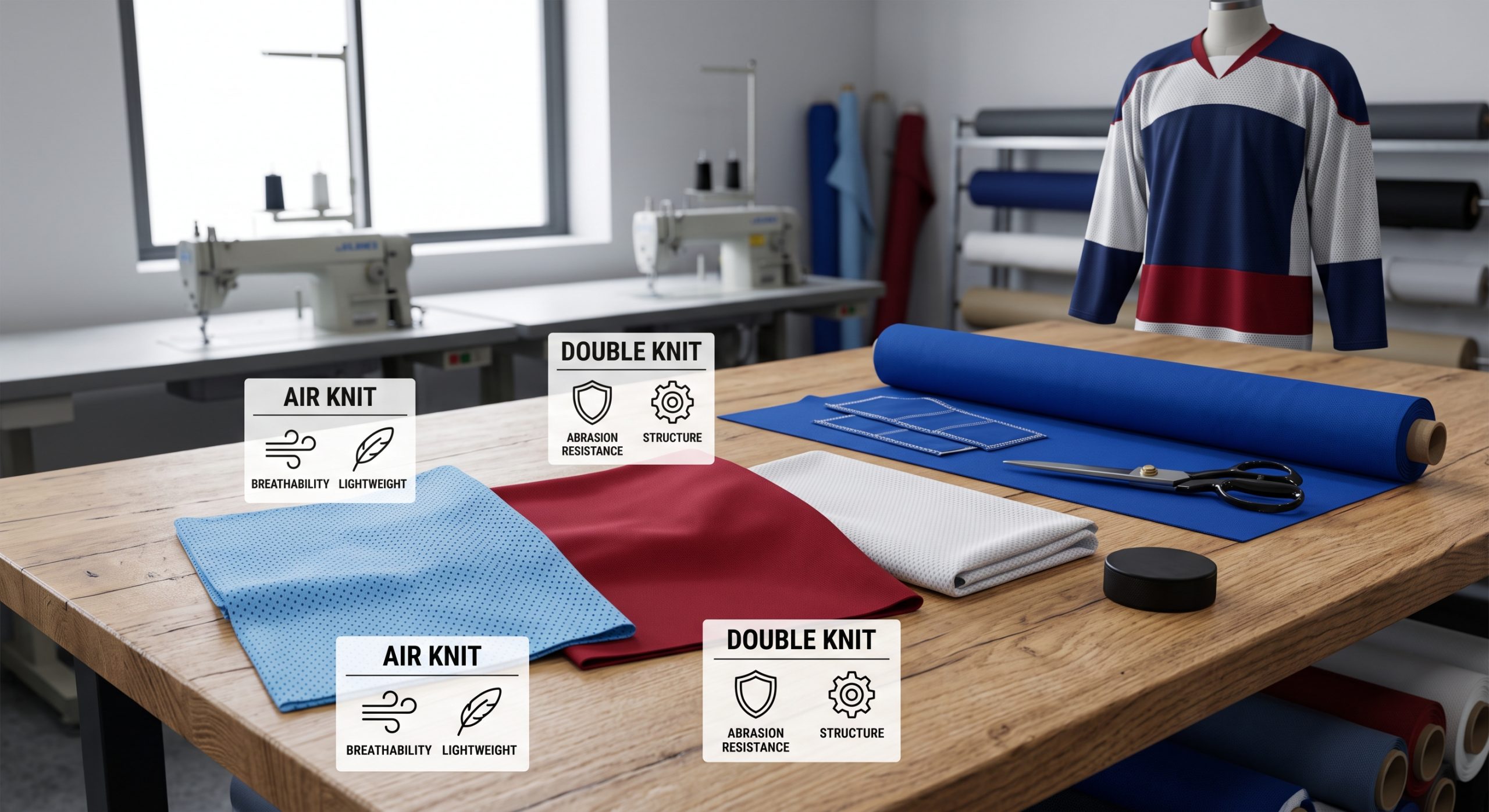
Hockey jerseys are primarily made of heavy-duty synthetic polyester knits, engineered specifically for high tear strength, moisture regulation, and abrasion resistance. High school athletic directors regularly handle torn sleeves and soaked team gear during demanding winter leagues. Thin materials shred quickly when rubbed against board pads and heavy shoulder armor, draining athletic budgets and frustrating players. Sourcing high-grade hockey fabric solves these persistent apparel problems by providing field-tested durability and superior ventilation on the ice.
What Defines High Performance Custom hockey fabric?
High performance custom hockey fabric is defined by high tensile strength, open-cell ventilation, and snag resistance against protective ice gear friction. Selecting premium hockey fabric guarantees that custom apparel withstands aggressive contact without tearing or stretching out of shape. Here’s the deal: synthetic fibers knitted into specialized patterns alter garment performance on the ice dramatically.
Competitive players require athletic textiles that resist abrasion during heavy board collisions. Choosing between distinct knit structures dictates how long team apparel remains functional across long seasons.
What makes air knit structure effective?
Air knit features micro-perforations woven directly into strong polyester yarns. These open channels permit continuous airflow while maintaining structural integrity during play.
- Open surface channels assist fast heat release.
- Soft inner texture prevents chafing against padded gear.
- Flexible yarn construction reduces overall garment weight.
How does bird-eye structure differ from pique?
Bird-eye patterns feature tiny circular perforations that optimize surface evaporation. Think about it: heavy contact sports demand materials that resist snagging on equipment straps.
- Perforated bird-eye channels speed up moisture evaporation.
- Raised pique structures add surface density against friction.
- Both knits handle frequent commercial laundering well.
Key Takeaway: Selecting bird-eye mesh offers rapid cooling during intense shifts, while dense pique knit provides robust wear resistance for high-contact positions.
| Structural Feature | Bird-Eye Knit | Pique Knit |
| Surface Pattern | Circular Micro-Pores | Raised Geometric Weave |
| Ventilation Level | High Airflow | Moderate Airflow |
| Primary Advantage | Rapid Evaporation | Friction Resistance |
This structural comparison shows how distinct knit choices influence garment breathability and longevity during ice matches.
How Does Air Knit Compare to Double Knit hockey fabric?
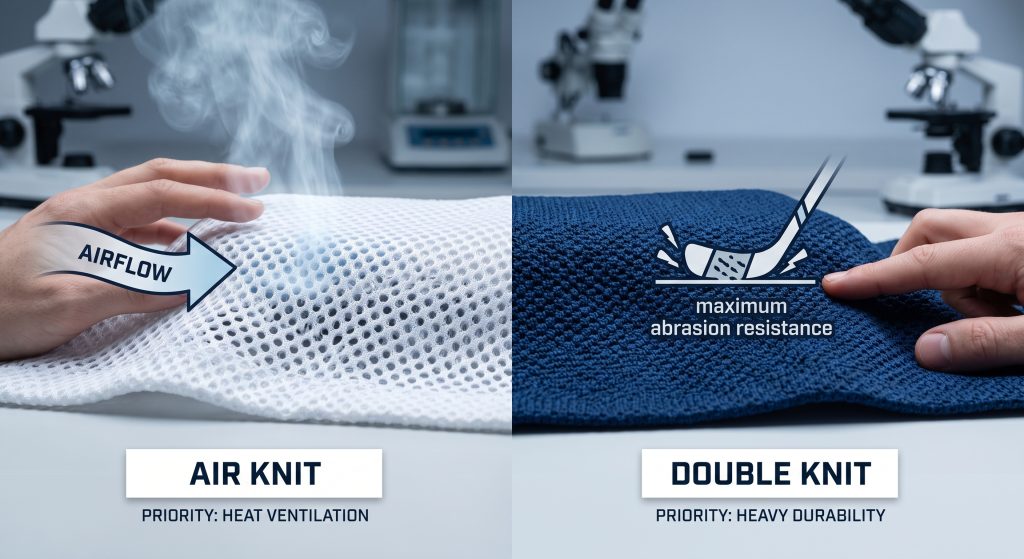
Air knit provides superior airflow for lightweight game jerseys while double knit offers maximum abrasion resistance for shoulder pads and elbows. Choosing the right hockey fabric depends on whether your team priority centers on heat ventilation or heavy durability. What’s the real story? Temperature regulation directly impacts athlete endurance during long third periods.
Airflow dynamics depend on how individual synthetic threads interlock within the textile structure. Open-cell designs facilitate quick thermal release across skin surfaces.
Why select air knit for torso panels?
Perforated channels in air knit material create direct passages for trapped body heat. Continuous cross ventilation cools active muscle zones without adding excess material weight.
- Open knit patterns guide airflow inward efficiently.
- Sweat evaporates quickly from synthetic fiber surfaces.
Can double knit resist board friction?
Double knit utilizes two interconnected yarn layers to construct a dense protective shield. You might be wondering: can heavy cloth survive rough board battles? Thick polyester layers absorb friction easily without tearing.
- Dual fabric layers resist rough equipment chafing.
- Dense construction maintains garment shape over years.
Key Takeaway: Air knit remains ideal for main jersey torsos, whereas double knit excels on heavy wear zones like sleeves and shoulders.
| Performance Metric | Air Knit Fabric | Double Knit Fabric |
| Fabric Weight | 150 – 180 GSM | 220 – 260 GSM |
| Air Permeability | Excellent | Moderate |
| Abrasion Rating | Standard | Heavy Duty |
This performance evaluation proves that combining different knits creates balanced jerseys suited for dynamic physical play.
Why Is Durability Critical When Buying hockey fabric?
Durability is critical because ice sports involve constant gear friction, board impacts, and sharp equipment contact. Investing in resilient hockey fabric prevents early sleeve fraying and seam splits during competitive league schedules. Look at it this way: fragile fabrics require constant replacement, increasing team apparel budgets significantly over time.
Selecting strong synthetic blends guarantees that jerseys retain structural integrity through physical shifts and frequent washing.
What causes early sleeve fraying?
Repetitive rubbing between jersey sleeves and outer board glass creates intense surface friction. Short synthetic fibers breakdown under this stress, causing visible pilling and thread tears.
- Equipment velcro hooks catch weak fabric threads.
- Rough arena boards abrade exterior sleeve surfaces.
How do synthetic blends prevent tears?
Continuous filament polyester yarns provide high tensile strength that resists pulling force. Here is the secret: interlocked knitting techniques stop small snags from spreading across entire panels.
- Continuous filament yarns resist fiber separation.
- High tenacity knits prevent tear expansion under load.
Key Takeaway: Utilizing high-tenacity synthetic yarns protects custom gear against heavy physical abrasion, extending uniform service life.
| Material Grade | Tensile Strength | Surface Pilling | Expected Lifespan |
| Standard Polyester | Moderate | High Risk | 1 Season |
| Filament Air Knit | High | Low Risk | 2-3 Seasons |
| Heavy Double Knit | Superior | Minimal Risk | 3-4 Seasons |
This durability guide highlights how yarn specification correlates directly with multi-season uniform endurance.
How Does Technical hockey fabric Manage Moisture?
Technical hockey fabric manages moisture through hydrophobic capillary channels that pull sweat away from skin to the outer surface. Specifying moisture-wicking hockey fabric stops damp apparel from clinging to player equipment during fast shifts. Believe it or not: wet garments increase fatigue and cause body chilling during bench breaks.
Engineered synthetic yarns convert liquid perspiration into broad surface moisture that evaporates rapidly in cold arena air.
How does capillary action keep players dry?
Microscopic channels within engineered polyester fibers draw liquid upward away from skin. Moisture spreads across a wider exterior surface area, speeding up drying times.
- Hydrophobic fibers refuse to absorb liquid moisture.
- Micro-channels guide sweat to outer fabric layers.
Why does rapid drying matter in cold rinks?
Damp apparel cools rapidly in chilly arena air, causing muscle stiffness during bench downtime. That is not all: fast-drying textiles keep core body temperatures stable throughout entire games.
- Accelerated evaporation prevents sudden post-shift chilling.
- Dry apparel stays lightweight throughout competitive play.
Key Takeaway: Advanced wicking channels protect athletes against discomfort and sudden body cooling in cold indoor arenas.
| Moisture Variable | Standard Knits | Technical Wicking Knits |
| Drying Speed | Slow | Rapid Evaporation |
| Liquid Retention | High Absorption | Surface Dispersal Only |
| Player Comfort | Clingy When Wet | Lightweight & Dry |
This moisture management table demonstrates how capillary engineering keeps players comfortable across demanding games.
Which Stretch Properties Excel in Modern hockey fabric?
Four-way stretch elastane blends excel by providing full range of motion for shooting, passing, and skating strides. Integrating flexible hockey fabric into shoulder and arm panels prevents restriction when players reach for pucks. Here’s the bottom line: restricted movement slows down reaction speeds on the ice.
Yarn elasticity combined with flexible knit geometry guarantees that garments return to original shape after intense mechanical pulling.
Why is mechanical stretch necessary?
Full shooting motions demand broad extension across shoulder and back garment panels. Fabrics without elastane pull tight against shoulder pads, limiting arm extension.
- Flexible shoulder panels enable full shooting range.
- Elastic side inserts adjust smoothly to body movement.
Does elastane retain shape after washing?
High-quality spandex filaments maintain elastic memory through repeated tension and laundering cycles. Ready for the good part? Premium stretch blends resist permanent sagging or bagginess.
- Quick shape recovery after heavy mechanical stretching.
- Durable elastic memory prevents sleeve distortion.
Key Takeaway: Strategic elastane integration delivers full athletic freedom while maintaining a crisp, tailored team appearance.
| Stretch Category | Movement Range | Structural Recovery | Ideal Application |
| Mechanical Stretch | Moderate | Good | Torso Main Panels |
| 2-Way Elastane | High | Superior | Sleeve Underarm Inserts |
| 4-Way Elastane | Maximum | Exceptional | Shoulder Flex Zones |
This elasticity analysis shows how targeted stretch zones enhance mobility without compromising overall jersey structure.
How Do Athletic Directors Source hockey fabric Smartly?
Athletic directors source smartly by buying bulk synthetic rolls directly from manufacturers to reduce per-unit uniform expenses. Securing commercial-grade hockey fabric allows equipment managers to build multi-season team inventories efficiently. Make no mistake: low-grade cheap materials cost significantly more due to frequent replacements.
Analyzing long-term fabric durability guarantees high school athletic programs maximize annual budget allocations effectively.
How do bulk purchases lower team costs?
Buying raw textile rolls reduces intermediary markups and enables custom garment tailoring for multiple school teams.
- Bulk procurement yields lower costs per yard.
- Consistent inventory allows quick jersey replacements.
What metrics verify fabric quality?
Checking burst strength, color fastness, and weight specs prevents purchasing sub-standard textiles. This is where it gets interesting: verification protects your program against premature fading and tears.
- High burst ratings indicate strong seam resistance.
- Certified dye processes prevent color fading in wash cycles.
Key Takeaway: Direct manufacturer sourcing lowers procurement costs while securing consistent material quality for entire school athletic departments.
| Sourcing Strategy | Upfront Cost | Replacement Need | Multi-Year Value |
| Ready-Made Generic | Low | Annual Replacement | Low Value |
| Direct Fabric Buying | Moderate | 3-4 Year Service | Maximum Value |
This purchasing comparison proves that direct textile procurement delivers superior financial return for school sports budgets.
How Should You Wash and Maintain Custom hockey fabric?
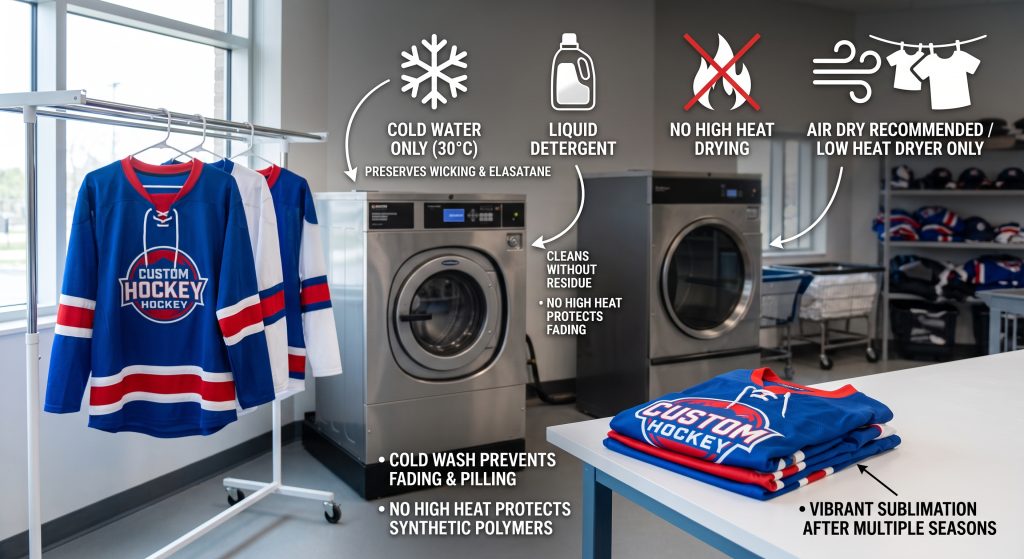
You should wash custom hockey fabric using cold water and liquid detergent while avoiding fabric softeners and high dryer heat. Following precise laundering rules for hockey fabric preserves moisture-wicking treatments and prevents elastane fiber breakdown. Here is why: excessive drying heat breaks down synthetic polymers rapidly.
Proper maintenance prevents surface pilling and keeps sublimated team colors vibrant across multiple competitive seasons.
Why do softeners damage technical knits?
Chemical softeners deposit a waxy coating across synthetic fibers, clogging open air channels completely.
- Softener residues block moisture-wicking channels.
- Waxy films trap bacteria and sweat odors inside knits.
What washing temperature protects colors?
Cold water cycles protect synthetic dyes and prevent color bleeding across contrasting team panels. Keep this in mind: cold water cleaning saves energy while preserving fiber strength.
- Cold wash cycles prevent sublimation dye bleeding.
- Gentle wash actions reduce exterior friction pilling.
Key Takeaway: Strictly adhering to cold washing and line drying protocols doubles uniform service life and preserves functional treatments.
| Laundry Parameter | Recommended Setting | Harmful Setting |
| Wash Temperature | Cold Water (30°C) | Hot Water Wash |
| Detergent Selection | Mild Liquid Detergent | Fabric Softener / Bleach |
| Drying Process | Open Air Drying | High Heat Machine Dryer |
This laundering guide outlines simple washing routines that protect technical synthetic garments from early wear.
Why Choose Specific Weights of Technical hockey fabric?
Specific weights ensure you achieve light agility for practice jerseys and heavy padding protection for match uniforms. Matching correct GSM ratings in hockey fabric balances speed with physical defense across all positions. Check this out: positional requirements demand different fabric densities.
Adjusting weight specifications across uniform builds improves player comfort while reinforcing high impact areas.
Which GSM range suits practice gear?
Lightweight fabrics between 140 GSM and 170 GSM offer maximum ventilation for intense practice sessions.
- Lighter weights increase air permeability during drills.
- Lower fabric weight minimizes physical player fatigue.
Why do match jerseys require heavier GSM?
Official game play demands dense 220 GSM to 260 GSM fabrics to endure physical checking and board contact. Now consider this: thick knits shield skin against abrasion during falls.
- Heavy fabrics resist sharp equipment friction.
- Dense construction holds heavy printed numbers securely.
Key Takeaway: Deploying light fabrics for practice and heavy knits for match games optimizes athlete performance and gear survival.
| Application Type | Target Weight | Primary Function |
| Practice Vests | 140 – 160 GSM | Air Permeability |
| Torso Main Body | 170 – 200 GSM | Balanced Comfort |
| Sleeves & Shoulders | 220 – 260 GSM | Impact & Tear Defense |
This weight distribution chart clarifies how fabric density corresponds to specific protective requirements on the ice.
How Does Rink Temperature Impact hockey fabric Selection?
Cold rink environments require breathable double knits that retain slight body heat while venting excess perspiration outward. Selecting climate-adjusted hockey fabric prevents players from chilling during bench breaks between intensive shifts on the ice. Plain and simple: fluctuating body temperatures reduce athletic efficiency.
Proper material selection balances wind protection with heat release, keeping core body temperature steady during games.
How do knit gaps control thermal loss?
Textured synthetic knits trap small layers of warm air near skin without stopping vapor dissipation.
- Structured air pockets insulate against chilly arena drafts.
- Micro-channels release excessive steam during sprints.
Can mesh panels cause thermal discomfort?
Overly open mesh panels admit excessive cold draft air during bench rests, chilling active muscles quickly. Here is the truth: reserve thin mesh for armpit ventilation zones.
- Excessive open mesh permits uncomfortable cold drafts.
- Strategic ventilation placement keeps core torso warm.
Key Takeaway: Combining insulating double knits with targeted underarm mesh panels preserves optimal muscle warmth in chilly arenas.
| Environmental Factor | Ideal Fabric Structure | Thermal Effect |
| Chilly Indoor Arenas | Textured Double Knit | Retains Mild Core Warmth |
| High Intensity Shifts | Wicking Air Knit | Disperses Sweat Rapidly |
| Bench Rest Intervals | Wind-Resistant Weave | Blocks Cold Arena Drafts |
This environmental guide demonstrates how ambient arena temperatures influence proper synthetic textile selection.
Which Combination of hockey fabric Works Best for Teams?
Combining air knit main body panels with double knit shoulder reinforcements creates the best hybrid jersey for teams. Ordering engineered hockey fabric allows apparel makers to craft durable hybrid uniforms for whole rosters. The best part? Hybrid designs satisfy cooling and wear resistance needs simultaneously.
Placing specialized fabrics in high-stress jersey zones delivers tailored performance for every athlete on your roster.
Why choose hybrid panel construction?
Hybrid construction positions lightweight mesh where body heat builds up and heavy double knits where equipment causes friction.
- Torso panels maximize heat dissipation during play.
- Sleeves and shoulders resist gear chafing and board tears.
How does color matching stay consistent?
Procuring all fabric types from a single specialized manufacturer guarantees precise color matching across distinct weaves. Here is what matters: uniform dyes ensure professional visual unity for your team.
- Identical dye lots across different knit patterns.
- Professional visual appearance across all squad tiers.
Key Takeaway: Adopting hybrid garment construction yields superior durability, ventilation, and unified brand aesthetics for athletic teams.
| Jersey Zone | Recommended Fabric | Functional Benefit |
| Main Chest / Back | Air Knit (180 GSM) | Maximum Sweat Evaporation |
| Shoulder / Sleeves | Heavy Double Knit (240 GSM) | Equipment Friction Defense |
| Underarm Inserts | Flex Mesh (150 GSM) | Targeted Heat Release |
This hybrid allocation plan shows how combining specialized knits produces high performance team apparel.
Equipping custom sports programs requires selecting technical textiles that balance physical durability, ventilation, and moisture control. Combining breathable air knit torsos with reinforced double knit sleeves solves common gear tearing and player overheating issues effectively. Partnering with a dedicated manufacturer ensures your teams receive consistent dye matching, high tensile strength, and multi-season performance. Feel free to contact us today to request fabric swatches and explore tailored textile solutions for your team.
FAQ
Q1: Can I use air knit fabric for heavy sleeve panels?
No, standard air knit lacks the heavy density required for high-friction sleeve zones. Open perforations tend to catch on board edges, leading to surface snags during physical play.
Q2: What’s the best fabric weight for official match hockey jerseys?
A 220 GSM to 250 GSM synthetic double knit delivers the best balance of tear strength and comfort. This weight range withstands gear friction without weighing players down on the ice.
Q3: How do I know if double knit is better for my team?
Choose double knit if your primary focus is garment durability and board abrasion resistance. Heavy double knit excels in physical contact leagues and cold playing environments.
Q4: Can I mix different fabric weights within one jersey design?
Yes, hybrid uniform construction is the industry standard for professional and collegiate hockey gear. Combining air knit torsos with double knit shoulders optimizes performance across all positions.
Q5: What’s the best way to prevent color bleeding on custom jerseys?
Wash team apparel in cold water with mild liquid detergent and air dry completely. Avoiding hot water and machine heat preserves synthetic dyes and protects sublimated graphics for years.