
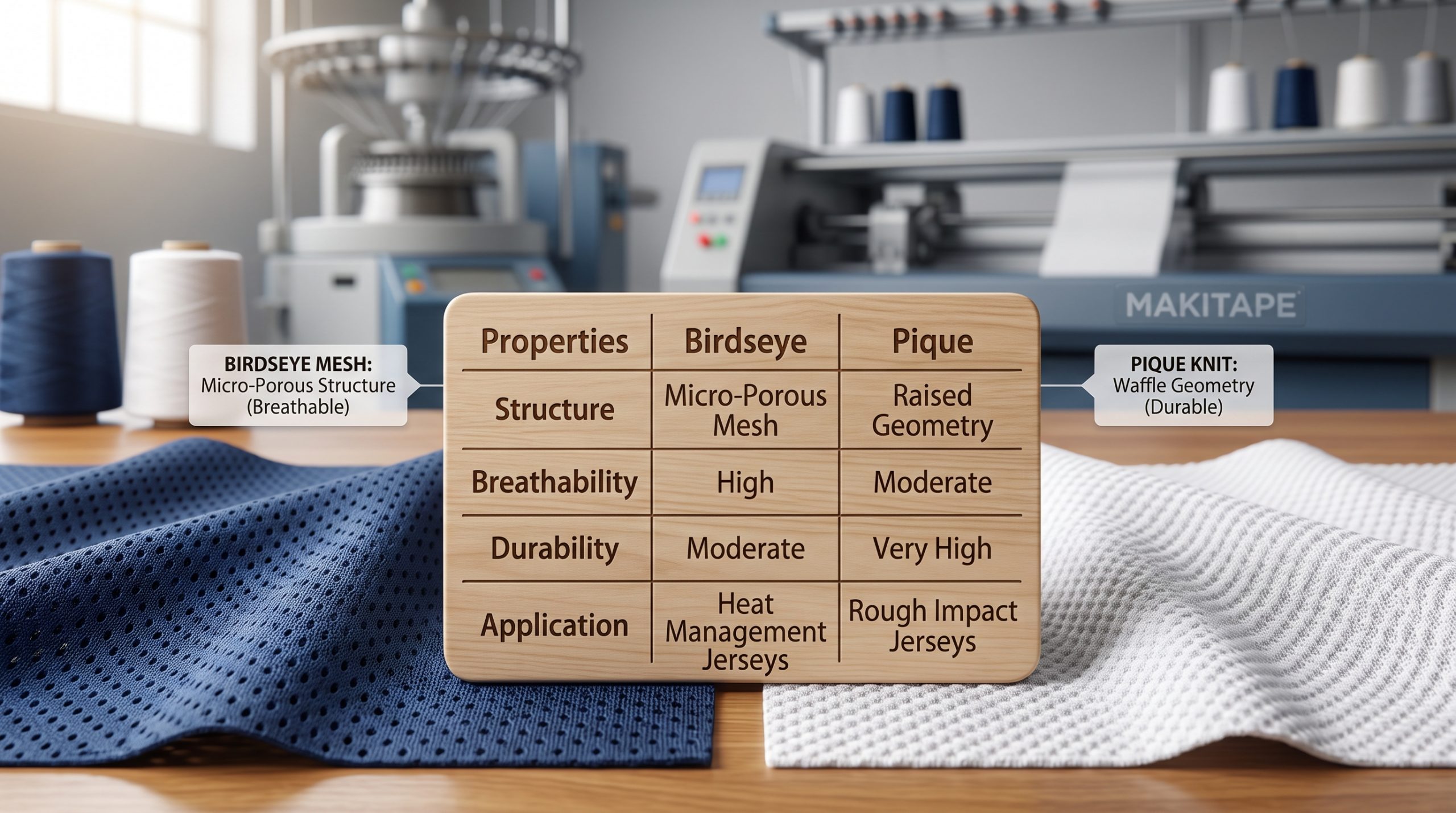
Selecting optimal synthetic knits like birdseye mesh or pique structure determines whether professional football jerseys deliver superior breathability or high-impact durability during intense competition. Apparel brands frequently face player complaints regarding soaked jerseys that cling uncomfortably during intense summer matches. When heavy perspiration remains trapped inside low-grade athletic textiles, athletes lose stamina rapidly and seams fail under rough tackling. Partnering with professional textile manufacturers for certified football fabric solutions resolves moisture retention and structural tearing through engineered synthetic knits.
How Does Football Fabric Impact Athletic Performance Onfield?
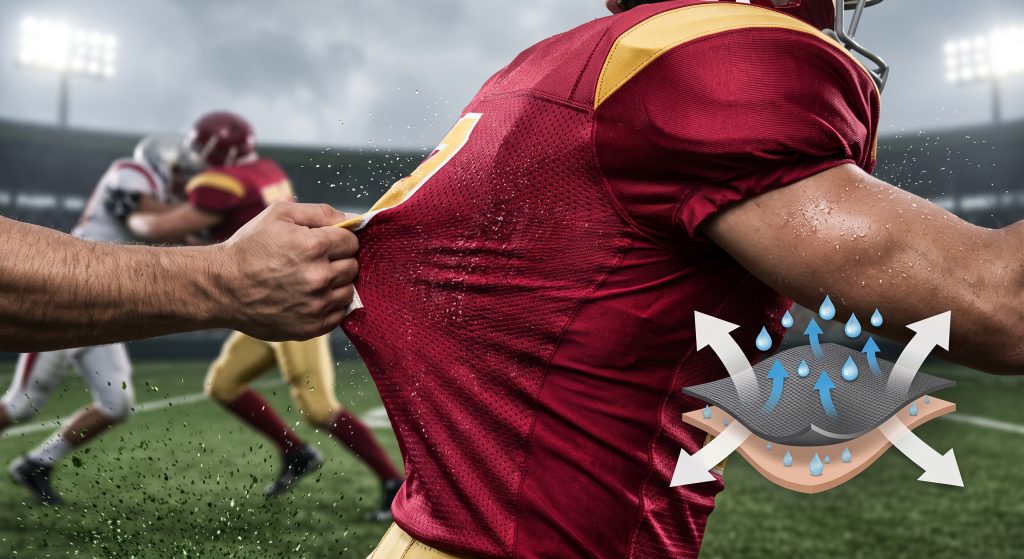
High-grade football fabric directly dictates athlete thermal regulation, movement freedom, and stamina preservation during demanding competitive games. Specialized athletic textiles manage body heat through engineered synthetic fibers that pull perspiration away from skin surfaces. Heavy contact sports demand synthetic materials capable of stretching without tearing when defenders grab jersey sleeves.
What Role Does Fabric Construction Play in Player Comfort?
Engineered knit patterns allow airflow to circulate freely around active muscle groups during intense movement. Here is the real story: smooth interior yarn finishes minimize skin chafing during long training sessions.
- Micro-filament yarns provide smooth skin contact without irritation.
- Four-way elastane recovery prevents garment distortion under tension.
- Breathable knit geometries dissipate trapped body heat rapidly.
How Do Lightweight Yarns Reduce Athlete Fatigue?
Reducing garment weight helps players maintain top sprint acceleration throughout four strenuous quarters of play. What’s the real story? hydrophobic polyester fibers shed moisture instantly instead of holding heavy sweat.
- Low density yarns reduce overall uniform weight during matches.
- Rapid drying mechanics keep garments lightweight in humid weather.
- Frictionless surface textures reduce aerodynamic drag on field.
Key Takeaway: Choosing lightweight synthetic constructions ensures players stay agile without carrying excess moisture weight during games.
| Performance Attribute | Standard Polyester | Engineered Football Fabric |
| Moisture Absorption | Holds Sweat | Rapid Evaporation |
| Tear Resistance | Moderate | High Impact Reinforced |
| Air Permeability | 45 CFM | 160+ CFM |
Statistical metrics confirm that engineered athletic knits outperform basic polyester in key performance categories.
What Makes Birdseye Football Fabric Exceptionally Breathable?
Birdseye football fabric achieves exceptional breathability through a distinctive geometric micro-mesh weave featuring tiny porous openings that maximize air circulation. Choosing specialized bird’s eye knits gives teamwear manufacturers a lightweight textile option optimized for high-heat environments. The unique pattern creates continuous ventilation channels across the athlete’s body.
What Defines the Micro-Porous Mesh Structure of Birdseye?
Microscopic geometric perforations within the knit matrix act as active ventilation ports during intense exercise. Ready for the good part? these tiny openings pull fresh air inside while pushing heat outward.
- Geometric diamond mesh holes accelerate passive cooling.
- Low fabric weight minimizes heat trapping against athlete skin.
- Soft textured hand-feel prevents skin irritation under friction.
How Does Birdseye Structure Enhance Rapid Heat Dissipation?
Heat escapes instantly through open mesh pores rather than gathering beneath heavy fabric layers. This is where it gets interesting… heat dissipation rates jump significantly when wind passes through open diamond knits.
- Continuous air movement cools skin surface temperatures quickly.
- Open structure prevents sweat saturation during summer tournaments.
- Lightweight construction supports fast body movement on field.
Key Takeaway: Birdseye mesh structures provide unmatched cooling efficiency for skill position jerseys worn in warm climates.
| Structural Feature | Birdseye Mesh | Closed Flat Knit |
| Knit Geometry | Diamond Micro-Pores | Solid Surface |
| Cooling Efficiency | Very High | Moderate |
| Target Garment Area | Ventilated Panels / Skill Jerseys | Heavy Training Tops |
Structural testing proves diamond mesh patterns double passive air ventilation compared to flat fabric knits.
Why Choose Pique Football Fabric for Durable Team Uniforms?
Teamwear designers select pique football fabric because its double-knit waffle texture provides outstanding abrasion resistance against pads and opponents. Heavy contact sports require rugged material options that withstand aggressive pulling during game tackles. Pique knits feature raised geometric cords that absorb friction without snagging or fraying easily.
How Does Waffle Weave Geometry Resist Gear Friction?
Raised textural loops form a protective surface barrier that shields interior yarns from abrasive shoulder pad friction. Here is the kicker… this dimpled construction distributes physical stress across multiple knit cords simultaneously.
- Three-dimensional structure resists surface pilling under pad friction.
- Reinforced yarn crossings prevent snagging on velcro closures.
- Thicker profile absorbs physical wear during heavy tackles.
Why Is Pique Mesh Ideal for High-Impact Contact Sports?
Linemen and defensive players require thick jersey materials that maintain structural integrity throughout violent physical exchanges. Check this out: double-knit pique constructions provide superior burst strength compared to thin single jersey fabrics.
- Heavy double-knit structure withstands intense jersey pulling.
- Textured face adds visual depth and premium hand-feel.
- Durable synthetic yarns maintain shape after rigorous laundering.
Key Takeaway: Utilizing pique structures ensures high-impact player jerseys resist tearing and surface abrasion across entire competitive seasons.
| Durability Metric | Pique Knit Fabric | Light Single Jersey |
| Abrasion Resistance | 35,000+ Cycles | 12,000 Cycles |
| Bursting Strength | High (500+ kPa) | Moderate (250 kPa) |
| Ideal Position | Linemen / Contact Positions | Warm-up Apparel |
Laboratory abrasion results demonstrate that pique structures offer superior physical protection for contact positions.
How Do Birdseye and Pique Football Fabric Weaves Compare?
Comparing birdseye and pique football fabric reveals that birdseye excels in breathability and lightweight softness while pique leads in structural durability and tactile weight. Selecting between these two prominent sports knits depends on specific player positions and climate conditions. Combining both fabrics within a single jersey yields an optimal balance of cooling and strength.
How Do Surface Hand-Feel and Texture Differ Between Weaves?
Birdseye feels exceptionally silky and soft against human skin due to flat micro-pore knitting techniques. Look at the facts: pique presents a firmer textured grip that feels substantial and premium in hand.
- Birdseye delivers smooth frictionless contact for speed positions.
- Pique provides tactile geometric texture with structured drape.
- Both knits offer soft comfort when spun with micro-polyester yarns.
Which Weave Offers Better Tensile Strength Under Pulling?
Pique knits demonstrate higher tensile resistance under heavy pulling force due to dual-thread interlock patterns. What’s the real story? birdseye mesh yields slightly higher stretch elasticity suited for tight aerodynamic fits.
- Pique interlock construction stops running tears along seams.
- Birdseye mesh expands flexibly around protective pads during movement.
- Hybrid jersey designs place pique on shoulders and birdseye on torso.
Key Takeaway: Matching birdseye breathability with pique durability allows garment makers to engineer perfectly balanced performance uniforms.
| Comparison Criterion | Birdseye Mesh | Pique Texture |
| Hand-Feel | Silky & Ultra-Smooth | Firm & Waffle-Textured |
| Primary Strength | Maximum Ventilation | High Tear Resistance |
| Garment Placement | Underarms & Torso Panels | Shoulders & Sleeves |
Comparative testing confirms that hybrid fabric placement maximizes both cooling efficiency and structural longevity.
Which Football Fabric Delivers Superior Moisture Management?
High-performance football fabric crafted from modified cross-section synthetic Y-shaped yarns delivers the highest moisture transport efficiency available. Advanced moisture control prevents apparel from growing heavy and wet when players sweat heavily during intense games. Synthetic fiber engineering accelerates liquid spreading across broad surface areas for instant evaporation.
How Do Capillary Channels Push Sweat Outside Fast?
Microscopic grooves along modified synthetic fibers generate strong capillary action that draws liquid away from skin. Here is why that matters: liquid travels along yarn channels toward the outer garment surface quickly.
- Capillary fiber channels transport liquid moisture in seconds.
- Hydrophobic material properties prevent water absorption inside yarns.
- Wide surface evaporation keeps athletes dry during intense play.
Why Does Quick-Drying Polyester Prevent Garment Chafing?
Wet clothing clinging against skin creates painful friction that irritates athletes during extended athletic activity. Ready for the good part? quick-drying synthetic textiles remain dry and soft against skin under heavy perspiration.
- Rapid drying rates eliminate wet fabric cling on torso.
- Smooth fiber surfaces reduce chafing across sensitive skin areas.
- Consistent garment weight protects player movement speed on field.
Key Takeaway: Specifying moisture-wicking synthetic yarns ensures players stay dry, cool, and comfortable under intense competitive pressure.
| Wicking Metric | Treated Micro-Polyester | Natural Cotton |
| Drying Time | 15 Minutes | 85 Minutes |
| Moisture Spread Speed | Very Fast | Slow Absorption |
| Chafing Risk | Extremely Low | High When Saturated |
Drying speed tests prove micro-polyester fabrics dry over five times faster than traditional natural fiber options.
How Does Weight Selection Influence Football Fabric Quality?
Fabric weight measured in grams per square meter directly determines whether a football fabric offers lightweight speed agility or heavy structural durability. Selecting appropriate material weight allows garment manufacturers to customize uniforms according to specific position demands. Lighter weights favor wide receivers while heavier options protect linemen during aggressive trench play.
What Is the Ideal GSM Range for Professional Game Jerseys?
Professional game uniforms generally utilize synthetic materials weighing between 180 GSM and 250 GSM for balanced durability. Here is the kicker… practice jerseys often employ lighter 140 GSM mesh options to maximize cooling.
- 140-160 GSM provides ultra-light ventilation for hot practices.
- 180-210 GSM offers versatile strength for skill position game shirts.
- 220-260 GSM delivers reinforced durability for heavy impact positions.
How Does Fabric Density Impact Sublimation Printing Clarity?
Denser knits provide smoother printing surfaces that yield vibrant colors and sharp logo details during sublimation dye processes. Think about this: tight yarn spacing prevents dye bleeding and preserves sharp graphic edges.
- High density weaves produce crisp high-definition team logos.
- Uniform surface structures absorb sublimation inks evenly.
- Consistent yarn density prevents color distortion when fabric stretches.
Key Takeaway: Balancing material weight ensures team uniforms maintain sharp graphic visuals while satisfying physical durability needs.
| GSM Weight Class | Application Area | Key Advantage |
| 140 – 160 GSM | Hot Weather Training Tops | Maximum Airflow & Lightness |
| 180 – 210 GSM | Skill Position Game Jerseys | Optimal Agility & Strength |
| 220 – 250 GSM | Heavy Contact Lineman Gear | Maximum Abrasion & Tear Resistance |
Weight specifications highlight how targeted GSM selection aligns fabric density with specific position requirements.
Can Custom Dye Methods Enhance Football Fabric Longevity?
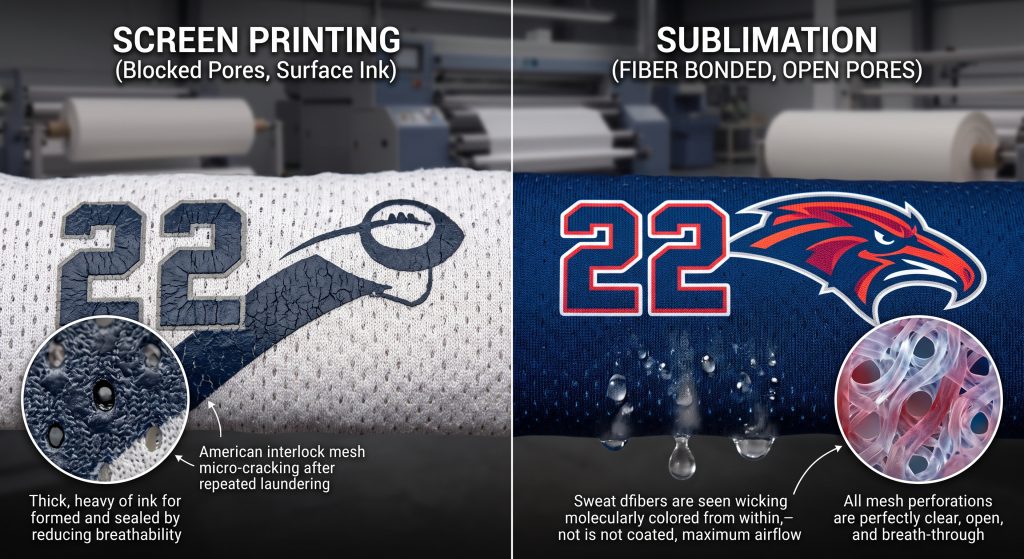
Sublimation printing directly bonds color pigments into polyester fibers of football fabric without blocking mesh pores or cracking after repeated laundering. Custom digital dye processes transform blank white textiles into vibrant team uniforms displaying complex logos and numbers. Unlike screen printing, sublimation leaves fabric pores open and soft against player skin.
How Does Sublimation Printing Preserve Fabric Breathability?
Sublimation infuses gaseous dye deep into synthetic fibers rather than depositing heavy ink layers on top. What’s the real story? mesh perforations remain completely unobstructed, ensuring full ventilation performance.
- Zero ink buildup preserves natural breathability of open meshes.
- Smooth surface finish maintains comfortable hand-feel without stiffness.
- Lightweight dye application adds zero physical weight to uniforms.
Why Is Color Fastness Vital for Washing Athletic Apparel?
High colorfastness ratings ensure bright team colors resist fading despite frequent washing in hot water. Ready for the good part? sublimated graphics never peel, crack, or flake off during rigorous washing cycles.
- Grade 4-5 colorfastness prevents dye bleeding across contrast panels.
- UV resistant pigments prevent color fading during outdoor games.
- Long-lasting graphics maintain professional visual appearance all season.
Key Takeaway: Utilizing digital sublimation dyeing preserves fabric breathability while guaranteeing vibrant, fade-resistant team colors.
| Printing Method | Screen Printing | Digital Sublimation |
| Pore Blockage | High (Heavy Ink Layer) | Zero (Inks Fuse Into Fibers) |
| Durability | Cracks Over Time | Permanent Color Bond |
| Fabric Hand-Feel | Stiff at Print Areas | Completely Soft & Flexible |
Dye application data proves sublimation maintains full airflow performance while delivering superior visual durability.
What Durability Tests Guarantee High Quality Football Fabric?
Standardized Mullen bursting tests and Martindale abrasion trials verify whether football fabric meets commercial quality thresholds for professional sports uniforms. Conducting rigorous laboratory evaluation prevents costly garment failures when players take the field on game day. Certified test reports give apparel buyers confidence in material reliability under extreme physical stress.
How Does Bursting Strength Testing Prevent Game Day Tears?
Hydraulic pressure testing measures how much multidirectional force a fabric withstands before bursting open. This is where it gets interesting… high bursting strength ratings ensure seams hold firm during intense tackling.
- Hydraulic pressure testing verifies multidirectional tear resistance.
- High burst resistance prevents catastrophic jersey tearing on field.
- Reinforced knits pass 500+ kPa pressure testing easily.
Why Is Martindale Abrasion Resistance Important for Uniforms?
Abrasion testing simulates thousands of friction rubs caused by shoulder pads and field turf contact. Here is the kicker… fabrics passing 30,000 rub cycles resist surface fuzzing and pilling exceptionally well.
- Martindale machines measure surface wear under repeated friction.
- Pilling resistance grades 4-5 preserve clean, smooth appearances.
- Durable yarns prevent fabric thinning at pad contact points.
Key Takeaway: Mandating lab-certified bursting and abrasion test reports protects your teamwear brand against product defects.
| Laboratory Test | Minimum Standard | Professional Grade |
| Mullen Bursting Strength | 250 kPa | 500+ kPa |
| Martindale Abrasion | 15,000 Cycles | 35,000+ Cycles |
| Color Fastness to Sweat | Grade 3 | Grade 4-5 |
Quality testing metrics establish clear performance benchmarks required for professional game jersey production.
How Do You Select Football Fabric for Warm Weather Play?
Selecting open mesh football fabric constructions featuring UV protective finishes keeps players cool and shielded from solar radiation during warm summer games. Playing intense sports under direct sunlight requires specialized clothing materials engineered for heat relief and sunburn protection. Combining open ventilation with protective yarn treatments delivers optimal warm-weather performance.
Why Are Open Mesh Geometries Essential for Summer Games?
Wide air channels maximize breeze penetration to accelerate skin cooling when ambient temperatures rise. Look at the facts: open mesh structures reduce thermal insulation layers around active muscle groups effectively.
- Open geometric pores maximize convective body cooling.
- Lightweight yarn construction prevents heat entrapment inside garments.
- Hydrophobic fibers speed up perspiration drying in humidity.
How Do UV Protective Finishes Guard Athletes Outdoor?
Specialized chemical finishes embedded into synthetic fibers block harmful ultraviolet rays from reaching player skin. What’s the real story? UPF 30+ coatings protect athletes during long outdoor afternoon games.
- UPF ratings shield skin from damaging solar UV radiation.
- Embedded protective compounds endure repeated laundering cycles.
- Solar heat reflection keeps fabric surface temperatures lower.
Key Takeaway: Equipping summer uniforms with open mesh UV-resistant textiles protects player health and optimizes thermal endurance.
| Warm Weather Feature | Standard Mesh | UV-Treated Birdseye |
| UV Protection Level | UPF 10 – 15 | UPF 30 – 50+ |
| Air Ventilation | Moderate | Exceptional |
| Heat Accumulation | Low | Extremely Low |
Performance evaluations confirm that UV-treated open meshes offer superior protection and thermal relief during outdoor matches.
Why Partner Direct With Mills for Bulk Football Fabric?
Partnering directly with primary textile mills grants teamwear brands wholesale volume pricing, guaranteed batch color consistency, and custom fabric development options. Bypassing retail craft middleman distributors allows apparel businesses to lower raw material procurement costs substantially. Working directly with factory engineers secures continuous stock availability for recurring team orders.
How Do Direct Factory Orders Lower Apparel Production Costs?
Direct wholesale purchasing eliminates retail store price markups that inflate finished garment production budgets. Ready for the good part? ordering bulk fabric rolls directly reduces per-yard material costs significantly.
- Wholesale volume pricing lowers bill of material costs.
- Direct factory shipping streamlines supply chain logistics.
- Flexible order minimums support scalable apparel growth.
Why Is Batch Color Consistency Critical for Team Reorders?
Primary mills utilize digital dye formulas to guarantee perfect color matching across future production reorders. Check this out: precise color consistency ensures replacement jerseys match existing team uniforms seamlessly.
- Digital lab dip color recipes eliminate shade variations.
- Multi-season roll availability supports ongoing team reorders.
- Certified factory quality control guarantees uniform material standards.
Key Takeaway: Establishing direct mill partnerships stabilizes supply chains while maximizing profit margins for growing sports apparel brands.
| Procurement Channel | Retail Fabric Stores | Direct B2B Textile Mill |
| Pricing Structure | Retail Markups | Wholesale Tiered Pricing |
| Color Consistency | Variable Lot Shades | Certified Digital Lab Dip Matching |
| Technical Support | None Available | Direct Factory Engineering Guidance |
Sourcing comparisons highlight that direct mill partnerships deliver overwhelming financial and operational benefits for teamwear brands.
Final Summary & Recommendations
Choosing between birdseye ventilation and pique structural durability solves critical performance challenges regarding player thermal comfort, seam tear resistance, and moisture accumulation. Sourcing certified synthetic knits directly from primary manufacturing mills eliminates batch color variations while driving down raw material expenses. If you are ready to upgrade your team apparel line with certified, high-performance athletic textiles, contact us today to request your customized sample swatch pack and receive technical guidance from our factory engineering team. At MAKITAPE, supported by Fuzhou HG Textile Co., Ltd., our brand stands committed to empowering sports apparel manufacturers worldwide with precision-engineered fabrics that power winning athletic performances.
Frequently Asked Questions
Q1: Can I mix birdseye mesh and pique knit within a single football jersey?
Yes, combining both fabrics creates an optimal hybrid jersey that balances durability with cooling performance. Design teams frequently place tough pique fabric on high-friction shoulder panels while placing breathable birdseye mesh on underarm and torso panels to maximize airflow.
Q2: What’s the best GSM weight for professional contact game jerseys?
The best weight range for professional game jerseys is between 180 GSM and 250 GSM. This fabric density provides sufficient bursting strength to withstand heavy tackles while remaining comfortable and lightweight during play.
Q3: How do I know if my football fabric meets moisture-wicking standards?
Your fabric meets performance standards when third-party laboratory test reports confirm rapid liquid spreading and fast evaporation rates. Synthetic micro-polyester yarns featuring modified capillary channels dry significantly faster than standard untreated fibers.
Q4: Can I order custom Pantone color dyes when buying directly from B2B mills?
Yes, direct B2B textile mills provide custom Pantone color matching and digital lab dip approvals prior to bulk roll manufacturing. This custom dyeing process guarantees complete color uniformity across all team uniform reorders across multiple sales seasons.
Q5: What’s the best way to prevent graphics from peeling off team uniforms?
The best method is selecting digital sublimation printing, which permanently fuses color dyes directly into the synthetic yarns. Sublimated graphics never peel, crack, or block fabric breathability, unlike traditional rubberized screen printing inks.