
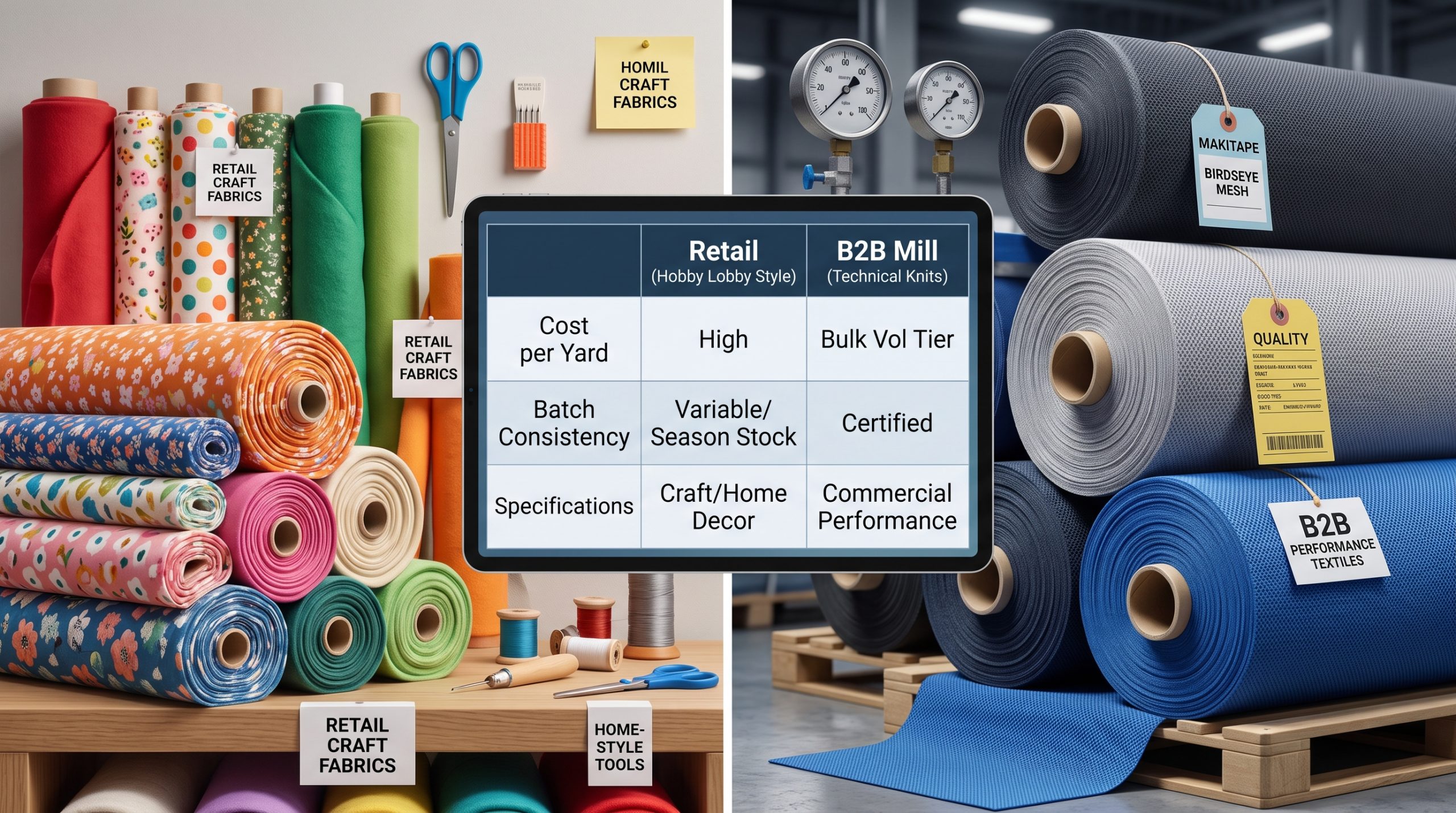
Running a growing apparel brand means constantly hunting for consistent fabric, yet relying on local retail counters creates massive production bottlenecks when rolls run out mid-run. You order swatches from retail craft chains hoping for commercial durability, only to realize the yardage lacks batch-to-batch color stability and technical weight specifications required for professional sewing factories. Professional apparel manufacturers buy bulk production textiles directly from certified B2B textile mills rather than retail craft outlets like hobby lobby fabric options. Partnering with dedicated industrial knitting mills grants you direct access to technical specifications, wholesale volume pricing, custom dye lots, and reliable fabric rolls that keep your factory floor running smoothly.
Where Are We Buying Our Fabric vs Hobby Lobby Fabric?
Apparel production teams purchase bulk rolls directly from wholesale textile manufacturers while retail shoppers purchase precut yardage from retail craft outlets. Commercial garment production requires structural fabric consistency and technical performance ratings that standard retail rolls simply cannot supply for scaled lines. Sourcing your bulk material from retail options such as hobby lobby fabric works well for quick prototyping or small craft runs, but rapid scaling demands specialized industrial machinery and certified yarn mills. Direct B2B factory partnerships grant apparel designers immediate access to custom roll widths, exact color matching protocols, and certified flame or moisture resistance ratings. When your production volume increases past a few garments, switching to professional mill sourcing prevents costly factory delays and fabric defects.
Is Retail Craft Fabric Suitable for Clothing Production?
Retail stores stock textiles designed primarily for home crafters and light hobby projects rather than heavy commercial sewing processes. Here is the real truth: when you feed retail yardage through high-speed automated cutting tables, subtle grain distortions and uneven weave tensions quickly result in misaligned garment panels. Commercial clothing manufacturers depend on rigorous quality control standards that guarantee uniform tensile strength across hundreds of continuous yards. Relying on store-bought yardage often introduces hidden defects that ruin garment drape and reduce seam durability after minimal wash cycles.
- Structural weave stability under commercial cutting tension.
- Batch-to-batch color consistency across recurring orders.
- Documented yarn composition and safety certifications.
How Do B2B Textile Mills Support Commercial Scaling?
Industrial fabric suppliers engineer performance textiles specifically to withstand intense activewear demands, commercial laundering, and high-tension stitching. Think about this: a dedicated B2B mill provides custom fiber blends like moisture-wicking pique knits or high-gauge birdseye meshes that maintain structural integrity through active usage. By working directly with factory textile specialists, you gain transparent material datasheets and custom weight options measured in precise grams per square meter. This level of technical oversight allows your brand to produce premium activewear that outperforms retail-grade craft materials in every physical metric.
- Custom weight options tailored to specific garment styles.
- Advanced moisture management and breathability treatments.
- Direct access to factory technicians and lab dip samples.
Key Takeaway: Partnering directly with industrial mills equips your brand with batch-consistent, high-performance textiles engineered for mass production and long-term garment durability.
| Sourcing Parameter | Retail Craft Outlets | B2B Textile Mills |
| Minimum Order Quantity | 1 Yard | 500+ Yards |
| Technical Datasheets | Unavailable | Full Lab Test Metrics |
| Batch Color Uniformity | Variable / Inconsistent | Certified Lab Dip Matching |
Analyzing this comparison demonstrates that B2B mill sourcing provides the necessary technical rigor and scale for commercial garment manufacturing.
Why Is Hobby Lobby Fabric Popular for Small Crafts?
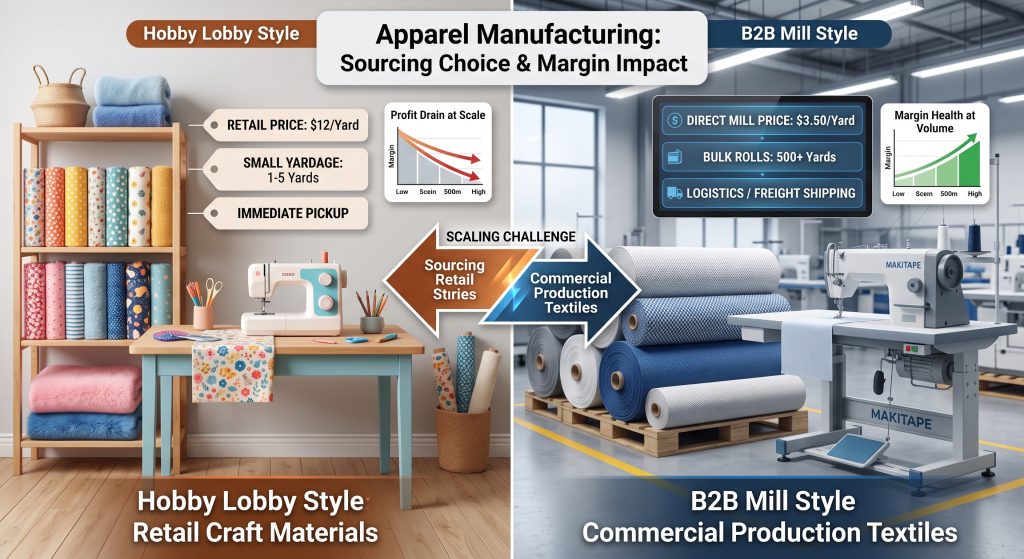
Small crafters favor retail outlets because they offer immediate over-the-counter access without requiring minimum order quantities or business tax documentation. Independent crafters and boutique makers love purchasing small yardage quantities of hobby lobby fabric because retail counters remove the barrier of high wholesale minimums. When you only need two yards of soft fleece or printed cotton for a custom gift, local retail store aisles offer convenient immediate pickup without waiting weeks for freight shipping. However, this retail model pricing structure builds in massive retail markups that cut deeply into commercial production margins as your order volume increases. Understanding the distinct divide between hobbyist convenience and commercial profitability keeps your apparel brand financially healthy.
Why Do Hobbyists Choose Precut Retail Fabrics?
Retail fabric counters cater to immediate creative projects by providing small quantities of trendy patterns and tactile fleece samples right off the shelf. What is the bottom line? Crafters value physical convenience and immediate visual feedback over technical fiber specifications or chemical safety certifications. While retail shelves display an impressive visual variety of cozy flannels and printed cottons, these materials are rarely tested for heavy athletic wear or industrial dye fastness. Consequently, home sewers accept minor structural variations that would cause major quality rejections inside a commercial garment factory.
- Zero minimum order requirements for quick creative projects.
- Immediate physical inspection and over-the-counter sales.
- Wide seasonal visual assortment tailored to home decor.
Can Small Businesses Margin Profit on Retail Yardage?
Purchasing raw materials at retail prices severely restricts your profit margins when selling finished garments through commercial retail channels. Look at the facts: retail fabric stores mark up wholesale mill prices by three hundred percent to cover retail store overhead and staffing expenses. When you buy fabric off retail bolts, your cost per garment remains inflated, making it impossible to compete with established brands sourcing directly from mills. Shifting your material procurement strategy to direct mill channels instantly lowers your bill of materials and unlocks healthy wholesale profit margins.
- High unit cost per yard reduces net garment profitability.
- Limited roll inventory restricts bulk batch manufacturing.
- Unpredictable restock schedules lead to dead inventory lines.
Key Takeaway: While retail fabric purchases offer instant gratification for small projects, direct mill sourcing is mandatory for maintaining competitive profit margins in commercial apparel.
| Metric | Retail Purchase Model | B2B Direct Sourcing |
| Average Markup Rate | 200% – 400% | Direct Wholesale Price |
| Stock Predictability | Seasonal / Random | Guaranteed Continuous Runs |
| Custom Fiber Blends | Not Available | Fully Customizable |
This cost breakdown confirms that direct B2B sourcing provides massive financial advantages over retail purchasing models.
How Does Hobby Lobby Fabric Compare to Industrial Textiles?
Industrial textiles feature higher tensile strength, specialized performance finishes, and precise technical weight specifications compared to standard retail crafts. Comparing commercial knits directly against retail hobby lobby fabric options reveals drastic differences in yarn density, color fastness, and dimensional stability. Industrial mills spin synthetic fibers under strict laboratory conditions to produce technical birdseyes and pique structures that actively pull sweat away from human skin. Retail craft fleece, while exceptionally plush and soft to the touch, relies on brushed surface fibers that trap heat without offering breathability or moisture regulation. Choosing the correct fabric construction ensures that your clothing line delivers functional performance rather than simple cosmetic softness.
What Are the Structural Differences in Fabric Weave?
Engineering specialized apparel requires precise control over knit structures, air permeability, and fiber recovery rates during physical strain. Here is why that matters: technical knits like pique and birdseye utilize geometric micro-structures that facilitate rapid air circulation during intense physical activity. In contrast, standard retail fleece fabrics feature dense, brushed fibers that trap air currents to maximize warmth at the expense of ventilation. When you build performance activewear, selecting open geometric knits over dense craft fleece prevents athlete overheating and improves overall garment comfort.
- Geometric knits encourage passive cooling airflow.
- Brushed craft fleece maximizes thermal insulation performance.
- High-gauge synthetics resist pill formation after repeated washing.
How Does Moisture Management Differ Between Fabrics?
Moisture management relies on hydrophobic synthetic yarns that push perspiration toward the outer garment surface for rapid evaporation. Ready for the good part? B2B performance fabrics undergo specialized chemical treatments and structural cross-section engineering to achieve rapid drying speeds during intense exercise. Retail fleece materials absorb moisture within their brushed pile fibers, causing garments to grow heavy and damp when worn during sweaty workouts. Integrating technical B2B textiles into your athletic clothing lines guarantees superior sweat wicking performance that retail craft materials cannot match.
- Hydrophobic yarn cross-sections speed up moisture transport.
- Integrated anti-microbial treatments limit odor accumulation.
- Quick-drying performance knits keep athletes comfortable.
Key Takeaway: Understanding the structural differences between decorative retail fleece and technical knits allows you to select fabrics engineered specifically for your garment’s functional demands.
| Performance Metric | Retail Fleece Textiles | Technical B2B Knits |
| Air Permeability | Low (5 CFM) | High (150+ CFM) |
| Moisture Wicking Speed | Slow / Water Retentive | Rapid Evaporation |
| Pilling Resistance | Moderate / Grade 2 | High / Grade 4-5 |
Evaluating physical properties highlights the clear functional superiority of technical B2B knits over basic craft materials.
Can Hobby Lobby Fabric Meet Commercial Durability Standards?
Retail craft fabrics generally fail commercial apparel durability standards due to lower abrasion resistance, seam slippage, and color fading under repeated laundering. Submitting standard retail hobby lobby fabric swatches to certified textile testing laboratories quickly highlights significant gaps in commercial durability performance. Industrial apparel brands test every fabric roll for pilling resistance, colorfastness to light, tear strength, and dimensional recovery after fifty wash cycles. Retail craft fabrics rarely undergo these rigorous testing protocols, leaving your brand exposed to high customer return rates and seam failures. Securing performance-tested textiles from B2B production mills protects your brand reputation and ensures long-lasting garment satisfaction.
What Laboratory Tests Determine Fabric Quality?
Professional garment manufacturers evaluate raw material performance using standardized ASTM and ISO laboratory testing procedures before cutting production runs. This is where it gets interesting… tests like the Martindale Abrasion Test and Crocking Colorfastness Test measure exactly how well fibers withstand rubbing and sweat exposure. Retail craft fabrics often show significant fiber fuzzing and color bleeding after basic laboratory testing cycles. By specifying mill-certified technical fabrics for your apparel line, you guarantee that your finished products maintain their appearance and structure over years of consumer wear.
- Martindale abrasion testing measures surface wear durability.
- Crocking tests evaluate dye transfer under friction and moisture.
- Tensile strength testing ensures seam integrity under stress.
Why Does Batch Testing Prevent Customer Returns?
Unchecked fabric defects like uneven shrinkage or crocking bleed directly into finished clothing lines, driving up negative customer reviews and product refunds. Here is the real truth: when you source raw materials lacking mill certification sheets, subtle batch variations turn entire sewing production batches into unsellable factory seconds. B2B textile mills provide comprehensive lab dip reports and pre-shipment inspection sheets for every roll shipped to your facility. Establishing strict material testing protocols safeguards your investment and elevates consumer trust in your clothing brand.
- Pre-shipment lab reports confirm exact color matching specifications.
- Standardized shrinkage testing prevents garment distortion after washing.
- Documented testing reduces warranty claims and customer returns.
Key Takeaway: Demanding lab-certified performance metrics for every fabric lot protects your brand against quality claims and ensures long-term customer loyalty.
| Quality Standard | Retail Craft Fabric | Certified B2B Mill Fabric |
| Shrinkage Control | 5% – 8% Variance | Under 2% Standard |
| Color Fastness Grade | Grade 2-3 (Fades) | Grade 4-5 (Colorfast) |
| Lab Test Reports | None Provided | Standardized ASTM/ISO Reports |
Laboratory metric comparisons prove that certified mill fabrics consistently meet professional apparel durability benchmarks.
What Are Cost Differences in Hobby Lobby Fabric Bulk Ordering?
Bulk ordering from direct B2B mills provides volumetric wholesale pricing, significantly lower per-yard costs, and custom freight terms unavailable at retail craft stores. Analyzing your manufacturing budget reveals that purchasing hobby lobby fabric on retail bolts incurs unnecessary retail markups that erode net profitability. Retail pricing covers retail store overhead, middleman distribution margins, and consumer marketing costs that add zero value to your finished clothing product. Direct B2B textile procurement allows your brand to negotiate volume tiered pricing, custom roll lengths, and direct mill freight agreements. Transitioning your procurement strategy from retail shopping to B2B mill ordering reduces raw material expenses by up to sixty percent.
How Do Minimum Order Quantities Drive Yardage Pricing?
Textile mills structure their pricing models around production volume efficiencies, offering steep discounts as your purchase quantity scales upward. Think about this: while buying five yards at a local retail counter costs twelve dollars per yard, ordering five hundred yards directly from a mill drops your cost per yard dramatically. These substantial raw material savings give your brand financial flexibility to invest in better garment trim, superior packaging, and aggressive marketing campaigns. Understanding how volume pricing tiers operate enables your purchasing team to maximize cash flow efficiency.
- Volume tiered pricing lowers unit fabric costs significantly.
- Direct mill ordering eliminates retail price markups.
- Bulk shipments streamline inventory management and logistics planning.
How Do Freight and Shipping Terms Impact Margins?
Managing logistics costs requires choosing raw material suppliers who offer structured B2B freight terms and predictable shipping schedules. What is the real story? retail fabric purchases force you to absorb individual package shipping rates or local sales taxes that inflate your total procurement bill. Direct B2B factory orders utilize commercial freight carriers, container consolidation, and duty-paid delivery terms that stabilize your landed material costs. Optimizing your supply chain logistics protects your operating margins and prevents unexpected cost spikes during peak production seasons.
- Consolidated sea and air freight reduces landed yardage costs.
- Commercial freight agreements provide tracking and arrival guarantees.
- Tax-exempt B2B purchasing eliminates unnecessary retail sales tax.
Key Takeaway: Shifting your raw material sourcing to direct B2B mill channels yields substantial cost savings that dramatically improve your bottom line profitability.
| Financial Factor | Retail Purchase | Direct B2B Mill |
| Cost Per Yard | $8.00 – $15.00 | $2.50 – $5.50 |
| Tax Exemption | Sales Tax Applied | B2B Tax-Exempt Status |
| Shipping Logistics | Retail Parcel Rates | Commercial Bulk Freight |
Financial evaluation demonstrates that direct B2B sourcing delivers overwhelming cost advantages for scaled apparel manufacturing.
Where Do Commercial Brands Source Beyond Hobby Lobby Fabric?
Commercial apparel brands source raw materials directly from global B2B textile manufacturers, specialized knitting mills, and trade fabric suppliers. When scaling an activewear or sports apparel brand beyond small boutique collections, sourcing beyond retail hobby lobby fabric counters becomes an urgent priority. Established apparel companies establish direct relationships with overseas textile mills capable of custom dyeing, technical fiber spinning, and continuous roll production. Partnering with professional textile manufacturers grants your business access to proprietary performance finishes, eco-friendly recycled polyesters, and specialized athletic meshes. Sourcing from accredited B2B mills provides the supply chain stability needed to launch global apparel collections.
What Are the Advantages of Direct Mill Partnerships?
Working directly with primary textile mills unlocks custom engineering options that retail craft stores simply cannot offer to apparel creators. Look at the facts: a direct factory partner allows you to specify exact weight specifications, custom Pantone dye colors, and specialized moisture-wicking chemical treatments. This level of customization ensures that your clothing line features unique aesthetic textures and superior functional performance that set your brand apart. Building strong mill relationships secures priority production slots and technical support throughout your brand’s growth journey.
- Custom Pantone color matching guarantees brand visual consistency.
- Tailored technical finishes match specific athletic movement requirements.
- Priority mill production scheduling during peak manufacturing seasons.
How Do Textile Sourcing Fairs Connect Buyers to Mills?
International textile trade expos and digital B2B sourcing platforms allow apparel teams to meet accredited mill representatives and evaluate physical swatches. Ready for the good part? attending sourcing fairs gives you direct access to hundreds of certified mills specializing in technical knits, fleece, and athletic meshes. Evaluating physical fabric swatches and reviewing mill compliance certificates in person accelerates your material development timeline significantly. Transitioning to professional sourcing networks connects your brand with dependable mill partners capable of supporting your long-term expansion goals.
- Direct physical access to thousands of B2B fabric swatches.
- In-person negotiation of pricing, minimums, and shipping timelines.
- Immediate verification of mill environmental and labor certifications.
Key Takeaway: Expanding your procurement network to include direct B2B textile mills opens access to custom performance fabrics engineered for scaled commercial success.
| Sourcing Channel | Sourcing Flexibility | Production Capacity |
| Retail Craft Stores | None (Pre-made Stock) | Very Low (Individual Bolts) |
| Direct B2B Mills | Full Custom Engineering | Mass Production (Thousands of Yards) |
| Textile Trade Fairs | High Variety Access | Scalable Mill Partnerships |
Exploring professional sourcing channels establishes a robust, highly customizable supply chain for growing apparel lines.
How Does Supply Chain Consistency Impact Hobby Lobby Fabric?
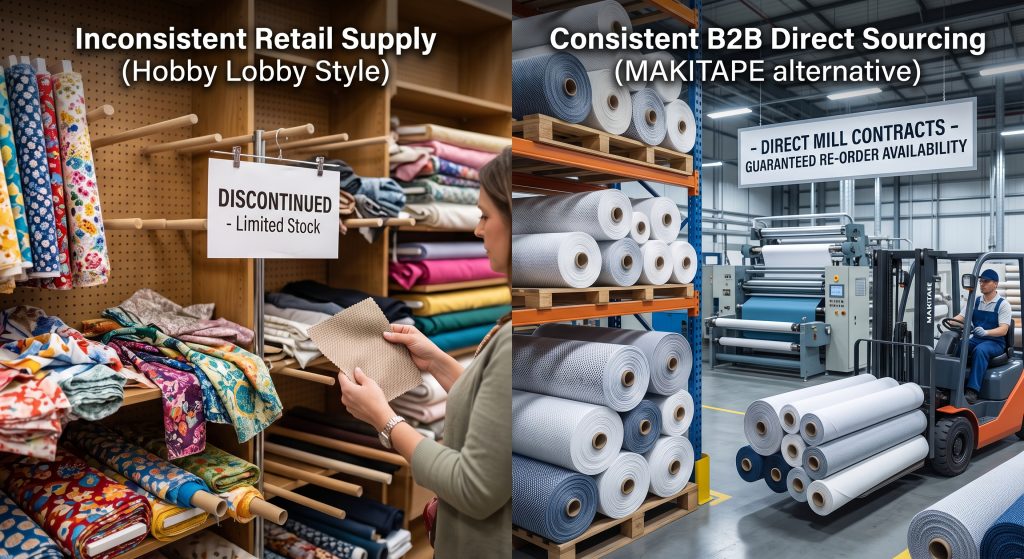
Retail craft inventory lacks supply chain consistency due to irregular store restocks, seasonal product rotations, and unannounced mill vendor changes. Relying on retail hobby lobby fabric inventory introduces severe supply chain risks when a popular fabric line disappears from store shelves mid-production. Retail craft chains adjust their store inventory based on seasonal consumer crafting trends rather than supporting continuous apparel manufacturing runs. When a key retail fabric item is discontinued, your apparel brand faces sudden production halts and lost sales opportunities. Establishing direct contracts with B2B textile manufacturers ensures guaranteed re-order availability and consistent batch colors across multiple sales seasons.
Why Do Discontinued Retail Lines Disrupt Manufacturing?
Unannounced retail stock outages force small apparel brands to waste time searching for matching replacement fabrics across multiple retail store locations. Here is the real truth: matching color dye lots across separate retail purchases is nearly impossible, resulting in mismatched garment panels and ruined production runs. B2B textile mills maintain permanent digital fabric formulas and dye recipes that guarantee identical color reproduction across future order placements. Partnering with reliable mill suppliers eliminates inventory anxiety and protects your manufacturing timeline from sudden supply disruptions.
- Guaranteed fabric availability across multi-year product seasons.
- Precise digital dye matching prevents color shade variations.
- Contracted reserve stock agreements ensure continuous factory feeding.
How Do B2B Contracts Guarantee Lead Time Stability?
Professional B2B supply agreements incorporate strict delivery timelines, guaranteed production slots, and penalty clauses for unexpected shipping delays. This is where it gets interesting… having a legally binding contract with a textile manufacturer ensures your factory receives raw materials exactly when cut plans dictate. In contrast, retail craft stores offer zero shipping commitments or inventory holds for commercial garment makers. Securing structured mill supply contracts allows your production team to schedule factory labor efficiency and meet customer delivery deadlines.
- Defined production lead times streamline factory labor scheduling.
- Binding supply agreements protect against unexpected price surges.
- Transparent shipment tracking provides complete supply chain visibility.
Key Takeaway: Securing continuous, batch-consistent fabric supplies through B2B mill contracts prevents costly production downtime and protects your brand reputation.
| Inventory Metric | Retail Craft Supplier | Direct B2B Mill Supplier |
| Stock Continuity | Unpredictable / Seasonal | Multi-Year Continuous Availability |
| Dye Lot Consistency | High Variation Between Bolts | Digital Lab Dip Color Precision |
| Delivery Guarantees | None (Subject to Store Stock) | Contractual Lead Time Commitments |
Analyzing inventory stability confirms that direct B2B mill partnerships remove severe supply chain vulnerabilities.
What Testing Standards Apply to Hobby Lobby Fabric Options?
Standard retail craft fabrics are tested primarily for consumer craft safety rather than heavy industrial apparel performance or flame resistance requirements. Evaluating retail hobby lobby fabric choices under formal textile testing frameworks demonstrates why professional apparel lines require certified industrial fabrics. Industrial garment specifications mandate documented compliance with OEKO-TEX safety certifications, REACH chemical restrictions, and standardized ASTM physical performance metrics. Retail craft textiles often lack formal testing documentation, making them unsuitable for commercial export or rigorous activewear applications. Sourcing mill-certified raw materials ensures your finished clothing complies with international apparel safety regulations and quality expectations.
What Chemical Safety Certifications Are Required for Apparel?
Global apparel regulations strictly restrict harmful azo dyes, heavy metals, and toxic chemical residues in fabrics intended for skin contact. Think about this: B2B textile mills certify their products under international safety frameworks like OEKO-TEX Standard 100 to prove zero harmful chemical contamination. Retail craft fabrics rarely provide certified chemical compliance datasheets, exposing your apparel business to legal liabilities and product recalls in international markets. Sourcing chemically certified textiles guarantees consumer safety and clears regulatory hurdles for global garment distribution.
- OEKO-TEX Standard 100 certification guarantees non-toxic chemical levels.
- REACH compliance ensures adherence to European chemical safety laws.
- Formal safety documentation protects your brand against product liability.
How Do Flammability and Performance Standards Protect Brands?
Commercial sleepwear and outerwear must meet strict federal flammability regulations before entering retail sales channels. Here is why that matters: industrial textile suppliers perform standard burn testing and physical performance evaluations to guarantee compliance with legal safety codes. Retail craft fabrics are sold for home decorative uses and may not meet mandatory garment flammability standards. Choosing mill-tested fabrics provides certified safety documentation that satisfies customs inspectors, retail buyers, and legal regulatory bodies.
- Documented burn testing meets federal garment safety regulations.
- Certified anti-pilling and colorfastness ratings ensure garment longevity.
- Third-party lab reports provide full compliance verification.
Key Takeaway: Choosing mill-certified fabrics with complete chemical and physical safety documentation protects your brand against regulatory fines and consumer safety risks.
| Compliance Area | Retail Craft Textiles | Certified Mill Fabrics |
| Chemical Safety | Unverified / No Certificates | OEKO-TEX Standard 100 Certified |
| Flammability Verification | None Provided | Mandatory Legal Testing Reports |
| Export Compliance | High Regulatory Risk | Fully Documented for International Trade |
Reviewing safety standards highlights the legal necessity of sourcing certified industrial textiles for commercial apparel.
Why Do Performance Brands Avoid Hobby Lobby Fabric Swatches?
Performance brands avoid retail craft swatches because they lack technical moisture-wicking structures, controlled elasticity, and engineered breathability required for athleticwear. Activewear designers testing hobby lobby fabric swatches quickly discover that general craft materials fail under high-intensity physical exertion and moisture loading. Performance apparel requires high-gauge synthetic knits like birdseye mesh or pique structures that actively manage heat and perspiration. Retail craft fleece traps humidity against the skin, causing thermal discomfort and chafing during prolonged athletic activity. Integrating specialized B2B performance fabrics ensures that your garments deliver technical functionality that serious athletes demand.
How Do High-Gauge Knits Superiorly Manage Sweat?
Engineered athletic textiles utilize specialized multi-filament polyester yarns that pull moisture away from human skin through capillary action. What is the real story? technical birdseye knits feature micro-apertures that increase surface area, accelerating sweat evaporation during intense exercise routines. Basic craft fleece materials absorb moisture without diffusing it, resulting in heavy, damp clothing that hinders athletic performance. Equipping your athletic lines with high-gauge B2B performance textiles ensures superior climate control and dry comfort for active consumers.
- Capillary yarn structures rapidly transport perspiration outward.
- Micro-porous knit patterns maximize surface evaporation speed.
- Lightweight synthetic blends reduce overall garment weight during workouts.
What Role Does Elastane and Recovery Play in Activewear?
High-performance athleticwear demands four-way stretch fabrics that maintain immediate shape recovery without sagging or bagging out after stretching. Ready for the good part? B2B performance mills blend high-grade elastane with durable synthetics, setting heat tension to guarantee permanent elasticity over long-term use. Retail craft fabrics often lack elastane or use low-grade elastic fibers that lose recovery power after a few wash cycles. Utilizing engineered four-way stretch textiles from certified mills ensures your activewear maintains a flattering fit and maximum freedom of movement.
- Four-way stretch construction allows unrestricted body movement.
- High-grade elastane guarantees shape retention after repeated stretching.
- Heat-set fabric finishing prevents bagging out at stress points.
Key Takeaway: Sourcing engineered performance knits with verified moisture-wicking and recovery specs is vital for building credible, high-performing activewear collections.
| Functional Feature | Retail Craft Fleece | B2B Performance Knits |
| Stretch & Recovery | Low 2-Way Stretch | Engineered 4-Way Stretch |
| Moisture Transport | Absorptive / Slow Drying | Capillary Wicking / Fast Drying |
| Knit Density | Thick Brushed Fiber | High-Gauge Precision Micro-Mesh |
Comparing athletic features confirms why technical B2B knits are mandatory for high-performance activewear production.
How Do You Transition From Hobby Lobby Fabric to B2B Sourcing?
Apparel brands transition from retail craft sourcing by establishing direct mill contacts, requesting sample headers, and placing pilot wholesale orders. Shifting your purchasing process from local retail hobby lobby fabric counters to professional B2B textile manufacturers transforms your supply chain reliability and brand profitability. The transition begins by defining your garment’s technical requirements, such as target weight specifications, fiber composition, and functional stretch percentages. Reaching out to established textile mills allows you to request professional sample swatches and lab dips before committing to bulk production rolls. Partnering with a dedicated mill supplier stabilizes your production costs and positions your clothing line for sustainable commercial growth.
How Do You Evaluate B2B Sample Headers and Swatches?
Transitioning to professional sourcing requires carefully reviewing mill sample headers and testing physical swatches for wash performance and drape. Look at the facts: commercial fabric sample headers include complete technical specifications detailing roll width, weight per square meter, yarn count, and colorfastness ratings. Conducting pre-production sample cuts allows your design team to verify garment fit and sewing performance before placing full production orders. Partnering with transparent mills that provide comprehensive sample packs ensures confident sourcing decisions for your expanding apparel collections.
- Review sample header datasheets for detailed technical specifications.
- Conduct prototype sample cuts to test drape and seam strength.
- Verify color accuracy using standardized Pantone matching systems.
How Do You Negotiate Initial Wholesale Minimums?
Many growing apparel brands worry about high mill minimum order quantities, but established suppliers often offer flexible pilot order tiers for emerging companies. Here is the real truth: communicating your long-term growth plans and product roadmaps encourages textile mills to support smaller initial sample runs. Establishing clear communication regarding target prices, sample schedules, and shipping options builds a collaborative foundation for future business expansion. Taking the step to connect directly with industrial fabric mills empowers your brand to manufacture professional-grade apparel with maximum profit margins.
- Discuss flexible pilot order minimums to support emerging collections.
- Establish clear communication timelines for lab dips and roll delivery.
- Build long-term mill partnerships to secure preferential pricing as you scale.
Key Takeaway: Taking proactive steps to transition from retail fabric purchasing to direct B2B mill partnerships secures higher margins, technical quality, and scalable production.
| Transition Phase | Action Step | Brand Outcome |
| 1. Spec Definition | Define target weight, width, and fiber mix | Clear technical requirements sheet |
| 2. Swatch Evaluation | Order B2B sample headers & test drape | Verified physical fabric performance |
| 3. Pilot Order | Negotiate initial wholesale minimums | Scalable, profitable roll manufacturing |
Following a structured transition roadmap ensures a seamless upgrade from retail purchasing to scalable B2B textile manufacturing.
Final Summary & Recommendations
Transitioning away from retail fabric bottlenecks and inconsistent craft store inventories unlocks the true manufacturing potential of your apparel brand. By replacing unpredictable retail yardage with certified, performance-engineered textiles, you solve critical challenges surrounding color shade variations, poor seam strength, low profit margins, and lack of technical specifications. Professional mill sourcing delivers the exact yarn density, moisture management, and batch consistency required to produce activewear that earns glowing customer reviews. If you are ready to elevate your clothing line with factory-direct pricing, custom material development, and lab-tested performance fabrics, contact us today to request your custom sample pack and receive personalized technical guidance from our textile engineering team. At MAKITAPE, supported by Fuzhou HG Textile Co., Ltd., we stand firmly committed to powering global apparel brands with durable, precision-engineered sports textiles that turn creative garment designs into market-leading commercial successes.
Frequently Asked Questions
Q1: Can I use retail craft fleece for commercial sportswear manufacturing?
No, retail craft fleece is not recommended for commercial sportswear because it lacks technical moisture-wicking properties and sufficient breathability. Craft fleece absorbs sweat without evaporating it, causing garments to become heavy during workouts, whereas technical B2B knits actively vent moisture and regulate body temperature.
Q2: What is the best way to transition from retail fabric to wholesale mill sourcing?
The best way is to define your garment’s technical specifications and request B2B sample headers directly from an accredited textile mill. Working directly with factory suppliers allows you to test fabric drape and negotiate flexible pilot order minimums tailored to your production volume.
Q3: How do I know if my fabric choice meets commercial durability standards?
You know your fabric meets commercial standards when the supplier provides certified laboratory test reports covering abrasion resistance, colorfastness, and shrinkage control. Certified B2B textiles undergo standardized ASTM and ISO testing to ensure seams and colors hold up through repeated commercial laundering.
Q4: Can I order custom dye colors when purchasing textiles directly from B2B mills?
Yes, direct B2B textile mills offer custom Pantone color matching and digital lab dip approvals before starting bulk roll production. This ensures complete color uniformity across your entire product line, avoiding the shade variations common in retail store bolts.
Q5: How do cost savings from B2B direct mill sourcing compare to retail prices?
Direct B2B sourcing cuts raw material costs by up to sixty percent compared to retail prices by removing retail markups and middleman distribution fees. Sourcing bulk rolls directly from manufacturers drastically improves your profit margins while providing higher-grade performance materials.