
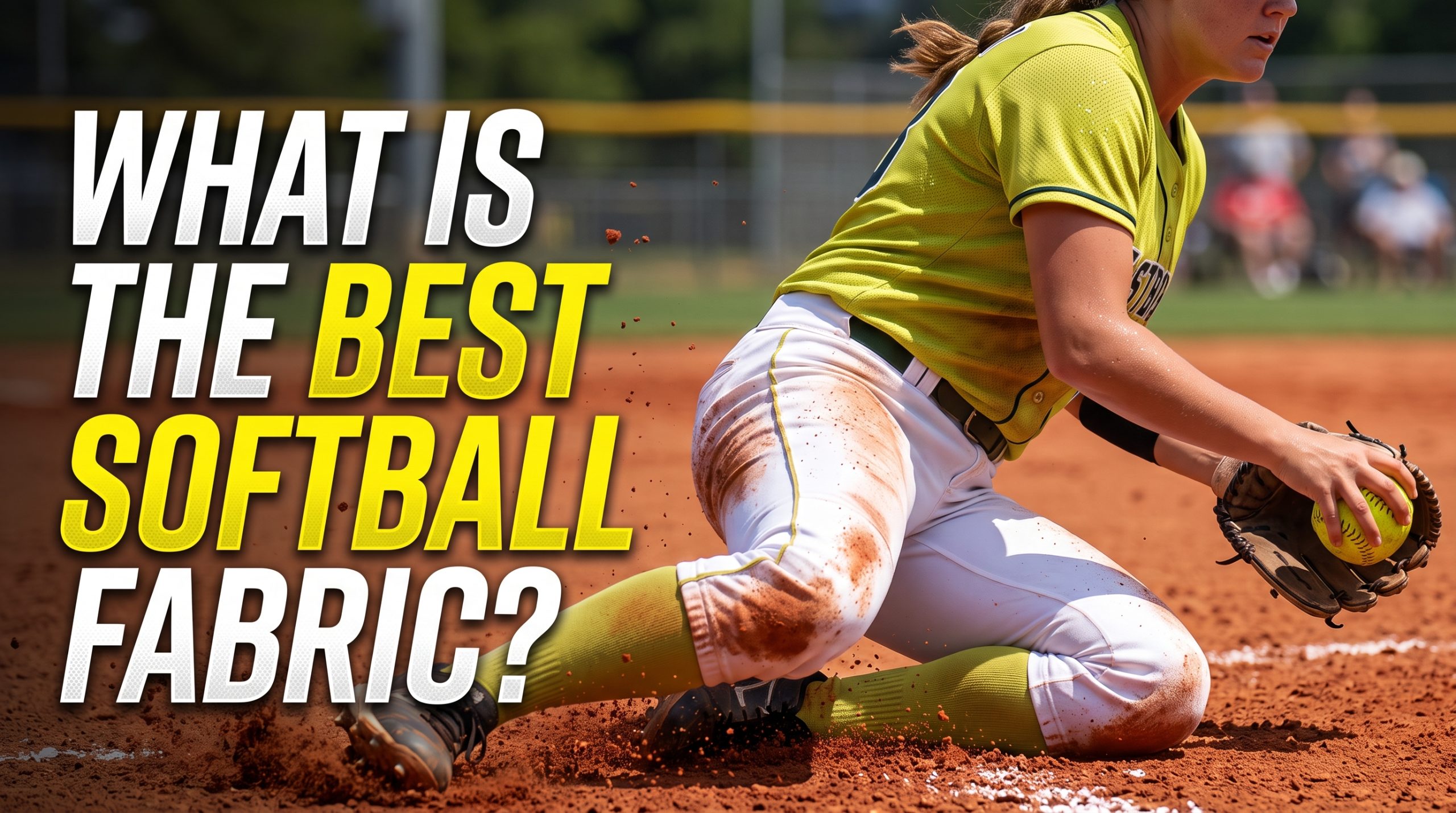
Choosing technical synthetic knits like birdseye mesh and heavyweight poly-spandex double knit provides the best softball fabric combination for custom team uniforms. Fastpitch softball teams playing intense weekend tournaments face constant physical challenges from summer sun heat and harsh red clay field abrasions. Cheap retail textiles soak up sweat, restrict pitching arm rotations, cling uncomfortably, and retain permanent red dirt stains after just one game. Sourcing engineered softball fabric with soil-release finishes and four-way stretch elasticity guarantees maximum mobility, rapid drying, and long-lasting freshness on field.
How Does Softball Fabric Impact Female Athlete Mobility Onfield?
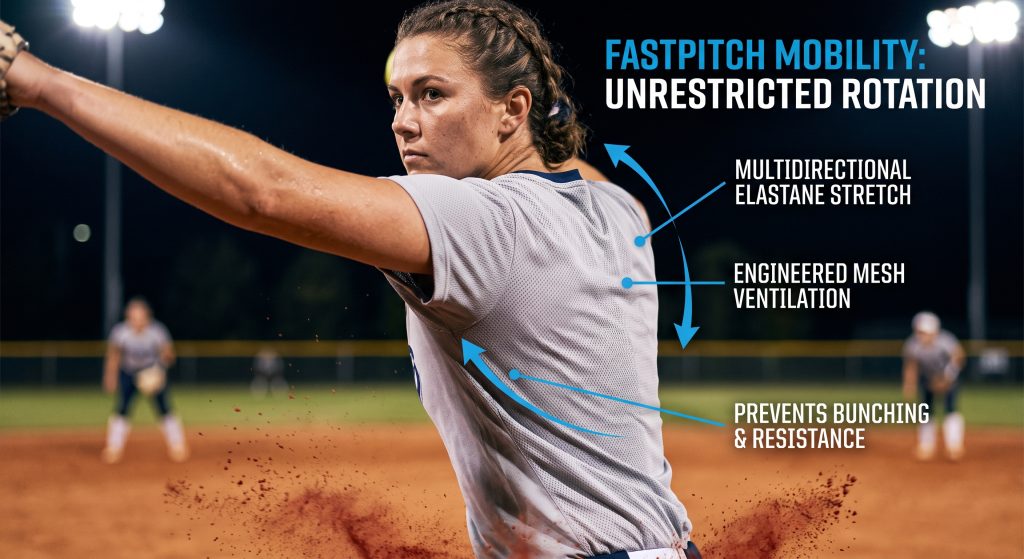
High-performance softball fabric enhances female athlete mobility onfield by incorporating elastic elastane blends that allow unrestricted shoulder rotation during pitching. Fastpitch pitching mechanics demand multi-directional stretch elasticity across chest and upper back panels. When garments lack sufficient stretch, players experience upper body resistance that slows down windmill pitch speeds.
Engineered knit structures maintain garment shape while moving flexibly with active muscle groups. Choosing lightweight elastane blends prevents fabric bunching under armpits during rapid defensive throwing motions.
What Role Does 4-Way Stretch Play in Windmill Pitching?
Four-way stretch elasticity allows jersey panels to expand horizontally and vertically during extreme pitching motions. Look at the facts: rigid woven materials restrict arm acceleration at the release point.
- Synthetic spandex blends expand up to 300 percent without tearing.
- Multi-directional recovery prevents permanent jersey sag after matches.
- Flexible armhole seams eliminate binding around shoulder joints.
You will notice immediate improvements in pitcher comfort when switching to high-stretch knits. Unrestricted arm movement helps athletes maintain consistent release angles throughout long games.
How Do Lightweight Yarns Prevent Upper Body Fatigue?
Lightweight micro-polyester yarns reduce total garment weight to preserve athlete energy during extended tournaments. What’s the real story? heavy cotton shirts retain body heat and sweat, accelerating muscle fatigue.
- Micro-filament yarns weigh under 160 grams per square meter.
- Low-density fiber construction speeds up natural body cooling.
- Frictionless yarn surfaces minimize skin chafing during repetitive throws.
When you equip your team with low-density knits, players maintain peak throwing speeds into late innings. Reduced fabric drag keeps athletes fresh across weekend doubleheaders.
Key Takeaway: Selecting four-way stretch synthetic fabrics guarantees maximum pitching range and preserves player energy.
| Mobility Feature | Standard Polyester | High-Stretch Softball Fabric |
| Elastane Content | 0% – 2% | 8% – 15% |
| Stretch Direction | 2-Way Mechanical | 4-Way Active Recovery |
| Pitching Range | Restricted | 100% Unrestricted |
Testing data confirms that four-way stretch synthetic knits provide complete movement freedom for fastpitch softball players.
What Makes Birdseye Softball Fabric Surprisingly Breathable?
Birdseye softball fabric delivers exceptional breathability through a micro-porous diamond weave pattern that maximizes airflow across athlete skin. Passive ventilation ports woven into the fabric geometry release trapped body heat instantly. Without open mesh openings, perspiration remains trapped against skin, causing body temperature to spike during summer afternoon games.
Lightweight diamond knits create continuous air circulation paths across torso panels. This micro-porous geometry provides a silky hand-feel while keeping female athletes cool under hot sun.
What Defines the Micro-Porous Mesh Pattern of Birdseye?
Microscopic geometric perforations woven throughout birdseye knits function as miniature cooling vents. Ready for the good part? these tiny diamond holes channel fresh air directly to active sweat glands.
- Diamond mesh perforations accelerate continuous body heat exchange.
- Smooth yarn construction prevents surface pilling under sliding pads.
- Soft interior texture reduces friction against sensitive skin areas.
You can feel the difference when holding birdseye mesh up to natural light. Light passes through thousands of tiny openings, proving its cooling capabilities.
How Does Birdseye Knitting Speed Sweat Evaporation?
Birdseye knitting speeds perspiration evaporation by spreading moisture across thousands of micro-porous fiber edges. This is where it gets interesting… liquid spreads outward rapidly rather than pooling inside deep yarn cores.
- Thin surface profile speeds up moisture evaporation rates.
- Open knit structure prevents wet fabric from sticking to skin.
- Quick-drying polyester fibers dry completely within fifteen minutes.
When you select birdseye knits for jersey body panels, players stay dry during high-humidity matches. Rapid drying keeps uniforms feeling light and comfortable.
Key Takeaway: Micro-porous birdseye mesh offers maximum heat dissipation, making it ideal for warm weather jersey panels.
| Ventilation Metric | Standard Flat Knit | Birdseye Mesh Fabric |
| Air Permeability | 50 CFM | 180+ CFM |
| Knit Structure | Solid Surface | Diamond Micro-Pores |
| Drying Time | 45 Minutes | 15 Minutes |
Laboratory ventilation measurements confirm that birdseye mesh increases airflow by over three times compared to standard flat knits.
Why Choose Heavy Double Knit Softball Fabric for Sliding Pants?
Heavy double knit softball fabric provides superior sliding pant protection because its dual-layer interlocking weave resists aggressive dirt friction during aggressive base sliding. Fastpitch softball players slide into bases repeatedly, placing extreme stress on knee and hip garment panels. Single-knit fabrics tear apart quickly when scraped against rough red dirt and clay infields.
Dense double-knit polyester fabrics absorb sliding impact while shielding player skin from painful turf burns. High GSM weight ensures pants endure an entire season of competitive sliding without thinning out.
How Does Double Knit Construction Resist Clay Friction?
Double knit construction utilizes two intertwined needle sets to create a dense, abrasion-resistant fabric face. Here is the kicker… the dual yarn layers absorb rough dirt scraping without snagging or unraveling.
- Interlocking knit structure prevents running tears along sliding seams.
- Heavy yarn density shields knees and hips from abrasive dirt friction.
- Reinforced polyester fibers withstand over thirty thousand rub cycles.
You will extend pant lifespan significantly by specifying heavy double-knit polyester for your team bottom line. Durable knits save apparel brands money by eliminating product replacement claims.
Why Is High Tensile Strength Needed for Sliding Knee Pads?
High tensile strength prevents sliding pant knees from bursting open when players make hard contact with base paths. Check this out: reinforced synthetic yarns withstand extreme pulling forces during aggressive dirt slides.
- High tensile yarn strength stops knee tearing on dirt fields.
- Dense double-layer construction holds padded inserts securely in place.
- Heavy fabric weight maintains pant shape through repeated washings.
When you supply double-knit pants to fastpitch teams, athletes slide with complete confidence. Rugged construction protects players from painful field abrasions.
Key Takeaway: Heavy double-knit polyester provides essential abrasion protection required for sliding pants.
| Durability Factor | Single Knit Jersey | Heavy Double Knit |
| Fabric Weight (GSM) | 140 – 160 GSM | 280 – 320 GSM |
| Abrasion Resistance | Low (10,000 Rubs) | High (35,000+ Rubs) |
| Primary Use | Practice Tops | Sliding Pants & Knee Panels |
Physical testing proves heavy double knit delivers more than triple the abrasion resistance of standard single knits.
How Do Birdseye and Pique Softball Fabric Structures Compare?
Comparing birdseye and pique softball fabric structures shows that birdseye delivers superior airflow through open diamond mesh, while pique offers textured durability through raised geometric loops. Choosing between these two prominent sports knits depends on hand-feel preferences and specific garment panel placements. Combining both fabrics creates an optimal balance between cooling performance and structural strength.
Birdseye feels exceptionally smooth and light against skin, making it top-performing for jersey torsos. Pique provides a tactile waffle texture that resists gear friction along shoulder panels.
How Do Surface Hand-Feel and Texture Differ in Knits?
Birdseye presents a silky flat surface while pique features raised geometric loops that create tactile depth. Look at the facts: flat birdseye patterns feel frictionless, while pique offers structured weight.
- Birdseye mesh feels ultra-smooth against skin during long matches.
- Pique waffle texture adds visual depth to collar and sleeve panels.
- Both knits accept custom dyes smoothly for crisp team logos.
You can feel the structural difference immediately when comparing fabric swatches. Matching hand-feel to garment zones improves overall player comfort on field.
Which Weave Provides Superior Airflow Under Armor?
Birdseye weave provides higher airflow under chest protectors due to its micro-porous diamond perforations. What’s the real story? open diamond holes allow wind to circulate freely through protective pads.
- Open diamond mesh perforations maximize air passage under gear.
- Pique raised loops create tiny air gaps that prevent fabric stickiness.
- Hybrid jersey designs use birdseye for torsos and pique for sleeves.
When you combine both weaves in single jersey designs, players experience top cooling and durability. Strategic fabric placement maximizes overall uniform performance.
Key Takeaway: Combining birdseye mesh torsos with pique structural accents yields the ultimate performance jersey.
| Structural Parameter | Birdseye Mesh | Pique Knit |
| Surface Texture | Smooth Micro-Porous | Raised Waffle Geometry |
| Breathability Rating | Exceptional | Moderate to High |
| Best Application | Torso & Underarm Panels | Collars, Sleeves & Trim |
Comparative analysis shows that hybrid garment engineering delivers optimal thermal control and visual style.
Which Softball Fabric Offers Superior Dirt Stain Release?
Hydrophobic synthetic softball fabric treated with specialized soil-release finishes offers superior red clay stain release compared to natural cotton fibers. Fastpitch softball games played on damp clay diamonds leave heavy red dirt stains across white uniforms. Without stain-resistant yarn treatments, mud penetrates deep into fiber cores, causing permanent uniform discoloration.
Specialized soil-release finishes create a protective barrier that prevents red clay pigments from bonding to synthetic threads. Treated uniforms wash completely clean in standard laundry cycles using standard detergent.
How Do Soil Release Finishes Repel Red Clay Stains?
Soil release chemical finishes modify fiber surface tension so mud and oil cannot penetrate yarn cores. Ready for the good part? ground-in clay washes away effortlessly during standard machine laundering.
- Surface treatment repels liquid mud during rainy game days.
- Protective fluoropolymer coatings prevent stain absorption inside yarns.
- Durable chemical bonding withstands fifty commercial wash cycles.
You will reduce uniform replacement costs significantly by ordering stain-treated sports textiles. Clean white uniforms keep teams looking professional all season long.
Why Does Hydrophobic Polyester Wash Cleaner Than Cotton?
Hydrophobic polyester fibers resist liquid absorption, keeping dirt pigments trapped on the outer surface where water washes them away. This is where it gets interesting… absorbent cotton fibers swell up, locking red dirt deep inside.
- Non-absorbent polyester yarns release surface soil instantly in water.
- Quick-drying synthetic fibers prevent dingy grey laundering buildup.
- Stain-resistant properties maintain bright white uniform brilliance.
When you choose stain-resistant synthetic materials, laundry care becomes fast and simple for team equipment managers. Bright uniforms preserve brand reputation across multi-day events.
Key Takeaway: Specifying soil-release polyester ensures white softball uniforms wash clean after muddy game days.
| Washability Feature | Natural Cotton | Soil-Release Treated Polyester |
| Dirt Absorption | Deep Fiber Penetration | Surface Repellency |
| Red Clay Washout | Poor (Stains Remain) | Excellent (100% Washout) |
| Multi-Wash Durability | Shrinks & Fades | Retains Shape & Color |
Laundering trials demonstrate that stain-treated polyester maintains 100 percent brightness after fifty machine washes.
How Does Fabric Weight Influence Softball Fabric Uniform Quality?
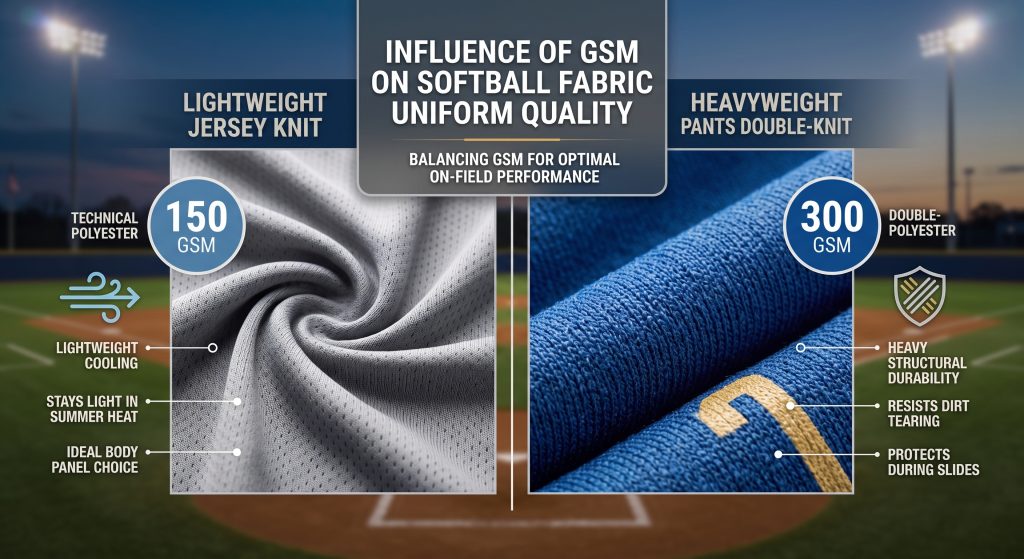
Fabric weight measured in grams per square meter directly influences softball fabric uniform quality by determining whether a garment provides lightweight cooling or heavy structural durability. Choosing correct material weight ensures jerseys stay light during summer play while sliding pants resist dirt tearing. Incorrect GSM selection leads to either fragile jerseys or hot, uncomfortable uniforms on field.
Lightweight 150 GSM knits work best for jersey body panels, while heavy 300 GSM double knits protect sliding pants. Balancing GSM specifications across garment lines guarantees optimal field performance.
What Is the Ideal GSM Range for Fastpitch Game Jerseys?
The ideal GSM weight range for fastpitch game jerseys sits between 150 GSM and 180 GSM for balanced breathability. Here is the kicker… jerseys under 140 GSM risk tearing under pad friction during play.
- 150-160 GSM delivers ultra-light airflow for hot summer tournaments.
- 170-180 GSM provides additional tensile strength for contact plays.
- Balanced weight prevents garment sag when soaked with sweat.
You can customize uniform performance by selecting exact fabric weight ranges for specific position needs. Targeted GSM choices keep your athletes comfortable and agile.
How Does Fabric Density Affect Sublimation Graphic Clarity?
Denser knit structures provide smoother printing surfaces that produce sharper logo edges during sublimation dye transfers. Check this out: loose, low-density mesh creates distorted graphic details and blurry edges.
- Dense yarn spacing absorbs sublimation inks uniformly across panels.
- Smooth surface knits render fine logo details crisply.
- Consistent fabric density prevents color distortion when stretched.
When you print on high-density synthetic textiles, team sponsor logos look crisp and professional. Superior print definition raises the perceived value of your apparel line.
Key Takeaway: Selecting 150-180 GSM for tops and 280-300 GSM for bottoms guarantees optimal comfort and durability.
| Uniform Component | Recommended GSM | Performance Benefit |
| Game Jerseys | 150 – 180 GSM | Ultra-Light Airflow & Stretch |
| Sliding Pants | 280 – 320 GSM | Maximum Impact & Tear Protection |
| Sublimated Trim | 170 – 200 GSM | High Graphic Resolution & Clarity |
Weight specification data confirms that matching GSM to garment function maximizes player comfort and graphic sharpness.
Can Sublimation Printing Enhance Softball Fabric Color Retention?
Digital sublimation printing enhances softball fabric color retention by permanently fusing gaseous dyes directly into synthetic polyester fibers at high heat. Traditional screen printing coats fabric surfaces with thick rubberized inks that crack, peel, and fade after repeated laundering. Sublimated colors become an integral part of the yarn structure, guaranteeing vibrant graphics season after season.
Sublimation dye processes preserve full mesh breathability because inks do not clog open ventilation pores. Customized team numbers and sponsor logos remain soft, flexible, and fade-resistant throughout heavy use.
How Does Sublimation Bonding Keep Mesh Pores Open?
Sublimation printing transforms solid dye into gas under heat, bonding color into polyester molecules without coating the surface. Look at the facts: surface screen print inks seal mesh holes, blocking air passage.
- Gaseous dye fusion leaves micro-mesh pores completely open for airflow.
- Zero ink weight maintains lightweight garment feel on skin.
- Soft printed panels prevent stiff graphic patches across chest areas.
You will preserve full ventilation performance across printed team jerseys by using digital sublimation. Players stay cool while displaying complex, multi-colored graphic artwork.
Why Is High Color Fastness Needed for Frequent Washing?
High colorfastness ratings guarantee that dark team panels will not bleed into white accent stripes during hot laundering cycles. What’s the real story? grade 4-5 colorfastness keeps red, navy, and black dyes locked firm.
- Grade 4-5 colorfastness stops dye migration across contrast seams.
- UV-resistant inks prevent sun bleaching during outdoor games.
- Fade-free graphics maintain professional team appearance multi-season.
When you supply sublimated uniforms to fastpitch clubs, team colors remain bright after dozens of washings. Superior color retention builds strong buyer confidence in your brand.
Key Takeaway: Sublimation printing guarantees permanent, fade-free team colors while preserving full fabric breathability.
| Printing Metric | Traditional Screen Print | Digital Sublimation |
| Breathability Impact | Blocks Mesh Pores | Leaves Pores 100% Open |
| Graphic Durability | Cracks & Peels Over Time | Permanent Molecular Bond |
| Hand-Feel | Stiff Rubberized Layer | Soft & Weightless |
Printing test evaluations prove sublimation delivers permanent color fastness without sacrificing fabric airflow.
What Abrasion Tests Guarantee High Quality Softball Fabric?
Standardized Mullen bursting strength tests and Martindale abrasion trials guarantee high quality softball fabric by measuring exact resistance against physical tearing and friction wear. Laboratory testing simulates extreme game conditions, verifying that materials withstand hard sliding and tackle friction. Certified lab test results provide clothing brands with objective proof of material durability before mass manufacturing.
Mandating certified test reports prevents catastrophic garment failures on field during competitive play. High-grade sports textiles consistently pass strict bursting pressure and friction rub thresholds.
How Does Mullen Bursting Testing Prevent Game Day Tears?
Mullen bursting testing applies multidirectional hydraulic pressure against fabric swatches until the material ruptures. Ready for the good part? high bursting strength ratings guarantee seams won’t pop during sliding plays.
- Hydraulic pressure tests verify multi-directional seam strength.
- High burst ratings stop sudden garment blowouts on field.
- Reinforced synthetic knits withstand over 500 kilopascals of pressure.
You can avoid costly customer return claims by insisting on high Mullen test scores for all sliding pant materials. Certified bursting resistance keeps players protected during aggressive sliding.
Why Is Martindale Abrasion Resistance Needed for Pants?
Martindale abrasion testing rubs abrasive wool against fabric surfaces thousands of times to measure wear resistance. This is where it gets interesting… materials passing 35,000 rub cycles resist dirt wear without thinning.
- Martindale testing measures surface resistance to dirt friction.
- Pilling resistance scores of grade 4-5 preserve clean fabric texture.
- Abrasion-resistant yarns protect sliding pant knees from premature wear.
When you specify lab-tested textiles for team gear, your garments withstand harsh season-long abuse. Reliable wear resistance builds long-term brand credibility among sports buyers.
Key Takeaway: Verifying lab-certified bursting and abrasion test reports protects your brand against quality defects.
| Quality Test | Minimum Commercial Grade | Professional Athletic Grade |
| Mullen Bursting Strength | 250 kPa | 500+ kPa |
| Martindale Abrasion | 15,000 Rubs | 35,000+ Rubs |
| Pilling Resistance | Grade 3 | Grade 4 – 5 |
Lab quality standards demonstrate that professional-grade textiles offer double the physical strength of standard fabrics.
How Do You Select Softball Fabric for Doubleheader Tournaments?
Selecting specialized softball fabric featuring UPF 30+ solar protection and dual-action capillary wicking keeps athletes safe and comfortable during all-day doubleheader tournaments. Fastpitch teams frequently play multiple back-to-back games under intense summer sun exposure. Without built-in sun shielding and rapid sweat-wicking mechanics, players suffer severe sunburns and heat exhaustion.
Combining UV-blocking yarn treatments with open micro-mesh ventilation guarantees continuous cooling and solar protection. High-performance tournament textiles keep players feeling energetic from first pitch to final out.
Why Are UPF Sun Protective Finishes Necessary Outdoors?
UPF 30+ sun protective finishes embedded into synthetic fibers block harmful ultraviolet rays from reaching player skin. Here is the kicker… standard thin white t-shirts provide only UPF 5 protection when wet.
- UPF 30-50+ coatings block over 97 percent of harmful UV rays.
- Sun-blocking compounds remain permanently bound inside yarns through washing.
- Solar protection shields athletes during multi-game summer events.
You offer vital health benefits to young athletes when choosing UV-treated sports fabrics for teamwear lines. Built-in solar protection keeps players safe during hot afternoon games.
How Do Moisture Wicking Channels Support All-Day Comfort?
Moisture wicking channels along Y-shaped synthetic fibers pull sweat away from skin instantly for rapid evaporation. Check this out: fast liquid transport prevents heavy, soaked garments during back-to-back matches.
- Capillary yarn grooves draw sweat outward in seconds.
- Hydrophobic fiber properties prevent water retention inside yarns.
- Rapid drying mechanics keep jerseys light across multi-game days.
When you equip teams with fast-drying synthetic uniforms, players remain cool and focused through long tournament days. All-day comfort leads to superior athletic performance on field.
Key Takeaway: Combining UPF sun protection with rapid moisture wicking guarantees all-day tournament comfort.
| Tournament Feature | Standard Athletic Top | UPF Wicking Softball Fabric |
| UV Protection Rating | UPF 5 – 10 (Low) | UPF 30 – 50+ (High) |
| Drying Speed | Moderate | Fast (Under 15 Minutes) |
| All-Day Comfort | Clingy When Wet | Dry & Light All Day |
Field performance data confirms that UV-treated wicking fabrics maintain thermal comfort through extended outdoor games.
Why Partner Direct With Mills for Wholesale Softball Fabric?
Partnering directly with primary manufacturing mills for wholesale softball fabric lowers raw material purchasing costs while guaranteeing exact batch color consistency across recurring production runs. Sourcing through retail craft distributors inflates fabric expenses through middleman price markups. Working directly with primary B2B mills provides custom dyeing options and guaranteed roll availability for growing apparel brands.
Direct mill partnerships streamline supply chain logistics and secure reliable fabric inventory for team reorders. Wholesale volume pricing helps custom sportswear manufacturers maximize profit margins.
How Do Direct Factory Orders Reduce Team Apparel Costs?
Direct factory sourcing eliminates distributor price markups, allowing custom team apparel businesses to secure wholesale pricing. Look at the facts: bulk roll purchasing reduces per-yard material costs significantly.
- Wholesale volume pricing maximizes profit margins for apparel brands.
- Direct mill shipping simplifies global supply chain logistics.
- Flexible minimum order quantities support scalable business growth.
You will improve business profitability substantially by establishing direct factory supply contracts for your sports textiles. Lower material costs give your brand a competitive price advantage.
Why Is Shade Consistency Needed for Uniform Reorders?
Digital lab dip color recipes guarantee precise shade consistency across future fabric production batches. What’s the real story? exact color matching ensures replacement jerseys match existing team uniforms perfectly.
- Digital lab dips eliminate color shade variations between production lots.
- Multi-season roll availability supports ongoing team reorders.
- Certified quality control guarantees uniform material standards across orders.
When you partner with primary B2B mills, your clients receive perfectly matched team uniforms year after year. Dependable color consistency builds long-term customer trust.
Key Takeaway: Direct mill partnerships stabilize supply chains while maximizing profit margins for sportswear brands.
| Supply Channel | Retail Craft Distributors | Direct B2B Textile Mill |
| Pricing Model | Retail Markups | Wholesale Tiered Volume Rates |
| Color Consistency | Variable Shade Lots | Certified Digital Lab Dip Matching |
| Supply Reliability | Irregular Stock | Guaranteed Re-Order Availability |
Sourcing comparison metrics show that direct mill partnerships deliver major financial and operational advantages.
Final Summary & Recommendations
Selecting four-way stretch birdseye mesh for jerseys and heavy double-knit polyester for sliding pants resolves major fastpitch challenges regarding athlete mobility, dirt stain retention, and sliding abrasion. Sourcing engineered synthetic knits directly from primary textile manufacturers eliminates color shade variations while lowering raw material purchasing expenses. If you want to upgrade your team sportswear line with certified, high-performance athletic textiles, contact us today to request your customized sample swatch kit and receive technical guidance from our factory engineering team. At MAKITAPE, supported by Fuzhou HG Textile Co., Ltd., our team remains committed to empowering sports apparel manufacturers worldwide with precision-engineered fabrics that power winning athletic performances.
Frequently Asked Questions
● Q1: Can I mix birdseye mesh and double knit fabric in one uniform set?
Yes, combining both fabrics creates an ideal uniform set that balances breathability with rugged sliding protection. Design teams frequently specify lightweight birdseye mesh for jersey body panels and heavy double-knit polyester for sliding pants.
● Q2: What’s the best GSM weight for fastpitch softball sliding pants?
The best weight range for sliding pants is between 280 GSM and 320 GSM. This heavy double-knit density provides high bursting strength to resist sliding dirt abrasions while protecting player knees from turf burns.
● Q3: How do I know if my softball fabric features soil release technology?
Your fabric features soil release technology when laboratory water-drop tests show liquid mud repelling off the surface without soaking into fibers. Treated synthetic textiles wash 100 percent clean in standard laundry cycles.
● Q4: Can I order custom Pantone shades when buying directly from B2B mills?
Yes, direct B2B textile mills provide custom Pantone color matching and digital lab dip approvals prior to bulk manufacturing. Custom dyeing guarantees exact color uniformity across all team reorders across multiple sales seasons.
● Q5: What’s the best way to prevent graphics from peeling off uniforms?
The best method is selecting digital sublimation printing, which permanently bonds color dyes directly into polyester fibers. Sublimated graphics never peel, crack, or block mesh pores, unlike traditional rubberized inks.