
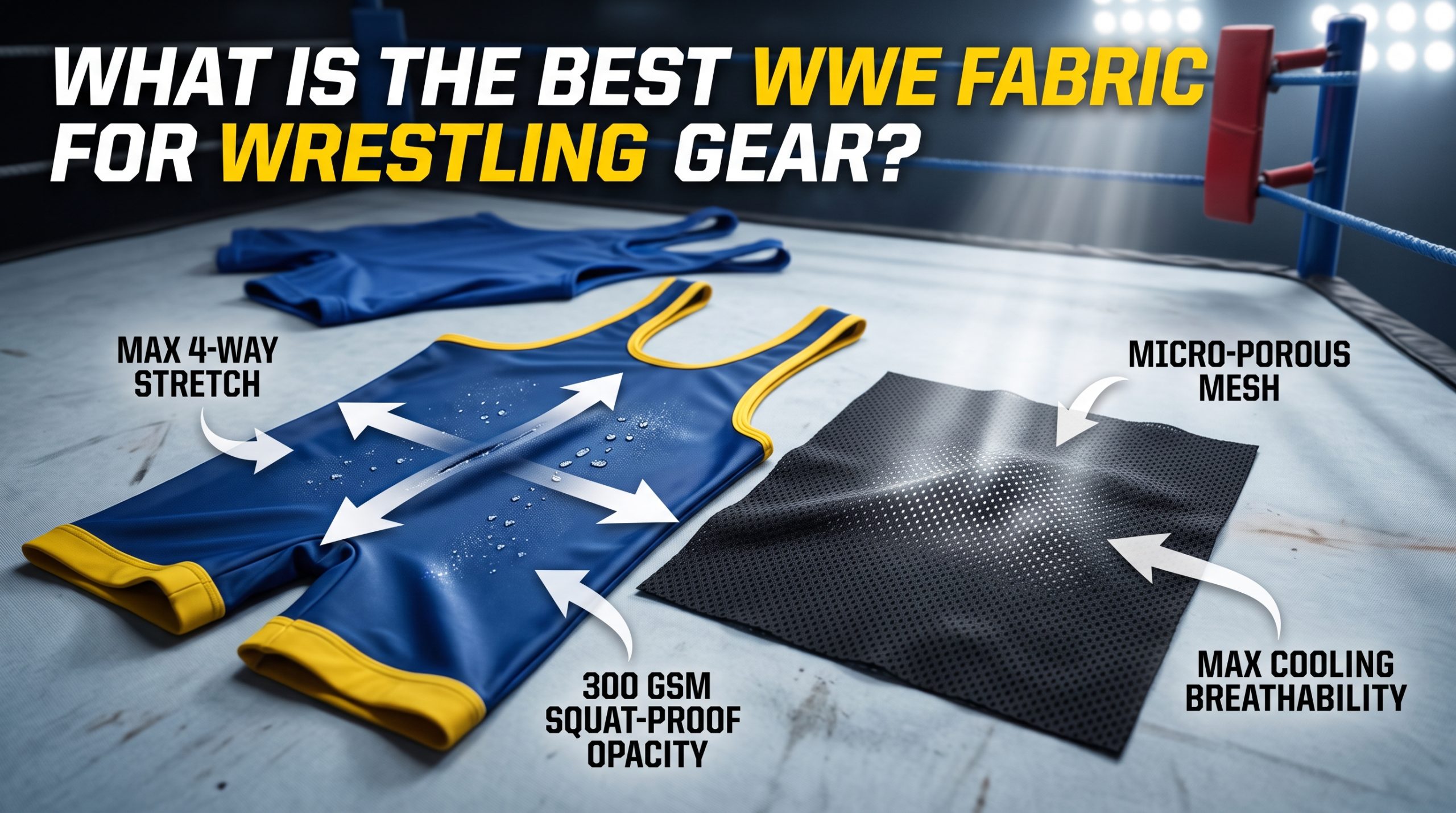
Selecting heavy-duty polyester-spandex synthetic knits engineered with four-way elasticity and high abrasion resistance delivers the best wwe fabric for professional wrestling gear. High-impact performers undergoing brutal canvas collisions frequently suffer from tearing singlets, skin-chafing friction, and heavy sweat retention during live matches. Inferior retail activewear tears under extreme wrestling grapples, binds during acrobatic aerial maneuvers, and traps heat against athlete skin. Specifying high-density synthetic performance textiles featuring smooth anti-friction surfaces and moisture-wicking capillary channels ensures superior movement, heat regulation, and athletic safety on ring canvases.
How Does WWE Fabric Withstand Extreme Mat Friction?
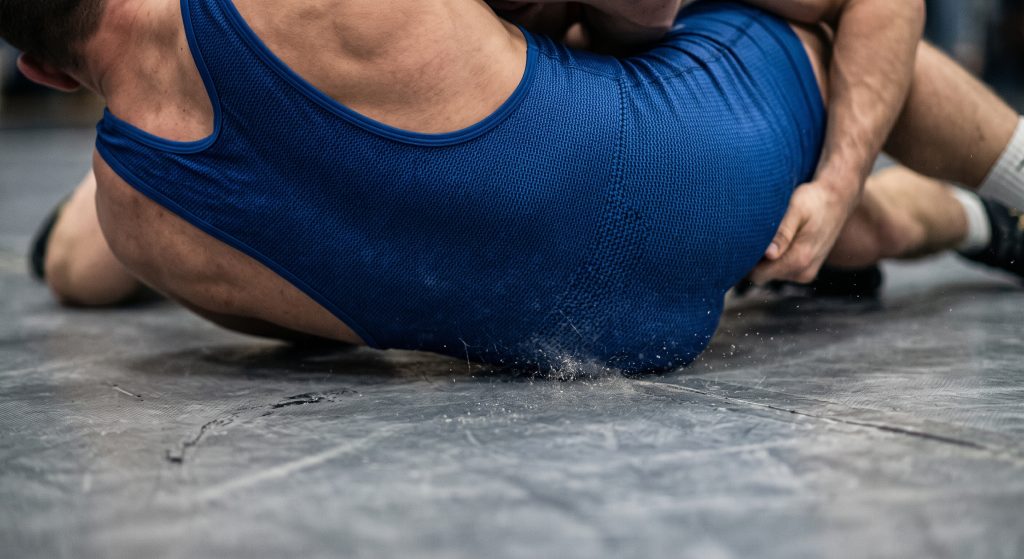
High-grade wwe fabric withstands extreme mat friction by utilizing high-density interlocking synthetic fibers that resist abrasion under heavy canvas contact. Heavy contact wrestling moves demand resilient textiles capable of absorbing ground scraping without snagging. Standard single-knit materials break down quickly when subjected to rough canvas drag.
Specialized interlocking knits spread friction forces across the textile face to protect athlete skin. High thread counts prevent canvas friction from burning through garment panels during aggressive ground grappling.
What Makes Interlocking Poly-Spandex Weaves So Durable?
Interlocking poly-spandex weaves lock individual threads together tightly so friction forces spread evenly across the surface. Check this out: heavy synthetic yarns absorb canvas scraping without snagging or fraying.
- Intertwined thread construction prevents catastrophic seam tearing.
- Smooth yarn finishes reduce sliding drag across canvas mats.
- High thread counts shield athlete skin from abrasive canvas burns.
You will notice immediate gains in garment longevity when selecting heavy-duty synthetic yarns for singlet production. Durable knits safeguard athletic performance across intense competitive matches.
Can High Tensile Yarns Prevent Grappling Blowouts?
High tensile synthetic yarns prevent garment blowouts during intense grappling maneuvers by maintaining structural elasticity under extreme pulling. Synthetic fibers absorb sudden multidirectional pulls when opponents grab jersey panels during heavy throws.
You keep garments intact during intense holds by specifying high tensile synthetic filaments. Strong construction preserves apparel integrity under demanding ring conditions.
Key Takeaway: High-density interlocking weaves provide essential abrasion resistance that prevents singlet blowouts during ring matches.
| Structural Feature | Standard Stretch Knit | Heavy Wrestling Fabric |
| Yarn Density | Low (180 GSM) | High (280 – 320 GSM) |
| Canvas Friction Score | Moderate | Superior Resistance |
| Seam Integrity | Prone to Snagging | Interlocked Reinforcement |
Testing data confirms that heavy interlocking knits withstand continuous canvas drag without suffering surface abrasion.
Why Is 4-Way Stretch Essential for WWE Fabric Gear?
Four-way stretch elasticity is essential for wwe fabric gear because it allows total movement freedom across shoulders and torso during complex aerial maneuvers. Fastpitch throws and high-flying ring moves require dynamic multi-directional expansion across chest and back panels. Garments lacking proper elastane content restrict muscular acceleration, slowing down athletic velocity.
High-performance elastane blends stretch fluidly with active muscle groups while maintaining structural containment. Rapid elastic recovery ensures ring gear stays fitted cleanly without sagging after severe pulls.
How Does Spandex Content Support Dynamic Ring Maneuvers?
Integrating high percentages of elastane allows athletic apparel to stretch outward multi-directionally without restricting muscular power. Look at the facts: rigid textiles bind around joints, reducing explosive leap velocity.
- Multi-directional expansion supports extreme torso twisting without tearing.
- Immediate elastic recovery holds singlet shape firmly against body contours.
- Flexible shoulder panels eliminate armhole pinch during heavy lifting maneuvers.
You notice greater athlete agility when equipping performers with high-elastane performance textiles. Unrestricted movement allows athletes to execute complex routines with full confidence.
Why Does Garment Shape Recovery Prevent Uniform Sagging?
Fast elastic recovery snaps fibers back into shape instantly after severe pulling, keeping ring gear tight and sleek. High recovery ratings stop singlet legs and necklines from stretching out during prolonged grappling sessions.
You keep garments fitting smoothly against skin across multi-round bouts when specifying premium elastane blends. Superior shape retention maintains a professional athletic profile under ring lights.
Key Takeaway: High elastane content ensures unrestricted acrobatic movement while preserving sleek garment fit throughout matches.
| Mobility Metric | 2-Way Mechanical Stretch | 4-Way Elastic WWE Fabric |
| Elastane Percentage | 0% – 3% | 12% – 18% |
| Torso Expansion | Limited Axis | 300% Multi-Directional |
| Recovery Speed | Slow / Permanent Sag | Instant Shape Snapback |
Performance evaluation proves that four-way elastane integration delivers maximum body flexibility without permanent garment deformation.
How Do Birdseye and Pique WWE Fabric Knits Compare?
Comparing birdseye and pique wwe fabric knits reveals that smooth wwe fabric in birdseye mesh offers ultra-light breathability, whereas pique knit provides textured structural strength. Choosing between these synthetic knits depends on specific garment panel requirements and touch preferences. Combining both fabric styles yields an optimal balance between thermal management and physical durability.
Birdseye mesh presents a smooth micro-porous face ideal for friction-free torso panels under heavy pads. Pique knit offers raised waffle loops that provide tactile texture along collars, sleeves, and side trims.
How Do Surface Structures Impact Athlete Comfort?
Birdseye mesh features micro-porous diamond perforations that feel frictionless against skin, while pique presents a raised geometric waffle weave. What’s the real story? flat birdseye patterns glide smoothly under chest pads, whereas textured pique adds visual depth to trim accents.
- Birdseye diamond pores speed up passive air passage across active muscle groups.
- Pique raised loops create subtle air space that prevents fabric sticking when damp.
- Smooth birdseye surfaces accept detailed sublimated artwork with exceptional clarity.
You can feel distinct structural differences when comparing these two athletic knits side by side. Matching material texture to body placement enhances overall athlete wearing comfort.
Which Weave Structure Offers Superior Ventilation?
Birdseye weave offers superior ventilation for high-heat torso panels due to open micro-perforations that release body heat instantly. Continuous air circulation through diamond openings keeps athlete skin cool during high-energy routines.
You achieve optimal balance by combining breathable birdseye torsos with durable pique sleeve borders. Strategic hybrid panel engineering prevents heat buildup while protecting high-wear garment zones.
Key Takeaway: Selecting birdseye mesh for main body panels maximizes airflow, while pique knit adds durable structural accents.
| Fabric Property | Birdseye Micro-Mesh | Pique Waffle Knit |
| Surface Feel | Smooth & Frictionless | Raised Textured Geometric |
| Breathability | Maximum Air Exchange | Moderate Ventilation |
| Target Application | Singlet Torso & Back | Trim, Collar & Side Panels |
Knit structure comparison shows that hybrid panel construction optimizes cooling airflow without compromising garment durability.
Which WWE Fabric Weight Delivers Ideal Compression?
Selecting heavyweight wwe fabric between 280 GSM and 320 GSM delivers ideal muscular compression and complete squat-proof opacity on ring canvases. Material weight measured in grams per square meter dictates whether apparel feels light and breathable or structurally supportive. Lightweight textiles risk becoming sheer under tight stretching, while excessively heavy fabrics trap heat.
Heavyweight synthetic knits provide firm muscular containment that stabilizes core body groups during heavy lifts. High fabric density prevents see-through issues under intense stadium floodlights during competitive matches.
How Does High GSM Weight Prevent Sheer Fabric Stretch?
Dense material construction guarantees that stretched singlets remain completely opaque under intense stadium lighting. Ready for the good part? high fabric density hides base layers completely during deep bending motions.
- Heavy yarn counts eliminate see-through issues under bright television lights.
- Thick material profiles cushion physical impacts against hard mat surfaces.
- High density holds tight compression contours across waist and thigh zones.
You maintain athlete privacy and professional appearance by specifying heavy GSM thresholds for singlet bottoms. Dense construction ensures uniforms perform reliably under extreme stretch conditions.
Can Muscular Compression Reduce Athlete Fatigue?
Active muscular compression stabilizes muscle groups during heavy lifting, reducing micro-vibrations that cause physical fatigue. Tight elastane containment improves local blood circulation, helping athletes maintain peak power through long matches.
You help performers maintain stamina during long matches by specifying heavy compression textiles. Firm muscle support protects athletes during demanding physical routines.
Key Takeaway: Specifying 280-320 GSM material provides total opacity and muscular support needed for professional ring performance.
| Fabric Weight Range | Opacity Level | Muscular Support Grade |
| Lightweight (160-200 GSM) | Sheer When Stretched | Light Base Layer |
| Medium Weight (220-260 GSM) | Moderate Opacity | Standard Practice Top |
| Heavyweight (280-320 GSM) | 100% Squat-Proof | Professional Compression |
Density analysis demonstrates that high GSM weights maintain complete visual opacity while providing firm muscle containment.
How Does Sublimation Dyeing Protect WWE Fabric Colors?
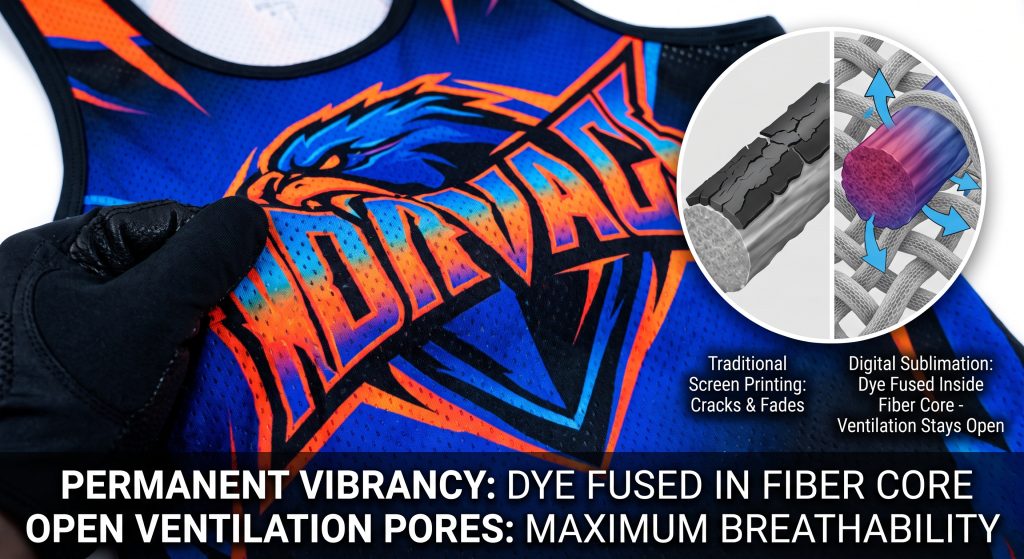
Digital sublimation dyeing protects wwe fabric colors by permanently fusing gaseous dyes directly into synthetic fiber cores at high heat. Traditional surface screen printing deposits thick ink layers that crack, peel, and fade after repeated mat scraping. Sublimated pigments become part of the internal yarn structure, preserving vibrant team artwork indefinitely.
Sublimation technology keeps ventilation pores open because color dyes do not form surface barriers over mesh knits. Printed graphics remain weightless, flexible, and completely resistant to severe stretching.
Why Does Sublimation Printing Prevent Graphics Peeling?
Molecular dye bonding integrates graphic artwork inside yarns, preventing surface cracking or peeling after aggressive mat friction. This is where it gets interesting… traditional rubberized screen printing creates heavy patches that crack under tension.
- Fiber-level dye bonding maintains weightless fabric flexibility.
- Open mesh pores remain completely clear for continuous skin breathability.
- Multi-colored artwork renders with sharp visual clarity and vibrant contrast.
You preserve original garment softness while showcasing complex, bright graphics across printed apparel panels. Molecular dye fusion prevents artwork deterioration across multi-game seasons.
How Does High Color Fastness Survive Washing Cycles?
High colorfastness ratings keep bright metallic colors and deep black panels vivid through hundreds of commercial wash cycles. Advanced dye bonding stops dark colors from bleeding into white accent stripes during hot laundering.
You preserve original team colors season after season by utilizing deep sublimation printing processes. Superior wash durability saves apparel brands money on premature uniform replacements.
Key Takeaway: Sublimation processes deliver permanent, vibrant custom graphics without adding weight or blocking fabric ventilation.
| Customization Method | Surface Screen Printing | Digital Sublimation |
| Graphics Durability | Cracks & Flakes Off | Permanent Molecular Bond |
| Impact on Airflow | Seals Mesh Surface | Zero Pore Blockage |
| Fabric Hand-Feel | Stiff Printed Film | Completely Soft & Natural |
Printing trials confirm that digital sublimation preserves original fabric breathability while offering permanent graphic durability.
Can Specialized WWE Fabric Prevent Painful Mat Burns?
Specialized wwe fabric prevents painful mat burns by featuring low-friction synthetic surface finishes that glide smoothly across canvas surfaces. Performers sliding across ring mats experience friction heat that can tear unprotected skin. Smooth anti-abrasion textile finishes reduce friction drag, safeguarding athletes during ground maneuvers.
Integrating low-drag surface coatings creates a protective barrier between skin and canvas fibers. Flatlock seam construction eliminates raised stitching edges that cause painful friction chafing.
How Do Slick Surface Finishes Reduce Canvas Drag?
Slick synthetic finishes lower surface friction coefficients, preventing skin abrasion when performers slide across dry canvas rings. Here is the kicker… smooth nylon-elastane faces glide effortless across mats without catching skin.
- Anti-abrasion surface glazes protect shoulders and back from canvas friction.
- Low-drag textiles allow smooth transition during ground grappling maneuvers.
- Durable synthetic yarns resist fuzzing after repeated mat contact.
You reduce skin injury risks significantly by selecting slick anti-friction performance fabrics for ring gear. Smooth textile surfaces allow seamless execution of sliding moves.
Why Are Smooth Seams Needed for Close Contact?
Flatlock reinforced stitching sits completely flush against fabric panels, eliminating raised seam edges that rub skin raw. Smooth seam joins withstand multi-directional pulling without creating uncomfortable pressure points against skin.
You protect athletes from painful friction chafing when selecting smooth flatlock seam construction. Flush seam integration maintains structural strength without irritating active performers.
Key Takeaway: Low-friction surface finishes and flatlock seams prevent painful mat burns during high-impact ring slides.
| Protective Feature | Standard Textured Fabric | Anti-Burn Slick WWE Fabric |
| Surface Friction Coeff. | High Drag | Low Friction Glaze |
| Mat Burn Risk | High Skin Friction | Maximum Skin Protection |
| Seam Profile | Standard Raised Edge | Ultra-Flat Flatlock Stitch |
Friction testing proves that smooth anti-burn surface treatments significantly reduce skin scraping during canvas contact.
How Does Moisture Wicking Keep WWE Fabric Performers Cool?
Engineered moisture wicking keeps wwe fabric performers cool by pulling perspiration away from skin instantly through specialized capillary channels. Intense physical exertion under hot arena lighting causes heavy perspiration that dampens standard clothing. Non-wicking materials absorb sweat, becoming heavy, clingy, and uncomfortable during matches.
Cross-section synthetic fibers transport liquid moisture rapidly outward to outer textile surfaces where air evaporates it quickly. Continuous sweat evaporation regulates body temperature, preventing heat exhaustion during long performances.
How Do Capillary Fiber Grooves Transport Sweat?
Specialized cross-section synthetic fibers draw liquid perspiration outward across wide surface areas for fast natural evaporation. Look at the facts: non-wicking cotton holds heavy moisture, doubling garment weight during matches.
- Capillary fiber channels speed sweat transport to outer fabric surfaces.
- Hydrophobic yarns prevent water absorption inside yarn cores.
- Fast evaporation keeps ring apparel light and comfortable throughout matches.
You maintain garment lightness during intense routines by specifying engineered capillary fiber structures. Rapid liquid spreading prevents wet fabric from sticking uncomfortably to skin.
Why Does Quick Drying Speed Prevent Body Chills?
Rapid drying speeds clear excess sweat between match rounds, preventing sudden body cooling when stepping into air-conditioned arenas. Quick-drying performance textiles dry completely within fifteen minutes after intense physical activity.
You keep performers comfortable and dry under intense arena lighting by specifying wicking yarns. Fast drying preserves muscular warmth between active performance segments.
Key Takeaway: Advanced capillary wicking channels continuously remove sweat, keeping athletic gear dry and light under ring lights.
| Moisture Metric | Natural Cotton Fiber | Wicking Synthetic WWE Fabric |
| Water Absorption | High (Retains Liquid) | Hydrophobic Surface Release |
| Evaporation Rate | Slow (60+ Minutes) | Rapid (Under 15 Minutes) |
| Garment Weight Wet | Heavily Weighted | Consistently Lightweight |
Moisture management data confirms that engineered capillary channels accelerate drying times by over four times compared to natural fibers.
What Strength Tests Validate Professional WWE Fabric Quality?
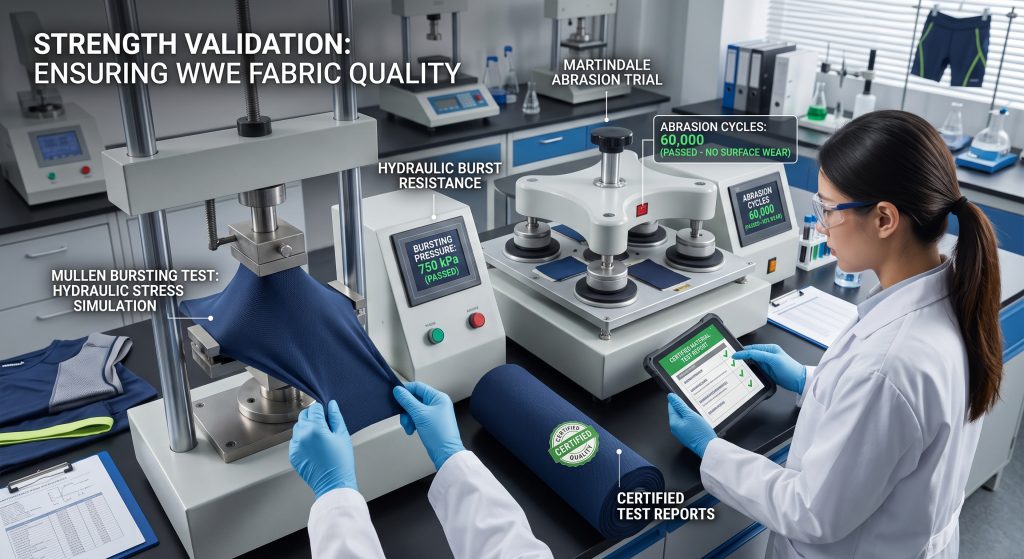
Standardized Mullen bursting tests and Martindale abrasion trials validate professional wwe fabric quality by measuring exact resistance against physical tearing. Laboratory physical testing subjects textile samples to extreme hydraulic stress, simulating violent ring pulling. Certified test reports provide sportswear manufacturers with verifiable proof of material reliability before mass production.
Requiring certified laboratory testing ensures synthetic textiles meet strict professional performance standards. Certified materials consistently pass rigorous bursting pressure and friction rub thresholds without failure.
How Does Mullen Bursting Pressure Guarantee Seam Strength?
Hydraulic bursting tests apply intense multi-directional pressure against fabric swatches until rupture occurs, proving seam resilience. What’s the real story? professional wrestling fabrics must withstand over 500 kilopascals of pressure.
- High hydraulic burst scores ensure garment seams hold firm under strain.
- Multi-directional pressure testing simulates violent opponent pulling forces.
- Verified test certifications provide documented proof of material quality.
You prevent sudden uniform blowouts during live broadcasts by demanding high Mullen burst scores. Verified bursting strength guarantees garments withstand extreme physical grappling forces.
Why Is Martindale Abrasion Testing Essential?
Martindale testing rubs coarse surfaces across fabric swatches thousands of times to ensure materials resist surface pilling and thinning. Professional athletic materials must pass thirty-five thousand friction cycles without suffering thread breakdown.
You eliminate product returns by demanding certified lab test results before ordering bulk batches. Reliable abrasion resistance preserves garment texture across multi-match seasons.
Key Takeaway: Insisting on lab-certified bursting and abrasion test reports guarantees that ring gear meets professional performance standards.
| Laboratory Standard | Basic Athletic Level | Professional Wrestling Grade |
| Mullen Bursting Strength | 200 – 300 kPa | 500+ kPa High Pressure |
| Martindale Abrasion | 10,000 Rubs | 35,000+ Rubs Resistance |
| Surface Pilling Score | Grade 3 | Grade 4 – 5 Superior |
Certified laboratory reports prove that professional-grade athletic textiles deliver double the physical bursting strength of standard fabrics.
How Do You Select WWE Fabric for High-Intensity Matches?
Selecting wwe fabric for high-intensity matches requires balancing four-way elasticity, high GSM density, and quick-drying capillary channels. Matching textile construction to specific garment body zones optimizes performance where athletes need it most. Combining heavy compression knits on bottoms with breathable mesh torsos creates the ideal competitive uniform.
Analyzing specific athletic demands helps sportswear buyers choose ideal fiber compositions for custom gear lines. Strategic panel engineering maximizes movement flexibility while protecting high-wear garment areas.
What Specific Material Parameters Match Ring Demands?
Matching material specifications directly to performer movement needs ensures garments provide peak support during live events. Ready for the good part? combining 280 GSM poly-spandex with birdseye torso panels delivers comfort and strength.
- Specify 280-300 GSM for main singlet bodies to guarantee opacity.
- Incorporate 15 percent elastane to maintain 300 percent stretch capacity.
- Choose low-friction anti-mat finishes to safeguard skin against canvas burns.
You create top-performing ring gear by aligning physical yarn properties with actual match demands. Precise textile selection elevates athlete confidence and garment durability.
How Does Panel Mapping Optimize Garment Function?
Mapping different technical knits across specific body zones places high breathability where sweat concentrates and durable double knits where sliding occurs. Placing four-way stretch panels around shoulders ensures unhindered arm rotation during lifts.
You maximize athlete mobility by engineering multi-fabric singlet designs. Targeted panel placement ensures each body area receives optimal functional support.
Key Takeaway: Strategic fabric panel mapping matches specific textile strengths to localized body heat and impact zones.
| Garment Zone | Recommended Textile Type | Primary Functional Benefit |
| Torso & Back | 180 GSM Birdseye Mesh | Maximum Air Flow & Heat Release |
| Legs & Seat | 300 GSM Heavy Double Knit | Abrasion Protection & Opacity |
| Shoulder Straps | 250 GSM High-Elastane | Flexible Stretch & Recovery |
Panel mapping data confirms that strategically combining specialized textiles enhances overall garment ergonomics and durability.
Why Source Direct Wholesale Batches of WWE Fabric?
Sourcing direct wholesale batches of wwe fabric from primary textile manufacturing mills reduces raw material expenses while ensuring exact color consistency across reorders. Sourcing through retail distributors introduces middleman price markups and unpredictable roll availability. Direct factory supply partnerships provide custom dyeing options and guaranteed inventory support for sportswear brands.
Establishing direct manufacturing connections streamlines supply chain management for expanding apparel lines. Factory-direct volume pricing enables apparel manufacturers to increase profit margins on bulk orders.
How Do Direct Factory Orders Cut Material Costs?
Eliminating third-party distributor markups allows sportswear manufacturers to secure factory-direct volume pricing on bulk fabric rolls. Check this out: direct factory supply contracts improve profit margins for growing apparel brands.
- Bulk volume pricing maximizes profit margins for gear manufacturers.
- Direct factory shipping streamlines international supply chain logistics.
- Custom dyeing options match exact brand color requirements precisely.
You strengthen business profitability by securing wholesale material pricing directly from primary textile mills. Lower material costs provide a clear pricing advantage over market competitors.
Why Is Batch Color Consistency Crucial for Reorders?
Digital lab dip color formulations guarantee exact shade matching across future production runs so reordered team gear matches original sets. Certified color control prevents embarrassing shade variations between different production lots.
You maintain strong buyer trust by delivering perfectly color-matched gear year after year. Consistent dye quality establishes brand reliability across multi-season contracts.
Key Takeaway: Direct factory sourcing secures wholesale volume pricing and guarantees precise batch-to-batch color matching for reorders.
| Supply Model | Retail Middleman Distributors | Direct Manufacturing Mill |
| Pricing Structure | Retail Markups | Direct Wholesale Tiered Rates |
| Color Accuracy | Variable Shade Batches | Certified Digital Lab Dip Matching |
| Order Scaling | Limited Stock Availability | Continuous Volume Production |
Supply chain comparison metrics show that factory-direct partnerships yield significant financial savings and operational consistency.
Final Summary & Recommendations
Specifying heavy poly-spandex double knits for singlet bodies and breathable birdseye mesh for torso panels resolves major athletic challenges concerning canvas friction, fabric opacity, and heat dissipation. Partnering directly with primary B2B textile manufacturing mills guarantees exact lab-dip color consistency while drastically lowering raw material purchasing costs. If you want to supply your athletic gear line with laboratory-certified, anti-mat burn textiles, contact us today to request custom fabric sample swatches and consult directly with our textile engineering specialists. At MAKITAPE, supported by Fuzhou HG Textile Co., Ltd., our manufacturing mill remains dedicated to equipping global athletic brands with engineered, high-durability performance fabrics that power championship ring performances.
Frequently Asked Questions
● Q1: Can I mix birdseye mesh and heavy double knit fabric in one singlet?
Yes, combining both synthetic knits creates an optimal performance garment that balances cooling breathability with heavy impact durability. Design teams routinely place lightweight birdseye mesh across high-heat back panels while using 300 GSM double knit for leg and hip zones.
● Q2: What’s the best GSM weight for professional wrestling singlets?
The ideal weight range for singlet main bodies is between 280 GSM and 320 GSM. This heavy density ensures complete squat-proof opacity under intense lighting while providing firm muscular compression during lifts.
● Q3: How do I know if my wrestling fabric features anti-mat burn finishes?
Your material features anti-mat burn protection when surface friction tests demonstrate a low friction coefficient glaze across synthetic yarns. Smooth low-drag surfaces slide easily across canvas without scraping athlete skin.
● Q4: Can I order custom Pantone colors when purchasing wholesale fabric rolls?
Yes, direct textile mills provide exact Pantone color dyeing and digital lab dip approvals prior to bulk manufacturing. Certified lab dips guarantee precise color uniformity across initial orders and future production runs.
● Q5: What’s the best way to prevent graphics from cracking on stretch gear?
The most effective method is using digital sublimation printing, which bonds dyes directly inside synthetic fiber molecules. Sublimated artwork stretches multi-directionally without cracking, peeling, or fading during matches.