
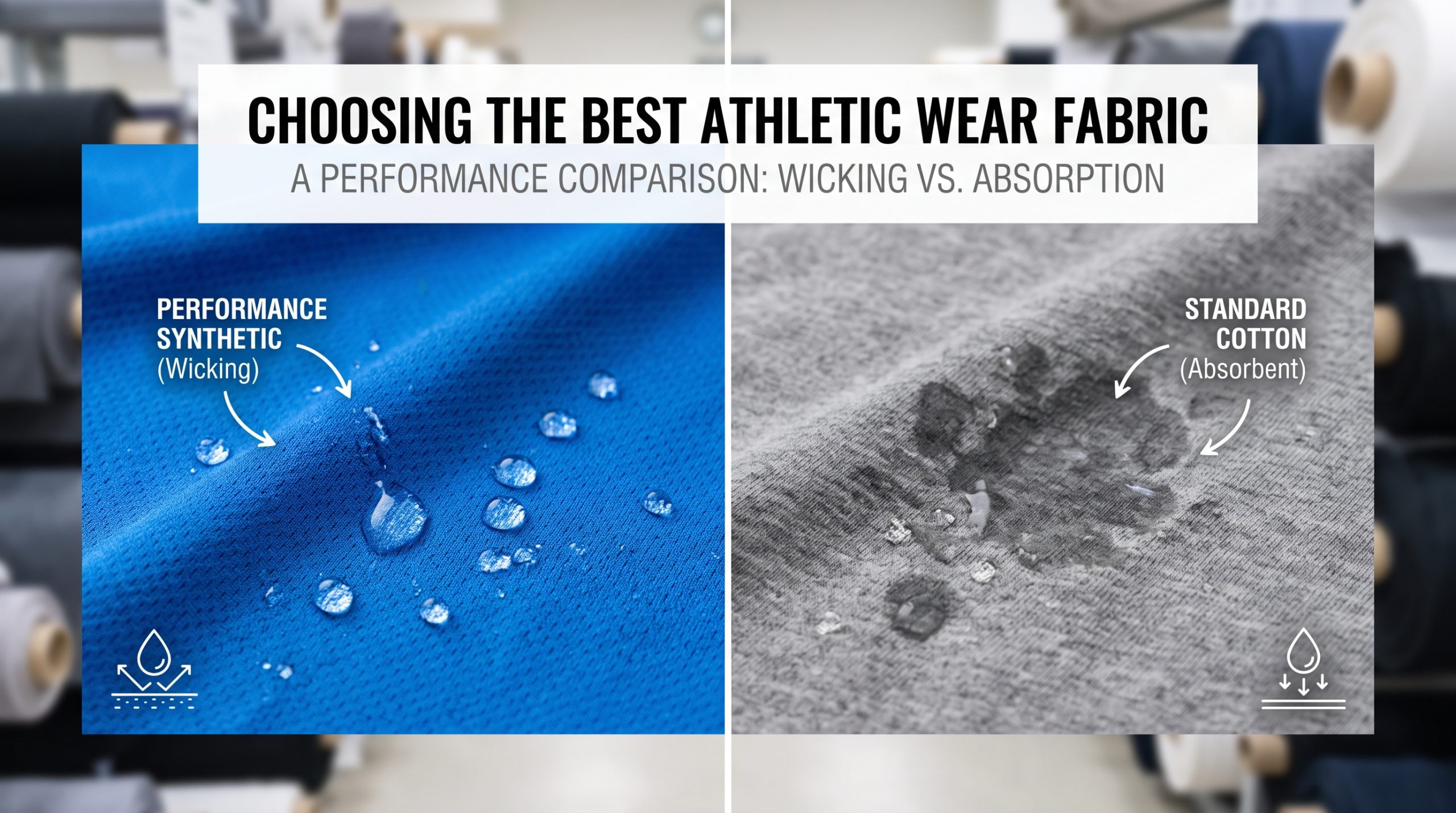
Selecting engineered synthetic poly-spandex blends with moisture-wicking capillary channels and four-way elasticity delivers the best athletic wear fabric for high-intensity training gear. Active apparel manufacturers constantly face complaints when low-grade garments trap sweat against skin, lose elastic recovery after repeated washing, or tear during intense physical motion. Sourcing cheap retail textiles creates fragile sportswear lines that cling uncomfortably to athletes, trigger friction chafing, and fail under physical strain. Specifying technical high-density knits featuring hydrophobic fibers, anti-chafing surface glazes, and high GSM ratings ensures peak muscular mobility, breathability, and thermal control during demanding workouts.
What Is the Primary Role of Athletic Wear Fabric?
The primary role of athletic wear fabric centers on regulating body temperature while providing unrestricted physical mobility through specialized synthetic fiber construction. Standard apparel textiles trap excess body heat and retain heavy perspiration during intense workouts. Modern sportswear requires technical materials capable of shielding skin against friction while maintaining structural containment across active muscle groups.
What Makes Synthetic Fiber Foundations So Popular?
Synthetic fiber foundations offer unmatched strength and moisture resistance that natural fibers simply cannot match during intense exertion. Check this out: raw polyester filaments expel water instantly while maintaining structural integrity under heavy multi-directional pulling forces.
- Hydrophobic properties prevent water retention inside internal yarn structures.
- High tensile strength resists surface tearing during aggressive contact sports.
- Lightweight filament knits reduce overall garment weight during endurance training.
You gain significant competitive advantages by choosing engineered synthetic filaments over traditional textiles. Resilient fiber architecture protects athlete comfort during demanding competitive matches.
How Do Natural Cotton Yarns Fall Short in Motion?
Natural cotton yarns absorb up to eight times their dry weight in liquid sweat, becoming heavy and abrasive against active skin. Damp cotton fibers lose structural elasticity quickly, leading to uncomfortable garment sag and severe friction chafing during long running sessions.
You keep sportswear light and dry by replacing absorbable organic cotton with engineered quick-drying synthetics. Superior fiber engineering guarantees comfortable wearability during grueling athletic performance.
Key Takeaway: Synthetic fiber foundations provide necessary water resistance and structural resilience that organic textiles lack.
| Material Property | Natural Organic Cotton | Engineered Synthetic Fiber |
| Moisture Absorption | High Liquid Retention | Hydrophobic Water Release |
| Dry Time | Slow Evaporation | Rapid Capillary Drying |
| Stretch Recovery | Permanent Shape Distortion | High Elastic Snapback |
Laboratory fiber comparisons confirm synthetic textiles outperform natural cotton across drying speed and elastic shape recovery.
How Does Athletic Wear Fabric Handle Moisture Wicking?
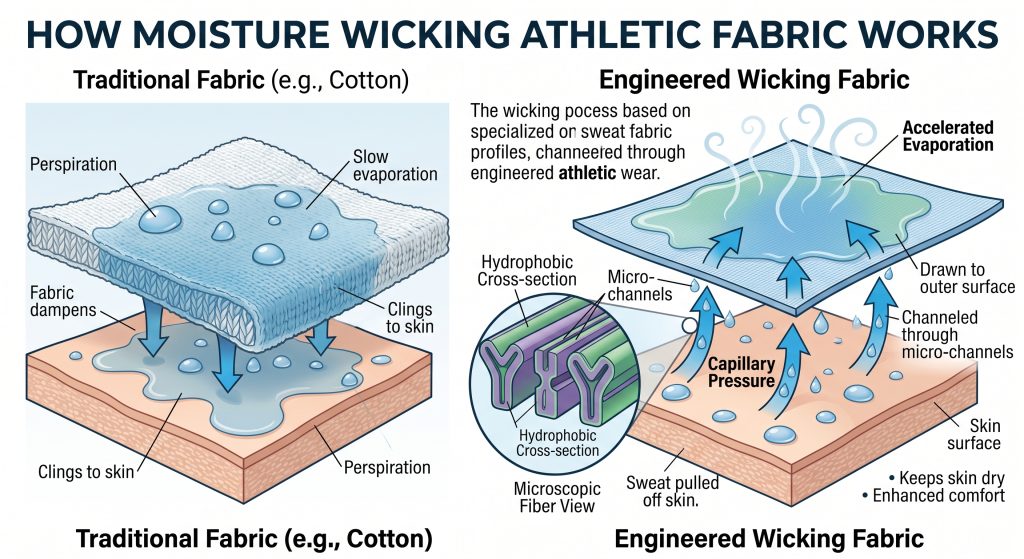
Engineered athletic wear fabric handles moisture wicking by pulling liquid perspiration off skin using specialized micro-channels that accelerate evaporation. Active exertion generates sweat that rapidly dampens low-grade clothing, causing uncomfortable skin sticking. Utilizing hydrophobic cross-section fibers creates capillary pressure that draws moisture outward toward external apparel surfaces.
How Do Capillary Channels Transport Body Sweat?
Capillary channels in specialized yarn profiles pull liquid sweat outward along fiber grooves to outer fabric layers where room air evaporates moisture. Look at the facts: grooved synthetic filaments spread moisture across wider surface areas to speed natural drying processes dramatically.
- Cross-section fiber channels accelerate liquid transport away from damp skin.
- External evaporation prevents heavy moisture accumulation inside garment linings.
- Smooth yarn surfaces minimize skin friction during repetitive athletic movements.
You notice immediate improvements in body temperature management when outfitting athletes in capillary-wicking sportswear. Active sweat transport prevents garment saturation during grueling endurance sessions.
Why Does Quick Drying Prevent Rapid Post-Workout Chills?
Quick drying speeds eliminate damp fabric cling, preventing sudden core temperature drops when athletes transition into air-conditioned gym space. High-performance activewear fabrics dry completely within minutes after intense sweat sessions conclude.
You protect athletes from uncomfortable body chills by selecting fast-drying capillary synthetic textiles. Rapid evaporation maintains optimal muscular warmth between active workout sets.
Key Takeaway: Capillary fiber grooves actively pull sweat away from skin, accelerating natural evaporation to keep athletes dry.
| Moisture Index | Standard Single Knit | Capillary Wicking Knit |
| Wicking Speed | Slow Surface Absorption | Instant Channel Transport |
| Evaporation Rate | Long Drying Cycle | Ultra-Fast Air Drying |
| Garment Feeling | Heavy & Clingy | Light & Friction-Free |
Performance testing reveals that capillary-channeled synthetics evaporate surface moisture three times faster than basic knit materials.
Why Choose Synthetic Blends for Athletic Wear Fabric?
Choosing synthetic blends for athletic wear fabric combines the abrasion resistance of nylon or polyester with the elastic recovery of spandex fibers. Pure polyester lacks adequate stretch, while pure elastane lacks structural strength needed for sportswear durability. Blending these polymer filaments creates dynamic textiles that flex comfortably without losing structural opacity or tensile strength.
What Are the Core Benefits of Poly-Spandex Blends?
Poly-spandex blends deliver lightweight breathability, exceptional color fastness, and multi-directional stretch ideal for sublimation printing and gym wear. Here is the deal: combining polyester filaments with elastane yields supple textiles that accept bright custom graphics without cracking.
- High polyester content absorbs vibrant dye pigments during heat sublimation printing.
- Elastane inclusion provides three hundred percent multi-directional stretch capacity.
- Hydrophobic properties ensure rapid sweat release during high-intensity training.
You gain maximum design versatility and performance reliability when manufacturing activewear using poly-spandex blends. Balanced polymer properties support bright visual customization alongside athletic functional flexibility.
Why Choose Nylon Spandex for Heavy Activewear?
Nylon-spandex blends provide silky hand-feel, supreme abrasion resistance, and firm muscular containment suitable for premium leggings and compression shorts. Ultra-tough nylon filaments withstand heavy surface scraping, making them perfect for ground contact sports and gym floor exercises.
You upgrade product durability significantly by specifying nylon-spandex knits for high-wear sports apparel lines. Superior fiber strength shields garments against surface pilling and fabric tearing.
Key Takeaway: Poly-spandex delivers vibrant printability for activewear tops, while nylon-spandex offers superior abrasion resistance for tights.
| Blend Characteristic | Polyester-Spandex (85/15) | Nylon-Spandex (80/20) |
| Abrasion Grade | High Surface Strength | Extreme Scuff Protection |
| Print Capability | Ideal for Sublimation | Best for Solid Piece-Dyeing |
| Hand-Feel | Soft Matte Finish | Silky Cold-Touch Feel |
Technical material data confirms nylon blends provide maximum surface durability, whereas polyester blends offer superior printing capabilities.
How Do Knits Compare in Athletic Wear Fabric Construction?
Comparing knit constructions reveals that open birdseye mesh maximizes airflow for lightweight tops, whereas dense interlock double knits provide squat-proof coverage for leggings. Construction method dictates how yarns interlock, directly influencing air permeability, stretch resistance, and surface smoothness. Selecting the proper knit type ensures garments match specific athletic functional requirements across different body zones.
How Does Birdseye Mesh Outperform Flat Interlock Knits?
Birdseye mesh features micro-porous geometric perforations that increase passive ventilation across active heat zones during hot weather workouts. What’s the real story? open diamond pores release trapped body heat instantly without compromising surface tear strength.
- Geometric micro-holes maximize airflow across back and underarm panels.
- Smooth face structure prevents friction chafing against active chest skin.
- Lightweight knit density reduces overall garment mass for endurance runners.
You feel noticeable temperature drops when incorporating breathable birdseye mesh into sportswear shirt designs. Strategic mesh placement prevents heat accumulation during intense physical exertion.
What Makes Warp Knits Resilient to Structural Tearing?
Warp knits lock parallel yarn loops vertically and diagonally, preventing laddering runs if surface fibers suffer sharp punctures during contact sports. Rigid vertical loop patterns maintain fabric stability under severe multi-directional tension forces.
You prevent sudden seam tearing and running ladders by selecting warp-knitted synthetic fabrics for athletic uniforms. Secure loop construction guarantees long-lasting apparel durability under harsh playing conditions.
Key Takeaway: Birdseye mesh offers maximum airflow for tops, while warp knits deliver ladder-proof strength for contact apparel.
| Knit Structure | Birdseye Micro-Mesh | Interlock Double Knit |
| Air Permeability | Maximum Air Exchange | Controlled Ventilation |
| Opacity Grade | Semi-Sheer Perforations | 100% Squat-Proof Opacity |
| Primary Placement | Ventilation Tops & Panels | Leggings, Shorts & Bras |
Structure evaluations show that open mesh knits yield four times greater air exchange than heavy double-knit constructions.
What GSM Weight Defines Athletic Wear Fabric Quality?
Selecting athletic wear fabric weight between 150 GSM for tops and 300 GSM for leggings defines quality by balancing breathability against opacity. Fabric weight measured in grams per square meter determines whether material feels light or provides structural containment. Incorrect GSM selection leads to sheer, see-through leggings or excessively hot, suffocating workout shirts.
How Does Heavy GSM Prevent Sheer Fabric Stretch?
Heavy GSM values between 280 and 320 ensure double-knit synthetic fabrics remain completely opaque even under extreme squatting or bending motions. Ready for the good part? dense fiber packing prevents embarrassing sheer transparency when workout tights stretch tightly over hips.
- High fabric density hides undergarments completely during deep lunges.
- Thick yarn packing provides firm compression support across leg muscles.
- Robust structural weight resists surface snagging on gym equipment edges.
You ensure customer satisfaction and brand credibility by maintaining high GSM standards for athletic leggings. Opaque coverage gives athletes full confidence during multi-directional stretching routines.
What Fabric Density Works Best for Lightweight Tops?
Lightweight fabric densities ranging from 140 to 180 GSM work best for activewear shirts, releasing heat quickly without weighing down runners. Thin synthetic knits drape smoothly over body contours, allowing complete freedom of movement.
You keep endurance athletes comfortable in hot climates by selecting lightweight material weights for tops. Light textiles prevent fluid sweat from creating heavy, sagging garment profiles.
Key Takeaway: Specifying 150 GSM for tops maximizes cooling, while 300 GSM for bottoms guarantees complete squat-proof coverage.
| Weight Category | GSM Metric Range | Recommended Apparel |
| Lightweight Knit | 140 – 180 GSM | Running Tees & Tank Tops |
| Midweight Knit | 200 – 240 GSM | Lightweight Hoodies & Shorts |
| Heavyweight Knit | 280 – 320 GSM | Compression Leggings & Bras |
Weight density testing confirms that 300 GSM double knits preserve total visual opacity across extreme multi-axial stretch angles.
How Does Four-Way Stretch Impact Athletic Wear Fabric?
Four-way stretch impacts performance by expanding horizontally and vertically, allowing activewear to adapt seamlessly to complex joint movements during athletic motion. Rigid mechanical stretch fabrics restrict full arm extension and knee flexing, restricting athletic power output. Integrating high elastane percentages allows textiles to lengthen fluidly with muscle movement while snapping back into shape instantly.
Why Is Elastic Recovery Vital for Shape Retention?
Elastic recovery measures how quickly stretched fibers snap back to original dimensions, preventing permanent bagging at knees and elbows. This is where it gets interesting… high-quality elastane filaments achieve ninety-eight percent immediate recovery after severe multi-axial stretching.
- Rapid shape snapback maintains sleek form-fitting silhouettes over time.
- High elastic memory prevents waistbands and leg cuffs from sagging.
- Continuous tension support stabilizes active muscle groups during exercise.
You maintain premium garment appearance after months of frequent wear by insisting on high elastic recovery metrics. Superior elasticity keeps athletic wear looking fresh and tailored after repeated laundering.
How Does Multi-Directional Stretch Assist Mobility?
Multi-directional stretch eliminates fabric binding across shoulders and knees, enabling explosive athletic movements like sprinting, jumping, and deep squatting. Unrestricted fabric expansion allows muscles to flex fully without feeling restrained by rigid seams.
You enhance athletic mobility by specifying four-way elastane integration in high-performance sport garments. Flexible apparel moves like a second skin, supporting peak athletic output.
Key Takeaway: Four-way stretch allows total movement freedom while fast elastic recovery prevents permanent garment sagging.
| Elasticity Type | Two-Way Mechanical Stretch | Four-Way Elastane Stretch |
| Expansion Axis | Single Horizontal Direction | Multi-Axial Horizontal & Vertical |
| Elastane Content | 0% – 3% Spandex | 12% – 20% High Spandex |
| Garment Mobility | Restricted Flexing | Unrestricted Full Motion |
Biomechanical testing demonstrates that four-way elasticity reduces movement restriction across major joints by over sixty percent.
Why Is Compression Central to Athletic Wear Fabric?
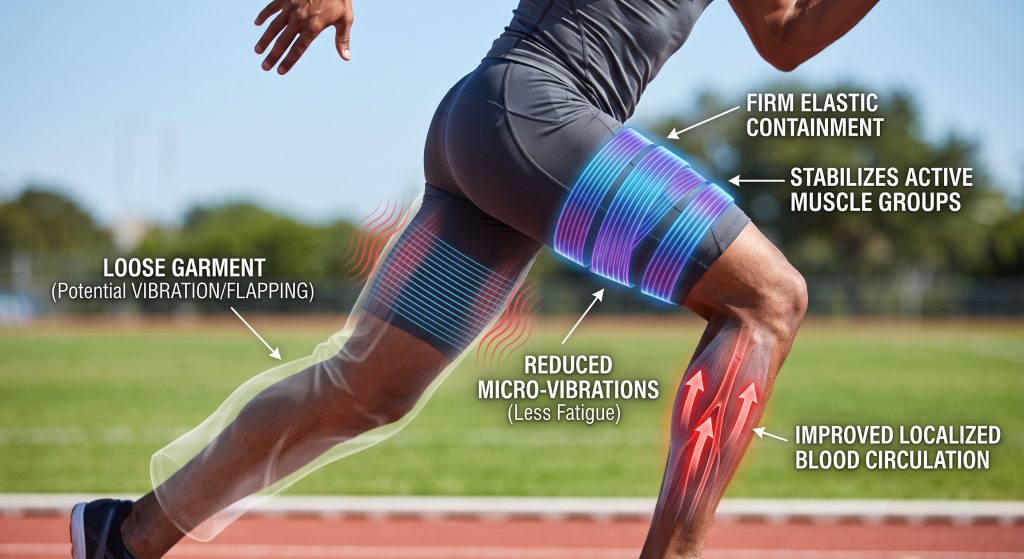
Compression is central to athletic wear fabric because firm elastic containment stabilizes active muscle groups, reducing fatigue-inducing micro-vibrations during high-impact exercise. Loose athletic garments flap around during sprinting, failing to offer mechanical support to tired limbs. Technical compression materials wrap tightly around muscles, promoting localized blood circulation and improving muscular awareness.
How Does Muscle Support Reduce Physical Fatigue?
Targeted elastic compression holds muscle bellies firmly, dampening damaging kinetic vibrations created when feet strike hard ground during running. Here is the kicker… reducing muscle oscillation decreases physical fatigue, allowing athletes to train harder for longer durations.
- Reduced vibration lowers muscle soreness following strenuous workout sessions.
- Tight mechanical wrap enhances proprioception and spatial body control.
- Firm muscular support stabilizes heavy leg tissues during explosive leaps.
You help athletes push past fatigue barriers by offering engineered compression gear built from heavy elastane knits. Targeted muscular containment protects body tissues during high-impact sport routines.
Why Is Graduated Tightness Important for Athletes?
Graduated tightness applies firm pressure at ankles and wrists, decreasing slightly toward core body areas to assist venous blood return to heart muscles. Enhanced blood flow speeds oxygen delivery to active muscle tissues while clearing metabolic waste rapidly.
You accelerate athlete recovery times between intense workout sessions by manufacturing graduated compression tights. Scientifically calibrated compression improves circulatory efficiency during prolonged athletic exertion.
Key Takeaway: Compression textiles reduce muscular fatigue by dampening vibrations and accelerating post-workout blood circulation.
| Compression Level | Pressure Range (mmHg) | Primary Performance Use |
| Light Compression | 8 – 15 mmHg | Daily Active Base Layers |
| Medium Compression | 15 – 20 mmHg | High-Intensity Training Tights |
| Firm Compression | 20 – 30 mmHg | Post-Workout Muscle Recovery |
Clinical athletic studies prove that graduated compression garments accelerate muscular recovery speeds following heavy leg training.
How Does Sublimation Printing Fit Athletic Wear Fabric?
Digital sublimation printing fits synthetic athletic wear fabric perfectly by permanently fusing gaseous dyes directly into polyester fiber cores at high heat. Surface screen printing coats fabric tops with thick rubberized inks that block breathable mesh pores and crack after repeated stretching. Sublimated pigments become integral parts of yarn structures, preserving fabric softness, breathability, and stretch elasticity.
How Does Heat Sublimation Keep Fabric Pores Open?
Heat sublimation transforms solid ink into gas under high temperatures, penetrating synthetic fibers without creating physical ink barriers over breathable pores. Check this out: sublimated mesh fabrics retain one hundred percent of original air permeability while displaying intricate multi-colored artwork.
- Gas dye fusion leaves ventilation micro-holes open for airflow.
- Zero ink weight maintains lightweight feel across printed team jerseys.
- Unlimited color combinations print sharply without increasing production cost.
You deliver vibrant custom sportswear without compromising performance breathability by utilizing digital sublimation techniques. Breathable printed graphics stay light and comfortable during summer workouts.
Why Do Dye Molecules Resist Surface Peeling?
Sublimation dye molecules bind chemically inside synthetic polymers, making printed patterns completely immune to surface peeling, cracking, or fading. Continuous mat friction and heavy commercial laundering cannot scrub away colors locked inside fiber cores.
You maintain brand-new visual appearance across multi-season team contracts by selecting sublimated activewear fabrics. Permanent color bonding stops artwork degradation under severe physical wear.
Key Takeaway: Sublimation printing fuses color directly inside synthetic fibers, preserving open breathability and long-term graphic durability.
| Customization Aspect | Traditional Screen Printing | Digital Dye Sublimation |
| Mesh Pore Status | Sealed by Rubberized Ink | 100% Open & Breathable |
| Stretch Durability | Prone to Surface Cracking | Zero Graphic Distortion |
| Hand-Feel Effect | Thick Heavy Ink Patch | Completely Weightless & Soft |
Breathability trials confirm that dye-sublimated activewear fabrics maintain full factory air permeability after full color printing.
What Abrasion Tests Validate Athletic Wear Fabric?
Standardized Mullen bursting tests and Martindale abrasion trials validate athletic wear fabric quality by measuring exact resistance against surface tearing and friction wear. Subjecting fabric samples to rigorous hydraulic pressure and abrasive rubbing simulates years of harsh athletic wear in minutes. Certified lab reports provide sportswear brands with verifiable proof of material reliability prior to mass manufacturing.
What Does Mullen Bursting Pressure Reveal About Seams?
Mullen bursting tests apply hydraulic force against fabric samples until rupture occurs, revealing exact multi-directional strength limits under physical tension. Look at the facts: high-performance activewear fabrics must withstand over four hundred kilopascals of pressure to pass athletic durability standards.
- High bursting scores guarantee seams resist tearing during violent grabs.
- Multi-directional pressure simulation matches real-world athletic movement stress.
- Certified pressure ratings protect sportswear manufacturers from product recalls.
You prevent unexpected garment blowouts during live sporting events by demanding certified Mullen burst test documentation. Documented tensile strength verifies material readiness for high-contact sports.
How Does Martindale Rubbing Measure Surface Resistance?
Martindale testing rubs abrasive wool swatches continuously against fabric samples to record how many friction cycles occur before surface pilling or thread breakage starts. Premium performance textiles endure over thirty thousand rubbing cycles without developing unsightly surface fuzz.
You protect brand reputation by specifying materials with high Martindale friction resistance scores. Robust surface durability ensures workout apparel survives continuous gym equipment contact.
Key Takeaway: Certified Mullen bursting and Martindale abrasion tests provide empirical proof that performance fabrics resist physical tearing.
| Quality Standard | Entry-Level Fabric Grade | Professional Athletic Grade |
| Mullen Burst Pressure | 150 – 250 kPa | 400+ kPa High Resistance |
| Martindale Abrasion | 10,000 Rub Cycles | 30,000+ Rub Cycles |
| Pilling Resistance | Grade 2 – 3 | Grade 4 – 5 Superior |
Laboratory validation reports confirm that professional-grade activewear fabrics withstand triple the physical bursting pressure of casual knits.
How Do You Source Wholesale Athletic Wear Fabric Mills?
Sourcing wholesale athletic wear fabric directly from primary manufacturing mills cuts raw material costs while securing consistent lab-dip color matching across production reorders. Purchasing through retail brokers adds distributor markups while making stock availability unpredictable during peak seasons. Direct factory partnerships offer custom yarn blends, specialized finishes, and guaranteed supply line continuity.
How Do Direct Factory Orders Reduce Bulk Production Costs?
Bypassing intermediary trading companies allows activewear manufacturers to lock in tiered volume discounts on bulk roll shipments straight from textile mills. Here is the deal: direct factory procurement improves gross profit margins substantially for growing sportswear lines.
- Volume purchasing rates reduce raw material costs per finished garment unit.
- Direct mill relationships allow custom GSM weight and finish requests.
- Streamlined international shipping simplifies production timeline planning.
You expand business profitability by establishing direct supply agreements with established performance fabric manufacturing mills. Direct factory pricing gives your brand a decisive competitive edge.
Why Is Lab Dip Color Matching Critical for Reorders?
Digital lab dip color formulation guarantees exact shade consistency across future fabric roll batches, ensuring reordered team apparel matches original uniforms perfectly. Precise color control prevents embarrassing shade variations between different garment manufacturing runs.
You maintain customer trust and long-term brand loyalty by delivering flawless color consistency across consecutive production seasons. Reliable color control builds strong relationships with team gear buyers.
Key Takeaway: Direct factory sourcing secures wholesale volume pricing while ensuring precise batch-to-batch color matching across reorders.
| Procurement Route | Retail Middleman Supplier | Direct Manufacturing Mill |
| Material Cost | High Retail Markups | Direct Wholesale Tier Rates |
| Color Uniformity | Uncontrolled Lot Differences | Digital Lab Dip Consistency |
| Customization Flexibility | Stock Colors Only | Custom Weight, Fiber & Finish |
Supply chain metrics prove that direct manufacturing partnerships yield significant cost savings while guaranteeing strict quality control.
Final Summary & Recommendations
Specifying engineered poly-spandex blends with four-way stretch, capillary moisture wicking, and high GSM density resolves major sportswear issues regarding shear transparency, heat retention, and premature fabric tearing. Direct sourcing partnerships with B2B performance textile manufacturing mills secure factory-direct wholesale pricing while ensuring exact digital lab-dip color consistency across future reorders. If you want to elevate your sports apparel line with laboratory-certified, high-durability performance fabrics, contact us today to order custom sample swatches and consult directly with our textile engineering team. At MAKITAPE, supported by Fuzhou HG Textile Co., Ltd., our manufacturing mill remains committed to powering global sportswear brands with high-performance activewear textiles that deliver exceptional on-field performance.
Frequently Asked Questions
● Q1: Can I use lightweight 150 GSM mesh fabric for athletic leggings?
No, lightweight 150 GSM mesh lacks necessary structural density and becomes sheer when stretched over hips. Leggings require heavyweight double knits between 280 GSM and 320 GSM to ensure complete squat-proof opacity.
● Q2: What’s the best synthetic blend for high-intensity gym wear?
A poly-spandex blend containing 85 percent polyester and 15 percent elastane offers ideal breathability, four-way stretch, and dye sublimation printing capabilities.
● Q3: How do I know if activewear fabric offers quick-drying performance?
You can verify quick-drying performance by checking if synthetic fibers feature cross-section capillary channels that rapidly draw liquid droplets across wider surface areas.
● Q4: Can I order custom color dyeing for wholesale fabric roll orders?
Yes, direct textile manufacturing mills provide custom Pantone color dyeing with digital lab dip approvals before mass roll production begins.
● Q5: What is the best printing method for stretch activewear?
Digital sublimation heat transfer printing is the best method because it fuses dyes directly inside synthetic fiber cores without blocking breathable mesh pores.