
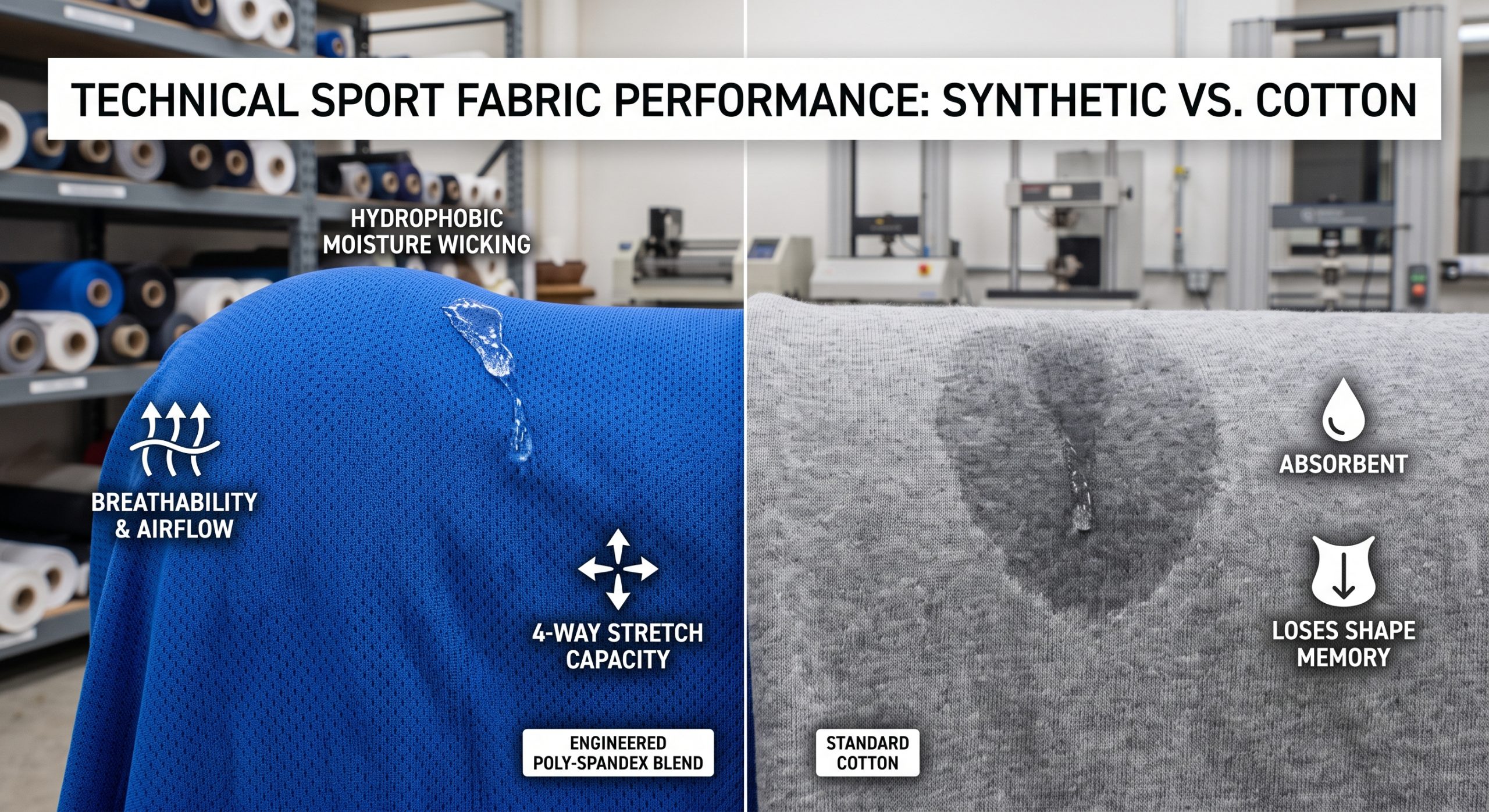
Choosing engineered synthetic poly-spandex blends equipped with micro-porous ventilation channels and capillary moisture transport provides the best sport fabric solution for high-intensity training apparel. Active apparel buyers frequently battle product complaints when low-grade garments trap perspiration against skin, suffer permanent elastic breakdown, or tear under sudden athletic motion. Sourcing substandard retail textiles results in heavy activewear that clings uncomfortably to athletes, causes severe friction chafing, and ruins brand reputation among serious fitness enthusiasts. Specifying technical high-density knits featuring hydrophobic synthetic yarns, anti-chafing smooth surfaces, and balanced GSM weights protects physical mobility while maintaining ideal thermal equilibrium during demanding workouts.
What Makes Breathable Sport Fabric Vital for Gear?
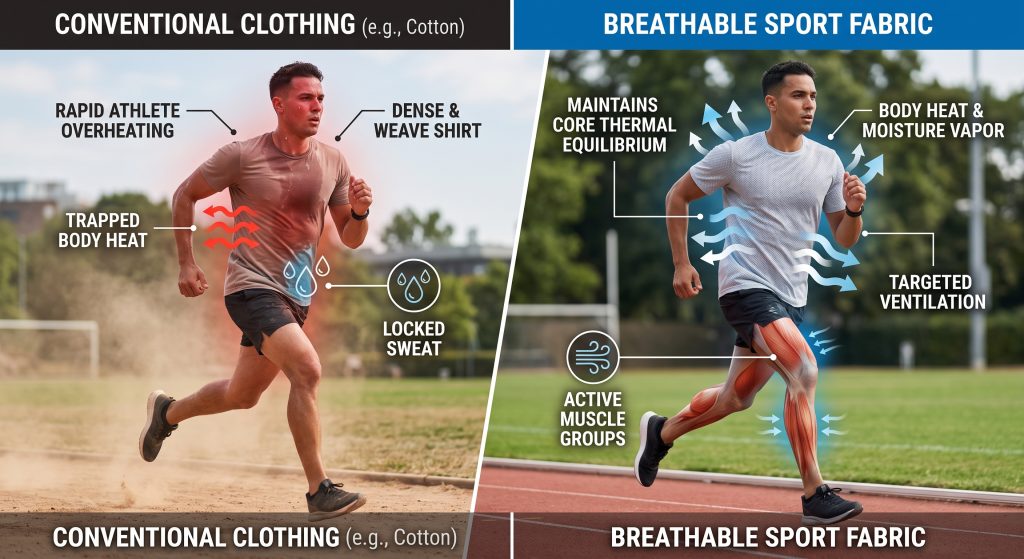
Breathable sport fabric maintains core thermal equilibrium while allowing body heat and moisture vapor to escape freely through open synthetic yarn gaps during physical exertion. Conventional clothing materials retain excess heat and lock sweat inside garment linings, causing rapid athlete overheating. High-performance activewear relies on targeted air permeability to cool active muscle groups without compromising outer material strength.
How Does Airflow Prevent Thermal Stress During Workouts?
Unrestricted airflow across garment panels accelerates convective body cooling during high-output exercise routines. Check this out: porous knit geometry allows room air to enter while expelling hot surface humidity instantly.
- Continuous air exchange regulates core temperature during heavy training.
- Micro-porous surface structure prevents internal heat build-up under stadium lights.
- Lightweight filament yards reduce total garment weight during endurance runs.
You gain a competitive advantage by specifying air-permeable synthetic knits for athletic sportswear lines. Active ventilation protects athlete stamina during grueling sports competitions.
Why Do Natural Fibers Fail Under Heavy Sweat Conditions?
Natural cotton yarns absorb liquid sweat up to eight times their dry weight, growing heavy and abrasive against active skin. Saturated natural fibers lose structural elasticity quickly, leading to sagging apparel and severe friction skin chafing.
You prevent heavy garment drag by replacing absorbent natural yarns with engineered quick-drying synthetics. High-grade fiber engineering maintains lightweight garment comfort throughout intense physical training.
Key Takeaway: Synthetic fiber architectures offer superior air circulation and structural resilience that traditional cotton yarns cannot match.
| Performance Parameter | Natural Organic Cotton | Engineered Synthetic Knit |
| Air Permeability | Drops When Saturated | High Continuous Air Exchange |
| Moisture Absorption | Holds Liquid Internally | Hydrophobic Surface Release |
| Structural Integrity | Sags Under Wet Weight | Maintains Shape Memory |
Laboratory performance evaluations demonstrate that synthetic knits maintain consistent airflow even when exposed to continuous moisture.
How Does Sport Fabric Manage Sweat Evaporation?
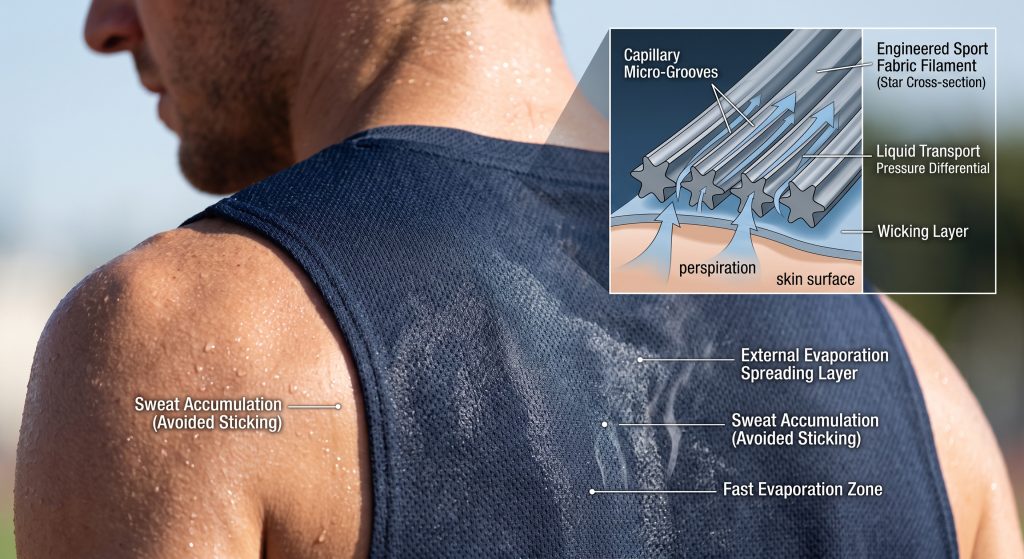
Engineered sport fabric manages sweat evaporation by drawing liquid perspiration off active skin through capillary micro-grooves that spread moisture outward across external textile faces. Unmanaged sweat accumulation dampens low-grade activewear, creating heavy skin sticking and uncomfortable thermal chilling. Utilizing specialized cross-section synthetic filaments creates pressure differentials that pull liquid away from the body.
How Do Capillary Channels Transport Moisture Away?
Capillary channels running inside grooved synthetic yarns pull perspiration outward toward external garment faces where surrounding air evaporates it quickly. Look at the facts: profiled cross-section filaments spread surface moisture across wider surface areas to multiply evaporation speed.
- Internal capillary grooves pull liquid away from damp skin surfaces.
- Rapid outer evaporation prevents heavy moisture pooling inside clothing.
- Smooth filament faces lower friction skin drag during repeated athletic motions.
You notice immediate improvements in athlete body dryness when outfitting sports teams in capillary-channeled activewear. Rapid fluid transport eliminates wet fabric weight during endurance training.
Why Does Fast Drying Prevent Post-Workout Chills?
Fast-drying synthetic textiles eliminate damp apparel cling, preventing rapid core temperature drops when athletes move into cooler gym settings. High-performance technical fabrics dry within minutes after heavy workout sessions conclude.
You protect athletes from post-exercise muscle chilling by selecting rapid-evaporating synthetic activewear materials. Quick surface drying maintains muscle warmth between active sports drills.
Key Takeaway: Micro-channel yarn profiles pull sweat off active skin, speeding evaporation to keep athletes dry and comfortable.
| Wicking Metric | Basic Single Jersey | Capillary Wicking Knit |
| Fluid Spread Rate | Slow Concentrated Spot | Rapid Wide Surface Dispersion |
| Evaporation Speed | Prolonged Drying Cycle | Rapid Air Evaporation |
| Garment Cling | High Wet Adhesion | Minimal Surface Contact |
Moisture transport testing confirms that capillary-profiled synthetic textiles dry three times faster than basic knit materials.
Why Choose Synthetic Blends for Sport Fabric Gear?
Choosing synthetic blends for sport fabric construction combines the abrasion resistance of polyester or nylon with the multi-directional stretch recovery of spandex elastane. Pure polyester lacks adequate stretch for flexing joints, while pure elastane lacks structural strength. Blending these synthetic polymers creates dynamic textiles that flex comfortably without sacrificing tensile durability or opacity.
What Makes Poly-Spandex Ideal for Activewear Tops?
Polyester-spandex blends provide lightweight breathability, vibrant dye sublimation color clarity, and flexible four-way elasticity perfect for training shirts. Here is the deal: pairing polyester filaments with elastane yields smooth materials that accept custom graphics without cracking.
- High polyester volume absorbs rich color dyes during heat sublimation.
- Spandex inclusion delivers high multi-directional stretch elasticity.
- Hydrophobic qualities encourage rapid liquid release during workouts.
You achieve design flexibility and long-lasting material durability when choosing poly-spandex blends for team jerseys. Balanced synthetic properties support detailed graphic customization alongside athletic flexibility.
Why Is Nylon Spandex Preferred for Heavy Leggings?
Nylon-spandex blends offer cold-touch smoothness, high abrasion resistance, and firm muscular containment suited for premium leggings and compression shorts. Tough nylon filaments withstand heavy surface rubbing, making them ideal for ground contact training.
You increase garment service life significantly by specifying nylon-spandex knits for high-abrasion athletic apparel lines. Superior yarn strength shields clothing against surface pilling and fabric tearing.
Key Takeaway: Polyester blends yield superior print clarity for tops, whereas nylon blends deliver maximum abrasion protection for bottoms.
| Material Property | Polyester-Spandex (85/15) | Nylon-Spandex (80/20) |
| Surface Abrasion | Standard Durability | Maximum Scuff Protection |
| Print Capability | Ideal for Sublimation | Best for Piece Dyeing |
| Touch Texture | Soft Matte Finish | Smooth Cold-Touch Feel |
Material durability charts highlight nylon-spandex as the optimal choice for high-friction legwear applications.
How Do Knits Influence Sport Fabric Airflow?
Knit construction directly influences sport fabric airflow by defining loop density, surface geometry, and micro-porous opening sizes across apparel panels. Open mesh structures maximize ventilation across high-heat body zones, whereas tight interlock double knits offer squat-proof coverage for bottoms. Selecting appropriate knitting techniques ensures active apparel satisfies functional performance requirements across varied athletic uses.
How Does Birdseye Mesh Maximize Cooling Ventilation?
Birdseye mesh incorporates geometric micro-perforations that accelerate passive air exchange across body heat zones during warm-weather exercise. What’s the real story? diamond-patterned micro-holes release trapped heat instantly without compromising material tear strength.
- Geometric micro-porous holes increase airflow across back and underarm panels.
- Smooth face knits prevent friction chafing against sensitive torso skin.
- Reduced material mass keeps running shirts lightweight during races.
You feel active cooling benefits when integrating breathable birdseye mesh panels into sportswear top designs. Strategic mesh placement prevents heat accumulation during prolonged physical activity.
What Makes Interlock Double Knits Squat-Proof?
Interlock double knits interweave two layers of yarn together, providing dense structural coverage that remains opaque even when stretched tightly over muscles. Thick interlock construction prevents see-through issues during deep squats and lunges.
You preserve complete garment opacity and athlete confidence by choosing interlock double knits for athletic bottoms. Dense looping structures provide full visual coverage under bright light conditions.
Key Takeaway: Birdseye mesh offers maximum airflow for activewear tops, while interlock double knits guarantee total squat-proof opacity.
| Knit Architecture | Birdseye Micro-Mesh | Interlock Double Knit |
| Air Exchange Rate | Maximum Flow Rate | Controlled Ventilation |
| Opacity Rating | Semi-Sheer Openings | 100% Squat-Proof Density |
| Primary Garment Use | Running Tees & Mesh Panels | Leggings, Shorts & Bras |
Structural airflow comparisons prove that open mesh geometry delivers four times greater air circulation than heavy double knits.
What Weight Metrics Define Sport Fabric Quality?
Establishing sport fabric weight between 150 GSM for tops and 300 GSM for leggings defines material quality by balancing breathability against opacity. Fabric weight measured in grams per square meter indicates whether textiles feel light or offer firm muscular coverage. Inappropriate GSM specification creates fragile see-through leggings or excessively heavy, hot workout shirts.
Why Is 150 GSM Ideal for Running Tops?
Lightweight 150 GSM synthetic knits drape smoothly over body contours, allowing body heat to dissipate quickly during cardio workouts. Thin fabric construction prevents liquid sweat from weighing down runners during long races.
- Low GSM density promotes fast body cooling during warm weather.
- Smooth drape minimizes material friction against moving arms and torso.
- Compact material packing reduces bulk in athletic travel gear.
You keep endurance athletes comfortable in hot environments by specifying lightweight fabric weights for activewear tops. Light textiles support natural body mobility without excess weight.
How Does 300 GSM Ensure Heavy Coverage?
Heavyweight 300 GSM double knits provide high thread density that prevents sheer transparency when athletic tights flex over hips. High fiber concentration delivers firm muscular support while resisting surface abrasion from gym equipment.
You guarantee product reliability and customer satisfaction by maintaining high GSM standards for compression tights. Heavy structural weight keeps activewear completely opaque during extreme stretching routines.
Key Takeaway: Specifying 150 GSM maximizes cooling for activewear tops, while 300 GSM delivers complete opacity for tights.
| GSM Weight Range | Material Categorization | Recommended Apparel |
| 140 – 180 GSM | Lightweight Performance Knit | Running Shirts & Tanks |
| 200 – 240 GSM | Midweight Athletic Structure | Lightweight Hoodies & Shorts |
| 280 – 320 GSM | Heavyweight High-Density Knit | Leggings & Sports Bras |
Weight density evaluations confirm that 300 GSM double knits maintain visual opacity across multi-directional stretch tension.
How Does Stretch Capacity Impact Sport Fabric Comfort?
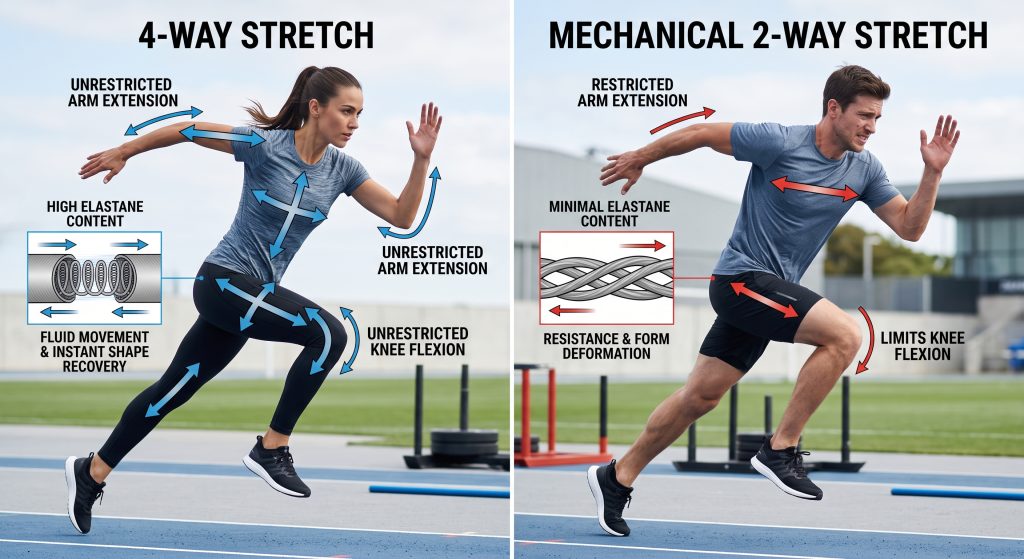
Four-way stretch capacity impacts sport fabric comfort by allowing materials to expand horizontally and vertically in response to complex joint movements. Mechanical two-way stretch textiles restrict arm extension and knee flexion, limiting athletic movement during training. Incorporating high elastane content enables clothing to move fluidly with muscle flexion while recovering shape instantly.
What Is the Difference Between 2-Way and 4-Way Stretch?
Two-way stretch fabrics expand along a single direction, whereas four-way stretch fabrics expand across horizontal and vertical axes simultaneously. Ready for the good part? four-way elasticity allows sportswear to conform to dynamic joint movements without pulling at seams.
- Multi-axial elasticity supports full physical range of motion.
- Reduced seam tension lowers risk of structural thread breakage.
- Adaptive fit eliminates material binding across shoulders and knees.
You improve athletic movement freedom by selecting four-way elastane textiles for training apparel lines. Dynamic fabric expansion supports unrestricted physical performance.
Why Is Elastic Recovery Crucial for Shape Memory?
Elastic recovery measures how quickly stretched yarns snap back to original dimensions, preventing permanent bagging at knees and elbows. High-grade elastane filaments achieve ninety-eight percent immediate recovery after repeated tension cycles.
You preserve tailored garment fit over long-term use by choosing fabrics with high elastic recovery ratings. Superior elasticity prevents waistbands and leg cuffs from sagging after laundering.
Key Takeaway: Four-way stretch provides full movement freedom, while strong elastic recovery prevents long-term garment distortion.
| Stretch Classification | Two-Way Mechanical Stretch | Four-Way Elastane Stretch |
| Expansion Direction | Single Horizontal Axis | Dual Horizontal & Vertical Axes |
| Spandex Percentage | 0% – 3% Minimal Elastane | 12% – 20% High Elastane |
| Joint Flexibility | Restricted Movement Range | Unrestricted Full Flexion |
Biomechanical studies indicate that four-way stretch fabrics reduce movement resistance across major joints during explosive exercise.
Why Is Compression Central to Sport Fabric Design?
Compression is central to sport fabric design because tight elastic containment stabilizes active muscle groups, reducing fatigue-inducing micro-vibrations during high-impact sports. Loose apparel flaps during sprinting, failing to provide mechanical stabilization to active limbs. Technical compression materials wrap firmly around muscle bellies, supporting blood circulation and physical body awareness.
How Does Muscle Containment Reduce Physical Fatigue?
Targeted elastic compression holds muscle tissues tightly, dampening kinetic shock vibrations caused when feet strike ground surfaces during running. This is where it gets interesting… reducing muscle oscillation minimizes physical tiredness, allowing athletes to perform longer.
- Reduced muscle vibration lowers post-workout tissue soreness.
- Firm mechanical wrapping improves body spatial awareness.
- Tight structural hold stabilizes leg muscles during leaping motions.
You help athletes combat fatigue by manufacturing compression garments built from dense elastane knits. Targeted muscular support protects soft tissue during high-impact training drills.
What Are the Benefits of Graduated Pressure?
Graduated pressure applies firm tension at lower extremities, decreasing toward core body areas to encourage venous blood flow back toward the heart. Improved circulatory flow speeds oxygen delivery to active muscles while flushing metabolic waste quickly.
You support faster athletic recovery by manufacturing graduated compression legwear for sports performance lines. Calibrated elastic pressure improves circulation efficiency during prolonged athletic exertion.
Key Takeaway: Compression materials reduce muscle fatigue by dampening vibrations and accelerating circulatory recovery after exercise.
| Compression Level | Pressure Range (mmHg) | Primary Performance Purpose |
| Light Compression | 8 – 15 mmHg | Daily Base Layers & Tees |
| Medium Compression | 15 – 20 mmHg | Active Athletic Training |
| Firm Compression | 20 – 30 mmHg | Post-Workout Muscle Recovery |
Clinical recovery trials verify that graduated compression garments accelerate muscle repair following intense athletic workout sessions.
How Does Dye Sublimation Protect Sport Fabric Colors?
Digital dye sublimation protects sport fabric colors by permanently fusing gaseous pigments directly into synthetic fiber cores at elevated heat levels. Traditional screen printing applies thick ink layers on surface faces that block breathable mesh pores and crack after repeated stretching. Sublimated dyes become integral components of internal yarns, preserving fabric softness, ventilation, and elasticity.
Why Does Sublimation Dye Keep Mesh Pores Open?
Heat sublimation converts solid dye into gas under intense heat, bonding with synthetic polymers without creating physical ink barriers across surface openings. Here is the kicker… sublimated mesh materials maintain complete air permeability while displaying detailed multi-colored artwork.
- Gas dye fusion leaves ventilation micro-holes open for cooling airflow.
- Zero surface ink weight keeps athletic jerseys light and flexible.
- Unlimited graphic colors print crisp detail without additional cost.
You deliver bright custom team apparel without sacrificing ventilation by choosing digital sublimation techniques. Breathable printed artwork stays light and comfortable during summer games.
How Do Fused Pigments Resist Cracking and Peeling?
Sublimation dye molecules lock inside synthetic yarns, making printed graphics completely resistant to surface peeling, cracking, or fading. Persistent surface friction and frequent industrial laundering cannot remove colors embedded inside fiber cores.
You preserve brand-new visual appearance across multi-season team orders by selecting sublimated performance fabrics. Permanent pigment bonding eliminates artwork degradation under harsh wear conditions.
Key Takeaway: Dye sublimation fuses pigments inside synthetic yarns, preserving open air permeability and graphic durability.
| Customization Factor | Traditional Screen Printing | Digital Dye Sublimation |
| Air Pore Status | Sealed by Rubberized Ink | 100% Open & Permeable |
| Graphic Flexibility | Cracks Under Heavy Stretch | Zero Image Distortion |
| Surface Hand-Feel | Thick Heavy Ink Layer | Completely Soft & Weightless |
Airflow testing shows that dye-sublimated synthetic knits maintain original factory air permeability after full color printing.
What Quality Tests Validate Sport Fabric Durability?
Standardized Mullen bursting tests and Martindale abrasion trials validate sport fabric quality by measuring exact resistance against physical tearing and friction wear under laboratory conditions. Subjecting textile samples to hydraulic pressure and abrasive rubbing simulates years of sports wear in minutes. Certified lab reports provide sportswear brands with verified proof of material reliability before mass production.
How Does Mullen Burst Testing Measure Tensile Limit?
Mullen burst testing applies hydraulic pressure against clamped fabric samples until structural rupture occurs, recording exact multi-directional strength limits. Check this out: performance activewear materials must withstand high pressure thresholds to satisfy professional durability standards.
- High bursting scores ensure seams resist tearing during athletic contact.
- Multi-directional pressure testing replicates real-world movement stress.
- Certified pressure ratings protect apparel brands against product failures.
You avoid unexpected garment tears during athletic events by requesting certified Mullen burst test documentation. Verified tensile strength confirms material readiness for high-contact sports.
Why Are Martindale Friction Trials Critical?
Martindale testing rubs abrasive swatches repeatedly against fabric samples to record how many friction cycles occur before pilling or thread breakage starts. High-grade activewear materials survive thousands of rubbing cycles without developing surface fuzz.
You protect brand standing by specifying textiles with high Martindale friction resistance ratings. Strong surface durability ensures athletic wear survives continuous contact with equipment.
Key Takeaway: Certified Mullen bursting and Martindale friction tests provide empirical proof of material strength and tear resistance.
| Quality Standard | Standard Commercial Grade | Professional Athletic Grade |
| Mullen Burst Rating | 150 – 250 kPa | 400+ kPa High Strength |
| Martindale Friction | 10,000 Rub Cycles | 30,000+ Rub Cycles |
| Pilling Resistance | Grade 2 – 3 | Grade 4 – 5 Superior |
Textile laboratory reports prove that certified performance knits withstand triple the physical bursting pressure of standard commercial fabrics.
How Do You Source Wholesale Sport Fabric Mills?
Sourcing wholesale sport fabric directly from primary manufacturing mills lowers raw material expenditure while securing consistent color matching across production reorders. Ordering through retail brokers introduces distributor markups while making inventory availability uncertain during high seasons. Direct mill partnerships grant access to custom fiber blends, specialized finishes, and guaranteed production continuity.
How Do Direct Factory Orders Lower Unit Costs?
Bypassing intermediate trading entities allows activewear manufacturers to secure tiered volume discounts on bulk roll shipments straight from production mills. Look at the facts: direct mill purchasing expands gross profit margins for growing sports apparel brands.
- Volume purchasing tiers reduce raw material costs per garment unit.
- Direct factory partnerships support custom GSM weight and finish requests.
- Streamlined supply channels simplify production schedule management.
You increase business margins by establishing direct supply contracts with established performance fabric manufacturing mills. Direct factory pricing offers a clear competitive edge in commercial markets.
Why Is Lab Dip Matching Vital for Reorders?
Digital lab dip color formulation guarantees precise shade consistency across future fabric production batches, ensuring reordered athletic apparel matches original uniforms. Controlled color management eliminates shade variations between separate production cycles.
You maintain customer trust and long-term brand loyalty by delivering uniform color quality across successive product seasons. Reliable color management strengthens long-term commercial relationships.
Key Takeaway: Direct factory sourcing secures wholesale volume pricing while ensuring batch color uniformity across reorders.
| Procurement Channel | Secondary Trading Broker | Primary Manufacturing Mill |
| Material Cost | High Retail Markups | Direct Wholesale Volume Rates |
| Color Uniformity | Uncontrolled Lot Variance | Digital Lab Dip Consistency |
| Custom Options | In-Stock Colors Only | Custom Weight, Fiber & Finish |
Supply chain analysis confirms that direct factory partnerships generate substantial cost savings while guaranteeing strict material quality control.
Final Summary & Recommendations
Specifying engineered poly-spandex blends with four-way stretch elasticity, capillary moisture transport, and balanced GSM density solves major athletic wear problems regarding transparency, heat retention, and fabric tearing. Direct sourcing partnerships with primary performance textile manufacturing mills secure factory wholesale pricing while guaranteeing precise digital lab dip color consistency across future reorders. If you want to elevate your sports apparel line with laboratory-certified, high-durability performance materials, contact us today to order custom sample swatches and consult directly with our technical textile engineering team. At MAKITAPE, supported by Fuzhou HG Textile Co., Ltd., our manufacturing mill remains committed to supplying sportswear brands worldwide with high-performance activewear textiles built for maximum on-field durability.
Frequently Asked Questions
● Q1: Can I use lightweight 150 GSM mesh fabric for athletic leggings?
No, lightweight 150 GSM mesh lacks structural yarn density and becomes sheer when flexed over muscles. Leggings require heavyweight double knits between 280 GSM and 320 GSM to ensure complete squat-proof opacity.
● Q2: What’s the best synthetic blend for high-intensity gym wear?
A polyester-spandex blend containing 85 percent polyester and 15 percent elastane provides ideal breathability, four-way stretch, and vibrant dye sublimation capabilities.
● Q3: How do I know if sport fabric offers quick-drying performance?
You can confirm quick-drying performance by checking if synthetic yarns feature cross-section capillary channels that pull liquid droplets outward across wider surface areas.
● Q4: Can I order custom color dyeing for wholesale fabric roll orders?
Yes, direct textile manufacturing mills provide custom color dyeing with digital lab dip approvals prior to mass roll manufacturing.
● Q5: What is the best printing method for stretch activewear?
Digital sublimation heat transfer printing is the best method because it fuses color dyes directly inside synthetic fiber cores without blocking breathable mesh pores.