
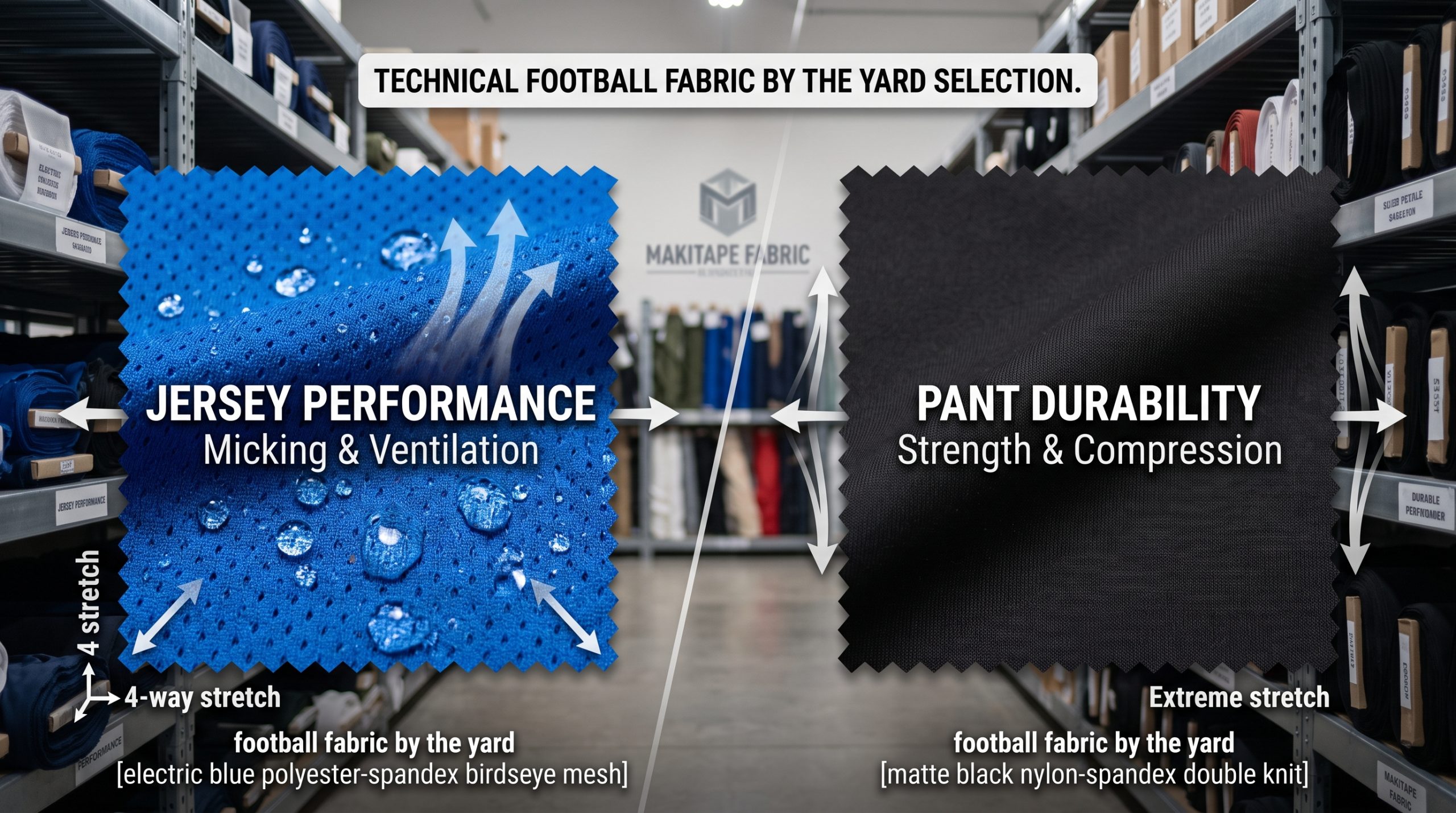
Purchasing high-density polyester-spandex synthetic knits featuring specialized moisture-wicking structures offers the best football fabric by the yard for professional team sportswear manufacturing. Sports apparel manufacturers often face severe quality complaints when low-grade fabrics tear under tackle tension or trap heavy perspiration against athlete skin. Using subpar materials leads to sagging uniforms, skin chafing, and costly production rejections. Sourcing lab-tested performance knits with engineered fiber profiles guarantees long-lasting tear strength and active ventilation.
What Is High-Performance Football Fabric by the Yard?
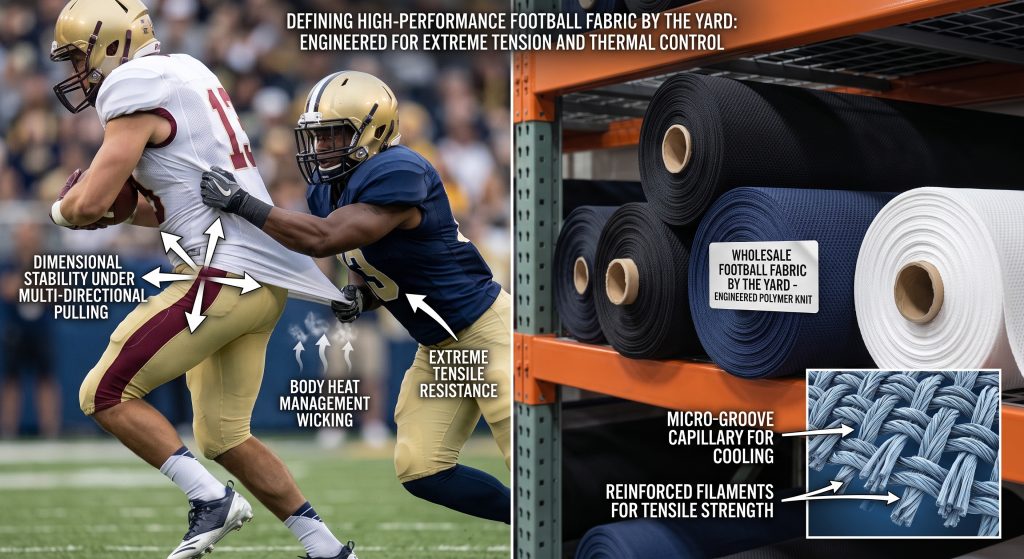
High-performance football fabric by the yard consists of engineered synthetic polymers crafted to withstand extreme mechanical tension while managing body heat during intense athletic competition. Conventional apparel textiles fail under aggressive physical contact because organic fibers lack structural snapback and absorb heavy perspiration. Modern athletic wear demands technical knitted synthetic yarns capable of shielding skin against turf burns while maintaining dimensional stability under severe multi-directional pulling.
How Do Synthetic Polymers Outperform Natural Yarns?
Synthetic polymer filament yarns provide supreme tensile resilience and hydrophobic moisture management that organic cotton yarns cannot deliver during physical sports. Look at the facts: continuous polyester filaments reject water absorption completely while holding structural integrity against intense ripping forces.
- Hydrophobic synthetic fibers push liquid sweat toward outer fabric surfaces quickly.
- High tensile filament strength prevents physical tearing during aggressive player contact.
- Lightweight yarn construction reduces total uniform mass during grueling wet games.
You gain major production advantages by choosing engineered synthetic knits over traditional organic textiles. Advanced fiber architecture shields athlete comfort while extending garment service life through full playing seasons.
Why Is Structural Stability Essential Under Tension?
Structural stability prevents sports uniforms from stretching out of shape permanently when opponents grab jersey sleeves during high-speed tackles. High-density warp knitting interlocks synthetic threads tightly, preventing seam slippage and unsightly fabric distortion.
You maintain sharp team aesthetic standards by selecting dimensionally stable performance fabrics. Superior knit construction ensures uniform garments fit tailored contours after repeated competitive matches.
Key Takeaway: High-performance synthetic fabrics deliver necessary tear resistance and water repellency that natural organic yarns lack.
| Performance Metric | Standard Cotton Fabric | Technical Synthetic Sport Knit |
| Moisture Absorption | Holds 800% Dry Weight | Hydrophobic Rapid Release |
| Tensile Resistance | Low Tear Threshold | High Hydraulic Burst Resistance |
| Dimensional Memory | Sags When Saturated | Instant Elastic Snapback |
Laboratory performance data confirms synthetic sport knits outperform traditional cotton across structural memory and fluid dispersion.
How Does Birdseye Mesh Football Fabric by the Yard Perform?
Birdseye mesh football fabric by the yard performs exceptionally well by utilizing small geometric surface perforations that accelerate passive air circulation across active heat zones. Incorporating specialized sports mesh fabric allows trapped humidity to escape rapidly through open yarn gaps without lowering outer material tensile strength. This porous knit architecture keeps athletes cool during high-temperature daytime games.
How Do Micro-Porous Eyelets Accelerate Cooling?
Micro-porous eyelets knitted into birdseye textiles create continuous air channels that pull fresh air inward while venting body heat outward. Check this out: diamond-patterned yarn gaps increase convective airflow across shoulder and torso areas dramatically.
- Geometric eyelet openings maximize continuous heat transfer away from hot skin.
- Smooth face knits minimize abrasive friction against moving shoulder pads.
- Low material weight prevents heavy sweat accumulation during long quarters.
You feel active cooling benefits immediately when specifying birdseye mesh panels for football jersey main bodies. Strategic mesh integration protects athlete stamina during extreme heat conditions.
Why Does Smooth Surface Contact Prevent Chafing?
Smooth face knits eliminate rough fiber points that rub abrasively against athlete skin during continuous running movements. Fine denier polyester filaments create silky interior surface textures that slide smoothly over torso skin.
You protect players from painful friction chafing by outfitting teams in smooth-faced micro-mesh jerseys. Abrasive friction defense ensures full physical focus remains on game execution.
Key Takeaway: Birdseye mesh offers maximum air exchange and smooth skin contact, making it ideal for jersey main bodies.
| Mesh Metric | Standard Flat Knit | Birdseye Micro-Mesh Knit |
| Airflow Exchange | Restricted Air Pass | High Passive Ventilation |
| Surface Texture | Dense Smooth Face | Micro-Porous Eyelet Pattern |
| Primary Placement | Heavy Pants & Sleeves | Main Jersey Body & Panels |
Airflow testing shows that birdseye micro-mesh delivers three times greater air permeability than flat double-knit materials.
Why Choose Pique Structured Football Fabric by the Yard?
Choosing pique structured football fabric by the yard provides elevated honeycomb surface geometry that creates subtle air pockets between fabric linings and skin surfaces. The raised waffle texture limits direct textile contact against damp skin, reducing uncomfortable wet fabric cling during heavy perspiration. Pique knits offer substantial structural body, making them perfect for sideline coaching apparel and durable sportswear trim.
How Does Honeycomb Texture Reduce Fabric Cling?
Honeycomb texture elevates alternate yarn loops, creating tiny physical air gaps that keep damp textile faces off sweaty skin. Here is the deal: raised waffle knits allow room air to circulate underneath garments even during heavy perspiration.
- Raised geometric loops prevent wet fabric from sticking flat against active muscles.
- Texturized surface hides minor snagging caused by contact with equipment edges.
- Substantial fabric drape gives athletic polos clean professional visual contours.
You maintain professional sideline team appearance by selecting pique knits for coaches polos and staff uniforms. Textured surface drapes maintain clean visual lines throughout long game days.
What Makes Pique Knits Resilient to Surface Wear?
Pique knits utilize interlocked tuck stitches that bind yarns securely, resisting surface pilling and snagging from rough Velcro pad fasteners. Robust stitch architecture keeps apparel looking pristine despite frequent commercial laundering cycles.
You extend garment utility significantly by specifying pique knits for high-friction sport apparel lines. Tough surface loop construction guards against premature fabric degradation.
Key Takeaway: Pique waffle knits reduce skin cling while providing crisp structural body ideal for sideline team wear.
| Pique Characteristic | Flat Jersey Knit | Pique Honeycomb Knit |
| Skin Touch Area | 100% Full Surface Contact | 50% Raised Loop Offset |
| Fabric Structure | Soft Pliable Drape | Firm Structured Body |
| Pilling Grade | Moderate Surface Fuzzing | High Snagging Resistance |
Textile friction trials prove that raised pique loops reduce skin contact area by half, preventing wet garment adhesion.
How Do Birdseye and Pique Football Fabric by the Yard Differ?
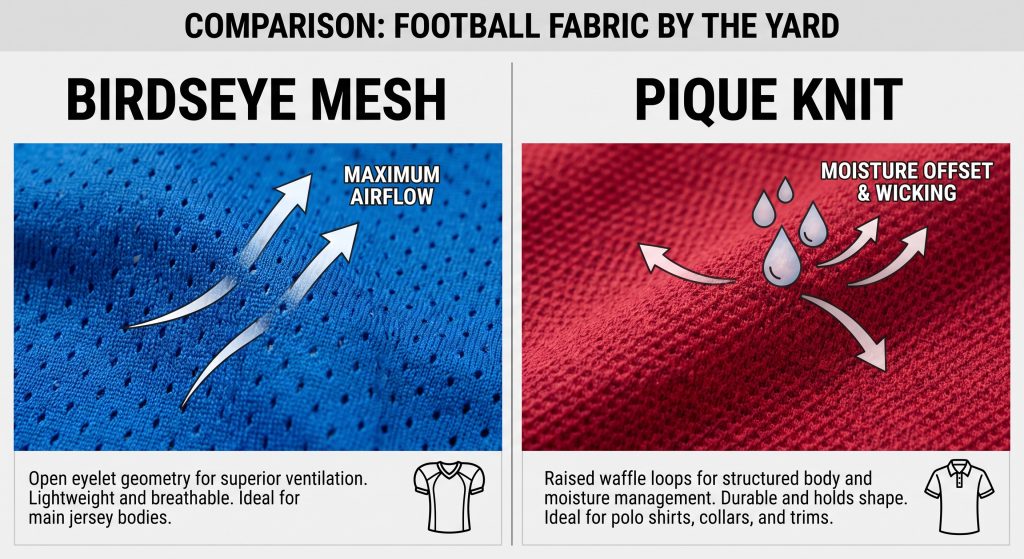
Birdseye and pique football fabric by the yard differ fundamentally in knit geometry, tactile hand-feel, and primary performance applications across sportswear production. Birdseye mesh features open eyelet perforations for maximum airflow, whereas pique knit uses raised waffle loops for structured body and moisture offset. Comparing birdseye mesh fabric against pique helps buyers match specific material strengths to distinct athletic uniform needs.
How Do Surface Structures Impact Tactile Comfort?
Surface structures dictate how fabrics feel against active skin, with birdseye offering smooth silky contact and pique providing firm textured grip. What’s the real story? smooth birdseye mesh glides seamlessly under heavy pad gear while pique creates air insulation gaps.
- Birdseye mesh provides silky smooth touch suitable for high-speed game jerseys.
- Pique knits offer firm waffle texture ideal for professional team polo shirts.
- Combined panel usage optimizes cooling and structure across different body zones.
You optimize sportswear functionality by pairing smooth birdseye mesh bodies with structured pique collar trims. Combining complementary knits creates balanced high-performance athletic apparel.
Which Fabric Option Fits Specific Game Uses Best?
Birdseye mesh fits high-intensity game jerseys requiring maximum heat dissipation, while pique suits sideline staff gear requiring clean visual drape. Matching fabric selection to player motion levels ensures optimal thermal comfort during matches.
You satisfy diverse team equipment needs by selecting tailored knitted textiles for specific roster roles. Correct material choices elevate overall team comfort and professional appearance.
Key Takeaway: Birdseye mesh delivers peak airflow for active jerseys, while pique knit offers crisp structure for sideline gear.
| Comparison Parameter | Birdseye Mesh Knit | Pique Waffle Knit |
| Knit Geometry | Open Diamond Perforations | Raised Waffle Loop Grid |
| Tactile Feeling | Silky Smooth & Light | Textured Crisp & Firm |
| Primary Application | Active Game Day Jerseys | Coaching Polos & Trims |
Comparative structural analysis reveals birdseye mesh maximizes air exchange, whereas pique knit excels in structural durability.
Which Fiber Blends Fit Football Fabric by the Yard Best?
Selecting synthetic polymer blends for football fabric by the yard combines the high tensile strength of polyester or nylon with the elastic stretch of spandex. Pure polyester lacks adequate stretch recovery, while pure elastane lacks structural tear strength required for football tackles. Blending these synthetic filaments creates balanced technical textiles that flex dynamically without losing opacity or shape.
What Are the Core Strengths of Poly-Spandex Blends?
Polyester-spandex blends deliver lightweight breathability, vibrant dye sublimation graphics, and four-way elastic stretch perfect for team uniforms. Ready for the good part? combining polyester filaments with elastane yields supple fabrics that accept bold custom graphics without cracking.
- High polyester volume absorbs rich color dyes during heat sublimation transfer.
- Spandex inclusion provides multi-directional stretch for dynamic joint motion.
- Hydrophobic properties ensure rapid sweat release during intense workouts.
You achieve maximum design freedom and performance durability when manufacturing game jerseys using poly-spandex blends. Balanced polymer properties support bright team branding alongside functional flexibility.
Why Choose Nylon Spandex for High-Collision Apparel?
Nylon-spandex blends offer silky hand-feel, extreme surface abrasion resistance, and firm muscular support suitable for heavy football pants. Tough nylon spandex fabric filaments withstand aggressive turf scraping, making them ideal for high-contact lower body gear.
You upgrade pant durability dramatically by specifying nylon-spandex knits for football pants and pad covers. Superior fiber strength guards garments against severe turf burns and surface tearing.
Key Takeaway: Poly-spandex provides bright printability for game jerseys, while nylon-spandex offers superior abrasion defense for pants.
| Polymer Blend | Polyester-Spandex (85/15) | Nylon-Spandex (80/20) |
| Abrasion Resistance | High Surface Strength | Extreme Scuff Protection |
| Graphic Printing | Ideal for Sublimation | Best for Solid Piece Dyeing |
| Tactile Texture | Soft Matte Finish | Silky Cold-Touch Feel |
Synthetic blend trials confirm nylon-spandex yields maximum scuff protection, while poly-spandex offers superior print clarity.
What GSM Weight Suits Football Fabric by the Yard Orders?
Specifying football fabric by the yard weight between 150 GSM for jersey bodies and 300 GSM for football pants balances ventilation against squat-proof opacity. Fabric weight measured in grams per square meter dictates whether material feels weightless or offers firm muscular containment. Selecting improper GSM weights results in fragile see-through pants or hot, suffocating game jerseys.
Why Is 150 GSM Ideal for Game Jersey Bodies?
Lightweight 150 GSM synthetic knits drape smoothly over shoulder pads, releasing core body heat quickly during warm game days. Thin fabric construction prevents liquid sweat from adding heavy wet mass to active players.
- Low GSM density encourages rapid cooling during summer games.
- Smooth drape minimizes material bunching beneath tight protective pads.
- Reduced overall garment weight preserves player sprinting speed.
You keep players cool and fast by selecting lightweight material weights for jersey main bodies. Light textiles prevent fluid perspiration from weighing down athlete uniforms.
How Does 300 GSM Ensure Squat-Proof Pant Opacity?
Heavyweight 300 GSM double knits provide high thread concentration that keeps football pants completely opaque when stretching over leg pads. Thick yarn packing delivers firm compression support while resisting severe turf friction during tackles.
You ensure complete garment reliability by specifying high GSM standards for athletic football pants. Dense structural weight keeps pants opaque and tear-resistant during extreme stretching movements.
Key Takeaway: Specifying 150 GSM maximizes cooling for jerseys, while 300 GSM guarantees complete opacity for pants.
| GSM Metric Range | Material Classification | Recommended Uniform Application |
| 140 – 180 GSM | Lightweight Ventilation Knit | Main Jersey Bodies & Inserts |
| 200 – 240 GSM | Midweight Athletic Structure | Practice Jerseys & Heavy Tops |
| 280 – 320 GSM | Heavyweight High-Density Knit | Football Pants & Pad Covers |
Weight density testing confirms 300 GSM double knits maintain total visual opacity across multi-directional stretch angles.
How Does Elasticity Impact Football Fabric by the Yard?
Four-way elasticity impacts football fabric by the yard performance by expanding horizontally and vertically, allowing uniforms to adapt smoothly to sudden athletic motions. Rigid mechanical stretch textiles restrict shoulder extension and knee flexing, limiting athlete power output on the field. Integrating high spandex percentages allows apparel to flex fluidly with muscle movement while snapping back instantly.
Why Is Elastic Recovery Essential for Shape Memory?
Elastic recovery measures how quickly stretched yarns snap back to original dimensions, preventing permanent sagging at knees and shoulders. This is where it gets interesting… high-grade elastane filaments achieve ninety-eight percent immediate recovery after severe multi-axial stretching.
- Rapid shape snapback maintains sleek form-fitting jersey silhouettes.
- High elastic memory prevents pant waistbands and leg cuffs from sagging.
- Continuous tension support holds protective pads securely in place.
You maintain tailored garment appearance across full playing seasons by choosing fabrics with high elastic recovery ratings. Superior elasticity keeps sports uniforms fitting snugly after repeated game washing cycles.
How Does Multi-Directional Stretch Assist Mobility?
Multi-directional stretch eliminates material binding across shoulders and hips, enabling explosive athletic movements like throwing, catching, and sprinting. Unrestricted fabric expansion allows muscles to flex fully without feeling constrained by tight seams.
You enhance player agility by specifying four-way elastane integration in high-performance sport apparel lines. Flexible textiles move like a second skin, supporting peak athletic movement.
Key Takeaway: Four-way stretch allows total physical mobility while fast elastic recovery prevents permanent uniform deformation.
| Elasticity Category | Two-Way Mechanical Stretch | Four-Way Elastane Stretch |
| Expansion Axis | Single Horizontal Direction | Dual Horizontal & Vertical Axes |
| Spandex Content | 0% – 3% Minimal Elastane | 12% – 20% High Elastane |
| Player Mobility | Restricted Flexion Range | Unrestricted Full Motion |
Biomechanical testing indicates four-way stretch textiles reduce movement resistance across major joints during explosive athletic drills.
Why Is Durability Critical for Football Fabric by the Yard?
Tough durability is critical for football fabric by the yard because aggressive tackles and field turf contact apply extreme mechanical stress to jersey seams. Using low-grade fabrics leads to embarrassing uniform blowouts during live televised games, damaging team brand reputation. Certified laboratory testing verifies that performance fabrics withstand severe hydraulic pressure and abrasive friction before mass production.
What Does Mullen Burst Pressure Reveal About Seams?
Mullen burst testing applies hydraulic force against fabric samples until rupture occurs, measuring exact multi-directional tear resistance limits. Here is the kicker… professional football fabrics must withstand over four hundred kilopascals of pressure to satisfy sports durability standards.
- High bursting scores guarantee seams resist tearing during violent tackles.
- Multi-directional pressure testing replicates real-world game strain.
- Certified strength ratings protect sportswear brands against garment failures.
You avoid unexpected garment tears during game play by demanding certified Mullen burst test documentation. Documented tensile strength verifies material readiness for aggressive contact sports.
How Does Martindale Rubbing Measure Turf Resistance?
Martindale testing rubs abrasive swatches repeatedly against fabric samples to record how many friction cycles occur before surface pilling or thread breakage starts. Premium performance textiles endure over thirty thousand rubbing cycles without developing surface fuzz.
You protect apparel brand reputation by specifying materials with high Martindale friction resistance ratings. Robust surface durability ensures football gear survives continuous artificial turf contact.
Key Takeaway: Certified Mullen bursting and Martindale friction tests provide empirical proof that performance fabrics resist physical tearing.
| Quality Standard | Standard Commercial Grade | Professional Football Grade |
| Mullen Burst Pressure | 150 – 250 kPa | 400+ kPa High Resistance |
| Martindale Abrasion | 10,000 Rub Cycles | 30,000+ Rub Cycles |
| Pilling Resistance | Grade 2 – 3 | Grade 4 – 5 Superior |
Lab validation reports confirm professional football knits withstand triple the bursting pressure of standard commercial textiles.
How Does Printing Work on Football Fabric by the Yard?
Digital dye sublimation printing works on football fabric by the yard by permanently fusing gaseous pigments directly into synthetic polyester fiber cores under high heat. Traditional screen printing applies thick ink layers on fabric faces that block breathable mesh pores and peel off after stretching. Sublimated pigments become integral parts of internal yarns, preserving fabric breathability, softness, and stretch elasticity.
How Does Heat Sublimation Keep Mesh Pores Open?
Heat sublimation converts solid dye into gas under high temperature, bonding with synthetic polymers without creating physical ink barriers over breathable eyelets. Look at the facts: sublimated mesh fabrics retain full factory air permeability while displaying detailed multi-colored team artwork.
- Gas dye fusion leaves ventilation micro-holes open for cooling airflow.
- Zero surface ink weight maintains lightweight feel across printed jerseys.
- Unlimited team numbers and logos print sharply without additional cost.
You deliver vibrant custom team jerseys without compromising cooling ventilation by selecting digital sublimation techniques. Breathable printed artwork stays light and comfortable during hot summer games.
Why Do Fused Pigments Resist Fading and Peeling?
Sublimation dye molecules lock chemically inside synthetic polymers, making printed numbers completely immune to surface peeling, cracking, or fading. Persistent turf friction and commercial laundering cannot scrub away colors embedded inside fiber cores.
You maintain sharp visual presentation across full playing seasons by choosing sublimated performance fabrics. Permanent color bonding stops graphic degradation under aggressive physical wear.
Key Takeaway: Dye sublimation fuses numbers directly inside synthetic fibers, preserving open ventilation and long-term color fastness.
| Customization Factor | Traditional Screen Printing | Digital Dye Sublimation |
| Air Pore Status | Sealed by Rubberized Ink | 100% Open & Permeable |
| Stretch Flexibility | Prone to Surface Cracking | Zero Graphic Distortion |
| Surface Hand-Feel | Thick Heavy Ink Layer | Completely Soft & Weightless |
Airflow trials confirm that dye-sublimated synthetic knits maintain original factory air permeability after full color printing.
How Do You Source Bulk Football Fabric by the Yard Mills?
Sourcing bulk football fabric by the yard directly from primary manufacturing mills lowers raw material costs while securing precise color matching across seasonal reorders. Purchasing through retail brokers adds distributor markups while making stock availability uncertain during peak production seasons. Direct factory partnerships offer custom yarn weights, specialized finishes, and guaranteed supply continuity.
How Do Direct Mill Orders Reduce Wholesale Costs?
Bypassing intermediary trading brokers allows sportswear manufacturers to secure tiered volume discounts on bulk roll shipments straight from textile mills. Here is the deal: direct factory procurement improves gross profit margins substantially for growing sports apparel brands.
- Volume purchasing rates reduce raw material costs per finished jersey unit.
- Direct factory relationships support custom GSM weight and finish requests.
- Streamlined international shipping simplifies production schedule planning.
You expand business profitability by establishing direct supply agreements with established performance fabric manufacturing mills. Direct factory pricing gives your brand a decisive competitive edge in commercial markets.
Why Is Lab Dip Color Accuracy Critical for Reorders?
Digital lab dip color formulation guarantees exact shade consistency across future fabric roll batches, ensuring reordered team apparel matches original game uniforms. Precise color control prevents shade variations between separate manufacturing cycles.
You maintain customer trust and long-term brand loyalty by delivering flawless color consistency across consecutive playing seasons. Reliable color control builds strong commercial relationships with team gear buyers.
Key Takeaway: Direct mill sourcing secures wholesale volume pricing while ensuring exact batch color matching across reorders.
| Sourcing Route | Secondary Trading Broker | Primary Manufacturing Mill |
| Material Unit Cost | High Retail Markups | Direct Wholesale Tier Rates |
| Color Uniformity | Uncontrolled Lot Variance | Digital Lab Dip Consistency |
| Custom Flexibility | Stock Colors Only | Custom Weight, Fiber & Finish |
Supply chain metrics prove that direct manufacturing partnerships yield substantial cost savings while guaranteeing strict quality control.
Final Summary & Recommendations
Specifying technical synthetic poly-spandex knits featuring four-way stretch elasticity, capillary moisture transport, and balanced GSM density solves major athletic uniform issues regarding transparency, heat retention, and fabric tearing. Comparing smooth birdseye mesh bodies against structured pique accents allows sportswear manufacturers to optimize thermal ventilation and garment drape across different body zones. Direct sourcing partnerships with primary performance textile manufacturing mills secure factory wholesale pricing while guaranteeing precise digital lab dip color consistency across future reorders. If you want to elevate your team sportswear line with laboratory-certified, high-durability performance textiles, contact us today to order custom sample swatches and consult directly with our technical engineering team. At MAKITAPE, supported by Fuzhou HG Textile Co., Ltd., our manufacturing mill remains committed to supplying sportswear brands worldwide with high-performance athletic fabrics built for maximum on-field durability.
Frequently Asked Questions
● Q1: Can I use lightweight 150 GSM birdseye mesh for football pants?
No, lightweight 150 GSM mesh lacks structural yarn density and becomes sheer when flexed over protective knee pads. Football pants require heavyweight double knits between 280 GSM and 320 GSM to ensure complete squat-proof opacity.
● Q2: What’s the best synthetic fiber blend for sublimated game jerseys?
A polyester-spandex blend containing 85 percent polyester and 15 percent elastane offers ideal breathability, four-way stretch flexibility, and rich dye sublimation printing clarity.
● Q3: How do I know if pique fabric suits coaching polo shirts?
You can confirm pique suitability by checking its raised honeycomb waffle surface, which creates subtle air insulation gaps while providing a crisp, structured drape for professional attire.
● Q4: Can I order custom GSM weights for wholesale fabric roll orders?
Yes, direct performance textile mills provide custom GSM weight knitting with digital lab dip color approvals prior to commercial roll manufacturing.
● Q5: What quality test verifies seam strength under tackle tension?
Standardized Mullen bursting tests apply hydraulic pressure to measure multi-directional force limits, verifying that seams resist tearing under violent player contact.