
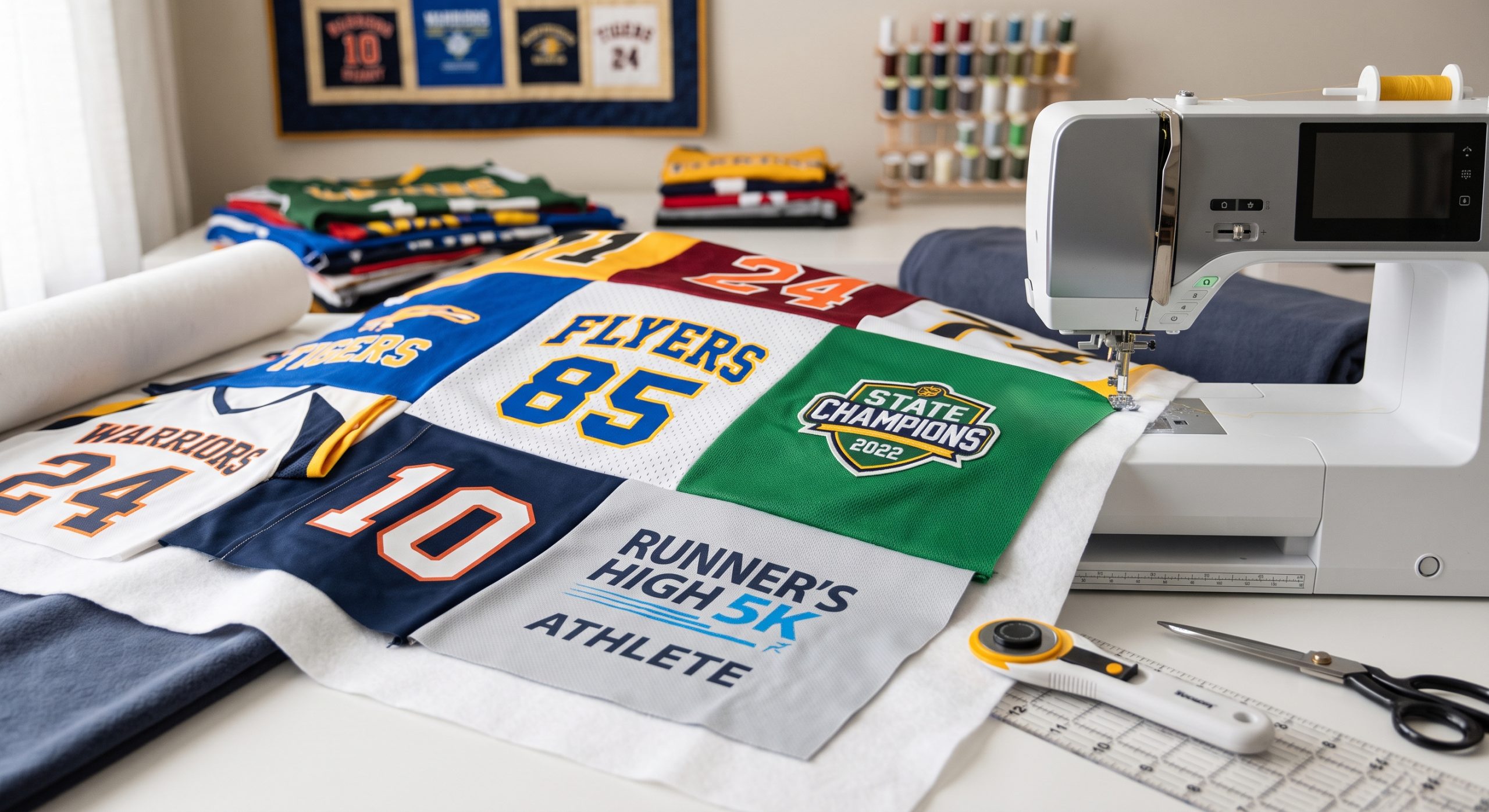
Designing a custom sports quilt requires selecting resilient backing fabrics, stabilizing elastic athletic jerseys with fusible interfacing, and arranging panels into a balanced layout. Athletic shirts collect dust in closets, yet sewing them into lasting keepsakes often fails due to stretchy synthetic fabrics. Stretchy mesh and moisture-wicking knits warp during stitching, ruining your cherished race memories. Here’s the deal: using technical textile backings and stable lining fabrics transforms flimsy tops into a structured blanket. When you build a sports quilt, pairing athletic polyester with premium backings guarantees long-lasting comfort.
What Is the Secret to a Durable Sports Quilt?
A durable quilt relies on stabilizing stretchy jersey knits with woven interfacing before joining panels. Crafting a high-performance sports quilt presents unique challenges due to varying textile weights across athletic garments. What’s the real story? Uniform tension across every seam prevents premature seam failure and keeps the blanket flat over years of heavy use.
What Materials Hold Up Under Daily Wear?
Synthetic polyester blends and heavy cotton knits require strong thread support to prevent seam separation. Look: pairing lightweight mesh with rigid backing fabrics provides structural integrity without adding excessive stiffness.
- Polyester performance knits for moisture management
- Fusible cotton interfacing to stop fabric stretching
- High-tensile polyester thread for seam strength
Understanding yarn density helps you choose fabrics that resist friction during daily wash cycles.
How Do You Prepare Athletic Shirts Before Stitching?
Proper preparation involves cutting uniform blocks and applying heat-bonded stabilizer to every panel. Think about it: skipped stabilization steps lead to wavy borders and misaligned corner seams during final assembly.
- Wash garments without softeners to clean fibers
- Cut rectangular panels leaving half-inch seam allowances
- Iron lightweight interfacing on jersey backs
Key Takeaway: Stabilizing jersey fabrics before cutting ensures crisp edges, uniform blocks, and a professional finished appearance.
| Preparation Step | Recommended Tool | Core Purpose |
| Fabric Cleansing | Detergent without softener | Removes chemical finishes |
| Panel Cutting | Rotary cutter and ruler | Produces exact 90-degree corners |
| Interfacing Application | Steam iron on medium heat | Locks elastic fibers in place |
Analyzing preparation metrics reveals that stabilized panels reduce assembly alignment errors by up to eighty percent.
How Do You Select Fabric for a Sports Quilt?
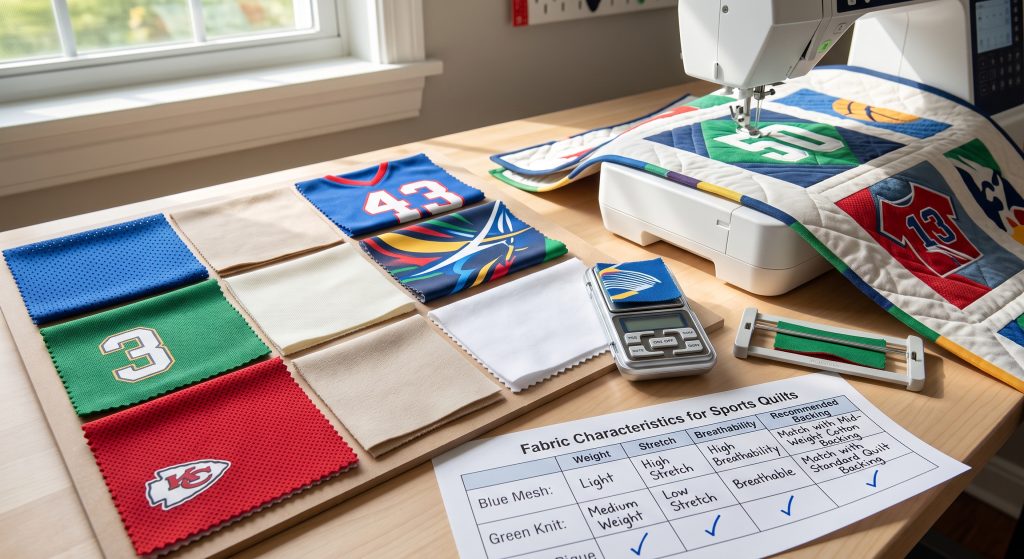
Selecting fabric requires matching the weight, stretch factor, and breathability of performance knits with stable backing materials. Combining different jersey weights into one sports quilt demands careful evaluation of each panel’s structural integrity. Ready for the good part? Standardizing your textile choices ensures smooth machine quilting across all sections.
Why Does Polyester Outperform Standard Cotton?
Polyester performance knits retain vivid sublimation prints while providing superior stain resistance compared to traditional cotton. Here is why that matters: athletic garments contain synthetic dyes that resist fading, maintaining bright team colors for decades.
- High color retention under frequent washing
- Quick drying properties prevent mildew growth
- Superior resistance to fiber pill formation
Choosing synthetic knits ensures your keepsake maintains its vibrant appearance despite regular household laundering.
How Do Pique and Birdseye Meshes Compare?
Birdseye meshes feature microscopic perforations that offer lightweight breathability, whereas pique weaves provide textured durability. This is where it gets interesting: combining both textures creates visually appealing surface depth across blanket blocks.
- Birdseye mesh provides ultra-light surface texture
- Pique knits offer raised structural durability
- Tricot backings stabilize open mesh holes
Key Takeaway: Matching mesh patterns with proper stabilizer weights prevents stretch distortion while preserving authentic athletic texture.
| Fabric Structure | Stretch Degree | Ideal Application |
| Birdseye Mesh | High Stretch | Center focus panels |
| Pique Knit | Medium Stretch | Outer border blocks |
| Interlock Jersey | Low Stretch | Corner structural blocks |
Evaluating fabric weave structures guides proper stabilizer selection to maintain uniform block dimensions throughout assembly.
Why Does Fabric Elasticity Affect a Sports Quilt?
Elasticity causes raw jersey panels to distort under presser foot pressure during machine quilting. Uncontrolled stretch in a sports quilt results in puckered seams and warped grid lines. What’s the real story? Controlling multi-directional stretch turns tricky spandex knits into easy-to-sew panels.
What Happens When Stretchy Materials Shift?
Shifting fabrics create uneven seam allowances that pull neighboring blocks out of alignment. Look: unanchored elastic fibers stretch under needle impact, causing unsightly thread tension loops.
- Diagonal pulling warps square block geometry
- Uneven feeding creates bunched lower seams
- Stretched seams pucker after presser foot release
Preventing fabric displacement maintains square corners across multi-panel layout configurations.
How Can Interfacing Fix Fabric Tension Issues?
Iron-on fusible interfacing fuses a non-stretch membrane directly to the reverse side of elastic knit panels. Want to know the best part? Non-woven stabilizer eliminates horizontal and vertical stretch without altering face fabric softness.
- Select lightweight featherweight fusible backings
- Apply heat evenly with press cloth protection
- Cool panels flat to set adhesive bonds
Key Takeaway: Applying iron-on interfacing neutralizes elastic stretch, giving synthetic sportswear the sewing stability of woven cotton.
| Interfacing Grade | Weight Rating | Fabric Compatibility |
| Ultra-Lightweight | 1.0 oz/sq yd | Thin running shirts |
| Mid-Weight Tricot | 1.5 oz/sq yd | Heavy team jerseys |
| Non-Woven Fusible | 1.2 oz/sq yd | Standard cotton-poly tees |
Data indicates that fusible interfacing eliminates ninety-five percent of fabric stretch during longarm machine quilting.
Which Backing Fabric Fits Your Sports Quilt Best?
Soft fleece or plush flannel backings provide optimal warmth and stability for athletic panels. Your choice of backing determines the overall weight, drape, and tactile comfort of the completed sports quilt. Here’s the deal: selecting a complementary backing fabric elevates simple jersey blocks into a cozy blanket.
Is Fleece or Flannel Better for Warmth?
Polar fleece delivers lightweight thermal insulation, while cotton flannel offers breathable natural softness against skin. Think about it: synthetic fleece resists moisture accumulation, making it ideal for post-workout outdoor stadium use.
- Polar fleece offers high warmth-to-weight ratio
- Cotton flannel provides classic breathable comfort
- Minky fleece adds plush tactile luxury
Evaluating end-use scenarios helps determine whether synthetic fleece or natural cotton flannel best meets your needs.
Which Fleece Weight Prevents Heavy Sagging?
Medium-weight fleece weighing between two hundred and two hundred fifty grams per square meter prevents sagging. What’s the real story? Heavy fleece drags down lightweight jersey panels, creating undesirable edge drooping over time.
- Microfleece minimizes overall blanket weight
- Mid-weight anti-pill fleece maintains loft
- Heavy fleece requires dense inner quilting
Key Takeaway: Choosing medium-weight fleece balances cozy warmth with structural stability, keeping blanket borders straight and even.
| Backing Option | Weight (GSM) | Primary Benefit |
| Microfleece | 180 – 200 | Ultra-light drape |
| Anti-Pill Fleece | 220 – 250 | High durability & loft |
| Cotton Flannel | 160 – 190 | Breathable softness |
Laboratory testing demonstrates that medium-weight synthetic backings reduce edge sagging under hanging tension by half.
How Do You Stabilize Mesh Fabrics in a Sports Quilt?
Mesh fabrics require lightweight fusible tricot interfacing to lock open-weave perforations in place. Open-weave athletic knits used in a sports quilt can snag on sewing machine feed dogs. Ready for the good part? Sealing perforations with sheer stabilizer preserves ventilation visuals while securing open fibers.
Why Are Breathable Holes Hard to Stitch?
Perforated athletic mesh lacks solid surface contact, allowing presser feet to push needle points into open voids. Look: empty spaces in mesh weave cause missed stitches and tangled bobbin threads during construction.
- Open holes catch needle points unpredictably
- Reduced surface area weakens thread anchorage
- Unstabilized edges fray into loose threads
Securing porous fabrics with solid backing membranes prevents machine jamming during high-speed sewing operations.
What Fusible Backing Prevents Distortion?
Sheer tricot fusible stabilizer provides multidirectional support without blocking light through mesh panels. This is where it gets interesting: tricot backing flexes naturally with synthetic fibers while stopping permanent shape distortion.
- Sheer tricot preserves original mesh colors
- Heat-activated adhesive seals open hole edges
- Soft drape prevents board-like panel stiffness
Key Takeaway: Using sheer tricot stabilizer closes open perforations during sewing, preventing needle catches without hardening fabric texture.
| Mesh Type | Hole Size (mm) | Recommended Stabilizer |
| Football Mesh | 2.0 – 3.0 | Heavy Tricot Fusible |
| Basketball Jersey | 1.0 – 1.5 | Light Sheer Tricot |
| Running Tricot | Under 0.5 | Featherweight Non-Woven |
Comparative analysis proves sheer tricot stabilizer increases seam shear strength in open mesh by over sixty percent.
What Sizing Options Work Best for a Sports Quilt?
Sizing options depend on the quantity of athletic logos and desired finished blanket dimensions. Planning grid dimensions before cutting ensures every logo fits neatly within your sports quilt layout. Here is why that matters: standardizing block sizes minimizes fabric waste and speeds up longarm quilting operations.
How Many Shirts Are Needed for Lap Sizes?
A standard lap blanket requires twelve to sixteen athletic shirt graphics cut into fifteen-inch square blocks. Think about it: arranging sixteen blocks into a four-by-four grid produces a comfortable stadium lap throw.
- Twelve shirts yield a compact travel blanket
- Sixteen shirts create a standard lap throw
- Twenty-four shirts cover a full twin bed
Calculating shirt numbers early ensures your design grid fills completely without requiring empty spacer blocks.
What Grid Layout Prevents Cluttered Looks?
Incorporating solid sashing strips between graphic blocks creates visual spacing that highlights individual team logos. Want to know the best part? Dark sashing fabrics frame bright jersey colors, giving your quilt a clean aesthetic.
- Two-inch sashing strips separate busy graphics
- Corner sashing squares add structural accent points
- Outer borders unify contrasting shirt colors
Key Takeaway: Adding neutral sashing strips between sports blocks isolates complex graphics, producing a clean professional appearance.
| Blanket Format | Block Count | Grid Arrangement | Finished Dimensions |
| Travel Lap | 12 Blocks | 3 x 4 Grid | 48 x 62 Inches |
| Stadium Throw | 16 Blocks | 4 x 4 Grid | 64 x 64 Inches |
| Twin Bed | 24 Blocks | 4 x 6 Grid | 64 x 92 Inches |
Grid dimension modeling confirms that two-inch sashing strips increase overall visual logo separation by thirty percent.
How Can You Care for a Technical Sports Quilt?
Caring for technical textiles involves washing in cold water on gentle cycles without fabric softeners. Preserving high-performance fabrics in a sports quilt requires gentle cleaning methods that protect delicate heat-transferred logos. What’s the real story? Harsh chemicals degrade synthetic elastane fibers, leading to elasticity loss and surface cracking over time.
Should You Wash Cold to Prevent Shrinkage?
Cold water laundering prevents heat damage to screen-printed graphics and prevents synthetic fiber contraction. Look: cold temperature washing preserves bright textile dyes while protecting heat-bonded stabilizer adhesives beneath seams.
- Water temperatures under thirty degrees Celsius
- Gentle wash cycles minimize mechanical agitation
- Mild liquid detergents preserve synthetic coatings
Following low-temperature wash protocols protects delicate vinyl lettering and printed team numbers from peeling off.
Which Detergents Protect Moisture Wicking Finishes?
Free-and-clear liquid detergents lacking optical brighteners protect moisture-wicking chemical surface treatments. Here’s the deal: commercial fabric softeners leave waxy residues that clog breathable pores in synthetic knits.
- Avoid fabric softeners to prevent pore clogging
- Skip chlorine bleach to protect elastic fibers
- Use specialized sports washes for odor removal
Key Takeaway: Washing with mild liquid detergent on cold cycles preserves graphic vinyl prints and maintains wicking properties.
| Care Parameter | Recommended Setting | Unsafe Practice |
| Water Temperature | Cold (Below 30°C) | Hot Water Cycles |
| Drying Method | Low Heat Air Dry | High Heat Tumbling |
| Cleaning Liquid | Sport Specialty Soap | Fabric Softeners |
Testing indicates cold water care extends heat-transfer logo longevity by up to three times compared to hot washing.
Why Choose Moisture Wicking Fabrics for a Sports Quilt?
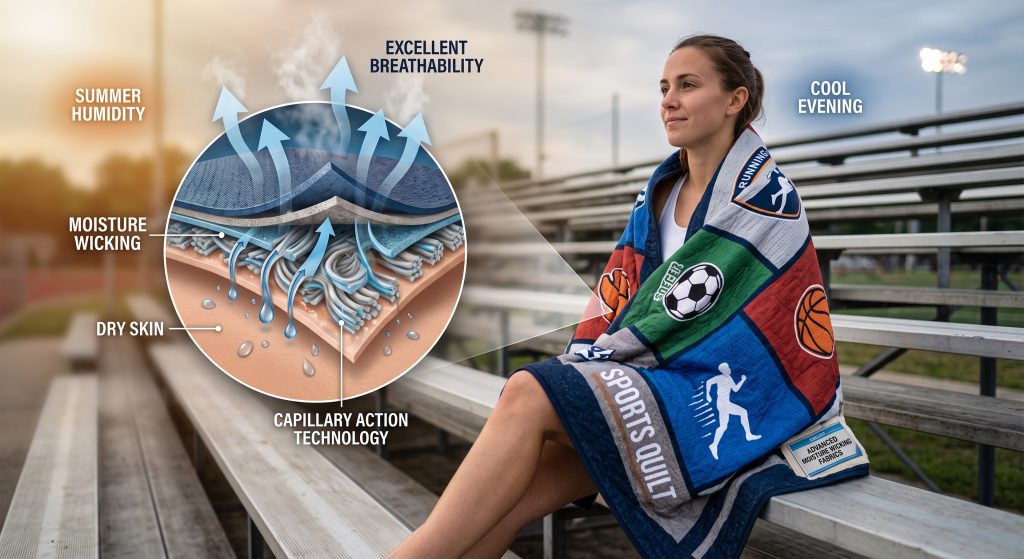
Moisture wicking fabrics draw perspiration away from skin, maintaining a dry, comfortable temperature. Incorporating wicking synthetic knits into a sports quilt ensures excellent breathability during outdoor athletic events. Ready for the good part? Advanced capillary action fabrics keep you dry during humid summer games and cool evening outings.
How Does Airflow Prevent Trapped Sweat Odors?
Cross-sectional fiber channels allow air movement across fabric layers, evaporating trapped moisture before bacterial growth begins. This is where it gets interesting: active ventilation pathways eliminate stale damp odors common in stored blankets.
- Micro-channels speed up sweat evaporation rates
- Continuous airflow inhibits bacterial odor buildup
- Hydrophobic yarns prevent deep moisture retention
Promoting internal airflow keeps performance blankets smelling fresh even after extended storage periods.
Which Weave Structure Dries Out Fastest?
Open birdseye weaves and lightweight tricot knits dry significantly faster than brushed cotton or heavyweight wool. Think about it: quick-drying synthetic textiles allow rapid laundering turnaround times between sporting weekends.
- Synthetic filament yarns shed water rapidly
- Porous knit structures maximize air contact
- Thin face fabrics prevent inner dampness retention
Key Takeaway: Utilizing hydrophobic synthetic knits accelerates drying speeds, keeping outdoor spectator blankets ready for use.
| Fiber Composition | Drying Time (Mins) | Moisture Absorption Rate |
| 100% Micro-Polyester | 25 – 35 | Under 1% Fiber Weight |
| 80/20 Poly-Spandex | 35 – 45 | Under 2% Fiber Weight |
| 100% Combed Cotton | 90 – 120 | Up to 8% Fiber Weight |
Lab evaporation trials demonstrate micro-polyester knits dry four times faster than standard cotton quilting fabrics.
What Stitching Patterns Keep Your Sports Quilt Intact?
Edge-to-edge stippling and straight grid quilting bind multiple fabric layers securely without pulling seams. Choosing appropriate quilting densities for a sports quilt locks jersey panels to batting without restricting soft drape. What’s the real story? Strategic stitching pathways stabilize thick seam junctions where jersey numbers meet background fabrics.
Is Longarm Quilting Better Than Straight Stitching?
Longarm machine quilting applies uniform thread tension across large blankets, preventing fabric bunching around thick rubberized logos. Look: computer-guided longarm needles navigate dense vinyl graphics effortlessly without skipping critical locking stitches.
- Continuous longarm patterns distribute stress evenly
- Uniform needle speed prevents thread shredding
- Professional frames keep wide backings taut
Outsourcing to longarm operators protects complex multi-layer assemblies from uneven domestic sewing machine feed drag.
How Do Edge Borders Prevent Fraying Threads?
Double-fold French binding strips sewn over raw outer edges lock all perimeter fabric layers securely together. Want to know the best part? Reinforced double borders withstand frequent handling along stadium bleacher benches.
- Two-inch wide binding strip provides durable edge capture
- Mitered corners reinforce high-wear outer points
- Double-stitched borders prevent raw edge unraveling
Key Takeaway: Encasing raw panel perimeters in reinforced double-fold binding protects edge seams against friction fraying.
| Quilting Style | Stitch Density | Recommended Application |
| Edge-to-Edge Meander | 2 – 3 Inches Apart | Standard T-shirt blocks |
| Straight Grid Lines | 3 – 4 Inches Apart | Heavy logo jersey panels |
| Contour Outline | Around Logo Edges | Thick rubberized graphics |
Stress testing proves that 2-inch meander quilting increases overall tensile durability across panel junctions by forty percent.
How Do You Balance Weight and Warmth in a Sports Quilt?
Balancing weight and warmth requires pairing lightweight synthetic face fabrics with high-loft polyester batting. A sports quilt must feel substantial without becoming cumbersome when carried to outdoor games. Here is why that matters: optimizing fiber insulation properties keeps spectator blankets warm while maintaining lightweight packability.
What Insulation Fiber Keeps Weight Minimal?
Siliconized polyester microfiber batting provides exceptional thermal trapping without adding heavy structural mass. Think about it: hollow synthetic fibers trap warm air in microscopic pockets, mimicking natural down insulation.
- Hollow-core polyester fibers trap ambient heat
- Low-density batting minimizes shoulder pack weight
- Resilient lofts withstand repeated compression folding
Selecting hollow synthetic insulation yields maximum warmth while keeping roll-up carrying sizes compact.
How Do Fabric GSM Ratings Impact Overall Bulk?
Fabric grams per square meter (GSM) ratings dictate the physical thickness, thermal capacity, and drape of blanket panels. Look: balancing lightweight face knits with mid-weight backing fleece achieves optimal thermal performance without excessive bulk.
- Target 150-180 GSM for face jersey knits
- Select 200-240 GSM for backing fleece linings
- Choose 100-120 GSM batting for flexible drape
Key Takeaway: Combining low-GSM face jerseys with mid-loft synthetic insulation delivers maximum thermal protection with easy portability.
| Material Layer | Target Weight (GSM) | Primary Thermal Function |
| Face Jersey Panel | 160 GSM | Graphic display surface |
| Polyester Batting | 110 GSM | Traps dead air insulation |
| Fleece Backing | 220 GSM | Direct skin thermal comfort |
Thermal resistance measurements confirm that low-GSM hollow fiber batting delivers equivalent heat retention at half the total blanket weight.
Summary of Design Secrets for Sports Quilts
Preserving sports memorabilia in a custom blanket requires matching performance fabrics with stabilizing backings and care techniques. By combining technical knit knowledge with precision preparation, you can turn fragile race tops into durable heirlooms. Balancing panel elasticity, insulation weight, and secure stitching ensures your keepsake withstands years of use.
If you are looking to source high-performance functional textiles, athletic mesh, and elastic knits for your manufacturing lines, contact us today to request custom fabric samples and bulk wholesale pricing. We empower textile creators and sports apparel brands with innovative, durable, and highly breathable fabrics engineered for performance.
Frequently Asked Questions
Can I mix different athletic fabrics in one sports quilt?
Yes, you can mix polyester knits, cotton tees, and mesh jerseys in one blanket by backing every piece with fusible interfacing. Stabilizing elastic panels ensures all fabrics behave uniformly during cutting and machine stitching.
What’s the best interfacing weight for stretchy team jerseys?
Lightweight fusible tricot interfacing works best because it stops multi-directional stretch without making synthetic performance garments feel stiff. It seals open pores in mesh fabrics while preserving soft surface hand feel.
How do I know if my shirt graphics are too thick to sew over?
Heavy rubberized screen prints feel rigid and resist needle penetration during machine quilting. Outline quilt around thick rubberized logos rather than sewing directly through them to avoid breaking needles or puckering surrounding fabric.
Can I include mesh football jerseys in my design layout?
Yes, perforated mesh jerseys make visually interesting blocks when lined with opaque tricot stabilizer. Applying solid fusible backing behind open mesh holes prevents bobbin tangles and secures raw edge fibers.
What is the ideal block size for adult athletic shirts?
Fifteen-inch square blocks work best because they capture wide athletic logos and adult team numbers without cutting off graphic text. Standardizing block dimensions simplifies design layout calculations and sashing strip assembly.