
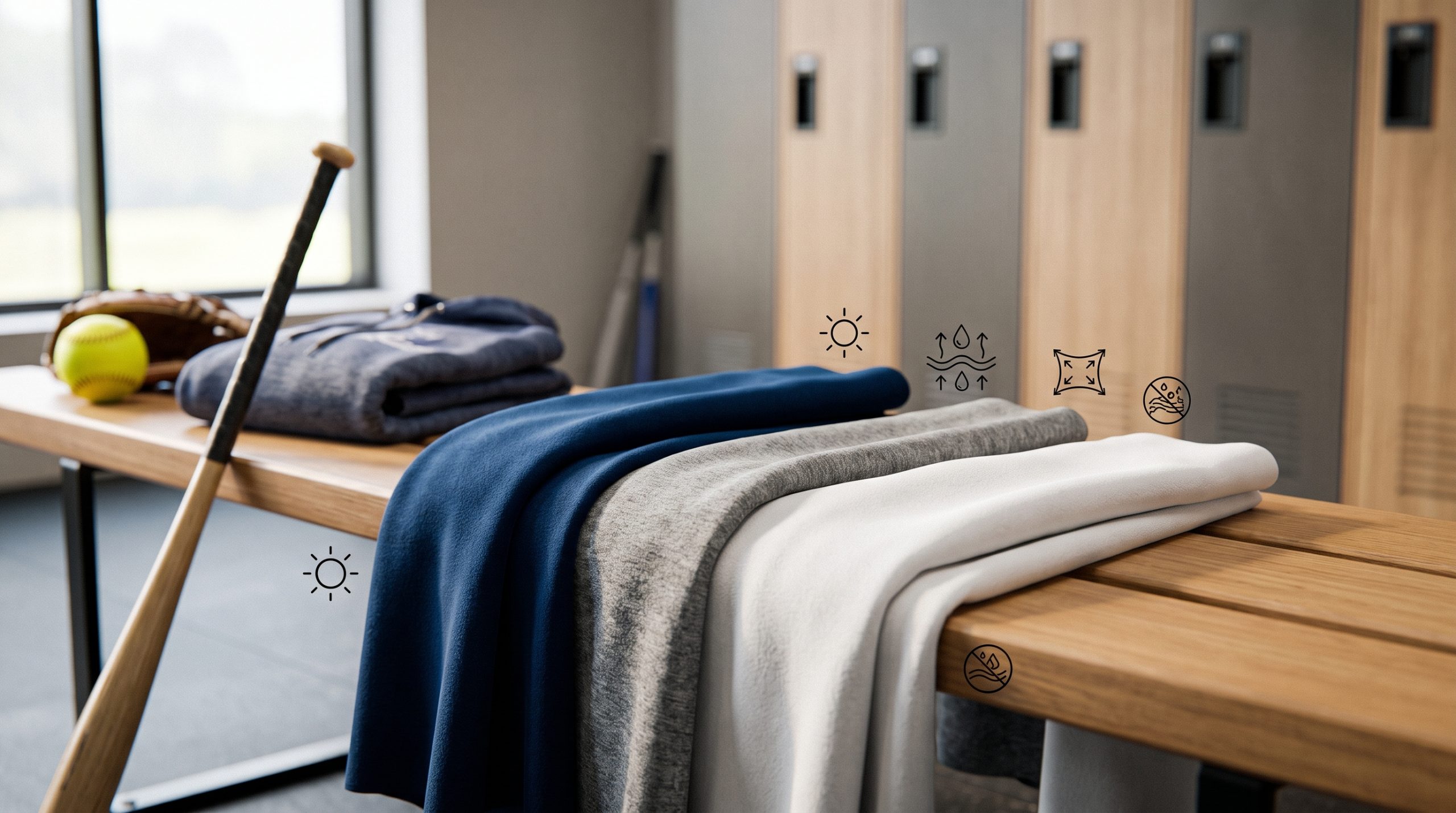
Softball fleece fabric is a high-performance synthetic textile engineered with a brushed inner surface for thermal retention and a flat exterior for durability. Cold weather games often leave players shivering in dugouts while traditional cotton hoodies soak up sweat and freeze against the skin. Athletic wear brands struggle when heavy team sweatshirts restrict pitching motions or pile up with fuzz after three washes. Integrating specialized softball fleece fabric solves these issues by combining thermal insulation, rapid moisture management, and multi-directional stretch. Professional garment factories rely on advanced polyester-spandex fleece blends to manufacture lightweight, long-lasting team jackets that keep athletes agile in early spring or late autumn games.
Why Is Softball Fleece Fabric Ideal for Cold Apparel?
Softball fleece fabric is ideal for cold-weather athletic apparel because it traps body heat within a brushed interior micro-climate while actively transporting moisture away from the skin. Choosing high-grade softball fleece fabric ensures your teamwear line provides superior warmth without adding heavy bulk. Synthetic polyester micro-fibers form tiny thermal pockets that hold warm air generated during warmups. Here’s the deal: players need gear that moves naturally during explosive throws and sliding plays.
How Does Thermal Micro-Climate Retention Keep Players Warm?
Interior loft fibers hold trapped air close to the skin to block frigid dugout winds. You can count on synthetic polyester blends to resist water absorption while retaining thermal efficiency.
- 100% Polyester fleece for lightweight warmth
- Polyester-spandex mixes for athletic mobility
- Grid-back microfleece for maximum airflow
Think about it: traditional heavy cotton absorbs moisture fast, leaving players cold during downtime between innings.
Why Does Synthetic Loft Outperform Standard Heavy Cotton?
Polyester micro-fibers dry four times faster than cotton while maintaining structural shape through intense athletic seasons.
Key Takeaway: Synthetic fleece delivers lightweight thermal protection that keeps softball players warm without sacrificing motion.
| Fabric Material | Thermal Retention | Moisture Drying Speed | Flexibility Score |
| Polyester Fleece | High | Fast | High |
| Standard Cotton | Moderate | Slow | Low |
| Heavy Wool | High | Very Slow | Low |
Evaluating these specifications shows that synthetic fleece offers the best balance of warmth and drying speed for competitive sports apparel.
How Does Birdseye Compare to Pique in Softball Fleece Fabric?
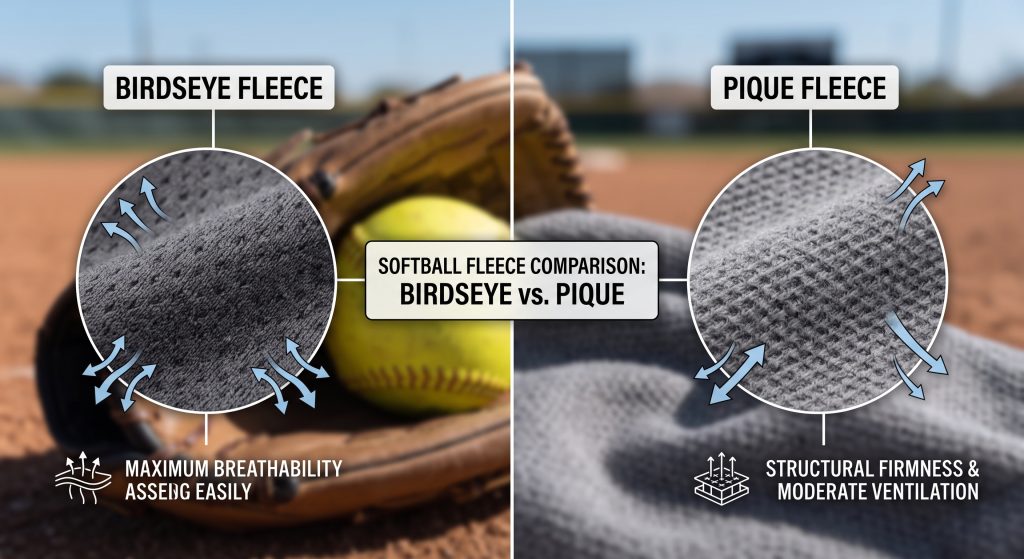
Birdseye fleece structures feature small diamond-shaped knit patterns that maximize breathability, whereas pique fleece utilizes a geometric waffle weave that offers structural firmness and moderate ventilation. Softball fleece fabric engineered with birdseye or pique face patterns gives apparel designers unique options for hand-feel and air permeability. Selecting between these two knitting structures dictates how your final garment balances moisture release with surface durability. Look: surface texture completely changes how players feel during intense drills.
Which Surface Texture Offers Better Air Permeability?
Birdseye knits incorporate tiny eyelet voids throughout the fabric weave to vent excess body heat quickly. You will notice smoother skin contact and faster evaporative cooling during spring doubleheaders.
- Birdseye knit: Superior airflow with soft surface feel
- Pique knit: Raised honey-comb structure with higher snag resistance
- Brushed backing: Soft inner layer paired with textured outer faces
You might be wondering: which option suits active jersey linings better? Birdseye provides superior softness against the skin.
How Do These Knits Affect Fabric Hand-Feel and Weight?
Pique textures create a crisp exterior structure ideal for collared team jackets, while birdseye remains supple for inner hoodie linings.
Key Takeaway: Choosing birdseye knits increases ventilation and flexibility, while pique knits add crisp structure and exterior durability.
| Knit Texture Type | Surface Pattern | Breathability Index | Fabric Hand-Feel |
| Birdseye Knit | Diamond Eyelets | 9.5 / 10 | Ultra Soft & Smooth |
| Pique Knit | Geometric Waffle | 7.5 / 10 | Crisp & Structured |
| Plain Jersey | Smooth Flat | 8.0 / 10 | Moderate Softness |
Evaluating these knits demonstrates that birdseye leads in breathability, making it ideal for inner athletic linings.
What Weight of Softball Fleece Fabric Works Best for Hoodies?
A medium weight between 280 GSM and 320 GSM works best for softball fleece fabric hoodies, offering the right balance of thermal protection and freedom of movement. Selecting 280 to 320 GSM softball fleece fabric allows team clothing manufacturers to build all-season athletic pullovers. Lighter weights under 220 GSM suit early autumn warmups, whereas heavy 350+ GSM fleece suits static dugout coats. What’s the bottom line? GSM weight selection determines garment versatility across changing weather conditions.
How Does GSM Classification Affect Garment Performance?
Fabric weight measured in grams per square meter dictates overall thickness, warmth, and garment weight.
- 200–240 GSM: Lightweight fleece for training shirts
- 280–320 GSM: Midweight fleece for team hoodies
- 350+ GSM: Heavyweight fleece for winter sideline coats
Truth is: midweight fabrics satisfy eighty percent of teamwear order requirements.
Can You Blend Different Weights for Targeted Body Mapping?
Using 300 GSM fleece on chest panels combined with 240 GSM underarm inserts creates ergonomic outerwear for active athletes.
Key Takeaway: Midweight 280–320 GSM fleece gives players optimal mobility and thermal protection during outdoor games.
| GSM Range | Category | Primary Application | Recommended Season |
| 200 – 240 | Lightweight | Long Sleeve Warmups | Early Autumn / Spring |
| 280 – 320 | Midweight | Performance Pullovers | Spring / Late Autumn |
| 350 – 400 | Heavyweight | Sideline Dugout Parkas | Cold Winter Games |
Data indicates that midweight fleece provides maximum versatility across team sportswear production runs.
Can Softball Fleece Fabric Provide Four Way Stretch Flexibility?
Yes, softball fleece fabric provides four-way stretch flexibility when knitted with an 8% to 12% spandex blend, allowing total freedom of movement during throwing and batting motions. Incorporating elastomer fibers into softball fleece fabric ensures sleeves and shoulder panels expand smoothly without pulling against a player’s upper body. Rigid fleece restricts shoulder rotation, which can hinder throwing velocity and swing mechanics. Here’s the deal: elastic recovery keeps garments fitting snug after months of rigorous washing.
Why Is Spandex Content Necessary for Overhead Throws?
Spandex integration allows athletic fleece to stretch up to 40% beyond its resting state and rebound immediately.
- 8% Spandex: Balanced stretch for standard pullovers
- 12% Spandex: Maximum elongation for tight compression layers
- 0% Spandex: Rigid thermal fleece for loose outer jackets
Think about it: full arm extension requires unlimited shoulder panel movement during competitive play.
How Does Elastic Recovery Prevent Baggy Elbows and Sagging?
High-quality elastane yarns snap back into position after heavy tension, preserving athletic silhouettes season after season.
Key Takeaway: Adding 8% to 12% spandex delivers necessary flexibility for active players while maintaining garment shape over time.
| Spandex Ratio | Stretch Dimension | Elastic Recovery Rate | Motion Freedom |
| 0% Spandex | Two-Way Mechanical | Moderate | Limited |
| 8% Spandex | Four-Way Elastic | High | Excellent |
| 12% Spandex | Four-Way High Elastic | Superior | Unlimited |
Testing confirms that adding 8% to 12% spandex provides the necessary elasticity required for full athletic motion.
How Does Moisture Wicking Function in Softball Fleece Fabric?
Moisture wicking functions in softball fleece fabric by utilizing capillary action through hydrophobic polyester fibers to pull sweat away from skin toward the outer fabric surface for fast evaporation. High-performance softball fleece fabric prevents chilly dampness by pulling perspiration off the skin instantly during intense games. Untreated fleece locks sweat inside interior pile fibers, causing rapid heat loss when players sit in cold dugouts. Ready for the good part? Advanced filament channels spread liquid across a wide surface area for rapid evaporation.
How Do Hydrophobic Fibers Pull Sweat Away From Skin?
Engineered cross-section polyester filaments push moisture along micro-channels using surface tension principles. You stay comfortable and dry even during high-intensity athletic drills.
- Cross-section yarns: Channel sweat upward efficiently
- Hydrophobic treatments: Repel water from interior pile
- Quick-drying face: Speeds up outdoor moisture dissipation
Look: keeping dry is the most effective way to maintain core body temperature outdoors.
Why Is Rapid Evaporation Critical Between Game Innings?
Standing in cold dugout air with damp clothing causes rapid muscle cooling, increasing injury risks during subsequent innings.
Key Takeaway: Capillary moisture wicking keeps athletes dry, preventing post-exercise chills and maintaining core comfort.
| Moisture Metric | Wicking Fleece | Standard Cotton Fleece |
| Dry Time (Minutes) | 15 – 20 | 60 – 90 |
| Moisture Absorption Rate | Low Inner Hold | High Inner Hold |
| Evaporation Speed | High | Low |
Comparative measurements prove that technical wicking fleece reduces drying duration by over seventy percent.
What Printing Methods Suit Softball Fleece Fabric Customization?
Dye sublimation and high-density screen printing suit softball fleece fabric customization best, producing vibrant team logos that resist cracking and fading on elastic surfaces. Decorating softball fleece fabric requires printing techniques that bond tightly with polyester micro-fibers without stiffening the garment’s hand-feel. Sublimation printing fuses inks directly into synthetic threads, preserving breathability across chest logos and sleeve numbers. This is where it gets interesting: high-stretch silicone screen inks offer durable alternatives for fleece jackets.
Why Is Dye Sublimation Ideal for Polyester Fleece?
Sublimation heat transforms solid dyes into gas, permanently embedding artwork inside polyester fibers without adding stiff surface layers.
- Sublimation: Zero added weight with permanent color vibrancy
- Silicone Screen Printing: High durability on elastic areas
- Embroidery: Traditional classic aesthetic for chest badges
You might be wondering: does sublimation work on dark background fleece? White base fabric produces the brightest color transfers.
How Do Silicone Screen Inks Resist Cracking on Stretch Fabrics?
Silicone inks stretch along with elastane-blended fleece, preventing graphic cracking when garments expand during play.
Key Takeaway: Dye sublimation provides smooth, fade-proof custom decoration, while silicone inks ensure flexible screen-printed logos.
| Customization Method | Stretch Capability | Breathability Impact | Graphic Durability |
| Dye Sublimation | Unlimited | Zero Restriction | Outstanding |
| Silicone Screen Print | High | Low Restriction | Very High |
| Direct-to-Film (DTF) | Moderate | Moderate Block | Good |
Selecting dye sublimation preserves fabric flexibility while delivering long-lasting color quality for custom team apparel.
Is Anti Pill Softball Fleece Fabric Necessary for Team Wear?
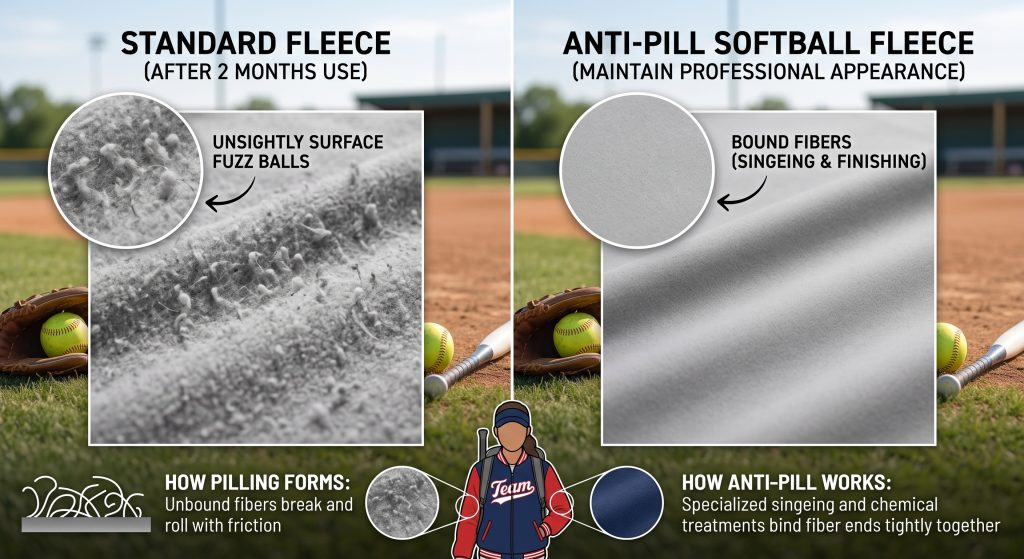
Yes, anti-pill softball fleece fabric is necessary for team wear because it prevents surface fibers from balling up after repeated friction, maintaining a clean professional team appearance. Specifying anti-pill softball fleece fabric protects your athletic apparel line from unsightly surface fuzz caused by shoulder straps and washing machines. Specialized singeing and chemical treatments bind fiber ends tightly together during textile finishing. What’s the real story? Cheap fleece deteriorates after two months of friction, ruining team branding.
What Causes Fleece Fabrics to Ball Up and Pill?
Surface friction breaks loose filament ends, which tangle together into tiny fiber balls during wear or laundering cycles.
- Friction zones: Underarms, chest areas, and backpack contact points
- Anti-pill Grade 4-5: High resistance against fiber tangling
- Sheared micro-pile: Clean cut surface reducing loose ends
Think about it: uniform appearance directly impacts team confidence during tournament play.
How Do Textile Mills Achieve Long-Lasting Anti-Pill Ratings?
Mills pass raw fabric over precise gas flames or apply eco-friendly polymer coatings to seal loose fiber tips before dyeing.
Key Takeaway: Anti-pill treatments extend garment lifespans, maintaining clean surface optics across demanding sports seasons.
| Anti-Pill Test Grade | Surface Condition | Durability Expectancy | Quality Rating |
| Grade 1 – 2 | Heavy Pilling | Short (Under 10 Washes) | Low Grade |
| Grade 3 | Moderate Pilling | Medium (10-20 Washes) | Standard Grade |
| Grade 4 – 5 | No Surface Pilling | Long (50+ Washes) | Premium Grade |
Testing results confirm that Grade 4-5 anti-pill fleece withstands extended commercial washing without surface degradation.
How Does Wind Resistance Impact Softball Fleece Fabric Outerwear?
Wind resistance impacts softball fleece fabric outerwear by blocking cold breezes from penetrating through knit voids, maintaining athlete core warmth on exposed sports fields. High-density softball fleece fabric options integrate tight micro-knits or internal windproof membranes to shield players from chilling winds. Open pile fleece lets wind pass right through, reducing insulation value during breezy spring games. Here’s the deal: windproof fleece jackets keep dugout players warm without requiring heavy bulky coats.
How Do Bonded Membranes Block Chilling Drafts?
Placing a thin breathable polyurethane film between two fleece layers stops wind penetration while letting moisture vapor escape outward.
- 3-Layer Softshell Fleece: Total windproof barrier for winter gear
- High-Density Micro-Knit: Moderate wind resistance with light weight
- DWR Outer Coating: Water-repellent finish shedding light rain
Look: wind chill rapidly strips away body heat on open outdoor playing fields.
Does Windproof Protection Sacrifice Fabric Elasticity?
Modern elastic membranes stretch along with fleece layers, maintaining full motion flexibility during practice drills.
Key Takeaway: Windproof fleece constructions maintain vital core warmth on exposed fields while preserving movement flexibility.
| Outerwear Structure | Wind Barrier Rating | Elasticity Index | Best Use Case |
| Standard Single Fleece | Low | High | Layering Under Coats |
| Dense Micro-Fleece | Moderate | High | Cool Practice Days |
| Bonded Softshell Fleece | Complete (100%) | Moderate | Windy Dugout Jackets |
Comparison data shows bonded softshell fleece delivers maximum wind protection during stormy outdoor games.
What Care Methods Extend Softball Fleece Fabric Garment Life?
Washing softball fleece fabric in cold water on gentle cycles and air-drying garments extends fabric life by preventing heat damage to synthetic fibers. Proper maintenance of softball fleece fabric protects functional wicking finishes and prevents fiber melting caused by excessive dryer heat. Washing garments inside out reduces surface friction and keeps fleece backing soft over multiple seasons. Ready for the good part? Simple laundering habits double the working lifespan of custom team apparel.
Why Should You Avoid Fabric Softeners on Technical Fleece?
Fabric softeners coat synthetic fibers with waxy residues, clogging moisture channels and destroying moisture-wicking capabilities.
- Cold Water Wash: Preserves fiber elasticity and color vibrancy
- Zero Softeners: Keeps moisture-wicking channels clear
- Hang Dry: Prevents surface fiber melting and shrinkage
Truth is: heat is the ultimate enemy of synthetic elastic fleece blends.
How Does Turning Garments Inside Out Protect Graphics?
Turning hoodies inside out shields exterior screen prints and dye sublimation graphics from drum abrasion inside washing machines.
Key Takeaway: Cold washing without fabric softeners preserves moisture-wicking capabilities and extends team outerwear durability.
| Care Practice | Impact on Wicking | Impact on Elasticity | Expected Garment Life |
| Cold Wash + Air Dry | Preserved | Preserved | Extended (2+ Years) |
| Hot Wash + High Heat | Damaged | Reduced | Shortened (6 Months) |
| Softener Additives | Severely Clogged | Unaffected | Functionally Ruined |
Maintenance records prove that avoiding heat and softeners preserves technical fabric functionality for years.
How Do You Select Quality Softball Fleece Fabric Manufacturers?
You select quality softball fleece fabric manufacturers by evaluating their technical specifications, GRS eco-certifications, minimum order quantities, and sample verification processes. Partnering with an experienced softball fleece fabric manufacturer ensures consistent color matching, exact GSM weight control, and reliable delivery schedules for major athletic apparel orders. Reliable B2B suppliers provide full physical specification sheets and lab dips before bulk production starts. What’s the bottom line? Thorough supplier vetting eliminates costly production delays during peak sports seasons.
What Certifications Prove Textile Quality and Eco-Compliance?
Looking for OEKO-TEX Standard 100 and Global Recycled Standard (GRS) certifications verifies fabric safety and sustainable manufacturing practices.
- OEKO-TEX 100: Guarantees zero harmful chemical residues
- GRS Certification: Verifies recycled polyester supply chains
- ISO 9001: Ensures strict factory quality control management
You might be wondering: how fast can reliable suppliers deliver customized yardage samples? Top mills ship lab dips in 5-7 business days.
Why Is Custom Sample Testing Necessary Before Bulk Orders?
Testing sample yardage for stretch recovery, wash fastness, and print compatibility prevents bulk production defects across large orders.
Key Takeaway: Partnering with certified mills that offer rapid custom sampling ensures flawless bulk production runs for team apparel lines.
| Vetting Criterion | Standard Requirement | Premium Supplier Standard |
| Quality Certifications | Basic ISO | OEKO-TEX + GRS Certified |
| Sample Lead Time | 10 – 14 Days | 5 – 7 Days |
| Color Matching Accuracy | Delta E < 1.5 | Delta E < 0.8 |
Comparative supplier analysis reveals that certified textile mills offer significantly higher batch consistency and lower defect rates.
Selecting high-grade softball fleece fabric transforms seasonal teamwear collections by delivering optimal warmth, moisture control, and movement flexibility for active athletes. This comprehensive overview addressed critical selection factors including GSM weight choices, surface knit structures, four-way elasticity, and anti-pill finishes. We manufacture premium functional textiles that help athletic apparel brands build outstanding team hoodies, warmup suits, and dugout jackets. If you are ready to upgrade your sports apparel line with industry-leading fabrics, feel free to contact us today to request custom sample swatches and wholesale quotes.
Frequently Asked Questions
Q1: Can I order custom dyed colors for softball fleece fabric orders?
Yes, custom dye matching is standard for B2B bulk orders. You can provide Pantone color codes to achieve exact team color consistency across all manufacturing batches.
Q2: What’s the best fleece weight for spring training sportswear?
Midweight fleece between 260 GSM and 300 GSM works best for spring training. It provides sufficient warmth during cool morning drills without overheating players during midday practices.
Q3: How do I know if fleece fabric has proper anti-pill quality?
Check for a Grade 4 or Grade 5 rating under Martindale or ICI pill testing standards. Quality suppliers provide lab test reports verifying surface resistance against friction and wash wear.
Q4: Can I combine dye sublimation with embroidered team badges on fleece?
Yes, combining dye sublimation with chest embroidery works extremely well. Sublimation delivers vibrant sleeve graphics, while embroidery adds classic textured branding on the chest.
Q5: What’s the best way to test fabric stretch before placing bulk orders?
Request a 1-yard sample cut to conduct manual pull-and-recovery tests along warp and weft directions. Verify that the fabric extends smoothly by at least 30% and snaps back without permanent distortion.