
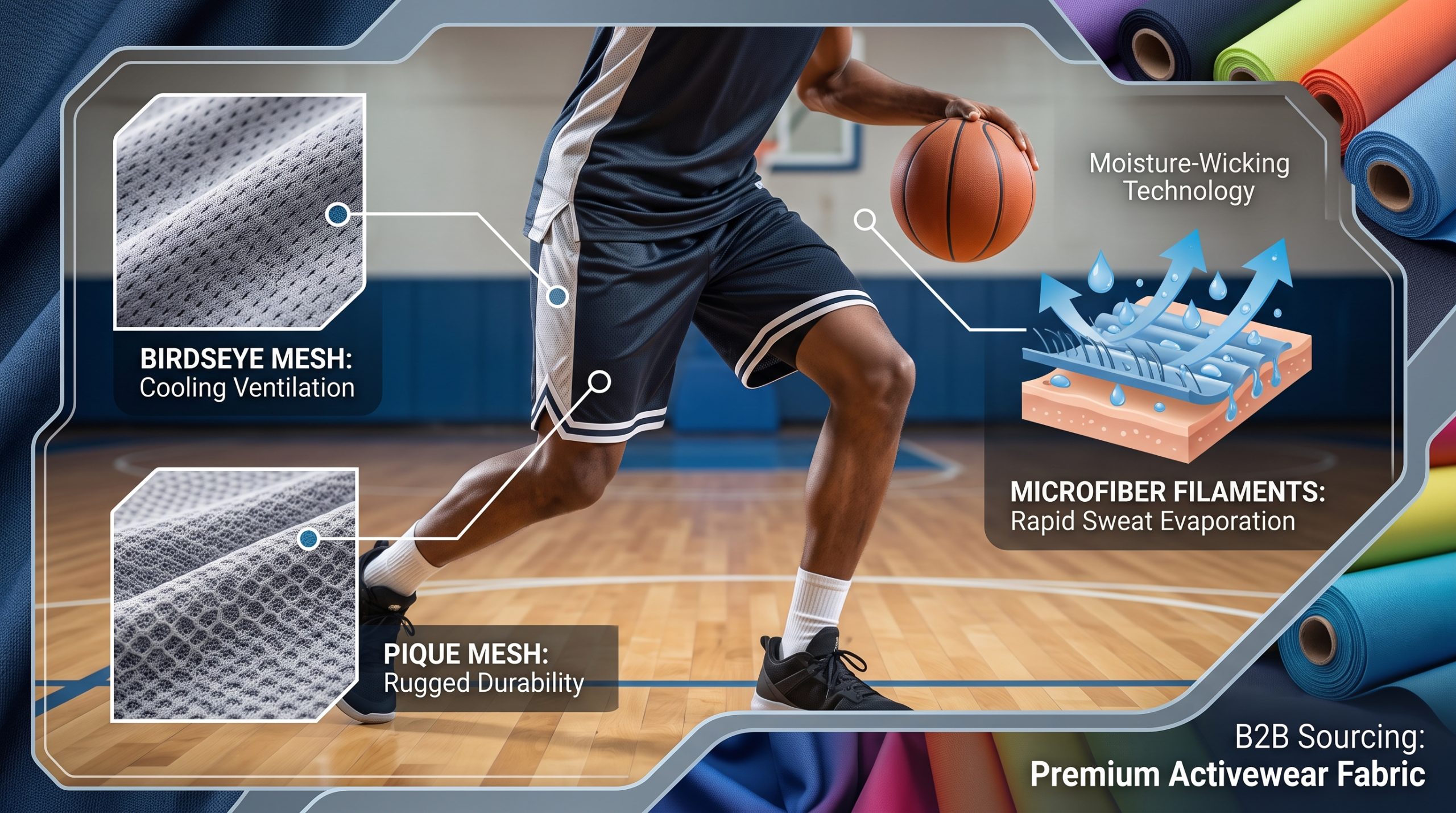
High-performance basketball apparel relies primarily on engineered polyester circular knits and technical synthetic blends that maximize court agility and moisture evaporation. Sourcing sportswear textiles that trap heavy sweat, turn soggy after ten minutes of sprinting, and tear along seamlines during physical contact causes major setbacks for apparel brands. Saturated natural fabrics cling to tired legs, slow down lateral quickness, and trigger costly quality returns from activewear buyers. Specifying advanced moisture-wicking synthetic knits solves these manufacturing challenges by combining open-pore ventilation, fast dry times, and high abrasion resistance. Sourcing directors consistently verify that basketball shorts material fabric options built from engineered microfibers provide the most dependable foundation for wholesale athletic collections.
Why Is Basketball Shorts Material Fabric Made of Polyester?
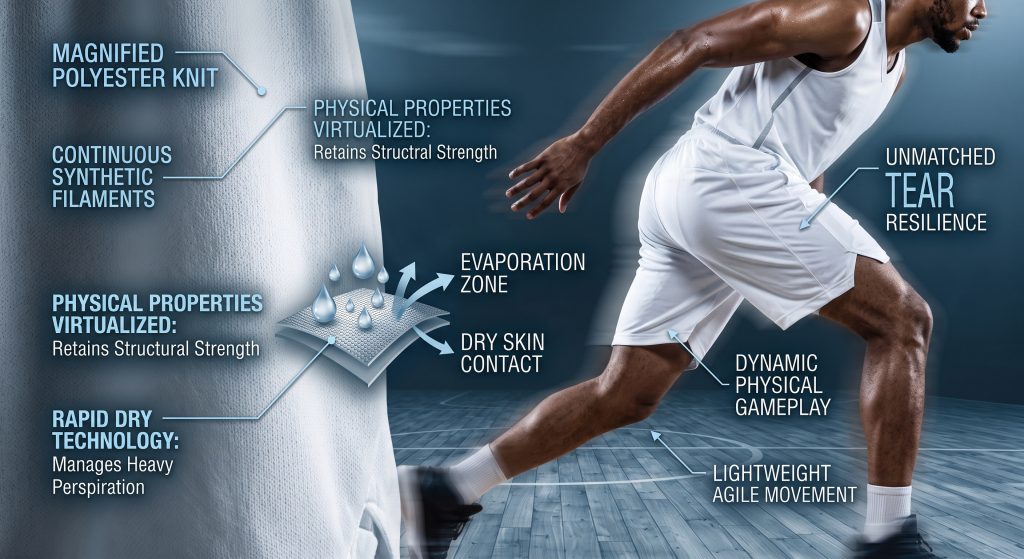
Modern sportswear manufacturers rely on polyester because synthetic polymers retain structural strength and dry quickly under heavy athletic perspiration. When evaluating whether basketball shorts material fabric specifications fit your catalog, continuous synthetic filaments deliver unmatched tear resilience during physical gameplay.
What Makes Microfiber Polyester Resist Tearing on Court?
Continuous synthetic filaments provide exceptional tensile durability that withstands aggressive grabbing and frequent floor dives. Here is the deal: tightly spun polyester yarns absorb extreme pulling forces without snapping delicate stitch junctions.
- High tensile resistance prevents sudden seam blowouts during aggressive defense.
- Continuous extruded yarn strands eliminate lint formation during frequent washing.
- Smooth polymer surfaces glide over leg muscles without causing skin chafing.
Why Does Low Moisture Absorption Keep Uniforms Light?
Hydrophobic polyester fibers repel liquid sweat molecules instead of trapping moisture inside individual yarn cores. Think about this: perspiration moves outward along micro-grooves so the inside fabric face remains dry against player skin.
- Surface moisture spreads across broad exterior zones to speed up air drying.
- Garment panels retain their shape without sticking to sweaty quadriceps.
- Fast drying prevents heavy garment sag during intense late-game action.
| Material Property | Synthetic Polyester Knit | Natural Ring-Spun Cotton |
| Moisture Uptake | Under 0.4% Fiber Weight | 7.5% to 8.5% Fiber Weight |
| Drying Velocity | Fast Continuous Release | Slow Saturated Retention |
| Wet Tensile Strength | 100% Strength Retention | Weakened Fiber Structure |
| Skin Drag Friction | Minimal Smooth Gliding | Heavy Damp Adhesion |
Evaluating yarn physical metrics proves that hydrophobic synthetic polymers eliminate fabric drag during active court competition.
Key Takeaway: Choosing hydrophobic polyester yarns keeps your athletic shorts lightweight and prevents damp garment cling during competitive matches.
How Does Birdseye Basketball Shorts Material Fabric Perform?
Birdseye mesh provides exceptional cooling airflow and a weightless, silky handfeel that excels during high-tempo tournament play. Sourcing teams analyzing how basketball shorts material fabric knits behave select Birdseye construction for its open geometric breathability.
How Do Micro-Diamond Pores Increase Air Ventilation?
Birdseye knitting utilizes alternating tuck and knit stitches on dual needle beds to create continuous diamond-shaped micro-apertures. Look at the facts: these precise geometric openings function as miniature ventilation windows across the whole garment face.
- Micro-diamond pores release trapped body heat rapidly during transition runs.
- Dual-face circular knit geometry provides total visual opacity under tension.
- Ultra-fine yarn counts maintain a featherweight handfeel for maximum mobility.
Why Does Smooth Birdseye Texture Prevent Skin Chafing?
The flat, silky face of Birdseye mesh glides smoothly against player skin during rapid changes of direction. Here is the real story: reducing surface texture friction protects sensitive skin zones during long tournament games.
- Smooth filament loops eliminate abrasive contact along inner leg seams.
- Lightweight fabric body moves naturally without bunching around player hips.
- Rapid moisture dispersal keeps the inner fabric face dry against player legs.
| Performance Attribute | Birdseye Mesh Structure | Plain Single Jersey |
| Surface Porosity | Micro-Diamond Pores | Closed Flat Face |
| Air Permeability | Maximum Ventilation Flow | Restricted Airflow |
| Tactile Sensation | Silky, Weightless, Fluid | Flat, Standard Contact |
| Primary Application | Pro Game Uniforms | Casual Training Shirts |
Comparing circular knit structures demonstrates that geometric stitch arrangements dictate both ventilation volume and fabric body.
Key Takeaway: Sourcing Birdseye mesh gives your competition shorts maximum breathability and a frictionless touch that protects players from chafing.
Is Pique Basketball Shorts Material Fabric Better for Shorts?
Pique mesh delivers high snag resistance, structured drape, and a crisp, dry tactile feel that suits team warmups and durable practice shorts. Apparel developers reviewing if basketball shorts material fabric lines should feature Pique choose this knit when clothing must withstand rough daily use.
How Does Honeycomb Waffle Stitch Prevent Fabric Cling?
Pique knits incorporate three-dimensional honeycomb tuck stitches that lift the fabric face slightly off warm skin. Check this out: this raised profile forms micro-channels beneath the garment where cool ambient air circulates freely.
- Raised geometric cords deflect external gym floor and pad abrasion.
- Internal air chambers assist in venting warm air away from leg muscles.
- Geometric knit structure provides a crisp, tailored appearance on team sidelines.
Why Does Double-Knit Geometry Stop Surface Snagging?
The interlocked double-knit construction of Pique fabric shields yarn loops from catching on sharp locker edges or athletic gear. What is the catch? Pique trades a small amount of peak airflow for exceptional surface toughness and structural shape retention.
- Compact yarn junctions stop snag loops from pulling through the fabric face.
- High structural stability prevents uniform wrinkling during long team travel.
- Textured exterior adds tactile depth and premium retail appeal to team collections.
| Knit Evaluation Metric | Pique Honeycomb Knit | Birdseye Mesh Knit |
| Surface Profile | Raised 3D Geometric Ridges | Micro-Diamond Pores |
| Snag Resistance Index | Superior Heavy-Duty Defense | Moderate to High Defense |
| Garment Body Drape | Structured, Tailored, Crisp | Lightweight, Flowing, Fluid |
| Recommended Garment | Warmup Apparel & Practice Gear | Elite Game Uniforms |
Reviewing structural parameters confirms that Birdseye mesh leads in pure ventilation while Pique knit excels in tailored silhouette retention and durability.
Key Takeaway: Selecting Pique mesh gives your sportswear line rugged snag resistance and a structured, non-cling drape ideal for practice gear.
Which Basketball Shorts Material Fabric Weight Suits Teams?
Standard basketball uniforms use fabric weights ranging from 140 GSM for ultra-light game meshes to 220 GSM for heavy retro-style double knits. Activewear designers deciding how basketball shorts material fabric weights align with seasonal lines balance lightweight breathability against structured retail silhouette.
When Should You Specify 140 GSM Ultra-Light Meshes?
Apparel brands specify 140 to 160 GSM lightweight meshes for elite competition uniforms where weight reduction improves player agility. Look at the facts: featherweight circular knits drape naturally and dump body heat rapidly during high-tempo full-court running.
- 140 GSM meshes reduce total uniform weight for fast-break offensive systems.
- Lightweight fabric folds compactly, reducing international ocean shipping parcel volumes.
- Thin knit profile dries within minutes after intense on-court conditioning sessions.
Why Choose 220 GSM Double Knits for Retro Bottoms?
Heavier 200 to 240 GSM double-knit fabrics deliver a substantial handfeel that retro streetwear consumers and team franchises demand. Here is why: heavier fabric weights increase raw material costs slightly, but they provide total zero-transparency opacity and clean structural drape.
- 220 GSM fabrics hold sharp embroidery badges and heavy silicone logos cleanly.
- Thick double-knit construction resists heavy wind on outdoor streetball courts.
- Substantial fabric handfeel allows activewear brands to justify premium retail prices.
| Fabric Weight Class | GSM Density Range | Target Basketball Application |
| Ultra-Light Performance | 135 – 155 GSM | Elite Pro Game Shorts & Tank Tops |
| Balanced Multi-Sport | 160 – 190 GSM | High School & Club Team Uniforms |
| Heavyweight Classic | 200 – 240 GSM | Streetwear Apparel & Warmup Bottoms |
Comparing weight specifications allows production managers to match fabric mass with specific athlete demographics and pricing tiers.
Key Takeaway: Matching precise fabric GSM to your target market guarantees your basketball shorts deliver the exact balance of lightweight speed and premium structural feel.
How Does Basketball Shorts Material Fabric Manage Sweat?
Synthetic fabrics manage moisture by pulling liquid sweat along outer yarn channels where vast surface areas accelerate ambient evaporation. In performance textile engineering, verifying how basketball shorts material fabric standards excel proves that synthetic capillary action prevents wet fabric weight accumulation during games.
How Do Grooved Synthetic Filaments Transport Moisture?
Specially extruded polyester filaments feature cross-sectional micro-channels that act as microscopic fluid pumps across the fabric face. Here is the deal: natural capillary pressure pulls liquid perspiration away from warm skin and distributes moisture across the external cloth face.
- Grooved yarn shapes pull sweat drops outward through natural capillary pressure.
- Broad fluid distribution creates thin moisture films that evaporate in seconds.
- Continuous transport mechanisms prevent liquid pooling against sensitive skin zones.
Why Does Natural Cotton Fail During Intense Training?
Cotton fibers absorb liquid sweat deep into their internal cellulose core, swelling up and holding multiple times their dry weight. Think about this: saturated cotton traps humid heat against player legs, creating heavy friction and promoting painful skin chafing.
- Cotton yarn saturation increases total uniform weight by over twenty percent.
- Damp natural fibers lose structural elasticity, causing wet garments to sag awkwardly.
- Slow evaporation rates leave players shivering during rest breaks and timeouts.
| Moisture Dynamic | Technical Synthetic Matrix | Traditional Cotton Fleece |
| Capillary Transport Action | Multi-Groove Filament Channels | Zero Filament Capillaries |
| Evaporation Dispersion | Broad Outer Face Spreading | Trapped Internal Core |
| Added Weight When Wet | Under 3% Added Liquid Mass | Up To 25% Added Liquid Mass |
| Skin Chafing Risk Factor | Minimal Smooth Gliding | High Abrasive Friction |
Evaluating fluid transport metrics demonstrates that synthetic wicking channels outperform natural absorbent fibers across athletic benchmarks.
Key Takeaway: Sourcing capillary-engineered polyester ensures your activewear line keeps athletes completely dry and free from friction chafing during intense exertion.
When Are Basketball Shorts Material Fabric Blends Preferred?
Designers specify poly-spandex blends when creating flexible compression inner liners and choose pure polyester for lightweight, free-flowing outer shells. Sourcing teams evaluating how basketball shorts material fabric blends perform can engineer 2-in-1 shorts that combine muscular support with classic court drape.
Why Add Elastane Filaments for Active 4-Way Stretch?
Adding elastane fibers introduces four-way mechanical stretch that accommodates explosive jumps and wide lateral defensive stances. Look at the facts: blending eight to fifteen percent spandex into polyester produces a form-fitting textile that tracks muscle extension without pinching.
- Four-way elasticity prevents seam restriction during deep defensive sliding steps.
- Snug compression fit promotes active blood circulation in leg muscle groups.
- Blended synthetic fibers retain their original recovery shape after repeated stretching.
How Does Pure Polyester Compare to Nylon Court Yarns?
Nylon delivers high surface abrasion resistance and a cool tactile handfeel, but polyester dries faster and accepts brighter sublimation colors. What is the real story: polyester remains the dominant choice for team basketball shorts because it resists solar fading and holds sharp print borders.
- Pure polyester yarns dry forty percent faster than equivalent nylon knits.
- Disperse dye sublimation bonds permanently to polyester fibers without cracking.
- Polyester provides high dimensional stability when exposed to commercial laundry heat.
| Fiber Composition | 100% Technical Polyester | 88% Poly / 12% Spandex | 100% Polyamide (Nylon) |
| Elastic Recovery | Mechanical Warp Stretch | 4-Way Active Stretch | High Natural Recovery |
| Moisture Evaporation | Rapid Heat Release | Fast Fluid Release | Moderate Release |
| Print Versatility | All-Over Sublimation | Sublimation / Heat Press | Screen Print / Reactive |
| Target Short Component | Outer Court Shell | Built-In Compression Liner | Heavy Duty Training Shell |
Analyzing fiber characteristics reveals that pure polyester dominates outer game shorts while elastane blends power flexible base layers.
Key Takeaway: Combining a 100% polyester outer shell with a poly-spandex inner liner creates a premium 2-in-1 basketball short that maximizes mobility and player comfort.
How Is Basketball Shorts Material Fabric Tested for Strength?
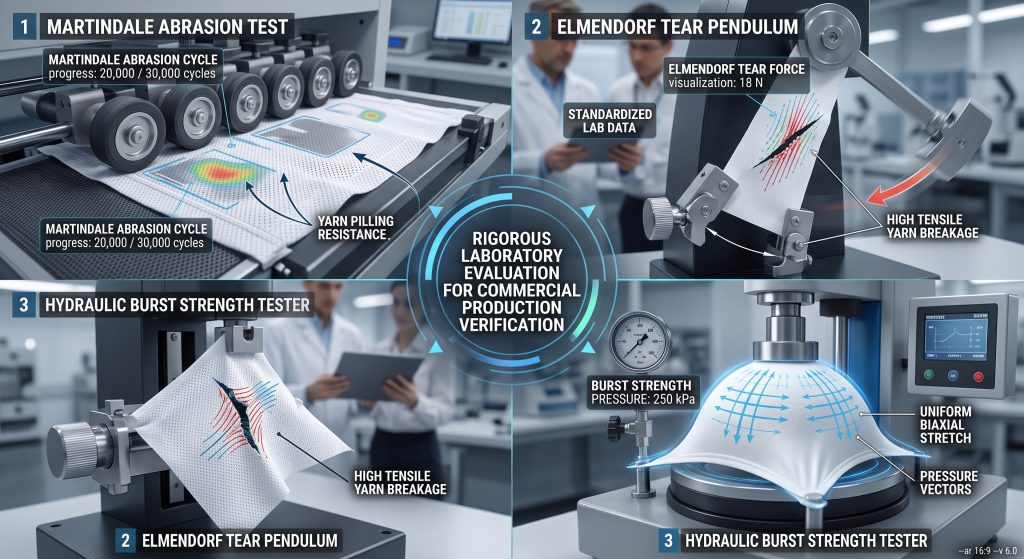
Textile laboratories evaluate athletic fabrics using automated Martindale abrasion wheels, Elmendorf tear pendulums, and burst strength testers. Apparel sourcing managers checking how basketball shorts material fabric rolls perform review standardized lab data to verify that commercial production lots withstand competitive physical contact.
What Standard Mechanical Trials Prevent Surface Snagging?
Mace snag tests and Martindale abrasion cycles drag weighted metal balls across fabric swatches to simulate aggressive contact with hardwood floors and pads. Here is the deal: high-grade circular knits utilize high yarn twist counts that resist snag loops and fiber pilling during intense contact.
- Martindale test ratings above twenty thousand cycles verify pro-grade durability.
- High needle density knits lock individual loops to stop running yarn ladders.
- Snag resistance testing confirms that finished shorts survive repeated gym machine friction.
How Does Colorfastness Hold Up Under Heavy Washing?
Colorfastness testing subjects dyed polyester swatches to high-temperature alkaline washes, simulated perspiration solutions, and xenon arc lighting. Think about this: disperse dye molecules fuse inside synthetic polymer chains at high heat, making the color impossible to wash out.
- Grade 4-5 colorfastness ratings prevent dye bleeding across contrasting team trim panels.
- UV stability trials confirm that outdoor sunshine will not fade vibrant team colors.
- Perspiration fastness tests show that acidic sweat never dulls bright uniform graphics.
| Quality Standard Test | Testing Methodology | Commercial Passing Grade |
| Martindale Abrasion | ASTM D4966 Circular Rubs | 20,000+ Smooth Cycles |
| Elmendorf Tear Strength | ASTM D1424 Falling Pendulum | 18+ Newtons Tensile Pull |
| Washing Colorfastness | ISO 105-C06 Alkaline Wash | Grade 4.5 / 5.0 (No Bleed) |
| Bursting Strength Trial | ASTM D3786 Hydraulic Diaphragm | 250+ Kilopascals Pressure |
Reviewing standardized laboratory test protocols confirms that your bulk fabric roll procurement meets professional competition standards.
Key Takeaway: Demanding certified durability test reports guarantees your wholesale garment inventory avoids costly surface snagging and customer color-bleeding returns.
Why Choose Sublimated Basketball Shorts Material Fabric?
Synthetic polyester lowers total garment production costs by reducing cutting scrap waste and accepting high-speed digital sublimation without expensive chemical wash cycles. Apparel brands evaluating why basketball shorts material fabric textiles dominate commercial supply chains find that synthetic materials offer predictable pricing and superior manufacturing yields.
How Does Dye Sublimation Protect Open Breathable Pores?
Digital sublimation printing embeds gaseous disperse inks directly into polyester fibers using heat, eliminating wet dye baths and thick ink deposits. Check this out: print shops can produce complex custom team graphics, player numbers, and gradient side panels in a single energy-efficient step.
- Single-step sublimation eliminates the setup cost of individual silk-screen mesh screens.
- Gas-phase dye bonding leaves the fabric surface completely soft without heavy ink layers.
- Zero liquid waste processing complies with international green manufacturing directives.
Why Does Bulk Synthetic Extrusion Stabilize Margins?
Synthetic polymer extrusion provides stable raw material pricing that remains insulated from agricultural weather events that disrupt natural cotton harvests. Here is why: uniform yarn diameters and consistent tensile properties reduce loom downtime and knitting defect rates across mass production runs.
- Predictable raw fiber costs protect your commercial profit margins during long contracts.
- High knitting uniformity minimizes fabric rejection rates during final factory inspection.
- Synthetic fibers store safely in warehouse environments without moisture damage risks.
| Production Efficiency Factor | Sublimated Synthetic Poly | Screen-Printed Cotton Fabric |
| Printing Setup Expense | Zero Screen Setup Charges | High Multi-Screen Tooling Fees |
| Material Defect Rates | Under 1.5% Roll Rejection | Variable 4-7% Natural Flaws |
| Color Detail Precision | High-Definition Vectors | Restricted Layer Spot Colors |
| Post-Print Washing Needs | Zero Wash-Off Required | Heavy Water Rinsing Mandate |
Analyzing manufacturing variables proves that polyester knitting rolls streamline custom decoration while securing reliable commercial profit margins.
Key Takeaway: Adopting polyester textiles with digital sublimation printing slashes sample setup costs and boosts production efficiency for customized team apparel lines.
How to Maintain Basketball Shorts Material Fabric Long-Term?
Equipment managers maintain polyester basketball uniforms by washing in cool water, avoiding chemical softeners, and air drying away from intense heat sources. Understanding how basketball shorts material fabric garments react to commercial laundry protocols helps coaches and players extend garment lifespan across multiple seasons.
Why Do Fabric Softeners Ruin Breathable Knit Channels?
Liquid fabric softeners leave a microscopic waxy silicone residue that coats synthetic fibers and clogs breathable knitting pores. Look at the facts: this oily barrier blocks capillary action, trapping body perspiration and odor-causing bacteria inside the garment structure.
- Chemical wax coatings stop synthetic micro-pores from venting warm humidity.
- Trapped moisture promotes rapid growth of odor-producing skin bacteria.
- Skipping fabric softener keeps moisture-wicking capillary channels completely open.
How Can You Eliminate Persistent Odors from Sportswear?
Washing uniforms inside out with a specialized sports detergent or adding a cup of distilled white vinegar breaks down trapped body oils. Ready for the good part: cool water cycles dissolve perspiration salts effectively without breaking down the mechanical elasticity of synthetic fibers.
- Vinegar rinses neutralize alkaline body odors trapped deep within synthetic loops.
- Washing inside out exposes high-sweat interior panels directly to water agitation.
- Air drying prevents high-heat tumble dryers from weakening heat-pressed team emblems.
| Maintenance Step | Recommended Best Practice | Action To Avoid Strictly |
| Washing Temperature | Cold to Warm (30°C / 85°F) | High Heat Boiling Water |
| Detergent Selection | Enzyme Sports Detergent | Heavy Chemical Fabric Softener |
| Drying Procedure | Low Heat Tumbler or Air Dry | Maximum Heat Commercial Dryers |
| Stain Removal Action | Oxygen-Based Color Safe Soak | Chlorine Bleach Applications |
Following structured laundering procedures protects synthetic knit pores and maintains team uniform freshness over long competitive seasons.
Key Takeaway: Educating your retail customers on proper cold washing without fabric softener preserves technical wicking performance and keeps team uniforms odor-free.
Where to Buy B2B Basketball Shorts Material Fabric Rolls?
Commercial apparel brands source specialized polyester rolls directly from established circular knitting factories that maintain custom dyeing and quality testing facilities. B2B procurement specialists determining where basketball shorts material fabric rolls are manufactured evaluate factory certifications, minimum order quantities, and custom development support.
What Mill Certifications Verify Chemical Safety Standards?
Global quality certifications such as OEKO-TEX Standard 100, GRS (Global Recycled Standard), and ISO 9001 verify that textile mills follow strict chemical safety and consistent production controls. Here is the real story: certified fabric rolls give international apparel brands total peace of mind regarding human skin safety and environmental compliance.
- OEKO-TEX certification confirms zero harmful chemicals touch player skin.
- GRS accreditation verifies authentic post-consumer recycled polyester fiber content.
- ISO factory management ensures batch-to-batch color and GSM consistency.
How Do Direct Factory Orders Streamline Custom Production?
Partnering with an experienced textile manufacturer allows your brand to order custom Pantone dyed lots, specific pore structures, and tailored functional finishes. Think about this: direct mill sourcing provides access to rapid lab dip matching and fast sample roll yardage for pre-season prototyping.
- Direct mill pricing eliminates intermediate trading markups to expand brand margins.
- Custom roll weights and knitting patterns differentiate your finished apparel line.
- Professional factory logistics support smooth container shipping to global ports.
| Sourcing Criterion | Direct Knitting Manufacturer | Intermediary Wholesaler |
| Custom Pattern Flexibility | Full Custom Knit & Dye Support | Limited Stock Inventory Only |
| Minimum Order Quantities | Flexible Custom Dye Lots | Fixed Roll Package Quantities |
| Quality Control Traceability | Complete Batch Inspection Data | Unverified Reseller Batches |
| Direct Wholesale Pricing | Factory Direct Cost Advantage | Layered Distribution Markups |
Partnering directly with specialized textile mills provides complete supply chain transparency and superior pricing power for your sportswear line.
Key Takeaway: Sourcing certified custom fabric rolls directly from specialized knitting mills strengthens your product quality and secures dependable wholesale margins for your apparel brand.
Build Your Next Championship Sportswear Collection
Selecting the right technical textiles solves common activewear challenges like heavy sweat accumulation, uncomfortable fabric cling, and premature seam failure. Throughout this guide, we examined how capillary polyester yarns outperform cotton, compared silky Birdseye mesh breathability against rugged Pique knits, and reviewed how standardized lab testing protects activewear brands from costly defects. Sourcing the right combination of 140 GSM Birdseye game meshes and structured Pique knits ensures your basketball line delivers elite court performance and all-day comfort.
Our specialized circular knitting facilities produce certified Birdseye meshes, durable Pique knits, and custom performance textiles tailored to your exact activewear specifications. We provide activewear brands, garment factories, and team uniform decorators with reliable textile manufacturing, rapid Pantone color matching, and certified quality testing. Contact us today to request complimentary fabric sample swatches and discuss your upcoming sportswear production requirements with our experienced textile engineering team. We stand committed to advancing athletic performance through precision fabric engineering and sustainable manufacturing standards.
Frequently Asked Questions
Q1: Can I use cotton fabric for competitive basketball shorts?
No, cotton shorts absorb sweat and become heavy during play. Natural cotton fibers trap damp moisture against player legs, creating severe friction chafing and slowing down agility compared to fast-drying polyester knits.
Q2: What’s the best fabric weight for professional basketball shorts?
A fabric weight between 140 GSM and 180 GSM provides balanced performance. This weight range delivers maximum airflow and rapid dry times while maintaining complete fabric opacity on court.
Q3: How do I know if Birdseye or Pique mesh is right for my apparel line?
Choose Birdseye mesh if your priority is silky softness and maximum airflow for game uniforms, or select Pique knit if you require snag resistance and structured drape for warmups. Birdseye maximizes ventilation during play, while Pique provides durable protection for practice gear.
Q4: Can I print detailed custom graphics on polyester basketball shorts?
Yes, dye sublimation works cleanly on all white and light-colored polyester knits. The high-heat sublimation process bonds gaseous dyes directly into synthetic filaments, preserving fabric softness without clogging breathable knit pores.
Q5: How do I prevent odor buildup in synthetic basketball uniforms?
Wash your athletic uniforms in cool water using an enzyme-based sports detergent and avoid liquid fabric softeners. Fabric softeners leave waxy silicone coatings that trap body oils and odor-causing bacteria inside synthetic micro-pores.