
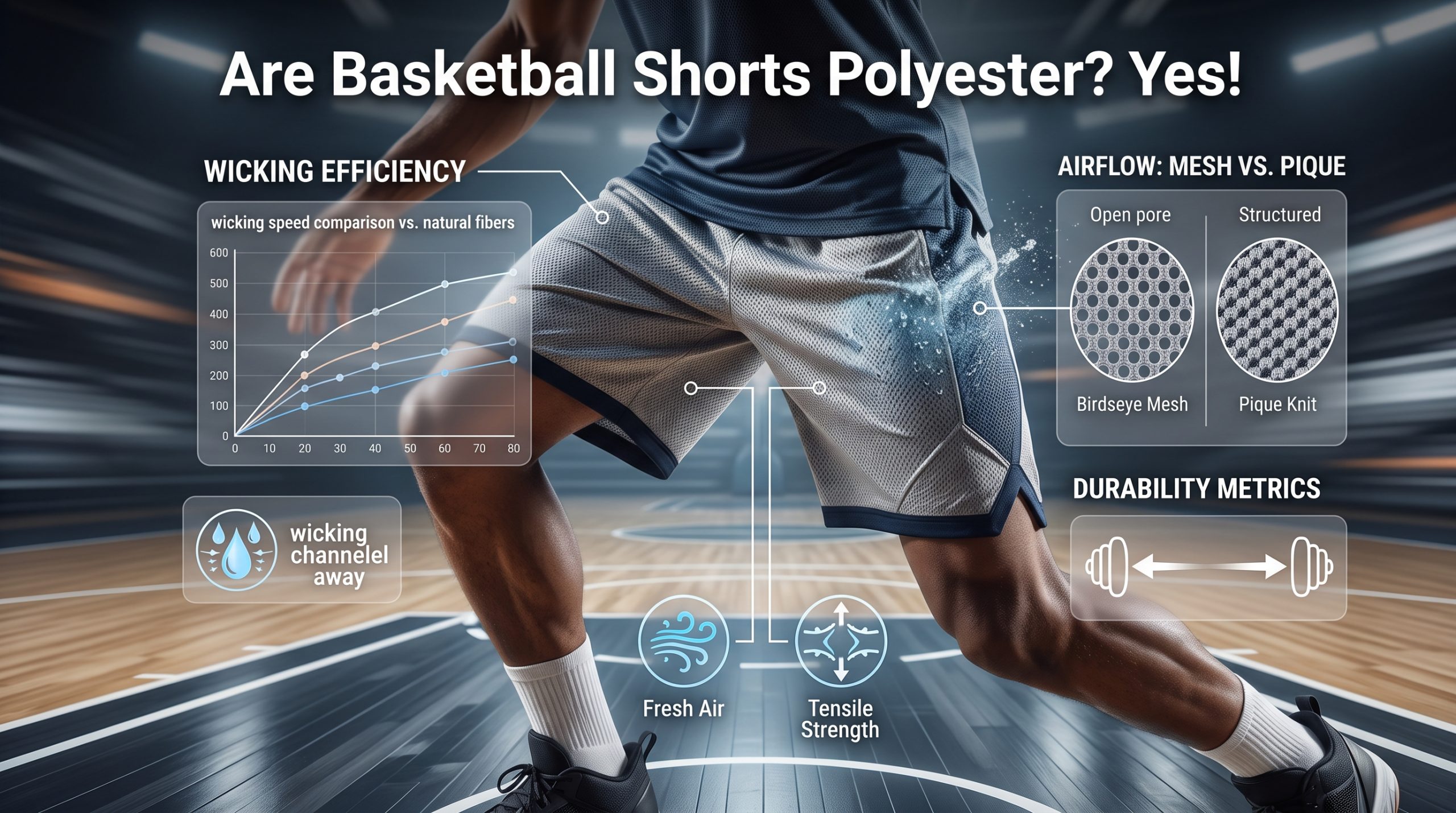
Most basketball uniforms rely on engineered synthetic polymers that maximize sweat evaporation and court mobility. You source bulk sports apparel for demanding teams, yet players complain about heavy, sweat-soaked bottoms that cling awkwardly during fast breaks. Heavy moisture retention ruins player focus, causes severe skin irritation, and destroys athletic performance across four quarters. Premium synthetic knits solve this issue immediately by channeling moisture away from skin to maintain continuous airflow. When garment creators evaluate whether are basketball shorts polyester, manufacturing data confirms synthetic microfibers form the premier foundation for competitive teamwear.
Why Are Basketball Shorts Polyester Fabric Today?
Basketball shorts feature polyester because synthetic filaments resist moisture absorption, maintain structural integrity, and provide extreme durability under physical friction. Garment developers evaluating why are basketball shorts polyester find synthetic fabrics outperform traditional natural fibers across every performance benchmark. Hydrophobic yarn pushes sweat outward along micro-grooves so it evaporates quickly in warm indoor courts. These resilient polymer chains keep uniforms featherlight throughout four grueling quarters of play.
What Drives Modern Court Performance Demand?
Fast court movements demand athletic apparel that stays dry under heavy sweat output. Here is the deal: competitive games produce high perspiration levels that immediately saturate and ruin standard cotton clothing.
- Moisture repulsion keeps garments light during full-court transitions.
- High tensile strength eliminates fabric tearing during aggressive rebounding scuffles.
- Smooth yarn construction prevents painful chafing across player thighs.
Why Does Synthetic Yarn Beat Pure Cotton?
Synthetic filaments maintain uniform tensile stability even when exposed to high moisture levels. Look at the facts: natural cotton absorbs up to twenty times its weight in water, creating unwanted bulk.
- Continuous synthetic threads eliminate lint accumulation during frequent laundering.
- Thermal heat-setting locks short silhouettes to stop post-wash shrinkage.
- Low liquid absorption speeds up laundry drying turnarounds between tournament games.
Key Takeaway: Sourcing synthetic fabrics guarantees your apparel line stays lightweight and durable through demanding competitive seasons.
| Performance Metric | Synthetic Polymer Knit | Traditional Ring-Spun Cotton |
| Moisture Uptake | Under 1.0% | 7.0% to 8.5% |
| Dry Time Index | 20 to 30 Minutes | 90 to 120 Minutes |
| Tensile Resistance | High (No wet loss) | Moderate (Weakens wet) |
Synthetic polymer structures consistently deliver superior moisture regulation and mechanical resilience compared to standard plant fibers.
How Are Basketball Shorts Polyester Blends Made?
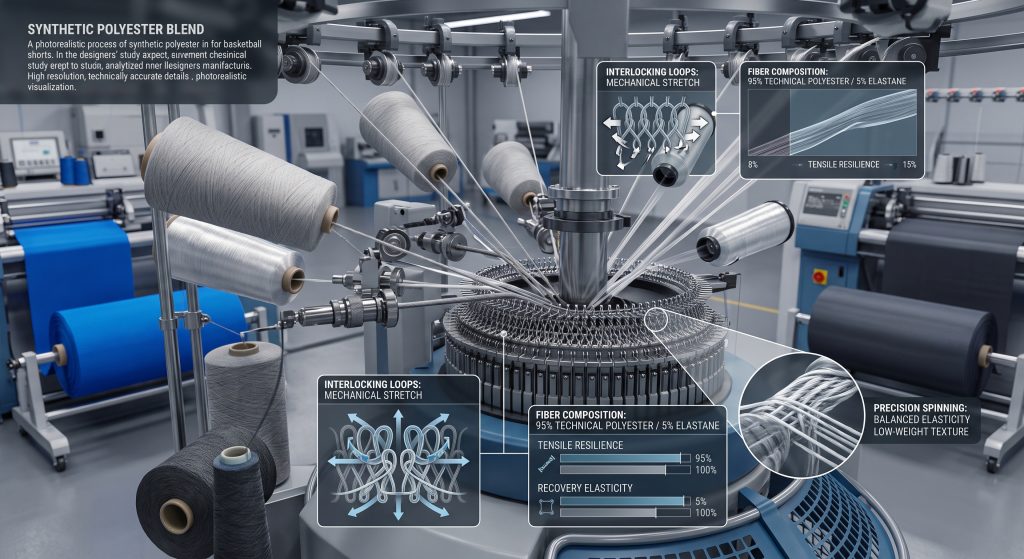
Synthetic athletic blends combine textured filament yarn with flexible elastane fibers on high-speed circular knitting machines. Designers studying how are basketball shorts polyester construction patterns identify distinct knitting densities that tailor flexibility for specific sports. Interlocking loops create mechanical stretch that moves with deep defensive stances. Precision spinning processes deliver balanced fabric elasticity without requiring heavy yarn weights.
What Yarn Densities Provide Great Flexibility?
Knitting mills tune denier counts to achieve balanced fabric weight and high flexibility. You might wonder: what thread thickness delivers optimal results for fast-paced court movement?
- Low-denier filaments create an ultra-soft skin feel.
- Multi-filament bundles create microscopic air channels that speed up sweat dispersal.
- Circular interlock weaves yield four-way mechanical stretch without heavy elastane additives.
How Do Elastane Additions Change Drape Quality?
Adding small percentages of spandex to synthetic polymers alters how the finished garment hangs. Here is what matters: a five percent elastane blend provides freedom of movement while preserving the traditional loose drape.
- Modest elastane levels protect the relaxed silhouette preferred by court players.
- Elastic recovery prevents sagging around the waistband and hem borders.
- Enhanced flexibility prevents seam rupture during extreme athletic lunges.
Key Takeaway: Choosing the right filament density and stretch ratio produces comfortable, flexible team shorts that maintain crisp silhouettes.
| Blend Composition | Target Stretch | Recommended Garment Application |
| 100% Synthetic Interlock | Mechanical (8-12%) | Traditional Loose-Fit Team Uniforms |
| 95% Synthetic / 5% Spandex | Dynamic (18-25%) | Modern Ergonomic Training Shorts |
| 90% Synthetic / 10% Spandex | High Compression | Integrated Padded Undershorts |
Balancing synthetic yarn ratios enables manufacturers to hit specific target flexibilities while keeping garment weight low.
Are Basketball Shorts Polyester or Nylon Better?
Polyester serves as the athletic industry standard because it provides superior moisture management and cost stability compared to nylon. When brands review whether are basketball shorts polyester or polyamide based, cost calculations and hydrophobic performance usually favor synthetic polyester. Polyamide offers exceptional abrasion resistance, yet it absorbs more liquid and costs significantly more per yard. Polyester delivers rapid moisture clearance that keeps teamwear dry during long practice sessions.
Which Polymer Delivers Superior Abrasion Defense?
Polyamide fibers offer slightly higher surface abrasion resistance, but synthetic polyester delivers better all-around court longevity. Think about this: basketball shorts face repeated friction from floor dives, sharp picks, and equipment bags.
- Polyamide yarns withstand intense surface friction before showing yarn pills.
- Polyester polymers offer higher resistance to UV radiation and sweat acid damage.
- Synthetic polyester fibers hold dye pigments deeper to resist color loss.
How Do Material Costs Impact Bulk Production?
Material acquisition budgets directly impact profit margins on large apparel production runs. What is the catch? Premium polyamide yarn runs thirty to fifty percent higher in raw bulk pricing.
- Stable polymer raw pricing keeps apparel manufacturing quotes predictable.
- Lower production scrap rates improve margins on large team uniform orders.
- Widespread fabric mill availability prevents costly supply chain bottlenecks.
Key Takeaway: Selecting polyester yields significant cost savings and faster drying speeds without sacrificing the toughness needed for team sports.
| Polymer Property | Synthetic Polyester | Polyamide (Nylon) |
| Raw Material Cost | Budget-Friendly | 30% to 50% Higher |
| Moisture Uptake Rate | Very Low (0.4%) | Moderate (4.0% to 4.5%) |
| Sublimation Capability | Excellent Color Bond | Poor (Requires Acid Dyes) |
Polyester maintains clear commercial advantages for team sports apparel through reliable color processing and economical raw pricing.
Are Basketball Shorts Polyester Mesh Breathable?
Synthetic mesh fabrics provide exceptional breathability by incorporating physical ventilation holes directly into the knit structure. Factory managers analyzing why are basketball shorts polyester open knits select these patterns to vent body heat during intense exertion. The open-hole geometry allows hot air to escape while drawing cooler outside air toward the athlete. Knit mesh structures prevent heat build-up without adding unnecessary layers.
How Does Birdseye Pattern Structure Air Flow?
Birdseye mesh uses tiny geometric tuck stitches that create continuous micro-apertures across the cloth surface. Here is the deal: these miniature openings act like tiny ventilation windows across the entire garment.
- Microscopic eyelets promote continuous heat release without exposing player skin.
- Soft circular yarns create an ultra-smooth handfeel against bare legs.
- Lightweight fabric drape gives players unrestricted speed on fast breaks.
Does Pique Mesh Offer Sturdier Moisture Release?
Pique knits incorporate raised waffle textures that lift fabric slightly off warm skin surfaces. Check this out: the three-dimensional geometric structure prevents clingy fabric sensations during intense perspiration.
- Raised honeycomb pockets create air circulation pathways underneath the short.
- Firm knit construction gives basketball shorts a crisp, structured appearance.
- Dense yarn junctions resist snagging from fingernails and sharp locker edges.
Key Takeaway: Choosing between open Birdseye knit and structured Pique allows you to tailor airflow, handfeel, and garment drape precisely.
| Fabric Architecture | Surface Texture | Primary Performance Advantage |
| Birdseye Mesh | Smooth, micro-porous | Ultra-soft touch, high passive airflow |
| Pique Knit | Geometric waffle grid | Non-cling structure, snag resistance |
| Closed-Hole Mesh | Flat interlock face | Maximum opacity, sleek aesthetic |
Structural knit variations give apparel creators precise control over ventilation rates, tactile skin feel, and overall garment drape.
How Are Basketball Shorts Polyester Knits Tested?
Textile laboratories evaluate athletic fabrics using standardized tests for tensile strength, pilling resistance, and sweat colorfastness. Bulk procurement officers verifying how are basketball shorts polyester batches perform run rigorous mechanical cycles before cutting panels. Burst tests measure how many pounds of pressure the knit withstands before tearing. These standardized metrics prevent costly factory defects and protect brand credibility.
What Tensile Standards Prevent On-Court Tearing?
Standardized grab tests measure the exact load capacity of warp and weft knit directions. You might wonder: how much force must a competition-grade basketball short survive?
- Quality athletic knits must withstand at least fifty pounds of sudden pulling force.
- Reinforced flatlock seams prevent stitch unravelling when opposing players grab uniforms.
- High burst ratings protect shorts during aggressive slides across polished wood courts.
How Is Colorfastness Measured Against Sweat?
Testing technicians soak knit swatches in acidic and alkaline sweat solutions before running color checks. Here is what matters: human perspiration contains minerals that break down low-grade fabric dyes.
- Solution testing confirms pigments will not bleed onto white undergarments.
- Lightfastness ratings ensure team colors stay bright under intense stadium floodlights.
- Multi-cycle wash tests verify that custom team hues remain deep through forty home washes.
Key Takeaway: Demanding certified lab test reports protects your brand from seam failures, dye bleed claims, and fabric tearing.
| Test Parameter | Standard Method | Minimum Commercial Target |
| Seam Burst Strength | ASTM D3786 | > 65 psi |
| Perspiration Fastness | AATCC 15 | Grade 4.0 Minimum |
| Pilling Resistance | Martindale (2000 revs) | Grade 4.0 or Better |
Standardized laboratory testing ensures that every production roll satisfies demanding athletic performance standards before garment assembly begins.
Are Basketball Shorts Polyester Pique Durable?
Polyester Pique knits deliver remarkable durability because their multi-yarn double-knit construction resists surface abrasion and snagging. Sourcing agents questioning whether are basketball shorts polyester Pique fabrics tough enough find the textured weave protects fibers from catching on sharp objects. The alternating raised structure absorbs contact friction rather than tearing yarn loops. This geometric surface protects uniform surfaces over intense tournament schedules.
Does Waffle Texture Resist Snagging and Pilling?
The geometric honeycomb surface of Pique knits shields internal threads from direct external snag hazards. Think about this: Velcro closures from gym bags can instantly ruin fragile single-jersey fabrics.
- Reinforced surface nodes prevent snag loops from pulling through the fabric face.
- Tight yarn packing stops friction-based pilling during rigorous machine washing.
- Firm structural body gives shorts a clean, professional sideline appearance.
Why Choose Birdseye Knits for High Ventilation?
Birdseye knits prioritize active cooling through smooth, pinpoint micropores across the fabric. Here is the deal: while Pique provides unmatched exterior toughness, Birdseye delivers a silkier, lighter handfeel that athletes love.
- Featherlight yarn density maximizes cooling airflow during intense cardio sprints.
- Soft interior touch eliminates abrasive skin irritation along inner thigh seams.
- Supple fabric flex allows fluid leg extensions during high jumping plays.
Key Takeaway: Pick rugged Pique knits for heavy-duty training shorts, and choose smooth Birdseye mesh for ultra-lightweight game uniforms.
| Comparative Characteristic | Pique Knit Fabric | Birdseye Mesh Fabric |
| Tactile Handfeel | Textured, firm, dry | Silky, ultra-soft, smooth |
| Snag Resistance | Superior (Heavy duty) | Moderate to High |
| Recommended Garment | Warmup Shorts & Practice Gear | Pro Game Uniforms |
Selecting between Pique and Birdseye knits allows manufacturers to tailor textile durability and player comfort to specific athletic requirements.
Why Are Basketball Shorts Polyester Lightweight?
Synthetic fabrics achieve minimal garment weight through ultra-fine microdenier filament construction that packs high strength into thin yarns. Product engineers researching why are basketball shorts polyester so light find microfibers weigh less than one denier per continuous strand. This tiny diameter lets mills weave robust, opaque textiles at low square-meter weights. The resulting athletic bottoms feel almost weightless without becoming transparent.
What Fabric Weights Fit Fast Game Movement?
Selecting the correct grams-per-square-meter rating ensures athletic bottoms stay light without turning see-through. What is the real story? Elite basketball shorts perform best between 130 and 160 GSM.
- 130 GSM mesh delivers maximum airflow for high-speed summer league play.
- 150 GSM interlock provides complete opacity for white and light-colored away uniforms.
- 180 GSM double-knit delivers heavyweight retro aesthetics for lifestyle streetwear collections.
How Do Microfiber Filaments Cut Garment Mass?
Extruded microfibers create dense protective surfaces using far less raw resin mass than standard yarns. Think about this: thinner filaments create more surface area per gram, speeding up sweat dispersion.
- Fine micro-grooves spread moisture thinly to speed up atmospheric drying.
- Reduced bulk allows team shorts to pack tightly into travel equipment bags.
- Low garment mass reduces player fatigue across back-to-back tournament games.
Key Takeaway: Specifying microdenier fabric between 140 and 160 GSM keeps teamwear light, completely opaque, and highly agile.
| Target Garment Class | Fabric Weight (GSM) | Key Physical Feature |
| Ultra-Light Game Short | 130 – 145 GSM | High Aeration, Rapid Dry |
| Standard Team Uniform | 150 – 165 GSM | Balanced Opacity, Great Drape |
| Heavyweight Retro Short | 180 – 220 GSM | Structured Vintage Handfeel |
Dialing in exact square-meter fabric weights prevents excessive uniform drag while preserving necessary fabric opacity on court.
Are Basketball Shorts Polyester Options Cost Savvy?
Synthetic fabrics provide outstanding cost efficiency due to streamlined melt-spinning production methods and high global supply volume. Sourcing coordinators analyzing why are basketball shorts polyester dominant see that synthetic manufacturing cuts fabric waste during high-speed cutting. Polymer consistency eliminates natural fiber flaws like yarn slubs and uneven vegetable debris. These smooth production runs keep unit costs low on large production volumes.
What Factors Determine Yarn Yield Economics?
Automated knitting machinery runs faster when processing consistent synthetic filament yarns. Look at the facts: continuous filament synthetic yarn experiences fewer thread snaps during high-speed knitting operations.
- Fewer machine stoppages translate into lower factory overhead costs per yard.
- Consistent roll width reduces edge waste during automated computer garment cutting.
- High yarn yield keeps seasonal wholesale teamwear prices stable.
How Do Recycled Filaments Affect Margins?
Recycled rPET yarns made from post-consumer bottles deliver strong marketing appeal at small cost differences. You might wonder: does sustainable recycled yarn damage garment profit margins?
- Premium eco-friendly certifications justify higher retail price points for green lines.
- Minimal cost premiums on recycled chips make sustainable team programs viable.
- Recycled filaments match virgin polymers in tensile strength and dye receptivity.
Key Takeaway: Sourcing synthetic fabrics stabilizes production budgets and provides affordable pathways to sustainable sportswear lines.
| Sourcing Factor | Virgin Synthetic Knit | Recycled rPET Synthetic |
| Base Yarn Cost | Most Economical | 5% to 10% Surcharge |
| Eco Certification Value | Standard Commercial | High Marketing Appeal (GRS) |
| Tensile Durability | High Performance | Equal to Virgin Standard |
Utilizing virgin or recycled synthetic fibers protects factory margins while satisfying modern consumer demand for durable activewear.
Can You Print When Basketball Shorts Are Polyester?
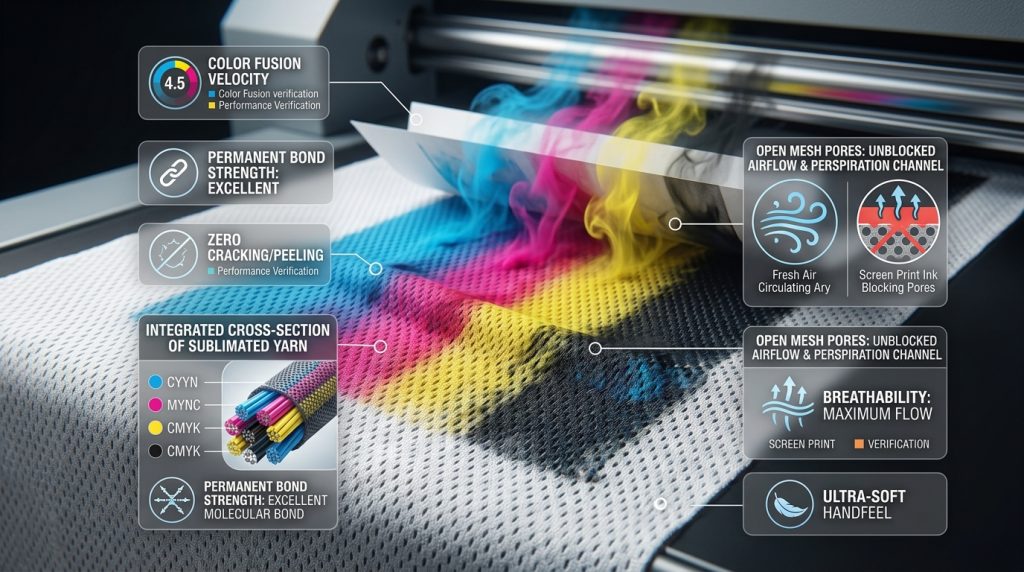
Synthetic polyester knits serve as the perfect medium for all-over dye sublimation printing because heated polymers permanently trap gas dyes. Designers checking if are basketball shorts polyester suitable for custom graphics discover sublimation fuses color directly into the yarn itself. This eliminates cracked graphics, peeling team numbers, and stiff chest patches. Sublimated patterns remain completely breathable because no heavy rubber ink blocks the open knit pores.
Why Is Sublimation Dye Ideal for Team Graphics?
Sublimation ink converts to gas under high heat and binds directly into the open synthetic polymer matrix. Here is the deal: the cured print becomes an inseparable physical part of the underlying yarn structure.
- Zero ink texture maintains the soft, non-abrasive handfeel of the original knit.
- Mesh holes remain open so airflow performance stays high across printed areas.
- Sharp graphic edges display intricate team logos, gradients, and player numbers cleanly.
How Do Heat Press Temperatures Affect Shrinkage?
Calendering machinery uses temperatures near two hundred degrees Celsius to bond gaseous sublimation dyes. Watch out for this: improper temperature controls can cause uneven fabric panel shrinkage during transfer.
- Pre-shrunk heat-set fabrics prevent panel distortion during dye transfer passes.
- Stable roll tensions protect uniform proportions across small and large sizes.
- Controlled heat application yields vibrant colors without weakening yarn strength.
Key Takeaway: Sublimation on synthetic fabrics yields soft, vibrant team graphics that never crack, peel, or block cooling air holes.
| Printing Method | Handfeel Texture | Breathability Impact | Longevity Under Wash |
| Dye Sublimation | Zero Added Texture | 100% Breathability Retained | Permanent (No Fading) |
| Screen Print Plastisol | Thick, rubbery hand | Clogs Mesh Openings | Cracks After 25+ Washes |
| Direct-to-Film (DTF) | Flexible Film Layer | Moderately Restricts Air | Good (40+ Washes) |
Dye sublimation on synthetic knits preserves fabric breathability while producing vibrant, permanent uniform graphics.
How Are Basketball Shorts Polyester Lines Sourced?
Apparel brands source synthetic basketball fabrics by partnering with certified textile mills that provide consistent dye lots and custom roll specifications. Sourcing directors evaluating how are basketball shorts polyester bulk orders managed specify exact yarn weights, widths, and finish treatments. Direct factory communication ensures clear quality control oversight from initial yarn spinning to final roll packaging. Reliable mill partnerships protect brand delivery schedules ahead of major athletic seasons.
What Mill Certifications Protect Sourcing Value?
Third-party mill accreditations verify that athletic textiles satisfy global chemical safety and environmental benchmarks. Ready for the good part? Standardized certifications remove supply chain uncertainty for international apparel brands.
- OEKO-TEX Standard 100 certification confirms fabrics are free from harmful irritants.
- Global Recycled Standard (GRS) documents verify genuine post-consumer recycled content.
- ISO 9001 factory audits confirm strict quality control across every production lot.
How Do Custom Pantone Batches Stay Uniform?
Spectrophotometer lab dip matching ensures mass-produced fabric rolls match official team color standards. Here is what matters: precise digital color formulation prevents visible shade variations between jerseys and shorts.
- Automated dye dispensers deliver exact color formulas across multi-ton production vats.
- Standardized light box checks catch color shifts under stadium lighting.
- Retained lot swatches ensure follow-up uniform reorders match original team sets perfectly.
Key Takeaway: Requiring strict mill certifications and computerized color matching prevents costly fabric delays and dye lot mismatches.
| Procurement Checklist Item | Verification Method | Buyer Protection Goal |
| Chemical Safety Standard | OEKO-TEX 100 Document | Prevents Player Skin Irritation |
| Color Accuracy Matching | Delta-E Colorimeter < 0.8 | Guarantees Uniform Set Matching |
| Roll Width Consistency | Automated Edge Sensors | Eliminates Cutting Table Waste |
Securing certified production documentation and digital color approvals safeguards bulk textile investments against costly production delays.
Final Summary: Sourcing Premium Basketball Fabric
Selecting the right synthetic fabric architecture separates elite sportswear from cheap, moisture-trapping gym clothing. Throughout this guide, we broke down how hydrophobic synthetic yarns beat cotton, compared open Birdseye mesh against snag-resistant Pique knits, and explored the precision economics of modern sublimation printing. Whether you need featherlight 140 GSM Birdseye knits for high-speed tournament uniforms or rugged 180 GSM Pique knits for durable training gear, choosing engineered synthetics guarantees moisture control and lasting durability.
We engineer high-performance athletic textiles that help sportswear brands, garment factories, and team uniform decorators build market-leading activewear. Our team delivers certified, color-matched Birdseye mesh, interlock knits, and technical stretch fabrics tailored to your exact garment requirements. To request custom lab dips, review fabric swatches, or plan your next seasonal sportswear run, contact us today to build your next championship collection.
Frequently Asked Questions
Can I use cotton instead of polyester for basketball shorts?
No, cotton should be avoided for competitive teamwear. Cotton absorbs large amounts of sweat, becomes heavy quickly, and causes painful skin chafing during intense running.
What is the best fabric weight for basketball shorts?
A fabric weight between 140 and 160 GSM works best for modern court uniforms. This weight range provides complete visual opacity without restricting player speed.
How do I know if Birdseye or Pique mesh is right for my order?
Choose Birdseye mesh if your priority is silky softness and maximum ventilation, or pick Pique knit if you need snag resistance and structured drape. Birdseye suits elite game uniforms, while Pique excels in durable daily practice gear.
Can I sublimate full color graphics on all polyester shorts?
Yes, dye sublimation works exceptionally well on all white and light-colored synthetic knits. The heat process locks gas dyes directly into synthetic filaments, preserving fabric softness and mesh breathability.
How do I care for 100% polyester basketball shorts?
Wash synthetic garments in cold water using mild detergent and tumble dry on low heat. Avoiding high dryer temperatures and fabric softeners prevents polymer breakdown and maintains moisture-wicking channels.