
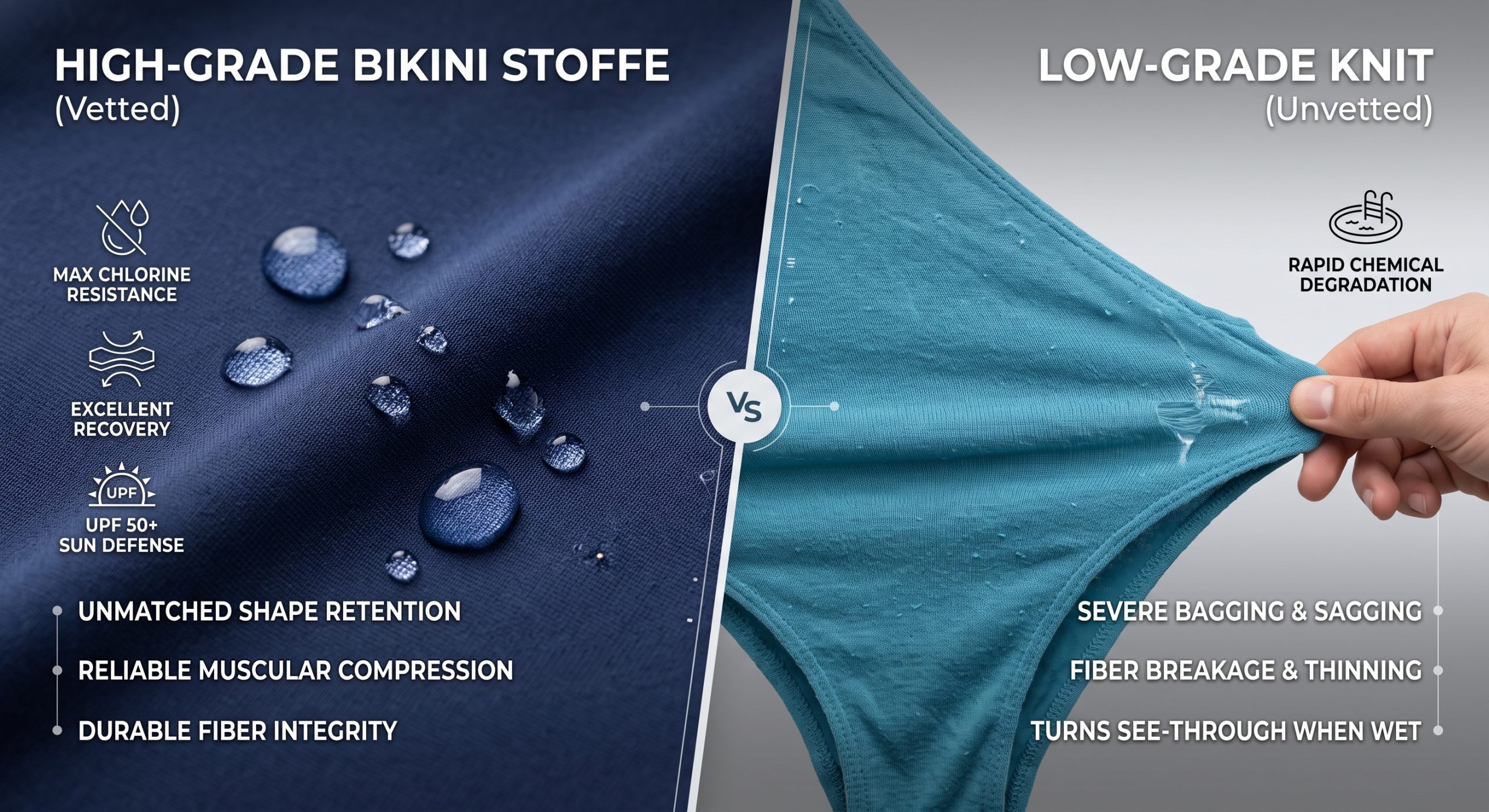
The finest bikini stoffe for active waterwear combine durable chlorine resistance, high tensile recovery, and low wet cling across engineered synthetic blends. Activewear designers often encounter customer complaints when delicate swimsuits sag, turn translucent, or pill after minimal beach exposure. Rapid fiber snapping and uneven fading damage product reputation while generating costly customer returns for boutique labels. Specifying high-gauge bikini stoffe with reinforced filament knits protects your apparel line from chemical degradation and preserves long-term brand credibility.
Why Do Active Brands Require Specialized Bikini Stoffe?
Specialized bikini stoffe shield active swimwear from fiber breakdown caused by chlorinated pools, saline surf, and intense sunlight. Generic activewear knits lose their elastic recovery rapidly when exposed to swimming pool oxidizers. Sourcing dedicated aquatic textiles ensures your athletic garments maintain supportive compression throughout rigorous training routines.
What Structural Defects Occur with Standard Knits?
Standard circular knits degrade quickly when exposed to friction and acidic chemical sanitizers. Their loose yarn loops stretch out permanently, creating unsightly sagging around waistbands and leg seams.
- Loose yarn loops cause swimwear to lose compression during active swimming.
- Rough pool edges create visible surface pilling and fuzzy abrasion zones.
- Chemical oxidizers snap internal elastane filaments, creating transparent fabric areas.
Here is the deal: selecting purpose-built aquatic textiles prevents early structural breakdown before garments reach consumer wardrobes.
How Does Early Quality Control Protect Your Margin?
Early textile verification confirms yarn tensile strength, knit gauge uniformity, and color fastness before bulk cutting begins. You avoid expensive product recalls by verifying physical properties through pre-production sample testing.
- Laboratory audits confirm knitting needle density and dimensional stability.
- Batch inspections verify four-way stretch recovery across dye lots.
- Documented defect logs prevent defective yardage from reaching sewing floors.
What is the real story? Verifying textile specs early keeps production on schedule and protects your gross profit margins.
Key Takeaway: Rigorous material qualification protects your activewear brand against premature fabric failures and costly customer warranty claims.
| Performance Category | Standard Activewear Knit | Specialized Aquatic Textile |
| Pool Chemical Resistance | Degrades in under 30 hours | Retains snap past 200 hours |
| Wet Tensile Recovery | Drops below 70% | Exceeds 94% retention |
| Fabric Opacity When Wet | High risk of transparency | Complete opacity protection |
These performance benchmarks demonstrate why active sports swimwear demands dedicated aquatic textile construction over standard activewear yardage.
How Do Bikini Stoffe Balance Polyamide and Polyester?
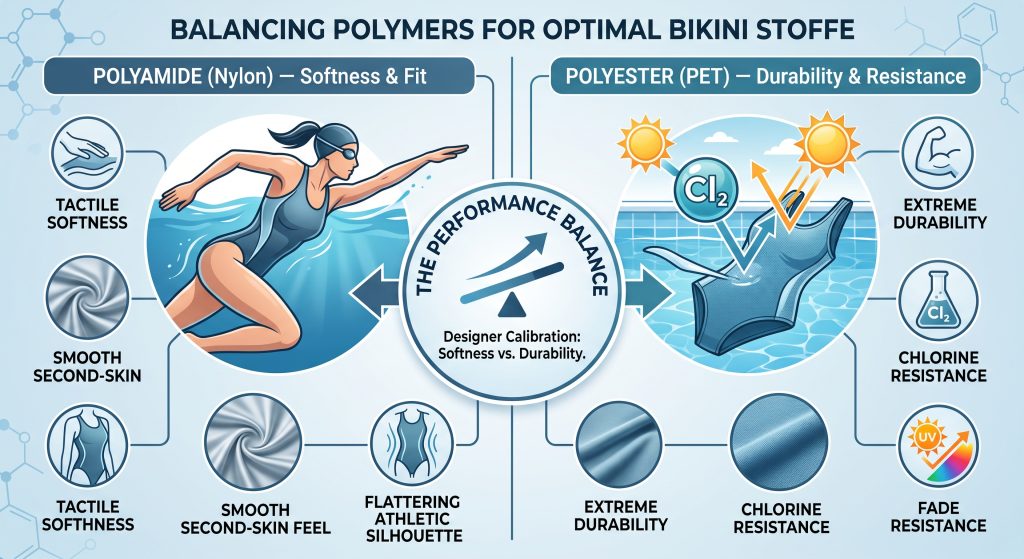
Balancing polyamide and polyester in bikini stoffe allows apparel designers to calibrate tactile softness against extreme chemical durability. Polyamide delivers a smooth second-skin touch that flatters athletic silhouettes, while polyester offers unmatched defense against fading and chlorine. Choosing the right polymer base guarantees that your activewear collection matches consumer performance expectations.
Why Do Designers Favor Polyamide for Soft Touch?
Polyamide fibers feature fine filaments that feel luxurious and supple against sensitive skin. This smooth texture prevents skin irritation during prolonged surfing and paddleboarding sessions.
- Supple micro-filaments eliminate chafing along high-movement seam borders.
- High natural elongation provides gentle body contouring without binding.
- Deep dye affinity produces rich, high-saturation colorways for fashion lines.
You might wonder: why does polyamide remain the preferred yarn for luxury beachwear collections?
How Does Polyester Provide Long-Term Resilience?
Polyester filaments resist chemical oxidation and UV degradation thanks to their dense crystalline molecular configuration. Garments made from polyester retain their original fit through continuous pool training and commercial laundering.
- Dense polymer chains block chemical attack from pool oxidizers.
- Low water absorption ensures rapid drying between workouts.
- High thermal stability supports vibrant, permanent dye sublimation graphics.
Look at the facts: polyester knits deliver the longest working lifespan for active aquatic sports gear.
Key Takeaway: Specifying polyamide provides superior tactile softness for resort beachwear, while choosing polyester secures long-lasting durability for athletic training lines.
| Fiber Property | Polyamide (Nylon) | Polyester (PET) |
| Tactile Surface Feel | Ultra-smooth and plush | Crisp and structured |
| Chemical Longevity | Moderate (60-80 pool hours) | Extreme (250+ pool hours) |
| Sublimation Print Clarity | Moderate print definition | Photographic print sharpness |
Evaluating these fiber characteristics helps you select the right polymer base for your target swimwear application.
Is PBT the Most Resilient Yarn for Bikini Stoffe?
Polybutylene terephthalate stands as the most resilient yarn choice for bikini stoffe because its crimped filaments deliver natural stretch without using elastane. Conventional spandex threads break down when submerged in chlorinated water, while textured PBT yarns retain full tensile snap. Manufacturers use PBT knits to build long-lasting suits for competitive athletes and swim teams.
What Molecular Features Give PBT Natural Stretch?
Texturized PBT filaments incorporate a thermal mechanical crimp that functions like a microscopic recoil spring. This physical stretch mechanism recovers instantly when released, providing comfortable two-way body compression.
- Zero elastane content eliminates chemical fiber embrittlement and thinning.
- High crystalline polymer structure prevents chemical oxidizer penetration.
- Low moisture regain keeps wet garments light and responsive in water.
Check this out: mechanical yarn crimping replaces fragile polyurethane threads while retaining comfortable stretch.
When Should You Specify 100% PBT for Sportswear?
Specify PBT blends when producing performance apparel for daily swim training, water polo, and outdoor triathlons. The fabric withstands intense sun exposure and commercial pool sanitizers without losing tension.
- Resists surface abrasion from kickboards and lane line ropes.
- Maintains consistent compression across hundreds of swimming workouts.
- Delivers reliable solar defense ratings exceeding UPF 50+ consistently.
Here is why: using PBT textiles eliminates the primary cause of swimwear bagging and sagging.
Key Takeaway: Choosing PBT-based textiles guarantees that your athletic swimwear collections will outlast garments built with standard elastane blends.
| Textile Composition | Expected Pool Lifespan | Stretch Recovery Mechanism | UPF Solar Rating |
| 80/20 Polyamide Elastane | 50 to 80 Hours | Polyurethane chemical snap | UPF 30 to 40 |
| 85/15 Polyester Elastane | 100 to 140 Hours | Polyurethane chemical snap | UPF 40 to 50 |
| 100% Poly / PBT Blend | 300+ Hours | Mechanical filament crimp | UPF 50+ Certified |
These data points demonstrate that PBT yarns offer superior operational longevity for demanding aquatic environments.
How Do Bikini Stoffe Utilize Pique Honeycomb Knits?
Pique knits enhance bikini stoffe by creating a raised, three-dimensional honeycomb texture that prevents damp fabric from sticking to athlete skin. Double-jersey knitting configurations produce structural body while delivering a refined matte finish. This structured architecture makes pique an outstanding choice for rash guards, athletic tops, and sporty bottoms.
What Knitting Geometry Creates the Honeycomb Face?
Specialized circular knitting machines alternate knit and tuck stitches to form geometric cellular nodes across the surface. This elevated surface minimizes direct fabric contact with damp skin, facilitating continuous air circulation.
- Alternating tuck stitches create microscopic air channels across the face.
- Double-knit architecture provides balanced crosswise stability during movement.
- Raised waffle nodes reduce skin friction during high-output activity.
Think about this: the raised geometry of pique prevents damp fabric from clinging uncomfortably to the torso.
How Does Pique Structure Improve Active Grip?
The textured handfeel of pique provides a firm grip that resists slipping when wet, making it popular for water polo and surfing. Its sturdy knit body conceals body contours effectively while withstanding physical pulling.
- Textured surface provides secure grip during dynamic water sports.
- High knit density prevents transparency under bright outdoor sunlight.
- Structured drape maintains tailored garment silhouettes through heavy use.
This is where it gets interesting… pique fabric blends sophisticated casual aesthetics with rugged sports utility.
Key Takeaway: Incorporating pique knits adds premium surface texture and anti-clinging comfort to your active aquatic apparel collection.
| Structural Feature | Pique Honeycomb Knit | Plain Single Jersey |
| Surface Architecture | Three-dimensional waffle relief | Smooth, continuous flat surface |
| Skin Contact Surface | Approximately 60% contact | 100% continuous contact |
| Fabric Rigidity | High structured stability | Fluid, draping elasticity |
Understanding pique stitch mechanics allows designers to build distinctive sportswear silhouettes that stay comfortable when damp.
Why Do Designers Choose Birdseye Mesh Bikini Stoffe?
Birdseye mesh provides exceptional performance in bikini stoffe because its micro-punctured eyelet geometry accelerates water drainage and maximizes skin breathability. The geometric diamond tuck pattern releases trapped water rapidly while keeping total garment weight minimal. Designers frequently select birdseye knits for internal linings, training briefs, and ventilated water shorts.
How Does Birdseye Eyelet Geometry Speed Drainage?
The micro-perforated knit pattern allows water to discharge immediately when an athlete steps out of the pool. Swimmers avoid carrying excess water weight, which reduces physical drag and speeds up surface drying.
- Micro eyelet openings release trapped water pockets instantly on deck.
- Balanced circular knitting prevents lateral distortion under mechanical stress.
- Porous face prevents vacuum suction against wet skin during flip turns.
What is the real story? Birdseye mesh evacuates surface water twice as fast as solid continuous knits.
Why Choose Birdseye Linings Over Solid Knits?
Replacing solid single-jersey linings with birdseye mesh reduces waterlogged bulk while providing soft, breathable skin support. The open eyelet structure promotes continuous airflow, preventing skin chafing during active beach sessions.
- Porous knit structure prevents sand grains from getting trapped inside seams.
- Lightweight yarn configuration dries rapidly between ocean swims.
- Soft interior handfeel eliminates friction burns along sensitive inner borders.
Ready for the good part? Lightweight birdseye linings make swimwear noticeably lighter and more comfortable in water.
Key Takeaway: Utilizing birdseye mesh in swim panels ensures rapid water drainage and superior ventilation, creating lighter garments for active swimmers.
| Performance Factor | Birdseye Micro-Mesh | Standard Solid Jersey |
| Water Drainage Speed | Instantaneous liquid release | Traps moisture between layers |
| Average Dry Time on Deck | 15 to 20 minutes | 45 to 60 minutes |
| Air Permeability Rating | High continuous air transfer | Restricted vapor transmission |
Integrating birdseye knits into swim designs optimizes moisture management and ensures athletes stay comfortable during training.
How Do Birdseye and Pique Bikini Stoffe Compare in Hand?
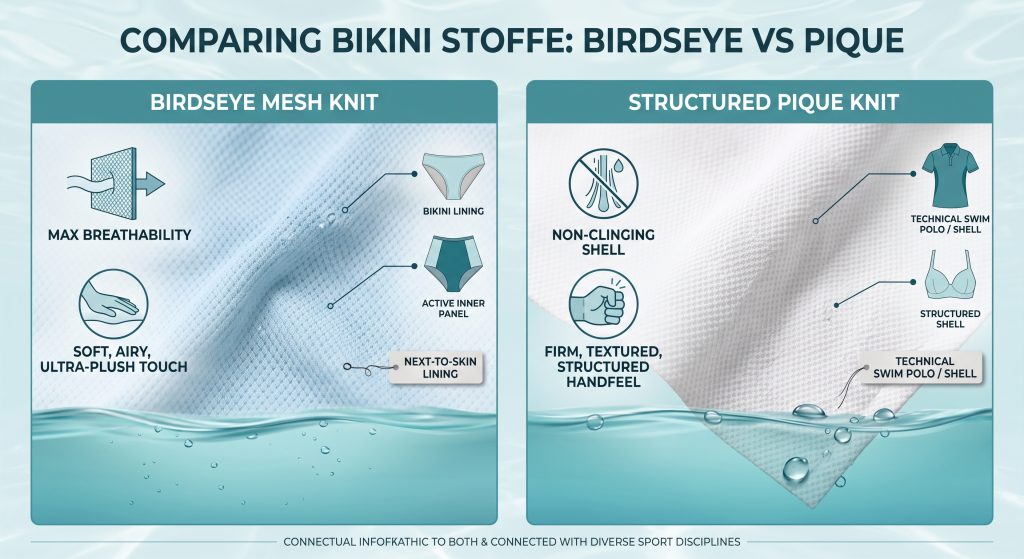
Comparing birdseye and pique in bikini stoffe reveals distinct handfeel and ventilation characteristics suited to different garment functions. Birdseye mesh offers a soft, airy, and ultra-plush touch designed for maximum breathability. Pique fabric provides a firm, textured, and structured handfeel engineered for non-clinging outer shells.
How Does Yarn Denier Influence Surface Softness?
Using fine micro-filament yarns with higher individual strand counts produces an exceptionally smooth surface against bare skin. Heavier denier yarns create a crisp, rugged exterior that withstands repeated physical friction.
- High filament counts yield velvety softness for interior lining panels.
- Low filament counts provide high abrasion resistance along outer borders.
- Calendering rollers smooth surface fibers for an ultra-flat gliding face.
Here is the deal: adjusting yarn denier allows textile mills to create tailored tactile profiles for activewear collections.
Which Knit Best Fits Specific Swimwear Silhouettes?
Select birdseye mesh when your primary design requirement is rapid drainage, high breathability, and lightweight comfort. Choose pique fabric when your design calls for tailored body, rich texture, and firm support.
- Birdseye fits performance training suits, inner linings, and drag shorts.
- Pique excels in athletic polo shirts, rash guards, and structured swim tops.
- Combining both knits within one garment delivers targeted zonal comfort.
Think about this: pairing both textiles in hybrid designs creates functional breathability and refined visual contrast.
Key Takeaway: Matching fabric handfeel and knit density to specific garment zones creates sophisticated activewear with superior comfort and function.
| Selection Parameter | Birdseye Mesh Knit | Pique Structured Knit |
| Primary Functional Benefit | Rapid airflow & instant drainage | Upscale texture & non-cling body |
| Best Garment Application | Training briefs & inner swim linings | Rash guards & athletic swim tops |
| Tactile Skin Impression | Lightweight, airy, and plush | Crisp, firm, and textured grip |
Selecting between birdseye and pique knits enables activewear brands to deliver purpose-built garments tailored to specific aquatic environments.
How Do Mills Test Chlorine Resistance in Bikini Stoffe?
Textile mills test chlorine resistance in bikini stoffe by submerging fabric swatches in concentrated chlorinated water baths under controlled thermal conditions. Standardized laboratory protocols record color fading, tensile loss, and elasticity retention across hundreds of hours. These rigorous audits verify that bulk fabric shipments withstand commercial pool sanitizers without thinning or sagging.
What Protocols Simulate Commercial Pool Aging?
Technicians follow ISO 105-E03 and AATCC 162 standards by exposing swatches to active chlorine solutions. Digital spectrophotometers measure color shifts while tensile machines calculate loss of stretch recovery.
- Standard procedures utilize active chlorine solutions up to fifty milligrams per liter.
- Elevated temperatures simulate heated indoor competition swimming facilities.
- Repeated immersion cycles detect internal fiber fatigue across extended exposures.
Look at the facts: systematic lab testing identifies weak elastomeric fibers before garments reach consumer shelves.
How Do Protective Finishes Shield Elastic Fibers?
Chemical engineers apply antioxidant finishes and polymer shields that protect elastane cores from chemical oxidizer attack. These protective barriers prevent chlorine from breaking polyurethane molecular bonds during pool workouts.
- Antioxidant finishes neutralize chlorine oxidizers upon surface contact.
- Hydrophobic outer coatings repel pool water from internal yarn bundles.
- Specialized polymer jackets prevent fiber snapping and surface pilling.
What is the real story? Protective chemical shielding extends fabric lifespan by more than three hundred percent.
Key Takeaway: Demanding certified chlorine laboratory reports from your mill protects your activewear brand against premature garment failure and costly warranty claims.
| Evaluation Standard | Standard Activewear Knit | Chlorine-Shielded Aquatic Knit |
| ISO 105-E03 Color Fastness | Grade 2.5 (Noticeable fading) | Grade 4.5 (Minimal shade shift) |
| Elastic Retention at 100 Hrs | Drops below 60% | Retains over 90% snap |
| Fiber Integrity Rating | Broken protruding elastane | Clean, intact filament matrix |
Requiring verified laboratory chlorine certifications guarantees that production yardage maintains structural integrity through grueling competitive seasons.
How Does GSM Density Prevent Sheerness in Bikini Stoffe?
Calibrating GSM density in bikini stoffe prevents see-through transparency and guarantees complete visual modesty when wet. Fabric weight measured in grams per square meter reflects yarn density and knit tightness across the textile face. Proper weight control ensures that athletic swim garments maintain complete opacity under bright sunlight and pool lighting.
Why Does Fabric Weight Control Wet Opacity?
Dense fabrics containing high filament counts block light from passing through knit voids when saturated with water. Maintaining sufficient fabric weight guarantees complete modesty during dynamic athletic movement.
- Fabric weights between 190 and 220 GSM provide dependable wet opacity.
- Lightweight knits below 170 GSM require inner linings to avoid transparency.
- High stitch density eliminates stretch grinning along fitted athletic seams.
Think about this: selecting the proper GSM prevents embarrassing transparency issues for your customers.
How Do Stenter Frames Set Final Fabric Density?
Stenter drying frames apply controlled heat and dimensional tension to stabilize knit width and weight per square meter. This thermal stabilization locks the synthetic polymer matrix, eliminating post-laundry shrinkage.
- Controlled heat zones relax internal knitting machine yarn stresses.
- Automated width adjustments calibrate uniform weight across fabric rolls.
- Overfeed controls set exact stitch density for balanced multi-directional stretch.
Here is why: accurate thermal setting guarantees that cut garment panels match pattern grading specifications perfectly.
Key Takeaway: Specifying exact GSM ranges and verifying stenter stabilization guarantees consistent opacity, fit, and pattern accuracy across bulk orders.
| Target Swim Category | Recommended GSM Range | Primary Functional Benefit |
| Fashion & Youth Swim | 170 to 190 GSM | Lightweight, flexible drape |
| Active Fitness & Lap Swim | 190 to 220 GSM | Optimal modesty and balanced snap |
| High-Compression Racing | 220 to 260 GSM | Firm muscular hold & hydrodynamic support |
Calibrating fabric density according to intended garment use prevents over-engineering while securing reliable modesty for athletes.
Why Are Recycled Filaments Popular for Bikini Stoffe?
Recycled filaments have become popular for bikini stoffe because they meet consumer demand for sustainable apparel without compromising athletic performance. Advanced spinning facilities convert reclaimed fishing nets and post-consumer plastic bottles into high-tenacity synthetic yarns. These sustainable fibers match virgin polymers in tensile strength, chemical resistance, and color vibrancy.
How Are Reclaimed Plastics Spun into Fine Yarn?
Collected ocean plastics undergo thorough washing, sorting, and chemical depolymerization before re-extrusion into ultra-fine filaments. The resulting recycled chips produce clean yarns that knit smoothly on modern machines.
- Advanced filtration removes impurities to match virgin polymer purity.
- Depolymerization restores intrinsic viscosity and filament tenacity.
- Uniform filament extrusion ensures consistent dye uptake across dye lots.
You might wonder: do recycled synthetic yarns perform equal to virgin materials in chlorinated water?
What Independent Certifications Validate Eco Knits?
Reputable textile mills hold third-party chain-of-custody certifications that track raw waste from collection to finished knitted rolls. These verified standards provide activewear brands with reliable documentation for marketing claims.
- Global Recycled Standard (GRS) audits recycled content percentages.
- OEKO-TEX Standard 100 certifies fabrics free of hazardous chemicals.
- Bluesign approval confirms environmentally responsible dyehouse operations.
Check this out: certified eco-friendly materials attract environmentally conscious consumers without sacrificing durability.
Key Takeaway: Sourcing certified recycled swim knits strengthens brand sustainability credentials while maintaining world-class performance and chlorine resistance.
| Sustainability Standard | Virgin Synthetic Knit | Certified Recycled Eco-Knit |
| Carbon Footprint | ~ 9.5 kg CO2 per kg fabric | ~ 4.2 kg CO2 per kg fabric |
| Raw Material Origin | Virgin petroleum feedstocks | Reclaimed PET bottles & ocean nets |
| Certified Chain of Custody | Standard commercial invoice | GRS Transaction Certificate |
Adopting certified recycled textiles allows activewear brands to reduce environmental impact while offering athletes top-tier functional durability.
How Do You Source High-Performance Bikini Stoffe?
Sourcing high-performance bikini stoffe requires balancing target garment silhouette, fabric weight, minimum order quantities, and laboratory performance benchmarks. Working directly with experienced circular and warp-knitting manufacturers provides access to custom Pantone dyeing and technical finishes. Establishing detailed material specification sheets streamlines sampling and guarantees dependable bulk delivery.
What Factors Influence Dye Minimums and Lead Times?
Custom Pantone color matching requires loading industrial dyeing vats that operate efficiently with specific minimum fabric poundage. Sourcing running stock collections helps emerging labels test new styles with lower financial exposure.
- Industrial dye vessels require specific liquid-to-cloth ratios for uniform color.
- Custom laboratory lab dips typically require three to five business days.
- Stock color programs offer accessible minimums starting at fifty meters.
What is the real story? Choosing running stock colors lets emerging brands test new designs with minimal financial risk.
How Do You Establish Clear Technical Specifications?
Creating a detailed technical package containing GSM density, elongation targets, and test standards ensures consistent quality from your mill. Testing physical swatch headers before placing bulk orders prevents costly manufacturing surprises.
- Specify target GSM weight, yarn composition, and width tolerances.
- Define minimum acceptable chlorine fastness and elastic recovery ratings.
- Request pre-production yardage to verify sewing behavior on flatlock machines.
Ready for the good part? Clear technical specifications eliminate miscommunication and keep your production timeline on track.
Key Takeaway: Establishing precise material specifications and partnering with dedicated textile manufacturers guarantees consistent quality, reduced sampling cycles, and reliable bulk delivery.
| Sourcing Tier | Minimum Order Volume | Average Lead Time | Recommended Purpose |
| Stock Color Sampling | 30 to 50 Meters | 3 to 7 business days | Rapid prototyping & samples |
| Seasonal Capsule Run | 150 to 300 Meters | 2 to 3 weeks | Boutique collection launches |
| Custom Industrial Dye Lot | 500+ Meters | 4 to 6 weeks | Scaled commercial production |
Structuring production schedules around realistic mill minimums maintains cost-effective manufacturing and on-time collection rollouts.
Strategic Sourcing for High-Performance Swimwear
Finding reliable textile manufacturing partners resolves the trade-offs between tactile comfort, water drainage, and long-term chemical resilience in active aquatic apparel. Specifying laboratory-tested warp and circular knits protects your product line against premature fabric sagging, color fading, and seam degradation under heavy chlorine contact. Our advanced textile manufacturing facility produces specialized warp-knit tricot, functional birdseye meshes, structured pique fabrics, and certified eco-friendly textiles tailored to your exact custom specifications. We stand committed to empowering global apparel brands with durable, high-performance textiles that inspire athletic confidence and secure market leadership. To request premium fabric swatch cards or discuss custom development for your upcoming collection, contact us today and speak with our technical textile specialists.
Frequently Asked Questions
Q1: What is the best composition for competitive bikini stoffe?
A blend of one hundred percent polyester or polybutylene terephthalate (PBT) is the best choice for competitive swimwear because these synthetic fibers resist chlorine breakdown completely. They maintain muscular compression through hundreds of training hours without sagging.
Q2: Can I use pique fabric for active bikini linings?
No, pique fabric is best used for outer shells and rash guards rather than linings because its textured waffle relief is thicker than traditional lining knits. You should instead choose smooth micro-mesh or birdseye knits for internal linings to maximize soft comfort and rapid drainage.
Q3: How do I know if bikini stoffe will become transparent when wet?
You can verify wet opacity by checking fabric weight and gauge density before confirming bulk orders. High-quality swimwear knits should feature a minimum density of 190 to 220 GSM and use tight needle configurations to guarantee complete modesty in water.
Q4: Can I print custom sublimation designs on bikini stoffe?
Yes, you can easily print high-definition custom designs on polyester-based swim fabrics using dye sublimation techniques. Sublimation inks fuse permanently into synthetic fibers, preventing peeling, cracking, and fading under intense sun and pool water.
Q5: How does birdseye mesh differ from pique knit in swimwear?
Birdseye mesh features micro-punctured eyelets designed for rapid airflow and rapid water drainage, making it ideal for inner linings and training suits. Pique fabric features a raised honeycomb structure designed for tailored stability and anti-clinging exterior panels.