
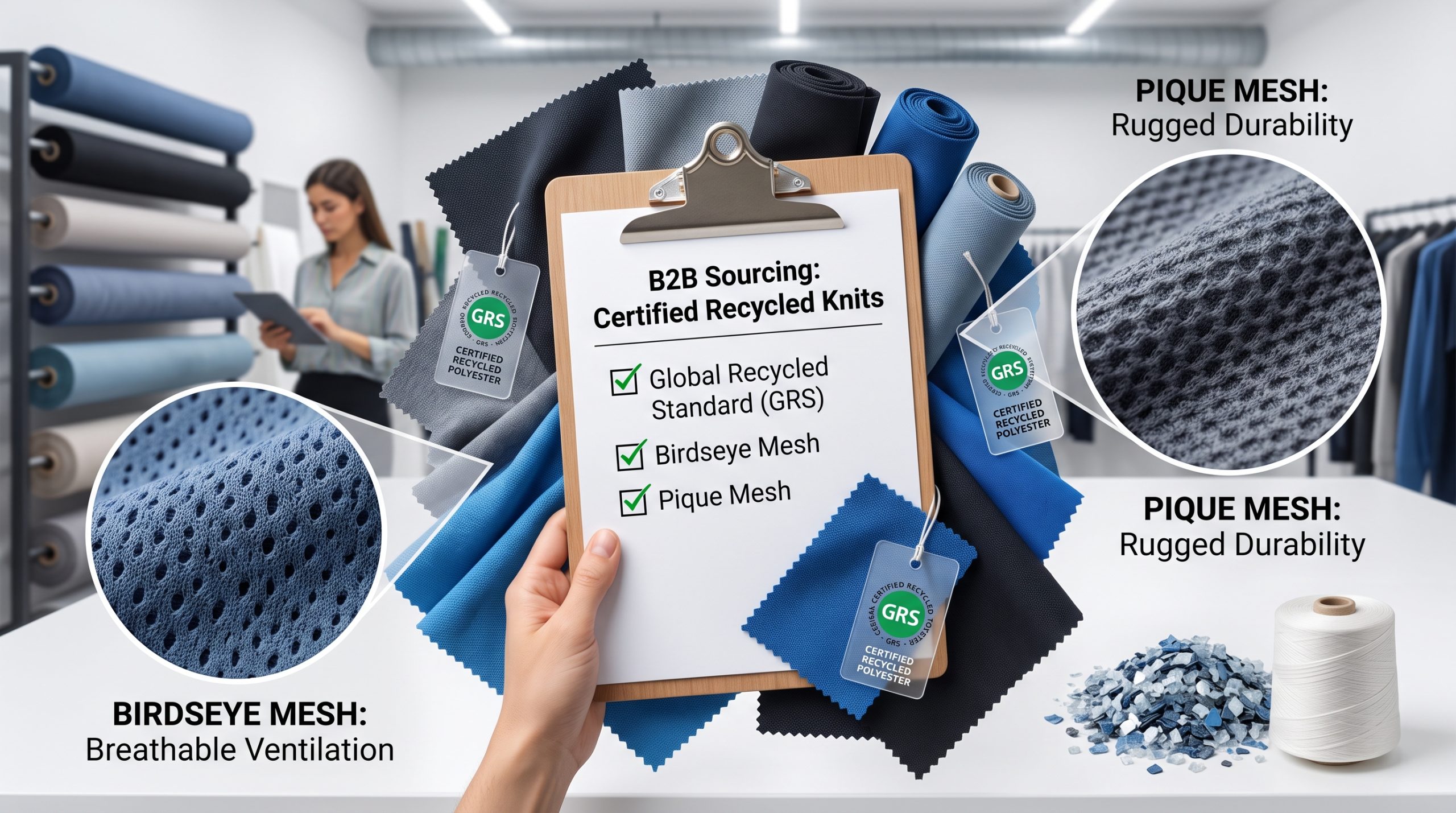
Choosing a certified textile distributor requires auditing official transaction certificates, inspecting circular knit structures, and testing physical yarn performance. Sourcing sustainable activewear fabrics without verified tracking documentation creates severe compliance risks for international apparel brands. Unverified recycled claims lead to failed customs audits, delayed seasonal collections, and customer backlash over greenwashing claims. Partnering with a fully certified textile manufacturer resolves these operational hurdles by providing verified supply chain traceability, consistent lot dyeing, and high-performance technical knits. International sportswear buyers consistently verify that working with an accredited grs jersey fabric dealer guarantees legal compliance and premium fabric consistency.
Why Work With a Certified GRS Jersey Fabric Dealer?
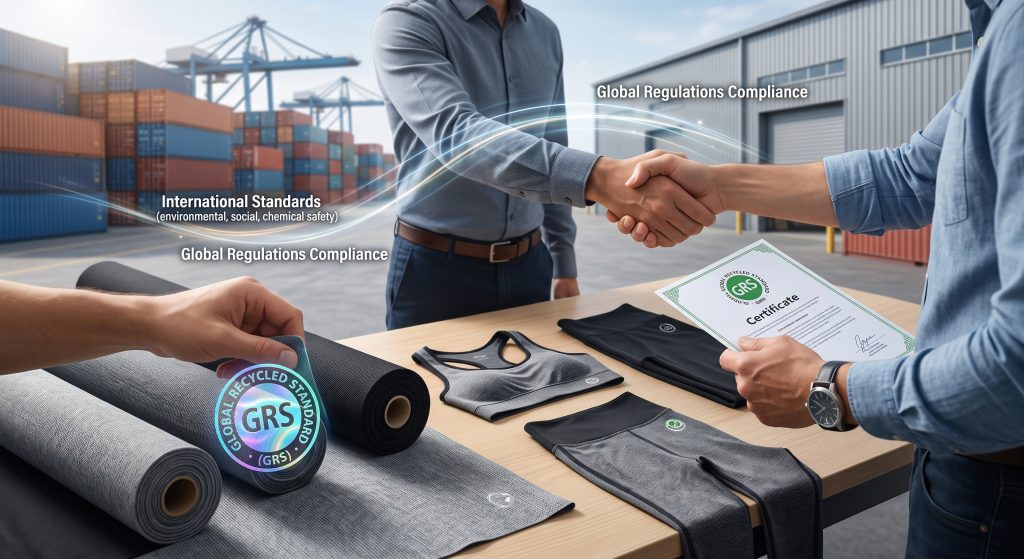
Working with an accredited dealer ensures every meter of recycled fabric meets international environmental, social, and chemical safety standards. When searching for a certified grs jersey fabric dealer for your activewear line, selecting a certified distributor eliminates supply chain risks and satisfies strict global import regulations.
How Do Scope Certificates Validate Factory Standards?
Scope certificates verify that a manufacturing mill complies with environmental processing rules and strict chemical restrictions. Here is the deal: an authentic annual scope certificate confirms that the knitting mill operates clean production lines.
- Annual audits inspect wastewater treatment and worker safety protocols.
- Third-party certifying bodies evaluate energy consumption records across facilities.
- Approved scope documentation proves authentic capabilities for sustainable production runs.
Why Are Transaction Certificates Critical for Shipments?
Transaction certificates track specific batches of recycled raw materials from resin flakes to finished fabric rolls. Think about this: a transaction certificate acts as an official legal passport for every single commercial fabric shipment.
- Batch-specific certificates list exact gross and net weights of recycled yarn.
- Documented chain-of-custody tracking prevents fraudulent mixing with virgin plastics.
- Customs officials require transaction certificates to clear sustainable garment imports.
| Certification Document | Primary Verification Role | Renewal & Audit Frequency |
| Scope Certificate (SC) | Validates Mill Production Facility | Annual On-Site Facility Audit |
| Transaction Certificate (TC) | Validates Specific Order Batch | Issued Per Individual Shipment |
| OEKO-TEX Standard 100 | Tests Chemical Skin Safety | Annual Laboratory Chemical Assay |
Reviewing standard textile certification documents confirms authentic supply chain compliance for international apparel brands.
Key Takeaway: Demanding verified scope and transaction certificates protects your brand from customs delays and fraudulent eco-friendly claims.
How Does a GRS Jersey Fabric Dealer Verify Recycled Yarn?
Textile suppliers verify recycled content through strict mass-balance documentation and molecular laboratory testing of extruded filament yarns. Sourcing teams analyzing how a grs jersey fabric dealer tracks recycled polymers review resin batch records to verify raw material origins.
How Are Post-Consumer Bottles Converted to Yarn?
Collected post-consumer bottles undergo sorting, intensive sanitization, and mechanical grinding into clean polymer flakes. Look at the facts: modern melt-spinning extruders melt these clean flakes into continuous micro-filaments with tensile strength matching virgin yarn.
- Mechanical sorting removes non-polyester caps and paper label residues.
- High-temperature vacuum drying purifies molten resin before filament extrusion.
- Spinneret nozzles create uniform yarn filaments for smooth circular knitting.
What Lab Tests Detect Authentic Recycled Content?
Specialized testing laboratories use differential scanning calorimetry and trace element testing to analyze recycled polymer structures. Here is the real story: laboratory verification confirms that the yarn contains authentic recycled content without chemical contamination.
- Isotope ratio mass spectrometry identifies recycled molecular signatures.
- Heavy metal testing ensures compliance with international textile safety laws.
- Viscosity testing verifies consistent yarn elasticity across bulk knitting runs.
| Raw Material Phase | Processing Technique | Key Quality Control Metric |
| Post-Consumer Bottle | Optical Sorting & Grinding | Flake Purity (>99.5%) |
| Extruded Recycled Filament | Vacuum Melt Spinning | Yarn Denier Uniformity |
| Circular Knitted Fabric | High-Speed Loop Interlocking | Tensile Burst & Tear Strength |
Analyzing the manufacturing steps from bottle flake to knit textile proves that recycled filaments deliver reliable commercial strength.
Key Takeaway: Sourcing verified recycled yarn guarantees that your finished activewear delivers authentic sustainability alongside high physical durability.
Can a GRS Jersey Fabric Dealer Provide Birdseye Mesh?
Certified dealers supply recycled Birdseye mesh engineered with micro-diamond apertures that maximize airflow and speed up moisture evaporation. Sourcing managers checking if a grs jersey fabric dealer stocks Birdseye fabric select this construction for lightweight competitive athletic apparel.
How Does Micro-Diamond Knitting Vent Body Heat?
Birdseye knitting utilizes alternating tuck and knit stitches on dual needle beds to form continuous diamond-shaped micro-apertures. Check this out: these precise geometric openings function as miniature ventilation windows across the whole garment face.
- Micro-diamond pores release trapped heat rapidly during physical exertion.
- Dual-face circular knit geometry provides total visual opacity under tension.
- Ultra-fine yarn counts maintain a featherweight handfeel for maximum mobility.
Why Does Frictionless Birdseye Protect Player Skin?
The flat, silky face of Birdseye mesh glides smoothly against moving skin during rapid changes of direction. What is the catch? While Birdseye delivers outstanding ventilation, picking the wrong yarn denier can increase snag risk on rough surfaces.
- Smooth filament loops eliminate abrasive contact along inner leg seams.
- Lightweight fabric body moves naturally without bunching around player joints.
- Rapid moisture dispersal keeps the inner fabric face dry against player skin.
| Performance Characteristic | Recycled Birdseye Mesh | Standard Virgin Single Jersey |
| Surface Porosity | Micro-Diamond Pores | Closed Flat Face |
| Air Permeability | Maximum Ventilation Flow | Restricted Airflow |
| Tactile Sensation | Silky, Weightless, Fluid | Flat, Standard Contact |
| Primary Application | Pro Game Jerseys & Shorts | Basic Casual T-Shirts |
Comparing circular knit structures demonstrates that geometric stitch arrangements dictate both ventilation volume and fabric body.
Key Takeaway: Sourcing recycled Birdseye mesh gives your competition shorts maximum breathability and a frictionless touch that protects players from chafing.
Does a GRS Jersey Fabric Dealer Stock Pique Mesh Knits?
Textile distributors supply recycled Pique knits featuring raised honeycomb waffle structures that deliver superior snag resistance and crisp garment drape. When asking your grs jersey fabric dealer for durable teamwear solutions, Pique knits provide the toughness required for daily training.
How Do Raised Geometric Ridges Prevent Cling?
Pique knits incorporate three-dimensional honeycomb tuck stitches that lift the fabric face slightly off warm skin. Here is why: this raised profile forms micro-channels beneath the garment where cool ambient air circulates freely.
- Raised geometric cords deflect external gym floor and equipment abrasion.
- Internal air chambers assist in venting warm air away from active muscles.
- Geometric knit structure provides a crisp, tailored appearance on sidelines.
Why Does Double-Knit Geometry Stop Surface Snagging?
The interlocked double-knit construction of Pique fabric shields yarn loops from catching on sharp locker edges or equipment gear. Look at the facts: compact yarn junctions stop snag loops from pulling through the fabric face.
- Dense stitch packing prevents yarn snagging during contact drills.
- High structural stability prevents uniform wrinkling during long team travel.
- Textured exterior adds tactile depth and premium retail appeal to team collections.
| Knit Evaluation Metric | Recycled Pique Mesh Knit | Recycled Birdseye Mesh |
| Surface Profile | Raised 3D Geometric Ridges | Micro-Diamond Pores |
| Snag Resistance Index | Superior Heavy-Duty Defense | Moderate to High Defense |
| Garment Body Drape | Structured, Tailored, Crisp | Lightweight, Flowing, Fluid |
| Recommended Garment | Warmup Apparel & Practice Gear | Elite Game Uniforms |
Reviewing structural parameters confirms that Birdseye mesh leads in pure ventilation while Pique knit excels in tailored silhouette retention and durability.
Key Takeaway: Selecting Pique mesh gives your sportswear line rugged snag resistance and a structured, non-cling drape ideal for practice gear.
How to Compare Birdseye and Pique From a GRS Jersey Fabric Dealer?
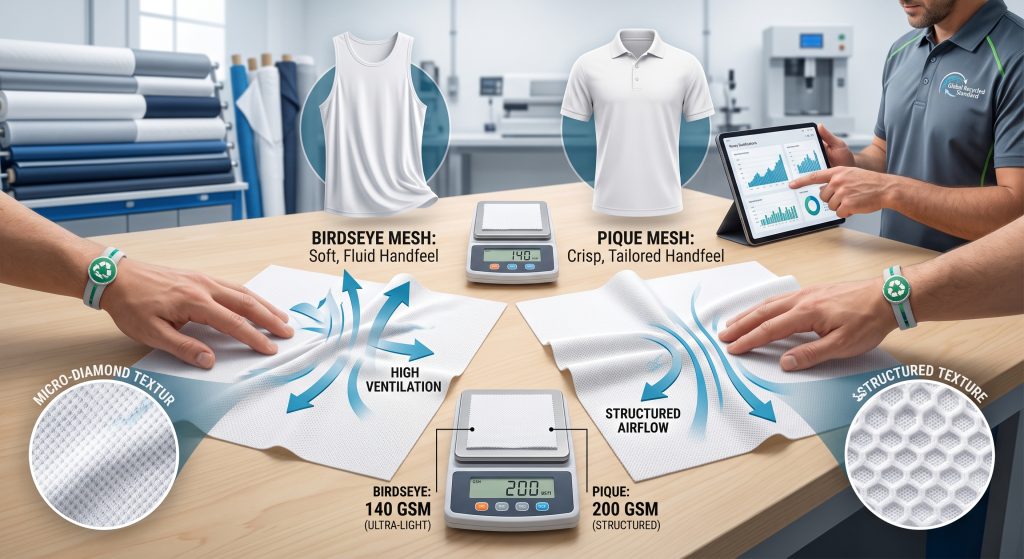
Comparing Birdseye mesh and Pique knit involves evaluating handfeel softness, ventilation capacity, surface weight, and target garment application. Apparel developers working with a grs jersey fabric dealer examine tactile samples to match specific knit characteristics with customer requirements.
How Do Tactile Textures Differ Under Direct Hand Inspection?
Birdseye mesh provides an ultra-smooth, fluid handfeel that drapes close to the body without sticking. Here is the deal: Pique knit feels dry, crisp, and substantial in your hands due to its raised three-dimensional ridges.
- Birdseye fabric yields a weightless sensation suitable for fast-running athletes.
- Pique fabric delivers a firm handfeel that holds sharp collar points and plackets.
- Flat Birdseye interior loops eliminate friction against sensitive skin.
Which Knit Construction Fits Your Sportswear Line?
High-exertion game uniforms require the maximum ventilation of Birdseye mesh, while coaching staff apparel and team travel gear benefit from Pique durability. Think about this: pairing both textiles in a unified team collection provides visual variety while maintaining performance standards.
- Birdseye mesh excels in lightweight game tank tops, running singlets, and inner shorts.
- Pique knit provides the structure required for polo shirts, warmup tops, and outer shorts.
- Both fabrics accept identical custom Pantone dyeing for unified team branding.
| Selection Parameter | Birdseye Mesh Knit Selection | Pique Knit Mesh Selection |
| Handfeel Sensation | Ultra-Soft, Silky, Fluid | Textured, Dry, Substantial |
| Primary Performance Goal | Maximum Airflow Ventilation | Structural Body & Anti-Snag |
| Ideal Sportswear Category | Pro Game Jerseys & Match Shorts | Warmup Gear, Polos & Sideline Sets |
Analyzing physical fabric properties helps activewear brands allocate specific knit constructions to appropriate garment categories.
Key Takeaway: Choose Birdseye mesh for ultra-light game jerseys and specify Pique knit for structured, durable warmup and travel apparel.
What GSM Weights Does a GRS Jersey Fabric Dealer Offer?
Certified dealers supply fabric weights ranging from 135 GSM for lightweight competitive jerseys to 240 GSM for structured double-knit tracksuits. Sourcing managers checking how a grs jersey fabric dealer categorizes fabric densities select specific square-meter weights to match seasonal sport demands.
When Should You Select 140 GSM Lightweight Meshes?
Apparel brands specify 140 to 160 GSM lightweight meshes for elite competition uniforms where shedding garment weight improves agility. Look at the facts: featherweight circular knits drape naturally and dump body heat rapidly during intense play.
- 140 GSM meshes reduce total uniform weight for high-tempo sports.
- Lightweight fabric folds compactly, reducing international ocean shipping parcel volumes.
- Thin knit profile dries within minutes after intense conditioning sessions.
Why Choose 220 GSM Double Knits for Outer Shells?
Heavier 200 to 240 GSM double-knit fabrics deliver a substantial handfeel that retro streetwear consumers and team franchises demand. Here is why: heavier fabric weights increase raw material costs slightly, but they provide total zero-transparency opacity and clean structural drape.
- 220 GSM fabrics hold sharp embroidery badges and heavy silicone logos cleanly.
- Thick double-knit construction resists heavy wind during outdoor training.
- Substantial fabric handfeel allows activewear brands to justify premium retail prices.
| Fabric Weight Class | GSM Density Range | Target Sportswear Application |
| Ultra-Light Performance | 135 – 155 GSM | Pro Match Uniforms & Running Tops |
| Balanced Multi-Sport | 160 – 190 GSM | High School & Club Team Uniforms |
| Heavyweight Classic | 200 – 240 GSM | Streetwear Apparel & Warmup Bottoms |
Comparing weight specifications allows production managers to match fabric mass with specific athlete demographics and pricing tiers.
Key Takeaway: Matching precise fabric GSM to your target market guarantees your activewear delivers the exact balance of lightweight speed and premium structural feel.
Why Ask a GRS Jersey Fabric Dealer for Poly-Spandex Blends?
Poly-spandex blends provide four-way mechanical stretch for supportive base layers while pure polyester delivers loose, airy drape for outer game shorts. Activewear brands consulting a grs jersey fabric dealer specify stretch blends to build ergonomic 2-in-1 shorts that combine muscle compression with classic court styling.
Why Add Elastane Filaments for Active 4-Way Stretch?
Adding elastane fibers introduces four-way mechanical stretch that accommodates explosive jumps and wide lateral defensive stances. Here is the deal: blending eight to fifteen percent spandex into recycled polyester produces a form-fitting textile that tracks muscle extension without pinching.
- Four-way elasticity prevents seam restriction during deep athletic movements.
- Snug compression fit promotes active blood circulation in working muscle groups.
- Blended synthetic fibers retain their original recovery shape after repeated stretching.
How Does Pure Polyester Compare to Stretch Blends?
Pure 100% technical polyester shells provide the airy, fluid drape that athletes prefer for unrestricted movement. What is the real story: pure polyester outer shorts float away from the body to encourage maximum air circulation.
- Pure polyester yarns dry forty percent faster than heavy elastane knits.
- Disperse dye sublimation bonds permanently to pure polyester without cracking.
- Pure polyester provides high dimensional stability during high-heat commercial laundry cycles.
| Fiber Composition | 100% Recycled Polyester | 88% rPET / 12% Spandex | 90% Recycled Nylon / 10% Spandex |
| Elastic Recovery | Mechanical Warp Stretch | 4-Way Active Stretch | High Natural Recovery |
| Moisture Evaporation | Rapid Heat Release | Fast Fluid Release | Moderate Moisture Release |
| Target Garment Component | Outer Court Shell | Built-In Compression Liner | Heavy-Duty Training Tights |
Analyzing fiber characteristics reveals that pure polyester dominates outer game shorts while elastane blends power flexible base layers.
Key Takeaway: Combining a 100% recycled polyester outer shell with a poly-spandex inner liner creates a premium 2-in-1 short that maximizes mobility and player comfort.
How Does a GRS Jersey Fabric Dealer Support Sublimation?
Certified dealers supply white and light-colored recycled polyester knits engineered to absorb high-heat gaseous disperse dyes during digital sublimation. Garment manufacturers checking how a grs jersey fabric dealer supports custom printing find that recycled filaments accept vibrant ink formulas with zero graphic peeling.
How Does Sublimation Protect Open Breathable Pores?
Digital sublimation printing embeds gaseous disperse inks directly into polyester fibers using heat, eliminating wet dye baths and thick ink deposits. Check this out: print shops can produce complex custom team graphics, player numbers, and gradient side panels in a single energy-efficient step.
- Single-step sublimation eliminates the setup cost of individual silk-screen mesh screens.
- Gas-phase dye bonding leaves the fabric surface completely soft without heavy ink layers.
- Zero liquid waste processing complies with international green manufacturing directives.
Why Does Bulk Recycled Polymer Extrusion Stabilize Margins?
Recycled polymer extrusion provides stable raw material pricing that remains insulated from agricultural weather events that disrupt natural cotton harvests. Think about this: uniform yarn diameters and consistent tensile properties reduce loom downtime and knitting defect rates across mass production runs.
- Predictable raw fiber costs protect your commercial profit margins during long contracts.
- High knitting uniformity minimizes fabric rejection rates during final factory inspection.
- Synthetic fibers store safely in warehouse environments without moisture damage risks.
| Production Efficiency Factor | Sublimated Recycled Poly | Screen-Printed Cotton Fabric |
| Printing Setup Expense | Zero Screen Setup Charges | High Multi-Screen Tooling Fees |
| Material Defect Rates | Under 1.5% Roll Rejection | Variable 4-7% Natural Flaws |
| Color Detail Precision | High-Definition Vectors | Restricted Layer Spot Colors |
| Post-Print Washing Needs | Zero Wash-Off Required | Heavy Water Rinsing Mandate |
Analyzing manufacturing variables proves that polyester knitting rolls streamline custom decoration while securing reliable commercial profit margins.
Key Takeaway: Adopting recycled polyester textiles with digital sublimation printing slashes sample setup costs and boosts production efficiency for customized team apparel lines.
How to Audit Quality With a GRS Jersey Fabric Dealer?
Textile quality audits involve reviewing standardized laboratory test reports for tensile strength, Martindale abrasion resistance, and perspiration colorfastness. Apparel sourcing managers evaluating a grs jersey fabric dealer request certified third-party lab documentation to verify that production rolls withstand competitive athletic use.
What Standard Mechanical Trials Prevent Surface Snagging?
Mace snag tests and Martindale abrasion cycles drag weighted metal balls across fabric swatches to simulate aggressive contact with floors and pads. Here is the deal: high-grade circular knits utilize high yarn twist counts that resist snag loops and fiber pilling during intense contact.
- Martindale test ratings above twenty thousand cycles verify pro-grade durability.
- High needle density knits lock individual loops to stop running yarn ladders.
- Snag resistance testing confirms that finished shorts survive repeated gym machine friction.
How Does Colorfastness Hold Up Under Heavy Washing?
Colorfastness testing subjects dyed polyester swatches to high-temperature alkaline washes, simulated perspiration solutions, and xenon arc lighting. Think about this: disperse dye molecules fuse inside synthetic polymer chains at high heat, making the color impossible to wash out.
- Grade 4-5 colorfastness ratings prevent dye bleeding across contrasting team trim panels.
- UV stability trials confirm that outdoor sunshine will not fade vibrant team colors.
- Perspiration fastness tests show that acidic sweat never dulls bright uniform graphics.
| Quality Standard Test | Testing Methodology | Commercial Passing Grade |
| Martindale Abrasion | ASTM D4966 Circular Rubs | 20,000+ Smooth Cycles |
| Elmendorf Tear Strength | ASTM D1424 Falling Pendulum | 18+ Newtons Tensile Pull |
| Washing Colorfastness | ISO 105-C06 Alkaline Wash | Grade 4.5 / 5.0 (No Bleed) |
| Bursting Strength Trial | ASTM D3786 Hydraulic Diaphragm | 250+ Kilopascals Pressure |
Reviewing standardized laboratory test protocols confirms that your bulk fabric roll procurement meets professional competition standards.
Key Takeaway: Demanding certified durability test reports guarantees your wholesale garment inventory avoids costly surface snagging and customer color-bleeding returns.
How to Order Direct From a Mill GRS Jersey Fabric Dealer?
Commercial apparel brands source specialized polyester rolls directly from established circular knitting factories that maintain custom dyeing and quality testing facilities. B2B procurement specialists determining where a grs jersey fabric dealer manufactures rolls evaluate factory certifications, minimum order quantities, and custom development support.
What Mill Certifications Verify Chemical Safety Standards?
Global quality certifications such as OEKO-TEX Standard 100, GRS (Global Recycled Standard), and ISO 9001 verify that textile mills follow strict chemical safety and consistent production controls. Here is the real story: certified fabric rolls give international apparel brands total peace of mind regarding human skin safety and environmental compliance.
- OEKO-TEX certification confirms zero harmful chemicals touch player skin.
- GRS accreditation verifies authentic post-consumer recycled polyester fiber content.
- ISO factory management ensures batch-to-batch color and GSM consistency.
How Do Direct Factory Orders Streamline Custom Production?
Partnering with an experienced textile manufacturer allows your brand to order custom Pantone dyed lots, specific pore structures, and tailored functional finishes. Think about this: direct mill sourcing provides access to rapid lab dip matching and fast sample roll yardage for pre-season prototyping.
- Direct mill pricing eliminates intermediate trading markups to expand brand margins.
- Custom roll weights and knitting patterns differentiate your finished apparel line.
- Professional factory logistics support smooth container shipping to global ports.
| Sourcing Criterion | Direct Knitting Manufacturer | Intermediary Wholesaler |
| Custom Pattern Flexibility | Full Custom Knit & Dye Support | Limited Stock Inventory Only |
| Minimum Order Quantities | Flexible Custom Dye Lots | Fixed Roll Package Quantities |
| Quality Control Traceability | Complete Batch Inspection Data | Unverified Reseller Batches |
| Direct Wholesale Pricing | Factory Direct Cost Advantage | Layered Distribution Markups |
Partnering directly with specialized textile mills provides complete supply chain transparency and superior pricing power for your sportswear line.
Key Takeaway: Sourcing certified custom fabric rolls directly from specialized knitting mills strengthens your product quality and secures dependable wholesale margins for your apparel brand.
Build Your Next Championship Sustainable Collection
Selecting verified recycled technical textiles solves common activewear challenges like heavy sweat accumulation, uncomfortable fabric cling, and compliance risks from unverified supply chains. Throughout this guide, we examined how certified recycled polyester filaments match virgin yarn durability, compared silky Birdseye mesh breathability against rugged Pique knits, and reviewed how standardized lab testing protects activewear brands from costly defects. Sourcing the right combination of 140 GSM Birdseye game meshes and structured Pique knits ensures your activewear line delivers elite athletic performance and sustainable peace of mind.
Our specialized circular knitting facilities produce certified Birdseye meshes, durable Pique knits, and custom performance textiles tailored to your exact activewear specifications. We provide activewear brands, garment factories, and team uniform decorators with reliable textile manufacturing, rapid Pantone color matching, and certified quality testing. Contact us today to request complimentary fabric sample swatches and discuss your upcoming sportswear production requirements with our experienced textile engineering team. We stand committed to advancing athletic performance through precision fabric engineering and sustainable manufacturing standards.
Frequently Asked Questions
Q1: Can I receive a Transaction Certificate for sample fabric yardage?
No, Transaction Certificates are issued for commercial production batches rather than small swatch samples. Certified mills provide copies of their active Scope Certificate to verify facility credentials during early prototyping phases.
Q2: What’s the best fabric weight for recycled sportswear jersey?
A fabric weight between 140 GSM and 180 GSM provides balanced performance. This weight range delivers maximum airflow and rapid dry times while maintaining complete fabric opacity on court.
Q3: How do I know if Birdseye or Pique mesh is right for my project?
Choose Birdseye mesh if your priority is silky softness and maximum airflow for game uniforms, or select Pique knit if you require snag resistance and structured drape for warmups. Birdseye maximizes ventilation during play, while Pique provides durable protection for practice gear.
Q4: Can I dye custom Pantone colors on recycled GRS jersey fabrics?
Yes, recycled polyester filaments accept disperse dyes exactly like virgin synthetic polymers. Direct manufacturers formulate custom lab dips to match official team colors under standard light box inspections.
Q5: How do I verify if a textile dealer is genuinely GRS certified?
Request their valid Scope Certificate and verify the certification code on the official Textile Exchange database. Always confirm that the supplier can issue batch-specific Transaction Certificates for commercial orders upon shipment.