
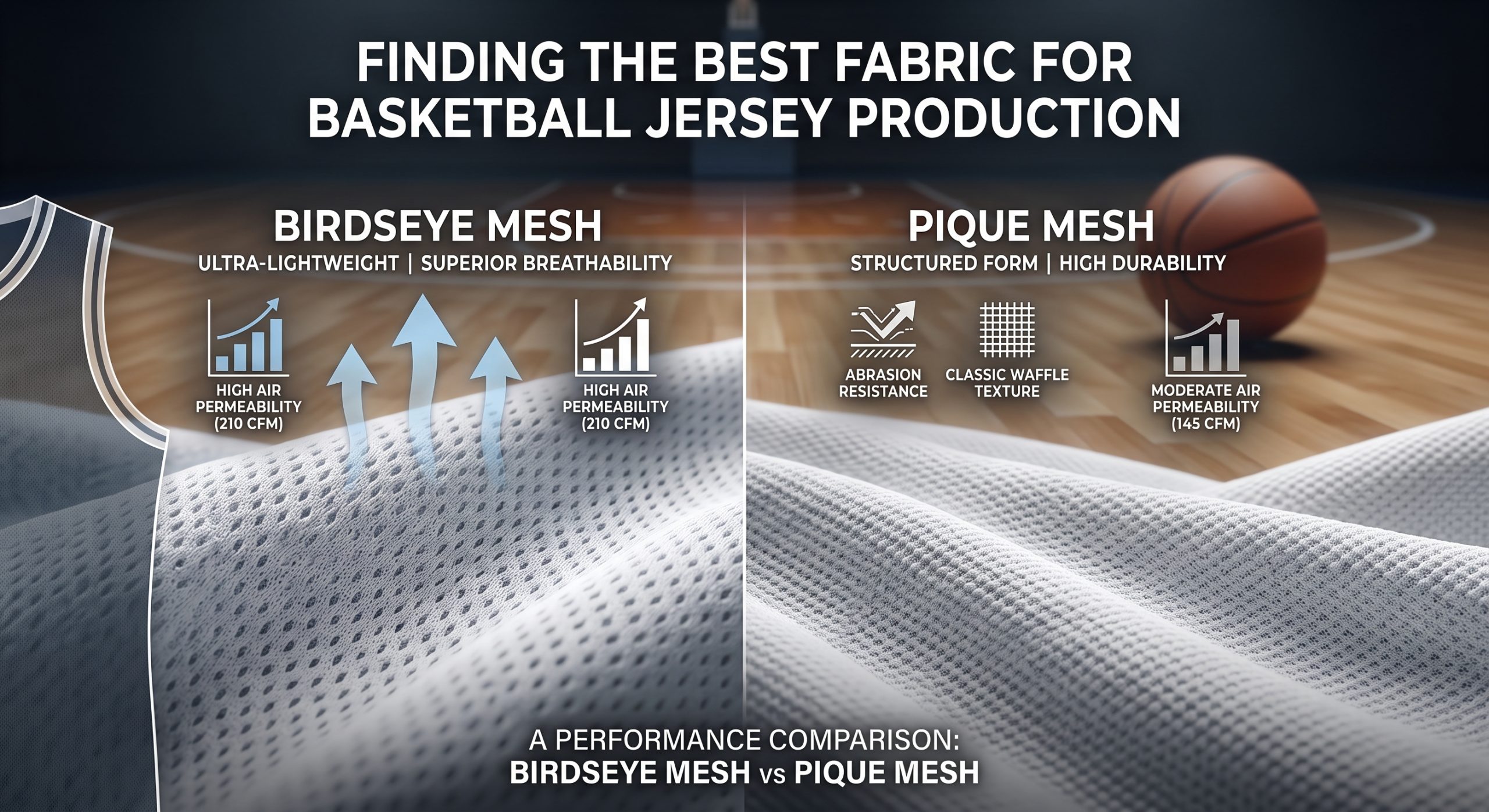
Birdseye polyester mesh is widely recognized as the single best fabric for basketball jersey construction due to its lightweight micro-porous structure and superior moisture management. Sourcing apparel materials for activewear brands often leads to complaints when players suffer from heat trapping and heavy, soggy uniforms during intense games. Delivering sub-par garments damages your brand reputation and leads to costly customer returns in competitive athletic markets. Selecting high-grade synthetic textiles designed specifically for high-intensity sports resolves these performance issues instantly. Finding the best fabric for basketball jersey manufacturing requires a direct comparison between bird’s eye mesh and traditional pique structures.
Which is the best fabric for basketball jersey production?
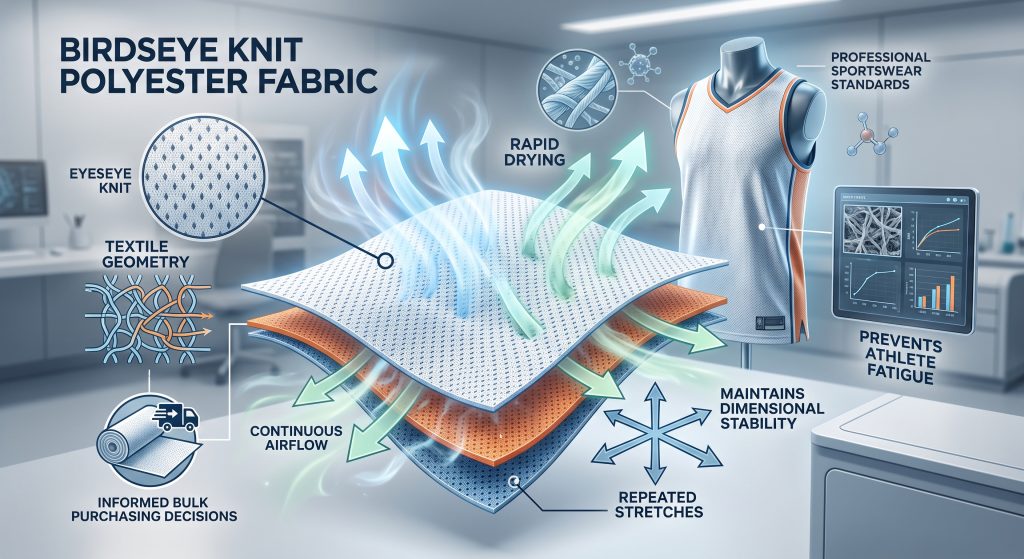
Birdseye knit polyester serves as the best fabric for basketball jersey production because it delivers rapid drying speed alongside continuous airflow. Garment manufacturers rely on technical synthetic knits to satisfy professional sportswear standards. Selecting these specialized textiles prevents athlete fatigue caused by excess heat retention.
Understanding textile geometry helps sourcing agents make informed bulk purchasing decisions. Athletic apparel demands lightweight material that maintains dimensional stability through repeated stretches.
What defines performance in athletic textiles?
High-performance sportswear relies on engineered yarn construction to pull sweat away from skin surfaces. You need material that resists snagging while remaining soft against sensitive areas during rapid movement. Here is the deal: moisture management determines player comfort over four quarters of play.
- Hydrophobic synthetic filament yarns
- Open-knit structures for ventilation
- High tensile strength for court contact
Fabric weight impacts garment drape and overall athletic agility on the court. Selecting heavy materials limits player movement and increases heat accumulation.
How do polyester knits support athlete comfort?
Synthetics like polyester excel at wicking sweat compared to natural cotton fibers. You might be wondering why natural fibers fail in activewear applications. Cotton absorbs moisture and grows heavy, whereas polyester channels moisture outward to evaporate rapidly.
- Minimal moisture retention during sweat spikes
- Rapid air circulation across surface pores
- Soft touch reducing skin chafing
Yarn treatments can further improve tactile comfort and anti-microbial properties for long tournament days.
Key Takeaway: Choosing engineered polyester knits ensures your apparel line keeps athletes cool and dry without adding weight.
| Fabric Metric | Standard Polyester Knit | Cotton Blend |
| Moisture Retention | Low (<1%) | High (>7%) |
| Drying Speed | Fast (15 mins) | Slow (60+ mins) |
| Tensile Strength | High | Moderate |
Reviewing yarn retention rates helps apparel managers select textiles that withstand intense game conditions.
How does Birdseye mesh act as the best fabric for basketball jersey?
Birdseye mesh serves as the best fabric for basketball jersey designs by utilizing a specialized tuck-stitch pattern that creates tiny breathable eyelets. This geometric construction accelerates sweat evaporation while maintaining structural integrity. Uniform suppliers favor this material for high-motion athletic wear.
The pattern resembles small bird eyes, creating passive air channels throughout the entire surface. This micro-porous layout provides exceptional ventilation during intense physical exertion.
What makes micro-hole patterns so breathable?
Micro-hole layouts allow continuous convective air circulation directly against the athlete’s body. What is the real story? Tiny knitted eyelets act as miniature exhaust vents during constant movement. You will notice immediate temperature reduction when swapping solid knits for open mesh.
- Passive ventilation channels across the chest
- Reduced garment surface contact with damp skin
- Efficient thermal dissipation during sprinting
The knit density prevents transparent visibility while maintaining maximum breathability.
Why do professional teams choose Birdseye knits?
Professional sportswear brands prioritize weight reduction and rapid moisture dispersion in court apparel. Think about it: every extra gram of absorbed sweat slows down player agility over time. You gain a competitive product advantage by specifying high-gauge bird’s eye knits.
- Featherlight feel on player shoulders
- Crisp surface ideal for screen printing
- Resistance to heavy physical tugging
Elite teams demand fabrics that maintain color brilliance and shape despite aggressive commercial laundering.
Key Takeaway: Birdseye mesh delivers superior breathability and print clarity, making it the top choice for modern pro-style jerseys.
| Characteristic | Birdseye Mesh | Standard Flat Knit |
| Air Permeability | High (>180 mm/s) | Moderate (80 mm/s) |
| Fabric Weight | 130-160 GSM | 180-220 GSM |
| Print Surface | Smooth & Uniform | Dense |
Comparing permeability metrics confirms why bird’s eye knits remain superior for hot court environments.
Is Pique mesh truly the best fabric for basketball jersey apparel?
Pique mesh can function as the best fabric for basketball jersey orders when durability and structured garment shape are your top priorities. Its raised waffle-like texture provides a classic tactile feel and increased abrasion resistance. Many classic sportswear lines choose pique for vintage aesthetic appeal.
While slightly heavier than bird’s eye mesh, pique offers high structural resilience. Understanding its mechanical properties allows you to select the right fit for your team market.
How does waffle texture alter fabric stiffness?
The raised geometric structure of pique gives the material higher dimensional stability and thickness. Ready for the good part? This texture prevents the jersey from clinging directly to wet skin during play. You receive a structured silhouette that maintains its form throughout heavy matches.
- Raised surface pockets minimize skin contact
- Higher fabric density increases tear strength
- Structured drape holds crisp jersey shape
Extra thickness increases total fabric weight, which may feel slightly warm in unventilated gyms.
When should you specify classic Pique fabrics?
Traditional pique fabrics fit fan apparel and practice jerseys where rugged build matters most. Here is the bottom line: pique handles rough outdoor courts and physical friction exceptionally well. You will reduce material wear and snagging when outfitting recreational leagues.
- Superior friction resistance on outdoor courts
- Classic aesthetic popular for retro team kits
- Durable yarn structure for long product lifecycle
Modern polyester pique blends incorporate moisture wicking to bridge the gap between traditional style and modern performance.
Key Takeaway: Pique mesh is ideal when durability, structured shape, and retro styling take priority over ultralight speed.
| Feature | Pique Mesh | Birdseye Mesh |
| Surface Texture | Waffle / Honeycomb | Small Diamond Eyelets |
| Abrasion Level | High | Moderate-High |
| Garment Structure | Rigid Drape | Soft & Fluid Drape |
Evaluating surface texture differences helps suppliers balance aesthetic preferences against player weight requirements.
Why does handfeel dictate the best fabric for basketball jersey lots?
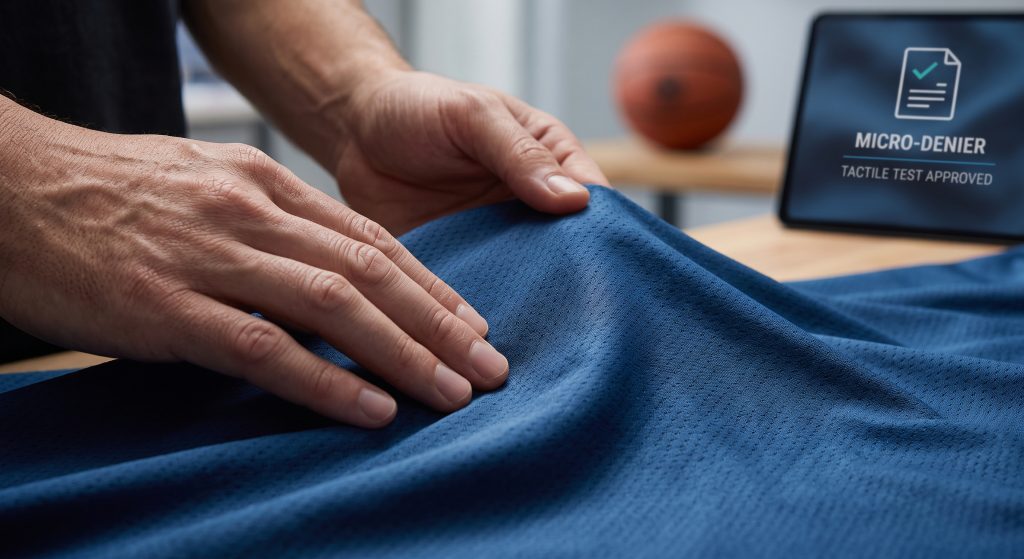
Soft handfeel dictates the best fabric for basketball jersey selection because skin comfort directly impacts player focus during movement. Coarse or scratchy textiles irritate skin during repetitive arm motion and running. Sourcing agents inspect soft finishes to guarantee high customer satisfaction.
Modern knitting machines use micro-denier polyester filaments to produce exceptionally soft textures. Tactile testing remains a core requirement during bulk fabric approval.
Does skin friction impact player performance?
Repetitive rubbing between wet fabric and skin causes painful chafing during prolonged athletic activity. This is where it gets interesting: soft micro-filament fabrics eliminate friction points across armholes and collars. You protect your athletes from skin irritation by choosing smooth knits.
- Micro-denier yarns provide soft tactile feel
- Reduced friction around shoulder and arm areas
- Smooth interior face prevents athlete distraction
Adding hydrophilic softeners during dyeing enhances tactile comfort without blocking sweat absorption.
How does finish treatment alter softness?
Textile finishing processes soften synthetic fibers while preserving moisture-wicking speed. Check this out: mechanical washing and silicone finishing alter surface texture significantly. You can customize the handfeel to match premium brand specifications.
- Softening agents enhance drape and flexibility
- Mechanical washing yields smooth surface fibers
- Anti-static treatments eliminate clingy behavior
Balancing chemical treatments ensures the fabric retains soft characteristics after dozens of wash cycles.
Key Takeaway: Prioritizing soft handfeel protects athletes from chafing while delivering a high-end luxury feel to your uniform lines.
| Finishing Type | Tactile Feel | Moisture Wicking Impact |
| Micro-Filament Standard | Smooth & Crisp | Unaffected |
| Softened Finish | Soft & Silky | Slightly Reduced |
| Brushed Interior | Plush & Warm | Moderate |
Selecting the proper finishing balance guarantees softness without compromising cooling performance.
How does airflow define the best fabric for basketball jersey design?
Airflow capacity defines the best fabric for basketball jersey construction because rapid heat ventilation prevents player fatigue during games. High air permeability enables sweat to evaporate swiftly from the athlete’s body. Fabric engineers prioritize open-pore knits to optimize indoor gym ventilation.
Measuring CFM (cubic feet per minute) air flow rates confirms which knits offer superior thermal release. Higher airflow directly correlates with lower skin surface temperatures.
How do micro-ventilation structures move sweat?
Micro-ventilation eyelets draw cooler external air inward while pushing warm, humid vapor outward. Look at it this way: active ventilation turns jersey fabric into a cooling system. You will keep team players cooler during intense fourth-quarter play.
- Continuous evaporative cooling through eyelets
- Rapid vapor expulsion from inner shirt face
- Temperature control during high cardio output
Combining breathable body panels with mesh side inserts maximizes targeted ventilation zones.
Can knit density stop thermal build-up?
Lower knit density creates larger open spaces that allow thermal energy to escape instantly. What is the bottom line? Dense fabrics lock heat against the skin, forcing body temperatures to rise quickly. You must strike the right balance between coverage density and air flow.
- Open knit patterns release body heat rapidly
- Optimized gauge prevents transparent see-through
- Airflow channels reduce sweat saturation rate
Testing fabric air permeability under lab conditions guarantees uniform cooling efficiency across production lots.
Key Takeaway: Optimizing airflow through open micro-mesh structures is needed to prevent heat stress during indoor athletic events.
| Fabric Structure | Air Flow Rate (CFM) | Evaporation Speed |
| Birdseye Micro-Mesh | 210 CFM | Rapid (12 mins) |
| Pique Textured Mesh | 145 CFM | Moderate (20 mins) |
| Solid Interlock Knit | 65 CFM | Slow (35 mins) |
Analyzing air flow test data confirms bird’s eye mesh provides over 40% higher airflow than pique alternatives.
Which offers durability as the best fabric for basketball jersey run?
Pique knit offers high durability as the best fabric for basketball jersey orders subject to heavy physical strain and frequent washing. Its interlocking geometry resists snagging, bursting, and surface pilling under intense game conditions. Garment brands choose pique when building long-lasting team uniforms.
Durability metrics include burst strength, abrasion resistance, and color retention. Selecting tough synthetic materials lowers garment replacement rates over long sports seasons.
Will intense athletic pulling tear jersey seams?
High burst strength prevents garments from tearing during aggressive jersey grabbing and court contact. Here is the deal: double-knit structures absorb mechanical tension far better than single knits. You ensure long-term uniform life by specifying high-tensile polyester yarns.
- High bursting pressure resistance (>400 kPa)
- Flexible stretch recovery along stress seams
- Snag-resistant stitch pattern prevents runs
Reinforcing side panel stitches ensures fabrics withstand intense physical pulling without tearing apart.
How does wash fatigue impact fabric lifespan?
Commercial washing and high-heat drying degrade inferior low-grade synthetic textiles over time. You might be wondering: why do cheap jerseys lose shape after several laundry cycles? Inferior yarns suffer fiber degradation, whereas premium knits maintain elasticity.
- Colorfastness against harsh detergents
- Dimensional stability prevents shrinking
- Anti-pilling surface stays smooth after washing
High-quality disperse dyes bind permanently into polyester fibers, keeping colors bright season after season.
Key Takeaway: High burst strength and wash resilience protect uniform orders from physical damage and fading.
| Durability Test | Pique Weave | Birdseye Weave |
| Snag Resistance | Grade 4.5 | Grade 3.5 |
| Bursting Strength | >450 kPa | >380 kPa |
| Pilling Rating | Grade 4-5 | Grade 4 |
Lab testing metrics demonstrate pique fabric provides slightly higher snag resistance under rough handling.
Does weight influence the best fabric for basketball jersey selection?
Fabric weight heavily influences the best fabric for basketball jersey selection because lightweight materials reduce player fatigue and improve speed. Most professional jerseys utilize fabrics weighing between 130 GSM and 160 GSM for optimal agility. Sourcing lighter fabrics provides players with an unrestricted range of motion.
Measuring Grams per Square Meter (GSM) helps buyers establish standard fabric specifications. Balancing lightness with opaqueness prevents garments from becoming see-through.
What metric balances drape and garment weight?
Selecting a weight between 140 GSM and 150 GSM offers a strong balance of durability and lightness. Ready for the good part? Mid-lightweight fabrics drape naturally over the body without clinging or weighing down players. You achieve a professional athletic silhouette with proper GSM control.
- 130-140 GSM: Ultralight pro game jerseys
- 150-160 GSM: Standard league uniforms
- 180+ GSM: Heavy practice pinnies
Lighter weight fabric reduces bulk freight costs during international shipping and distribution.
Does lightweight mesh improve player movement?
Reducing uniform weight gives athletes greater freedom during explosive jumps and rapid directional changes. Think about it: saving weight per uniform boosts comfort over a grueling tournament. You supply gear that supports peak athletic performance.
- Less dead weight carried during long games
- Faster drying speed due to reduced yarn volume
- Enhances athlete mobility on jumps and drives
Modern micro-denier yarns achieve opacity even at lower GSM levels, preserving modesty and style.
Key Takeaway: Specifying 140 to 150 GSM polyester provides a balanced middle ground for lightweight comfort and professional durability.
| Weight Bracket (GSM) | Suitable Application | Main Advantage |
| 130 – 145 GSM | Pro Match Jerseys | Ultra-Lightweight & Fast Drying |
| 150 – 165 GSM | Club & High School | Balanced Strength & Comfort |
| 170 – 200 GSM | Reversible Practice Gear | High Toughness |
Standardizing order specifications within 140-150 GSM keeps lightweight speed aligned with garment opacity.
How to select the best fabric for basketball jersey customization?
Smooth surface uniformity determines how to select the best fabric for basketball jersey customization through dye sublimation or screen printing. Birdseye mesh provides an even, flat surface that absorbs dye evenly across micro-hole gaps. Selecting proper printing-compatible fabrics ensures crisp graphic logos and vibrant numbers.
High heat tolerance in synthetic polyester allows high-temperature sublimation without fabric damage. Evaluating print clarity avoids blurry team crests and graphics.
How does dye absorption differ across weaves?
Birdseye mesh features a flatter surface plane, allowing heat-transfer inks to distribute evenly across fibers. What is the real story? Textured pique fabrics can create minor white gaps in printed logos due to deep peaks and valleys. You achieve sharper graphic detail on smoother bird’s eye knits.
- Smooth bird’s eye surface holds solid color fills
- Pique textured valleys may cause minor print gaps
- 100% polyester composition allows full ink transfer
Sublimation ink bonds chemically with polyester yarns, creating fade-proof custom graphics that do not peel.
Will sublimation printing ruin fabric texture?
Dye sublimation infuses ink directly into synthetic fibers without blocking breathable fabric pores. This is where it gets interesting: unlike heavy screen printing inks, sublimation maintains total air permeability. You keep jerseys breathable regardless of graphic complexity.
- Zero added weight from ink application
- Pores remain fully open for ventilation
- Artwork does not crack or peel off
Testing press temperatures prevents thermal shrinkage during the custom printing process.
Key Takeaway: Birdseye mesh offers smooth print sharpness for complex dye-sublimated graphics without blocking breathability.
| Customization Method | Birdseye Mesh Result | Pique Mesh Result |
| Dye Sublimation | Crisp, Sharp Edges | Slightly Textured Pattern |
| Screen Printing | Smooth Application | Textured Finish |
| Heat Transfer Vinyl | Strong Adhesion | Good Adhesion |
Comparing print clarity results demonstrates why dye sublimation on bird’s eye mesh yields high visual quality.
What cost metrics shape the best fabric for basketball jersey orders?
Bulk yield, fabric GSM, and minimum order quantities shape the cost metrics for the best fabric for basketball jersey bulk procurement. Standardizing fabric widths and weights optimizes cutting efficiency and reduces fabric waste during garment production. Sourcing directly from textile mills lowers total manufacturing costs.
Managing fabric yield per kilogram keeps budget margins profitable for apparel brands. Wholesale pricing typically decreases as order volumes reach container capacities.
What factors drive bulk mill procurement costs?
Yarn grade, dyeing method, and fabric weight directly influence bulk price calculations per meter. Here is the deal: high-gauge circular knitting machines require higher quality filament yarns that slightly raise material costs. You secure better profit margins by ordering custom roll widths to fit patterns.
- Raw material fiber quality (virgin vs recycled)
- Custom dye matching fees and lab dips
- Roll packing and shipping volumetric weight
Ordering standard colorways reduces dye setup charges for smaller production runs.
How do minimum order quantities impact budget?
Textile mills set minimum order quantities (MOQ) to cover machine setup costs for custom dyeing. You might be wondering: how can smaller brands access factory-direct pricing? You can partner with mills that offer stocked color cards or aggregate fabric orders.
- Stocked color cards lower MOQ thresholds
- Custom color matching requires higher MOQs
- Volume tier discounts reduce price per meter
Evaluating shipping terms and roll packaging saves money during ocean and air freight logistics.
Key Takeaway: Standardizing fabric widths and leveraging mill stock colors reduces unit costs and lowers minimum order barriers.
| Order Tier | Price Level | Minimum Quantity |
| Stock Color Sample | Standard Rate | 1 – 50 Meters |
| Small Batch Custom | Moderate Rate | 300 – 500 Meters |
| Container Bulk Roll | Direct Wholesale Rate | 2,000+ Meters |
Analyzing order tiers reveals substantial price reductions when consolidating fabric volume above 2,000 meters.
Which option secures the best fabric for basketball jersey lineups?
Birdseye mesh secures the position as the best fabric for basketball jersey lineups needing maximum ventilation, soft handfeel, and bright sublimated graphics. Conversely, pique fabric serves heavy-duty requirements where texture and high abrasion resistance take priority. Choosing between them depends on your specific market focus and athlete needs.
Combining both fabrics across different garment panels delivers a hybrid jersey solution. Sourcing custom knit options allows brands to stand out in competitive sports markets.
Which knit style fits modern sportswear trends?
Modern activewear trends favor lightweight materials with high ventilation and smooth graphic prints. Check this out: bird’s eye mesh aligns with modern player demands for speed and quick cooling. You keep your product line relevant by adopting market-preferred materials.
- High demand for light 140 GSM bird’s eye knits
- Preference for eco-friendly recycled synthetic yarns
- Preference for smooth sublimated full-coverage graphics
Adding mesh side panels to pique main bodies creates a stylish functional contrast.
How do you finalize your bulk order details?
Finalizing your textile order requires requesting physical color cards and sample swatches before mass production begins. Look at it this way: testing physical fabric swatches eliminates surprises in weight, stretch, and handfeel. You ensure full quality control by confirming specs upfront.
- Request sample color cards for shade matching
- Conduct lab wash and stretch test checks
- Confirm roll delivery timelines and freight terms
Partnering with experienced textile manufacturers streamlines sample approvals and mass shipment deliveries.
Key Takeaway: Requesting fabric swatches and evaluating target athlete needs ensures you pick the right knit structure for your production run.
| Sourcing Criteria | Birdseye Mesh | Pique Mesh | Recommended Option |
| Heat Ventilation | High | Moderate-High | Birdseye Mesh |
| Graphic Printing | Smooth | Textured | Birdseye Mesh |
| Rugged Durability | Moderate-High | High | Pique Mesh |
Weighing functional criteria confirms bird’s eye mesh as an effective choice for modern performance basketball jerseys.
Conclusion
Choosing between Birdseye mesh and Pique mesh determines your sportswear line’s breathability, weight, graphic print crispness, and durability. Birdseye mesh excels in lightweight evaporative cooling and smooth dye sublimation, making it a strong choice for modern pro-style team jerseys, while Pique provides structured durability for rugged wear.
By understanding how fiber density, stitch patterns, and GSM ratings impact player thermal comfort, you eliminate overheating concerns and deliver athletic garments that support your brand reputation.
Our team provides high-grade functional synthetic textiles engineered to meet rigorous sportswear standards. If you are ready to expand your activewear collection with performance fabrics tailored to your specifications, contact us today to request custom sample swatches and mill-direct price quotes. We believe every athlete deserves reliable comfort through dedicated fabric innovation.
FAQ
Q1: What’s the best fabric weight for basketball jerseys?
A: A fabric weight between 140 GSM and 150 GSM offers a practical balance for basketball jerseys. This weight range provides lightweight agility and fast moisture drying while maintaining garment opacity during competition.
Q2: Can I use dye sublimation on Pique mesh fabric?
A: Yes, you can sublimate on Pique mesh fabric if it is composed of 100% polyester. However, the raised waffle texture of pique may create minor micro-gaps in intricate graphic prints compared to smooth Birdseye mesh.
Q3: How do I know if Birdseye mesh is better than Pique for my brand?
A: You should choose Birdseye mesh if your main goals are high airflow, soft handfeel, and vibrant sublimation printing. Choose Pique if your product focus centers on textured aesthetics and higher abrasion resistance.
Q4: Can I combine different mesh fabrics in a single jersey?
A: Yes, combining different fabrics is a common technique in modern sportswear manufacturing. Designers frequently use Birdseye mesh for side body ventilation panels while using durable knits for main torso panels.
Q5: What’s the best way to care for 100% polyester sports mesh?
A: Machine washing in cold water on a gentle cycle works well for synthetic sports mesh. Air drying or low-heat tumble drying prevents thermal damage to elastane blends and preserves printed graphic vibrancy.