
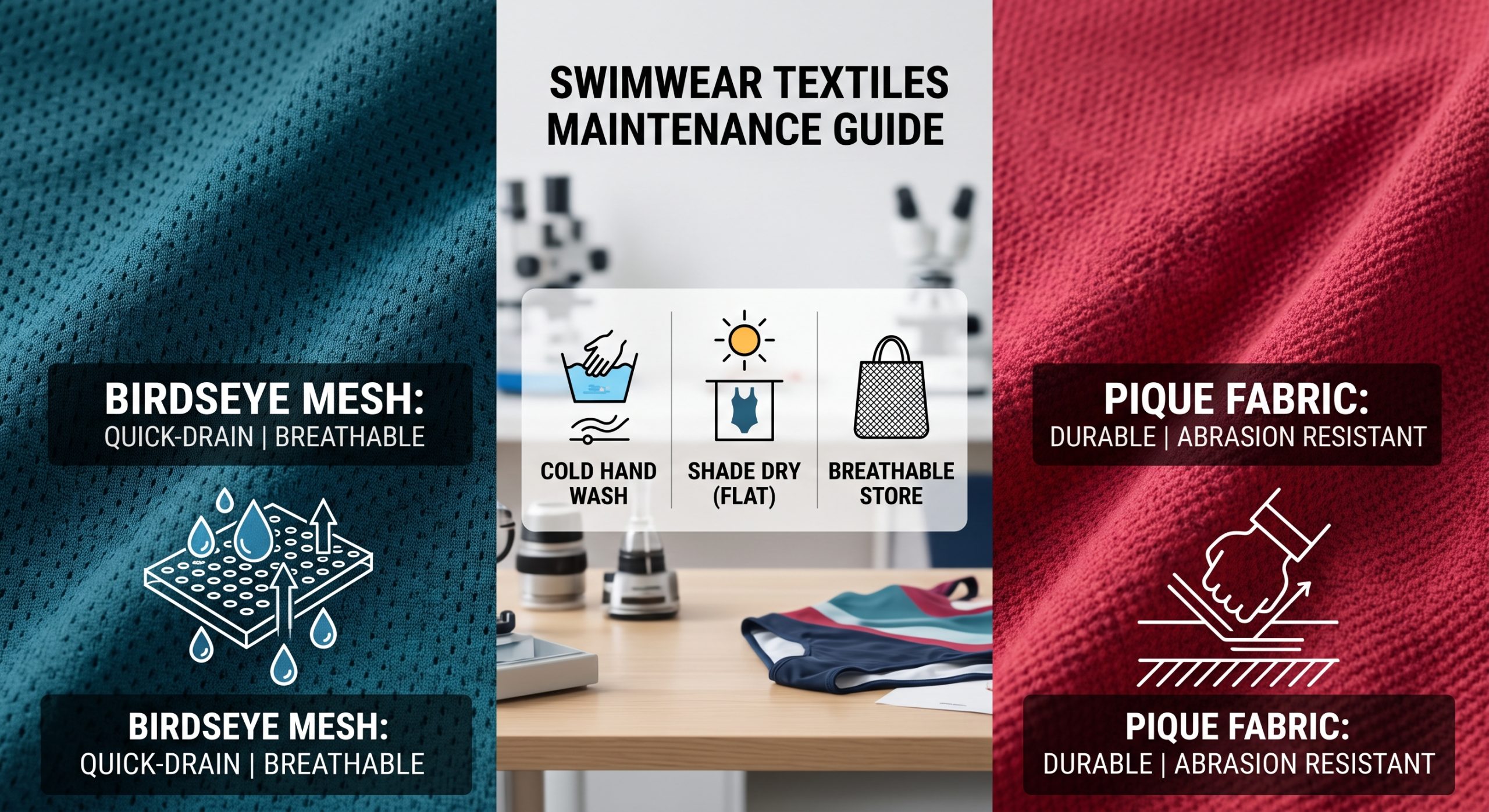
Maintaining synthetic stretch fibers prevents premature elastic breakdown caused by pool chlorine, saltwater, heat, and friction during laundering. Brand owners frequently receive complaints when athletic swimwear stretches out, fades, or loses shape after only a few uses. Supplying garments that degrade rapidly damages customer retention and increases expensive return rates for apparel labels. Implementing precise care protocols alongside sourcing durable swimwear textiles protects fiber integrity and extends garment life.
Why do swimwear textiles require special care during washing?
Synthetic fibers demand gentle cleaning protocols because aggressive mechanical agitation and heat cause elastane breakdown and permanent fabric sagging. When laundry machines spin synthetic garments violently, the microscopic stretch filaments suffer mechanical stress that disrupts the original knit geometry. Buyers who select high-grade swimwear textiles rely on proper cleaning procedures to preserve garment compression over hundreds of wear cycles.
How does water temperature affect synthetic stretch fibers?
Washing synthetic stretch garments in hot water melts internal polyurethane bonds and causes permanent elasticity loss. Here is the deal: cold water preserves yarn elasticity while clearing away mineral salts and sweat residues trapped within micro-pores. You maintain uniform stretch recovery across all garment seams by maintaining wash temperatures below thirty degrees Celsius.
- Cold water rinse preserves elastic recovery
- Gentle neutral detergent stops chemical erosion
- Avoid fabric softeners that coat breathable fibers
Using harsh bleach or acidic stain removers strips protective yarn finishes and causes immediate color fading on printed fabric surfaces.
Should you choose hand washing over machine cycles?
Hand washing reduces fabric friction and eliminates severe mechanical twisting that tears delicate side seams. You might be wondering if short machine wash cycles are acceptable for volume laundry processing. Manual soaking in mild soapy water gently releases salt crystals without stretching out delicate shoulder straps.
- Soaking releases salt crystals without strain
- Squeezing water out prevents seam tearing
- Rinsing thoroughly removes soap film completely
Proper washing habits keep stretch fabrics pliable and comfortable against the body throughout full swimming seasons.
Key Takeaway: Cold hand washing with mild detergents shields synthetic yarns from friction and thermal damage, preserving compression performance.
| Cleaning Factor | Cold Hand Wash | Hot Machine Wash |
| Elasticity Retention | High (95% after 50 washes) | Low (<60% after 20 washes) |
| Mechanical Strain | Minimal Friction | High Agitation |
| Color Fastness | Excellent | Moderate Fading |
Establishing consistent washing guidelines helps apparel brands lower product return rates tied to stretched seams.
How does chlorine damage elastane in swimwear textiles?
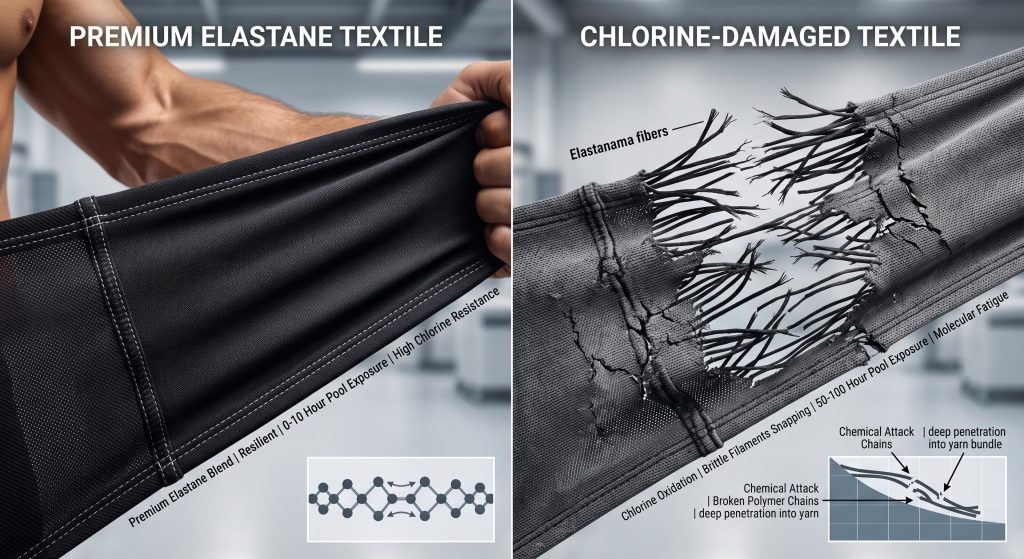
Chlorine oxidizes synthetic elastane polymer chains, converting springy fibers into brittle threads that snap under normal body tension. Pool sanitizing chemicals penetrate deep into yarn bundles, breaking down internal chemical bonds and triggering severe fabric fatigue. Manufacturers using premium swimwear textiles test chlorine resistance ratings to provide durable performance products.
What chemical process breaks down stretch filaments?
Active chlorine ions attach to synthetic polyurethane segments, causing molecular chain scission and structural fiber weakening. What is the real story? Repeated pool exposure slowly eats away the internal elasticity until garments sag and lose shape. You can prevent rapid oxidation by rinsing garments in fresh water immediately after leaving swimming pools.
- Chemical oxidation breaks internal polymer chains
- Fiber brittleness causes snap lines in fabric
- Accelerated damage occurs in warm pool water
Pre-wetting garments in fresh water before entering pools limits the total volume of chlorinated water absorbed by dry yarns.
How do resistant yarns stop chlorine erosion?
Engineered polyester blends and specialized chlorine-resistant elastane yarns block chemical penetration to extend garment lifespan. Ready for the good part? Polymer-coated yarns resist chemical oxidation up to five times longer than standard stretch threads. You deliver longer-lasting swimwear lines by choosing specialized synthetic compositions built for pool use.
- Polyester blends offer inherent chlorine immunity
- Specialty elastane resists chemical degradation
- Protective coatings shield internal fiber cores
Testing fabric samples in concentrated chlorine baths verifies material durability before committing to bulk manufacturing runs.
Key Takeaway: Choosing chlorine-resistant synthetic yarns prevents chemical oxidation and maintains garment shape during frequent pool training.
| Exposure Time | Standard Elastane Blend | Chlorine-Resistant Polymer Blend |
| 10 Hours Pool Water | 12% Elasticity Loss | 2% Elasticity Loss |
| 50 Hours Pool Water | 45% Elasticity Loss | 8% Elasticity Loss |
| 100 Hours Pool Water | Complete Shape Failure | 15% Elasticity Loss |
Reviewing lab exposure data confirms that specialized polymer yarn blends preserve garment compression under intense chemical contact.
Can Birdseye mesh enhance breathability in swimwear textiles?
Birdseye mesh structure improves internal airflow and drainage in swimwear textiles lining applications by using micro-porous tuck-stitch eyelets. The tiny diamond-shaped openings allow water to drain rapidly while supporting continuous air circulation across wet skin. Sourcing agents prefer lightweight eyelet knits to create comfortable, non-stick garment linings for active watersports.
How does micro-eyelet geometry accelerate water drainage?
Small geometric openings inside bird’s eye knits prevent water from pooling inside internal garment pockets or lining layers. This is where it gets interesting: water flows out instantly through micro-holes, dramatically reducing total garment drying times. You keep swimmers comfortable because lightweight mesh linings do not hold heavy, soggy water weight.
- Open eyelet pores purge trapped water quickly
- Reduced fabric surface area speeds air drying
- Fluid knits contour softly against body shapes
Combining open mesh linings with smooth outer fabrics improves overall ventilation without sacrificing outer garment opacity or sun protection.
Does open mesh prevent skin sticking when wet?
The raised textured surface of bird’s eye knits minimizes direct fabric contact with wet skin, reducing uncomfortable drag. Check this out: tiny air pockets between fabric stitches stop wet linings from clinging tightly to the body. You improve athletic comfort by incorporating open mesh panels in high-sweat chest and back areas.
- Textured surface reduces skin friction drag
- Air gaps stop wet fabric from sticking
- Soft micro-polyester filaments prevent chafing
Using breathable lining fabrics prevents skin irritation during long hours of water training and recreational beach activities.
Key Takeaway: Birdseye mesh linings accelerate water drainage and reduce skin cling, keeping garments lightweight and comfortable when wet.
| Fabric Structure | Water Drainage Rate | Drying Time |
| Birdseye Mesh Lining | Fast (<5 seconds) | 18 Minutes |
| Standard Flat Tricot | Moderate (15 seconds) | 38 Minutes |
| Solid Interlock Knit | Slow (>30 seconds) | 55 Minutes |
Evaluating drainage speed demonstrates why open eyelet structures work best for quick-drying internal lining panels.
Is Pique fabric durable enough for swimwear textiles use?
Pique knit fabrics provide high durability for swimwear textiles applications that demand high abrasion resistance against rough concrete pool decks. The double-knit geometric waffle texture gives the fabric body, preventing premature tearing and surface pilling. Apparel brands choose pique materials when designing rugged boardshorts and heavy-duty athletic training suits.
How does honeycomb texture increase surface toughness?
The raised geometric loops in pique knits absorb physical friction, protecting core yarn filaments from sharp deck surfaces. Here is the deal: raised texture barriers shield inner threads from snagging when swimmers sit on rough concrete edges. You reduce customer complaints regarding pilled fabric seat areas by choosing tough pique weaves.
- Double-knit geometry resists surface abrasion
- Thick yarn loops absorb physical deck drag
- High tensile strength prevents seam pulling
The geometric weave holds structural shape even after repeated stretching and heavy water saturation during long workouts.
Does fabric thickness limit swim mobility?
Modern micro-pique knits use fine synthetic yarns to deliver surface toughness without adding excess fabric weight. You might be wondering if heavier waffle knits feel stiff and restrictive during fast water movements. You gain a durable garment structure that flexes smoothly across every body motion.
- Fine synthetic yarns maintain flexibility
- Lightweight options avoid heavy water absorption
- Raised texture provides a premium matte look
Balancing fabric weight with structural durability yields reliable athletic swimwear designed for demanding daily training schedules.
Key Takeaway: Pique fabrics deliver high abrasion resistance against rough surfaces, making them ideal for long-wearing boardshorts and training gear.
| Durability Test | Pique Honeycomb Weave | Flat Smooth Tricot |
| Pool Deck Abrasion | Grade 4.5 (High) | Grade 2.5 (Moderate) |
| Snagging Resistance | Excellent Resistance | Prone to Pulls |
| Garment Rigidity | Structured Form | Soft & Fluid Drape |
Comparing abrasion ratings shows pique textures shield garments from physical wear far better than flat smooth knits.
How do handfeel finishes impact swimwear textiles performance?
Soft handfeel finishes enhance swimwear textiles by reducing skin friction along armhole seams and inner linings during repetitive motion. Smooth micro-filament yarns protect skin from painful chafing during long swimming sessions. Sourcing managers evaluate tactile smoothness to guarantee high consumer satisfaction across active performance lines.
Can smooth yarn finishes prevent seam chafing?
Micro-denier polyester yarns contain ultra-thin filaments that feel silky and soft against sensitive skin under water. What is the real story? Rough synthetic fibers cause painful red chafing marks when wet garments rub continuously against shoulders. You eliminate athlete skin irritation by specifying fine micro-filament fabric specifications.
- Micro-denier filaments feel silky soft
- Reduced friction along armhole borders
- Smooth surface prevents skin reddening
Adding hydrophilic softeners during dyeing improves tactile comfort without blocking water evaporation or fabric drying speeds.
Do chemical softeners affect water-repellent coatings?
Excessive chemical softeners can reduce hydrophobic coating effectiveness, causing fabrics to absorb extra water weight. Look at it this way: balance tactile softness with water-shedding performance to prevent soggy garments. You achieve the ideal handfeel by combining fine yarn knitting with controlled finishing treatments.
- Controlled finishing preserves water repellency
- Soft touch achieved through fine yarn gauge
- Fast drying speed maintained with light finishes
Testing tactile softness alongside water absorption rates ensures your fabric selection performs well in aquatic conditions.
Key Takeaway: Prioritizing smooth micro-filament finishes eliminates skin chafing without sacrificing necessary water-shedding capabilities.
| Finish Type | Tactile Softness | Water Repellency Impact |
| Micro-Filament Standard | Silky & Smooth | Unaffected |
| Heavy Silicone Finish | Ultra Soft | Reduced Repellency |
| Brushed Surface | Plush & Soft | High Water Retention |
Selecting micro-filament knits provides a soft touch while keeping fabric water absorption levels low.
What drying techniques protect elasticity in swimwear textiles?
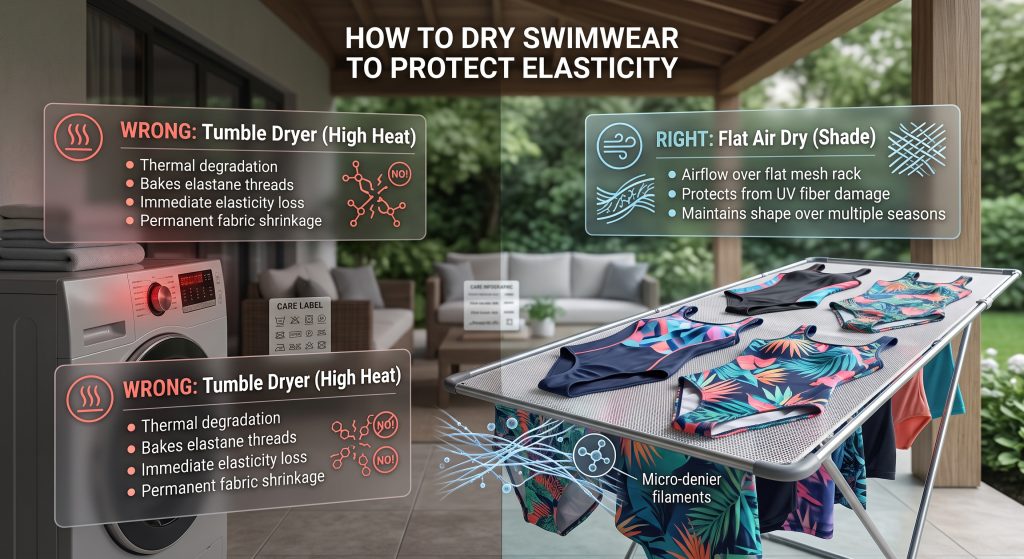
Air drying flat in shaded areas protects synthetic swimwear textiles from thermal degradation and UV fiber damage caused by hot dryers. High heat from tumble dryers bakes elastane threads, causing immediate elasticity loss and permanent fabric shrinkage. Brand managers supply clear drying instructions to help end-users maintain garment shape over multiple seasons.
Why does high dryer heat ruin stretch fabrics?
Commercial dryer heat breaks down synthetic polyurethane bonds, turning elastic filaments stiff and brittle within minutes. Ready for the good part? Air drying at room temperature preserves elastane elasticity and keeps side seams straight. You prevent customer returns caused by melted elastic bands by advising low-temp or flat line drying.
- High dryer heat melts internal elastic bonds
- Tumble action tears fragile wet stitching
- Room temperature air drying preserves shape
Hanging heavy wet garments by thin shoulder straps stretches out necklines, causing permanent garment distortion over time.
Does direct sunlight fade printed synthetic fabrics?
Strong ultraviolet radiation breaks down disperse dye molecules while weakening damp synthetic fibers during outdoor drying. Think about it: drying suits in direct sunlight causes vibrant custom prints to fade quickly into dull colors. You protect vivid pattern colors by drying garments flat in well-ventilated shaded zones.
- Shaded drying stops ultraviolet dye fading
- Flat position prevents heavy water sagging
- Good air circulation speeds moisture release
Providing proper garment care labels ensures consumers preserve bright colors and snug garment fits season after season.
Key Takeaway: Drying suits flat in shaded areas prevents heat damage and UV fading, keeping garments colorful and elastic.
| Drying Method | Elasticity Preservation | Color Retention |
| Flat Shade Drying | Excellent (100%) | High Color Fastness |
| Direct Sun Line Drying | Moderate (80%) | Rapid Color Fading |
| High Heat Tumble Dryer | Poor (<40%) | Severe Heat Damage |
Comparing drying methods confirms that flat shaded drying remains the safest process for preserving stretch garments.
How does storage orientation affect swimwear textiles longevity?
Storing dry swimwear textiles flat inside breathable bags prevents mildew growth, permanent fiber creasing, and elastic decay. Trapping damp garments inside airtight plastic containers fosters bacterial growth that destroys fabric fibers and creates foul odors. Sourcing teams emphasize proper off-season storage habits to preserve wholesale inventory quality over long periods.
Why do damp storage bags cause mildew damage?
Enclosing wet synthetic fabrics in airtight bags creates a warm, humid environment that promotes mildew and bacterial growth. This is where it gets interesting: dark mold spots eat through fabric finishes and leave permanent stains on light-colored materials. You protect valuable fabric stock by ensuring items dry completely before packing them away.
- Complete drying stops mold and bacterial growth
- Breathable cloth bags allow residual moisture escape
- Storing in cool places prevents elastic degradation
Avoiding sharp folds in structured padded cups prevents foam distortion and permanent creasing across chest panels.
How to stack garments to avoid cup distortion?
Stacking molded cups inside one another preserves their original shape without crushing delicate internal foam structures. Check this out: folding molded cups inside out snaps internal foam fibers, creating permanent surface wrinkles. You maintain smooth garment contours by laying suits flat or nesting cups carefully during storage.
- Nesting cups maintains original molded shape
- Flat stacking stops permanent fabric creasing
- Cool, dark closets prevent UV fiber decay
Following structured storage methods keeps off-season inventory looking fresh, crisp, and market-ready for upcoming sales seasons.
Key Takeaway: Storing completely dry suits flat in breathable containers prevents mildew, permanent creasing, and cup distortion.
| Storage Condition | Mold Risk | Elasticity Impact |
| Dry / Breathable Bag | Very Low | Retained Compression |
| Damp / Sealed Plastic | High Mold Danger | Severe Odor & Fiber Rot |
| Folded / Crushed Cups | Low | Permanent Foam Creasing |
Evaluating storage conditions confirms that cool, dry, breathable storage environments preserve garment quality best.
Which fabric weight offers durability for swimwear textiles orders?
A fabric weight between 190 GSM and 220 GSM offers the optimal balance of opacity, durability, and stretch in swimwear textiles. Lightweight fabrics below 170 GSM risk becoming see-through when stretched wet under bright outdoor lighting. Sourcing agents balance GSM specs to deliver non-transparent coverage without creating heavy, water-logged garments.
What GSM range guarantees full wet opacity?
Selecting fabrics above 200 GSM ensures complete modesty and opacity even when white or light pastel suits get wet. Here is the deal: thin fabrics lose opacity when water fills the spaces between stretched synthetic yarns. You protect your brand reputation by specifying higher GSM weights for light-colored swimwear designs.
- 190-220 GSM provides non-see-through coverage
- Thick yarn density maintains stretch privacy
- Balanced weight offers comfortable compression
Higher fabric density improves UV shielding ratings, protecting swimmers from harmful solar radiation during long beach days.
Does heavier fabric slow down drying times?
Excessively heavy fabrics above 250 GSM hold extra water volume, slowing down drying times and adding uncomfortable weight. You might be wondering if heavy fabrics are necessary to achieve durable compression performance. You achieve strong shape control at 200 GSM without creating heavy, slow-drying athletic wear.
- 200 GSM balances opacity with fast drying
- Micro-synthetic knits reduce water retention
- Medium fabric weight yields comfortable compression
Selecting the correct fabric weight delivers opaque coverage, comfortable body support, and fast drying performance.
Key Takeaway: Specifying 190 to 220 GSM fabrics guarantees non-see-through opacity and durable compression without slowing down drying times.
| Weight Class (GSM) | Opacity When Wet | Drying Speed |
| 150 – 170 GSM | Prone to Transparency | Very Fast |
| 190 – 220 GSM | Excellent Opacity | Fast & Balanced |
| 240 – 280 GSM | Fully Opaque | Slow Drying |
Standardizing fabric orders around 200 GSM ensures dependable opacity alongside comfortable drying speeds.
How to evaluate UV resistance ratings across swimwear textiles?
Evaluating UPF ratings confirms how effectively high-density swimwear textiles block solar radiation from penetrating fabrics and damaging skin. Tight knit construction and specialized UV-absorbing yarn treatments provide superior sun protection without chemical coatings. Sourcing certified UPF 50+ materials adds functional value to outdoor athletic and children’s swim collections.
How does knit density affect UV radiation blocking?
Tightly knitted synthetic fabrics leave smaller micro-gaps, blocking solar rays from passing directly through to skin surfaces. What is the real story? Loose knits stretch open under body tension, allowing solar radiation to leak through open pores. You ensure maximum sun protection by selecting high-gauge knits that hold tight structures when stretched.
- High knit gauge blocks solar radiation
- Tight stitch loops stop ray penetration
- UPF 50+ blocks over 98% of solar UV rays
Dye colors also impact protection levels, as darker pigments absorb more UV radiation than untreated white yarns.
Do UV finishes wash out over time?
Inherent UV protection built into synthetic yarn polymer structures lasts through the lifetime of the garment. Ready for the good part? Fiber-level sun blocking does not wash away like temporary surface spray treatments. You provide reliable sun protection by specifying yarn-integrated UV barrier technologies.
- Yarn-integrated protection lasts through washing
- Chemical sprays fade after multiple laundry cycles
- Certified UPF testing verifies fabric safety
Testing fabrics under wet stretch conditions ensures garments maintain high sun protection ratings during active outdoor swimming.
Key Takeaway: Choosing certified UPF 50+ fabrics with tight knit density provides long-lasting sun protection that will not wash out.
| Protection Level | UPF Rating | Solar Ray Block Rate |
| Moderate Protection | UPF 15 – 24 | 93.3% – 95.9% Blocked |
| Very Good Protection | UPF 25 – 39 | 96.0% – 97.4% Blocked |
| Excellent Protection | UPF 40 – 50+ | 97.5% – 98.0%+ Blocked |
Reviewing UPF test certificates verifies that tight micro-knits deliver excellent solar protection for outdoor swim collections.
What cost metrics influence wholesale swimwear textiles orders?
Bulk fiber yarn quality, custom dyeing methods, roll widths, and minimum order quantities shape the total cost metrics for wholesale swimwear textiles orders. Sourcing standard roll widths maximizes pattern yield, reducing fabric waste during industrial cutting processes. Garment manufacturers lower unit costs by consolidating fabric orders to reach factory volume tiers.
How do yarn grades drive fabric pricing?
Premium chlorine-resistant yarns and fine micro-denier filaments carry higher raw material costs than standard industrial polyester. Think about it: investing in high-grade synthetic yarns prevents costly garment returns and brand damage. You secure profitable wholesale pricing by ordering mill-direct volumes.
- High-grade yarns raise raw material costs
- Custom color dyeing requires minimum batch sizes
- Specialty chlorine coatings add finishing fees
Ordering mill stock colorways eliminates custom dye laboratory fees and reduces production turnaround times for smaller brands.
How does roll width optimize pattern yield?
Selecting wider fabric rolls allows cutting markers to place swim pattern pieces tightly together, minimizing scrap waste. Look at it this way: improving fabric yield by five percent directly lowers total production costs per garment. You maximize profitability by calculating marker efficiency before finalizing fabric width orders.
- Wider rolls increase pattern marker efficiency
- Efficient placement reduces waste scrap volume
- Higher pattern yield lowers per-unit suit costs
Evaluating freight packaging options and roll shipping dimensions prevents unexpected volumetric shipping charges during international distribution.
Key Takeaway: Optimizing pattern marker yields on wider fabric rolls lowers fabric scrap waste and reduces unit manufacturing costs.
| Order Quantity Tier | Unit Price Rating | Custom Color Support |
| Sample Cut (1 – 50m) | Premium Rate | Stock Colors Only |
| Production Lot (300 – 500m) | Standard Commercial | Small Batch Dyeing |
| Bulk Roll (2,000m+) | Mill Direct Wholesale | Full Custom Matching |
Analyzing order volume tiers demonstrates that scaling fabric orders significantly lowers per-meter procurement costs.
Conclusion
Understanding synthetic care guidelines and structural fabric differences helps apparel brands protect garment stretch, chlorine durability, and drying performance. Selecting the right materials—from quick-draining Birdseye mesh linings to tough Pique weaves—prevents premature elastic failure and protects your brand reputation in competitive swimwear markets.
We solved common performance issues like chlorine degradation, seam chafing, and wet transparency by analyzing fabric weights, UPF sun ratings, and proper maintenance methods. Our mill provides high-grade synthetic functional textiles engineered to meet demanding athletic performance standards.
If you are ready to expand your activewear and swimwear collections with premium textiles, contact us today to request custom sample swatches and mill-direct wholesale quotes. We believe every brand deserves reliable fabric quality that keeps athletes comfortable and confident in the water.
FAQ
Q1: Can I machine wash modern swimwear fabrics safely?
A: Yes, you can machine wash modern swimwear fabrics if you use a delicate cycle with cold water and a mild detergent. However, hand washing remains the safest method to prevent mechanical seam strain and maintain long-term elastane recovery.
Q2: What’s the best way to remove chlorine odors from lining material?
A: Soaking the garment in cold water mixed with a tablespoon of baking soda or mild neutral detergent neutralizes trapped chlorine ions. Rinsing thoroughly with fresh water afterward removes residual chemical odors without damaging delicate synthetic linings.
Q3: How do I know if elastane fiber breakdown has occurred?
A: You can spot elastane breakdown when garments lose shape, display visible white elastic threads snapping through the surface, or feel loose and saggy when wet. This damage is permanent and indicates that chlorine or heat has destroyed the internal stretch bonds.
Q4: Can I iron synthetic swimwear linings on low heat?
A: No, you should avoid ironing synthetic swimwear linings because direct iron heat melts synthetic polyester and polyurethane filaments instantly. Instead, smooth wrinkles out by hand while the garment is damp and allow it to dry flat naturally.
Q5: What’s the best fabric weight for competitive athletic swimsuits?
A: A fabric weight between 190 GSM and 210 GSM offers the best performance for athletic swimsuits. This weight range provides strong muscle compression, full non-see-through opacity when wet, and fast drying speed during intense training schedules.