
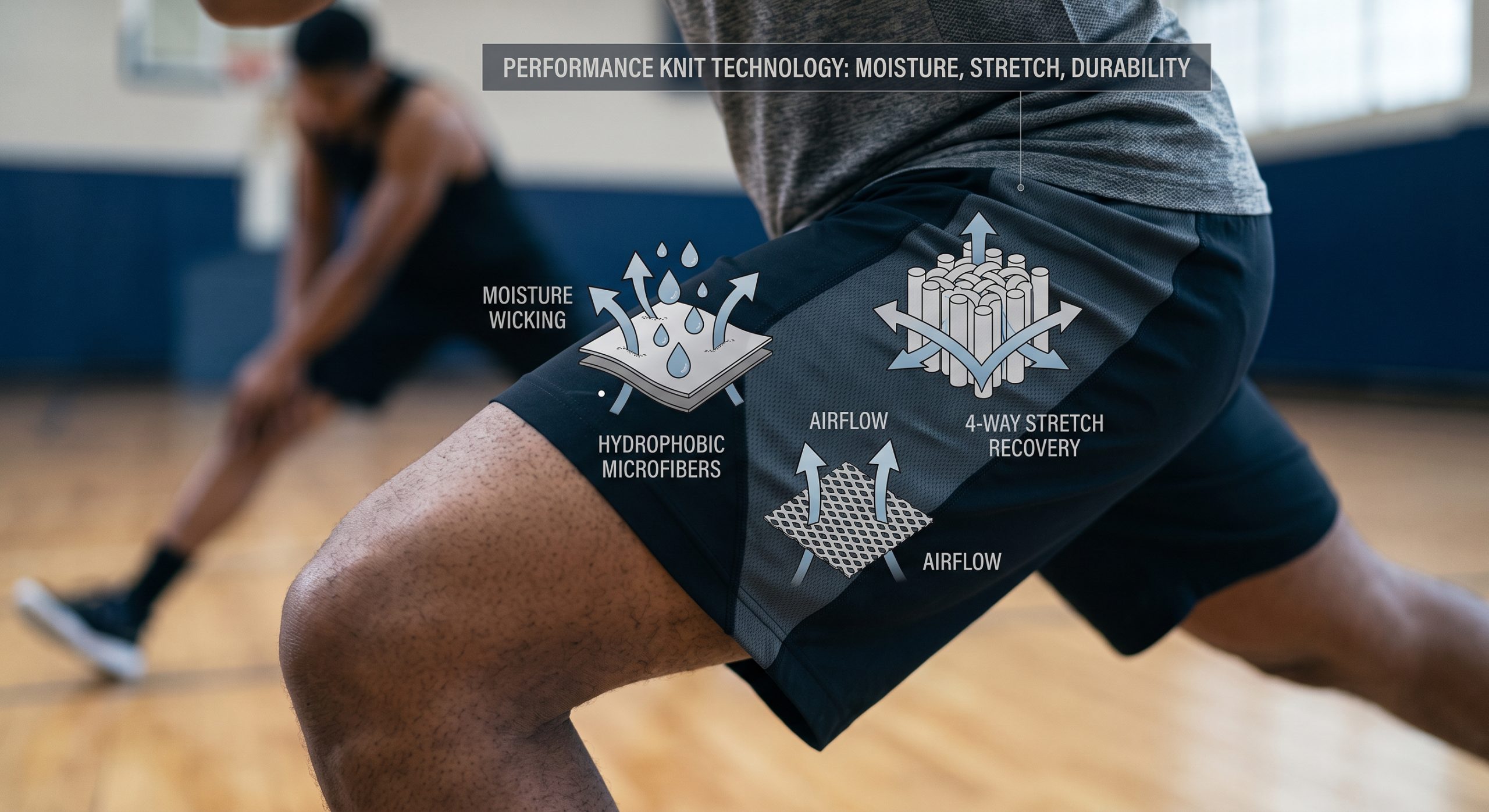
Performance knit fabrics are engineered knitted textiles constructed from synthetic microfibers that combine directional stretch, thermal regulation, and moisture transport for active apparel. Activewear apparel brand managers frequently deal with rising customer returns when athletic shirts lose shape after washing or trap sweat during workouts. Watching customer reviews sour over heavy, soggy shirts and blown-out seams drains profit margins and damages brand credibility overnight. Selecting engineered performance knit textiles constructed with advanced yarn structures provides your athletic line with reliable durability, sweat management, and customer satisfaction.
1. What Is Performance Knit Fabric and How Does It Function?
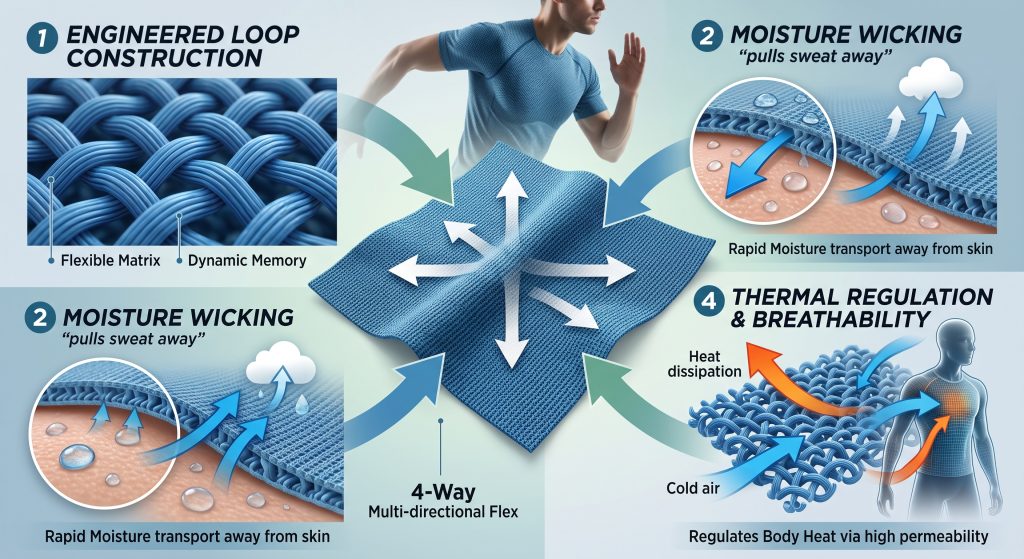
Performance knit fabric functions by looping continuous synthetic filaments together to create a flexible matrix that pulls sweat away from skin while stretching dynamically during movement. Utilizing an engineered performance knit textile allows activewear garments to regulate body heat and maintain structural shape under physical stress.
How Do Synthetic Yarns Manage Body Heat?
Microscopic channels between synthetic yarn filaments allow warm air to vent outward while pulling fresh air toward muscle groups. Here is the deal. Rapid body movement creates friction and heat that must dissipate immediately to keep athletes comfortable.
- High-gauge knit construction prevents surface snagging on outdoor trail gear.
- Hydrophobic microfibers refuse to store moisture within yarn cores.
- Lightweight knit geometry accelerates evaporation across outer fabric surfaces.
You need yarns that vent body heat rapidly while resisting snagging on outdoor equipment.
Does Warp Knit Construction Prevent Runs?
Warp knitting loops yarns vertically in zig-zag columns to lock adjacent loops into place permanently. Think about it. Single-thread circular knits unravel rapidly when a strand snaps during physical contact.
- Interlocking vertical pillars prevent laddering runs from spreading across garment panels.
- High mechanical tension tolerance supports explosive body stretching without seam tearing.
- Dimensional knitting retains shape memory after dozens of laundering cycles.
You protect garments against unraveling tears by specifying interlocking warp knit construction.
Key Takeaway: Selecting warp knit microfiber fabrics guarantees high-speed heat venting and prevents unraveling tears during intense workouts.
| Performance Feature | Standard Jersey Knit | Warp Performance Knit |
| Run Resistance | Low (Unravels easily) | High (Interlocking pillars) |
| Airflow Velocity | Moderate | High (Micro-vents) |
| Shape Recovery | Average | Superior |
Analyzing this comparative data reveals that warp knits offer significantly greater structural durability and ventilation for active sportswear.
2. Why Is Warp Knitting Ideal for Performance Knit Textiles?
Warp knitting is ideal because its vertical interlocking loop structure provides exceptional tensile strength, dimensional stability, and run resistance under heavy mechanical stress. Implementing a warp performance knit material guarantees that high-stress sportswear seams remain secure during dynamic movements.
What Makes Tricot Structure Exceptionally Strong?
Tricot warp knits feature a smooth face and textured back that distribute mechanical tension evenly across all surface yarns. What is the real story? Uniform tension distribution stops physical stress from concentrating on a single thread.
- Zig-zag yarn paths absorb sudden multidirectional pulling forces effectively.
- Dense stitch counts resist surface pilling when rubbed against backpack straps.
- Smooth face textures reduce skin friction during repetitive arm movements.
You secure garment seams against blowout by choosing balanced tricot knit construction.
Can Circular Knits Match Warp Knit Stability?
Circular knits offer soft lateral stretch but lack the structural support necessary for intense athletic compression garments. Look at it this way. Unreinforced circular knits sag under sweat weight, causing garments to ride up or drop down.
- Warp knits maintain vertical tension stability without sagging under sweat load.
- Rigid pillar stitches lock elastane filaments securely within the yarn matrix.
- Superior dimensional recovery keeps waistbands firm across hundreds of uses.
You keep garments fitting snugly across long training sessions by choosing warp knit stability.
Key Takeaway: Utilizing tricot warp knits secures active garments against sagging and seam failure under dynamic mechanical strain.
| Structure Type | Tensile Stability | Surface Pilling Resistance | Compression Support |
| Circular Knit | Moderate | Low to Moderate | Average |
| Tricot Warp Knit | High | High | Superior |
Evaluating these mechanical properties shows why tricot warp knits remain the premier choice for high-strain athletic compression apparel.
3. How Does Birdseye Mesh Compare to Pique Performance Knit?
Birdseye mesh features small geometric diamond openings that maximize airflow and skin softness, whereas pique fabric utilizes a raised waffle texture that holds more air and feels stiffer. Selecting a birdseye mesh performance knit option gives athletic apparel superior cooling performance and minimal skin friction during intense training.
What Gives Birdseye Mesh Superior Airflow?
Birdseye mesh relies on uniform diamond pinholes to create direct ventilation corridors that push heat away from muscles. Pay close attention. Direct air corridors cool skin faster than textured raised weaves.
- Diamond micro-perforations promote instant heat dissipation during fast sprints.
- Silky surface texture glides smoothly over legs without causing friction burns.
- Lightweight structural weight reduces overall fabric mass for racing gear.
You keep athletes cool and chafing-free by specifying smooth diamond pinhole knits.
Why Does Pique Fabric Feel Heavier on Skin?
Pique knit features raised geometric loops that create tiny surface pockets where warm air and moisture collect. Truth be told. Trapped air pockets make pique fabric feel thicker and stiffer against sweat-covered skin.
- Raised waffle knits increase surface friction against moving thigh muscles.
- Trapped moisture inside loops delays drying times after heavy sweating.
- Rigid geometric texture suits structured polo shirts better than active running shorts.
You optimize speed and comfort by steering active collections away from heavy pique knits.
Key Takeaway: Specifying birdseye mesh instead of pique knit provides maximum cooling ventilation and eliminates skin chafing for athletes.
| Fabric Parameter | Birdseye Mesh Knit | Pique Textured Knit |
| Surface Texture | Smooth diamond dots | Raised waffle pattern |
| Airflow Permeability | Very High | Moderate |
| Hand Feel & Softness | Silky & pliable | Rigid & textured |
| Skin Friction Level | Minimal | Moderate |
Comparing these structural metrics clearly indicates that birdseye mesh delivers superior moisture release and lower skin friction during active movement.
4. Which Yarns Provide Maximum Performance Knit Stretch?
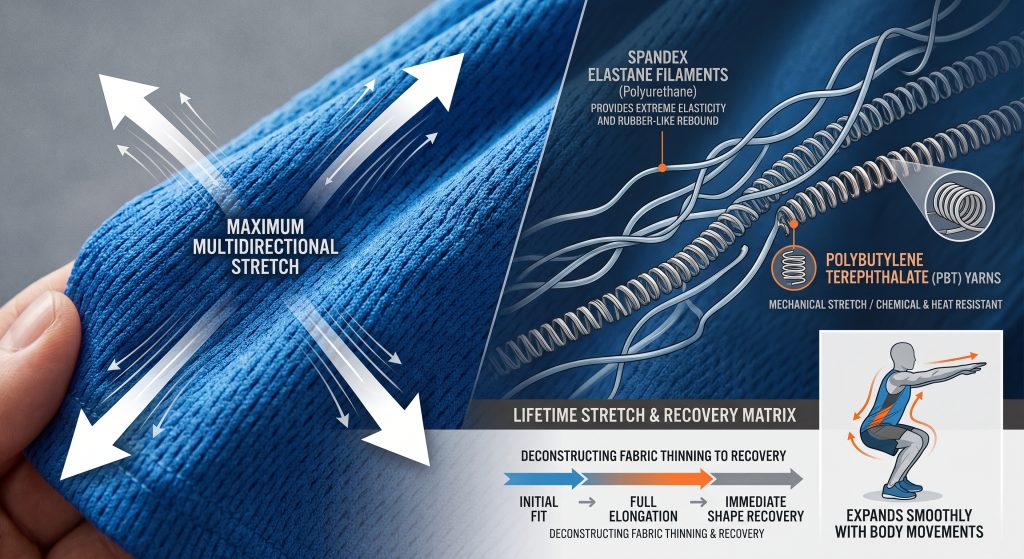
Spandex elastane filaments blended with polybutylene terephthalate yarns deliver maximum multidirectional stretch and full shape recovery for sportswear collections. Incorporating these elastic filaments into a performance knit construction allows active garments to expand smoothly with body movements.
How Does Spandex Elastane Restore Garment Shape?
Polyurethane elastane strands stretch up to five hundred percent of original length before snapping back instantly to initial dimensions. Check this out. High elastic recovery keeps form-fitting apparel snug against muscle groups during workouts.
- Four-way elasticity supports deep squats and wide arm extensions without restriction.
- High recovery force prevents baggy knees and loose waistbands over time.
- Elastane blends between eight and eighteen percent optimize muscle compression.
You preserve form-fitting garment silhouettes across extended wear cycles by incorporating verified elastic filaments.
Can Mechanical Stretch Yarns Replace Rubber?
Textured crimped polyester yarns create mechanical elasticity through coiled fiber geometry without using vulnerable rubber additives. Make no mistake. Mechanical stretch yarns never rot or degrade when exposed to sweat or laundry heat.
- Microscopic spring geometry provides permanent thirty percent fabric elongation.
- Elastane-free polyester fibers survive hundreds of industrial wash cycles easily.
- Recyclable single-polymer composition simplifies apparel recycling initiatives.
You achieve long-lasting stretch stability without worrying about elastic degradation in hot dryers.
Key Takeaway: Combining elastane filaments or mechanical stretch yarns guarantees unrestricted body mobility and permanent shape recovery.
| Stretch Mechanism | Elastane Blends | Mechanical Stretch Yarns |
| Elongation Capacity | Up to 500% | Up to 35% |
| Chemical Durability | Moderate (Vulnerable to heat) | Exceptional (Inert polymer) |
| Recyclability | Difficult (Blended fibers) | Easy (100% Polyester) |
Analyzing these stretch mechanisms helps product developers select between high-compression spandex blends and lifetime-durable mechanical stretch yarns.
5. How Does GSM Weight Affect Performance Knit Durability?
Fabric weight measured in GSM determines whether a textile feels featherlight for racing or heavy enough to provide muscle compression and opacity. Balancing GSM density in your performance knit selection prevents garment transparency while maintaining comfortable athletic mobility.
Is 160 GSM Featherlight Weight Better for Racing?
Lightweight 160 GSM textiles minimize garment weight and speed up moisture drying times during competitive endurance races. Here is the deal. Lightweight fabrics feel weightless on body surfaces during marathon running.
- Low material mass reduces athlete fatigue over long competition hours.
- High fiber porosity allows immediate body heat venting under sun exposure.
- Thin profile layers smoothly beneath outer windbreakers or trail jackets.
You reduce athlete physical fatigue by selecting lightweight GSM materials for high-speed racing collections.
Why Pick 220 GSM Weight for Compression Wear?
Heavyweight 220 GSM knits pack more fibers per square centimeter to deliver opacity and firm muscle stabilization. Think about it. Thin fabrics become transparent when stretched over hips during squats.
- Dense yarn weaving guarantees zero transparency under bright gym lights.
- Firm muscle compression reduces muscle oscillation and post-workout fatigue.
- Superior burst strength withstands heavy mechanical friction against gym equipment.
You safeguard customer privacy and support muscle recovery by using higher GSM density for gym leggings.
Key Takeaway: Selecting mid to heavy GSM weights eliminates see-through risks while providing muscle stabilization for training apparel.
| GSM Range | Fabric Opacity | Primary Performance Benefit | Target Garment |
| 130 – 160 GSM | Moderate | Ultra-light ventilation | Marathon race tops |
| 170 – 200 GSM | High | Balanced strength & drying | Athletic training tees |
| 210 – 250 GSM | Complete | Firm compression & zero opacity | Leggings & shorts |
Reviewing density metrics confirms that selecting the appropriate GSM range aligns fabric strength and opacity with specific athletic demands.
6. Why Choose Polyester Blends for Performance Knit Gear?
Polyester blends are ideal because synthetic hydrophobic fibers refuse to absorb liquid, drying three times faster than natural cotton during sweat-heavy activities. Constructing active apparel from a polyester performance knit guarantees long-lasting color brightness, dimensional stability, and easy laundry care.
Why Does Hydrophobic Polyester Dry Fast?
Polyester polymers absorb less than 0.4 percent water weight, forcing sweat to spread across fiber exteriors rather than soaking inside. Look at it this way. Cotton absorbs up to twenty times its weight in sweat, turning heavy and soggy.
- Hydrophobic fibers keep garments light even during intense perspiration.
- Rapid surface drying prevents body chilling during post-workout rest breaks.
- Mold and bacteria resistance prevents permanent mildew odors in gym bags.
You keep activewear lightweight and odor-free by building collections on hydrophobic synthetic bases.
Can Nylon Blends Upgrade Abrasion Resistance?
Blending nylon microfibers into polyester knits increases surface abrasion resistance against trail rocks and rough outdoor gear. Pay close attention. Nylon polymer chains possess superior tensile strength that resists friction tearing.
- High friction tolerance prevents surface fuzzing from backpack strap rubbing.
- Silky nylon hand feel enhances skin luxury for premium activewear lines.
- High tear resistance protects garments during rugged outdoor wilderness use.
You create rugged outdoor gear that withstands trail abuse by incorporating tough nylon microfibers.
Key Takeaway: Utilizing polyester-nylon blends provides fast moisture drying combined with rugged outdoor abrasion resistance.
| Fiber Component | Drying Velocity | Abrasion Resistance | Moisture Absorption Rate |
| 100% Polyester | Rapid | High | < 0.4% |
| Nylon-Poly Blend | Fast | Very High | 1.0% – 2.0% |
| 100% Cotton | Slow | Low | 8.0% – 20.0% |
Examining fiber characteristics proves that synthetic polyester and nylon blends vastly outperform organic cotton for active sports use.
7. How Does Wicking Technology Power Performance Knit Wear?
Wicking technology powers activewear by utilizing capillary action across engineered microfiber grooves to pull sweat off skin toward outer fabric surfaces. Integrating advanced wicking features into your performance knit collection keeps athletes dry, comfortable, and free from skin chafing.
How Does Capillary Action Pull Body Moisture?
Narrow channels between synthetic microfibers act as hydraulic pumps that draw liquid upward against gravity automatically. What is the real story? Engineered cross-sectional yarns push liquid away from skin without chemical assistance.
- Micro-grooved fibers pull perspiration outward to expand surface evaporation areas.
- Dry skin contact prevents painful friction chafing under arms and thighs.
- Continuous moisture transport maintains stable skin temperature during exercise.
You prevent painful athlete skin chafing by specifying multi-channel wicking yarn structures.
Do Fiber Cross Sections Outlast Sprays?
Inherently grooved yarns retain wicking performance for the lifetime of the garment, whereas topical spray coatings wash off in laundry. Truth be told. Chemical bath finishes lose effectiveness after twenty home laundering cycles.
- Star-shaped cross-section yarns never lose moisture transport power over time.
- Permanent wicking capability eliminates customer claims regarding performance loss.
- Clean manufacturing avoids chemical runoff associated with topical spray baths.
You deliver lifelong customer satisfaction by choosing inherently grooved yarn profiles over temporary chemical treatments.
Key Takeaway: Specifying inherently grooved yarn profiles guarantees permanent moisture management that never washes away in laundry cycles.
| Wicking Technology | Wash Durability | Environmental Footprint | Performance Longevity |
| Topical Chemical Spray | 15 – 25 Washes | Higher chemical runoff | Temporary |
| Inherent Grooved Fiber | Lifetime of Garment | Clean production | Permanent |
Comparing moisture control methods underscores the commercial superiority of permanent inherent fiber engineering over surface spray treatments.
8. Can Sublimation Printing Excel on Performance Knit Lines?
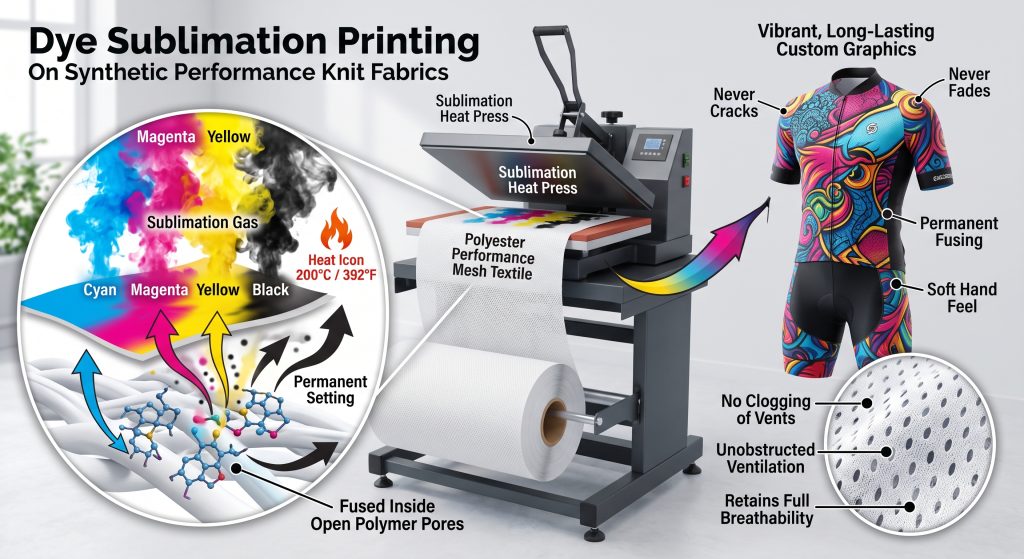
Dye sublimation printing excels on synthetic textiles because heat turns dye into gas that fuses permanently inside open polyester pores at 200°C. Applying sublimation techniques to a polyester performance knit produces brilliant custom graphics that never crack, fade, or obstruct fabric ventilation vents.
How Does Heat Sublimation Fuse Dye Pigment?
Sublimation heat opens synthetic polymer structures, allowing gaseous dye to penetrate deep inside yarn walls before sealing shut. Check this out. Fusing pigment directly into fibers ensures colors never peel off under stretching.
- Unlimited color options allow intricate custom team graphics and vibrant patterns.
- Gas-phase dye fusion leaves fabric surfaces completely weightless and smooth.
- ISO colorfastness ratings ensure printed graphics withstand laundry and sunlight.
You create brilliant graphic sportswear lines without adding extra weight or stiff rubber patches.
Does Screen Printing Clog Open Ventilation Vents?
Plastisol screen printing inks create a thick rubbery layer over fabrics that blocks air openings and restricts stretch. Make no mistake. Rubberized ink patches trap sweat against skin, creating uncomfortable hot zones.
- Heavy ink layers crack and peel when stretched across elastic muscle zones.
- Sealed mesh pinholes lose up to eighty percent of ventilation capacity.
- Sublimation printing keeps one hundred percent of fabric air vents open.
You maintain total fabric breathability and stretch flexibility by choosing dye sublimation decoration.
Key Takeaway: Dye sublimation locks custom colors deep inside fibers without blocking breathability or restricting fabric stretch.
| Decoration Method | Ventilation Retention | Stretch Flexibility | Graphic Durability |
| Dye Sublimation | 100% (Unblocked Pores) | Full Stretch | Lifetime / No Peeling |
| Plastisol Screen Print | 20% – 40% (Sealed Vents) | Rigid / Cracks | Flakes over time |
Evaluating printing methodologies demonstrates why dye sublimation is ideal for preserving activewear ventilation and elasticity.
9. How Do Synthetic Fibers Resist Performance Knit Wear Tear?
Synthetic microfibers resist tear damage by combining high polymer tensile strength with interlocking loop structures that lock adjacent threads together under strain. Utilizing high-tenacity fibers in a performance knit weave protects garments from snags, abrasion holes, and seam blowouts during outdoor sports.
How Do Interlocking Loops Stop Snag Runs?
Interlocking warp loops share mechanical tension across multiple columns, preventing a broken thread from unraveling adjacent stitches. Here is the deal. Single-thread knits tear open rapidly when snagged by branches or gear.
- Interlocked pillar stitches restrict thread damage to the immediate impact point.
- High stitch density stops sharp objects from penetrating between yarn loops.
- Structural firmness resists surface fuzzing during long outdoor trail runs.
You protect outdoor gear against snag tears by selecting interlocking warp knit fabrics.
Why Does High Tensile Strength Matter for Sports?
High-tenacity synthetic polymers endure extreme pulling forces without snapping, protecting seams during explosive physical contact. Think about it. Low-tenacity natural fibers snap easily under sudden stretching strain.
- High breaking force prevents embarrassing garment rips during competitive play.
- High-gauge fiber density resists friction heat generated from floor slides.
- Retains structural shape over years of aggressive activewear use.
You build consumer trust in your sportswear line by utilizing high-tenacity synthetic yarns.
Key Takeaway: Interlocking warp knit loop construction prevents snag runs and protects active apparel against explosive seam failure.
| Fiber Category | Tensile Breaking Force | Snag Resistance Rating | Seam Durability |
| High-Tenacity Poly | Very High | Excellent | Outstanding |
| Standard Cotton | Low | Poor | Average |
Assessing tensile strength data verifies that high-tenacity synthetic yarns provide maximum tear protection during athletic contact.
10. How Can Brands Source Verified Performance Knit Batches?
Apparel brands can source verified textiles by demanding third-party laboratory test certificates and inspecting physical sample cards before authorizing bulk production runs. Verifying lab reports for colorfastness, GSM weight, and wicking speed guarantees that every performance knit shipment satisfies strict commercial quality standards.
What Lab Test Standards Prove Material Quality?
Independent laboratory testing validates physical material performance metrics scientifically to protect brands from receiving defective batches. Look at it this way. Supplier promises mean little without certified laboratory testing documentation.
- ISO 105 tests confirm colorfastness against washing, sunlight, and heavy sweat.
- AATCC 195 reports confirm capillary liquid moisture transport speed.
- ASTM D5034 audits confirm breaking strength and tensile stretch recovery.
You protect your brand reputation by requiring verified laboratory testing metrics prior to production.
Why Are Physical Swatch Cards Necessary?
Physical swatch cards allow product managers to evaluate hand feel, weight, and stretch recovery directly before placing orders. Pay close attention. Computer screens alter fabric colors and fail to convey true tactile texture.
- Tactile inspection confirms exact softness, stretch, and thickness in hand.
- Physical color swatches prevent shade discrepancies under stadium lights.
- Address verification ensures reliable color card shipping to development teams.
You eliminate bulk production surprises by evaluating physical sample cards beforehand.
Key Takeaway: Demanding physical swatch cards and independent lab certificates eliminates production defects and guarantees batch consistency.
| Quality Audit Step | Metric Verified | Primary Risk Avoided |
| ISO Lab Certificate | Colorfastness & Tensile Strength | Color bleeding & fabric tearing |
| Physical Swatch Inspection | Hand Feel, Stretch & GSM Weight | Tactile disappointment & wrong weight |
| Pre-Production Wash Trial | Dimensional Shrinkage | Garment distortion after laundering |
Implementing these verification protocols provides apparel brands with reliable batch consistency and complete product quality control.
Conclusion
Choosing warp knit structures, selecting birdseye mesh over pique weaves, and verifying GSM weights eliminates garment sagging, fabric transparency, and poor moisture wicking. Our specialized mill produces elite functional fabrics designed for high-intensity activewear, featuring superior stretch recovery and vibrant dye sublimation results. If you are ready to elevate your sportswear collection with verified material quality, contact us today to order physical sample cards and discuss your technical activewear specifications. We stand committed to advancing activewear performance through scientific textile engineering and reliable material supply.
Frequently Asked Questions
- Q1: Can I use 100% cotton for active sportswear t-shirts?
No, cotton absorbs sweat rapidly and becomes heavy, taking hours to dry and causing uncomfortable skin chafing during workouts. - Q2: What’s the best GSM weight for workout compression leggings?
A weight between 210 GSM and 250 GSM delivers the best balance of firm muscle compression, high stretch recovery, and complete visual opacity. - Q3: How do I know if my fabric supports dye sublimation printing?
Check that your textile contains at least 85% polyester content, as sublimation dyes require synthetic polymer pores to fuse permanently under high heat. - Q4: Can I blend nylon and polyester in the same sports knit?
Yes, combining nylon and polyester creates a material with nylon’s superior abrasion resistance and polyester’s fast drying speed and cost efficiency. - Q5: What’s the main difference between Birdseye mesh and Pique fabric?
Birdseye mesh features smooth diamond openings that maximize airflow for sports, whereas pique fabric has a raised waffle texture that traps heat and feels stiffer.