
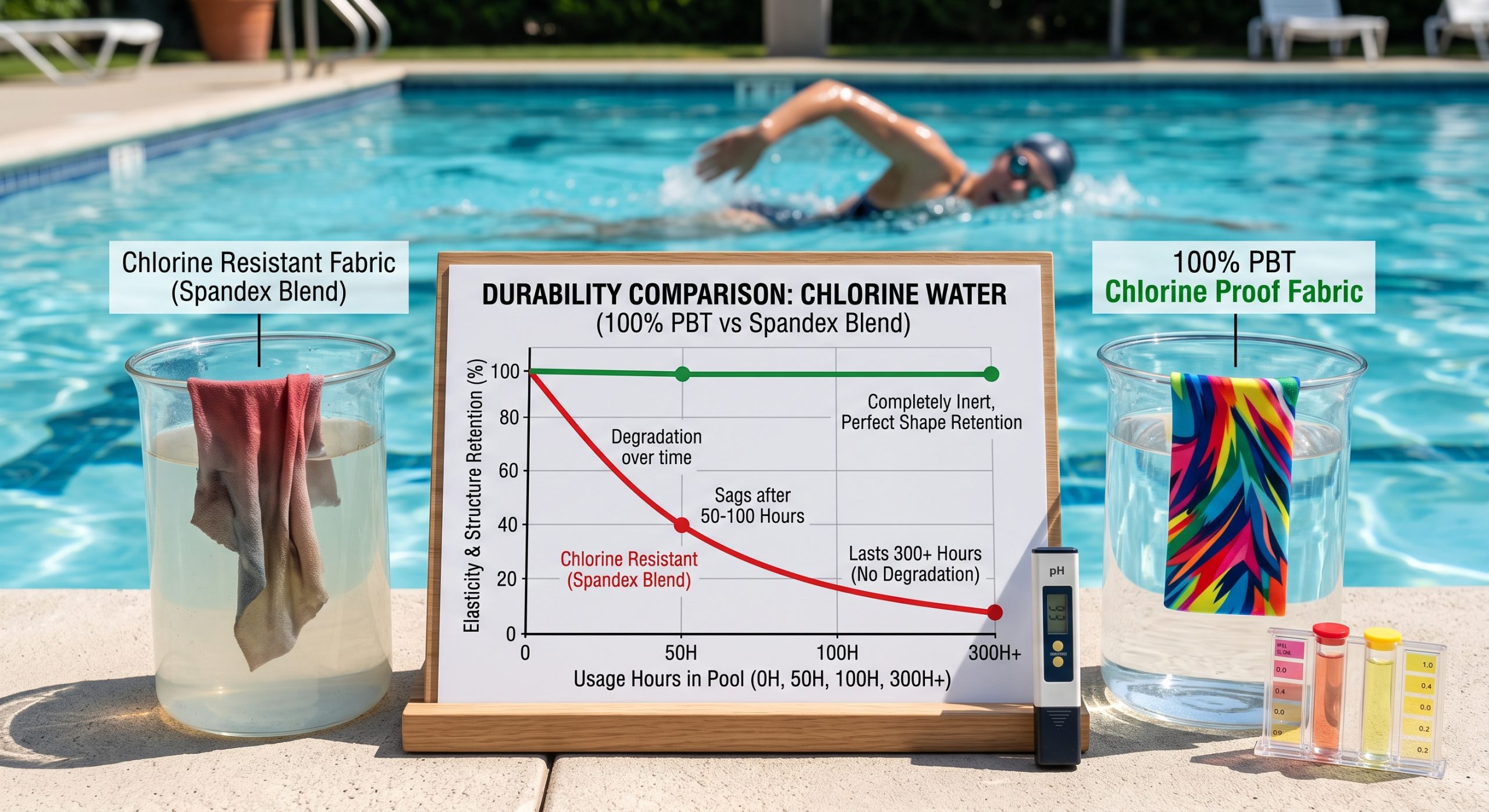
Chlorine resistant fabric uses modified elastane to delay chemical degradation in pool water while chlorine proof fabric utilizes 100% polyester or PBT fibers to completely eliminate chemical degradation forever. Swimwear procurement managers face massive product returns when manufactured suits disintegrate after mere weeks of intense pool usage. Watching customer complaints explode over faded colors, sagging waistbands, and thin see-through panels destroys brand reputation overnight. Upgrading your production line to verified chlorine proof fabric solves chemical corrosion permanently while safeguarding customer loyalty across every retail season.
1. What Is Chlorine Proof Fabric Compared to Resistant Fabric?
Chlorine proof fabric contains zero elastane filaments and relies entirely on polybutylene terephthalate or polyester yarns that resist chemical attack permanently. Standard swim textiles rely on polyurethane elastane fibers that dissolve rapidly under continuous exposure to harsh pool sanitizers.
How Does Chemical Breakdown Attack Elastane Yarns?
Free chlorine in swimming pools oxidizes the molecular bonds within traditional spandex yarns, turning flexible elastic threads brittle and weak. Here is the deal. Once chemical oxidation begins, individual elastane fibers snap internally under light physical tension.
- Chlorine molecules sever polyurethanic chemical bonds during every swim workout session.
- Broken elastic filaments poke through outer yarn structures as ugly white threads.
- Fabric panels expand rapidly, losing original shape and compression support around waistlines.
You must avoid standard elastane when engineering garments destined for daily lap training or water aerobics.
Why Does PBT Polymer Resist Pool Chemical Corrosion?
Polybutylene terephthalate features an aromatic polyester chemical structure that remains completely inert against chlorine oxidation. Think about it. Synthetic PBT fibers retain original tensile strength regardless of pool sanitizer concentration or water pH levels.
- Aromatic polymer chains prevent chemical bonding with dissolved pool sanitizing agents.
- Fibers absorb less than one percent water weight, guaranteeing rapid drying cycles after swimming.
- Yarns resist UV radiation damage simultaneously, protecting colors during outdoor pool usage.
Key Takeaway: Choosing elastane free PBT textiles eliminates chemical rot, preventing embarrassing garment thinning and returns.
| Metric | Chlorine Resistant (Spandex Blend) | Chlorine Proof (100% PBT/Poly) |
| Fiber Lifespan | 50 – 100 Hours | 300+ Hours |
| Chemical Inertness | Low (Degrades over time) | Complete (Zero degradation) |
| Dry Time | Moderate | Rapid |
100% PBT materials deliver unmatched lifespan advantages over traditional elastane blends under daily pool usage.
2. Why Does PBT Polymer Define Chlorine Proof Fabric Performance?
PBT polymer defines elite performance by utilizing an engineered helical molecular chain that provides natural stretch without relying on vulnerable elastane additives. This built-in mechanical spring structure returns garments to original dimensions after intense physical stretching.
How Does Helical Molecular Memory Provide Stretch?
Synthetic PBT yarns act like microscopic metal coil springs that flex and snap back under mechanical tension. Look at it this way. Traditional fabrics require rubbery spandex strands to stretch, but PBT creates elastic recovery through geometry alone.
- Coiled polymer chains extend smoothly during deep body flexes and muscle extension.
- Elastic recovery rates exceed ninety-five percent after repeated stretch tests.
- Mechanical elasticity remains constant even after hundreds of hours spent underwater.
You give athletes dynamic freedom of movement while eliminating the risk of permanent fabric bagging.
What Do Long Term Pool Testing Protocols Prove?
Accelerated laboratory testing exposes fabric samples to concentrated chlorine baths for hundreds of consecutive hours. Truth be told. Elastane blends show severe fiber breakage within forty-eight hours, whereas PBT samples retain full structural integrity.
- Tensile strength tests reveal zero loss in breaking force after three hundred hours submerged.
- Microscopic surface scans show smooth fiber walls without pitting or chemical erosion.
- Colorfastness ratings maintain grade four or higher across demanding lab washing trials.
Key Takeaway: Helical PBT yarn construction delivers true mechanical stretch that never degrades from pool chemical exposure.
| Test Parameter | Standard Spandex Blend | PBT Mechanical Stretch Yarns |
| Stretch Recovery After 100 Hours | 62% | 96% |
| Tensile Retention | 45% | 99% |
| Microscopic Surface Pitting | Severe | None |
Testing data confirms PBT yarns outlast conventional elastic components by exceptional margins under continuous chemical immersion.
3. How Does Birdseye Mesh Compare to Pique Fabric in Swimwear?
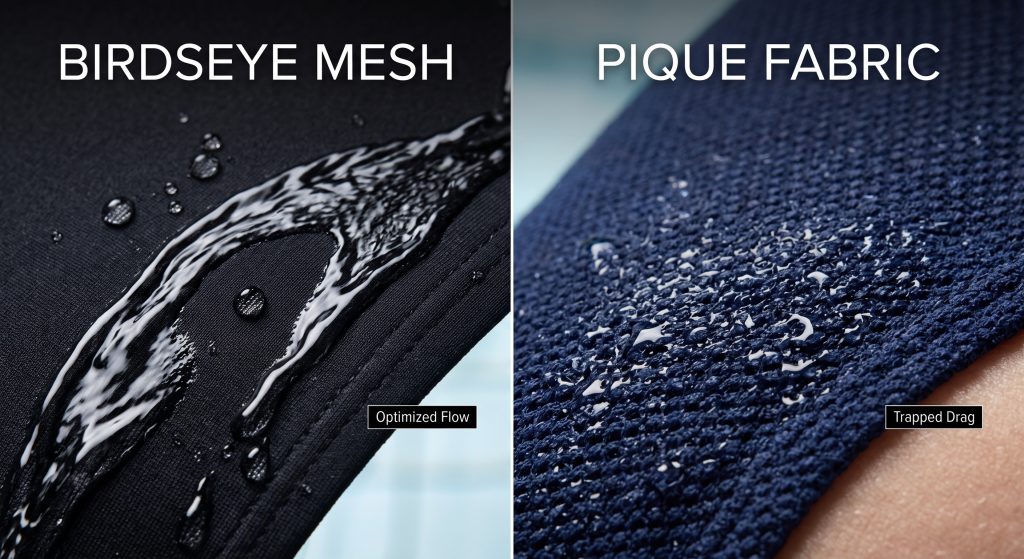
Birdseye mesh provides smooth diamond-shaped micro openings that maximize water flow and minimize skin friction during swimming. Pique fabric features a raised waffle-like texture that traps water pockets, creating extra drag and skin chafing. Utilizing chlorine proof fabric in a birdseye mesh knit optimizes speed and comfort for competitive aquatic athletes.
What Differences Exist in Surface Friction and Feel?
Birdseye mesh features a flat silky face that glides smoothly against sensitive skin during repeated stroke mechanics. Check this out. Raised pique textures create uneven contact points that chafe inner thighs during long swimming sets.
- Diamond knit micro openings allow water to pass through effortlessly, reducing drag coefficients.
- Flat surface texture prevents painful skin abrasion along armpits and inner leg seams.
- Lightweight hand feel ensures garments feel completely unnoticeable during intense physical training.
You protect swimmers from painful friction burn while boosting speed through hydrodynamically efficient knits.
Which Structure Dries Faster After Leaving Pool Water?
Smooth birdseye mesh sheds surface water droplets immediately upon exiting pool facilities due to open geometric pathways. What is the real story? Raised waffle loops in pique fabrics hold trapped water pockets like a tiny sponge.
- Open diamond pores promote rapid air circulation, drying garments in minutes under ambient conditions.
- Low liquid retention keeps swim trunks light when transitioning from water to dry deck space.
- Reduced moisture holding capacity prevents thermal chilling during windy outdoor swim meets.
Key Takeaway: Specifying birdseye mesh over pique structure drastically reduces hydrodynamic drag while eliminating skin chafing.
| Performance Attribute | Birdseye Mesh Knit | Pique Textured Knit |
| Water Flow Permeability | Exceptional | Moderate |
| Surface Friction Rating | Very Low (Silky Smooth) | High (Textured Waffle) |
| Post-Swim Drying Speed | Rapid | Slow |
Birdseye mesh outperforms textured pique knits across every critical water mobility and comfort metric.
4. Can Spandex Yarns Ever Achieve True Chlorine Resistance?
Spandex yarns can achieve moderate chemical resistance through specialized protective coatings or modified polymer formulas, but they cannot achieve true immunity. Chemically modified elastane strands delay chemical breakdown but still degrade eventually under daily pool immersion.
What Is Modified Polyurethane Fiber Chemistry?
Engineered spandex variants incorporate chemical additives directly into the fiber spinning dope to neutralize free chlorine molecules. Ready for the truth? These chemical barriers shield internal elastane chains, extending garment life significantly over cheap basic spandex.
- Protective additives neutralize active chlorine ions before they attack core polymer chains.
- Fibers maintain elasticity up to three times longer than standard unprotected elastane strands.
- Improved thermal stability helps swim trunks endure hot tub temperatures without shrinking.
You gain decent garment longevity for casual leisure swim lines using modified elastane blends.
How Fast Does Tensile Stretch Recovery Degrade?
Even modified elastane suffers gradual polymer degradation when exposed to warm pool water over several months. Pay close attention. After one hundred hours of active immersion, elasticity drops sharply as protective chemical barriers wear away.
- Elastic recovery rates drop steadily by two to five percent during every ten hours of use.
- Waistbands lose tension gradually, requiring tighter drawstrings to keep swim trunks secure.
- Fabric density thins out around high stress zones like hips and rear seat panels.
Key Takeaway: Modified spandex extends leisure garment lifespan, but 100% PBT remains mandatory for true long term durability.
| Lifespan Milestone | Standard Spandex | Modified Resistant Spandex | 100% PBT Poly |
| 30 Pool Hours | Minor Bagging | Like New | Like New |
| 100 Pool Hours | Severe Breakdown | Moderate Loss | Like New |
| 250 Pool Hours | Complete Failure | Severe Degradation | Like New |
Gradual chemical breakdown makes modified spandex suitable only for occasional recreational swimming rather than daily squad training.
5. What Weight Range Works Best for Chlorine Proof Fabric Gear?
Ideal swimwear fabrics weigh between 170 GSM and 210 GSM to guarantee complete opacity alongside light water weight. Choosing chlorine proof fabric within this optimal weight range prevents embarrassing see-through issues when light-colored garments get wet.
Why Is 180 GSM Ideal for Swim Team Uniforms?
A weight of 180 GSM provides sufficient yarn density to block light transmission without feeling heavy or bulky. Here is why it counts. Fabric falling below 150 GSM becomes transparent when wet, ruining garment functionality.
- High density knits prevent sunlight from penetrating wet suit panels on deck.
- Moderate material weight maintains firm muscular compression across glutes and leg panels.
- Balanced thickness permits rapid heat evaporation, keeping athletes cool during dry land warmups.
You ensure client confidence by delivering total modesty across wet light-colored swimwear designs.
How Does Warp Knitting Enhance Tensile Durability?
Warp knit construction loops vertical yarn strands into zig-zag patterns that lock adjacent threads together securely. Make no mistake. Circular knits unravel quickly when snagged, but warp knits hold structural shape under pressure.
- Interlocking vertical loops prevent laddering runs when fabric catches on pool lane lines.
- High multidirectional tension handling stops seam blowout during explosive race starts.
- Dimensional stability keeps leg openings taut without needing heavy elastic banding.
Key Takeaway: Target 180 GSM warp-knit fabrics to deliver absolute opacity, muscular support, and ladder-proof durability.
| GSM Weight Range | Opacity Level (Wet) | Water Absorption | Target Swimwear Style |
| 120 – 150 GSM | Poor (Risks Transparency) | Very Low | Ultra-light rash guards |
| 170 – 200 GSM | Excellent (100% Opaque) | Low | Professional team suits |
| 220 – 260 GSM | Complete Opacity | Moderate | Heavy leisure trunks |
Selecting mid-weight warp knits guarantees flawless modesty and physical strength across active aquatic product lines.
6. How Does Dye Sublimation Print on Chlorine Proof Fabric Options?
Dye sublimation printing fuses colors directly into synthetic polyester fibers at 200°C, creating vibrant graphics that never fade in pool water. Synthetic PBT fabrics absorb gaseous disperse dyes completely, locking deep color pigment inside open fiber walls.
Why Does Gas Phase Fusion Eliminate Color Bleed?
Sublimation heat transforms solid ink into gas that penetrates expanded polymer pores before cooling into solid pigment. Think about it. Surface screen prints peel off when stretched, but sublimated dyes become part of the actual fiber.
- High heat bonds ink molecules inside polymer chains, preventing chemical stripping by chlorine.
- Colors remain brilliant through hundreds of laundering cycles and intense sun exposure.
- Breathable fabric pores remain completely open because no heavy rubber ink sits on top.
You can print intricate custom logos and vivid graphic patterns without restricting fabric stretch or breathability.
What Colorfastness Standards Should You Expect?
Rigorous ISO 105 testing measures how well printed textiles resist color fading under chlorinated water immersion. Check this out. Sublimated PBT fabrics consistently earn top tier scores during standardized laboratory color audits.
- Grade 4-5 fastness rating against chlorinated pool water prevents bleeding into adjacent white panels.
- UV light colorfastness ratings ensure bright neon shades resist sun bleaching during summer.
- Perspiration fastness scores guarantee sharp graphics stay clear during intense workout sessions.
Key Takeaway: Dye sublimation on PBT fabrics produces permanent custom graphics that withstand pool chemicals and sun exposure.
| Test Standard | Standard Screen Print | Sublimated PBT Textile |
| ISO 105-E03 (Chlorinated Water) | Grade 2 – 3 (Fades/Bleeds) | Grade 4 – 5 (Zero Bleed) |
| ISO 105-B02 (UV Lightfastness) | Grade 3 (Dulls quickly) | Grade 4 – 5 (Bright color) |
| Graphic Surface Texture | Thick & Rubberized | Completely Weightless |
Dye sublimation provides flawless graphic longevity, making it mandatory for custom team uniforms and branded collections.
7. Is Nylon Ever Suitable for Chlorine Proof Fabric Collections?
Nylon is never suitable for chlorine proof collections because chemical oxidizers attack nylon amide linkages, causing rapid fiber yellowing and breakdown. Selecting chlorine proof fabric engineered from polyester or PBT avoids the chemical decay inherent to nylon in pool environments.
Why Do Amide Linkages Break Down in Pool Water?
Nylon polymer chains rely on chemical amide bonds that react aggressively with dissolved hypochlorous acid in pools. Truth be told. Active chlorine strips hydrogen atoms from amide groups, fracturing the polymer chain into weak fragments.
- Chemical breakdown converts elastic nylon threads into brittle, chalky residues.
- White nylon swimsuits turn dingy yellow as chemical oxidation alters fiber light reflection.
- Garment panels stretch out out of shape, losing structural support after brief pool use.
You should reserve nylon textiles exclusively for ocean beachwear or casual fitness gear used outside treated pool water.
When Does Soft Nylon Hand Feel Outweigh Durability?
Nylon offers a luxurious silky texture against skin that makes it attractive for fashion swimwear lines. Look at it this way. If customers swim casually in ocean water rather than treated pools, soft nylon hand feel takes priority.
- Ultra-fine nylon filaments feel buttery soft against delicate skin areas during beach wear.
- Premium gloss sheen gives fashion swimsuits a high-end luxury appearance on retail racks.
- Excellent dye affinity produces deep jewel-toned shades for resort lifestyle wear.
Key Takeaway: Avoid nylon for pool training gear due to amide link decay, reserving it for ocean fashion swimwear.
| Fiber Property | 100% PBT / Polyester | Nylon 6 / 6,6 |
| Pool Chemical Resistance | Complete Immunity | Severe Degradation |
| Fiber Yellowing Risk | Zero | High |
| Surface Softness | Smooth & Firm | Ultra-Silky |
Nylon excels in luxury ocean resort wear but fails rapidly under the chemical demands of chlorinated swimming pools.
8. What Water Conditions Accelerate Chemical Corrosion in Swimwear?
High water temperatures, low pH levels, and elevated free chlorine concentrations drastically accelerate chemical attack on elastic fibers. Warm commercial pools and shock-treated training facilities destroy vulnerable swimwear components in a fraction of normal timeframes.
How Does Water Temperature Impact Chemical Reactions?
Elevated water temperatures increase kinetic energy, accelerating chemical reaction speeds between chlorine and elastic polymers. Here is the deal. Swimming in a heated indoor pool or hot tub triples the rate of chemical oxidation.
- Warm water opens up synthetic fiber structures, allowing chlorine ions to penetrate deeper inside.
- Kinetic energy speeds up the breaking of polyurethanic bonds within spandex yarns.
- Heated water causes elastic threads to lose mechanical tension much faster.
You must educate customers that warm pool environments demand fully chemically immune PBT suit construction.
Why Do pH Imbalances Destroy Fiber Strength?
Pool water with low pH levels becomes acidic, generating aggressive hypochlorous acid compounds that attack synthetic fibers. Think about it. Poorly maintained pool water destroys swimsuits much faster than properly balanced facilities.
- Acidic water environments corrode rubber elastic bands and stitching threads simultaneously.
- High free chlorine shock treatments strip fabric dyes and degrade synthetic elastane.
- Chemical imbalances weaken seam threads, causing sudden splits along stress zones.
Key Takeaway: Heated water and acidic pH levels multiply chemical damage, making PBT construction essential for heated pools.
| Pool Parameter | Recommended Standard | Accelerated Damage Zone |
| Free Chlorine | 1.0 – 3.0 PPM | > 5.0 PPM (Shock Levels) |
| Water Temperature | 25°C – 28°C | > 32°C (Heated / Hot Tubs) |
| Water pH | 7.2 – 7.6 | < 7.0 (Acidic Imbalance) |
Sub-optimal pool water chemistry destroys vulnerable elastane fibers rapidly, proving the necessity of chemical-proof PBT textiles.
9. How Do Mechanical Elasticity Yarns Eliminate Elastane Rot?
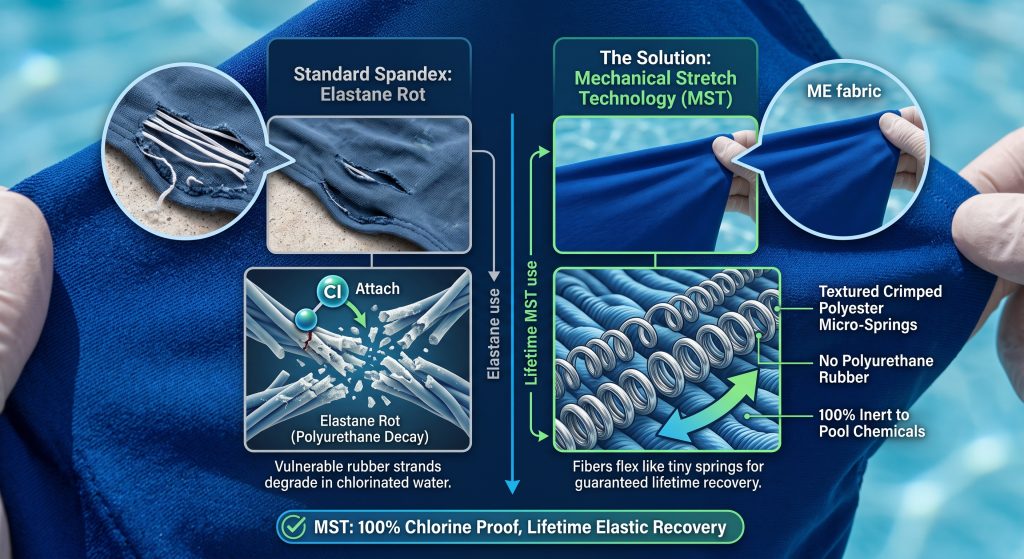
Mechanical elasticity yarns eliminate elastane rot by using textured crimped polyester fibers that flex like tiny springs without using polyurethane rubber. Utilizing chlorine proof fabric built with mechanical stretch technology guarantees lifetime elastic recovery in pool water.
What Is Crimp Textured Polyester Technology?
Thermal texturing processes imprint permanent microscopic zig-zag bends into continuous polyester filaments during yarn spinning. Check this out. When woven into fabric, these crimped filaments compress and expand mechanically under body pressure.
- Heat-set yarn crimps act like thousands of microscopic metal springs woven together.
- Synthetic fibers stretch up to thirty percent beyond relaxed dimensions without snapping.
- Zero rubber content means pool sanitizers have no organic or elastomeric bonds to destroy.
You deliver comfortable body-shaping garments without risking elastic rot or permanent garment sagging.
How Does Mechanical Stretch Prevent Sagging?
Because mechanical stretch relies on durable polyester geometry, fibers never lose their spring-back tension over time. Ready for the truth? Traditional spandex loses elasticity as chemical bonds break, causing loose baggy seat panels.
- Crimped geometry snaps back to original length after every stretch cycle.
- Leg openings remain snug against thighs without cutting off blood circulation.
- Rear seat panels hold shape through thousands of flip turns and dive starts.
Key Takeaway: Crimp-textured polyester yarns provide durable stretch that never sags, thins, or rots in pool water.
| Stretch Mechanism | Elastane / Spandex Strands | Mechanical Crimped PBT |
| Chemical Vulnerability | High (Dissolves in chlorine) | Zero (Inert polyester) |
| Elastic Lifespan | 50 – 150 Hours | Lifetime of Garment |
| Sagging Resistance | Degrades over time | Permanent |
Mechanical stretch yarns solve elastic breakdown permanently, providing lifetime shape retention for athletic aquatic apparel.
10. How Should Brands Source Quality Chlorine Proof Fabric Batches?
Apparel brands should source high-grade fabrics by demanding verified third-party laboratory test certificates and inspecting physical color cards before placing bulk production orders. Testing raw material samples for tensile strength, colorfastness, and fiber purity prevents costly batch defects.
Which Lab Certifications Verify Performance Claims?
Third-party testing laboratories perform standardized chemical exposure trials to validate fabric durability claims scientifically. Make no mistake. Unverified supplier claims often mask cheap polyester blends that lack true mechanical stretch or opacity.
- ISO 105-E03 certificates confirm high colorfastness against chlorinated pool water immersion.
- AATCC 195 reports measure multidimensional liquid moisture management and drying speed.
- OEKO-TEX Standard 100 certification guarantees fabrics are free from harmful chemical residues.
Demanding verified lab reports protects your business against substandard textile shipments and customer complaints.
Why Are Physical Swatch Cards Essential Before Ordering?
Digital monitor screens distort fabric colors and mask subtle hand feel differences between various knit patterns. Pay close attention. Inspecting physical swatch cards lets you verify stretch, weight, and texture directly.
- Touch testing confirms exact hand feel, smoothness, and thickness before bulk cutting.
- Physical color matching under standardized lighting prevents shade variations across production lots.
- Address verification ensures smooth color card dispatch directly to your development team.
Key Takeaway: Request third-party lab certificates and physical swatch cards to guarantee consistent batch quality.
| Verification Step | Key Metrics Checked | Primary Risk Prevented |
| ISO Lab Certification | Colorfastness & Tensile Strength | Material failure & color bleeding |
| Physical Swatch Audit | Hand feel, Stretch & GSM Weight | Incorrect texture & thin fabric |
| Pre-Production Trial | Seam strength & Print quality | Manufacturing defects in bulk |
Rigorous quality verification protocols guarantee your bulk swimwear shipments meet elite commercial performance standards.
Summary
Choosing elastane free PBT textiles, specifying optimal 180 GSM warp knits, and utilizing birdseye mesh over pique structures eliminates chemical rot, garment transparency, and hydrodynamic drag. Upgrading your sportswear manufacturing line ensures exceptional garment longevity that builds lasting customer loyalty across global markets. If you are ready to produce high-performance swimwear collections that win market share, contact us today to request physical sample cards and discuss your technical material requirements with our expert team.
Frequently Asked Questions
- Q1: Can I use standard spandex for competitive pool training suits?
No, standard spandex breaks down within thirty hours of chlorine exposure, causing fabric thinning and shape loss. - Q2: What’s the best fabric weight for long lasting swim team suits?
A weight between 170 GSM and 200 GSM offers ideal balance, providing zero transparency alongside fast drying speeds. - Q3: How do I know if a textile sample is truly chlorine proof?
Check for 100% polyester or PBT composition on laboratory spec sheets, as elastane free construction guarantees total chemical immunity. - Q4: Can I print vibrant custom graphics on 100% PBT swimwear fabrics?
Yes, dye sublimation printing fuses color directly into synthetic fibers, producing bright patterns that never bleed or fade in pool water. - Q5: What’s the main difference between Birdseye mesh and Pique fabric?
Birdseye mesh features smooth diamond openings for maximum water flow, whereas pique fabric utilizes a raised waffle texture that holds more water.