
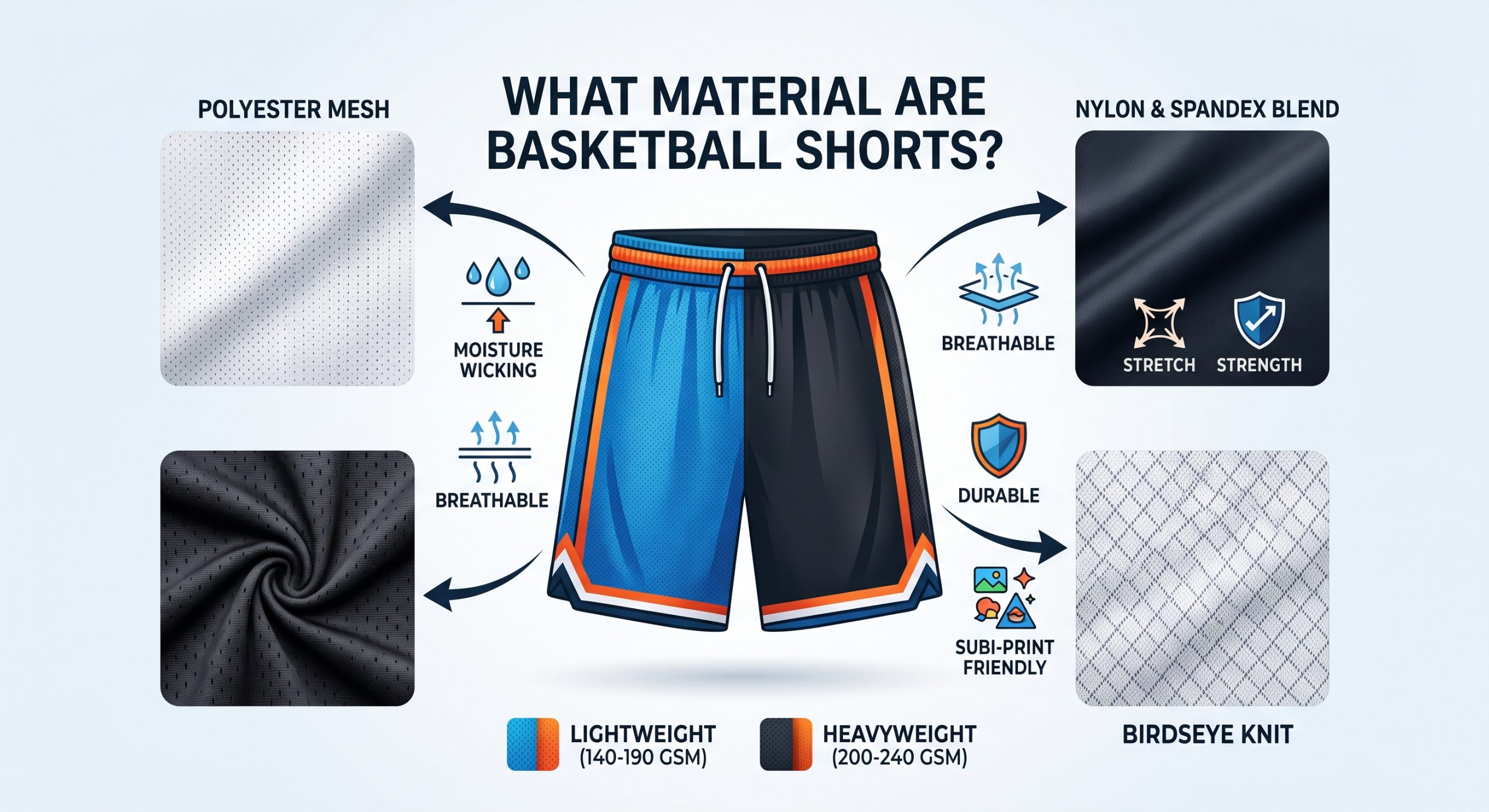
Basketball shorts are constructed primarily from 100% polyester mesh, nylon-spandex synthetic blends, or specialized eyelet knits engineered for rapid moisture evaporation and athletic durability. Apparel production managers frequently face costly product returns when manufactured shorts tear along seams during aggressive play or trap heavy sweat against skin. Choosing an inferior textile damages brand credibility and drains profit margins overnight. Understanding precisely what material are basketball shorts engineered from gives your garment collection the competitive performance edge needed in modern sports retail.
1. What Material Are Basketball Shorts Made Of for Pro Teams?
Professional athletic teams rely on heavyweight polyester mesh combined with elastane lining when selecting what material are basketball shorts engineered with. This specific combination provides structural durability alongside fluid movement during high-intensity games.
What Makes Synthetic Micro-Mesh Premier Quality?
Micro-mesh fabrics utilize thousands of tiny knitted perforations to generate continuous airflow across the body. Here is the core truth. When athletes move at top speeds, skin temperature rises rapidly, demanding immediate heat dissipation.
- High-gauge knit construction prevents snagging on equipment.
- Hydrophobic synthetic yarns push sweat to the outer surface.
- Lightweight structure reduces player fatigue during late game minutes.
You need yarns that resist friction while maintaining structural integrity over repeated industrial washing cycles.
Do Double-Layer Designs Increase Durability?
Double-layer construction places two thin mesh sheets back-to-back to prevent fabric transparency without adding bulk. Think about it. Single-layer white shorts often become see-through when saturated with perspiration during play.
- Inner layers reduce skin abrasion caused by aggressive movement.
- Outer layers display custom sublimation graphics without color bleeding.
- Trapped air between layers provides slight thermal regulation.
| Feature | Single-Layer Mesh | Double-Layer Mesh |
| Transparency | High when wet | Zero transparency |
| Average Weight | 120 – 150 GSM | 220 – 260 GSM |
| Abrasion Resistance | Moderate | Exceptional |
Double-layer configurations remain the industry gold standard for professional uniforms due to zero transparency and enhanced durability.
Key Takeaway: Selecting double-layer micro-mesh guarantees elite athletic durability while solving transparency issues for light-colored sportswear lines.
2. Why Is Polyester Mesh What Material Are Basketball Shorts Need?
Polyester mesh stands out as the dominant choice when manufacturers decide what material are basketball shorts should incorporate due to its lightweight strength and hydrophobic properties. Synthetic polyester fibers refuse to absorb water, forcing moisture to evaporate instantly.
Why Does Hydrophobic Fiber Perform Better?
Hydrophobic fibers act as water repellents at a microscopic level. You see, natural fibers soak up sweat like a sponge and become heavy during competition.
- Synthetic yarns retain original weight even during extreme perspiration.
- Rapid drying cycles prevent athlete chilling during bench timeouts.
- Mold and mildew resistance prolongs garment shelf life in storage.
Your customers demand gear that remains light from opening tip-off to the final whistle.
Can Warp-Knit Mesh Prevent Fabric Tears?
Warp-knitting loops yarns vertically in a zig-zag pattern to lock fibers together tightly. Here is why it matters. Standard circular knits unravel easily when snagged by fingernails or floor contact.
- Vertical loop structures stop runs from spreading across panels.
- High tensile strength withstands intense pulling during rebounds.
- Dimensional stability holds garment shape after dozens of laundry cycles.
| Knit Category | Tear Resistance | Air Permeability | Stretch Recovery |
| Warp-Knit Mesh | High | Exceptional | Moderate |
| Circular Knit Jersey | Low | Moderate | High |
| Flat Woven Fabric | Very High | Low | Low |
Warp-knit polyester mesh delivers unmatched tear resistance, making it essential for contact sports apparel.
Key Takeaway: Utilizing warp-knit polyester mesh protects your apparel line against accidental rips, preserving brand reputation for quality construction.
3. How Does Birdseye Mesh Compare to Pique Fabric for Shorts?
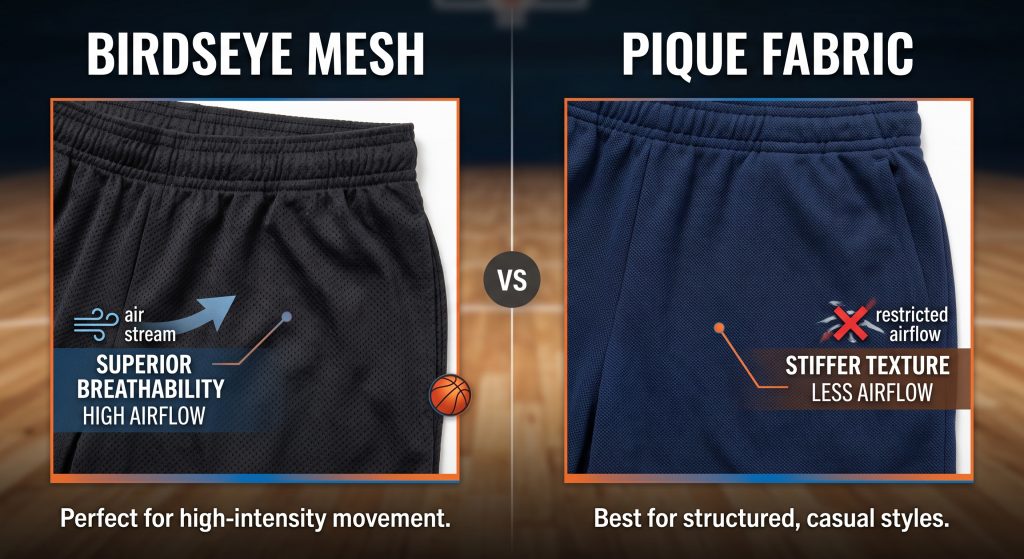
Birdseye mesh features small diamond-shaped openings that deliver superior breathability compared to pique fabric, making it the preferred choice for what material are basketball shorts constructed with. Pique fabric utilizes a raised waffle-like texture that feels stiffer and offers less airflow during rapid movement.
What Differences Exist in Hand-Feel and Texture?
Birdseye mesh provides a silky, flexible feel that glides over skin without causing friction points. What does this mean for you? Pique knits possess a bumpy geometric surface designed primarily for structured polo shirts rather than active sports.
- Birdseye mesh feels soft and drapes naturally over leg muscles.
- Pique fabric holds rigid structure that can chafe thighs during sprints.
- Smooth diamond patterns prevent sweat accumulation against skin.
You want fabrics that minimize skin contact resistance to maintain athlete comfort during lateral movements.
Which Knit Pattern Provides Maximum Airflow?
Geometric diamond pinholes in birdseye mesh create direct pathways for heat to escape away from muscles. Truth be told. Pique knits restrict direct ventilation due to their tightly raised cotton-blend loops.
- Birdseye openings allow immediate heat release during high exertion.
- Pique textures trap warm air pockets against body surfaces.
- Uniform hole distribution speeds up moisture evaporation rates.
| Property | Birdseye Mesh (鸟眼布) | Pique Fabric (珠地布) |
| Surface Texture | Smooth with tiny diamond dots | Raised waffle pattern |
| Air Permeability | Very High (180+ cm³/cm²/s) | Moderate (80-110 cm³/cm²/s) |
| Primary Application | Active performance sportswear | Casual polo shirts & leisurewear |
| Skin Friction | Minimal friction | Moderate friction |
Birdseye mesh outperforms pique knit across every breathability metric required for intense athletic activities.
Key Takeaway: Specifying birdseye mesh over pique fabric guarantees superior cooling performance and reduces thigh friction for your sportswear customers.
4. Is Nylon What Material Are Basketball Shorts Demand for Duty?
Premium sportswear lines frequently select nylon textiles when evaluating what material are basketball shorts requiring superior tensile strength and smooth tactile feel. Nylon fibers resist friction tears significantly better than standard polyesters.
Does Nylon Offer Greater Abrasion Resistance?
Nylon polymer chains possess exceptional tensile strength and flexibility under mechanical stress. Let that sink in. When players slide across hardwood floors, nylon resists friction heat without melting or tearing.
- Outstanding surface resistance against floor burns and scrapes.
- Superior elasticity prevents permanent bagginess at knee zones.
- Premium sheen creates a high-end visual appeal on retail displays.
Your brand gains a luxury positioning by offering nylon-based court apparel.
Why Is Nylon More Expensive to Produce?
Synthesizing nylon polymers requires specialized chemical processing and higher energy inputs than polyester production. Here is the catch. Higher material costs raise total production estimates for garment brands.
- Raw material pricing runs thirty to fifty percent higher than polyester.
- Dyeing nylon requires strict temperature controls to avoid streakiness.
- Lower moisture absorption demands precise chemical wicking treatments.
| Fiber Property | Nylon Textile | Standard Polyester |
| Abrasion Resistance | Highest | High |
| Raw Material Cost | Premium | Economical |
| Melting Point | 220°C | 260°C |
| Tensile Strength | Extremely High | High |
Although nylon increases manufacturing budgets, its extraordinary durability justifies higher retail price points for pro-tier shorts.
Key Takeaway: Incorporating nylon components allows apparel brands to command premium retail pricing through superior tear resistance and sleek hand-feel.
5. Can Spandex Blends Change What Material Are Basketball Shorts?
Integrating spandex or elastane filaments transforms what material are basketball shorts designed around by granting 360-degree elasticity for unrestricted athletic cuts. Adding 5% to 15% elastane allows players to execute deep squats without fabric binding.
How Much Elastane Yields Optimal Stretch?
Elastane ratios must be balanced carefully to avoid making garments excessively heavy or loose. Check this out. Too little elastane restricts motion, while too much causes fabric sag when soaked with sweat.
- 8% elastane content provides ideal recovery for woven shorts.
- 12% elastane blends work best for integrated compression liners.
- High elastic recovery maintains original waistband dimensions over time.
You retain athletic fit integrity across extended seasons by selecting verified stretch ratios.
Does Four-Way Stretch Prevent Seam Splitting?
Four-way stretch textiles expand horizontally and vertically under sudden physical stress. Why does this matter? Rigid fabrics concentrate pressure directly onto stitched seams during explosive crossovers.
- Elastic yarns absorb movement forces before stress reaches seam threads.
- Reduced seam strain eliminates embarrassing garment rips on court.
- Ergonomic contours hug muscle groups without restricting circulation.
| Elastane Ratio | Stretch Capacity | Fabric Weight Impact | Ideal Use Case |
| 0% (Pure Poly) | Rigid / No Stretch | Baseline Weight | Loose vintage mesh shorts |
| 5% – 8% Blend | 2-Way Stretch | Slight Increase | Modern game-day shorts |
| 10% – 15% Blend | 4-Way Stretch | Moderate Increase | Compression inner liners |
Integrating moderate elastane percentages drastically reduces seam failure points during dynamic sports maneuvers.
Key Takeaway: Blending 5% to 8% elastane into base fabrics prevents seam stress failures while delivering full motion freedom to athletes.
6. How Does Weight Impact What Material Are Basketball Shorts Use?
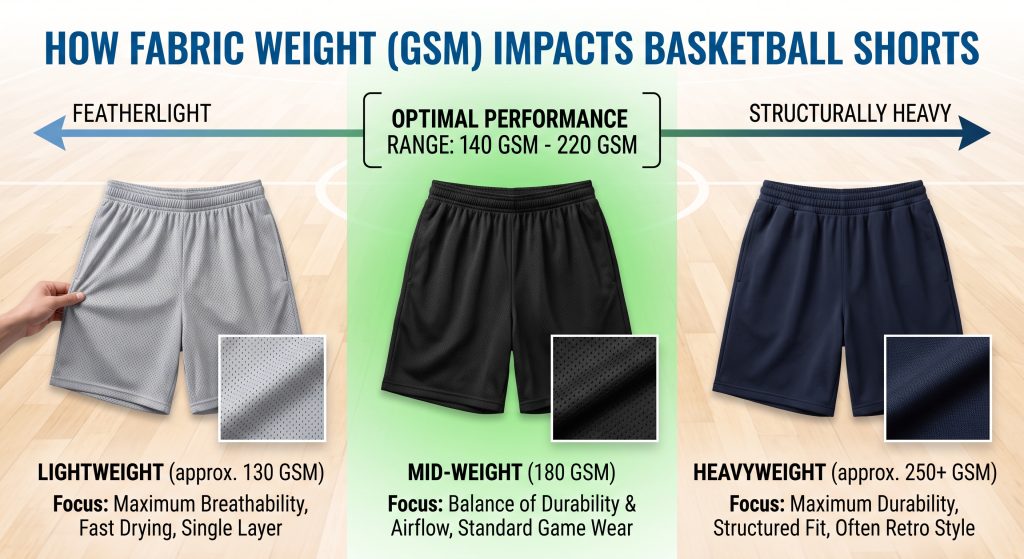
Fabric weight, measured in grams per square meter (GSM), determines whether what material are basketball shorts made from feels featherlight or structurally heavy during competition. Optimal performance shorts typically range between 140 GSM and 220 GSM.
Is Light 140 GSM Better Than 220 GSM Fabric?
Ultra-lightweight 140 GSM fabrics maximize velocity and heat escape for elite sprinters and guards. Here is the real secret. However, lightweight fabrics require tighter knits to maintain structural longevity.
- 140 GSM options feel weightless during fast-break transitions.
- 180 GSM choices strike the ideal balance between strength and ventilation.
- 220 GSM weights suit heavy-duty retro streetwear shorts collections.
Your target customer demographic determines whether featherlight speed or heavy retro feel takes priority.
How Does GSM Influence Fabric Transparency?
Lower GSM values reduce yarn density per square centimeter, opening up space between fibers. Look at it this way. Pushing fabric weight below 130 GSM risks complete transparency under bright arena lights.
- Dark colorways mask low GSM transparency effectively.
- White and pastel fabrics require at least 180 GSM density.
- Multi-layer constructions balance low individual panel GSM with full opacity.
| GSM Category | Fabric Feel | Transparency Risk | Recommended Apparel Line |
| 130 – 150 GSM | Ultra-Lightweight | High (Requires Liner) | Track & high-heat training |
| 160 – 190 GSM | Mid-Weight Standard | Low | Mainstream game shorts |
| 200 – 240 GSM | Heavyweight Retro | Zero Transparency | Urban streetwear collections |
Selecting mid-weight 160-190 GSM textiles eliminates transparency concerns without sacrificing athlete comfort.
Key Takeaway: Target a 160-190 GSM fabric range to strike the perfect commercial balance between opacity, weight, and durability.
7. What Material Are Basketball Shorts Using for Moisture Wicking?
Advanced capillary-action synthetic treatments define what material are basketball shorts utilizing to pull sweat away from skin toward the outer garment shell. Cross-sectional micro-grooves channel moisture across a wider surface area for rapid drying.
How Does Capillary Action Remove Sweat?
Engineered fiber cross-sections create narrow channels that draw liquid upward against gravity. You might be wondering. Standard round fibers simply trap liquid droplets along skin surfaces.
- Star-shaped or channel yarns pull perspiration outward mechanically.
- Expanded surface area speeds up air-drying rates by three times.
- Dry skin contact prevents painful chafing during extended play.
You deliver tangible performance benefits to players by utilizing moisture-channeling yarn profiles.
Do Chemical Finishes Wash Out Over Time?
Topical wicking chemicals applied via dipping baths gradually degrade after twenty to thirty washings. Here is what you need to know. Inherently wicking yarns retain performance permanently because moisture control resides inside the fiber structure.
- Inherently wicking polymers survive over one hundred industrial wash cycles.
- Topical coatings lose twenty percent effectiveness after ten laundries.
- Sustainable manufacturing favors inherent mechanical wicking over chemical baths.
| Wicking Technology | Permanence Level | Wash Durability | Production Cost |
| Topical Spray Finish | Temporary | 15 – 20 Washes | Low |
| Bath Immersion Coating | Semi-Permanent | 30 – 50 Washes | Moderate |
| Inherent Fiber Structure | Permanent | Lifetime of Garment | Higher Initial Investment |
Inherent fiber wicking provides long-term customer satisfaction and reduces warranty claims against performance degradation.
Key Takeaway: Specifying inherently wicking yarns guarantees lifelong sweat management that never washes out in laundry cycles.
8. Is Cotton Ever What Material Are Basketball Shorts Should Use?
Pure cotton is unsuitable for performance apparel, yet what material are basketball shorts designed for lifestyle streetwear often relies on heavy French terry cotton blends. Cotton absorbs up to twenty times its weight in water, making it heavy during athletic play.
Why Does Cotton Fail in High-Intensity Games?
Cotton fibers swell when absorbing liquid, closing air gaps and trapping body heat inside. That is not all. Wet cotton sticks tightly to skin, causing severe friction chafing across thighs.
- Saturated cotton garments sag heavily off waistlines.
- Slow drying times leave athletes cold during recovery periods.
- Organic fibers harbor odor-causing bacteria rapidly after sweat exposure.
Your technical sportswear line must avoid pure cotton to maintain athletic performance standards.
When Is French Terry Cotton Appropriate?
Heavyweight French terry cotton delivers exceptional comfort and structure for off-court lifestyle collections. The takeaway is clear. Streetwear fashion values heavy drape and soft hand-feel over sweat management.
- 350 GSM French terry creates a premium structured silhouette.
- Loopback cotton interiors offer comfortable lounge feel.
- Polyester-cotton blends reduce shrinkage during hot drying cycles.
| Parameter | Performance Polyester | Lifestyle French Terry Cotton |
| Primary Use Case | Active court competition | Casual lifestyle & lounging |
| Sweat Absorption | Low (Pushes moisture out) | Very High (Holds liquid inside) |
| Drying Speed | Fast (15-20 minutes) | Slow (2+ hours) |
| Garment Drape | Fluid & light | Heavy & structured |
Keep cotton exclusively within your casual lifestyle lines while keeping technical performance gear purely synthetic.
Key Takeaway: Reserve cotton textiles strictly for off-court streetwear lines to prevent sweat-saturation failures during active sport use.
9. How Does Printing Alter What Material Are Basketball Shorts Cut?
Dye-sublimation printing requires 100% polyester composition when selecting what material are basketball shorts customized with, as sublimation dyes only bind to synthetic polymers under high heat. Screen printing on natural fibers can crack when stretched over athletic mesh openings.
Why Does Sublimation Demand Synthetic Fiber?
Sublimation turning points require solid dye gasification at 200°C to fuse into open polymer pores. Here is why this counts. Natural fibers like cotton or silk lack open polymer slots, causing dyes to wash away completely.
- Sublimation gas binds permanently inside polyester filaments.
- Printed graphics never peel, crack, or fade over years of play.
- Mesh perforation holes remain completely unblocked for full airflow.
You achieve unlimited color customization without compromising the breathability of athletic mesh.
Does Screen Printing Block Mesh Air Vents?
Plastisol screen printing inks form a thick rubbery layer across textile surfaces upon drying. Plain and simple. Thick inks seal mesh pinholes, creating hot plastic patches over key ventilation zones.
- Rubberized ink patches increase garment stiffness dramatically.
- Trapped sweat accumulates directly behind printed team numbers.
- Ink layers crack when stretched across elastic mesh openings.
| Decoration Technique | Airway Obstruction | Color Limit | Graphic Durability |
| Dye Sublimation | Zero (0% blocked) | Unlimited colors | Lifetime / No peeling |
| Plastisol Screen Print | High (60-90% blocked) | Limited per screen | Flakes over time |
| Heat Transfer Vinyl | Total (100% blocked) | Moderate | Peels after washings |
Dye sublimation remains the supreme decoration method for athletic shorts because it preserves 100% mesh air permeability.
Key Takeaway: Choose dye sublimation on polyester fabrics to offer bold custom graphics without blocking crucial fabric ventilation holes.
10. How Do You Source What Material Are Basketball Shorts Demand?
Sourcing high-grade athletic textiles requires verifying lab test reports for colorfastness, tear resistance, and moisture wicking before committing to what material are basketball shorts mass-manufactured with. Partnering directly with specialized textile mills guarantees consistent batch quality.
What Lab Certifications Should You Request?
Reputable fabric mills supply third-party testing metrics verifying raw material performance specs. Make no mistake. Uncertified textiles often suffer from erratic color bleeding or sudden batch shrinkage.
- ISO 105 tests verify high colorfastness against washing and perspiration.
- ASTM D5034 reports prove fabric breaking strength under tension.
- AATCC 195 metrics confirm multidimensional liquid moisture management.
Demanding verified lab reports shields your procurement department from costly manufacturing mistakes.
How Do Sample Cards Prevent Production Errors?
Physical sample cards allow product managers to verify exact hand-feel, shade accuracy, and GSM weight prior to bulk ordering. Here is the bottom line. Digital screens distort fabric colors and mask texture differences between mesh types.
- Physical color swatches verify dye match under stadium lighting.
- Tactile testing confirms weight and stretch parameters directly.
- Address verification ensures smooth color card dispatch to your team.
| Quality Verification | Primary Risk Mitigated | Essential Test Standard |
| Lab Test Certification | Substandard strength & toxic dyes | ISO / ASTM / AATCC |
| Physical Color Cards | Shade mismatch & wrong hand-feel | Lab dip comparison |
| Pre-Production Swatches | Shrinkage & unexpected transparency | Laundering trial |
Requesting physical swatch cards and verified lab tests guarantees seamless transition from initial design concept to bulk production.
Key Takeaway: Always confirm lab test certifications and physical swatch cards before committing to bulk textile orders to avoid production defects.
Summary
Selecting high-grade synthetic textiles, optimizing GSM weights, and choosing birdseye mesh over pique fabric eliminates garment tearing, transparency issues, and athlete discomfort. Our specialized manufacturing facility delivers industry-leading sports fabrics engineered for long-lasting athletic performance and vibrant sublimation printing. If you are ready to produce standout sportswear collections that win customer trust, contact us today to order physical sample cards and discuss your technical fabric requirements.
Frequently Asked Questions
Can I use 100% cotton for competitive basketball shorts?
No, 100% cotton absorbs sweat rapidly and becomes extremely heavy during play, leading to uncomfortable chafing and restricted player movement.
What is the best GSM weight for lightweight basketball shorts?
A weight range of 160 to 190 GSM provides the ideal balance between featherlight breathability, structural strength, and fabric opacity.
How do I know if my mesh fabric will hold sublimation prints?
Check that your textile contains at least 85% polyester content, as sublimation dyes require synthetic polymers to fuse permanently under high heat.
Can I blend nylon and polyester in the same garment?
Yes, combining nylon and polyester creates a textile with nylon’s superior abrasion resistance and polyester’s cost-effective dyeability.
What is the main difference between Birdseye mesh and Pique fabric?
Birdseye mesh features smooth diamond openings that maximize airflow for sports, while pique fabric has a raised waffle structure designed for casual polos.