
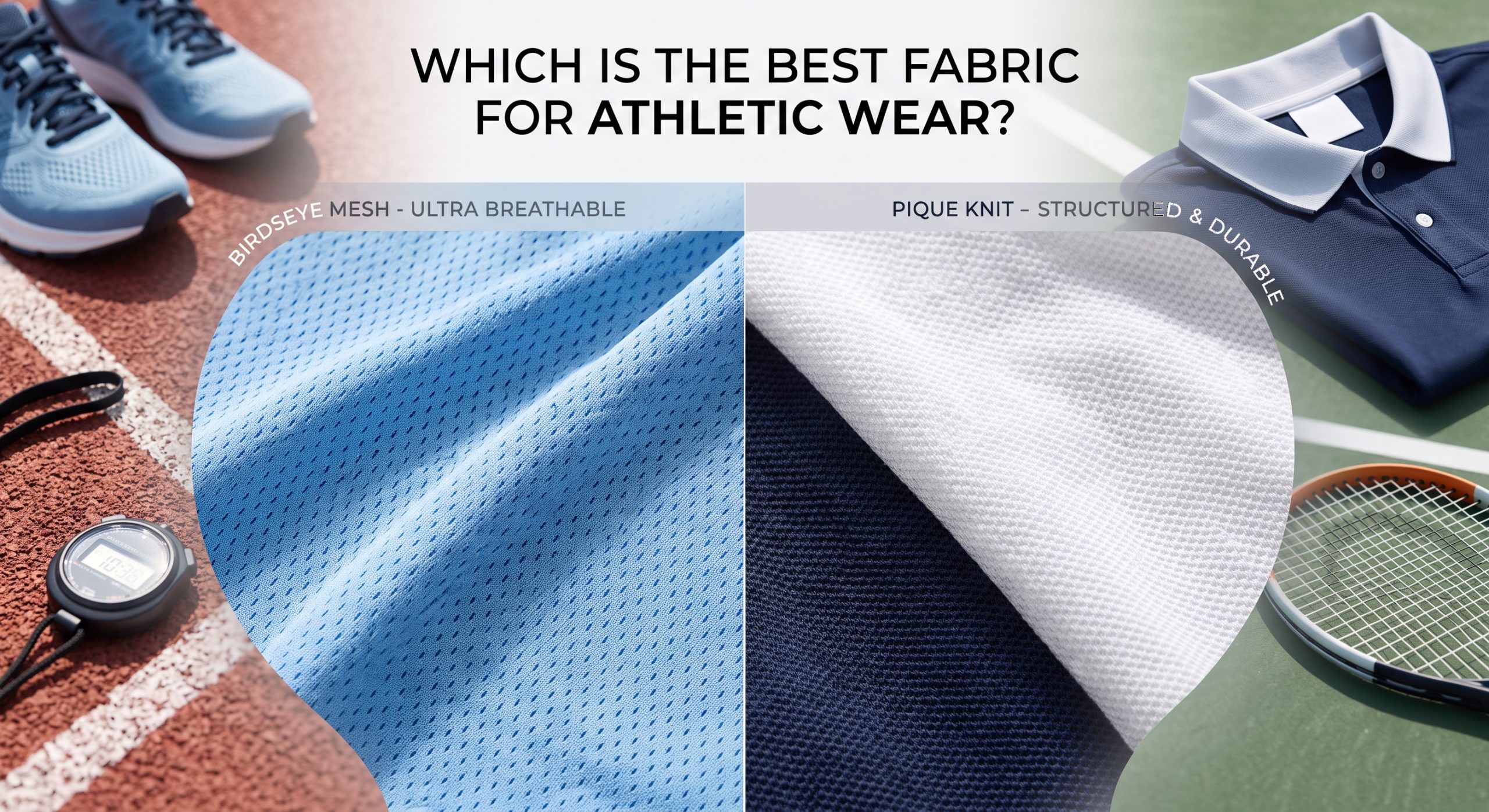
Understanding performance fabrics requires evaluating how structural knitting techniques impact moisture management durability and tactile comfort across athletic applications. Sourcing bulk activewear fabric often leaves product sourcing managers struggling with unexpected surface pilling poor breathability and dissatisfied retail buyers. Ordering large shipments only to discover your chosen knit traps heat during intense workouts destroys customer trust instantly. Matching specialized birdseye mesh or durable pique fabric engineered as the best fabric for athletic wear solves these sourcing bottlenecks by aligning exact fiber construction with athlete movement requirements.
Which structure makes the best fabric for athletic wear?
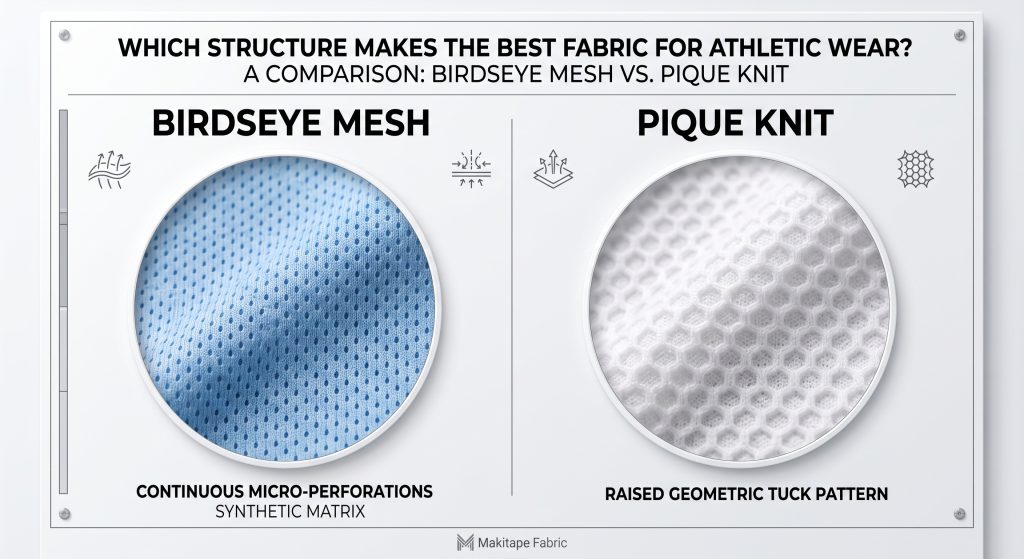
Birdseye mesh and pique knits represent two distinct structural engineering methods designed to supply the best fabric for athletic wear across varied performance environments. Birdseye fabric features continuous micro-perforations across a synthetic matrix whereas pique utilizes a raised geometric tuck pattern.
What are the main differences in surface geometry?
Birdseye fabric features a continuous pattern of minute holes resembling small eyes that maximize airflow through garments. Pique fabric relies on double-knit construction creating geometric raised ridges that lift material slightly off human skin.
- Birdseye geometry: Open hole matrix with flat surface orientation.
- Pique geometry: Textured waffle pattern with elevated surface points.
Here is the deal: selecting between these surfaces alters tactile sensation instantly. You will notice that flatter open matrices feel slicker against working muscles.
How do yarn arrangements influence performance?
Yarn tension in birdseye knits creates flexible stretch vectors suitable for body contours. In contrast pique structures lock yarns tightly to preserve garment shape during prolonged athletic stress.
- Birdseye yarn grid: High multi-directional flexibility.
- Pique yarn grid: High structural shape retention.
Think about it: demanding stretch applications favor loose mesh matrices over dense waffle weaves. You can rely on loose meshes when garments require extreme physical reach.
| Structural Feature | Birdseye Mesh Knit | Pique Tuck Knit |
| Surface Pattern | Open micro-holes | Raised geometric waffle |
| Dimensional Stretch | High multi-directional recovery | Structured moderate recovery |
| Fabric Weight Range | Ultra-lightweight (120-160 GSM) | Mid-weight (180-240 GSM) |
Evaluating these structural parameters allows garment designers to align knit density with product function.
Key Takeaway: Select birdseye for lightweight flexibility and pique for structured garment shape retention.
How does birdseye mesh qualify as the best fabric for athletic wear?
Birdseye mesh qualifies as the best fabric for athletic wear by utilizing open-pore knit patterns that accelerate continuous convective heat transfer during aerobic exercise. Its unique geometric perforation allows heat and sweat vapor to exit rapidly without trapping moisture against human skin.
Can micro-perforations improve ventilation?
Microscopic pore networks integrated throughout birdseye knit allow air to pass directly through garment layers. Active airflow reduces core body heat during endurance training routines.
- Continuous air channels prevent sweat accumulation.
- Reduced fabric weight lowers physical fatigue over time.
Here is why that matters: lower heat stress keeps endurance athletes operating longer. You will observe immediate performance stability when skin remains dry.
What makes birdseye suitable for high-intensity training?
High-intensity activities require apparel that dries within minutes after sweat exposure. Birdseye fabric spreads liquid moisture across its broad surface area to speed evaporation.
- Surface spreading speeds moisture evaporation.
- Smooth inner face minimizes skin friction.
That is not all: smooth inner surface friction prevents chafing during repetitive motion. You protect runners from painful friction injuries using flat open-pore textiles.
| Performance Metric | Birdseye Mesh Standard | Conventional Flat Knit |
| Air Permeability | Very High (>180 mm/s) | Moderate (<80 mm/s) |
| Drying Speed | Fast (<15 minutes) | Slow (>35 minutes) |
| Surface Friction | Low smooth touch | Medium standard contact |
Measuring drying speeds confirms that open mesh architectures process moisture faster than traditional flat textiles.
Key Takeaway: Choose birdseye mesh when designing high-speed running tops or cardio garments.
Why is pique knit considered the best fabric for athletic wear?
Pique knit is considered the best fabric for athletic wear because its textured 3D weave balances professional presentation with reliable moisture absorption for sportswear. The raised geometry creates micro-air pockets between fabric and skin while maintaining a refined aesthetic.
How does 3D structure affect skin contact?
Raised tuck stitches minimize direct contact between damp fabric and human body surfaces. Reduced skin contact stops garment clinging during light sweating or warm weather activities.
- Minimal surface contact improves overall wearable comfort.
- Natural air gaps provide thermal balance during rest intervals.
Ready for the good part? Air gaps created by raised ridges insulate body skin against temperature spikes. You stay comfortable moving between outdoor humidity and air-conditioned clubhouses.
Can pique maintain garment shape over time?
The geometric tuck pattern provides structural integrity that resists sagging after multiple laundry cycles. Athletic polos made from pique maintain crisp collars and straight hemlines longer than flat jersey.
- Tuck stitches resist edge rolling on collars.
- Dense weave prevents vertical stretch sagging.
Look at the facts: structural tests reveal that tuck knits hold shape through heavy industrial laundering. You avoid costly consumer returns caused by deformed shirt collars.
| Durability Characteristic | Pique Weave | Standard Single Jersey |
| Shape Retention | High structural stability | Moderate stretch sagging |
| Collar Crispness | Resistance to curling | Prone to edge rolling |
| Surface Texture | Distinctive tactile waffle | Smooth flat surface |
Structural testing indicates pique maintains garment architecture despite repeated commercial wash cycles.
Key Takeaway: Opt for pique knit when manufacturing corporate sportswear, tennis apparel, or athletic polos.
How do hand feel factors affect the best fabric for athletic wear?
Hand feel factors determine athlete comfort by altering surface friction softness and drape when selecting the best fabric for athletic wear. Smooth synthetic blends provide silk-like tactile contact whereas textured knits deliver crisp structured grip.
What role does filament fineness play in tactile comfort?
Micro-denier synthetic filaments create silky surfaces that feel gentle against sensitive skin areas. Finer yarns yield softer hand feel without sacrificing synthetic tensile strength.
- Microfiber construction reduces mechanical skin irritation.
- Soft touch treatments improve initial consumer tactile impression.
What is the real story? Filament thickness alters sensory perception before an athlete even begins workouts. You gain instant buyer approval when swatches feel soft during initial handling.
How do finish treatments alter fabric hand?
Hydrophilic softeners applied during finishing processes improve surface slickness while preserving moisture management. Proper finishing converts stiff synthetic fibers into plush performance textiles.
- Softener applications smooth outer fiber scales.
- Mechanical brushing generates velvet-like surface textures.
Check this out: mechanical brushing techniques modify surface touch without adding heavy chemical coatings. You achieve luxurious comfort while keeping fabrics light.
| Tactile Parameter | Birdseye Soft Finish | Pique Standard Finish |
| Surface Smoothness | Ultra-smooth slick feel | Textured tactile grip |
| Fabric Drape | Fluid relaxed drape | Firm structured drape |
| Skin Friction Index | Very Low | Moderate |
Tactile evaluations confirm that finishing agents significantly improve initial hand feel satisfaction for athletes.
Key Takeaway: Prioritize micro-filament yarns and specialized softeners to guarantee maximum skin comfort.
Does breathability define the best fabric for athletic wear?
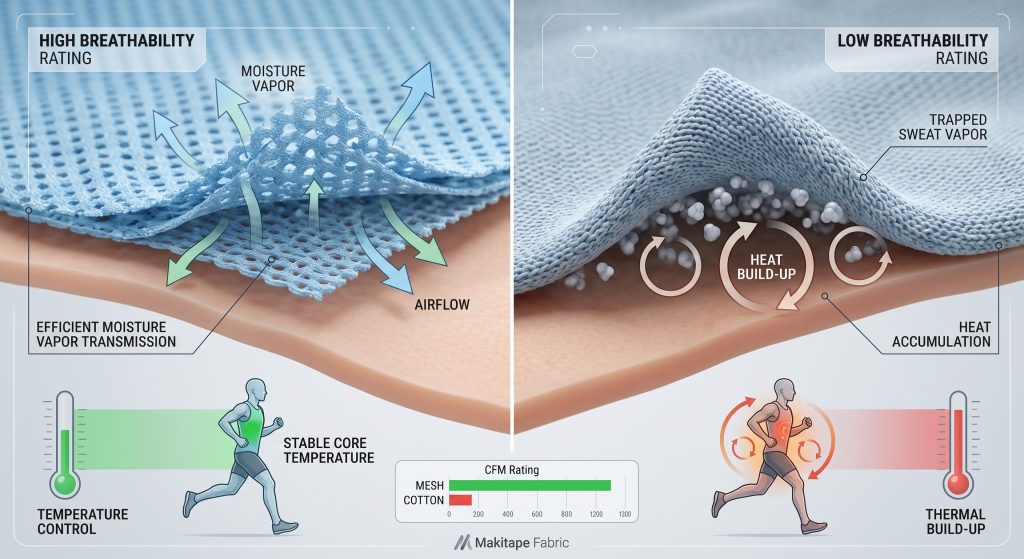
Breathability defines the best fabric for athletic wear by permitting moisture vapor transmission away from human skin during physical activity. High breathability ratings prevent thermal buildup allowing athletes to maintain stamina during exercise.
How is air permeability measured in lab testing?
Laboratory instruments measure air volume passing through fabric samples under controlled pressure. Open mesh knits register air flow scores nearly double those of tightly woven pique options.
- Standardized airflow testing quantifies breathability precisely.
- Higher CFM numbers indicate superior ventilation during outdoor training.
Here is the kicker: high CFM scores correlate directly with core body temperature reduction. You ensure optimal ventilation by choosing high airflow scores.
Why does temperature control depend on fiber choice?
Synthetic polyester and nylon yarns do not absorb water internally allowing vapor to pass freely through structural voids. Synthetic fiber matrices dissipate heat faster than natural cotton equivalents.
- Synthetic fibers bypass internal water absorption.
- Hydrophobic properties speed vapor passage.
Believe it or not: natural fibers trap moisture internally and choke airflow during heavy sweat events. You keep athletes cooler by selecting hydrophobic synthetic matrix knits.
| Breathability Factor | Open Mesh Textiles | Heavy Textured Knits |
| Vapor Permeability | Superior (>3000 g/m²/24h) | Moderate (1500 g/m²/24h) |
| Heat Dissipation Rate | Immediate cooling effect | Gradual thermal release |
| Air Resistance | Low draft barrier | Moderate wind resistance |
Lab data demonstrates that pore size directly dictates vapor dissipation speed across synthetic sportswear fabrics.
Key Takeaway: Rely on open mesh constructions for extreme heat environments and heavy aerobic workouts.
Which knitting density creates the best fabric for athletic wear?
Knitting density creates the best fabric for athletic wear by controlling the balance between garment weight opacity and structural durability. Choosing correct GSM numbers prevents fabric show-through while keeping garments lightweight for outdoor performance.
How does GSM impact activewear utility?
Grams per square meter defines fabric heft and coverage during dynamic physical stretches. Light GSM fabrics offer agility whereas heavier weights provide complete non-see-through coverage.
- 120-150 GSM: Ideal for lightweight marathon tops and singlets.
- 180-220 GSM: Perfect for athletic polo shirts and gym training wear.
You might wonder: how low can GSM drop before fabric becomes sheer? You must balance low weight against opacity requirements when designing light tops.
Can gauge selection alter stretch elasticity?
Higher machine gauge creates finer knit loops that enhance horizontal and vertical elastic recovery. Fine gauge knits rebound quickly after repeated stretch deformation during movement.
- High gauge knits resist permanent baggy distortion.
- Dense needle beds produce uniform smooth fabric faces.
Here is why that matters: tight loop arrays maintain physical stretch recovery across hundreds of uses. You deliver durable activewear that keeps its original snug fit.
| Density Parameter | Light Mesh (130 GSM) | Mid Pique (200 GSM) |
| Opacity Level | Semi-sheer breathability | Fully opaque coverage |
| Elastic Recovery | Flexible spring-back | Moderate firm recovery |
| Garment Category | Running singlets, lining | Sportswear polos, shorts |
Comparing yarn gauge and GSM allows sourcing specialists to tailor fabric opacity to specific garment silhouettes.
Key Takeaway: Match lightweight GSM to endurance items and heavier GSM to structured outerwear.
How do moisture wicking traits define best fabric for athletic wear?
Moisture wicking traits define the best fabric for athletic wear by drawing liquid sweat along synthetic fibers to outer garment surfaces for rapid evaporation. Capillary action prevents heavy moisture pooling keeping active wearers dry and comfortable.
How does capillary action transport liquid sweat?
Grooved synthetic fiber cross-sections create channels that pull liquid upward against gravity. Engineered cross-sections move sweat away from skin instantly without chemical additives.
- Modified cross-sections increase liquid movement speed.
- Broad surface distribution hastens evaporation cycles.
What is the bottom line? Physical fiber channels pull sweat away much faster than smooth round fibers. You achieve dry skin feel through advanced fiber geometry.
Does wicking efficiency change after frequent washing?
Inherent fiber-level wicking properties remain permanent throughout the entire lifespan of athletic garments. Chemical softeners can clog fiber channels reducing wicking speed over time.
- Inherent fiber channels resist wash degradation.
- Fabric softeners coat surfaces and reduce capillary flow.
That is not all: temporary chemical treatments wash away after twenty laundry cycles. You guarantee long-term performance by specifying inherent channel yarns.
| Wicking Indicator | Channel-Fiber Synthetic | Standard Treated Cotton |
| Vertical Wicking Speed | Fast (10 cm in 5 mins) | Slow (2 cm in 5 mins) |
| Wash Durability | Permanent lifecycle performance | Degrades after 15 washes |
| Moisture Retention | Less than 1% water hold | High water saturation |
Testing proves structural fiber wicking far outperforms surface-applied chemical treatments over repeated laundry cycles.
Key Takeaway: Specify inherent cross-section yarns over temporary chemical finishes for long-lasting sportswear.
Can durability testing identify the best fabric for athletic wear?
Durability testing identifies the best fabric for athletic wear by evaluating pilling resistance tensile strength and abrasion resistance under intense physical conditions. Standardized lab tests ensure fabrics survive friction against gym equipment and backpack straps.
How is pilling resistance evaluated in textile labs?
Abrasion testing machines rub fabric samples against standard wool surfaces to measure surface fuzzing. Tightly twisted synthetic yarns achieve higher pilling resistance ratings than loose staple fibers.
- High test ratings ensure anti-pilling surface longevity.
- Continuous filament yarns prevent surface fuzz accumulation.
Ready for the truth? Cheap staple fibers break and form pills after minor friction exposure. You protect brand reputation by verifying high pilling resistance scores.
Why is tear strength important for contact sports?
High tensile strength prevents fabric ripping when garments endure grabbing or accidental snagging on training equipment. Double-knit pique weaves resist mechanical tearing better than delicate lightweight mesh.
- Double-knit structures distribute mechanical stress widely.
- Filament synthetics resist sudden tearing forces.
Here is the deal: rough equipment contact demands robust structural interlock knits. You prevent embarrassing fabric tears during intense athletic matches.
| Durability Test | Birdseye Mesh Score | Pique Tuck Score |
| Abrasion Resistance | 20,000 Friction Cycles | 35,000 Friction Cycles |
| Surface Pilling Grade | Grade 3.5 – 4 | Grade 4 – 5 |
| Tensile Resistance | Moderate force resistance | Superior force resistance |
Laboratory abrasion results demonstrate that dense tuck structures offer extended wear lifespans under heavy friction.
Key Takeaway: Select high pilling grade pique knits for high-friction sports gear and rugged outerwear.
What application fits the best fabric for athletic wear production?
Target application fits the best fabric for athletic wear production by aligning fabric breathability weight and structure with specific athletic movements. Matching fabric characteristics to athlete requirements ensures optimal garment performance in every environment.
What garments utilize birdseye mesh most effectively?
Endurance running tops trail shirts and jersey linings benefit immensely from birdseye mesh ventilation. Featherweight mesh reduces garment drag during marathon events and hot weather training.
- Marathon race shirts and singlet garments.
- Inner lining for athletic shorts and jackets.
Want to know the best part? Ultra-light mesh garments feel weightless during long distance running events. You help runners focus on pace rather than heavy wet clothing.
Where does pique fabric excel in sportswear lines?
Golf wear tennis apparel team travel polos and casual athleisure styles rely heavily on pique knit structure. Pique combines athletic moisture control with a smart professional appearance suitable for clubhouses.
- Executive golf shirts and tennis tops.
- Team uniform polo shirts and travel gear.
Think about it: corporate athletic events demand garments that look crisp through long days. You deliver professional polish combined with hidden athletic cooling features.
| Sportswear Application | Recommended Fabric | Primary Advantage |
| Track Running Tees | Birdseye Mesh | Maximum airflow, low weight |
| Golf & Tennis Polos | Pique Knit | Shape retention, smart look |
| Gym Training Wear | Birdseye Blend | High stretch, quick drying |
Mapping end-use scenarios guides apparel designers toward selecting the ideal textile construction for target buyers.
Key Takeaway: Assign birdseye mesh to high-sweat endurance gear and pique to structured polo activewear.
How to select supplier for the best fabric for athletic wear?
Selecting a reliable supplier for the best fabric for athletic wear requires evaluating manufacturing capacity color fastness standards custom fiber blending capabilities and strict quality control protocols. Partnering with experienced textile manufacturers guarantees batch-to-batch consistency for international garment brands.
What certifications should textile mills provide?
Quality suppliers hold environmental safety certifications and global recycled standard verifications for eco-friendly fabrics. Verified certifications ensure non-toxic dyes and sustainable supply chain compliance.
- Eco-safety certifications guarantee chemical compliance.
- Recycled standards verify authentic eco-friendly fibers.
Here is why that matters: international retail regulations require verified eco-safe chemical processing. You protect your business from customs rejections by sourcing certified fabrics.
How can sample testing prevent mass production errors?
Ordering lab dips and physical color cards allows procurement managers to check shade accuracy and hand feel prior to bulk knitting. Preliminary sample evaluation prevents costly shade deviations across large production orders.
- Physical color cards verify true shade appearance.
- Sample yards allow pre-production garment wear testing.
Look at the facts: checking pre-production swatches saves thousands of dollars in rejected garment shipments. You ensure perfect color matching across every manufacturing lot.
| Supplier Criteria | Standard Mill | Premium Textile Partner |
| Quality Inspection | Basic visual check | Rigorous multi-point system |
| Color Fastness | Grade 3 standard | Grade 4+ high washing fastness |
| Custom Development | Limited stock options | Full custom GSM, width, function |
Establishing rigorous supplier vetting criteria minimizes manufacturing risks and guarantees premium fabric delivery.
Key Takeaway: Partner with certified textile mills offering comprehensive lab dipping and strict quality control.
Conclusion
Selecting high-performance activewear textiles requires matching structural characteristics with athlete demands. Understanding how birdseye mesh delivers cooling airflow while pique knit offers crisp structural stability solves common sourcing dilemmas regarding breathability hand feel and long-term durability. We deliver precision-engineered performance knits designed to meet the rigorous demands of global apparel brands. Reach out to our technical fabric specialists and contact us today to request physical color cards custom swatches and factory-direct pricing for your next activewear collection. Elevate your sportswear line with world-class textile engineering built for modern athletic performance.
FAQ
Q1: Can I use birdseye mesh for golf polo shirts?
Yes, you can use birdseye mesh for polo shirts, but it yields a lighter athletic drape rather than a traditional structured collar. Pique knit remains the traditional choice for crisp polo styling.
Q2: What is the best fabric for athletic wear in hot humid climates?
Birdseye mesh is the superior choice for hot humid climates due to its open-pore ventilation matrix. It maximizes air circulation and dries faster than denser knits.
Q3: How do I know if a pique fabric is suitable for activewear?
Check the fiber composition to verify it contains synthetic polyester or nylon blended with elastane rather than heavy cotton. Synthetic pique provides moisture wicking alongside classic texture.
Q4: Can I order custom colors and recycled yarns for these performance fabrics?
Yes, modern textile mills offer custom Pantone color matching alongside certified recycled polyester fibers. This ensures your collection meets eco-friendly standards without sacrificing performance.
Q5: What is the best way to clean performance fabrics to maintain moisture wicking?
Wash garments in cold water using gentle detergents without liquid fabric softeners. Fabric softeners coat synthetic fibers and reduce their natural capillary wicking ability over time.