
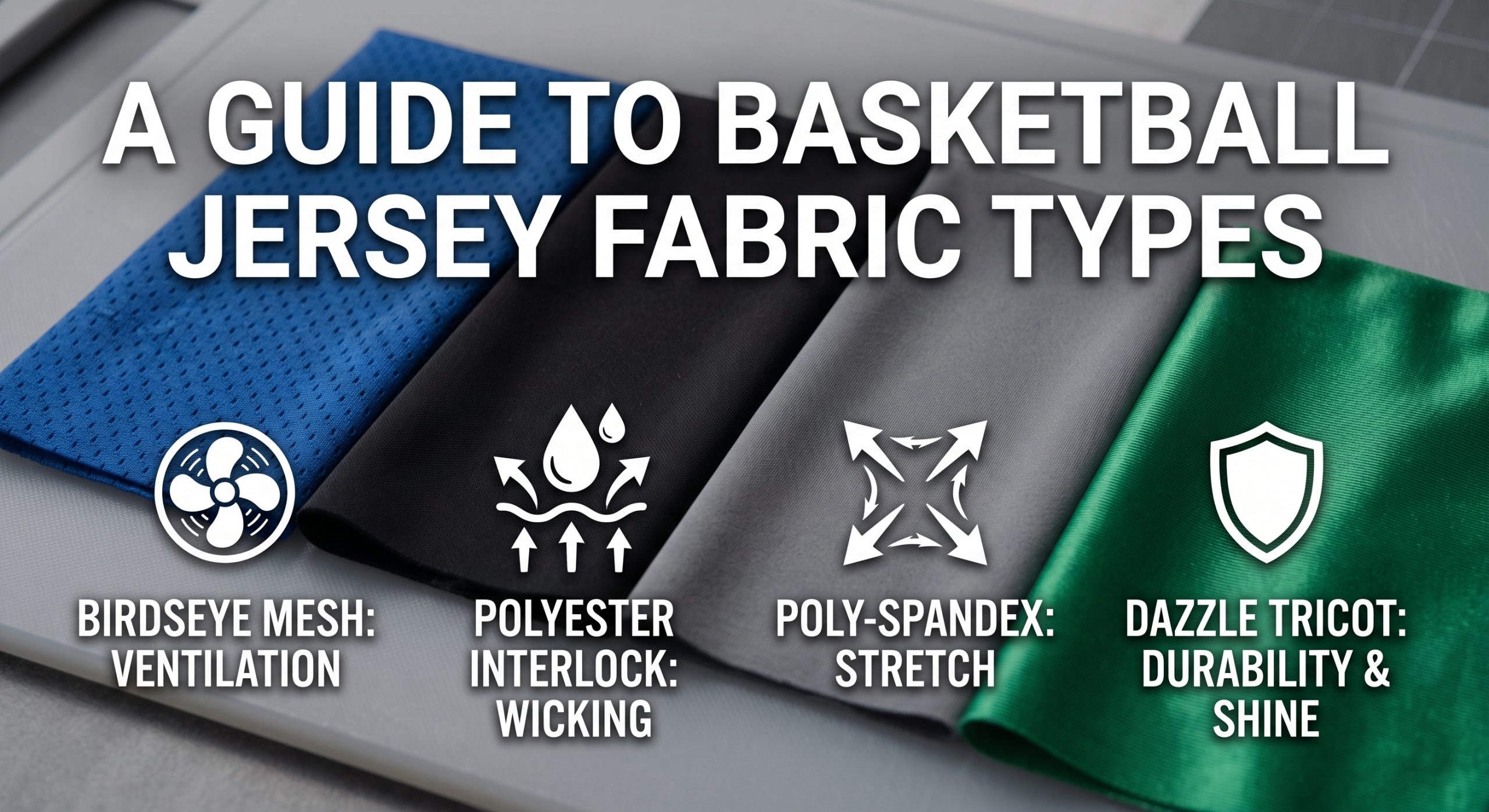
The principal basketball jersey fabric types include micro-perforated birdseye mesh, smooth polyester interlock, dynamic poly-spandex blends, and lustrous nylon tricot engineered for active moisture management. Apparel sourcing managers frequently face costly customer complaints when athletic uniforms trap sweat, feel scratchy against damp skin, or tear along side seams during aggressive court play. Supplying teamwear brands with low-grade textiles damages manufacturer credibility and triggers expensive product returns from disappointed sports clients. Specifying technical synthetic knits with controlled porosity and high tensile strength solves these procurement headaches while guaranteeing maximum player cooling. Understanding how different basketball jersey fabric types perform under extreme athletic pressure enables apparel buyers to choose materials that maximize athlete mobility and factory yield.
1. What Define Popular Basketball Jersey Fabric Types Today?
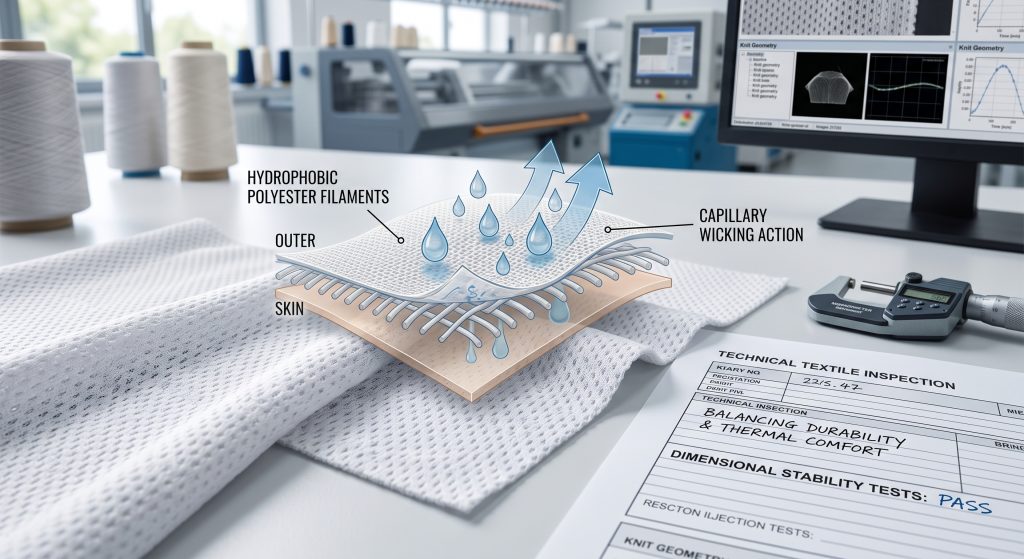
Hydrophobic polyester filaments and specialized knit geometries define modern basketball jersey fabric types used across professional leagues and custom teamwear programs. Synthetic fibers dominate athletic uniform production because natural materials absorb excess moisture, growing heavy and dragging down athlete performance during long competition. Modern knitting mills construct lightweight synthetic fabrics using micro-denier yarns that move perspiration outward through natural capillary action.
Sourcing teams select specific yarn density profiles to balance structural garment durability against thermal comfort requirements. Blending micro-polyester filaments with flexible elastane polymers creates durable jersey materials that maintain dimensional stability through repeated high-temperature laundry cycles.
How Synthetic Yarns Drive Court Mobility?
Synthetic yarn formulations allow basketball players to execute explosive movements without experiencing fabric binding or heavy sweat saturation. You can optimize athletic apparel collections by choosing synthetic materials engineered specifically for instant moisture dispersion.
- Hydrophobic micro-denier filaments resist liquid retention on the skin surface.
- Interlocked knit loops provide high tensile resilience against aggressive pulling.
- Specialized yarn cross-sections accelerate liquid evaporation along filament grooves.
Why Weight Metrics Dictate Sourcing Decisions?
Garment weight directly influences player endurance and total bulk transport expenditures for growing apparel brands. Here’s the deal, selecting ultra-lightweight synthetic textiles lowers international shipping costs per unit while improving player agility on court.
Finely knitted synthetic yarns maintain total garment opacity even when manufactured at exceptionally low gram weights.
Key Takeaway: Choosing high-density micro-polyester yarns provides maximum fabric opacity while keeping uniform weight low for agile court play.
| Yarn Composition | Core Technical Benefit | Primary Application |
| 100% Micro-Polyester | Rapid moisture evaporation | Lightweight game jerseys |
| Poly-Spandex Blend | 4-Way elastic recovery | Form-fitting game shorts |
Analyzing fundamental yarn properties enables procurement officers to select base materials that fulfill rigorous athletic performance standards.
Image Title: popular-basketball-jersey-fabric-types-performance-chart
Alternative Text: A photorealistic market research chart displaying performance metrics and material market share for basketball jersey fabric types, placed on a modern textile mill inspection desk with fabric swatches.
Caption: A technical breakdown comparing performance properties and market adoption across major basketball jersey fabric types.
Description: This photorealistic B2B image visualizes the core performance metrics of popular basketball jersey fabric types. Set in a textile mill laboratory, the data chart illustrates key parameters such as air permeability, moisture wicking speed, tensile strength, and color fastness across micro-mesh, interlock, and spandex blends to assist procurement teams.
2. Why Does Birdseye Mesh Lead Basketball Jersey Fabric Types?
Engineered micro-eyelet grid structures position birdseye mesh as the most popular choice among basketball jersey fabric types for summer tournament play. Microscopic eyelet perforations create continuous ventilation pathways that actively release trapped body heat during intense physical competition. Sourcing directors regularly specify birdseye mesh when developing high-intensity practice gear and professional game kits.
Porous mesh geometry draws liquid sweat away from active muscle groups, spreading liquid thin across the outer fabric face. What’s the real story? Ambient surrounding air evaporates surface moisture in seconds, maintaining stable core body temperatures for athletes.
How Micro-Perforations Boost Air Permeability?
Micro-perforated knit structures lower wind resistance and facilitate continuous passive airflow across the athlete’s torso. You can rely on birdseye mesh fabric to maintain exceptional breathability without risking fabric transparency during play.
- Thousands of micro-eyelets vent body heat continuously during active sprints.
- Porous grid patterns reduce total fabric mass for an ultra-lightweight feel.
- Flat exterior faces accept sharp dye sublimation printing without visual distortion.
What Makes Grid Eyelets Evaporate Sweat Fast?
Targeted micro-perforations channel liquid perspiration outward through accelerated capillary force across open knit windows. Ready for the good part? Sweat spreads broad across the eyelet grid rather than pooling against skin surfaces.
Smooth interior yarn loops keep surface friction low, protecting active players against skin irritation.
Key Takeaway: Birdseye mesh maximizes player thermal regulation by pairing continuous passive ventilation with rapid capillary sweat evaporation.
| Knit Architecture | Ventilation Rating | Evaporation Speed |
| Birdseye Micro-Mesh | Exceptional (> 250 cm³/cm²/s) | Rapid (< 15 seconds) |
| Standard Flat Jersey | Moderate (< 80 cm³/cm²/s) | Moderate (> 45 seconds) |
Specifying micro-perforated birdseye mesh guarantees superior thermal comfort during high-temperature athletic competition.
Image Title: birdseye-mesh-basketball-jersey-fabric-ventilation
Alternative Text: A detailed photorealistic close-up shot of dark blue birdseye micro-mesh fabric showing ventilation eyelets and moisture wicking airflow graphics on a textile cutting table.
Caption: Micro-perforated birdseye mesh provides continuous passive ventilation and accelerated sweat evaporation during intense basketball play.
Description: A high-definition macro photograph illustrating the engineered grid construction of birdseye mesh fabric used in basketball jerseys. The detailed view reveals micro-eyelet perforations that allow continuous airflow and rapid moisture transport, highlighting why this textile leads activewear manufacturing.
3. How Does Interlock Knit Elevate Basketball Jersey Fabric Types?
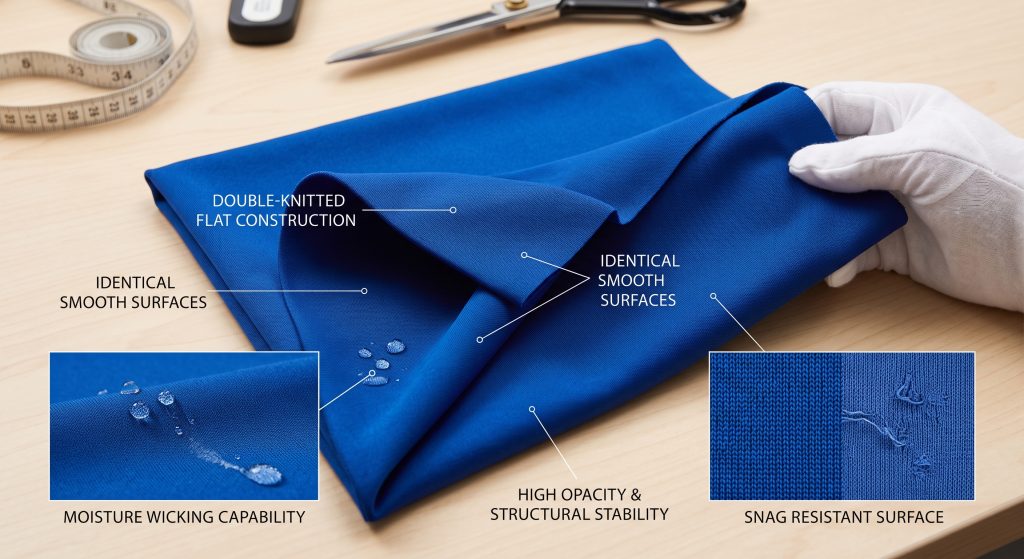
Double-knitted flat constructions allow polyester interlock to deliver a smooth double-sided surface across professional basketball jersey fabric types. Interlock knits feature identical smooth surfaces on both sides, offering high opacity and structural stability. Sourcing managers choose interlock fabrics when constructing premium reversible jerseys and custom dye-sublimated uniform lines.
Compact yarn knitting creates a tight barrier that shields players against cold drafts while maintaining high moisture wicking capabilities. This is where it gets interesting, double-knit interlock fabrics resist surface snagging far better than traditional single-knit jerseys.
Why Smooth Surfaces Excel in Dye Sublimation?
Flat interlock surfaces absorb liquid sublimation inks evenly, producing vibrant graphics with razor-sharp edge definition. You achieve deep color saturation and flawless team logo printing without the graphic distortion caused by open mesh holes.
- Double-faced smoothness provides ideal canvas conditions for sublimation inks.
- High yarn density prevents graphic fading after repeated commercial wash cycles.
- Tight stitch construction ensures complete fabric opacity at light shades.
How Dual-Knit Layers Prevent Surface Snagging?
Interlocked needle loops lock individual synthetic filaments firmly in place, resisting sharp velcro or fingernail pulls. Think about it, sturdy dual-knit construction prevents premature fabric fuzzing during aggressive court contact.
Selecting double-knit interlock maintains clean garment aesthetics throughout demanding competitive sports seasons.
Key Takeaway: Polyester interlock provides an exceptionally smooth printing surface and high snag resistance for vibrant team uniforms.
| Fabric Surface | Graphic Print Sharpness | Snag Resistance Rating |
| Polyester Interlock | Ultra-sharp detail definition | High (Grade 4.5) |
| Open Hole Mesh | Textured broken definition | Moderate (Grade 3.0) |
Integrating smooth interlock fabrics elevates teamwear collections by delivering vivid sublimation graphics and robust surface durability.
Image Title: polyester-interlock-vs-mesh-basketball-jersey-fabric
Alternative Text: A photorealistic comparison panel showing smooth polyester interlock knit fabric next to textured mesh on a textile mill quality control table.
Caption: Polyester interlock knit offers a double-smooth surface that delivers vibrant dye sublimation graphics and high snag resistance.
Description: This professional macro photograph compares smooth polyester interlock knit with textured athletic mesh fabric. The image highlights interlock’s dense double-knit construction, showing how its flat surface provides superior print clarity and durability for custom basketball uniforms.
4. When Do Spandex Blends Upgrade Basketball Jersey Fabric Types?
Integrating flexible elastane polymers creates dynamic four-way stretch recovery across specialized basketball jersey fabric types. Adding small spandex percentages allows textiles to expand effortlessly alongside active player muscles during jumps and rapid direction shifts. Procurement executives choose poly-spandex blends when designing athletic compression baselayers and elite professional game uniforms.
Superior elastic recovery prevents garment sagging around armholes and waistbands over extended competitive play. You might be wondering, how much spandex is needed to optimize athletic performance?
How Four-Way Stretch Enhances Athletic Range?
Four-way elastic stretch eliminates garment pulling across shoulder blades and hips during athletic shooting motions. You can provide players with unrestricted movement freedom by selecting fabrics containing five to twelve percent elastane.
- Multi-directional stretch adaptation matches natural body biomechanics.
- High elastic recovery returns garments to their original fitted shape instantly.
- Form-fitting silhouettes reduce excess fabric drag during full-court sprints.
What Protects Uniforms From Tension Ruptures?
Elastic synthetic polymers absorb sudden tensile shocks, protecting side seams from tearing under extreme physical pulling. Believe it or not, spandex additions increase total seam strength significantly under high strain.
Flexible yarn blends maintain structural garment integrity through tough defensive physical play.
Key Takeaway: Incorporating spandex blends ensures multi-directional mobility while protecting uniform seams against physical tension ruptures.
| Spandex Content | Elastic Stretch Capacity | Target Application |
| 5% – 8% Elastane | Moderate 2-way stretch | Professional game jerseys |
| 10% – 15% Elastane | High 4-way stretch | Compression baselayers |
Selecting appropriate elastane percentages empowers athletes with complete motion freedom while extending uniform service life.
Image Title: poly-spandex-stretch-basketball-jersey-fabric
Alternative Text: A photorealistic shot of a poly-spandex blend fabric being stretched in four directions on a textile laboratory worktable to show elastic recovery.
Caption: Adding elastane spandex to micro-polyester creates dynamic four-way stretch recovery that supports explosive athletic movement.
Description: A technical laboratory photograph demonstrating the multi-directional stretch properties of a polyester-spandex fabric blend. The visual illustrates how elastic polymer integration provides multi-directional recovery and prevents seam stress during intense athletic performance.
5. Why Does Dazzle Tricot Persist in Basketball Jersey Fabric Types?
High-luster nylon and polyester filament knits maintain a permanent niche among traditional basketball jersey fabric types for retro uniform designs. Dazzle tricot features a distinctive glossy surface shine that reflects stadium lighting, creating an iconic classic aesthetic. Sourcing specialists select dazzle fabric when producing vintage team uniforms, side trim paneling, and traditional athletic shorts.
Densely knitted warp filament structures provide exceptional abrasion resistance along outer garment borders. Here’s the deal, dazzle tricot holds structural shape firmly, giving side panel inserts a crisp decorative appearance.
How High-Luster Nylon Yields Retro Styling?
Flat filament surfaces reflect light directly, delivering a striking glossy finish that defines vintage basketball team wear. You can recreate classic championship team aesthetics by incorporating high-shine dazzle tricot inserts into garment accents.
- Reflective filament surface creates a brilliant high-gloss visual shine.
- Firm warp-knit structure prevents fabric distortion along side seams.
- Deep dye affinity produces intense visual contrast on uniform trims.
Why Abrasion Resistance Fits Side Panels Well?
Warp-knitted filament constructions withstand harsh floor sliding and physical equipment friction without wearing thin. What’s the real story? Dazzle fabric guards outer garment edges against premature abrasion damage.
Pairing sturdy dazzle accents with breathable body mesh creates a balance of durability and cooling.
Key Takeaway: Dazzle tricot delivers an iconic high-gloss retro aesthetic while offering strong surface abrasion resistance for side panel accents.
| Feature Comparison | Dazzle Tricot | Standard Matte Mesh |
| Surface Aesthetics | High-luster glossy shine | Low-glare matte finish |
| Abrasion Resistance | High warp filament strength | Moderate mesh strength |
Utilizing dazzle tricot accents allows sportswear brands to honor classic athletic heritage while maintaining modern uniform durability.
Image Title: dazzle-tricot-nylon-basketball-jersey-fabric
Alternative Text: A photorealistic macro photograph of lustrous blue dazzle tricot nylon fabric showcasing its shiny reflective surface alongside retro basketball jersey samples.
Caption: Dazzle tricot nylon provides an iconic high-luster shine and strong abrasion resistance for classic teamwear side panels.
Description: A detailed close-up shot capturing the reflective surface texture of dazzle tricot fabric on a design table. The image illustrates why this high-gloss warp-knitted material remains a staple choice for retro basketball jerseys and decorative uniform accents.
6. How Does Air Permeability Rule Basketball Jersey Fabric Types?
Measured air flow rates dictate thermal comfort limits and sweat evaporation velocity across athletic basketball jersey fabric types. Open porosity metrics calculate the volume of ambient air passing through a knit matrix under specific pressure differentials. Sourcing technical fabrics with high air permeability prevents athlete heat exhaustion during grueling tournament schedules.
Garment buyers adjust porosity choices based on indoor climate control and outdoor seasonal temperatures. Ready for the good part? High air permeability allows body heat to dissipate naturally before sweat accumulates heavily on the skin.
What Pore Ratios Prevent Overheating on Court?
Higher pore surface ratios facilitate constant thermal exchanges, keeping core body temperatures balanced during intense exertion. You can tailor fabric ventilation choices by selecting open porosity levels suitable for warm gym environments.
- Open porosity ratios above twenty percent maximize thermal heat dissipation.
- Continuous airflow prevents perspiration accumulation against active skin.
- Balanced air permeability maintains player energy levels during late game play.
How Climate Needs Guide Sourcing Selections?
Selecting appropriate fabric permeability ensures optimal thermal regulation across varying regional playing conditions. This is where it gets interesting, tropical game locations require highly porous mesh while climate-controlled arenas suit compact interlock.
Matching fabric porosity to regional environments protects athletes from thermal discomfort.
Key Takeaway: Selecting fabrics with high air permeability facilitates heat release and maintains stable player body temperatures in hot game environments.
| Playing Environment | Recommended Air Flow | Optimal Fabric Structure |
| Hot Outdoor Courts | High (> 300 cm³/cm²/s) | Open Micro-Birdseye Mesh |
| Indoor Arenas | Balanced (120 – 180 cm³/cm²/s) | Smooth Compact Interlock |
Prioritizing air permeability parameters guarantees superior thermal management across diverse competitive playing environments.
Image Title: air-permeability-testing-basketball-jersey-fabric
Alternative Text: A photorealistic textile testing laboratory scene illustrating airflow permeability through porous athletic micro-mesh fabric on a testing instrument.
Caption: Air permeability testing measures thermal air exchange through porous mesh to ensure optimal cooling in activewear.
Description: A photorealistic laboratory photograph showing technical air permeability testing on basketball jersey fabric. The image displays airflow measurement equipment quantifying ventilation performance to help apparel buyers select textiles with high thermal dissipation capabilities.
7. Why Does Surface Friction Impact Basketball Jersey Fabric Types?
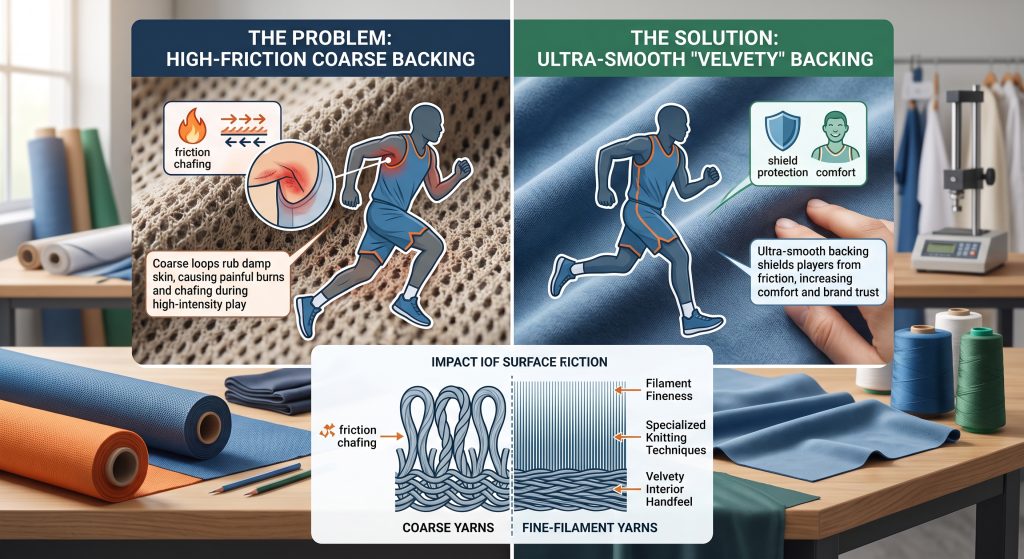
Interior loop smoothness and filament fineness dictate skin comfort levels across athletic basketball jersey fabric types. Athletes wearing fitted uniforms notice inner textile friction instantly during full-court sprints and sudden stops. Coarse interior backings rub against damp skin, causing painful friction chafing during continuous physical running.
Sourcing ultra-smooth interior backings shields players from friction burn while building long-term brand trust. You might be wondering, how do textile mills achieve velvety interior handfeel without adding heavy fabric weight?
How Interior Smoothness Prevents Skin Chafing?
Flat interior yarn loops eliminate rough contact points against delicate skin during repetitive body movements. You protect athletes from friction burn by specifying high filament counts during raw knit production orders.
- Ultra-fine micro-denier filaments feel smooth against active skin.
- Flat interior stitch loops prevent localized abrasive skin rubbing.
- Soft textile backings eliminate the need for extra protective undershirting.
What Yarns Shield Players During Sprints?
Micro-denier polyester filaments yield plush interior handfeel while preserving overall fabric tensile durability. Think about it, finer individual filaments create a smooth surface that glides smoothly over wet skin.
Combining chemical softening finishes with smooth knitting structures delivers maximum tactile comfort.
Key Takeaway: Sourcing smooth micro-filament interior backings prevents painful skin chafing during intense athletic competition.
| Interior Texture | Friction Coefficient | Skin Comfort Index |
| Micro-Filament Smooth Loop | Low (Smooth Glide) | High (Anti-Chafing) |
| Coarse Filament Rough Loop | High (Abrasive Rub) | Low (Irritation Hazard) |
Selecting fabrics with low surface friction coefficients increases player comfort and enhances product brand reputation.
Image Title: low-friction-interior-basketball-jersey-fabric
Alternative Text: A photorealistic comparison of smooth micro-filament fabric interior backing versus coarse loop fabric interior on a studio table with tactile testing notes.
Caption: Smooth interior backings made from micro-denier filaments prevent skin chafing and irritation during continuous athletic sprints.
Description: A photorealistic macro shot comparing two fabric backing textures used in basketball jerseys. The image shows how ultra-fine micro-filaments create a soft, low-friction interior surface that protects athletes against painful skin chafing during long game play.
8. Which Quality Metrics Control Basketball Jersey Fabric Types?
Hydraulic bursting strength and colorfastness ratings define essential quality control standards across basketball jersey fabric types. Technical testing laboratories evaluate tensile resistance to ensure athletic gear withstands rough physical pulling on court. High hydraulic burst strength prevents seam blowouts and fabric ruptures during aggressive game contact.
Apparel brands suffer severe financial loss when uniforms tear or fade prematurely during competitive seasons. Here’s the deal, sourcing lab-tested textiles protects apparel brands against product returns and warranty claims.
How Bursting Strength Tests Standardize Quality?
Interlocked needle loops distribute mechanical stress evenly across the textile face during intense physical pulling. You can mandate strict burst strength thresholds during mill procurement to guarantee long garment service life.
- High-tenacity synthetic yarns maintain physical strength when wet.
- Interlocked needle stitches absorb sudden multidirectional tension forces.
- Quality laboratory testing prevents costly uniform tears under physical strain.
Why Colorfastness Shields Uniform Brand Trust?
High colorfastness ratings ensure team colors remain brilliant despite heavy perspiration and repeated industrial laundering. What’s the real story? Quality synthetic dyes bond deep inside polyester fibers, preventing shade bleeding.
Enforcing strict colorfastness standards guarantees color consistency across entire team rosters over time.
Key Takeaway: Mandating high bursting strength and colorfastness test standards protects uniform durability and brand reputation.
| Quality Standard | Target Specification | Commercial Protection |
| Bursting Strength | > 420 kPa | Prevents fabric tearing under strain |
| Colorfastness to Washing | Grade 4.0 or higher | Eliminates color bleeding in wash |
Establishing rigorous quality control parameters secures athletic performance and reduces garment return rates.
Image Title: quality-testing-basketball-jersey-fabric-burst-strength
Alternative Text: A photorealistic quality control testing instrument measuring hydraulic bursting strength on a navy blue basketball jersey fabric swatch in a laboratory.
Caption: Hydraulic bursting strength testing ensures athletic textiles withstand intense physical pulling and mechanical stress.
Description: A technical quality assurance photograph depicting hydraulic bursting strength testing on basketball jersey fabric. The image showcases laboratory validation equipment measuring tensile limits to ensure uniforms resist tearing during competitive sports.
9. How Does GSM Weight Balance Basketball Jersey Fabric Types?
Selecting appropriate gram weight per square meter balances breathability against garment drape across basketball jersey fabric types. Lightweight fabrics ranging from 130 GSM to 150 GSM offer maximum cooling for hot summer game play. Medium weight textiles between 160 GSM and 190 GSM deliver sturdy garment structure suitable for reversible team uniforms.
Sourcing teams choose fabric weights carefully to match specific sport application needs and seasonal demands. Ready for the good part? Controlling GSM uniformity prevents sizing variations across automated factory cutting tables.
Why Lightweight Mesh Fits Summer Competition?
Lightweight micro-mesh fabrics reduce total athlete garment mass, supporting fast footwork during warm weather games. You provide players with high air circulation by choosing low-GSM fabrics engineered for high heat dissipation.
- Gram weights below 150 GSM minimize physical garment drag on court.
- Low-density knitting structures allow rapid sweat evaporation.
- Lightweight textiles lower air shipping costs for international brand distribution.
How Heavy Interlock Supports Reversible Gear?
Higher GSM interlock fabrics offer total opacity and structural body needed for double-sided team uniforms. This is where it gets interesting, dense interlock constructions prevent dark reverse colors from showing through light front panels.
Specifying medium-weight fabrics guarantees complete visual separation on reversible jersey styles.
Key Takeaway: Matching fabric GSM specifications to uniform design requirements balances active ventilation against visual opacity.
| Weight Category | GSM Specification Range | Recommended Application |
| Ultra-Lightweight | 130 GSM – 150 GSM | Summer league game jerseys |
| Medium-Weight | 160 GSM – 190 GSM | Reversible team uniforms |
Carefully balancing fabric weight metrics ensures athletic apparel delivers correct visual opacity and physical performance.
Image Title: gsm-weight-measurement-basketball-jersey-fabric
Alternative Text: A photorealistic precision digital scale measuring GSM fabric weight on a micro-mesh swatch inside a textile manufacturing laboratory.
Caption: Precision digital GSM measurement ensures uniform fabric density and correct opacity for single-layer and reversible basketball jerseys.
Description: A detailed laboratory photograph displaying precision GSM weight measurement on a basketball jersey fabric sample. The image emphasizes the technical quality control required to balance light weight and opacity across athletic uniform collections.
10. Why Direct Mill Access Beats Basketball Jersey Fabric Types Traders?
Direct mill partnerships grant teamwear brands complete control over custom shade dyeing, lab-dips, and technical finishes for basketball jersey fabric types. Establishing direct factory connections eliminates middleman markups and speeds up pre-production approval timelines. Direct technical communication prevents costly manufacturing mistakes during custom order production runs.
Growing apparel brands benefit from flexible minimum order quantities that reduce seasonal capital risks. You might be wondering, how does direct mill access accelerate seasonal teamwear product launches?
How Fast Lab-Dips Accelerate Production Runs?
Working directly with textile mills reduces color matching lead times for custom team shade requirements. You receive rapid lab-dip shade approvals and custom fabric swatches tailored precisely to brand specifications.
- Fast lab-dip color matching speeds seasonal sample approvals.
- Custom fabric weight developments fulfill unique brand specifications.
- Direct technical support resolves manufacturing queries without delay.
Why Low MOQs Reduce Seasonal Inventory Risks?
Flexible minimum order quantities allow emerging teamwear brands to launch custom shade collections safely. Think about it, small batch ordering minimizes capital tied up in unproven seasonal inventory.
Direct factory partnerships provide scaling flexibility as brand customer demand grows.
Key Takeaway: Partnering directly with specialized textile mills grants custom color control, faster production lead times, and lower capital risk.
| Sourcing Channel | Lab-Dip Turnaround | Customization Capability |
| Direct Textile Mill | Fast (5 – 8 Business Days) | Full custom shade, weight & finish |
| Stock Lot Traders | No custom lab-dips | Restricted to leftover market stock |
Establishing direct relationships with performance textile mills secures long-term supply chain efficiency and competitive pricing.
Image Title: direct-mill-sourcing-basketball-jersey-fabric
Alternative Text: A photorealistic textile mill studio scene featuring custom Pantone lab-dip swatches, yarn spools, and fabric rolls for direct B2B uniform sourcing.
Caption: Direct mill partnerships provide teamwear brands with fast custom lab-dip approvals, low MOQs, and complete material customization.
Description: A professional B2B photograph showcasing direct textile mill sourcing capabilities for basketball jersey fabrics. Set in a fabric studio, the image highlights Pantone color swatches, technical lab-dips, and fabric rolls, emphasizing supply chain efficiency for custom sportswear brands.
Summary
This guide analyzed how synthetic fiber composition, micro-perforated birdseye mesh, smooth polyester interlock, and poly-spandex stretch blends shape athletic jersey performance. Specifying high-tenacity, dimensionally stable synthetic knits resolves garment chafing, prevents seam tears under tension, and protects brand reputation. Partnering directly with performance textile manufacturers ensures your athletic collection meets rigorous court standards. Ready to elevate your custom teamwear line with performance fabrics? Please contact us today to request custom fabric sample swatches and start developing your high-performance athletic apparel collection.
Frequently Asked Questions
Q1: Can I use birdseye mesh for winter athletic uniforms?
No, birdseye mesh features micro-perforations engineered specifically for summer heat ventilation. Cold air penetrates open mesh perforations quickly, so double-knit interlock or brushed fleece textiles suit cold-weather athletic wear much better.
Q2: What’s the best fabric weight for competitive basketball jerseys?
A fabric weight between 140 GSM and 160 GSM delivers the optimal balance for single-layer game jerseys. This weight range provides sturdy drape and full visual opacity without adding heavy physical mass during intense game movement.
Q3: How do I know if poly-spandex suits my uniform line?
You can test poly-spandex suitability by evaluating your desired garment fit and target athletic performance requirements. Poly-spandex delivers multi-directional stretch recovery that supports explosive body movement, making it ideal for elite fitted game wear.
Q4: Can I request custom Pantone color matching for small orders?
Yes, direct textile mills provide custom lab-dip shade matching for flexible batch quantities. Working directly with fabric manufacturers enables growing brands to launch custom colorways without holding excessive warehouse inventory.
Q5: What’s the main cause of fabric snagging in mesh jerseys?
Loose surface yarn loops catching on sharp velcro equipment or fingernails cause most fabric snagging. Selecting tight micro-eyelet constructions or double-knit polyester interlock significantly increases surface snag resistance during contact play.