
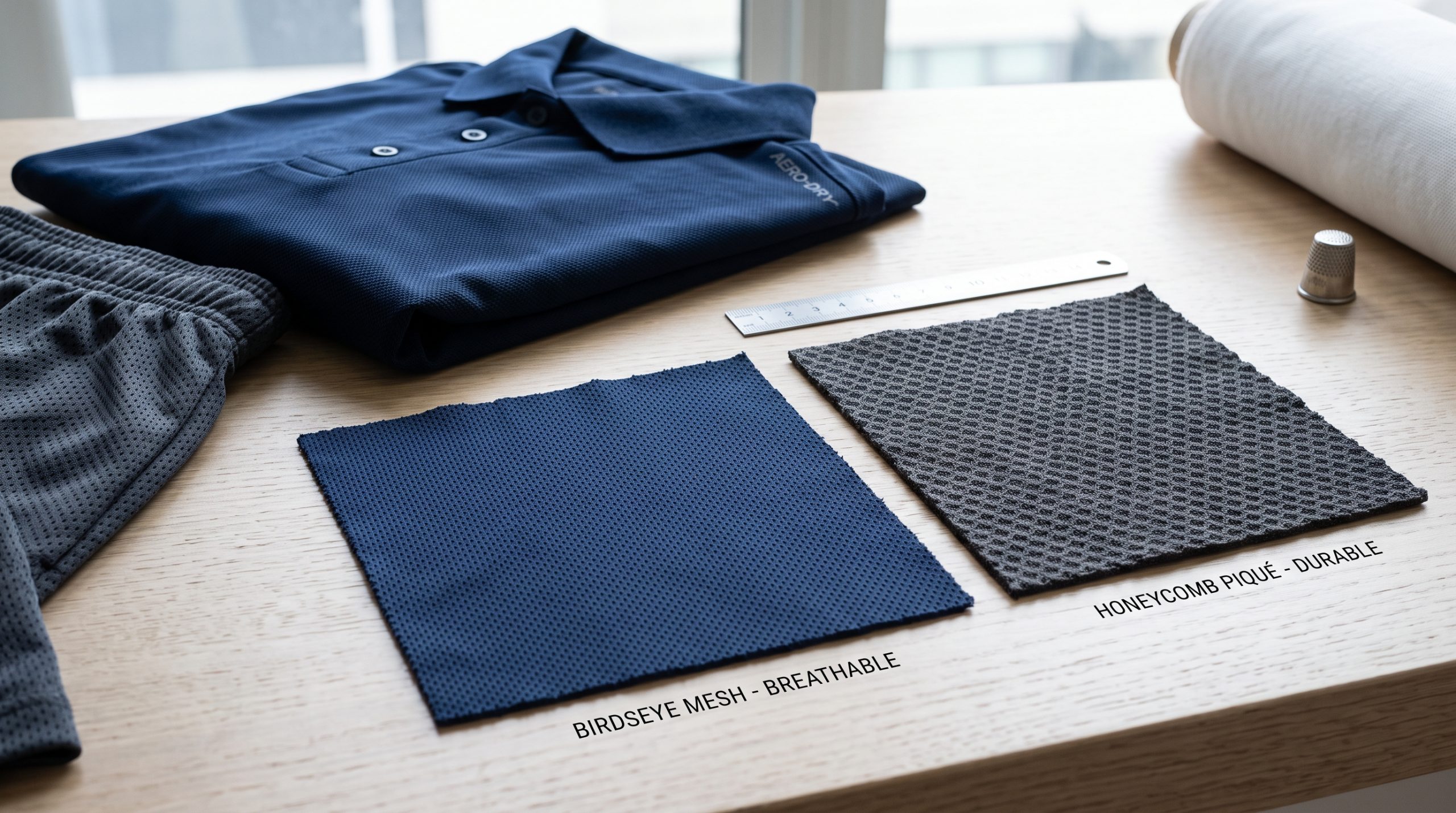
A performance knit controls air and water vapor comfort by balancing yarn porosity with surface capillary channels. You send athletic shirts into mass production, only to hear active runners complain about heavy sweat clinging to their skin during hot marathons. Trapped vapor rapidly raises skin microclimate humidity, causing skin chafing and fabric cling that ruin customer satisfaction. Sourcing an engineered sports textile with targeted permeability and moisture dispersion resolves this production headache immediately.
1. How Does a Sports Textile Regulate Heat and Moisture?
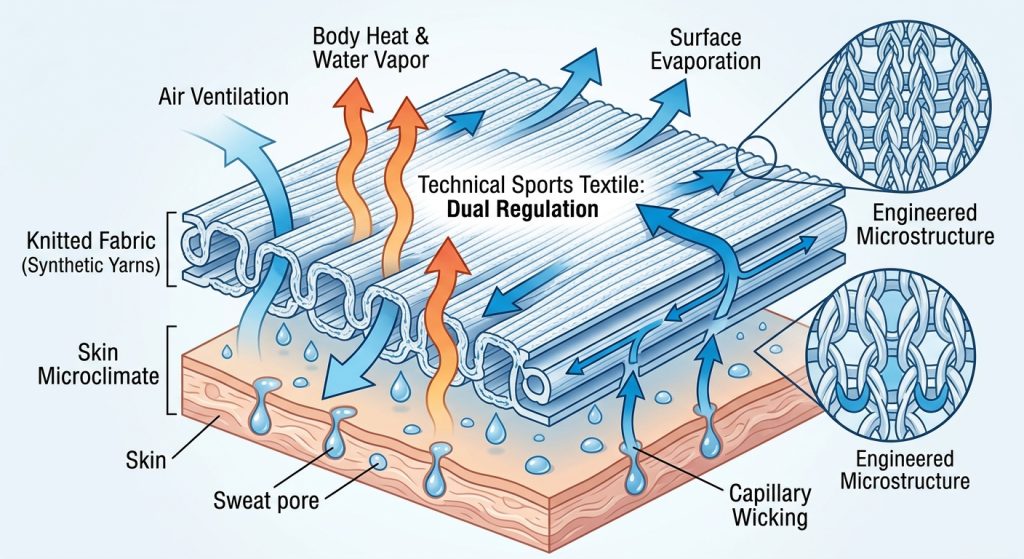
A technical sports textile regulates heat and moisture through continuous capillary wicking and open-pore air ventilation. Synthetic knit yarns push liquid perspiration outward while permitting excess body warmth to escape into ambient air. This dual mechanism maintains a balanced skin microclimate across intensive physical training.
Knitted structures actively manage human transpiration by creating a low-resistance path for heat dissipation. When an athlete exercises, continuous airflow through knitting gaps accelerates evaporative cooling across skin boundaries.
How Does Microclimate Management Function?
Thermal microclimate stability depends directly on how fast perspiration leaves human skin. Knitted polyester filaments pull liquid droplets along microscopic yarn grooves away from body contact zones.
- Fast capillary wicking pulls liquid sweat off skin pores.
- Open interstitial spaces channel body heat outward.
- Hydrophobic synthetic yarns prevent liquid saturation during hard workouts.
Here is the deal: moisture buildup inside athletic garments causes sudden post-exercise chill if air circulation stalls. You need yarns that disperse wetness across outer fabric faces for instant drying.
Why Does Water Vapor Permeability Prevent Saturation?
Water vapor permeability allows gaseous sweat to leave before condensing into heavy liquid drops. When fabrics exhibit high vapor transmission rates, athletes stay dry even during peak cardio sessions.
- Gaseous sweat escapes before forming heavy liquid droplets.
- Dry inner knit faces eliminate cold clinging sensations.
- Low moisture retention keeps finished activewear extremely lightweight.
What does this mean for you? Sourcing fabrics with high moisture permeability keeps garments light and breathable through extended competitions.
Key Takeaway: Choosing high-permeability knit structures prevents sweat accumulation, keeping athletes dry and extending garment lifespan under heavy perspiration.
| Performance Metric | Low-Permeability Knit | High-Permeability Sports Textile |
| Water Vapor Permeability Rate | Under 4,000 g/m²/24h | Exceeds 8,500 g/m²/24h |
| Air Permeability Value | Under 80 mm/s | Exceeds 220 mm/s |
| Surface Drying Speed | 35 to 50 Minutes | 8 to 15 Minutes |
| Skin Cling Tendency | High under heavy sweat | Near Zero |
This technical breakdown proves that higher vapor transmission rates directly eliminate fabric cling during athletic exercise.
2. Why Does Birdseye Mesh Excel as a Sports Textile?
Birdseye mesh excels as a high-flow sports textile because its signature dot-matrix micropores generate continuous ventilation channels. These geometric eyelets disperse perspiration across broad surface zones while reducing direct fabric-to-skin contact. The resulting airflow keeps active runners cool under blazing outdoor conditions.
The diamond-like eyelet layout creates a soft texture with negligible surface drag. This knit architecture prevents garment cling during strenuous training matches.
How Do Geometric Micropores Drive Fast Evaporation?
The recessed knit pattern forms thousands of miniature ventilation windows per square decimeter. These open gaps accelerate fresh air exchange across active muscle groups.
- Uniform eyelets generate continuous cross-ventilation.
- Recessed pinholes create micro-gaps against wet skin.
- High surface area speeds up liquid sweat evaporation.
Think about it: flat knit surfaces trap moisture against skin, while birdseye indentations pull airflow directly across wet areas. You gain superior cooling without adding unnecessary garment weight.
Why Is Birdseye Mesh Ideal for Sublimated Jerseys?
Birdseye mesh provides a stable polyester surface that accepts disperse dyes with exceptional clarity. The micro-textured face locks in vibrant team colors without distorting sharp graphic lines.
- Flat pore perimeters hold sharp sublimation lines.
- 100% synthetic composition guarantees rich color fastness.
- Lightweight yarn counts support vivid print penetration.
Here is the kicker: your team wear stays bright after fifty commercial laundry cycles.
Key Takeaway: Birdseye mesh delivers superior airflow and dye absorption, making it an excellent choice for lightweight marathon singlets and soccer uniforms.
| Fabric Attribute | Flat Single Jersey | Birdseye Mesh |
| Knit Architecture | Uniform flat loops | Geometric open eyelets |
| Contact Area with Skin | Over 85% | Under 55% |
| Sublimation Print Clarity | Standard | Sharp with rich contrast |
| Typical Fabric Weight | 150 – 180 GSM | 120 – 160 GSM |
This structural comparison shows how birdseye eyelets reduce skin contact while maximizing print clarity for team apparel.
3. What Makes Piqué Knit a Resilient Sports Textile?
Piqué knit serves as a durable sports textile by using a distinct honeycomb tuck-stitch that builds natural loft and body. This geometric relief structure holds its crisp shape without wrinkling during active sports matches. Garment brands choose piqué to combine athletic function with structured business-casual styling.
The raised waffle surface creates internal air cushions that insulate against sudden temperature shifts. This layered thickness delivers excellent tensile strength and long-term shape retention.
How Does the Honeycomb Tuck-Stitch Add Structure?
The interlocking tuck-loop design creates a firm dimensional weave that resists stretching out of shape. Polo shirt collars and plackets made from piqué remain upright through heavy daily use.
- Textured waffle loops resist surface abrasion.
- Raised geometric cords support crisp garment drape.
- Dimensional stability prevents distortion around buttons and seams.
Let’s take a closer look: loose knits tend to sag after repeated washings, but piqué maintains a sharp silhouette. You deliver a polished aesthetic that appeals directly to golf and tennis players.
Does Piqué Resist Snagging and Pilling?
Piqué knits resist yarn snagging during physical contact sports due to their compact loop interlocking. The textured exterior buffers against abrasive contact from equipment straps and friction points.
- Dense tuck points lock individual yarn filaments in place.
- Textured exterior minimizes fiber fraying and pilling.
- High burst strength withstands heavy team sport contact.
Why does this matter? Garments maintain a brand-new retail appearance even after months of intense athletic use.
Key Takeaway: Piqué knit delivers superior structural integrity and abrasion resistance, making it the premier choice for premium athletic polos and school uniforms.
| Mechanical Property | Standard Cotton Piqué | Synthetic Performance Piqué |
| Pilling Resistance Rating | Grade 2 – 3 | Grade 4 – 5 |
| Wrinkle Recovery Speed | Slow and prone to creases | Instantaneous |
| Dimensional Shrinkage | Up to 5% | Under 1.5% |
| Tensile Burst Strength | 320 kPa | Over 650 kPa |
These durability metrics highlight why synthetic performance piqué outlasts conventional natural fiber knits in active sportswear lines.
4. Which Sports Textile Provides Superior Air Permeability?
Birdseye mesh provides significantly higher air permeability than piqué knit because its open eyelets let ambient air flow directly through yarn voids. Laboratory testing shows birdseye mesh delivers almost double the airflow rate of standard honeycomb piqué knits. This open structure makes birdseye the clear choice for heat-intensive athletic gear.
Piqué knits incorporate tighter tuck stitches that create an insulating air buffer rather than an open wind channel. While piqué offers adequate breathability, birdseye mesh remains unmatched for raw air throughput.
How Do Knit Pores Shape Airflow Resistance?
Airflow volume corresponds directly to the total open pore area across the knit surface. Birdseye mesh features open passages that offer minimal resistance to moving air streams.
- Direct air passages lower air resistance below 15 Pa.
- Honeycomb piqué traps air in small surface pockets.
- Open knit apertures boost passive convective cooling.
What is the bottom line? When an athlete runs at top speed, open mesh catches external air currents to cool body temperature instantly. You give runners immediate thermal relief when choosing open eyelets.
Which Structure Fits Intense Cardiovascular Workouts?
High-intensity cardio demands maximum ventilation to prevent heat exhaustion during summer matches. Birdseye mesh allows rapid heat transfer, keeping core body temperature stable through strenuous workouts.
- Minimal thermal resistance ($R_{ct}$) dissipates body heat quickly.
- Continuous airflow dries inner yarn layers rapidly.
- Reduced yarn bulk eliminates sweat entrapment.
Here is the deal: competitive runners notice the cooling difference within minutes of intense physical exertion.
Key Takeaway: Birdseye mesh provides superior airflow dynamics, making it the best candidate for endurance running gear and warm-weather training tops.
| Airflow Parameter | Birdseye Performance Mesh | Honeycomb Piqué Knit |
| Air Permeability (ISO 9237) | 280 – 350 mm/s | 110 – 170 mm/s |
| Thermal Resistance ($R_{ct}$) | 0.015 m²·K/W | 0.038 m²·K/W |
| Wind Flow Resistance | Very Low | Moderate |
| Best Application | Marathon singlets, track jerseys | Tennis shirts, golf polos |
This laboratory airflow data proves that birdseye mesh allows substantially higher wind penetration than structured piqué knits.
5. How Does Vapor Transfer Differ Across Each Sports Textile?
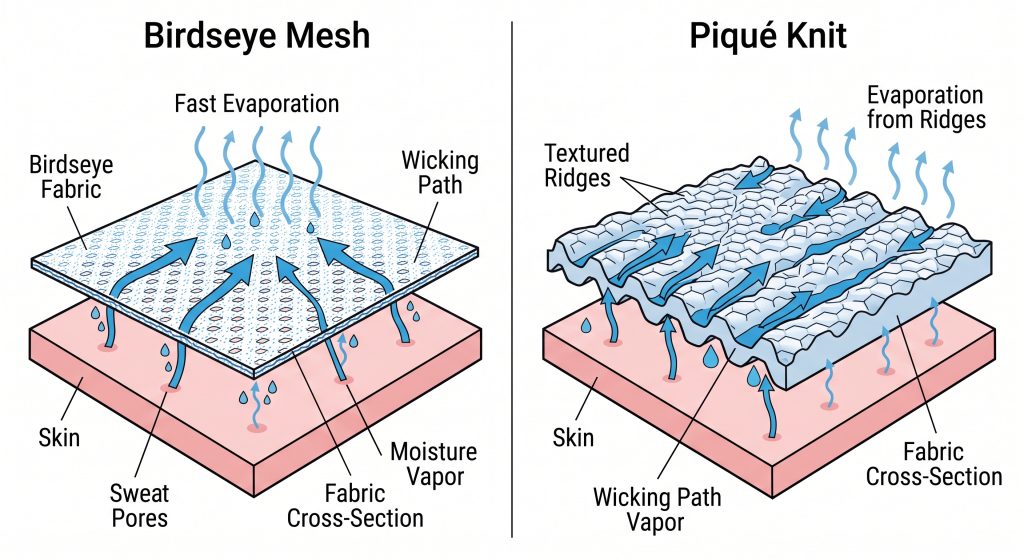
Vapor transfer in a sports textile depends on capillary yarn channels and knit thickness. Birdseye mesh relies on thin cross-sections to vent vapor instantly, while piqué uses its raised texture to lift moist cloth off skin. Both fabrics transport moisture efficiently but achieve comfort through different physical mechanisms.
Birdseye mesh moves moisture outward along short yarn paths for fast evaporation. In contrast, piqué stores sweat within outer textured ridges to keep damp fabric away from sensitive skin.
How Does Capillary Wicking Move Moisture Outward?
Capillary wicking pulls liquid sweat through narrow gaps between micro-denier synthetic filaments. The smaller the filament diameter, the stronger the capillary suction pulling moisture toward outer air.
- Micro-denier filaments generate strong capillary lift.
- Short yarn paths speed up surface moisture dispersion.
- Hydrophobic chemistry prevents water absorption into fiber cores.
Think about it: standard cotton threads trap sweat inside their cell walls, while synthetic microfibers pump wetness to the garment exterior. You eliminate heavy, soggy shirts from your athletic line.
How Do Wet Cling Tendencies Compare in Practice?
Wet cling happens when saturated fabric sticks flat against human skin, causing discomfort and painful chafing. Piqué prevents cling through its raised structural dots, while birdseye avoids cling through rapid drying speeds.
- Raised piqué dots reduce wet skin contact points.
- Birdseye mesh dries too fast to stay wet against skin.
- Both knits prevent painful nipple chafing during long runs.
Ready for the good part? Athletes wearing either technical knit stay completely focused on their performance without mid-game clothing distractions.
Key Takeaway: Birdseye mesh accelerates total moisture evaporation, whereas piqué prevents fabric cling by creating physical space between fabric and skin.
| Moisture Dynamic | Birdseye Mesh Knit | Textured Piqué Knit |
| Evaporative Speed | Ultra Fast (under 10 min) | Fast (15 – 20 min) |
| Moisture Wicking Height | 120 mm / 10 min | 95 mm / 10 min |
| Wet Skin Cling Index | Minimal | Low |
| Primary Transport Mode | Direct vapor diffusion | Capillary spread along ribs |
These moisture metrics confirm that birdseye mesh excels in drying speed while piqué excels in keeping wet fabric elevated off skin.
6. Which Sports Textile Delivers a Softer Hand-Feel?
Birdseye mesh delivers a smoother hand-feel due to its fine-denier yarn composition and flat face loops. Piqué knit features a slightly textured, granular surface feel created by its raised waffle stitches. Sourcing teams evaluate these tactile traits to match consumer expectations across sports categories.
Athletes who prefer a silky touch against sensitive skin choose fine birdseye jersey fabrics. Buyers targeting structured casual athletic wear favor the firm, substantial grip of piqué.
How Does Filament Denier Control Skin Friction?
Filament denier determines whether a fabric feels silky or coarse against bare skin. Microfiber yarns below one denier per filament eliminate harsh friction points across repetitive athletic motions.
- Micro-filaments generate a silky, frictionless skin touch.
- Lower surface friction prevents runner nipple chafing.
- Flexible yarn bundles drape smoothly over body contours.
What is the real story? Rough fabrics irritate sweaty skin during long workouts, while fine-denier knits glide smoothly across moving joints. You protect your customer base from painful skin abrasion.
How Does Fabric Weight Affect Tactile Perception?
Fabric weight changes how consumers perceive quality and comfort in retail showrooms. Lightweight knits feel feather-soft and airy, while heavier knits convey durability and tailored sophistication.
- 130 GSM mesh feels virtually weightless during exercise.
- 200 GSM piqué provides a substantial, premium retail hand-feel.
- Balanced drape matches specific garment silhouettes.
Here is the bottom line: matching fabric weight to garment intent builds strong brand loyalty among discerning buyers.
Key Takeaway: Birdseye mesh offers silky skin comfort for intense workouts, while piqué delivers a substantial, structured hand-feel for premium athletic polos.
| Sensory Metric | Micro-Denier Birdseye Mesh | Classic Honeycomb Piqué |
| Surface Texture | Smooth with tiny micro-dimples | Granular with raised waffle ridges |
| Skin Friction Coefficient | 0.18 (Very Low) | 0.32 (Moderate) |
| Tactile Stiffness | Flexible and pliable | Semi-rigid and structured |
| Ideal End-Product | Running tees, base layers | Golf shirts, tennis uniforms |
These tactile comparisons demonstrate how yarn thickness and knit relief create completely different skin sensations for activewear consumers.
7. How Does Yarn Selection Shape Sports Textile Durability?
Selecting premium synthetic yarns shapes sports textile durability by providing high tensile strength and color retention. Blending high-tenacity polyester with flexible spandex fibers prevents torn seams under heavy physical stress. Sourcing verified yarn filaments ensures finished sportswear survives rigorous commercial wash cycles.
Virgin and certified recycled polyester yarns offer superior resistance to sweat acids and detergent chemicals. Adding elastane components gives athletic garments full four-way stretch without bagginess.
How Do Polyester and Spandex Blends Perform?
Blending polyester with spandex combines moisture resistance with dynamic four-way stretch. Polyester yarn shields the garment from abrasion while spandex fibers allow full joint mobility.
- Polyester filaments resist tearing under tensile load.
- Spandex elastane adds 4-way stretch recovery.
- Synthetic blends dry three times faster than cotton.
Let’s look at the facts: athletic movements put intense strain on garment seams during squats and jumps. You keep garments intact by sourcing fabrics with high-recovery elastane content.
Can Recycled GRS Yarns Match Virgin Fiber Strength?
Global Recycled Standard certified polyester yarns deliver identical tensile strength and dye uptake compared to virgin synthetic polymers. High-precision melting and filtration remove impurities to produce durable filament yarns.
- Post-consumer PET bottles melt into high-tenacity yarns.
- GRS certification validates authentic eco-friendly sourcing.
- Identical bursting strength ensures zero quality drop.
Why does this matter? You satisfy modern sustainability regulations without sacrificing mechanical fabric performance.
Key Takeaway: Sourcing high-tenacity polyester blends with certified recycled filaments ensures maximum seam durability and meets global sustainability standards.
| Yarn Composition | Tensile Strength (N) | Stretch Recovery Rate | Eco-Certification |
| 100% Virgin Polyester | 480 N | 92% | OEKO-TEX Standard 100 |
| 92% Poly / 8% Spandex | 520 N | 98% | OEKO-TEX Standard 100 |
| 100% Recycled PET (GRS) | 475 N | 91% | GRS & OEKO-TEX |
| 85% Recycled / 15% Spandex | 510 N | 97% | GRS & OEKO-TEX |
This yarn analysis proves that recycled polyester matches virgin polymers in physical strength while supporting eco-friendly activewear lines.
8. Which Sports Textile Fits High-Sweat Athletic Activities?
Birdseye mesh is the superior choice for high-sweat athletic activities because its open micropores vent heat and sweat immediately. When athletes engage in soccer, basketball, or distance running, birdseye mesh prevents liquid accumulation. Piqué knit remains better suited for moderate-sweat sports like golf, tennis, and coaching sidelines.
The light weight of birdseye mesh prevents physical fatigue caused by heavy, waterlogged clothing. Athletes stay agile throughout entire tournament matches.
What Makes Birdseye Perfect for Running and Basketball?
Endurance sports demand fabrics that dry rapidly and maintain high ventilation under heavy perspiration. Birdseye mesh meets these demands by combining low fabric weight with open eyelet pores.
- Rapid sweat dispersion keeps shirts lightweight.
- Open pores cool athlete core temperatures during sprints.
- Frictionless texture prevents painful inner-arm chafing.
Here is the deal: basketball players and marathoners produce liters of perspiration per game. You keep players agile by supplying ultralight birdseye jerseys.
Why Does Piqué Suit Golf and Tennis Apparel?
Golf and tennis require a refined aesthetic with structured collars and sharp plackets. Piqué knit provides this tailored look while offering adequate breathability for moderate activity.
- Structured collar construction stays crisp in hot weather.
- Dimensional waffle texture provides a sophisticated silhouette.
- Breathable knit loops handle moderate sweat levels with ease.
What is the bottom line? You capture premium country club markets by offering classic piqué apparel with modern moisture wicking.
Key Takeaway: Choose birdseye mesh for high-cardio team jerseys and running singlets, while selecting piqué knit for structured tennis and golf collections.
| Sport Category | Recommended Fabric Base | Optimal GSM | Primary Functional Benefit |
| Marathon Running | Birdseye Mesh | 120 – 140 GSM | Ultra-lightweight and rapid drying |
| Team Basketball / Soccer | Birdseye Mesh | 140 – 160 GSM | High breathability and tear strength |
| Tennis Apparel | Performance Piqué | 180 – 210 GSM | Structured drape with sweat wicking |
| Golf Shirts | Performance Piqué | 190 – 220 GSM | Crisp collar shape and UV protection |
This sport-specific matrix helps brand managers select the correct knit structure for their target athletic demographics.
9. How Do Finishing Treatments Refine a Sports Textile?
Chemical and mechanical finishing treatments refine a sports textile by adding specialized functions like antimicrobial odor control, UPF sun protection, and wicking finishes. These post-knitting processes transform basic synthetic cloth into high-performance athletic apparel. Applying durable finishes ensures garments perform reliably over years of heavy laundry cycles.
Hydrophilic wicking coatings accelerate moisture spreading across outer fabric faces. Meanwhile, silver-ion additives eliminate odor-causing bacteria before sweat degrades into unpleasant smells.
How Do Antibacterial and Wicking Finishes Work?
Antibacterial treatments apply silver ions or zinc compounds to prevent bacterial growth on moist synthetic fibers. Hydrophilic finishing agents reduce liquid surface tension, pulling sweat rapidly across outer yarn surfaces.
- Silver-ion finishes stop 99% of odor-causing bacteria.
- Hydrophilic chemical baths boost capillary wicking speed.
- Wash-durable treatments remain active after 50 laundering cycles.
Think about it: synthetic clothes often trap unpleasant gym odors, causing consumers to discard them prematurely. You protect brand reputation by incorporating permanent antimicrobial finishes.
Why Is UPF 50+ Sun Protection Necessary for Outdoor Gear?
Outdoor athletes require strong protection against harmful ultraviolet radiation during long training sessions. Specialized UV-blocking dyes and tight knit structures block over 98% of UVA and UVB rays.
- Tight knit micro-spacing creates a physical radiation shield.
- UV-absorbing compounds block harmful sunlight penetration.
- UPF 50+ rating protects skin during multi-hour outdoor events.
Ready for the good part? You can market certified sun safety as a premium selling point on your hangtags.
Key Takeaway: Integrating antimicrobial, UPF 50+, and hydrophilic finishes adds high-margin technical value to finished athletic apparel lines.
| Functional Finish | Active Chemical Mechanism | Durability Standard | Primary End-Benefit |
| Silver-Ion Antibacterial | Inhibits bacterial cell growth | 50+ Industrial Washes | Zero post-workout odor |
| Hydrophilic Wicking Agent | Lowers water surface tension | 40+ Domestic Washes | Instant sweat dispersion |
| UV-Blocker Treatment | Absorbs UVA / UVB radiation | 50+ Sun Exposures | UPF 50+ skin protection |
| Soft-Touch Silicone Bath | Coats fibers with silky layer | 30+ Domestic Washes | Buttery smooth hand-feel |
This finishing overview outlines how specialized chemical treatments upgrade baseline knits into certified high-performance activewear.
10. How Should You Select the Right Sports Textile Base?
Selecting the right sports textile base requires balancing fabric weight, breathability, structural drape, and end-use requirements. Garment factories analyze sample swatches to determine whether an activewear collection requires lightweight mesh or structured piqué. Evaluating these core parameters prevents costly manufacturing mistakes during bulk cutting and sewing.
Careful fabric selection aligns product performance with customer expectations and budget constraints. Sourcing teams review minimum order quantities, dyeing capabilities, and lab test reports before placing bulk orders.
What Sourcing Checklist Should You Follow?
A structured sourcing checklist helps procurement teams verify fabric specifications before production begins. Reviewing yarn certificates, weight tolerances, and shrinkage rates ensures smooth cut-and-sew operations.
- Verify GSM weight matches seasonal sportswear demands.
- Inspect laboratory test reports for air permeability and color fastness.
- Confirm OEKO-TEX and GRS certifications for environmental compliance.
What is the real story? Skipping raw material verification leads to high factory defect rates and rejected shipments. You protect your profit margins by testing sample rolls thoroughly before mass cutting.
How Do You Balance Production Cost and Quality?
Balancing unit cost against fabric performance involves choosing the right fiber blend and manufacturing partner. Direct factory partnerships with integrated knitting and dyeing plants eliminate middleman markups and reduce lead times.
- Direct mill sourcing reduces fabric cost by 15% to 25%.
- Standardizing core fabric bases lowers inventory carrying costs.
- Low MOQ options allow safe testing of new seasonal colorways.
Here is the bottom line: working with an experienced textile mill streamlines your supply chain from lab dips to final roll delivery.
Key Takeaway: Establishing strict technical testing criteria and partnering directly with experienced textile mills guarantees consistent activewear quality and protects business margins.
| Sourcing Criterion | Target Benchmark for Elite Activewear | Risk Factor if Ignored |
| Color Fastness to Washing | Grade 4.0 or higher | Color bleeding into adjacent panels |
| Dimensional Shrinkage | Less than 2.0% | Garment sizing distortion after washing |
| Pilling Resistance | Grade 4 – 5 (Martindale test) | Surface fuzzing after athletic use |
| Formaldehyde & Toxin Safety | Zero (OEKO-TEX Standard 100) | Regulatory fines and customs rejections |
This quality checklist ensures your technical activewear orders meet global consumer standards without unexpected factory delays.
Strategic Sourcing Insights and Next Steps
Choosing between birdseye mesh and piqué knit comes down to balancing airflow against structural drape. Birdseye mesh remains the undisputed champion for lightweight running gear and sublimated team uniforms due to its open ventilation micropores. Meanwhile, piqué knit delivers the substantial body and crisp silhouette needed for premium golf polos and athletic school wear. Understanding these physical differences allows you to engineer sportswear lines that athletes love to wear and repurchase.
Our factory manufactures premium circular knit fabrics with in-house dyeing, custom weight development, and certified GRS recycled options. Whether you need high-flow birdseye mesh for marathon singlets or structured piqué for country club collections, our team delivers consistent batch quality and low minimum order flexibility. To request custom color lab dips or receive a curated swatch sample kit for your upcoming activewear season, contact us today to get started.
We stand committed to powering global athletic apparel brands through technical innovation, sustainable yarn sourcing, and unyielding textile craftsmanship.
Frequently Asked Questions
Q1: Can I use birdseye mesh for winter athletic apparel?
No, because its open micropores allow cold wind to pass directly through the fabric. Birdseye mesh is engineered for warm-weather ventilation, whereas winter sports demand dense interlock knits or brushed thermal fleeces to trap body heat.
Q2: What’s the best fabric choice between birdseye and piqué for team soccer jerseys?
Birdseye mesh is the best option for soccer jerseys. Its lightweight construction, rapid sweat evaporation, and flat printing surface make it ideal for high-speed running and vibrant full-coverage sublimation prints.
Q3: How do I know if a piqué fabric is made from high-performance synthetic yarn?
Check the fiber composition and water droplet absorption speed on the swatch. High-performance athletic piqué uses micro-polyester or nylon blends that wick water within three seconds, whereas cotton piqué absorbs and holds dampness.
Q4: Can I add spandex to both birdseye mesh and piqué knits?
Yes, blending 5% to 15% spandex into either knit structure adds dynamic four-way stretch. This elastane addition improves garment flexibility for form-fitting running tops, compression panels, and modern athletic golf shirts.
Q5: What’s the best way to prevent snagging on lightweight mesh fabrics?
Specify high-filament count yarns and tightly bonded finishing heat-sets during fabric manufacturing. Sourcing polyester yarns with compact twist configurations prevents loose filaments from catching on rough sports equipment.