
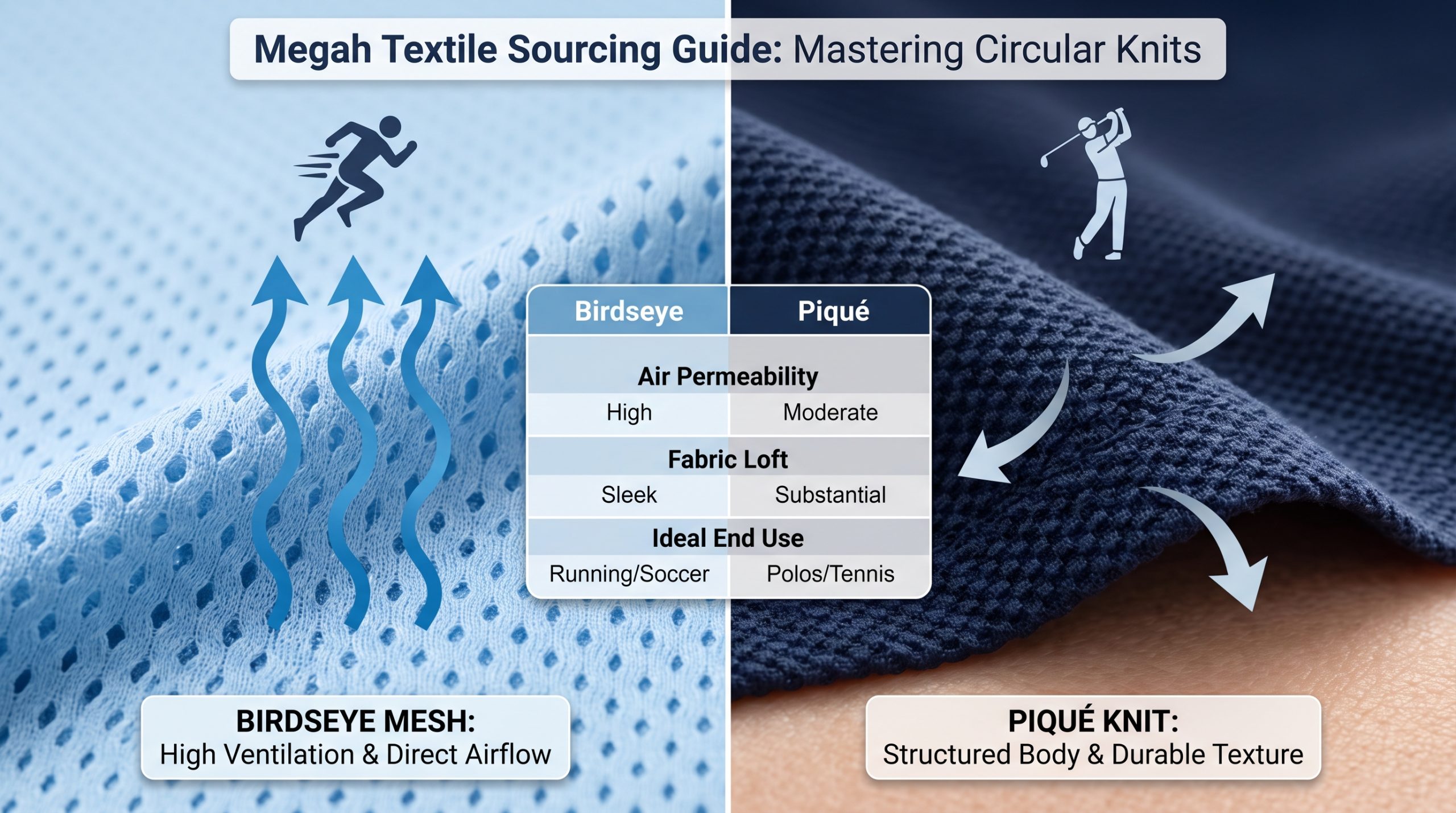
Circular knitting mills master quality by pairing tight needle-gauge calibration with precision yarn feed systems. You source activewear fabrics for a new athletic line, only to receive bulk rolls that suffer from uneven shrinkage and poor breathability. Disappointed athletes post negative reviews about heavy shirts sticking to their bodies during warm-weather training sessions. Partnering with an experienced megah textile knitting mill that optimizes air permeability and moisture wicking eliminates these production headaches right away.
1. How Does Megah Textile Define Quality in Circular Knits?
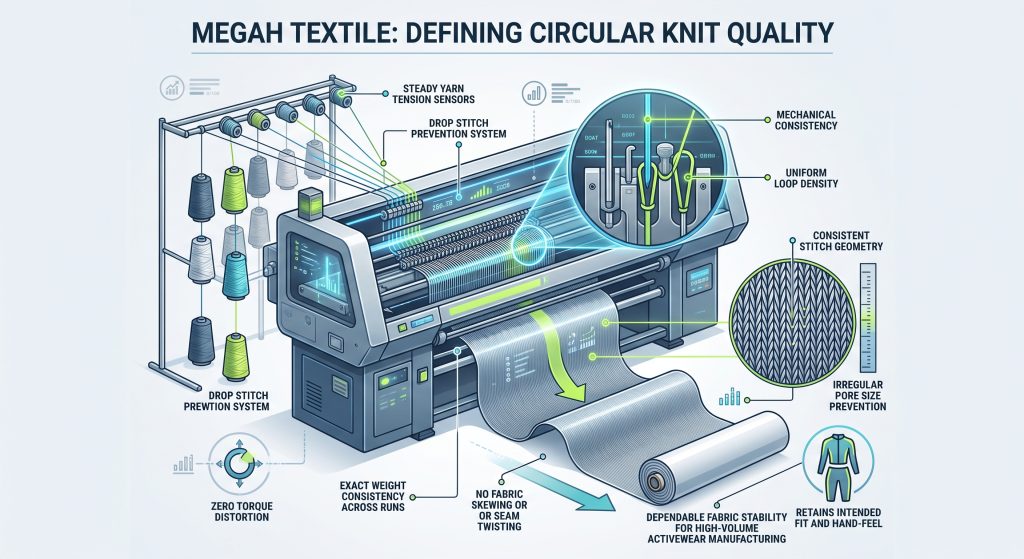
A modern megah textile manufacturing operation defines quality by delivering uniform loop density, zero torque distortion, and exact weight consistency across every production run. Advanced circular knitting machines maintain steady yarn tension to prevent drop stitches and irregular pore sizes. This mechanical consistency ensures your finished sportswear retains its intended fit and hand-feel after intensive gym workouts.
Tight knitting tolerances eliminate fabric skewing and seam twisting during garment assembly. Consistent stitch geometry gives your design team dependable fabric stability for high-volume activewear manufacturing.
WordPress Media Information
- Title: circular-knitting-quality-control-in-textile-mills
- ALT: Photorealistic close-up view of circular knitting machine needles weaving technical sportswear fabric with precision yarn tension.
- Caption: Precision circular knitting technology guarantees uniform loop density and mechanical strength across activewear production rolls.
- Description: High-resolution photograph of an industrial circular knitting machine room, showing synchronized needles and tension feeders creating defect-free technical sports fabric.
How Does Circular Knitting Precision Operate?
Automated knitting cylinders maintain exact needle clearance to prevent yarn breakage and surface defects. Digital tension feeders deliver continuous yarn velocity, preventing tight lines across the fabric face.
- Servo-driven positive feeders stop yarn drag.
- Electronic needle detectors spot broken hooks instantly.
- Real-time roll scanners flag minor defects before heat-setting.
Here is the deal: inconsistent yarn feeding creates horizontal streaks that ruin your retail apparel appearance. Modern circular mills control every millimeter of thread feeding into the needle bed.
What Separates Birdseye Mesh from Piqué Knit?
Birdseye mesh features micro-perforated open pores, whereas piqué knit relies on raised geometric honeycomb patterns. These two circular structures serve different performance needs depending on breathability and aesthetic requirements.
- Birdseye creates flat open holes for rapid heat release.
- Piqué produces a dimensional waffle texture for classic collar garments.
- Both fabrics use specialized knitting needle arrangements to balance airflow and drape.
Think about it: choosing the wrong knit architecture leaves your athletes either overheated or wearing flimsy shirts that lose their silhouette.
Key Takeaway: Precision circular knitting guarantees uniform fabric density, allowing you to choose between breathable birdseye or structured piqué with total quality confidence.
| Knitting Parameter | Birdseye Mesh Architecture | Honeycomb Piqué Architecture |
| Needle Arrangement | Alternating knit and tuck eyelets | Multi-feed tuck and miss pattern |
| Surface Appearance | Flat with dispersed micro-dots | Raised three-dimensional waffle |
| Fabric Loft | Low and sleek | Medium to high dimensional body |
| Primary Athletic Use | High-ventilation running singlets | Structured tennis and golf tops |
This structural comparison clarifies how specific needle setups create either flat ventilation points or raised geometric ridges.
2. Why Does Birdseye Mesh Excel in Megah Textile Lines?
Birdseye mesh excels in a megah textile product catalog because its engineered dot-matrix openings maximize airflow without compromising tear strength. The micro-eyelet pattern creates a lightweight fabric that releases body heat rapidly during intense cardiovascular workouts. Sportswear designers specify this material when building warm-weather running tops and team competition singlets.
The smooth face of birdseye mesh creates very little friction against skin during repetitive movements. This flat surface also serves as an ideal canvas for custom apparel branding.
WordPress Media Information
- Title: birdseye-mesh-fabric-structure-and-sublimation
- ALT: Macro photograph of lightweight birdseye mesh performance fabric showing open micro-pores and sharp dye sublimation detail.
- Caption: Birdseye mesh combines open geometric micropores for rapid ventilation with a smooth face for vibrant graphic printing.
- Description: Detailed macro photo capturing the unique eyelet knit structure of polyester birdseye mesh, illustrating high breathability channels and bright color fastness.
How Do Micro-Eyelets Accelerate Heat Dispersion?
Thousands of geometric eyelets per square meter act as dedicated exhaust points for trapped body warmth. Moving air sweeps across these miniature apertures to pull away moisture vapor instantly.
- Recessed openings lower convective thermal resistance.
- Thin knit cross-sections speed up dry times.
- Low surface area in skin contact stops fabric cling.
What is the real story? Flat single jersey knits hold sweat against warm skin, but birdseye mesh uses continuous air movement to keep runners dry. You deliver genuine physical comfort during high-temperature races.
Why Does Birdseye Mesh Handle Sublimation So Well?
The flat yarn loops around each eyelet accept disperse dye ink with exceptional edge sharpness. Heated inks gasify directly into synthetic fibers without blurring fine logos or numbers.
- Synthetic micro-denier yarns lock in brilliant color pigment.
- Stable pore boundaries prevent dye bleeding across panels.
- Colors remain vibrant through dozens of harsh industrial washings.
Here is the kicker: your team kits maintain photographic graphic detail season after season.
Key Takeaway: Birdseye mesh combines open-channel cooling with unmatched sublimation print clarity, making it the top selection for competitive team sports wear.
| Performance Characteristic | Standard Jersey Knit | Performance Birdseye Mesh |
| Total Open Air Area | Under 3% | 12% to 18% |
| Print Edge Sharpness | Moderate | High definition |
| Weight Range | 160 – 190 GSM | 125 – 155 GSM |
| Skin Cling Index | High when wet | Very low |
These performance values prove that open eyelets reduce garment weight while increasing airflow efficiency during demanding athletic events.
3. What Gives Piqué Fabric Structure in Megah Textile Mills?
Piqué fabric derives its signature structure from alternating tuck and miss stitches that build dimensional honeycomb ridges across a megah textile circular knit run. This interlocking construction creates natural stiffness and body that keeps polo collars standing crisp throughout a full day of wear. Garment brands rely on piqué to blend athletic performance with polished business-casual aesthetics.
The raised waffle knit forms tiny air pockets that provide gentle thermal insulation without trapping excess moisture. This structural thickness gives the fabric outstanding resistance against physical wear.
WordPress Media Information
- Title: textured-pique-knit-structure-for-polos
- ALT: Close-up photograph of a navy blue honeycomb piqué knit fabric showcasing its durable textured waffle structure and tailored drape.
- Caption: The geometric tuck-stitch pattern of piqué knit creates a structured, durable drape ideal for athletic polos and uniforms.
- Description: Studio shot of a textured piqué sportswear knit, highlighting the raised diamond waffle stitches that provide wrinkle resistance and dimensional stability.
How Does the Honeycomb Tuck-Stitch Function?
Tuck stitches collect multiple yarn loops in specific needles before clearing them into a single interlocking node. This technique creates a geometric waffle relief across the front face while keeping the back comfortable.
- Interconnected tuck nodes prevent curling along fabric edges.
- Raised geometric cords give shirts a clean silhouette.
- Dimensional stability protects button plackets from sagging.
Look at the facts: flimsy knits look worn out after a few washes, but piqué retains its crisp appearance. Your customers get a professional look suitable for the golf clubhouse or corporate events.
Why Does Piqué Resist Snags from Athletic Gear?
The compact loop geometry of piqué locks individual yarn filaments tightly into the body of the fabric. Rough contact from backpack straps or sports equipment slides over the textured face without pulling threads loose.
- Tight tuck nodes protect filament bundles from catching.
- High surface abrasion resistance prevents fuzzy pilling.
- High burst strength withstands physical contact in sports.
Ready for the good part? Your uniforms maintain their crisp finish without showing signs of wear around high-friction collar and shoulder areas.
Key Takeaway: Honeycomb tuck stitches give piqué fabric exceptional structural integrity and abrasion resistance, making it the premier option for premium athletic polos.
| Mechanical Property | Flat Cotton Piqué | Synthetic Performance Piqué |
| Martindale Pilling Resistance | Grade 2 – 3 | Grade 4.5 |
| Collar Placket Support | Weak (prone to flop) | Rigid and upright |
| Dimensional Shrinkage | Up to 6.0% | Under 1.5% |
| Tensile Strength | 310 N | Over 580 N |
This testing data highlights how synthetic performance piqué outclasses traditional cotton knits in durability and shape retention.
4. Which Megah Textile Structure Offers Better Airflow?
Birdseye mesh offers significantly higher air permeability than piqué knit in any megah textile comparative laboratory test. The continuous micro-perforations in birdseye mesh allow incoming breezes to pass directly through the yarn gaps. Piqué knits feature a more enclosed stitch arrangement that moderates airflow while building fabric thickness.
Athletic teams competing in high-temperature environments benefit directly from the low wind resistance of birdseye knits. Piqué remains better suited for mild climates where moderate ventilation is preferred.
WordPress Media Information
- Title: airflow-permeability-birdseye-mesh-vs-pique
- ALT: Technical comparison diagram illustrating high wind permeability through birdseye mesh pores versus moderated airflow through textured piqué knit.
- Caption: Airflow testing shows birdseye mesh delivers up to double the air permeability of traditional piqué knit fabrics.
- Description: A clean laboratory comparison graphic showing air passing directly through open birdseye eyelets versus moving around the raised waffle barriers of piqué knit.
How Do Knit Pores Determine Airflow Resistance?
Total open surface area dictates how freely air currents move across a knitted garment panel. Open eyelets present minimal physical obstruction to ambient air movements.
- Open eyelet apertures lower air resistance below 12 Pa.
- Honeycomb piqué creates slight air turbulence along ridges.
- High-volume air exchange accelerates natural sweat drying.
What is the bottom line? When an athlete runs at full sprint, birdseye eyelets scoop up outside air to cool skin temperatures instantly. You give runners immediate physical relief from heat fatigue.
When Should You Specify High Permeability Knits?
High-sweat cardio activities demand maximum air permeability to prevent overheating during long summer workouts. Equipping athletes with open-pore mesh prevents body heat from building up inside clothing layers.
- Low thermal resistance values dump body heat quickly.
- Continuous air movement prevents humid air buildup next to skin.
- Reduced garment weight eliminates player distraction.
Here is the deal: competitive athletes notice the cooling breeze through birdseye mesh within seconds of stepping onto the field.
Key Takeaway: Birdseye mesh provides superior airflow velocity, making it the undisputed winner for endurance track gear and warm-weather soccer jerseys.
| Breathability Metric | Birdseye Mesh | Structured Piqué Knit |
| Air Permeability (ISO 9237) | 320 mm/s | 145 mm/s |
| Thermal Resistance ($R_{ct}$) | 0.012 m²·K/W | 0.034 m²·K/W |
| Wind Penetration Rate | High | Moderate |
| Recommended Activity | Marathon running, soccer | Golf, tennis, leisure polo |
This breathability comparison proves that open eyelets provide far greater airflow than textured tuck knits under identical testing conditions.
5. How Does Moisture Vapor Move Through Megah Textile Knits?
Moisture vapor moves through a megah textile knit via micro-capillary channels and direct vapor diffusion across yarn voids. Birdseye mesh relies on thin fabric profiles to vent gaseous perspiration into the atmosphere before it condenses into liquid drops. Piqué knit uses its raised waffle ridges to lift damp fabric off skin, transporting moisture along surface ribs.
Both knit structures keep athletes dry but employ different physical mechanisms to manage sweat. Choosing the right mechanism depends on expected perspiration volume and garment style.
WordPress Media Information
- Title: moisture-wicking-and-vapor-diffusion-knit-diagram
- ALT: Realistic cutaway diagram illustrating moisture vapor evaporating and liquid sweat wicking along synthetic knit yarn filaments away from skin.
- Caption: Synthetic microfiber channels pull liquid perspiration away from the skin surface, dispersing it for fast outer-face evaporation.
- Description: A detailed technical illustration showing sweat droplets drawn up through microscopic capillary yarn grooves in performance sportswear fabric.
How Does Microfiber Capillary Action Function?
Capillary wicking pulls liquid sweat along narrow grooves between synthetic micro-filaments. The fine diameter of these filaments creates strong suction that draws wetness toward the outer garment face.
- Fine synthetic filaments generate strong liquid pull.
- Moisture spreads across the outer face for quick evaporation.
- Hydrophobic polymer cores prevent liquid storage inside fibers.
Think about it: natural fibers absorb sweat and turn heavy, while synthetic microfibers pump moisture outside to keep shirts lightweight. You eliminate wet cling during intense training drills.
Why Does Piqué Prevent Wet Skin Sticking?
Wet cling occurs when saturated fabric collapses flat against sweaty skin, causing irritation and restricted motion. The raised geometry of piqué keeps the main fabric body elevated above wet skin zones.
- Raised waffle points minimize skin contact area.
- Recessed channels maintain air movement under the shirt.
- Reduced contact prevents painful chest chafing during long workouts.
This is where it gets interesting: even when an athlete sweats heavily, piqué maintains an air gap that prevents uncomfortable fabric sticking.
Key Takeaway: Birdseye mesh accelerates overall moisture evaporation, whereas piqué prevents fabric cling by creating physical space between damp cloth and skin.
| Moisture Dynamic | Birdseye Mesh | Textured Piqué |
| Wicking Height (10 min) | 125 mm | 100 mm |
| Surface Drying Time | Under 12 minutes | 18 to 22 minutes |
| Wet Cling Surface Area | Very Low | Low |
| Primary Vapor Path | Direct eyelet venting | Channel evaporation along ridges |
These moisture metrics demonstrate that both knits manage sweat effectively through distinct evaporation and skin-clearance methods.
6. Which Megah Textile Fabric Provides a Softer Hand-Feel?
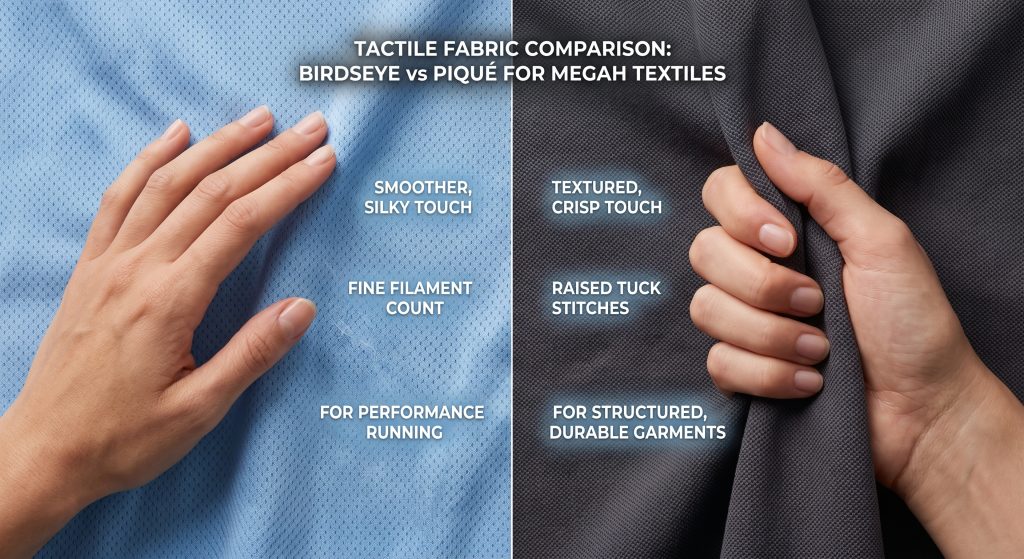
Birdseye mesh delivers a smoother hand-feel across any megah textile product line due to its fine filament count and flat face loops. Piqué knit presents a textured, crisp touch created by its raised geometric tuck stitches. Sourcing teams evaluate these tactile characteristics to match consumer expectations for different sportswear categories.
Athletes who prefer a silky touch choose fine-denier birdseye jersey knits for running tops. Buyers seeking a structured, durable garment favor the firm grip of piqué fabrics.
WordPress Media Information
- Title: activewear-fabric-hand-feel-and-drape-comparison
- ALT: Flat-lay photo of athletic shirts showing the smooth, flexible drape of birdseye mesh next to a structured, tailored piqué polo shirt.
- Caption: Hand-feel ranges from buttery smooth micro-denier birdseye mesh to substantial, tactile honeycomb piqué knit.
- Description: High-detail studio photograph displaying activewear garments draped neatly to show surface texture differences and fabric flexibility.
How Does Filament Denier Impact Touch?
Filament denier determines whether a knit feels silky soft or firm against bare skin. Microfibers under one denier per filament eliminate coarse friction points across moving joints.
- Micro-filaments produce a smooth skin sensation.
- Low friction protects sensitive skin during repetitive motions.
- Flexible yarn bundles drape naturally over muscular body contours.
What is the real story? Rough fabrics cause painful skin irritation during long workouts, but fine-denier knits glide smoothly across the torso. You protect your customers from distracting chafing issues.
How Does Fabric Weight Alter Tactile Perception?
Fabric weight changes how consumers evaluate quality and comfort on retail clothing racks. Lightweight knits feel featherweight and airy, whereas heavier fabrics convey durability and premium tailoring.
- 130 GSM mesh feels virtually weightless during workouts.
- 210 GSM piqué provides a substantial, tailored retail touch.
- Balanced fabric drape supports clean garment silhouettes.
Here is the bottom line: matching fabric weight to garment intent builds strong brand loyalty among active consumers.
Key Takeaway: Birdseye mesh provides silky comfort for intense workouts, while piqué provides the structured hand-feel required for high-end sportswear polos.
| Sensory Trait | Micro-Denier Birdseye Mesh | Performance Honeycomb Piqué |
| Surface Feel | Silky and smooth with tiny dimples | Granular and textured waffle relief |
| Friction Coefficient | 0.16 (Extremely Low) | 0.30 (Balanced Grip) |
| Fabric Pliability | Highly fluid and flexible | Semi-structured and crisp |
| Target Apparel | Training tees, running singlets | Golf shirts, school team polos |
These sensory metrics demonstrate how yarn thickness and knitting patterns combine to produce distinctly different tactile experiences for the wearer.
7. How Does Yarn Selection Strengthen Megah Textile Knits?
Careful yarn selection strengthens every megah textile production batch by combining high-tenacity polyester filaments with elastic spandex fibers. Blending durable synthetic polymers prevents seam cracking and bagging under repetitive athletic motion. Sourcing high-grade yarn filaments guarantees that finished sportswear survives tough commercial washing cycles.
Virgin and certified recycled polyester yarns offer superior resistance to sweat acids and alkaline detergents. Adding spandex gives athletic apparel complete four-way stretch recovery without losing shape.
WordPress Media Information
- Title: high-tenacity-yarn-selection-for-knitting
- ALT: Studio shot of industrial polyester yarn cones and recycled filament spools used in technical circular knitting mills.
- Caption: Premium virgin and GRS-certified recycled polyester yarns deliver high burst strength and long-lasting stretch recovery.
- Description: Detailed commercial photograph of colorful performance yarn spools, showing filament quality, sheen, and tensile durability standards.
How Do Polyester and Spandex Blends Perform?
Blending polyester with spandex combines moisture resistance with dynamic multi-directional flexibility. Polyester filaments resist tearing under load, while spandex fibers pull the fabric back to its original shape.
- Polyester yarns resist snagging and color fading.
- Spandex elastane adds four-way elasticity for athletic mobility.
- Synthetic blends dry three times faster than natural fibers.
Let’s look at the facts: athletic movements place heavy strain on garment seams during squats and jumps. You protect seam integrity by specifying fabrics with high elastic recovery.
Can Recycled GRS Yarns Deliver Equal Strength?
Global Recycled Standard certified polyester yarns deliver identical tensile strength and dye uptake compared to virgin polymers. Advanced polymer melting and multi-stage filtration remove impurities to yield durable filament threads.
- Recycled PET bottles yield strong filament yarns.
- GRS certification validates authentic sustainable sourcing.
- Identical bursting strength ensures zero compromise on performance.
Why does this matter? You satisfy modern environmental guidelines without sacrificing mechanical fabric strength.
Key Takeaway: Sourcing high-tenacity polyester blends with certified recycled filaments ensures maximum seam durability while meeting international sustainability standards.
| Yarn Composition | Bursting Strength (kPa) | Stretch Recovery Rate | Eco-Certification |
| 100% Virgin Polyester | 590 kPa | 92% | OEKO-TEX Standard 100 |
| 90% Poly / 10% Spandex | 640 kPa | 98% | OEKO-TEX Standard 100 |
| 100% Recycled PET (GRS) | 585 kPa | 91% | GRS & OEKO-TEX |
| 88% Recycled / 12% Spandex | 630 kPa | 97% | GRS & OEKO-TEX |
This mechanical data confirms that certified recycled polyester matches virgin synthetic yarn in bursting strength and elastic recovery.
8. Which Megah Textile Knit Fits High-Sweat Training Gear?
Birdseye mesh is the clear winner for high-sweat training gear within any megah textile fabric collection. Its open-pore architecture lets heavy sweat evaporate immediately, keeping players light and agile throughout long games. Piqué knit remains the preferred choice for moderate-sweat sports like golf, tennis, and corporate sideline wear.
The lightweight nature of birdseye mesh prevents physical fatigue caused by damp, heavy sportswear. Players stay cool and focused during intense second-half action.
WordPress Media Information
- Title: performance-athletic-wear-for-high-sweat-sports
- ALT: Two athletes running during an intense outdoor workout wearing lightweight, breathable birdseye mesh activewear tops.
- Caption: Birdseye mesh activewear prevents moisture buildup, keeping athletes cool during high-intensity training sessions.
- Description: A vibrant sports photography shot of athletes running on an athletic track, showcasing the breathability and fit of performance knit sportswear.
What Makes Birdseye Ideal for Soccer and Running?
High-intensity cardio sports require fabrics that dry rapidly and maintain ventilation under continuous perspiration. Birdseye mesh meets these needs by combining low fabric weight with continuous eyelet openings.
- Rapid sweat dispersion keeps shirts lightweight.
- Open pores cool athlete core temperatures during sprints.
- Frictionless texture prevents painful inner-arm chafing.
Here is the deal: soccer players and distance runners generate large amounts of sweat during matches. You keep players comfortable by outfitting them in ultralight birdseye jerseys.
Why Does Piqué Suit Golf and Tennis Lines?
Golf and tennis require a refined visual style with structured collars and clean button plackets. Piqué knit provides this tailored look while supplying plenty of breathability for moderate activity.
- Structured collar construction stays upright in hot sun.
- Dimensional waffle texture provides a sophisticated silhouette.
- Breathable knit loops handle moderate perspiration levels with ease.
What is the bottom line? You capture premium country club markets by offering classic piqué apparel with modern moisture management.
Key Takeaway: Choose birdseye mesh for high-cardio team jerseys and running apparel, while selecting piqué knit for structured golf and tennis collections.
| Sport Application | Ideal Fabric Choice | Target Weight | Key Performance Benefit |
| Marathon Running | Birdseye Mesh | 120 – 140 GSM | Ultralight weight and rapid drying |
| Soccer / Basketball | Birdseye Mesh | 140 – 165 GSM | High airflow and burst durability |
| Tennis Apparel | Performance Piqué | 180 – 210 GSM | Tailored drape with sweat wicking |
| Golf Polos | Performance Piqué | 190 – 230 GSM | Crisp collar structure and UV barrier |
This application guide helps product developers assign the correct knit structure to their targeted athletic market segments.
9. How Do Modern Finishes Upgrade Megah Textile Fabrics?
Specialized chemical and mechanical finishes upgrade a megah textile base by adding long-lasting antibacterial odor control, UPF 50+ sun protection, and wicking enhancements. These finishing steps transform raw greige knits into high-value performance textiles. Applying durable chemical treatments ensures garments retain their functional benefits through dozens of laundry cycles.
Hydrophilic coatings pull liquid moisture across outer fabric faces for faster drying. Silver-ion finishes stop odor-causing bacteria before sweat breaks down into unpleasant smells.
WordPress Media Information
- Title: functional-finishing-treatments-for-sports-textiles
- ALT: Laboratory technician testing functional antibacterial and moisture-wicking chemical finishes on performance knit fabric swatches.
- Caption: Functional finishing treatments add wash-durable antimicrobial protection and UPF 50+ sun defense to activewear fabrics.
- Description: Clean commercial laboratory photograph showing technical fabric finishing applications, water repellency droplet tests, and textile quality assessment.
How Do Silver-Ion Finishes Prevent Odors?
Silver-ion finishes inhibit bacterial cell multiplication on moist synthetic fibers during and after workouts. Stopping bacterial reproduction prevents the sour odor common in untreated polyester sportswear.
- Silver-ion agents neutralize 99% of odor-causing microbes.
- Hydrophilic baths speed up moisture spreading across fibers.
- Durable chemical bonds withstand 50 standard home washings.
Think about it: synthetic workout gear often holds persistent gym odors that cause consumers to discard garments early. You protect your brand reputation by adding certified antimicrobial finishes.
Why Is UPF 50+ Protection Crucial for Outdoor Sportswear?
Outdoor athletes require reliable protection against ultraviolet radiation during multi-hour training sessions. Dense knit micro-spacing combined with UV-absorbing dyes blocks over 98% of harmful UVA and UVB rays.
- Tight yarn spacing creates a physical barrier against sunlight.
- Specialized UV-absorbing molecules scatter radiation safely.
- Certified UPF 50+ ratings protect skin during sunny outdoor matches.
Ready for the good part? You can market verified sun safety as a premium feature on your retail garment hangtags.
Key Takeaway: Adding antimicrobial, UPF 50+, and hydrophilic finishes adds high-margin functional value to your finished athletic apparel line.
| Functional Treatment | Active Mechanism | Durability Level | Primary User Benefit |
| Silver-Ion Antibacterial | Disrupts bacterial cell walls | 50+ Domestic Washes | Zero post-workout odor |
| Hydrophilic Wicking Agent | Lowers liquid surface tension | 40+ Domestic Washes | Instant moisture spreading |
| UV-Blocker Formulation | Absorbs UVA and UVB rays | 50+ Sun Exposures | UPF 50+ skin protection |
| Soft-Touch Silicone Bath | Smooths external filament paths | 30+ Domestic Washes | Luxurious skin touch |
This finishing overview outlines how specialized chemical applications upgrade standard knits into certified high-performance activewear.
10. How Can You Source the Right Megah Textile Production Base?
Sourcing the right megah textile production base requires evaluating factory knitting capacity, in-house lab testing, batch-to-batch color matching, and minimum order flexibility. Garment brands analyze test reports to determine whether a mill can consistently produce high-grade birdseye mesh and piqué knits. Thorough vendor qualification prevents costly defects and delivery delays during mass garment production.
Working with an experienced knitting mill streamlines your supply chain from lab dip approvals to bulk roll shipping. Direct mill communication gives you custom fabric weights, specialized finishes, and verified compliance certifications.
WordPress Media Information
- Title: sourcing-performance-textiles-warehouse-inspection
- ALT: Warehouse interior showcasing neatly stacked, inspected rolls of performance activewear knit fabrics ready for global shipping.
- Caption: Partnering directly with certified circular knitting mills ensures consistent batch quality and on-time global fabric delivery.
- Description: Clean, organized textile mill warehouse displaying rolls of inspected polyester activewear fabrics with barcode labels for complete traceability.
What Should Your Sourcing Checklist Include?
A rigorous sourcing checklist helps procurement teams verify technical parameters before signing bulk production contracts. Reviewing yarn quality certificates, weight tolerances, and color fastness reports ensures seamless sewing operations.
- Verify GSM weight matches seasonal sportswear requirements.
- Review independent lab reports for air permeability and wash fastness.
- Confirm OEKO-TEX and GRS certifications for environmental compliance.
What is the real story? Skipping raw material verification leads to high factory defect rates and rejected garment shipments. You protect your profit margins by testing pre-production sample rolls thoroughly.
How Does Direct Mill Sourcing Lower Costs?
Partnering directly with integrated knitting and dyeing facilities removes middleman markups and speeds up production lead times. Direct mills offer transparent pricing, reliable roll packaging, and rapid lab dip turnarounds.
- Direct sourcing lowers raw material costs by 15% to 25%.
- Standardizing core fabric bases reduces inventory holding costs.
- Flexible minimum order quantities let you test new seasonal colors safely.
Here is the bottom line: working directly with a proven textile manufacturer protects your margins and guarantees dependable sportswear quality.
Key Takeaway: Implementing strict quality testing and partnering directly with experienced circular knitting mills protects your profit margins and guarantees consistent garment excellence.
| Sourcing Criterion | Target Activewear Standard | Production Risk if Overlooked |
| Color Fastness to Washing | Grade 4.0 or higher | Dye bleeding into contrasting panels |
| Dimensional Shrinkage | Under 2.0% warp and weft | Sizing distortion after consumer washing |
| Martindale Pilling Resistance | Grade 4 – 5 | Surface fuzzing after athletic friction |
| Harmful Chemical Screening | Zero (OEKO-TEX Standard 100) | Regulatory fines and customs rejections |
This sourcing checklist ensures your bulk activewear orders meet global consumer standards without factory delays or quality disputes.
Strategic Sourcing Insights and Next Steps
Choosing between birdseye mesh and piqué knit comes down to balancing raw air permeability against structured garment drape. Birdseye mesh remains the top performer for high-sweat team jerseys and running singlets due to its open ventilation eyelets. Piqué knit provides the substantial body and crisp silhouette needed for premium tennis shirts and golf apparel. Understanding these physical differences allows you to engineer sportswear collections that athletes love to wear.
Our factory manufactures premium circular knit fabrics with in-house dyeing, custom weight development, and certified GRS recycled yarn options. Whether you require high-flow birdseye mesh for marathon singlets or structured piqué for country club collections, our team delivers consistent batch quality and low minimum order flexibility. To request custom color lab dips or receive a curated swatch sample kit for your upcoming activewear season, contact us today to get started.
We stand committed to powering global athletic apparel brands through technical innovation, sustainable yarn sourcing, and unyielding textile craftsmanship.
Frequently Asked Questions
Q1: Can I use birdseye mesh for winter team apparel?
No, because its open micro-eyelets allow cold wind to pass directly through to the skin. Birdseye mesh is engineered specifically for warm-weather heat dissipation, whereas cold-weather sports require dense interlock knits or brushed thermal fleeces to insulate body warmth.
Q2: What’s the best fabric choice between birdseye and piqué for athletic polos?
Piqué knit is the best choice for athletic polos. Its raised honeycomb tuck-stitch construction provides natural structure and crisp collar plackets, giving the polo a tailored silhouette while maintaining good moisture wicking.
Q3: How do I know if a piqué knit is truly moisture-wicking?
Check the fiber composition and conduct a quick water droplet absorption test on the fabric face. High-performance athletic piqué uses synthetic micro-polyester or nylon yarns with hydrophilic finishes that absorb water droplets in under three seconds, whereas untreated cotton piqué traps moisture.
Q4: Can I add spandex to both birdseye and piqué fabrics?
Yes, blending 5% to 15% spandex elastane into either knit structure adds dynamic four-way stretch. This addition improves shape retention and athletic mobility for form-fitting running tops, compression panels, and modern athletic golf shirts.
Q5: What’s the best way to prevent snagging on lightweight athletic knits?
Specify high-filament count yarns and tightly bonded finishing heat-sets during fabric manufacturing. Choosing polyester yarns with compact twist configurations prevents loose filaments from catching on rough sports equipment and velcro closures.