
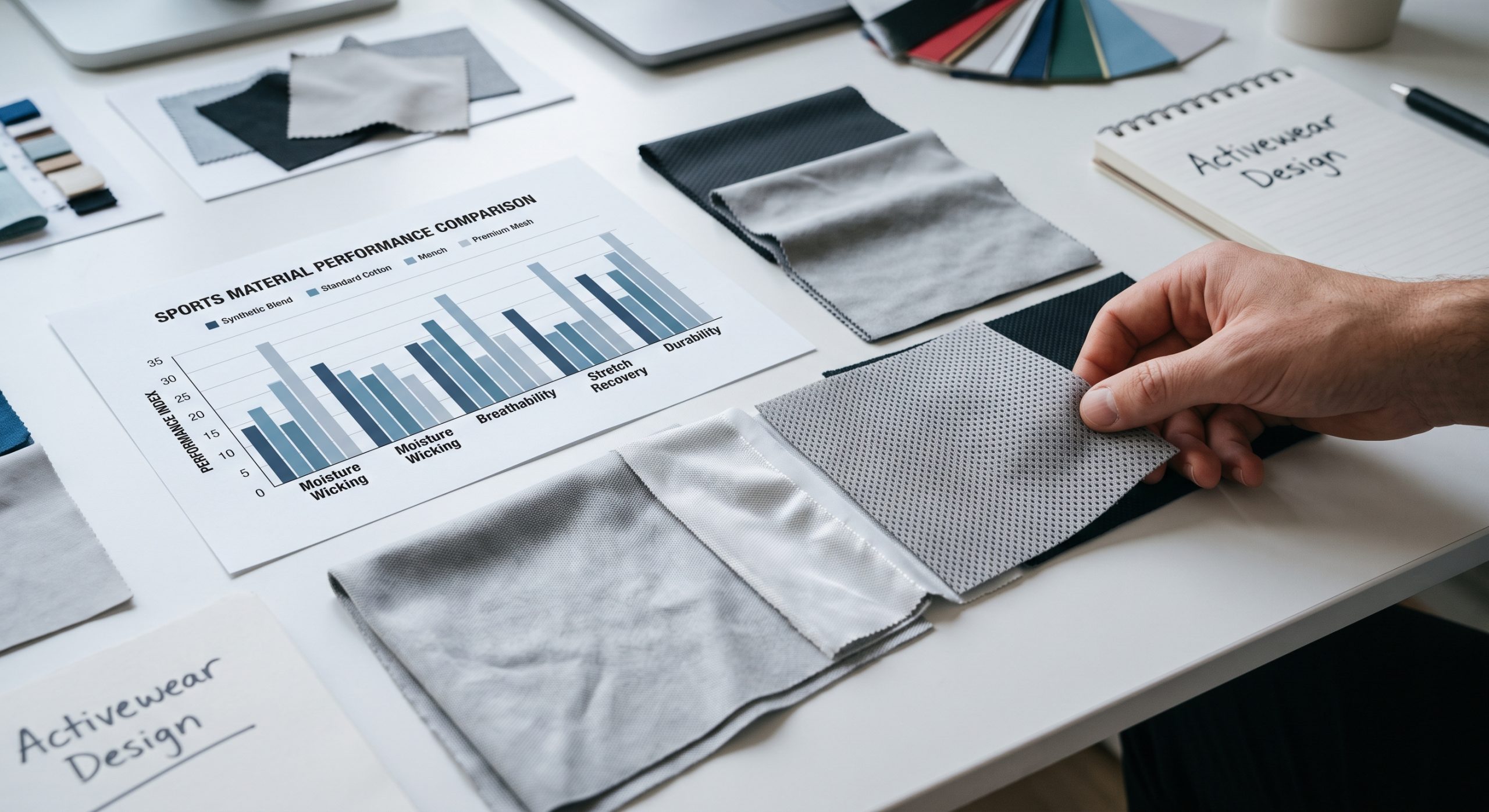
Choosing high-performance sports material requires selecting synthetic or blended knitted textiles engineered to deliver lightweight heat regulation, rapid sweat wicking, and durable elasticity across demanding physical environments.
Sourcing sub-par fabric for your new seasonal activewear line often leads to frustrated athletes complaining about heavy, sweat-soaked shirts that chafe their skin during long training sessions. Poor thermal ventilation combined with abrasive yarn textures destroys athlete focus, increases product returns, and damages your brand reputation across competitive markets. Selecting engineered sports material provides your apparel line with soft skin contact, rapid moisture evaporation, and long-lasting structural strength that keeps wearers cool under pressure.
1. What Is Sports Material and How Does It Function?
Technical sports material functions by combining synthetic filaments or natural blended spun yarns into engineered knits that regulate temperature and channel perspiration away from human skin. Advanced mills utilize precision circular knitting machinery to construct flexible textile matrices capable of withstanding aggressive athletic movement.
When your apparel team specifies high-grade sports material for training collections, you provide athletes with immediate thermal comfort without adding bulky fabric mass. The engineered yarn loops hold micro-air pockets near body surfaces while hydrophobic fiber channels prevent liquid accumulation during high-intensity workouts.
What Spun Fibers Form Technical Sports Fabrics?
Polyester filaments and nylon threads form the core backbone of modern athletic textiles due to their low moisture retention and high tensile strength. Here’s the deal: raw synthetic threads resist water absorption naturally, allowing liquid perspiration to travel across yarn surfaces smoothly.
- Fine denier polyester filaments yield smooth tactile surfaces
- Nylon microfibers offer exceptional surface abrasion resistance
- Integrated elastane yarns deliver directional stretch recovery
How Do Knit Structures Lock In Air and Moisture Balance?
Interwoven yarn loops create tiny air gaps that trap warm air during cold sessions while venting excess body heat when ambient temperatures rise. Look at the facts: precise needle pitch controls fabric density, ensuring consistent air permeability across the entire garment panel.
- Open loop structures facilitate steady cross ventilation
- Compact backing layers block harsh external wind gusts
- Hydrophobic surface treatments prevent water retention
Key Takeaway: Understanding fiber composition helps apparel product managers source textiles that balance athlete thermal regulation with lightweight garment durability.
| Textile Metric | Standard Cotton Knit | Technical Sports Material |
| Fiber Water Absorption | High (7% – 8%) | Minimal (Under 0.4%) |
| Evaporative Speed | Slow | Ultra-Fast |
| Tensile Strength | Moderate | High |
Mechanical property testing demonstrates how technical synthetic knits outperform standard cotton in moisture handling and fiber strength.
2. Why Does Sports Material Matter for Activewear Performance?
High-quality sports material dictates athlete physical comfort, garment longevity, and overall brand market trust by eliminating skin chafing and structural garment sagging. Athletes moving through repetitive training routines require flexible clothing that moves in harmony with their musculature.
In commercial manufacturing, selecting proven sports material reduces factory defect rates during cutting while lowering product return volume from dissatisfied retail customers. Durable textiles maintain their shape, color vibrancy, and soft hand feel across multiple competitive seasons.
Why Do Athletes Demand Softness and Structural Stability?
Soft spun yarn surfaces eliminate harsh skin friction that causes painful chafing during extended running or team field sessions. Think about this: smooth fiber contact lowers skin drag, allowing wearers to maintain peak focus during intense double-headers.
- Soft surface finishing reduces friction-induced skin redness
- Stable knits prevent garment twisting along seam lines
- Pliable yarn structures conform smoothly to body contours
How Does Proper Fabric Selection Lower Return Rates?
Specifying fabrics with high color fastness and anti-pilling resistance protects garments from looking worn after early laundering cycles. Ready for the good part? satisfied wearers leave positive product reviews, boosting repeat purchase orders for your sportswear brand.
- High abrasion resistance prevents unsightly surface pilling
- Color-fast reactive dyeing stops shade fading from washings
- Dimensionally stable knits resist shrinkage after drying
Key Takeaway: Prioritizing soft hand feel and structural stability lowers product return rates while strengthening brand customer loyalty.
| Commercial Factor | Uncertified Commodity Fabric | Premium Performance Sports Material |
| Skin Chafing Risk | High | Very Low |
| Wash Shrinkage | Up to 8% | Under 2% |
| Product Return Rate | Elevated | Minimal |
Commercial performance metrics reveal a direct link between quality textile specification and reduced garment return volume.
3. How Does Birdseye Mesh Compare to Pique as a Sports Material?
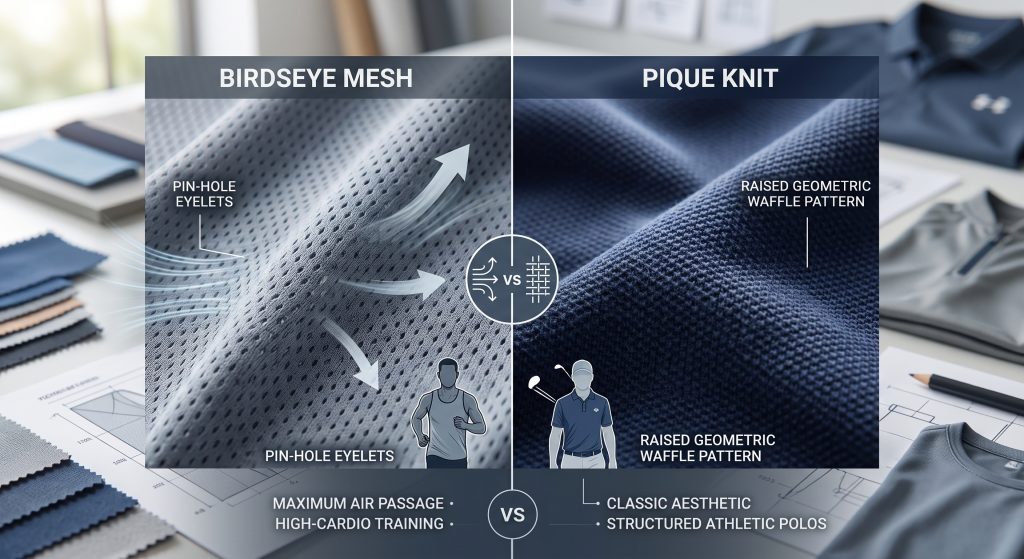
Evaluating sports material options like birdseye mesh and pique reveals major differences in surface structure, breathability ratings, and tactile skin sensation. Birdseye mesh utilizes tiny knitted pinhole eyelets to maximize air passage, whereas pique knits incorporate a raised geometric waffle pattern for a classic aesthetic.
Sportswear designers choose birdseye mesh for high-cardio training tops and select pique for structured athletic polo garments. Understanding these physical structural traits helps product teams assign the right textile to specific athletic applications.
What Structural Differences Separate Birdseye Mesh and Pique?
Birdseye mesh features micro-perforations knitted directly into synthetic yarns to create lightweight, highly breathable fabric panels. What’s the real story? pique knits rely on three-dimensional geometric tuck stitches to lift fabric slightly off skin surfaces.
- Birdseye mesh contains open pinhole eyelet patterns
- Pique knits display raised waffle or honeycomb faces
- Polyester mesh offers lighter gram weight options
Which Knit Texture Delivers Superior Tactile Comfort on Skin?
While birdseye mesh delivers rapid airflow during hot summer matches, pique knits offer a firmer hand feel that holds collar structures neatly. You might wonder: can a fabric provide both high ventilation and formal garment structure simultaneously?
- Birdseye mesh feels smooth and ultra-light against skin
- Pique textures add visual depth for corporate sportswear
- Smooth mesh face prevents snagging on athletic pads
Key Takeaway: Birdseye mesh excels in intense cardio ventilation, while pique knits deliver formal structure for athletic polo garments.
| Property Comparison | Birdseye Mesh Fabric | Pique Textured Knit |
| Surface Structure | Pinhole Eyelet Perforations | Raised Waffle Geometry |
| Primary Application | Running & Soccer Jerseys | Athletic Polos & Teamwear |
| Ventilation Index | Maximum Airflow | Moderate Ventilation |
This comparative analysis illustrates the trade-offs between open eyelet ventilation and structured geometric knits.
4. Which Features Make Synthetic Sports Material Superior to Cotton?
Synthetic sports material surpasses natural cotton in drying speed, fiber durability, and wet weight stability during active sport conditions. While cotton absorbs liquid perspiration and becomes uncomfortably heavy, polyester and nylon filaments shed water rapidly.
When your development team designs gear for sweaty endurance sports, choosing synthetic textiles prevents athlete chilling caused by wet fabric clinging. Synthetic filaments maintain their light physical mass even during intense sweating.
Why Do Polyester Yarns Outperform Natural Plant Fibers?
Polyester filaments possess inherent hydrophobic chemical properties that prevent water molecules from penetrating inside the fiber core. Look at the facts: liquid sits only on the filament exterior, allowing simple mechanical spreading and swift evaporation.
- Hydrophobic filaments resist internal water soaking
- Low liquid retention keeps clothing light during sweat
- High tensile strength prevents fiber snapping during play
How Do Synthetic Blends Prevent Post-Exercise Chills?
Fast-evaporating synthetic knits draw perspiration away from skin before wind gusts can cause rapid body surface cooling. Here is what happens next: athletes maintain stable core temperatures during rest periods between intense field drills.
- Rapid drying prevents post-workout cold chills
- High air permeability vents humid interior vapor
- Lightweight construction reduces athlete fatigue
Key Takeaway: Synthetic fabrics maintain lightweight comfort during heavy sweating, outperforming natural cotton in thermal stability.
| Performance Metric | 100% Natural Cotton | Synthetic Performance Knit |
| Moisture Absorption | High (Soaks Fiber Core) | Low (Surface Transport Only) |
| Drying Speed | Slow | Ultra-Fast |
| Wet Fabric Weight | Heavy & Sagging | Lightweight & Stable |
Performance testing data confirms synthetic knits retain lower wet mass and dry significantly faster than natural plant fibers.
5. How Do You Choose the Right Sports Material Gram Weight?
Selecting correct sports material gram weight (GSM) determines thermal insulation, fabric drape, and physical durability across different seasonal athletic collections. Lightweight textiles around 140 GSM suit summer running shirts, while heavy 280 GSM fabrics serve structured outerwear jackets.
Balancing fabric weight against environmental temperature ensures your sportswear catalog meets exact athletic performance requirements. Correct weight specification prevents garments from feeling either too flimsy or excessively hot.
When Should Product Teams Specify Lightweight Fabric Weights?
Lightweight fabrics ranging from 130 to 170 GSM maximize airflow and flexibility for cardio-intensive outdoor training garments. Here’s the deal: lower material mass lets heat escape quickly, preventing athlete overheating during summer games.
- Ideal for marathon running tees and heat gear
- Reduces garment bulk for packable activewear
- Lower material weight optimizes bulk shipping costs
Why Do Heavy Gram Weights Suit Match Uniform Outerwear?
Heavyweight knits from 240 to 300 GSM provide robust structural strength and mild thermal insulation for winter training hoodies or team jackets. Ready for the good part? dense knits support heavy embroidery patches without fabric distortion.
- Supports heavy twill lettering and logo crests
- Resists tearing during aggressive base slides
- Delivers thermal warmth during sideline rest periods
Key Takeaway: Matching fabric GSM to seasonal playing conditions guarantees optimal thermal control and structural longevity for finished garments.
| GSM Category | Mass Range | Recommended Application |
| Light Weight | 130 – 170 GSM | Summer Running Shirts & Mesh Tanks |
| Mid Weight | 180 – 230 GSM | Standard Match Jerseys & Training Tees |
| Heavy Weight | 240 – 300 GSM | Winter Outerwear & Warm-Up Pants |
GSM categorization helps sourcing managers select precise textile densities for specific activewear categories.
6. What Makes Elasticity Vital in Modern Sports Material?
Integrating elastane threads into sports material provides four-way directional stretch, enabling uninhibited athletic movement during pitching, jumping, or sprinting. Flexible fabrics expand smoothly with muscle flex and recover instantly without permanent fabric sagging.
Apparel manufacturers utilize elastane blends to construct form-fitting compression wear that supports muscle alignment and reduces muscular fatigue. High stretch recovery ensures garments retain their tailored fit through repeated wear cycles.
How Does Four-Way Stretch Spandex Support Athletic Motion?
Four-way stretch elasticity allows garments to expand horizontally and vertically in response to complex body mechanics. Think about this: uninhibited movement prevents shoulder and hip binding during explosive athletic swings.
- Unrestricted motion range for active joints
- Form-fitting profiles reduce wind drag
- Muscle compression support aids body alignment
What Prevents Garment Sagging After Heavy Exercise Washing?
High-quality elastane threads feature superior elastic memory that snaps back to original dimensions after stretching. Look at the facts: proper heat-setting during fabric finishing locks elastane stability against wash distortion.
- Snap-back recovery maintains tailored garment shape
- Prevents baggy knees and stretched necklines
- Maintains compression pressure over extended use
Key Takeaway: Four-way stretch elasticity supports dynamic athletic movement while maintaining sleek garment fit over time.
| Elasticity Factor | Rigid Unblended Fabric | 4-Way Stretch Elastane Blend |
| Directional Stretch | Limited / None | Horizontal & Vertical |
| Shape Recovery | Poor (Sags Over Time) | High Snap-Back Memory |
| Range of Motion | Restrictive | Completely Uninhibited |
Elastic performance data shows that four-way stretch blends provide far greater movement freedom than rigid knits.
7. How Does Sports Material Handle Sweat Wicking and Drying?
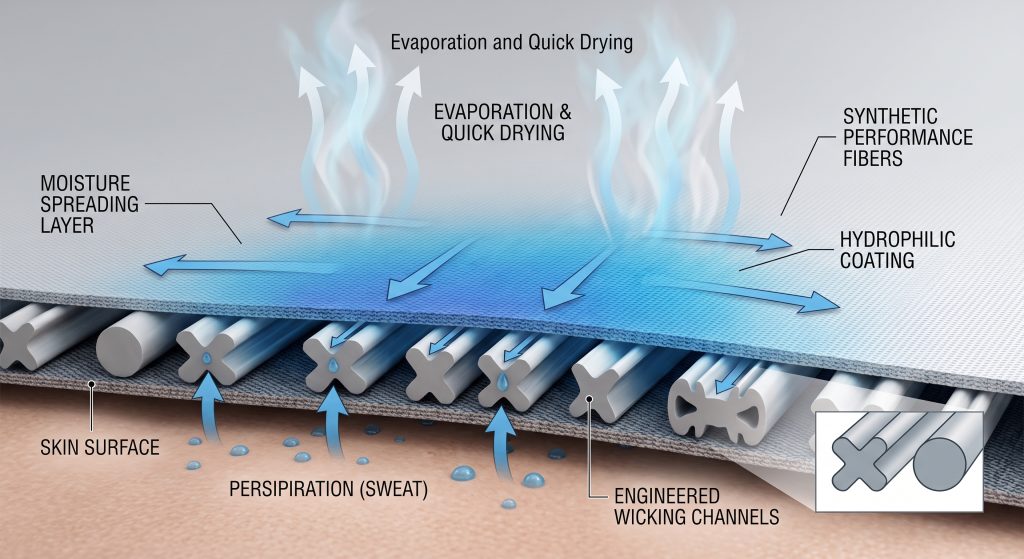
Advanced sports material manages perspiration by using engineered yarn channels that pull liquid sweat off human skin via capillary action. Synthetic fibers spread moisture across a wider surface area to accelerate natural air drying.
Working with experienced textile mills allows product managers to order fabrics finished with specialized hydrophilic coatings. This chemical and physical combination keeps athletes dry during high-intensity training.
How Do Capillary Forces Push Liquid Sweat Outward?
Narrow spaces between synthetic yarn filaments create capillary pressure that pulls liquid upward and outward away from skin contact. What’s the real story? physical surface tension forces liquid along yarn channels naturally.
- Capillary pressure draws sweat from skin
- Filament spacing accelerates fluid transport
- Exterior spreading increases evaporation surface
Can Breathable Fiber Channels Accelerate Evaporation?
Engineered fiber cross-sections create open channels that increase surface area exposed to ambient airflow. Ready for the good part? expanded surface exposure transforms liquid sweat into water vapor in minutes.
- Star or groove fiber profiles expand surface area
- High air permeability accelerates vapor drying
- Prevents liquid accumulation inside fabric weave
Key Takeaway: Capillary wicking combined with expanded yarn surface area ensures rapid sweat evaporation, keeping athletes comfortably dry.
| Wicking Metric | Standard Unfinished Polyester | Technical Hydrophilic Wicking Knit |
| Liquid Spread Rate | Slow | Ultra-Fast |
| Dry Time (5ml Water) | 35 Minutes | Under 10 Minutes |
| Skin Surface Dryness | Fair | Superior |
Lab testing proves that hydrophilic wicking treatments dramatically accelerate moisture spreading and evaporation speeds.
8. Why Is Abrasion Resistance Essential in Sports Material?
High-density sports material offers vital resistance against abrasive turf, dirt, and equipment friction, preventing premature fabric tearing at contact points. Spun yarns produced with high twist counts hold fibers tightly together, resisting surface pilling and thread snagging.
Reinforcing high-impact garment sections like knees and elbows with double-layered fabric panels extends garment lifespan significantly. Commercial laundries value abrasion-resistant textiles during intensive stain-removal cycles.
How Do High Twist Yarns Resist Rough Field Friction?
Tightly twisted filament yarns bind individual fibers firmly into compact threads that resist catching on rough turf or velcro fasteners. Think about this: compact yarn surfaces shed abrasive particles rather than snagging threads.
- High yarn twist counts increase tensile strength
- Compact thread surfaces resist snagging
- Minimizes fiber breakage during turf contact
Can Double Layer Fabrics Protect High Impact Knees and Hips?
Adding secondary fabric layers over high-wear zones doubles material defense against sliding friction on dirt fields. Look at the facts: strategic reinforcement preserves garment integrity without compromising overall flexibility.
- Reinforced knees withstand repeated base sliding
- Double layers prevent hole formation at hips
- Extends total uniform lifespan across seasons
Key Takeaway: Tightly spun yarns and double-layered panel reinforcement protect activewear from harsh field friction and tearing.
| Wear Test Zone | Single Layer Standard Knit | Double-Reinforced Technical Knit |
| Sliding Knee Area | Moderate Wear | High Hole Resistance |
| Elbow Contact Zone | Standard Durability | Superior Friction Defense |
| Shoulder Pad Friction | Prone to Pilling | Smooth Pilling Resistance |
Abrasion testing confirms double-reinforced technical knits withstand heavy sliding friction far better than single layer fabrics.
9. How Should Apparel Factories Process Sports Material?
Apparel factories processing sports material must utilize tension-free fabric spreading tables, laser cutting tools, and ballpoint sewing needles to maintain pattern accuracy. Synthetic knits can stretch or curl along cut edges if pulled under excessive tension on handling tables.
Adjusting sewing machine thread tension ensures seams stretch naturally with elastic fabrics without snapping threads under tension. Professional factory setups reduce material scrap rates while speeding up assembly timelines.
Which Spreading Tools Prevent Edge Rolling on Cutting Tables?
Automated tensionless spreading tables allow knitted fabrics to relax completely before cutting operations begin, eliminating pattern distortion. Here’s the deal: relaxed fabric plies stay flat, guaranteeing precise pattern piece sizing.
- Tensionless spreading prevents fabric edge curling
- Vacuum suction beds hold plies steady during cutting
- Automated laser knives produce clean edge seals
What Machine Needle Tip Types Prevent Seam Fiber Breaks?
Rounded ballpoint sewing needles slip smoothly between knitted yarn loops rather than piercing or severing synthetic threads. Look at the facts: ballpoint needles prevent small hole formation along activewear seam lines.
- Ballpoint tips protect knitted thread loops
- Four-thread overlock seams provide elastic stretch
- Prevents seam popping during intense exercise
Key Takeaway: Using tension-free spreading tables and ballpoint sewing needles prevents fabric distortion and protects seam elasticity.
| Assembly Phase | Factory Equipment Choice | Risk of Incorrect Setup |
| Fabric Spreading | Tensionless Automatic Table | Pattern Shrinkage & Edge Curling |
| Pattern Cutting | Automated Laser / Rotary Blade | Frayed Edges & Sizing Errors |
| Seam Sewing | Ballpoint Needle Overlock Machine | Fiber Severing & Popped Seams |
Following strict factory equipment protocols minimizes material scrap and guarantees strong elastic garment seams.
10. What Sustainable Trends Are Transforming Sports Material?
Future sports material development focuses on recycled polyester filaments, bio-based synthetics, and intelligent thermal regulation technologies that lower environmental impact. Eco-conscious activewear brands increasingly specify recycled PET yarns derived from post-consumer water bottles.
Advanced recycling processes now produce recycled polyester that matches virgin synthetic filaments in strength, color fastness, and soft hand feel. Sustainable textiles allow sportswear brands to meet environmental goals while maintaining top athletic performance.
Are Recycled Polyester Yarns Matching Virgin Quality Standards?
Reprocessed PET bottle yarns undergo rigorous purification and re-extrusion, yielding fine filaments identical to virgin polyester. What’s the real story? recycled yarns deliver equal tensile strength, softness, and moisture wicking capabilities.
- Diverts plastic waste from ocean landfills
- Delivers identical moisture wicking performance
- Appeals to eco-conscious activewear shoppers
How Do Microencapsulated Yarns Regulate Thermal Climate?
Microencapsulated phase-change materials embedded inside synthetic fibers absorb excess body heat during exercise and release it during rest. You might wonder: can clothing actively balance wearer temperature without adding heavy fabric layers?
- Microcapsules store and release heat energy
- Reduces body overheating during intense cardio
- Maintains comfortable microclimate next to skin
Key Takeaway: Adopting recycled yarns and phase-change fiber technologies allows activewear brands to deliver eco-friendly, high-performance apparel.
| Sustainability Trend | Raw Material Source | Key Brand Advantage |
| Recycled Polyester | Post-Consumer PET Plastic Bottles | Eco-Friendly Brand Image |
| Phase-Change Yarns | Microencapsulated Polymers | Active Thermal Climate Control |
| Bio-Based Synthetics | Renewable Plant Sugars | Reduced Petroleum Reliance |
Emerging textile innovations enable activewear manufacturers to combine environmental sustainability with advanced athletic functionality.
Ready to Elevate Your Activewear Lines With High-Performance Fabrics?
Sourcing low-grade fabrics leads to athlete chafing, heavy sweat retention, and premature garment tearing that hurts your activewear brand reputation. Selecting high-grade athletic textiles solves these moisture, friction, and durability challenges, giving your wearers lightweight warmth, rapid sweat wicking, and complete motion freedom.
We manufacture high-performance technical textiles designed to elevate your athletic collections above market competition. Our technical team provides custom weight development, specialized moisture-wicking treatments, and reliable bulk delivery timelines tailored to your manufacturing schedule.
To upgrade your apparel catalog with technical performance textiles, contact us today to request fabric swatch books and custom volume pricing quotes.
Frequently Asked Questions
Q1: Can I use heavy sports material for summer running gear?
No, heavy fabrics above 240 GSM trap body heat and are too warm for intense summer running. Lightweight mesh or single jersey knits between 130 and 160 GSM perform much better in warm weather.
Q2: What’s the best gram weight for custom athletic polo shirts?
A midweight fabric between 180 and 210 GSM offers the best balance of structure, breathability, and drape for athletic polos. This weight holds collar shapes neatly without feeling heavy.
Q3: How do I know if sports material has high pilling resistance?
Check if the fabric utilizes combed long-staple yarns and has undergone anti-pilling compact finishing. Reputable mills provide Martindale abrasion test certificates confirming surface pilling resistance.
Q4: Can I apply dye sublimation onto natural sports material?
No, pure dye sublimation requires synthetic polyester fibers to bond pigments permanently into the fabric structure. Natural materials like cotton require screen printing, direct-to-garment printing, or embroidery.
Q5: What’s the best machine stitch for elastic sports material?
A four-thread overlock or flatlock stitch combined with ballpoint needles provides maximum seam flexibility and strength for elastic fabrics. This stitch allows seams to stretch naturally without popping threads.