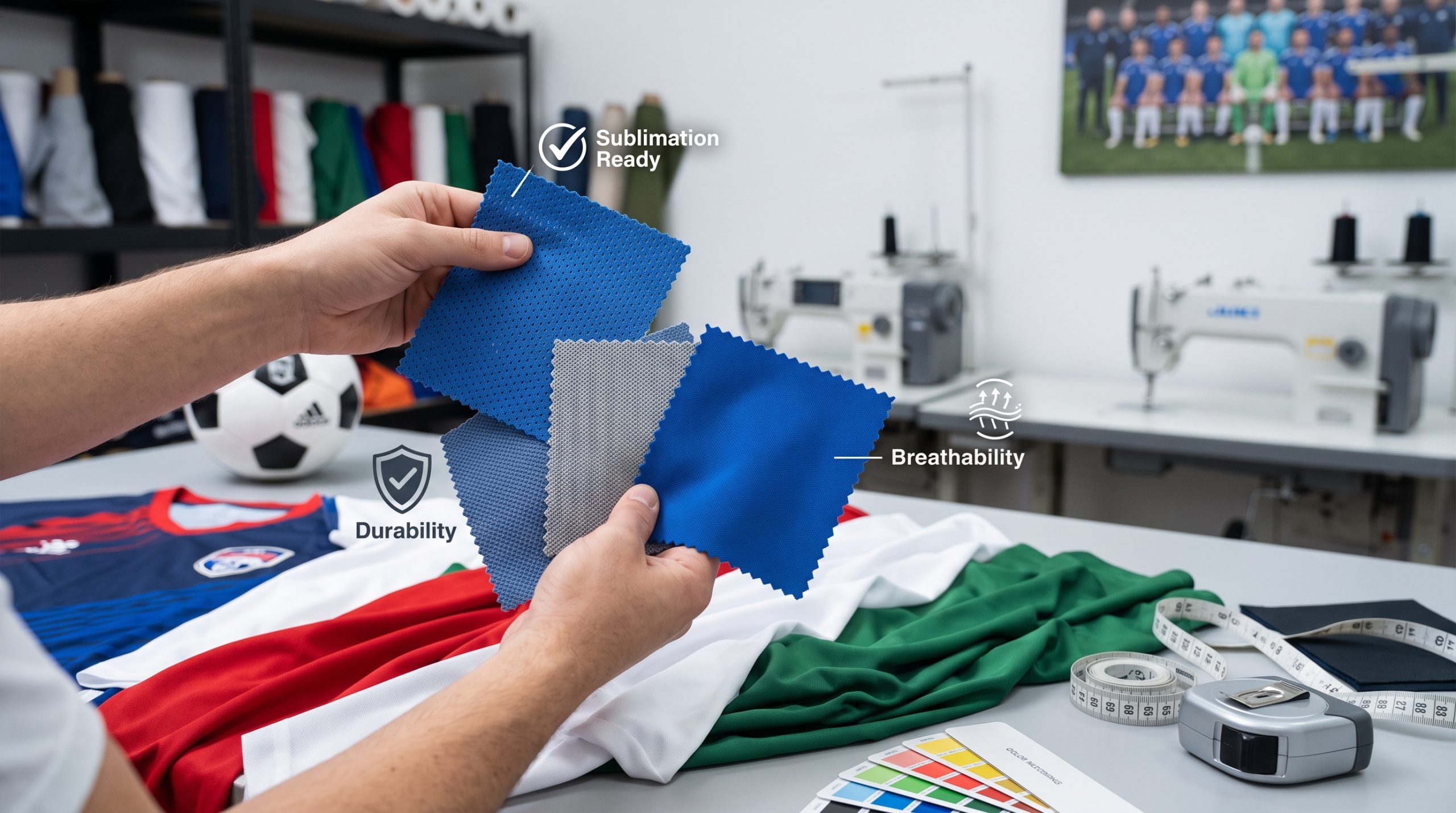
Selecting performance fabric determines whether custom athletic uniforms maintain professional appearance, ventilation, and durability throughout an intense sporting season. Imagine placing a massive production order for custom soccer jerseys, only to receive itchy, heavy garments that trap sweat and fade after three industrial wash cycles. Players complain about heavy wetness, coaches express frustration over peeling sublimated numbers, and brand managers face costly product returns that damage commercial reputation. Sourcing high-grade team fabric engineered for activewear applications eliminates these garment performance failures by providing rapid moisture dispersion, soft tactile comfort, and print clarity. Professional sportswear procurement teams rely on specialized synthetic knit structures to deliver top-grade uniforms for high-level athletic competition.
1. What makes birdseye mesh a top team fabric?
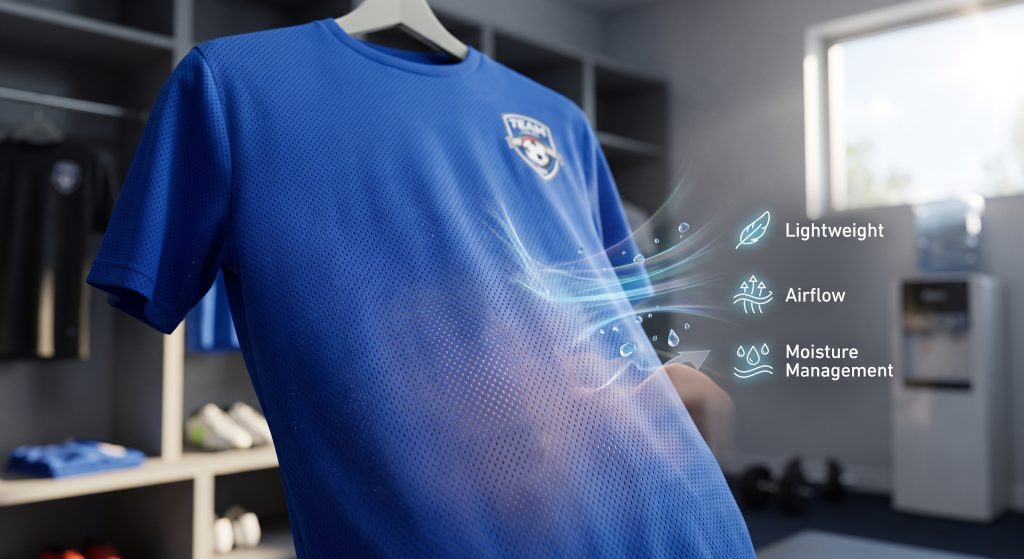
Birdseye mesh features a lightweight synthetic knit structure defined by small woven pinholes that maximize continuous airflow across active body zones. Commercial sportswear manufacturers select this specialized team fabric because micro-vents draw perspiration away from skin to accelerate liquid surface evaporation during heavy exercise. You receive lightweight athletic apparel that maintains structural stability while keeping athletes cool on the field.
How does the birdseye structure work?
Birdseye knits feature microscopic circular openings embedded directly within continuous polyester filament yarns. Here is the deal, these engineered micro-pores act as miniature ventilation channels that pull trapped body heat outward while drawing cool ambient air inward. You get rapid moisture management without compromising fabric opacity or tear strength.
- Micro-pinholes accelerate surface sweat evaporation
- Hydrophobic polyester filaments block liquid absorption
- Smooth interior surface prevents active skin friction
Why do players prefer birdseye hand-feel?
Soft yarn finishing gives birdseye mesh a flexible hand-feel that glides smoothly against human skin during quick sprinting motions. Synthetic fiber flexibility reduces friction against chest and shoulder zones during long training sessions. You protect active players from skin chafing while maintaining light garment weight.
Key Takeaway: Selecting birdseye mesh guarantees high airflow and soft tactile comfort for fast-moving sports like basketball and track.
| Material Property | Birdseye Performance Level | Commercial Benefit |
| Air Permeability | Maximum (180-220 CFM) | Prevents athlete thermal fatigue |
| Surface Weight | Lightweight (130-150 GSM) | Minimizes physical movement drag |
| Tactile Texture | Soft Micro-Pinhole | Eliminates skin chafing risks |
This performance data confirms why birdseye mesh serves as a preferred choice for high-speed athletic apparel collections.
2. Why select pique mesh as your team fabric?
Pique mesh provides a textured geometric waffle weave that delivers structural body, anti-clinging capabilities, and professional garment drape. Sourcing this durable team fabric allows activewear designers to create tailored athletic shirts, coaching polo tops, and structured team uniforms. You get a resilient textile that holds crisp shape through repeated physical wear and industrial laundering.
What gives pique mesh structural body?
Parallel raised cords and fine waffle knits create a three-dimensional surface architecture that keeps fabric slightly elevated off skin. What is the real story, this raised geometry prevents wet activewear from clinging to sweaty muscle groups during physical exertion. You maintain a clean, professional uniform appearance even under heavy sweat conditions.
- Raised waffle knits reduce direct fabric-to-skin contact
- Textured surface structure adds visual depth to apparel
- Strong yarn interlock retains sharp tailored garment fit
Is pique mesh durable for active sports?
Thicker interlooping yarn paths give pique knits high resistance against surface pulls, snags, and mechanical abrasion. High filament density prevents threads from loosening when garments contact turf surfaces or equipment straps. You cut warranty returns by choosing fabrics built for long-term athletic wear.
Key Takeaway: Pique mesh delivers crisp garment structure, anti-cling elevation, and durability for active sidelines and sports.
| Material Property | Pique Mesh Level | Commercial Benefit |
| Fabric Structure | 3D Geometric Waffle | Prevents wet fabric clinging |
| Surface Weight | Medium (160-200 GSM) | Provides crisp tailored drape |
| Snag Resistance | High Grade | Survives mechanical equipment friction |
This evaluation demonstrates how pique mesh provides structural stability for premium athletic team apparel lines.
3. How does birdseye compare to pique team fabric?
Birdseye mesh offers lighter weight and higher breathability, whereas pique mesh delivers structural body, anti-snag resistance, and formal appearance. Evaluating both variants of team fabric allows procurement managers to match textile characteristics with specific athletic requirements. You balance thermal cooling against long-term garment durability across dynamic sport environments.
Which weave offers superior breathability?
Birdseye knits deliver higher CFM air permeability values due to open pinhole micro-ventilation channels. Ready for the good part, open circular pores evaporate heavy sweat faster than dense textured weaves during hot summer matches. You keep endurance runners and soccer athletes cool under warm weather conditions.
- Birdseye pinholes yield faster liquid evaporation rates
- Pique waffle knits offer moderate airflow with insulation
- Open knits reduce total fabric mass for lightweight speed
How do tactile textures differ?
Birdseye features a smooth, flat surface feel, while pique displays a distinct tactile geometric grain with firm hand-feel. Smooth birdseye textures work best for tight performance tops worn directly against torso skin. Pique surfaces excel on collar polos, sideline jackets, and structured team jerseys.
Key Takeaway: Choose birdseye mesh for ventilation during high-sweat speed sports, and select pique mesh for structured team uniforms.
| Metric Comparison | Birdseye Mesh | Pique Mesh |
| Average GSM Weight | 130 – 150 GSM | 160 – 200 GSM |
| Breathability Score | 9.5 / 10 | 7.8 / 10 |
| Fabric Drape | Soft & Flexible | Structured & Firm |
| Primary Application | Basketball, Soccer, Track | Golf, Polo Shirts, Sideline Gear |
This direct comparison matrix simplifies textile selection for sportswear brands developing diverse team apparel categories.
4. Which team fabric handles sublimation best?
100% polyester synthetic knits handle dye sublimation heat transfer printing best by forming permanent molecular bonds with disperse dyes. Selecting high-grade team fabric manufactured from bright white prepared-for-dyeing polyester yarn guarantees sharp graphic definition, bold team colors, and zero image peeling. You receive custom sublimated jerseys that keep vivid graphics intact through years of hard play.
Why does polyester absorb dye so well?
Polymer filaments open their molecular structure under high heat press temperatures, allowing vaporized disperse dyes to sink directly into fiber cores. This is where it gets interesting, cooling locks color pigments permanently inside synthetic fibers rather than sitting on fabric surfaces. You produce sublimated team apparel that never cracks, peels, or fades over time.
- High heat tolerance preserves structural fabric shape
- Deep dye absorption delivers rich color saturation
- Permanent color bonding resists harsh laundry detergent
How to prevent color bleed during heat press?
Maintaining consistent polyester fiber quality prevents uneven ink absorption and ghosting during press operations. Pre-shrunk synthetic rolls eliminate fabric shrinkage distortions when exposed to 200°C sublimation heat plates. You achieve crisp vector graphics and sharp sponsor logos across every production run.
Key Takeaway: Utilizing 100% bright white polyester textiles guarantees vibrant, durable sublimated printing results without graphic degradation.
| Sublimation Factor | Technical Requirement | Print Result |
| Fiber Composition | 100% Hydrophobic Polyester | Permanent dye core penetration |
| Heat Tolerance | Stable at 200°C / 400°F | Zero fabric shrinkage or yellowing |
| Surface Whiteness | High PFD Brightness | Sharp visual contrast and accurate colors |
This technical breakdown highlights why pure polyester fabrics remain the primary standard for custom sublimated team sportswear.
5. How does weight impact performance team fabric?
Fabric weight directly dictates athletic movement freedom, thermal regulation, and overall garment durability across different sport seasons. Choosing lightweight or heavyweight team fabric allows apparel brands to balance agility against wear resistance. You customize team uniform lines to meet exact environmental and physical demands.
When should you choose lightweight GSM knits?
Lightweight fabrics ranging from 110 to 140 GSM work best for high-speed endurance sports requiring heat dissipation. You might be wondering, how does lower fabric mass improve athletic performance over long distances? Reducing clothing weight cuts physical body exertion while allowing rapid moisture evaporation during hot summer competitions.
- Sub-140 GSM weights minimize runner limb movement resistance
- Thin fiber matrices speed up surface sweat evaporation
- Lightweight activewear packs easily for team travel logistics
What are the benefits of heavy GSM weaves?
Heavyweight fabrics between 180 and 240 GSM deliver high opacity, thermal retention, and mechanical strength for contact sports. Thicker knit structures resist physical pulling, ground abrasion, and cold ambient wind during outdoor winter games. You supply dependable winter activewear built to withstand physical contact.
Key Takeaway: Match low GSM knits with high-speed summer sports, and reserve high GSM fabrics for contact sports or cold weather.
| GSM Category | Weight Range | Recommended Sport | Key Performance Benefit |
| Ultra-Lightweight | 110 – 135 GSM | Running, Marathon | Minimal body movement drag |
| Mid-Weight | 140 – 170 GSM | Basketball, Soccer | Balanced comfort & strength |
| Heavyweight | 180 – 240 GSM | Rugby, American Football | High abrasion & tear resistance |
This weight classification chart helps sportswear buyers select precise fabric densities for target athletic disciplines.
6. What team fabric offers maximum durability?
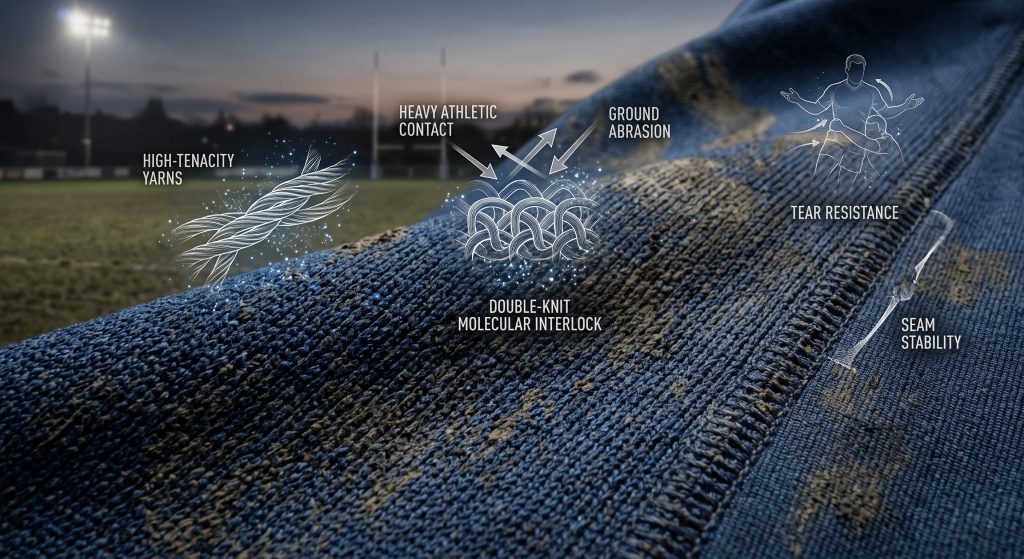
High-tenacity nylon blends and double-knit polyester structures offer maximum physical durability under heavy athletic contact. Sourcing resilient team fabric protects garments from surface tearing, seam splitting, and severe ground abrasion during intense physical matches. You deliver sports apparel that retains structural integrity across multiple competitive playing seasons.
How do high-tenacity yarns block tears?
High-tenacity filament bundles distribute mechanical pull forces evenly across continuous synthetic thread matrices. Here is the truth, molecular cross-linking prevents individual yarn strands from snapping under sudden tensile strain. You protect active players from embarrassing jersey tears during aggressive contact games.
- Twisted filament strands resist mechanical tension
- Interlocked weave structures arrest minor fabric punctures
- Polymer surfaces withstand rough synthetic turf friction
Why do double knits withstand rough contact?
Double-knit constructions utilize two sets of needle beds to interlock two fabric layers into a dense, unified textile. Double density prevents surface snags from penetrating through the garment to protect player skin underneath. You cut product replacement costs by supplying double-knit team gear.
Key Takeaway: Utilizing high-tenacity nylon and double-knit constructions guarantees long-term garment resilience against physical wear.
| Durability Standard | High-Tenacity Nylon | Standard Polyester | Single Jersey Cotton |
| Tensile Strength | High (6.5+ g/denier) | Moderate (4.5 g/denier) | Low (2.2 g/denier) |
| Martindale Rub Cycles | 50,000+ Cycles | 25,000 Cycles | 8,000 Cycles |
| Tear Resistance | Superior | Good | Poor |
This comparative data proves why high-tenacity synthetic textiles lead the market in athletic apparel manufacturing.
7. How do breathability factors shape team fabric?
Air permeability and moisture vapor transmission rates dictate how effectively a team fabric regulates human core body temperature. Integrating open-pore knit geometries into activewear allows heat vapor to escape while drawing ambient cooling currents inward. You keep active athletes comfortable and focused during prolonged physical workouts in high-heat environments.
How does porosity speed up sweat drying?
Open-pore fabric channels expand liquid surface exposure to surrounding airflow, accelerating liquid sweat evaporation. What comes next, rapid drying eliminates wet fabric cling and heavy water weight buildup on active players. You maintain light garment weight throughout competitive matches.
- Open micro-pores create continuous cooling airflow
- High vapor transmission rates prevent internal overheating
- Hydrophobic fibers shed moisture rapidly after sweating
Can open knits maintain opacity on field?
Engineered micro-mesh structures position pinholes strategically to maintain fabric opacity while providing ventilation performance. Specialized yarn twisting techniques block direct light transmission without restricting airflow through the garment matrix. You deliver breathable athletic shirts that remain non-see-through when damp.
Key Takeaway: High air permeability combined with strategic opacity management keeps players cool and confident under competition.
| Porosity Metric | High-Airflow Mesh | Solid Interlock Knit | Commercial Impact |
| Airflow Rate (CFM) | 200+ CFM | 35-50 CFM | 4x faster cooling response |
| Drying Time (Minutes) | 12 Minutes | 35 Minutes | Eliminates heavy sweat retention |
| Fabric Opacity | 92% Non-Transparent | 99% Non-Transparent | Maintains player privacy when wet |
This comparative analysis highlights the direct relationship between knit porosity, drying speed, and garment opacity.
8. What team fabric fits contact sports best?
Heavyweight polyester-elastane interlock fabrics fit contact sports best by combining high tensile strength with four-way stretch flexibility. Sourcing this heavy-duty team fabric prevents jersey ripping during tackle situations while allowing uninhibited player movement. You supply professional contact sport teams with resilient uniforms built for aggressive physical play.
Why do rugby uniforms need heavy interlock?
Heavy interlock fabrics feature thick double-knit structures that resist tearing when opponents grab or pull player garments. What is the secret, smooth dense surfaces offer minimal grip leverage to opposing players during contact tackles. You gain competitive performance advantages by equipping teams with tough interlock apparel.
- High fabric weight (220-280 GSM) resists heavy pulling forces
- Smooth double-face finish reduces opponent hand grip leverage
- Reinforced yarn interlock prevents seam burst under strain
How to prevent seam splitting under pressure?
Combining high-tenacity polyester thread with four-way elastane stretch permits fabric seams to elongate under tension without snapping. Flatlock seam stitching spreads pull forces across six parallel thread lines for joint security. You eliminate seam repairs and broken stitches during aggressive sports matches.
Key Takeaway: Heavy interlock fabrics paired with flatlock seam stitching prevent jersey tearing during contact sports.
| Contact Sport Feature | Heavy Interlock Requirement | Athletic Benefit |
| Fabric Weight | 220 – 280 GSM | Resists aggressive jersey pulling |
| Stretch Elasticity | 15-20% 4-Way Spandex | Allows full shoulder joint mobility |
| Seam Construction | Flatlock 6-Thread Stitch | Eliminates seam popping under stress |
This requirement table details the structural standards necessary for manufacturing durable contact sport athletic wear.
9. How to evaluate color consistency in team fabric?
Evaluating color consistency requires inspecting fabric rolls under standardized light boxes to verify Delta E color variance values below 1.0. Quality control on every batch of team fabric guarantees exact shade matching between initial apparel production and future re-orders. You protect brand reputation by delivering uniform color matching across entire team rosters.
What causes shade variance between batches?
Variations in dye bath temperature, chemical immersion timing, or raw yarn sources create subtle shade shifts across mill runs. Ready to see results, digital color measurement protocols detect microscopic shade shifts before cutting and sewing begins. You prevent mismatched uniform tops and bottoms in commercial shipments.
- Temperature fluctuations alter synthetic dye absorption rates
- Different yarn spinning lots reflect light with slight variance
- Digital tools verify precise dye accuracy
How to verify dye lot stability before sewing?
Require textile suppliers to provide lab dip swatches and batch test reports prior to approving bulk fabric shipments. Inspecting sample yards under daylight D65 and store light sources confirms color stability across different environments. You guarantee consistent team uniform colors across re-orders.
Key Takeaway: Digital color testing and certified lab dips guarantee shade matching across initial orders and future team re-orders.
| Color Quality Metric | Target Standard | Risk of Non-Compliance |
| Delta E Color Variance | < 1.0 (Strict Pass) | Mismatched shirt and pant shades |
| Color Fastness to Washing | Grade 4.5+ (AATCC Test) | Dye bleeding during hot laundry cycles |
| Color Fastness to Perspiration | Grade 4.0+ (ISO Test) | Color fading around neck and underarms |
This quality control benchmark table outlines essential standards for maintaining consistent color accuracy in commercial textile manufacturing.
10. How to source high quality team fabric in bulk?
Sourcing high-quality bulk fabrics requires partnering with certified textile mills that maintain ISO quality management and OEKO-TEX environmental credentials. Vetting commercial suppliers guarantees consistent yarn quality, competitive volume pricing, and reliable delivery lead times for seasonal apparel lines. You secure a stable supply chain that supports your growing sportswear business.
What mill credentials should you verify?
Verify that your fabric manufacturer holds international quality certifications and operates circular knitting machinery. Here is the strategy, auditing factory production capacity confirms the mill can handle order volume spikes without compromising quality. You establish manufacturing partnerships that protect your delivery schedules.
- ISO 9001 certification confirms quality control systems
- OEKO-TEX Standard 100 guarantees eco-friendly textiles
- High monthly output capacity secures order fulfillment
How to balance order volumes with lead time?
Establish flexible minimum order quantity thresholds with your fabric supplier to accommodate prototype sampling and bulk orders. Maintaining strategic buffer inventory of core white PFD sublimation fabric reduces turnaround time for urgent custom orders. You deliver custom athletic gear faster than market competitors.
Key Takeaway: Partnering with certified textile mills and maintaining core fabric stock secures lower production costs and fast order delivery.
| Supplier Criteria | Standard Target | Business Value |
| Quality Certification | ISO 9001 & OEKO-TEX 100 | Guarantees safe, high-grade fabric quality |
| Minimum Order Quantity | Low MOQ (100 kg per color) | Reduces capital risk for sample orders |
| Production Lead Time | 10 – 14 Days Bulk Turnaround | Ensures rapid market delivery for team re-orders |
This procurement checklist helps commercial apparel buyers select reliable textile manufacturing partners for bulk fabric supply.
Selecting specialized athletic fabrics eliminates performance failures such as sweat pooling, garment tear, color fading, and athlete discomfort. This comprehensive buyer guide reviewed technical knit choices—including breathable birdseye mesh, structured pique knits, sublimated polyesters, and heavy-duty interlocks—enabling activewear brands to build superior athletic apparel lines. Our technical fabric manufacturing capabilities help sportswear companies deliver durable, high-performance team uniforms that excel in competitive markets. To elevate your team apparel line with technical textiles, contact us today for expert textile consultation and custom fabric sampling.
- Q1: Can I use birdseye mesh for sublimated basketball jerseys?
Yes, birdseye mesh is an ideal choice because its hydrophobic polyester fibers absorb disperse dyes deeply while open pinholes maintain player cooling during fast games. - Q2: What’s the best weight for soccer team jerseys?
Lightweight fabrics between 130 and 150 GSM work best because they cut garment mass and accelerate sweat evaporation during continuous running. - Q3: How do I know if pique mesh is suitable for team polo shirts?
Checking fabric structure confirms suitability because pique mesh features a raised geometric waffle knit that provides crisp tailored drape and prevents wet fabric cling. - Q4: Can I order low minimum quantities for custom team fabrics?
Yes, working with flexible textile manufacturers allows you to place low minimum bulk orders starting at 100 kilograms to test new team sportswear colors and prints. - Q5: What’s the best way to prevent color bleeding during printing?
Using pre-shrunk 100% white polyester fabric and maintaining stable 200°C press temperatures ensures disperse dyes bond permanently inside synthetic fiber cores without bleeding.