
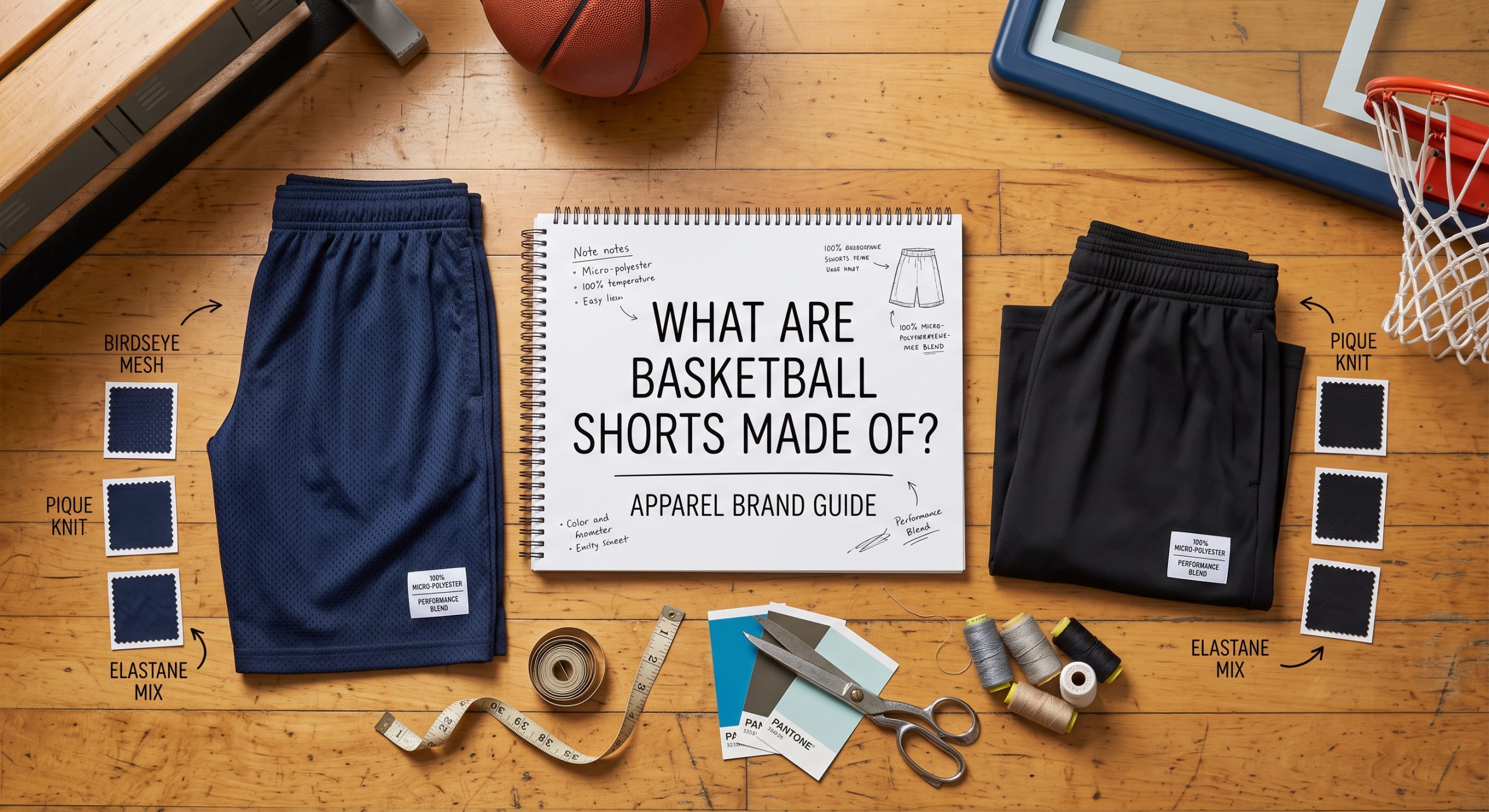
Basketball shorts are primarily made of lightweight synthetic polyester fabrics, specialized micro-eyelet mesh, and textured pique knits engineered for rapid moisture evaporation and athletic mobility. Apparel managers face massive customer complaints when athletic gear traps sweat, feels rough against skin, or loses shape after a few intense games on court. Sourcing poor quality textiles damages brand reputation and causes costly product returns. Finding high-performance knits resolves these sourcing headaches by supplying sportswear brands with dimensionally stable, ultra-breathable fabrics built for competitive athletic wear. Understanding what are basketball shorts made of enables procurement teams to pick raw materials that maximize player comfort and factory efficiency.
1. What Are Basketball Shorts Made Of in Modern Apparel?
Modern athletic shorts rely heavily on high-tenacity synthetic yarns knitted into porous mesh or pique structures. Sourcing teams analyzing what are basketball shorts made of focus on fiber weight, breathability, and stretch recovery. Fabric selection directly affects player agility on court.
What Primary Fibers Dominate Shorts Manufacturing?
Polyester filaments dominate sportswear manufacturing because they resist liquid absorption. Here’s the deal, synthetic polymers channel perspiration away from skin instantly.
- 100% micro-polyester for ultra-lightweight game jerseys.
- Polyester and elastane blends for flexible compression liners.
- High-tenacity nylon for rugged court durability.
How Do Synthetic Blends Enhance Player Comfort?
Blending small elastane percentages gives fabrics dynamic four-way stretch without adding unnecessary weight. What’s the real story? Flexible yarns allow full range of motion during quick directional cuts.
- Improved stretch recovery maintains original garment shape.
- Soft filament counts reduce friction against active muscles.
- Hydrophobic properties keep clothing lightweight during heavy sweat.
Key Takeaway: Synthetic fiber blends protect athletes from heavy moisture accumulation while delivering full movement flexibility.
| Fiber Composition | Primary Function | Ideal Application |
| 100% Micro-Polyester | Moisture Wicking | Lightweight Mesh Shorts |
| 88% Poly / 12% Elastane | 4-Way Flexibility | Pro Practice Shorts |
Selecting the right synthetic blend forms the foundation for durable and breathable athletic apparel.
2. Why Birdseye Grid Defines What Basketball Shorts Are Made Of?
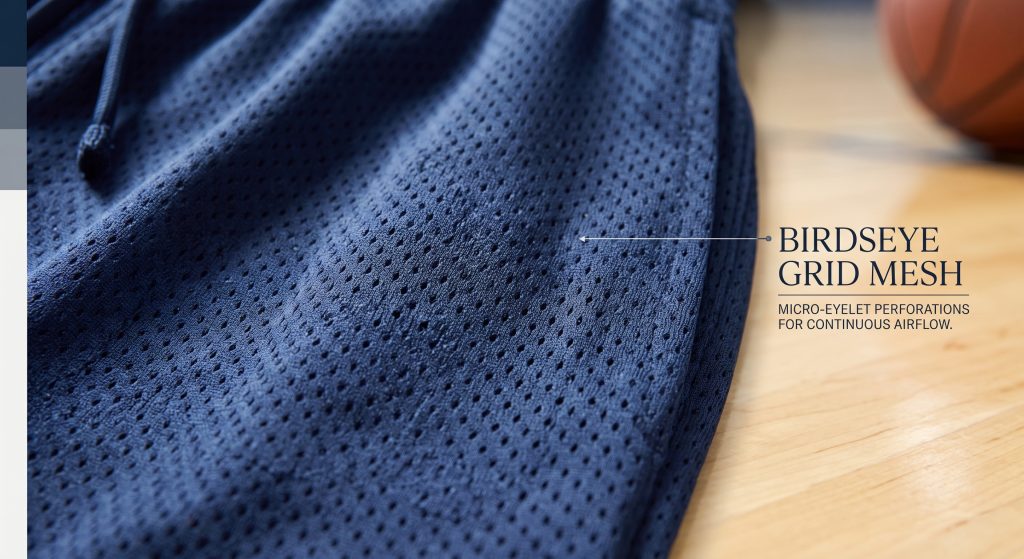
Birdseye grid structures define performance shorts because micro-eyelet perforations generate continuous passive airflow across active muscles. Fabric buyers evaluating what are basketball shorts made of often select birdseye mesh for intense gym training garments. Tiny eyelet patterns create immediate heat release zones.
What Makes Birdseye Micro-Mesh Excel in Airflow?
Micro-perforations act as built-in ventilation windows across the entire garment surface. Ready for the good part? Air moves freely through the knit matrix to cool the athlete.
- Thousands of tiny eyelets vent body heat constantly.
- Lightweight construction keeps garment weight minimal.
- Smooth outer face accepts sharp sublimation printing.
How Does Eyelet Geometry Accelerate Evaporation?
Eyelet geometry narrows liquid pathways to pull sweat outward rapidly. This is where it gets interesting. Moisture spreads across a wide exterior surface area to dry in seconds.
- Capillary channels draw liquid away from inner skin.
- Accelerated surface evaporation prevents soggy fabric buildup.
- Flat interior loops maintain comfortable contact during movement.
Key Takeaway: Birdseye mesh maximizes active cooling by combining continuous air permeability with rapid capillary wicking.
| Structural Feature | Birdseye Mesh | Standard Plain Knit |
| Surface Perforations | High-density micro-eyelets | Solid continuous face |
| Drying Velocity | Rapid evaporation | Slow moisture trapping |
Engineered micro-eyelet grids make birdseye mesh the leading choice for high-intensity summer sportswear lines.
3. How Pique Knits Change What Basketball Shorts Are Made Of?
Pique knits transform athletic garments by providing a three-dimensional waffle texture that holds garment shape and prevents body clinging. Sourcing managers reviewing what are basketball shorts made of select pique when building structured streetwear shorts. The raised geometric pattern adds visual depth to sports apparel.
What Gives Pique Knits Superior Garment Structure?
Geometric tuck stitches create a stable waffle grid that adds natural fabric body. Think about it. The textured face keeps the fabric elevated off sweaty skin.
- Textured surface reduces full contact friction.
- Natural fabric body supports clean pocket and waistband construction.
- Sturdy knit resists wrinkling inside gym bags.
Why Do Premium Sportswear Lines Favor Pique?
Premium athletic brands choose pique fabrics to achieve an elevated, high-end aesthetic. Believe it or not. Pique combines lifestyle fashion appearance with active cooling performance.
- Rich geometric texture elevates basic apparel designs.
- Excellent drape creates a tailored athletic silhouette.
- High yarn density resists surface fuzzing over time.
Key Takeaway: Pique knits give athletic shorts superior structural body and a refined visual appeal suitable for premium collections.
| Performance Metric | Pique Geometry | Flat Jersey Knit |
| Garment Body | Firm geometric drape | Soft limp structure |
| Skin Contact Area | Reduced point contact | Full flat contact |
Choosing pique fabric allows sportswear brands to bridge the gap between court performance and casual street fashion.
4. How Breathability Varies in What Basketball Shorts Are Made Of?
Breathability varies significantly depending on pore size density and yarn thickness across different knit constructions. Analyzing open-porosity ratios shows what are basketball shorts made of determines heat dissipation during tournament play. Higher surface porosity directly lowers body heat retention.
How Does Open Porosity Speed Up Sweat Evaporation?
Open porosity measures the proportion of open space within a knit structure. You guessed it. Larger micro-perforations let trapped body heat escape into surrounding air.
- Open eyelets create low-resistance airflow channels.
- Continuous air passage keeps core temperatures stable.
- Custom pore density matches specific regional climates.
Which Structure Performs Best in High Heat?
Lightweight micro-birdseye mesh performs best during high-heat summer games. Here’s what matters most. Open mesh pores release vapor far faster than dense double-knits.
- Micro-mesh prevents overheating during long practice sessions.
- Light yarn weights keep athletes agile on court.
- Hydrophobic treatments prevent moisture absorption.
Key Takeaway: Matching fabric porosity to playing environments protects athletes against heat fatigue during summer games.
| Climate Condition | Target Porosity | Recommended Knit |
| Extreme Heat (> 30°C) | High Open Ratio (> 25%) | Light Micro-Birdseye |
| Moderate Gym Temperature | Balanced Ratio (15% – 20%) | Structured Pique |
Selecting controlled porosity fabrics gives activewear brands exact thermal management options for different markets.
5. Which Fibers Control What Basketball Shorts Are Made Of?
Hydrophobic polyester and flexible elastane fibers control fabric functionality in professional athletic shorts. Quality mills crafting what are basketball shorts made of blend synthetic polymers to match dynamic movement demands. Raw fiber selection sets the baseline for strength and comfort.
Why Polyester and Nylon Lead Synthetic Sourcing?
Polyester and nylon lead activewear manufacturing because they offer exceptional tensile strength. The bottom line is simple. Synthetic fibers do not absorb moisture like natural cotton.
- Polyester dries rapidly and holds vibrant colors.
- Nylon adds superior surface abrasion resistance.
- Both synthetics resist shrinking in industrial wash cycles.
How Does Elastane Addition Improve Player Agility?
Adding 5% to 12% elastane provides dynamic stretch recovery across active muscle groups. Here’s the deal. Flexible fabrics move with the player without binding at the knees.
- Four-way stretch supports full athletic stride.
- High elastic recovery maintains garment shape after stretching.
- Lightweight elastane keeps fabric weight low.
Key Takeaway: Combining high-tenacity polyester with elastic fibers delivers the ideal mix of physical durability and unrestricted movement.
| Fiber Type | Key Advantage | Processing Benefit |
| Micro-Polyester | Moisture management | Quick heat setting |
| Spandex / Elastane | Dynamic 4-way stretch | Shape retention |
Understanding raw fiber mechanics guides procurement teams toward smarter raw material purchasing decisions.
6. How Friction Softness Defines What Basketball Shorts Are Made Of?
Friction softness depends on interior surface loop smoothness and filament fineness against skin. Players wearing fitted gear notice immediately what are basketball shorts made of when running full court sprints. Soft interior backings shield athletes from painful chafing.
How Do Smooth Backing Knits Prevent Skin Chafing?
Smooth interior backing loops eliminate rough surface friction during continuous running motion. What’s the real story? Low friction surfaces glide over sweaty skin comfortably.
- Flat back structures prevent point pressure rubbing.
- Fine filament yarns feel silky against sensitive skin.
- Soft interior linings protect athletes during long games.
What Yields Soft Skin Contact During Play?
High filament micro-denier yarns yield exceptionally soft handfeel without compromising fabric strength. Ready for the good part? Finer individual fibers create a plush, gentle surface texture.
- Micro-denier yarns double the contact softness.
- Chemical softening finishes enhance tactile comfort.
- Smooth knits prevent skin irritation during intense play.
Key Takeaway: Soft inner knits shield athletes from painful friction chafing during long, repetitive athletic movements.
| Tactile Property | Micro-Filament Mesh | Standard Coarse Mesh |
| Surface Friction | Low smooth glide | Moderate abrasive rub |
| Skin Sensitivity | Comfortable | Potential chafing |
Prioritizing smooth interior backings increases long-term player comfort and satisfaction with your garment line.
7. How Durability Impacts What Basketball Shorts Are Made Of?
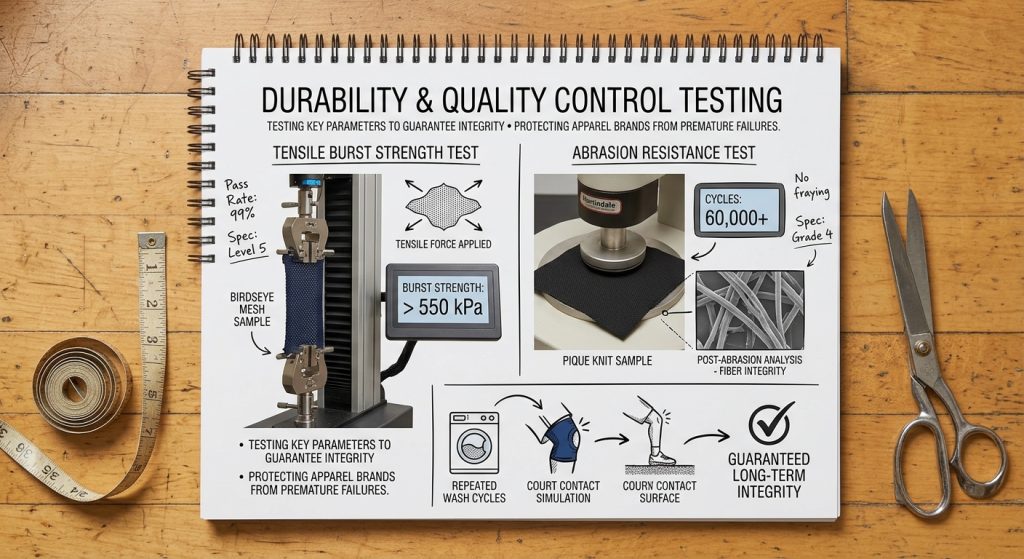
High burst strength and abrasion resistance dictate how well shorts withstand rough court contact and repeated washing. Factories producing what are basketball shorts made of test tensile parameters to guarantee long-term garment integrity. Durable textiles protect apparel brands from premature product failures.
How Does Bursting Strength Resist Heavy Gym Wear?
Bursting strength measures how much hydraulic pressure a fabric withstands before rupturing. This is where it gets interesting. High bursting strength prevents seam blowouts during aggressive physical play.
- Interlocked knit patterns resist high pressure tearing.
- High-tenacity synthetic yarns maintain strength when wet.
- Reinforced construction withstands intense physical strain.
What Stops Fabric Snagging During Contact Sports?
Tight micro-loop construction stops sharp fingernails or velcro from snagging individual yarns. Think about it. Compact knit loops lock fibers tightly into place.
- Snag-resistant knits keep garment surfaces smooth.
- Continuous filament yarns resist pulling out of weave.
- Robust finishing treatments prolong fabric lifespan.
Key Takeaway: High burst strength and snag resistance reduce product returns by ensuring sportswear survives rough gym use.
| Test Parameter | Target Value | Quality Benefit |
| Bursting Strength | > 400 kPa | Prevents seam tearing |
| Snag Resistance | Grade 4 or higher | Maintains smooth surface |
Investing in high-durability fabrics builds customer trust and reduces warranty replacement costs for apparel brands.
8. Can Defect Rates Lower Based on What Basketball Shorts Are Made Of?
Consistent gram weight and flat selvage edges dramatically lower garment defect rates during automated cutting. Factory managers evaluating what are basketball shorts made of select dimensionally stable rolls to optimize sewing throughput. Uniform raw materials eliminate costly sewing line delays.
How Does Weight Stability Prevent Sewing Defects?
Stable fabric weight guarantees consistent stretch behavior across every batch cut on factory floors. Believe it or not. Uniform roll GSM prevents sizing variations in finished apparel.
- Equal weight distribution ensures accurate pattern sizing.
- Consistent stretch keeps sewing lines running smoothly.
- Uniform density prevents needle breakage during assembly.
Why Is Flat Edge Behavior Vital for Cutting?
Flat selvage edges stop fabric from curling on vacuum cutting tables. You guessed it. Flat layers allow automated blades to cut exact pattern shapes.
- Low edge curl prevents misaligned pattern cuts.
- Flat laydown speeds up automatic spreading machines.
- Reduced fabric skew eliminates twisted side seams.
Key Takeaway: Dimensionally stable fabric rolls increase cutting precision and reduce expensive fabric waste in garment factories.
| Manufacturing Metric | Standard Tolerance | Factory Impact |
| Weight Variance (GSM) | ± 3% max | Consistent sizing |
| Edge Curl Index | Flat (< 2mm) | Faster cutting speed |
Supplying cutting rooms with flat, uniform fabric rolls directly increases garment production speed and factory margins.
9. What Sourcing Costs Shift What Basketball Shorts Are Made Of?
Raw yarn consumption, machine knitting speed, and fabric yield per kilogram drive unit sourcing costs. Procurement officers calculating what are basketball shorts made of compare linear meter output against raw material price. Calculating true fabric yield prevents budget overruns.
How Does Fabric Weight Yield Change Output Units?
Lighter weight fabrics yield significantly more linear meters per kilogram of raw material. Here’s what matters most. Higher yield lowers the individual material cost per short.
- Light mesh (130 GSM) produces more shorts per roll.
- High linear yield lowers overall shipping weight costs.
- Efficient yardage reduces raw material expenditure.
What Balances Material Cost Against Market Price?
Balancing fabric GSM against garment retail price points maximizes profit margins. The bottom line is simple. Premium weight fabrics justify higher retail pricing.
- Light mesh targets budget volume practice gear.
- Heavy pique suits premium lifestyle sportswear lines.
- Yield calculations keep production budgets on target.
Key Takeaway: Evaluating fabric yield per kilogram allows procurement teams to balance unit costs against retail price positioning.
| Fabric Grade | Gram Weight | Yield Per Kilo |
| Light Micro-Mesh | 130 – 140 GSM | ~ 4.2 linear meters |
| Heavy Pique Knit | 180 – 200 GSM | ~ 2.8 linear meters |
Factoring total linear yield into early costing models keeps garment manufacturing profitable and competitive.
10. Why Mill Partners Matter for What Basketball Shorts Are Made Of?
Direct mill partnerships grant brands full control over custom shade dyeing, technical finishes, and quality compliance. Choosing experienced suppliers ensures what are basketball shorts made of matches international sportswear standards. Direct communication eliminates costly sourcing mistakes.
How Does Direct Mill Access Speed Product Launch?
Working directly with textile mills shortens color dip approvals and sample lead times. Here’s the deal. Direct mill communication speeds up pre-production approval stages.
- Quick lab dips accelerate color matching approvals.
- Custom weight options match exact brand specifications.
- Direct technical support resolves production issues fast.
Why Are Low Minimum Orders Helpful for New Lines?
Low minimum order quantities allow emerging brands to test new market designs safely. What’s the real story? Flexible order sizes reduce inventory risks for startup lines.
- Small batch orders minimize financial risk on new designs.
- Flexible sourcing supports rapid market testing.
- Scalable mill capacity supports brand growth as orders rise.
Key Takeaway: Direct mill collaboration gives apparel brands complete customization control and faster market launch times.
| Sourcing Channel | Sample Speed | Customization Range |
| Direct Mill Partnership | Fast (7 – 10 days) | Fully custom shade & weight |
| Stock Lot Traders | Immediate | Limited to leftover stock |
Partnering directly with established fabric manufacturers secures your supply chain with high-quality, fully customized textiles.
Activewear Fabric Selection Guide
This guide resolved your core activewear sourcing questions by analyzing the material, breathability, and structural differences between birdseye micro-mesh and textured pique fabrics. We help sportswear brands and garment factories select engineered textiles that maximize player comfort, reduce cutting room defects, and control unit material costs. Sourcing high-performance fabrics protects your brand reputation and keeps your customers active on court. Ready to build your next sportswear collection? Please contact us today to request custom fabric sample swatches and start building your high-performance athletic shorts line.
Frequently Asked Questions
Q1: Can I use birdseye mesh for heavy winter basketball gear?
No, birdseye mesh is engineered specifically for summer heat dissipation and cooling. Its micro-perforations let cold air penetrate quickly, so double-knit or brushed fleeces work much better for cold climates.
Q2: What’s the best fabric weight for adult basketball shorts?
A weight between 140 GSM and 160 GSM provides the optimal balance for basketball shorts. This weight range offers durable drape and opacity without adding heavy bulk during intense game movement.
Q3: How do I know if pique fabric is right for my athletic line?
You can test pique suitability by examining your desired garment silhouette and target retail positioning. Pique delivers a structured, premium texture that resists body clinging, making it ideal for high-end lifestyle sportswear.
Q4: Can I order custom Pantone colors for small production runs?
Yes, direct mills provide custom lab-dip shade matching for flexible batch quantities. Working directly with fabric manufacturers allows emerging brands to launch custom colorways without holding excessive inventory.
Q5: What’s the primary cause of fabric snagging in sports shorts?
Loose surface yarn loops catching on sharp equipment or velcro cause most fabric snagging. Tight micro-eyelet structures and continuous filament polyester yarns significantly increase snag resistance during contact play.