
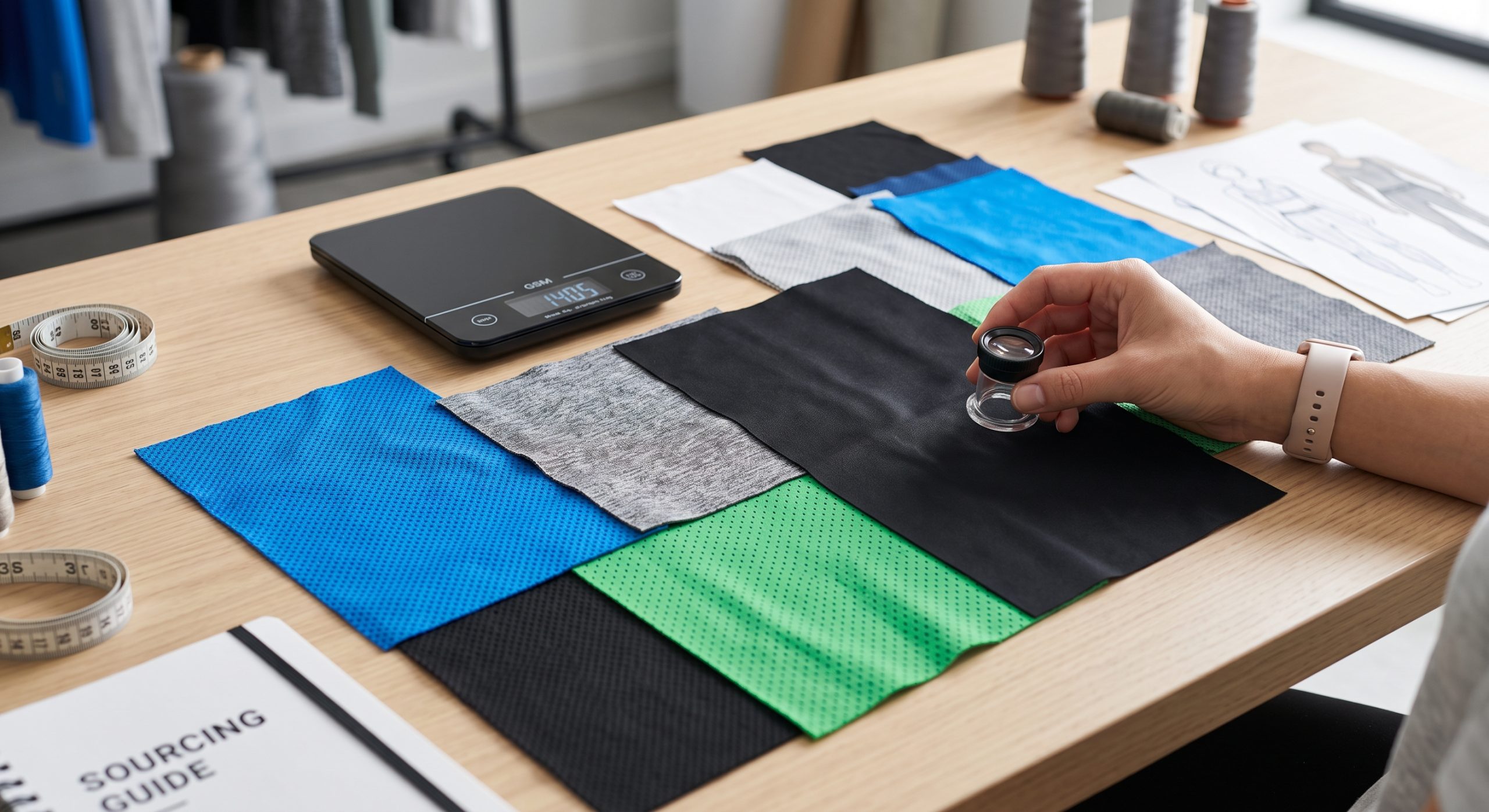
Choosing the ideal material involves selecting specialized synthetic or blended fibers engineered with moisture transport channels and durable knit patterns to meet athletic performance demands. Garment manufacturers frequently experience client rejections due to activewear t-shirts that hold heavy sweat, lose shape after three washes, or cause chafing during intense training sessions. Poor material selection leads to low repeat sales, damaged brand credibility, and squeezed profit margins across activewear lines. Specifying high-grade sports t-shirt fabric solves these production bottlenecks by delivering light weight, rapid sweat dissipation, and long-lasting shape retention for your athletic collection.
1. What defines high performance sports t-shirt fabric?
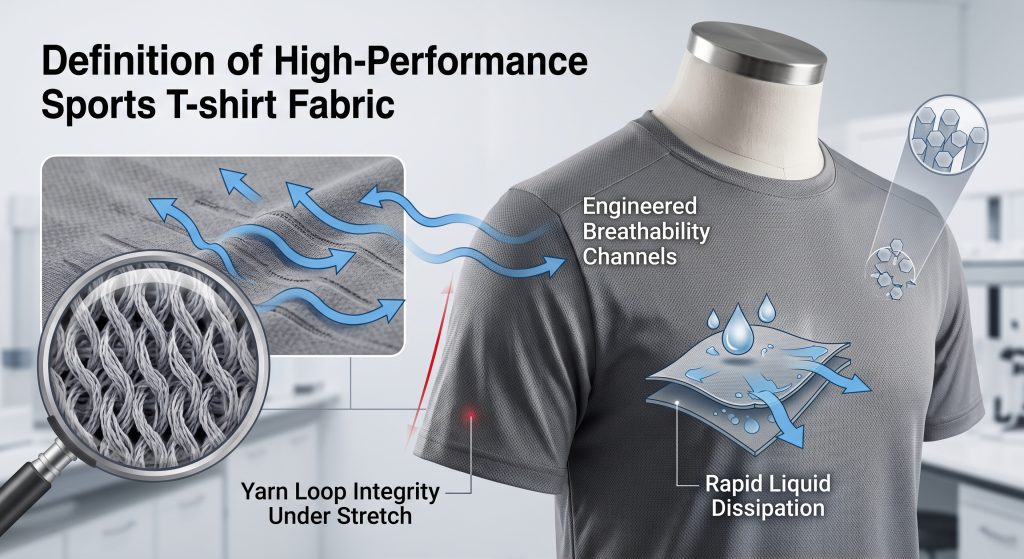
High performance material combines targeted yarn density, engineered breathability channels, and rapid liquid dissipation to balance comfort with durability. Sourcing premium sports t-shirt fabric allows apparel factories to construct garments that adapt to severe thermal stress during high-impact workouts. Yarn loops maintain physical integrity under intense stretching forces.
Manufacturers must prioritize fiber composition and surface geometry when building functional athletic lines. Proper construction prevents fabric distortion and reduces athlete skin friction during continuous motion.
How does fiber density control heat regulation?
Fiber density governs how easily body heat escapes through the knit matrix during exercise. Here is the deal: lighter density knits promote immediate thermal dissipation.
- Low-density knits allow rapid air movement.
- High-density knits retain structure for colder outdoor activities.
- Balanced gauge knitting prevents fabric transparency.
Can surface loops accelerate sweat dissipation?
Surface loop structures pull liquid off the skin to speed up external air evaporation. What is the real story? Micro-engineered loops create larger surface areas for quick drying.
- Micro-eyelet loops maximize liquid movement.
- Smooth surface loops minimize friction against skin.
- Hydrophobic loop treatments prevent water absorption.
Key Takeaway: Selecting targeted fiber densities and surface loop patterns protects athletes from overheating while maintaining long-term garment structure.
| Performance Metric | Low Density Knit | High Density Knit |
| Air Permeability | Very High | Moderate |
| Structure Retention | Moderate | High |
Analyzing density metrics allows garment makers to match fabric breathability directly to physical training demands.
2. Why does synthetic sports t-shirt fabric wick moisture?
Synthetic fibers wick moisture by using microscopic channels that pull liquid away from skin through capillary action. Modern sports t-shirt fabric engineered from polyester or nylon features modified cross-sections that accelerate liquid transport across the outer garment surface. This technical process keeps athletes dry throughout demanding athletic routines.
Unlike natural fibers that absorb and retain liquid, synthetics push sweat to the surface where ambient air evaporates it quickly. This functional advantage makes synthetic materials the preferred standard for high-sweat activewear applications.
How do polyester filaments pull surface moisture?
Polyester filaments feature grooved cross-sections that create continuous suction channels for liquid transport. You might be wondering: how do synthetic fibers outperform standard cotton?
- Grooved channels increase capillary pull speed.
- Non-absorbent yarn walls prevent liquid retention.
- Continuous filaments maintain high tensile resistance.
Why do hydrophobic coatings dry rapidly?
Hydrophobic finishes repel liquid droplets, forcing water to spread thin across the outer fabric surface. This is where it gets interesting: thin water spreads evaporate five times faster than absorbed droplets.
- Surface finishes lower water adhesion.
- Thin water dispersion speeds up drying times.
- Durable water repellent coatings withstand repeated laundering.
Key Takeaway: Synthetic capillary channels and hydrophobic finishes work together to maintain dry skin contact during maximum physical output.
| Fiber Technology | Moisture Transport Speed | Drying Rate |
| Standard Round Polyester | Moderate | Fast |
| Channel-Engineered Fiber | Rapid | Ultra-Fast |
Evaluating capillary performance data helps procurement managers specify activewear textiles that handle extreme perspiration.
3. How does cotton blend sports t-shirt fabric perform?
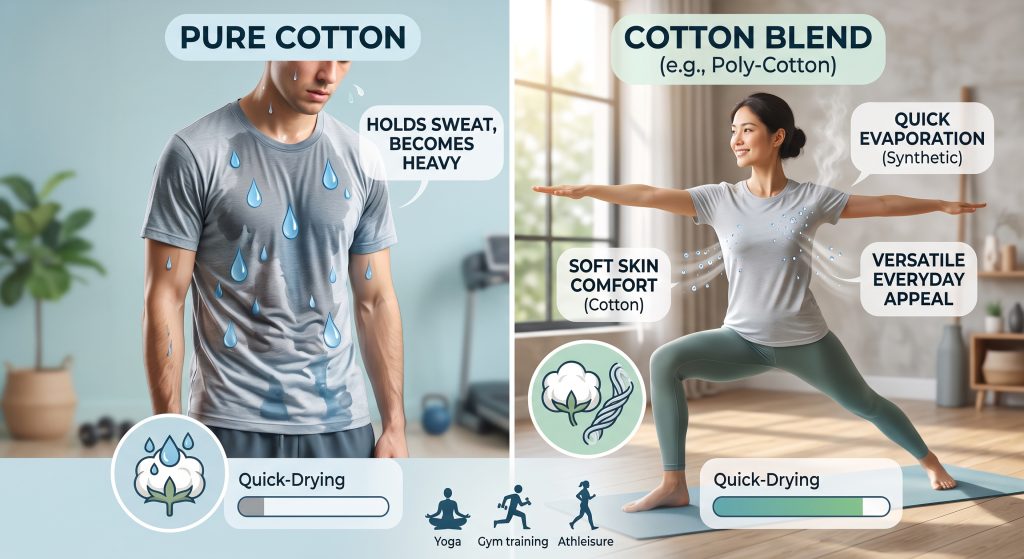
Cotton blends balance soft skin tactile comfort with technical synthetic quick-drying capabilities. Blending natural fibers with synthetic sports t-shirt fabric options yields comfortable casual activewear that handles moderate perspiration without feeling stiff. This hybrid approach appeals to lifestyle athletic brands seeking versatile everyday appeal.
Pure cotton holds sweat and becomes heavy during strenuous activity, whereas adding synthetic polyester prevents sag and speeds up drying times. Apparel brands leverage these hybrid fabrics for low-impact yoga, gym training, and athleisure apparel lines.
Does natural cotton retain excess perspiration?
Pure cotton fibers absorb up to 27 times their weight in water, leading to heavy, clinging clothing during workouts. Ready for the good part? Mixing synthetic fibers eliminates heavy water retention entirely.
- Natural cellulose fibers lock in liquid moisture.
- Wet cotton increases skin friction and chafing risk.
- Unblended cotton distorts shape when saturated.
How do poly-cotton blends balance softness?
Combining 60 percent cotton with 40 percent polyester creates a soft touch paired with functional dimensional stability. Look at the facts: poly-cotton knits retain their shape through dozens of wash cycles.
- Cotton provides premium skin tactile comfort.
- Polyester fibers maintain garment shape and recovery.
- Hybrid knits reduce fabric shrinking tendencies.
Key Takeaway: Poly-cotton blends provide a soft natural hand feel while relying on synthetic fibers to control shrinkage and sweat retention.
| Blend Ratio | Softness Rating | Drying Speed | Shape Retention |
| 100% Cotton | High | Slow | Low |
| 60/40 Poly-Cotton | High | Moderate | High |
Comparing blend proportions empowers apparel developers to craft comfortable athleisure lines without sacrificing garment durability.
4. Which weave optimizes sports t-shirt fabric airflow?
Open eyelet knits and micro-mesh weaves deliver maximum airflow by creating micro-perforations across the textile surface. Incorporating specialized weaves in sports t-shirt fabric production reduces wind resistance and allows continuous heat escape during intense cardio activities. Ventilated construction keeps body temperatures stable under direct solar exposure.
Choosing between pique, interlock, or mesh weaves directly influences garment weight, opacity, and thermal regulation performance. Mesh structures offer high breathability, while interlock knits provide higher coverage and structured stability.
What makes mesh structure maximize ventilation?
Mesh knits feature engineered eyelet holes that permit unobstructed air movement across the body surface. Believe it or not, micro-mesh can increase air throughput by over 150 percent compared to flat knits.
- Open eyelets allow continuous air exchange.
- Low fabric weight reduces runner fatigue.
- Porous construction prevents heat buildup.
How do micro-perforated knits cool skin?
Micro-perforations accelerate sweat evaporation by exposing surface moisture directly to ambient breezes. Here is the kicker: faster evaporation creates an immediate cooling sensation on warm skin.
- Micro-holes break surface tension for rapid venting.
- Smooth internal loops reduce skin friction points.
- Strategic panel placement optimizes body heat release.
Key Takeaway: Utilizing open mesh weaves in targeted garment zones delivers maximal cooling efficiency without compromising structural coverage.
| Weave Type | Air Permeability (CFM) | Opacity Rating |
| Micro-Mesh | 220 – 280 | Moderate |
| Flat Interlock | 70 – 110 | High |
Measuring air throughput metrics helps designers select appropriate weave structures for targeted high-heat body mapping.
5. How do weight and GSM alter sports t-shirt fabric?
Fabric weight measured in GSM directly dictates garment drape, opacity, thermal insulation, and mechanical tear resistance. Selecting lightweight sports t-shirt fabric options between 120 and 150 GSM produces fluid race jerseys, while heavier 180 to 220 GSM fabrics suit structured athletic shirts. Fabric GSM dictates both production costs and seasonal garment suitability.
Lower GSM textiles minimize physical weight for endurance athletes but demand stronger filament yarns to resist tearing. Heavier GSM fabrics provide higher opacity and warmth, making them suitable for autumn training apparel and team uniforms.
Does higher GSM fabric reduce breathability?
Higher GSM fabrics use denser yarn concentrations that can restrict air permeability if stitch patterns are tight. What’s the real story? Denser knits trade maximum airflow for higher durability and complete coverage.
- Heavy GSM limits air movement through fibers.
- Increased yarn mass holds more thermal heat.
- Thick structures offer complete opacity under tension.
What GSM range fits lightweight training tees?
The ideal weight range for competitive training tees spans from 130 GSM to 160 GSM for balance. Check this out: lightweight 140 GSM knits drape smoothly without burdening active runners.
- 130-140 GSM suits hot summer outdoor workouts.
- 150-160 GSM balances general indoor training needs.
- Lightweight options dry faster post-wash.
Key Takeaway: Balancing fabric GSM against activity intensity ensures finished garments deliver necessary opacity without adding unwanted bulk.
| Target GSM Range | Garment Type | Primary Benefit |
| 120 – 140 GSM | Marathon Race Tops | Ultra-lightweight movement |
| 180 – 210 GSM | Training Polos | Structured durability & opacity |
Analyzing GSM parameters allows sourcing teams to align fabric density with target climate conditions and retail price points.
6. What gives stretch to sports t-shirt fabric items?
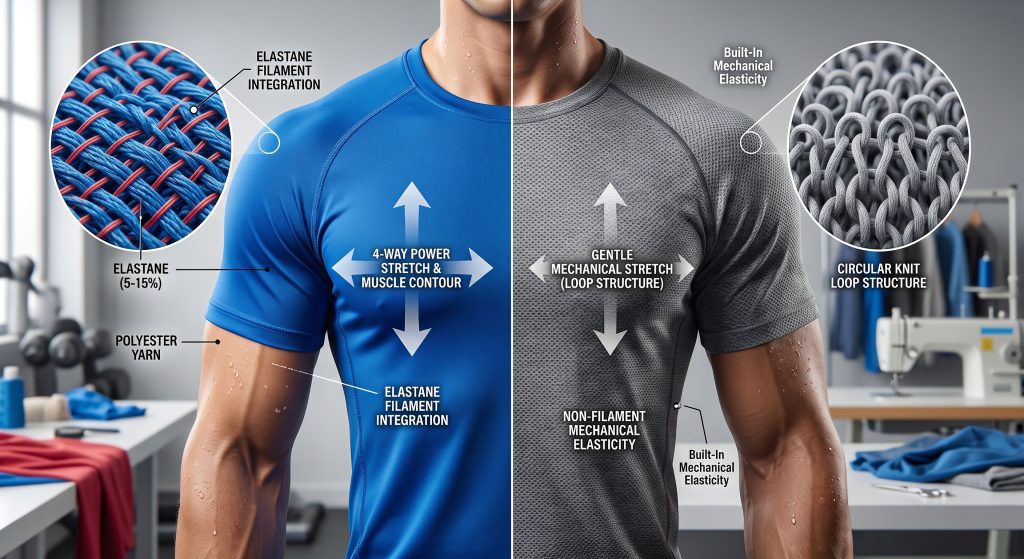
Stretch performance stems from elastane synthetic yarn integration or mechanical elasticity built into circular knit stitch loops. Integrating elastane into sports t-shirt fabric blends allows full 4-way movement recovery during complex dynamic movements. Mechanical stretch provides gentle elasticity without relying on degrading elastic filaments over time.
Spandex or elastane content ranging from 5 percent to 15 percent gives activewear garments power stretch, ensuring shirts contour to muscle movement without restricting mobility. Proper stretch recovery guarantees garments keep their fitted shape through repeated wearing.
How does elastane content improve recovery?
Elastane filaments extend up to 500 percent of their original length before snapping back instantly into position. You might be wondering: why is recovery speed vital for athletic shirts?
- High elasticity allows unrestricted arm extension.
- Fast recovery prevents baggy elbows and sagging hems.
- Synthetic elastane retains power through repeated wash cycles.
What is 4-way mechanical stretch flexibility?
Mechanical stretch uses specific loop configurations to achieve horizontal and vertical flexibility without adding spandex yarns. Here is the kicker: mechanical stretch knits remain recyclable because they contain single-polymer polyester.
- Single-polymer composition simplifies recycling.
- Moderate stretch provides comfortable daily wear.
- Eliminates elastane degradation from heat or chlorine.
Key Takeaway: Incorporating elastane delivers high-power body-contouring stretch, while mechanical stretch knits provide eco-friendly elasticity.
| Stretch Mechanism | Flexibility Level | Recyclability |
| Spandex / Elastane Blend | High (4-Way) | Complex |
| Mechanical Knit Stretch | Moderate (2-Way) | High (100% Poly) |
Choosing between elastane blends and mechanical stretch helps garment brands hit performance targets while supporting sustainability goals.
7. How to evaluate sports t-shirt fabric durability?
Evaluating fabric durability requires testing tensile breaking strength, seam tear resistance, and surface pilling scores under lab conditions. High-grade sports t-shirt fabric options resist surface friction caused by backpack straps, velcro, and rough gym equipment contact. Rigorous quality testing protects apparel brands against high return rates caused by premature wear.
Filament synthetic yarns offer higher abrasion resistance than spun natural yarns, ensuring surface smoothness remains intact after extended use. Standardized Martindale testing quantifies how many friction cycles a textile withstands before fiber breakdown occurs.
How to measure abrasion resistance on knits?
Martindale abrasion testers rub felt pads against fabric swatches under continuous pressure until yarn breakage appears. This is where it gets interesting: high-end activewear fabrics withstand over 30,000 friction cycles.
- Standardized friction cycles measure wear resistance.
- Filament yarns resist surface fuzzing better than spun yarns.
- High cycle counts correlate with longer garment lifespans.
What causes surface pilling during washing?
Surface pilling occurs when loose fiber ends rub together during laundering, forming small unsightly tangles on fabric faces. Ready for the good part? Anti-pilling finishes lock loose fibers tightly into the yarn core.
- Friction in wash drums detaches weak surface fibers.
- Anti-pilling treatments seal fiber ends together.
- Tightly twisted yarns reduce pill formation naturally.
Key Takeaway: Specifying anti-pilling treatments and high Martindale cycle ratings ensures activewear withstands aggressive washing and rough athletic use.
| Durability Test | Standard Target | High-Performance Target |
| Martindale Abrasion | 15,000 Cycles | 35,000+ Cycles |
| Pilling Grade (ISO) | Grade 3 | Grade 4-5 |
Verifying lab durability ratings prevents customer dissatisfaction and extends product life across activewear apparel lines.
8. Which finish improves sports t-shirt fabric gear?
Chemical and topical finishes improve performance by adding antibacterial odor control, UV defense, and moisture-spreading properties to textiles. Applying functional finishes during sports t-shirt fabric finishing transforms basic knits into multi-functional gear suitable for outdoor endurance activities. Modern finishes lock into fiber matrices to survive dozens of home washings.
Silver ion treatments and zinc-based coatings inhibit odor-causing bacteria growth on synthetic polyester surfaces. Adding UPF sun protection coatings shields athletes from dangerous ultraviolet rays during daytime outdoor training.
How do anti-odor treatments control bacteria?
Silver ion finishes disrupt bacterial cell membranes on synthetic fibers, stopping sweat breakdown and odor formation. Believe it or not, treated activewear stays fresh through multi-day backcountry workouts.
- Antimicrobial ions stop microbial cell reproduction.
- Prevents permanent body odor buildup in polyester.
- Bio-based coatings reduce chemical runoff.
What role do quick-dry coatings play?
Quick-dry topical finishes lower fabric surface tension, causing liquid sweat to spread out instantly into thin drying layers. Check this out: treated shirts dry twice as fast as untreated synthetics.
- Hydrophilic topcoats pull moisture across wide areas.
- Accelerated drying prevents post-workout body chills.
- Durable finish applications last over 30 domestic washes.
Key Takeaway: Technical topical finishes give synthetic fabrics powerful anti-odor and quick-drying benefits that keep athletes fresh.
| Finish Type | Primary Function | Durability Standard |
| Silver Ion Antimicrobial | Odor Prevention | 30+ Wash Cycles |
| UPF 50+ Sun Block | UV Radiation Defense | 50+ Wash Cycles |
Incorporating specialized functional finishes allows apparel brands to command higher retail price points for activewear gear.
9. How to select sports t-shirt fabric for warm weather?
Selecting warm weather activewear materials requires prioritizing lightweight GSM, open ventilation knits, light colors, and high UPF sun ratings. Choosing breathable sports t-shirt fabric options between 110 and 130 GSM helps athletes regulate core body temperatures in high summer heat. Proper hot-weather materials reduce thermal strain and improve athletic endurance.
Lightweight eyelet mesh and micro-porous knits vent trapped body heat while reflecting solar radiation. Designers combine lightweight base fabrics with UPF 50+ sun protection finishes to shield runner skin during outdoor summer training.
Which micro-mesh patterns vent summer heat?
Hexagonal and pinhole micro-mesh patterns maximize air movement across hot body zones like back panels and underarms. What’s the real story? Zoned mesh paneling lowers skin temperature by up to two degrees Celsius.
- Geometric pinhole meshes encourage constant convection.
- Lightweight structure prevents fabric heat trapping.
- Open knits speed up evaporative cooling rates.
How to prevent sun damage with UPF finishes?
UPF-treated fabrics absorb or block harmful UVA and UVB radiation before reaching skin layers. You might be wondering: can lightweight summer knits block radiation?
- Tight weave density physically blocks light rays.
- Titanium dioxide fiber additives absorb ultraviolet radiation.
- UPF 50+ ratings block 98 percent of harmful UV rays.
Key Takeaway: Combining micro-mesh ventilation with UPF 50+ coatings produces summer activewear that keeps athletes cool and sun-protected.
| Summer Feature | Target Specification | Functional Result |
| Fabric Weight | 110 – 130 GSM | Minimal thermal insulation |
| Sun Protection | UPF 40+ to 50+ | Blocks 97.5%+ UV rays |
Specifying summer-ready functional textiles allows apparel brands to capture lucrative warm-weather training markets.
10. What cost factors shape sports t-shirt fabric sourcing?
Sourcing costs are driven by raw fiber selection, machine knitting complexity, dyeing techniques, and total mill minimum order quantities (MOQ). Procuring high-grade sports t-shirt fabric economically requires balancing specialty functional finishes against target retail pricing structures. Managing raw material costs protects wholesale profits while maintaining competitive market pricing.
Recycled polyester fibers and complex jacquard knit patterns carry higher material premiums than standard virgin filament knits. Sourcing managers negotiate mill MOQs and shipping logistics to minimize per-yard textile procurement expenses.
How do yarn selections impact wholesale costs?
Micro-denier filaments and brand-name recycled yarns increase raw yarn costs compared to commodity polyester. Here is the deal: premium recycled fibers add a 10 to 20 percent raw material cost increase.
- Recycled PET yarns require specialized cleaning processes.
- Fine micro-denier yarns require slower spinning times.
- Commodity polyester filament remains the most economical option.
What mill minimums affect order quantities?
Custom dyeing colors and specialized functional coatings usually require minimum order volumes of 1,000 meters per shade. Look at the facts: ordering stock colors reduces mill MOQs down to 100 meters per roll.
- Stock color programs lower initial procurement barriers.
- Custom pantone dyeing increases mill MOQ thresholds.
- Bulk order volumes unlock lower price tiers per meter.
Key Takeaway: Strategic yarn choices and stock color selection enable apparel manufacturers to optimize material costs without compromising garment performance.
| Sourcing Factor | Economy Choice | Premium Choice |
| Fiber Type | Virgin Polyester | Recycled PET / Micro-Filament |
| Color Program | Mill Stock Shades | Custom Pantone Lab Dips |
Analyzing sourcing cost structures helps activewear brands build profitable product lines that align with market expectations.
Conclusion
Selecting ideal activewear materials requires matching fiber compositions, knit geometries, weight parameters, and technical finishes to specific performance demands. We solved your sourcing challenges by detailing moisture wicking mechanisms, durability metrics, blend ratios, and cost structures for activewear production. When you contact us today, our technical textile specialists will assist you with swatch selection, custom lab dips, and bulk manufacturing pricing for your activewear line. We remain dedicated to empowering activewear brands worldwide with high-precision functional textile solutions.
Frequently Asked Questions
Q1: Can I use cotton blends for intense marathon training shirts?
No, cotton blends retain sweat and become heavy, making synthetic polyester or nylon fabrics better suited for intense long-distance running.
Q2: What’s the best GSM range for summer activewear t-shirts?
The ideal weight range spans between 110 GSM and 140 GSM, providing lightweight comfort, rapid drying, and optimal breathability in warm weather.
Q3: How do I know if a fabric has good moisture wicking?
Check for channel-engineered synthetic fibers or conduct a drop test to confirm water spreads outward instantly rather than soaking into the core.
Q4: Can I recycle synthetic sports t-shirt fabric after use?
Yes, 100 percent polyester sports t-shirt fabric items without elastane can be mechanically recycled back into fresh polyester yarns.
Q5: What’s the best way to prevent odor buildup in synthetic activewear?Select fabrics treated with silver ion or zinc-based antimicrobial finishes that inhibit odor-causing bacteria growth on polyester fibers