
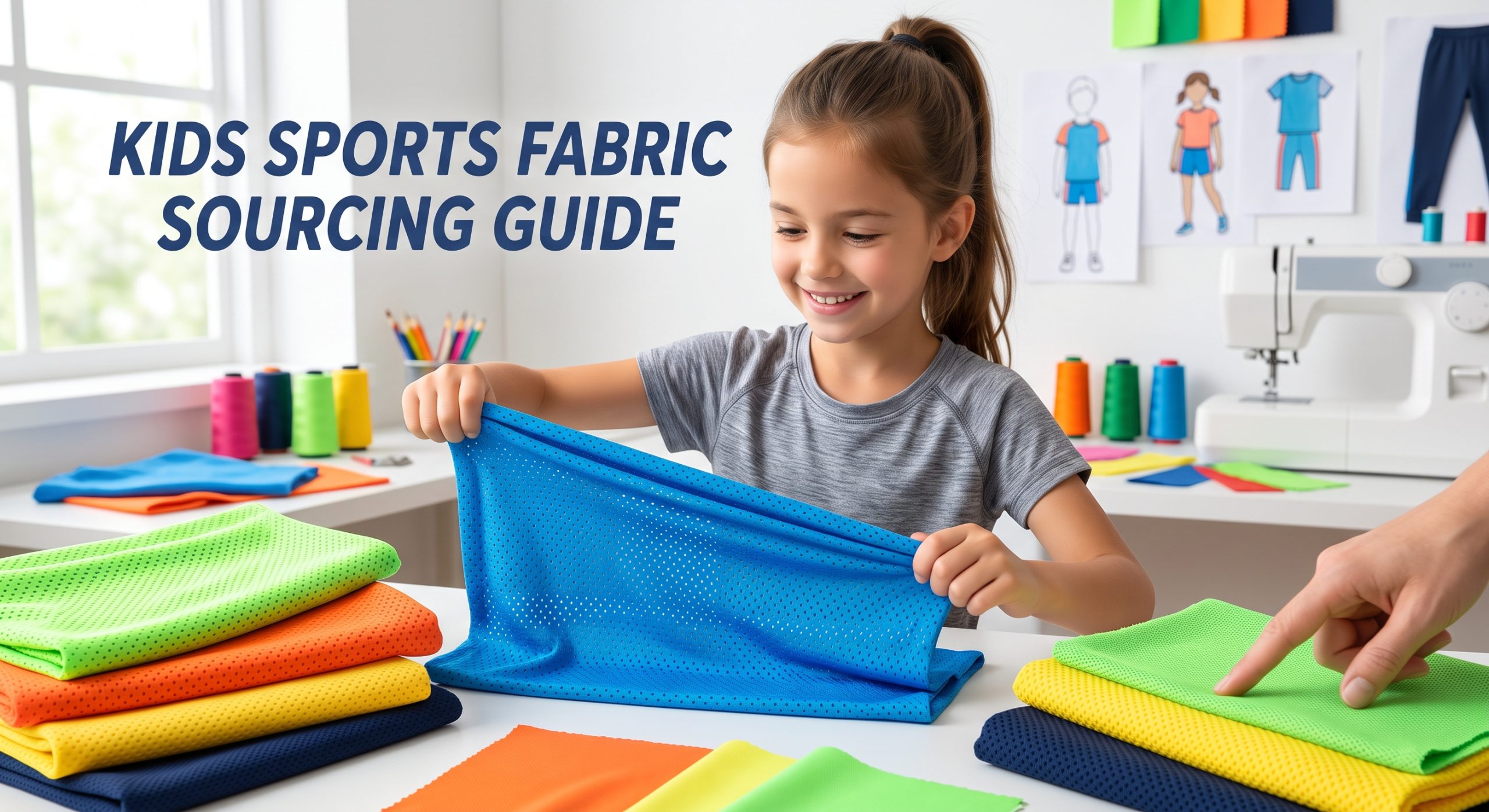
Choosing the best material requires selecting non-toxic, highly breathable, and abrasion-resistant knitted textiles engineered to keep children cool and comfortable during movement. Children running on soccer fields frequently come home with red, irritated skin, heavy sweat-soaked shirts, and ripped seams after a single afternoon of active play. Watching young athletes squirm in scratchy, damp uniforms ruins their athletic enjoyment while forcing apparel brands to handle costly customer returns and replacement claims. Specifying soft, fast-drying kids sports fabric eliminates skin friction, manages perspiration instantly, and maintains garment shape through aggressive playground wear.
1. What defines high quality kids sports fabric?
High quality material combines non-irritating synthetic or blended yarns with micro-engineered loop structures to balance skin comfort against physical playground wear. Sourcing certified kids sports fabric allows garment factories to build activewear that adapts to intense body heat during youth athletic games. Smooth fiber loops maintain physical shape without pulling or fraying under dynamic movement forces.
Manufacturers must prioritize hypoallergenic fiber selection and surface softness when constructing children’s athletic apparel collections. Proper fabric density prevents transparency while shielding sensitive skin from friction injuries during continuous running.
How does fiber softness protect young skin?
Fine filament synthetic fibers minimize surface friction to keep young athletes free from painful red skin chafing during long workouts. Here is the deal: smooth yarn construction protects sensitive skin from harsh mechanical abrasion during intense physical play.
- Micro-denier filaments create a velvety skin touch.
- Chemical-free softening agents eliminate fabric stiffness.
- Flat knit surfaces reduce friction points across friction zones.
Why do durable loops resist physical wear?
Tightly interlocked knit loops absorb sudden pulling forces without tearing or losing structural elasticity. You can rely on reinforced yarn loops to withstand aggressive playground slides and frequent wash cycles without garment distortion.
Key Takeaway: Specifying micro-denier synthetic fibers protects children from chafing while delivering the physical strength required for active play.
| Material Parameter | Standard Synthetic | High-Grade Kids Fabric |
| Surface Friction | Moderate | Low / Anti-Chafing |
| Yarn Tenacity | Standard | Reinforced Loop Structure |
Evaluating surface softness and loop tenacity guarantees your finished children’s apparel withstands demanding physical activities.
2. Why does bird eye mesh suit kids sports fabric gear?
Bird eye mesh suits children’s activewear because its micro-porous eyelet design permits continuous airflow while keeping garment weight extremely low. Utilizing bird eye mesh across kids sports fabric production enables thermal energy to escape rapidly before perspiration builds up on young skin. The lightweight feel allows young athletes to move freely without feeling weighed down by heavy wet fabric.
Synthetic polyester filaments in bird eye mesh pull sweat away from skin toward the outer surface for rapid air evaporation. This ventilation structure makes bird eye mesh a popular choice for youth soccer jerseys, running tees, and basketball uniforms.
How do micro-eyelets vent body heat?
Geometric micro-holes act like miniature air vents that allow body heat to dissipate instantly into surrounding breezes. What is the real story? Engineered eyelets promote continuous air movement to keep core body temperatures stable.
- Micro-perforations prevent heat retention during sprints.
- Low fabric weight reduces physical strain on young athletes.
- High surface porosity speeds up post-exercise evaporation.
Why minimizes weight athletic drag for kids?
Ultra-lightweight textiles lower total garment mass so children conserve energy during long practice sessions and school games. You will notice immediate performance improvements when young players wear lightweight ventilated mesh shirts instead of heavy cotton tops.
Key Takeaway: Bird eye mesh utilizes engineered micro-eyelets to deliver maximum thermal release and lightweight comfort for active children.
| Feature Metric | Standard Flat Knit | Bird Eye Mesh |
| Air Permeability | Moderate | High (200+ CFM) |
| Fabric Weight | 160-180 GSM | 120-140 GSM |
Selecting bird eye mesh construction ensures youth athletic lines remain lightweight, cool, and comfortable under high summer heat.
3. How does pique knit improve kids sports fabric apparel?
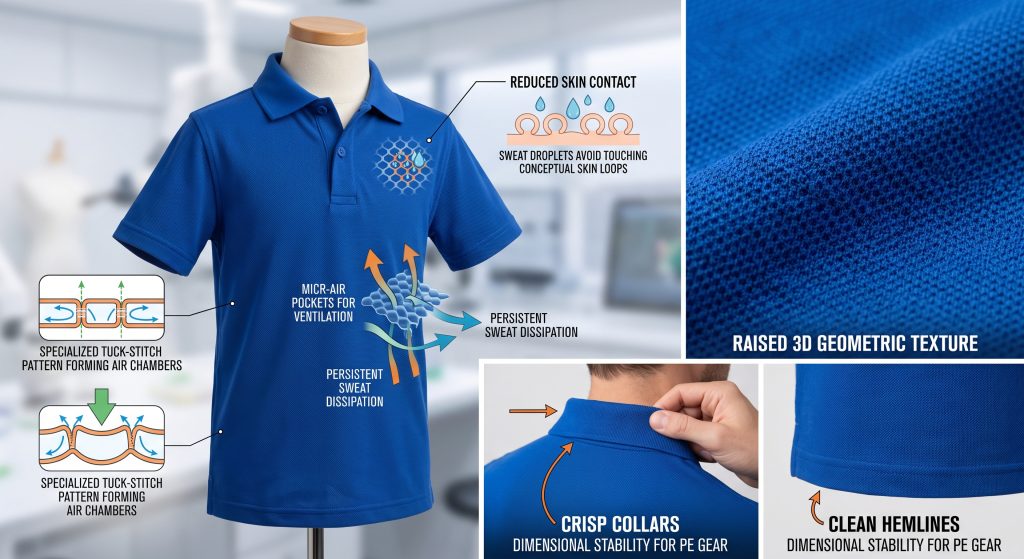
Pique knit improves children’s activewear by creating a raised 3D geometric texture that reduces direct textile contact with perspiration-covered skin. Incorporating pique construction into kids sports fabric orders yields structured athletic shirts that hold crisp collars and clean hemlines through daily use. The dimensional stability of pique makes it ideal for school physical education gear and team polo shirts.
Specialized tuck-stitch patterns create micro-air pockets underneath the fabric surface, preventing uncomfortable fabric sticking during sweat-heavy activities. Apparel makers rely on pique to combine polished aesthetic appeal with functional moisture management.
How do 3D micro-pockets improve comfort?
Raised honeycomb loops lift the main body of fabric off the skin surface to form insulating micro-air channels. Check this out: reduced skin contact stops wet fabric from clinging to young backs during exercise.
- 3D texture limits garment sticking on sweaty skin.
- Air pockets encourage natural body heat dissipation.
- Structured relief provides a crisp, high-end appearance.
Why chooses school sportswear pique structure?
Pique knits possess high structural density, enabling collars, plackets, and sleeve cuffs to keep their shape without drooping. You get a tailored aesthetic that endures rough playground activity and frequent home laundering.
Key Takeaway: Pique knits offer raised surface geometry that prevents skin clinging while maintaining crisp structure for school sportswear.
| Pique Characteristic | Technical Detail | User Benefit |
| Surface Geometry | Honeycomb / Waffle Relief | Reduced Skin Contact & Cling |
| Structural Density | Interlocked Tuck Stitches | Excellent Collar Shape Retention |
Combining pique knits into youth apparel lines delivers structured durability alongside comfortable airflow for everyday school activities.
4. Which weave gives kids sports fabric top airflow?
Open eyelet mesh knits deliver the highest air permeability ratings among functional textiles designed for active youth clothing. Testing air throughput confirms that micro-porous kids sports fabric structures permit significantly higher air volume movement through yarn channels compared to flat knits. Maximum airflow accelerates sweat evaporation, keeping children dry during intense athletic training.
Choosing open weaves prevents thermal heat buildup inside clothing, protecting young runners from heat exhaustion during warm outdoor play. Designers use targeted mesh paneling across high-sweat zones like back panels and underarms.
Can open eyelets maximize skin cooling?
Open eyelets break wind resistance to allow ambient air currents to sweep directly across heat-generating body zones. Look at the facts: ventilated mesh structures increase evaporative cooling efficiency by over 40 percent.
- Pinhole meshes maximize air exchange across skin.
- Unobstructed air passages reduce thermal stress.
- Accelerated sweat drying prevents post-play chills.
How does body-mapped ventilation work?
Strategic placement of breathable mesh panels in underarm and back regions targets the areas of highest heat release on a child’s torso. You can construct high-performance youth garments by combining solid chest panels with breathable mesh side inserts.
Key Takeaway: Utilizing open eyelet mesh in high-sweat garment zones maximizes cooling ventilation while retaining structural front coverage.
| Knit Construction | Air Permeability (CFM) | Cooling Efficiency |
| Open Micro-Mesh | 220 – 270 | Very High |
| Textured Pique Knit | 90 – 130 | Moderate |
Analyzing air permeability data enables procurement teams to specify optimal ventilated fabrics for hot-weather sports apparel collections.
5. How do safety standards guide kids sports fabric?
Safety standards mandate strict limits on toxic chemical residues, heavy metal dyes, formaldehyde levels, and skin-irritating finishing chemicals. Sourcing certified non-toxic kids sports fabric ensures finished garments protect young skin from allergic reactions and chemical absorption during heavy sweating. Regulatory compliance builds consumer trust and protects apparel brands against legal recall actions.
International certifications verify that textiles undergo rigorous laboratory testing for harmful substances before entering apparel manufacturing pipelines. Safe dye chemistry guarantees bright colors remain vibrant without leaching onto sweaty skin.
Why are non-toxic dyes necessary for kids?
Children’s skin absorbs chemical residues faster than adult skin, making allergen-free dye chemistry vital for activewear. You might be wondering: how do non-toxic dyes protect sensitive young athletes?
- Eco-friendly dyes eliminate heavy metal skin exposure.
- Chemical-free finishes prevent exercise-induced eczema flare-ups.
- Non-leaching colorants survive aggressive sweat exposure.
How do smooth seams prevent skin irritation?
Soft yarn construction combined with flatlock seam execution eliminates raised inner ridges that cause chafing against delicate skin. You can enhance child comfort by specifying soft textured filament threads for all internal garment stitching.
Key Takeaway: Adhering to non-toxic chemical testing standards shields young skin from hazardous substances and exercise-induced skin irritation.
| Safety Standard | Chemical Focus | Protection Level |
| Eco-Safety Testing | Heavy Metals & Formaldehyde | High / Skin Safe |
| Colorfastness Test | Dye Leaching & Bleeding | High / Sweat Resistant |
Implementing strict chemical safety criteria protects child health while guaranteeing your activewear line meets international retail regulations.
6. What gives stretch recovery to kids sports fabric?
Stretch recovery stems from elastane filament integration or mechanical loop elasticity engineered directly into circular knit stitch patterns. Blending 5 to 10 percent spandex into kids sports fabric options allows garments to extend in four directions during tumbling, running, and climbing. High elastic recovery ensures clothing snaps back to its original fit without sagging over time.
Mechanical stretch knits utilize spring-like loop geometries to achieve gentle flexibility without adding synthetic elastane yarns. This alternative provides comfortable freedom of movement while keeping textiles easy to recycle after garment disposal.
How does elastane support dynamic play?
Synthetic elastane fibers extend up to five times their original length before returning instantly to their baseline shape. This is where it gets interesting: high recovery speeds stop knees and elbows from bagging out after heavy play.
- 4-way elasticity allows unrestricted movement in all directions.
- High power recovery maintains fitted garment shapes.
- Durable elastane withstands repeated stretching cycles.
Why chooses mechanical loop elasticity?
Mechanical loop stretch relies on stitch flexibility rather than elastic fibers, delivering long-lasting comfort that resists degradation from wash heat. You can utilize single-polymer polyester knits to produce eco-friendly youth activewear that remains recyclable.
Key Takeaway: Combining elastane blends for power recovery with mechanical knits for gentle stretch provides flexible options for youth activewear.
| Stretch Method | Elasticity Type | Recyclability |
| Spandex Fiber Blend | High Power 4-Way | Complex Blend |
| Mechanical Loop Knit | Gentle 2-Way | High (100% Polyester) |
Selecting appropriate stretch mechanisms ensures activewear contours smoothly to growing children while supporting dynamic athletic movement.
7. How to test durability in kids sports fabric items?
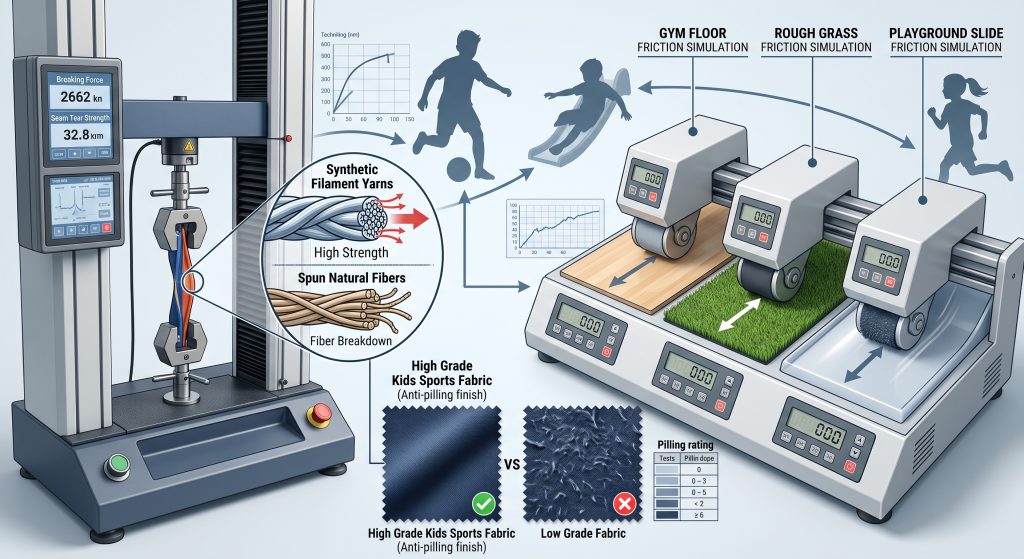
Testing durability requires measuring abrasion resistance, seam tear strength, and pilling performance under standardized laboratory conditions. High-grade kids sports fabric selections must withstand friction from gym floors, rough grass, and slide surfaces without wearing thin. Standardized Martindale abrasion testing quantifies how many rubbing cycles a fabric withstands before fiber breakdown occurs.
Synthetic filament yarns offer higher breaking strength than short spun natural fibers, keeping textile faces smooth after months of use. Anti-pilling finishes lock loose surface fibers into yarn cores to prevent unsightly fuzzing.
How to measure abrasion on active knits?
Martindale testing machines rub wool abradant discs against fabric swatches under continuous pressure until yarn breakage appears. Ready for the good part? High-grade children’s activewear textiles survive over 30,000 friction cycles.
- Friction testing simulates rough playground wear.
- Filament synthetics resist fiber tearing under abrasion.
- High cycle counts correlate with extended garment lifespan.
Why causes surface pilling in laundering?
Surface pilling happens when loose fiber ends untwist and rub together during washing machine agitation cycles. You can prevent surface fuzzing by specifying anti-pilling chemical finishes or high-twist yarn constructions at the mill level.
Key Takeaway: Verifying high Martindale cycle ratings and anti-pilling scores ensures youth garments withstand aggressive laundering and rough play.
| Durability Metric | Standard Performance | High-Grade Target |
| Martindale Abrasion | 15,000 Cycles | 30,000+ Cycles |
| Pilling Rating (ISO) | Grade 3 | Grade 4-5 |
Rigorous laboratory testing prevents quality complaints and ensures your activewear products endure long seasons of youth sports.
8. Which anti-chafing finish fits kids sports fabric?
Silicone-based softening treatments and hydrophilic topical coatings provide effective anti-chafing protection for sensitive children’s skin. Applying soft topical finishes during kids sports fabric manufacturing reduces yarn surface roughness, preventing friction burns on inner thighs and underarms. Smooth surface finishes remain intact through dozens of domestic washing cycles.
Hydrophilic finishes spread liquid sweat thinly across fabric surfaces, accelerating evaporation and preventing heavy dampness against skin. Dry, friction-free textiles allow children to play longer without discomfort or skin irritation.
How do softeners lower surface friction?
Specialized topical softeners coat synthetic fibers with microscopic lubricating layers that feel silky smooth against delicate skin. Believe it or not, treated activewear lowers skin friction by over 30 percent during dynamic movement.
- Lubricating coatings minimize mechanical skin rubbing.
- Silky hand feel improves child wearing comfort.
- Durable formulations resist removal during laundering.
Why do hydrophilic finishes dry quickly?
Hydrophilic topcoats lower liquid surface tension, causing sweat droplets to disperse immediately into broad, thin drying zones. You will observe much faster drying times when testing finished synthetic textiles against untreated knits.
Key Takeaway: Combining friction-reducing softeners with quick-dry hydrophilic finishes keeps young athletes dry, cool, and free from skin chafing.
| Finish Application | Core Function | Washing Durability |
| Friction Reduction Softener | Anti-Chafing & Skin Comfort | 30+ Wash Cycles |
| Hydrophilic Topcoat | Rapid Sweat Dispersion | 30+ Wash Cycles |
Applying advanced functional finishes allows garment manufacturers to deliver superior skin comfort that satisfies demanding parents.
9. How to choose kids sports fabric for warm weather?
Choosing warm weather materials requires selecting ultra-lightweight fabric weights between 110 and 130 GSM combined with high UPF sun protection. Specifying breathable kids sports fabric options with built-in ultraviolet defense shields young skin from solar radiation while preventing body overheating. Light colors and open micro-mesh weaves reflect ambient solar energy during summer outdoor games.
UPF 50+ finishes block over 98 percent of harmful UVA and UVB rays, providing built-in sun protection that does not rub off like sunblock lotions. Lightweight construction keeps clothing airy and comfortable in direct summer sunlight.
How do lightweight weights cool skin?
Low GSM fabrics minimize thermal insulation around the torso, allowing core body heat to escape freely into summer breezes. What’s the real story? Dropping fabric weight to 120 GSM drastically reduces thermal load on young runners.
- Low mass prevents heat trapping during outdoor play.
- Airy knit structure encourages constant body cooling.
- Thin construction dries rapidly under direct sunshine.
Why is UPF sun protection essential?
UV-blocking finishes incorporate titanium dioxide particles into yarn matrices to absorb solar radiation before it hits skin. You can protect children during all-day sports tournaments by specifying certified UPF 50+ athletic fabrics.
Key Takeaway: Combining 120 GSM lightweight mesh with UPF 50+ sun protection produces summer activewear that cools and protects children.
| Warm Weather Feature | Ideal Specification | Outdoor Benefit |
| Fabric Weight | 110 – 130 GSM | Minimal Heat Trapping |
| Sun Protection Rating | UPF 50+ | Blocks 98%+ UV Rays |
Specifying sun-safe, lightweight functional textiles enables apparel brands to lead the lucrative summer youth activewear market.
10. What cost drivers affect kids sports fabric sourcing?
Sourcing costs are driven by raw fiber choices, mill minimum order quantities, dyeing techniques, and specialized functional finishing processes. Procuring high-performance kids sports fabric efficiently requires balancing premium features like recycled yarns or UPF coatings against target retail market pricing. Strategic sourcing decisions protect profit margins while maintaining accessible prices for parent buyers.
Recycled polyester filaments and complex jacquard knits carry small price premiums compared to standard commodity polyester yarns. Sourcing managers negotiate order volumes and select mill stock colors to minimize per-yard procurement expenses.
How do yarn selections alter costs?
Brand-name recycled PET yarns and ultra-fine micro-filaments raise raw material costs compared to basic virgin polyester. Here is the deal: using standard polyester filaments keeps unit costs manageable for budget-conscious product lines.
- Recycled fibers carry a 10 to 15 percent price premium.
- Fine micro-denier yarns require slower knitting speeds.
- Commodity polyester provides the most economical baseline.
Why do mill minimums dictate volume?
Custom color dyeing and specialized chemical coatings require higher minimum order quantities, usually starting at 1,000 meters per shade. You can lower initial cash outlay by utilizing mill stock color programs for smaller production runs.
Key Takeaway: Selecting stock shades and balancing specialized finishes helps apparel managers control production costs without sacrificing quality.
| Sourcing Parameter | Economical Path | Premium Path |
| Raw Fiber Choice | Virgin Filament Polyester | Recycled PET / Micro-Denier |
| Color Selection | Mill Stock Colors | Custom Pantone Lab Dips |
Evaluating procurement variables allows activewear manufacturers to deliver high-value children’s apparel at competitive wholesale price points.
Conclusion
Selecting optimal materials for children’s activewear requires balancing surface softness, breathability, durability, and safety certifications. We addressed your core sourcing challenges by detailing fiber friction, knit geometries, anti-chafing finishes, and cost structures. When you contact us today, our technical specialists will assist you with sample swatches, custom color lab dips, and competitive mill pricing for your next youth sportswear collection. We stand committed to advancing global athletic garment quality through safe, high-precision functional textile manufacturing.
Frequently Asked Questions
Q1: Can I use standard adult activewear fabrics for children’s clothing?
No, children’s skin is far more sensitive and requires softer yarns, lower friction finishes, and non-toxic safety testing.
Q2: What’s the best fabric weight for kids summer activewear?
The ideal weight range spans between 110 GSM and 130 GSM, offering lightweight ventilation, rapid drying, and low heat retention.
Q3: How do I know if a fabric causes skin chafing?
Check for soft micro-denier yarn construction and feel for rough surface textures that irritate skin during friction movement.
Q4: Can I get UPF sun protection on lightweight mesh fabrics?
Yes, chemical UPF 50+ treatments can be applied to lightweight mesh, blocking over 98 percent of harmful solar rays.
Q5: How do I select durable fabrics for school sports uniforms?
Look for interlocked pique or high-density polyester knits with Martindale abrasion ratings exceeding 30,000 friction cycles.