
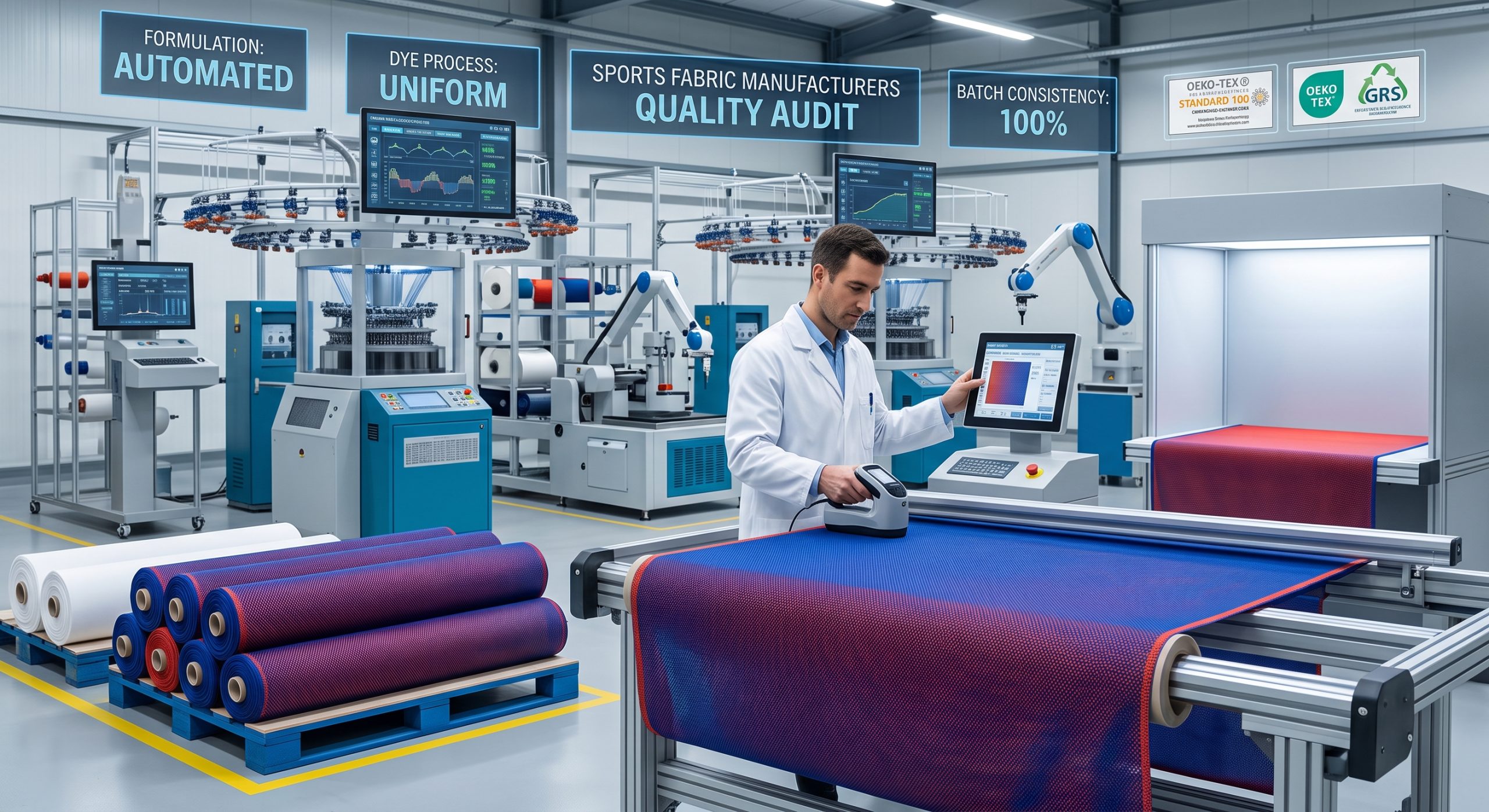
Achieving reliable activewear color uniformity requires collaborating with specialized, asset-heavy sports fabric manufacturers that implement automated chemical formulation recipes during continuous dye processes. Many athletic clothing brands confront massive supply line disruptions when bulk textile shipments arrive with noticeable tint variations across separate seasonal runs. Unpredictable material variance severely compromises your hard-earned consumer market trust while simultaneously inflating overhead costs through unexpected defective waste production cycles. Working alongside elite production facilities stabilizes raw material procurement streams by rendering every manufacturing step transparent from initial yarn selection to final shipment validation.
How Do sports fabric manufacturers Prevent Color Bleeding?
Leading sports fabric manufacturers prevent color bleeding by executing rigorous high-temperature post-dye laundering cycles and applying advanced chemical fixing agents to bind synthetic pigments securely. This technical stabilization ensures that finished performance garments maintain immaculate shade boundaries even during intense physical perspiration or repeated domestic washing machine cycles.
Managing thermodynamic chemical variables requires absolute oversight of fluid movement during execution. This careful observation guarantees that finished technical textiles bypass typical bleeding vulnerabilities entirely.
What Chemical Fixatives Secure Synthetic Pigments?
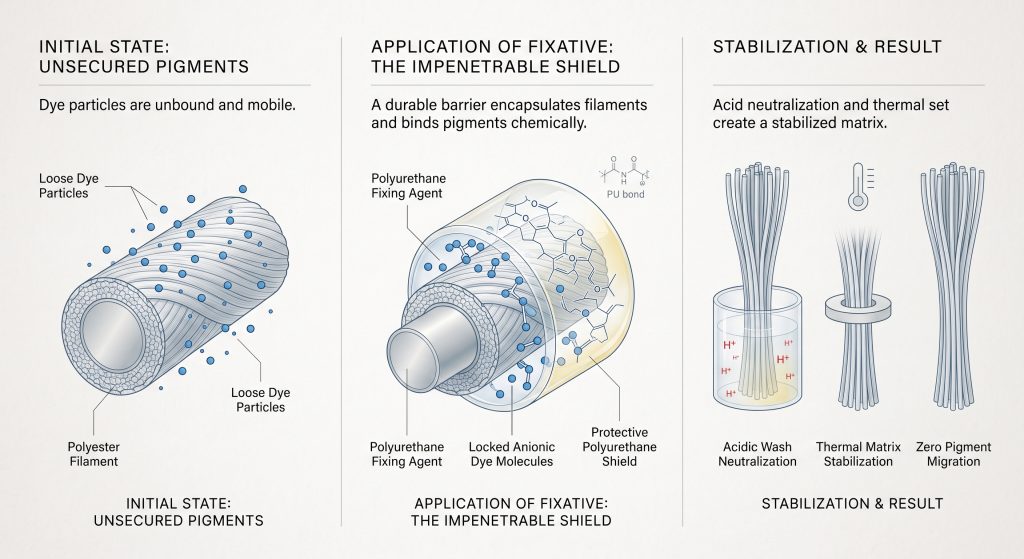
Here’s the deal. Applying premium polyurethane-based fixatives forms an impenetrable chemical shield around individual polyester filaments. This protective barrier stops loose dye particles from migrating during subsequent wet manufacturing treatments or intense consumer use phases.
- Polyurethane fixing agents lock anionic dye molecules permanently.
- Acidic wash treatments neutralize alkaline processing residues completely.
- Thermal setting procedures stabilize synthetic polymer matrices uniformly.
Why Do Post-Dye Laundering Cycles Matter?
What’s the real story? Removing unfixed surface pigments through controlled continuous scouring prevents migration during subsequent processing or consumer wear. This thorough purification keeps contrasting fabric panels looking sharp and professional over years of use.
- Continuous scouring removes loose surface dye particles efficiently.
- Temperature-controlled rinsing prevents thermal shock to elastomer blends.
- Mechanical agitation displaces chemical sub-products from deep knits.
Key Takeaway: Prioritizing thorough chemical fixation and post-dye washing ensures your activewear designs never suffer from muddy color bleeding or consumer returns.
| Fixation Element | Premium Standard | Commodity Grade |
| Chemical Base | Polyurethane Polymer | Simple Salt Solutions |
| Temperature Resistance | High Thermal Threshold | Low Laundering Limit |
Reviewing these chemical parameters helps procurement teams select textiles that retain deep pigment integrity through hundreds of wash cycles.
Why Do sports fabric manufacturers Require Lab Dips?
Certified sports fabric manufacturers require lab dips to establish an exact mathematical formula for custom color matching before initiating full-scale commercial dye lots. This crucial prototyping phase eliminates expensive human guesswork by aligning your specific digital color profiles with physical textile swatches under standardized lighting environments.
Developing accurate physical swatches protects your upfront financial investment from unexpected tint variations. This systematic approval process establishes a transparent operational benchmark that guarantees long-term product rollout security.
How Do Spectrophotometers Calculate Formulas?
You might be wondering. Digital optical sensors measure light reflectance across the fabric surface to generate an exact chemical recipe instantly. This automated precision ensures perfect reproduction accuracy across multiple production runs.
- Optical sensors measure precise wavelength reflectance curves accurately.
- Digital software translates color coordinates into chemical recipes.
- Automated dispensing systems measure liquid dyes down to milligrams.
Why Use Standardized Lighting Booths?
This is where it gets interesting. Evaluating swatches under multiple simulated light sources prevents metamerism where colors alter unexpectedly under retail store lamps. This rigorous optical testing preserves your aesthetic brand identity across various commercial lighting setups.
- D65 artificial daylight simulates natural outdoor environments perfectly.
- TL84 store lighting matches modern retail commercial environments.
- UV illumination checks for unwanted optical brightener activation.
Key Takeaway: Demanding detailed lab dip approvals under strict lighting protocols secures predictable color accuracy across every single clothing line you launch.
| Light Source | Technical Application | Brand Benefit |
| D65 Daylight | Outdoor Athletic Apparel | Accurate Natural Color |
| TL84 Store | Retail Showroom Display | Consistent Shelf Appeal |
Examining these technical lighting standards empowers design houses to eliminate color shifting across diverse retail environments.
Can sports fabric manufacturers Insure Batch Consistency?
Genuine sports fabric manufacturers insure absolute batch consistency by utilizing single-source raw yarn lots and maintaining automated telemetry over computerized circular knitting machinery parameters. This continuous operational vigilance prevents slight structural variances in stretch recovery or dye absorption that typically happen when production gets outsourced to fragmented secondary processing mills.
Securing identical physical textile attributes across seasonal shifts protects your hard-earned corporate market reputation. This calculated oversight allows enterprise apparel groups to plan expansive marketing campaigns with absolute inventory safety.
Why Focus on Single-Source Yarn Lots?
Ready for the good part? Blending filaments from disparate spinning facilities introduces unpredictable structural chemical variations that ruin subsequent dye lot matching uniformity. Sourcing continuous yarn polymer batches guarantees identical chemical alignment across entire shipments.
- Uniform polymer extrusion guarantees consistent filament dye receptivity.
- Identical moisture regain metrics prevent localized fabric shrinking.
- Consistent yarn twist profiles eliminate unexpected torque defects.
How Does Computerized Telemetry Protect Runs?
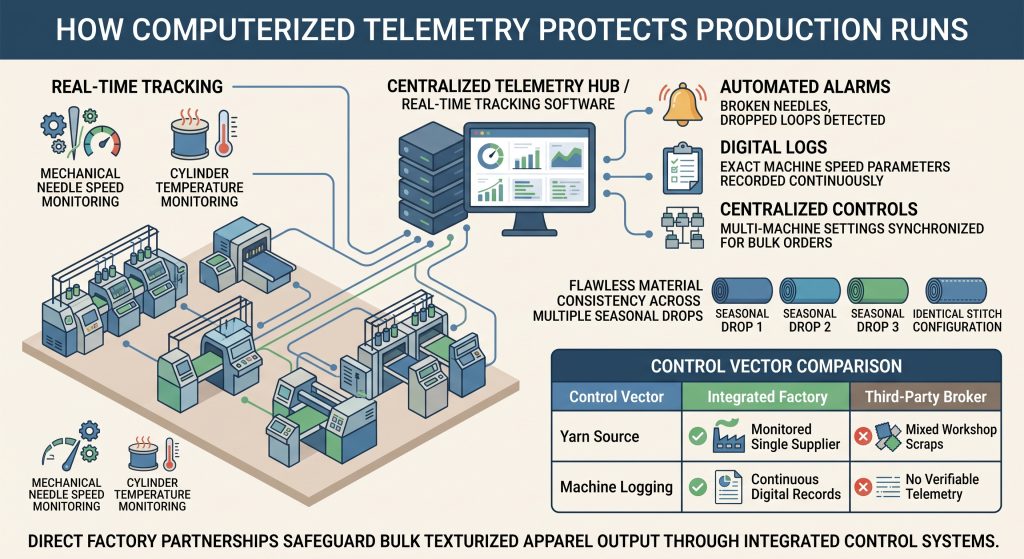
Think about it. Real-time tracking software monitors mechanical needle speed and cylinder temperature to ensure identical stitch configuration across millions of meters. This automated oversight removes human operational errors from the production equation.
- Automated alarms detect broken needles or dropped loops.
- Digital logs record exact machine speed parameters continuously.
- Centralized controls synchronize multi-machine settings for bulk orders.
Key Takeaway: Verifying that your production partner controls their internal asset infrastructure ensures flawless material consistency across multiple seasonal product drops.
| Control Vector | Integrated Factory | Third-Party Broker |
| Yarn Source | Monitored Single Supplier | Mixed Workshop Scraps |
| Machine Logging | Continuous Digital Records | No Verifiable Telemetry |
Reviewing these integrated control systems reveals why direct factory partnerships safeguard bulk texturized apparel output.
How Do sports fabric manufacturers Check Yarn Purity?
High-capacity sports fabric manufacturers check yarn purity by utilizing specialized laser scanning filtration systems and conducting detailed chemical laboratory validation tests on arriving raw material shipments. Eliminating irregular polymer contaminants during initial receipt guarantees that every single synthetic filament possesses uniform tensile strength metrics before knitting operations commence.
This deep screening protocol prevents micro-tears from developing when the finished activewear fabric encounters abrasive surfaces during intense outdoor sports training activities.
Why Filter Polymer Contaminants Early?
What’s the real story? Microscopic debris embedded within raw polyester melts causes weak focal points that fracture under intense multidirectional tension testing phases. Purifying raw materials secures structural integrity under heavy physical loads.
- Laser scanning detects microscopic density anomalies instantly.
- Mechanical filters trap foreign particulate matter during winding.
- Chemical assays verify molecular weight distribution parameters accurately.
How Does Purity Prevent Snagging Defects?
But here’s the kicker. Immaculate filament textures provide an ultra-soft silky touch that glides smoothly across human skin without catching on jagged structural elements. This pure composition extends garment life expectancy significantly.
- Uniform filament cross-sections reduce surface friction significantly.
- High-purity polymers resist abrasive degradation during laundering cycles.
- Flawless yarn surfaces maximize comfort during competitive sports matches.
Key Takeaway: Insisting on rigorous raw material filtration protocols eliminates costly post-production garment returns driven by sudden structural fiber failures.
| Purity Grade | Filament Defect Rate | Performance Outcome |
| Ultra-Filtered Premium | Under 0.05 Percent | High Tensile Integrity |
| Unrated Commodity | Exceeds 0.40 Percent | Frequent Snagging Risks |
Analyzing these filament defect frequencies clarifies why top-tier synthetic choices outperform cheap unrated alternative options.
Why Do sports fabric manufacturers Focus on Knit Density?
Experienced sports fabric manufacturers focus on knit density to achieve a flawless balance between absolute opaque coverage and dynamic moisture-wicking capillary forces within the performance textile matrix. Optimizing the internal stitch frequency per square centimeter builds a robust physical framework that retains its shape perfectly over long operational cycles.
Insufficient stitch compacting causes severe fabric transparency failures when garments undergo intense stretching or complex athletic maneuvers on the field.
How Does Birdseye Geometry Outperform Pique in Airflow?
You might be wondering. Birdseye structures utilize a tuck-stitch micro-aperture arrangement that optimizes passive cross-ventilation dynamics whereas pique weaves use alternate tuck sequences creating a heavy honeycomb profile. This specific architectural variation empowers designers to engineer clothing tailored to demanding physical activities.
- Birdseye micro-dots minimize skin contact to accelerate sweat evaporation.
- Pique honeycomb configurations provide structured body ideal for corporate polos.
- Air permeability testing heavily favors birdseye patterns under hot conditions.
Which Structure Fits Your Specific Hand Feel Selection?
This is where it gets interesting. Selecting birdseye delivers an ultra-soft silky touch that glides effortlessly over moving muscles while pique alternatives provide a distinctly texturized tactile feedback. Matching structural topologies to environmental expectations accelerates consumer satisfaction.
- Fluid drape characteristics make birdseye perfect for streamlined racing singlets.
- Rugged textured exteriors allow pique weaves to resist fabric wrinkling efficiently.
- Dimensional stability prevents classic pique edges from curling after laundering.
Key Takeaway: Mastering the structural trade-offs between birdseye smoothness and pique body allows you to satisfy distinct regional sportswear market preferences perfectly.
| Textile Topology | Tactile Hand Feel | Air Permeability | Primary Application |
| Birdseye Eyelet | Silky Smooth | Maximum Air Transfer | High-Intensity Training |
| Pique Honeycomb | Substantial Texture | Moderate Passive Draft | Corporate Golf Polos |
Examining these structural attributes enables sourcing managers to match exact fabric textures to targeted athletic performance environments.
Can sports fabric manufacturers Accelerate Sampling Timelines?
Modern sports fabric manufacturers accelerate sampling timelines by operating dedicated fast-track prototype production lines and utilizing automated color formulation spectrophotometers. Compressing the technical phase between initial design inspiration and physical validation reduces financial vulnerability during fast-evolving retail fashion macro planning cycles.
This rapid response capability ensures that your finalized activewear collections reach commercial retail shelves precisely when global consumer interest peaks.
How Do Automated Dispenser Systems Save Time?
Ready for the good part? High-speed laboratory dipping machinery removes tedious human guesswork from matching critical corporate brand palette specifications across diverse synthetic bases. Automated chemical tracking bridges the gap between digital concepts and tangible physical garments effortlessly.
- Computerized pigment dispensing delivers perfect shade formulations instantly.
- Automated sample vats simulate large-scale dye environments accurately.
- Digital color transmission bypasses slow physical courier validation loops.
Why Maintain Pre-Knitted Base Material Rolls?
What’s the real story? Keeping raw white base rolls prepared allows immediate application of custom digital sublimation artwork or specialized chemical finishes within forty-eight hours. This operational speed captures maximum full-price retail revenue during peak seasonal demand spikes.
- Pre-stocked greige fabric eliminates initial mechanical setup delays.
- Instant digital printing strike-offs accelerate aesthetic layout approvals.
- Dedicated sample circular frames process custom structural requests rapidly.
Key Takeaway: Partnering with agile manufacturing specialists eliminates multi-week development delays and secures early product positioning in competitive retail spaces.
| Sampling Milestone | Fast-Track Production | Standard Legacy Flow |
| Lab Dip Completion | 2-3 Business Days | 2-3 Operational Weeks |
| Strike-Off Dispatch | 5 Working Days | 30 Days Average |
Comparing these specific milestone durations highlights how rapid sample iteration protects your seasonal wholesale revenue streams.
How Do sports fabric manufacturers Manage Machine Tension?
Progressive sports fabric manufacturers manage machine tension by deploying automated servo-driven yarn feeding platforms that continuously calibrate resistance metrics across the entire width of the knitting cylinder. Maintaining uniform structural feeding pressure prevents unwanted localized structural distortion like uneven material stretching or wavy fabric edges during processing.
This immaculate tension tracking yields flat uniform textile rolls that cooperate perfectly with automated CNC cutting tables in your assembly plant.
Why Deploy Servo-Driven Feeding Systems?
Think about it. Microelectronic sensors detect minute variations in yarn resistance instantly and adjust speed profiles to maintain completely stable loop dimensions. This mechanical precision yields flawless mesh configurations that retain shape flawlessly over time.
- Servo motors adjust rotational feeding speeds within milliseconds.
- Tension transducers monitor yarn delivery paths continuously.
- Digital control loops eliminate manual mechanical operator errors.
How Does Flatness Improve Cutting Efficiency?
But here’s the kicker. Eliminating internal material stress ensures that cut garment panels retain their precise dimensions without shrinking or twisting before sewing operations. Consistent panel geometry minimizes material waste across expensive markers.
- Stress-free textile layout maximizes physical pattern cutting accuracy.
- Perfect edge flatness prevents automated fabric feeding jams.
- Consistent panel geometry minimizes material waste across markers.
Key Takeaway: Confirming that your textile supplier utilizes automated tension management platforms guarantees seamless transitions from raw rolls to finished apparel shapes.
| Tension Profile | Automated Servo Control | Manual Pulley Feeding |
| Elastic Uniformity | Under 1 Percent Variance | High Structural Distortion |
| Cutting Yield | Maximum Panel Accuracy | Unpredictable Border Shrinkage |
Examining these mechanical feeding differences clarifies why automated production assets preserve your long-term pattern accuracy.
Why Do sports fabric manufacturers Track GRS Certifications?
Responsible sports fabric manufacturers track Global Recycled Standard (GRS) certifications to provide an unbroken chain of custody that validates eco-friendly material origin claims for international brands. This meticulous ledger documentation protects your retail business from greenwashing litigation risks by proving the exact mathematical volume of recycled materials used.
Aligning your supply requirements with certified sustainable manufacturing processes opens highly lucrative sales avenues with modern environmentally conscious consumer segments worldwide.
How Does Chain of Custody Auditing Work?
You might be wondering. Regular third-party inspections verify transaction certificates at every transformation step from raw plastic bottle flakes to finished yarn spindles. This strict ledger system protects your corporate operations from complex auditing liabilities.
- Transaction certificates verify material flow between approved processors.
- Mass-balance calculations confirm true recycled content percentages accurately.
- Social compliance audits enforce ethical workplace practices globally.
Why Do Certified Origins Attract Retail Accounts?
Here’s the deal. High-profile enterprise procurement departments now require authentic environmental verifications before onboarding new athletic clothing lines into their global distribution networks. Certified inputs form the absolute baseline for brands competing within regulated global clothing spaces.
- Verified green claims build powerful consumer brand authenticity.
- Traceable supply chains comply with strict regional import mandates.
- Premium eco-friendly pricing models capture superior retail net margins.
Key Takeaway: Selecting fully certified GRS manufacturing partners secures your brand reputation while cleanly satisfying complex international environmental import standards.
| Compliance Standard | Verification Scope | Operational Protection |
| GRS Certification | Recycled Content Origin | Prevents Greenwashing Risks |
| OEKO-TEX 100 | Chemical Non-Toxicity | Guarantees Consumer Safety |
Synthesizing these international compliance protocols demonstrates how authenticated documentation safeguards your global commercial expansion plans.
Can sports fabric manufacturers Support Flexible Low MOQs?
Forward-thinking sports fabric manufacturers support flexible minimum order quantities (MOQs) by investing in versatile small-scale dyeing vats and optimizing machinery changeover procedures for shorter custom production runs. Shifting away from rigid multi-ton volume mandates allows emerging sportswear entities to test diverse regional consumer color preferences without draining liquid capital.
This agile financial positioning protects your net operating margins from heavy post-season discount liquidation events driven by unproven dead inventory accumulation.
How Do Small-Scale Dye Vats Protect Capital?
What’s the real story? Operating compact chemical equipment allows precise matching for boutique capsule runs without requiring miles of single-color fabric commitments. Releasing boutique capsule collections becomes financially viable when working alongside adaptive factories.
- Compact dyeing systems process smaller yarn volumes efficiently.
- Reduced water consumption minimizes specialized chemical processing waste.
- Lower upfront capital exposure preserves essential liquid working reserves.
Why Does Agile Sourcing Outperform Speculation?
This is where it gets interesting. Consumer purchasing trends shift rapidly via digital media updates which makes massive forward material commitments highly dangerous for growing organizations. Maintaining structural procurement flexibility constitutes an essential operational practice for modern apparel market leaders.
- Responsive production loops replenish high-demand colors within weeks.
- Boutique capsule releases match fast-moving lifestyle apparel trends.
- Minimized warehouse storage exposure lowers overhead logistics costs.
Key Takeaway: Securing accommodating low-volume entry thresholds empowers your product design team to iterate rapidly based on real-time customer data.
| Procurement Strategy | Flexible MOQ Factory | Legacy High-Volume Mill |
| Capital Exposure | Minimal Risk Tie | Heavy Financial Strain |
| Market Response | Ultra-Fast Turnaround | Rigid Multi-Month Delays |
Reviewing this operational contrast clarifies how flexible raw material lines form the financial backbone of low-risk brand growth.
How Do sports fabric manufacturers Ensure Order Accuracy?
High-performing sports fabric manufacturers ensure order accuracy by establishing direct communication links with factory floor technical managers and utilizing automated barcode tracking systems throughout production. Connecting your product development group straight to machine operations eliminates the costly administrative messaging distortion common when dealing with third-party brokers.
This unhindered transparency allows real-time visual verification of custom knitting patterns and packaging milestones before shipments depart international cargo docks.
Why Use Direct Contact Over Email Tickets?
Ready for the good part? Utilizing direct communication channels allows factory floor technicians to send immediate machine-side photo updates straight to your smartphone. This immediate contact format allows procurement personnel to upload visual reference files instantly.
- Instant messaging platforms bypass slow administrative corporate switchboards.
- Machine-side multimedia files verify color correctness before container packing.
- Immediate alignment resolves complex finishing questions within minutes.
How Do Barcode Ledger Systems Eliminate Mix-Ups?
But here’s the kicker. Tracking every textile roll with a unique digital identifier guarantees that your customized technical finishes remain correctly labeled across transit. This continuous scanning eliminates receiving errors at your downstream cut-and-sew assembly line.
- Unique digital labels track specific batch formulation histories.
- Automated scans match finished weights against initial purchase orders.
- Cross-border shipping marks remain perfectly legible for customs clearance.
Key Takeaway: Cultivating direct open dialogue windows with asset-heavy operators removes project execution uncertainty across long-distance supply partnerships.
| Channel Profile | Direct WhatsApp Line | Legacy Email Systems |
| Resolution Speed | Minutes | 24-48 Business Hours |
| Verification Type | Real-Time Video/Photo | Static Document Links |
Comparing these communication models highlights how direct digital avenues protect procurement groups from expensive multi-ton manufacturing errors.
Securing Your Activewear Supply Chain Moving Forward
Resolving complex procurement challenges requires anchoring your production pipeline with transparent, asset-heavy production facilities that eliminate unpredictable batch variance completely. Our advanced industrial factory provides the rigorous chemical verification, precise structural birdseye versus pique knitting configurations, and global regulatory compliance required to protect your brand equity. We stand ready to compress your development windows through rapid sample strike-offs and accommodating low-volume vats built for expanding clothing lines. Please reach out to our engineering department and contact us today to secure high-purity performance materials that empower global athletes to redefine their physical boundaries without compromise.
Frequently Asked Questions
Q1: Can I request custom performance fabric colors with low minimum volumes?
Yes, you can absolutely secure custom dye runs for smaller boutique orders. Our flexible production facility operates specialized compact vats to help expanding sportswear brands run market testing phases without heavy upfront capital stagnation.
Q2: What’s the best way to choose between Birdseye and Pique fabric for athletic apparel?
Evaluating your target climate and athletic application provides the best direction. Birdseye topologies excel during intense training due to their superior cross-ventilation pores, while pique honeycomb structures offer excellent tailored body for casual golf polos.
Q3: How do I know if an overseas textile supplier operates real manufacturing assets?
Requesting live machine-side video calls reveals true factory infrastructure instantly. Genuine operators gladly present real-time telemetry, physical machinery bays, and authenticated GRS declarations that tie back directly to their legal business entity.
Q4: Can I trust uncertified polyester materials for premium international distribution?
No, utilizing unrated synthetic components introduces severe customs seizure and chemical toxicity risks. Verified compliance certifications like OEKO-TEX Standard 100 guarantee absolute product purity, ensuring zero border delays or costly product recalls.
Q5: How do quick prototyping turnarounds safeguard my activewear retail revenue?
Delivering fast laboratory color swatches prevents your brand from missing rigid retail presentation windows. Compressing sample cycles down to mere days allows your team to capture rapidly moving marketplace trends ahead of rigid competitors.
Achieving reliable activewear color uniformity requires collaborating with specialized, asset-heavy sports fabric manufacturers that implement automated chemical formulation recipes during continuous dye processes. Many athletic clothing brands confront massive supply line disruptions when bulk textile shipments arrive with noticeable tint variations across separate seasonal runs. Unpredictable material variance severely compromises your hard-earned consumer market trust while simultaneously inflating overhead costs through unexpected defective waste production cycles. Working alongside elite production facilities stabilizes raw material procurement streams by rendering every manufacturing step transparent from initial yarn selection to final shipment validation.
How Do sports fabric manufacturers Prevent Color Bleeding?
Leading sports fabric manufacturers prevent color bleeding by executing rigorous high-temperature post-dye laundering cycles and applying advanced chemical fixing agents to bind synthetic pigments securely. This technical stabilization ensures that finished performance garments maintain immaculate shade boundaries even during intense physical perspiration or repeated domestic washing machine cycles.
Managing thermodynamic chemical variables requires absolute oversight of fluid movement during execution. This careful observation guarantees that finished technical textiles bypass typical bleeding vulnerabilities entirely.
What Chemical Fixatives Secure Synthetic Pigments?
Here’s the deal. Applying premium polyurethane-based fixatives forms an impenetrable chemical shield around individual polyester filaments. This protective barrier stops loose dye particles from migrating during subsequent wet manufacturing treatments or intense consumer use phases.
- Polyurethane fixing agents lock anionic dye molecules permanently.
- Acidic wash treatments neutralize alkaline processing residues completely.
- Thermal setting procedures stabilize synthetic polymer matrices uniformly.
Why Do Post-Dye Laundering Cycles Matter?
What’s the real story? Removing unfixed surface pigments through controlled continuous scouring prevents migration during subsequent processing or consumer wear. This thorough purification keeps contrasting fabric panels looking sharp and professional over years of use.
- Continuous scouring removes loose surface dye particles efficiently.
- Temperature-controlled rinsing prevents thermal shock to elastomer blends.
- Mechanical agitation displaces chemical sub-products from deep knits.
Key Takeaway: Prioritizing thorough chemical fixation and post-dye washing ensures your activewear designs never suffer from muddy color bleeding or consumer returns.
| Fixation Element | Premium Standard | Commodity Grade |
| Chemical Base | Polyurethane Polymer | Simple Salt Solutions |
| Temperature Resistance | High Thermal Threshold | Low Laundering Limit |
Reviewing these chemical parameters helps procurement teams select textiles that retain deep pigment integrity through hundreds of wash cycles.
Why Do sports fabric manufacturers Require Lab Dips?
Certified sports fabric manufacturers require lab dips to establish an exact mathematical formula for custom color matching before initiating full-scale commercial dye lots. This crucial prototyping phase eliminates expensive human guesswork by aligning your specific digital color profiles with physical textile swatches under standardized lighting environments.
Developing accurate physical swatches protects your upfront financial investment from unexpected tint variations. This systematic approval process establishes a transparent operational benchmark that guarantees long-term product rollout security.
How Do Spectrophotometers Calculate Formulas?
You might be wondering. Digital optical sensors measure light reflectance across the fabric surface to generate an exact chemical recipe instantly. This automated precision ensures perfect reproduction accuracy across multiple production runs.
- Optical sensors measure precise wavelength reflectance curves accurately.
- Digital software translates color coordinates into chemical recipes.
- Automated dispensing systems measure liquid dyes down to milligrams.
Why Use Standardized Lighting Booths?
This is where it gets interesting. Evaluating swatches under multiple simulated light sources prevents metamerism where colors alter unexpectedly under retail store lamps. This rigorous optical testing preserves your aesthetic brand identity across various commercial lighting setups.
- D65 artificial daylight simulates natural outdoor environments perfectly.
- TL84 store lighting matches modern retail commercial environments.
- UV illumination checks for unwanted optical brightener activation.
Key Takeaway: Demanding detailed lab dip approvals under strict lighting protocols secures predictable color accuracy across every single clothing line you launch.
| Light Source | Technical Application | Brand Benefit |
| D65 Daylight | Outdoor Athletic Apparel | Accurate Natural Color |
| TL84 Store | Retail Showroom Display | Consistent Shelf Appeal |
Examining these technical lighting standards empowers design houses to eliminate color shifting across diverse retail environments.
Can sports fabric manufacturers Insure Batch Consistency?
Genuine sports fabric manufacturers insure absolute batch consistency by utilizing single-source raw yarn lots and maintaining automated telemetry over computerized circular knitting machinery parameters. This continuous operational vigilance prevents slight structural variances in stretch recovery or dye absorption that typically happen when production gets outsourced to fragmented secondary processing mills.
Securing identical physical textile attributes across seasonal shifts protects your hard-earned corporate market reputation. This calculated oversight allows enterprise apparel groups to plan expansive marketing campaigns with absolute inventory safety.
Why Focus on Single-Source Yarn Lots?
Ready for the good part? Blending filaments from disparate spinning facilities introduces unpredictable structural chemical variations that ruin subsequent dye lot matching uniformity. Sourcing continuous yarn polymer batches guarantees identical chemical alignment across entire shipments.
- Uniform polymer extrusion guarantees consistent filament dye receptivity.
- Identical moisture regain metrics prevent localized fabric shrinking.
- Consistent yarn twist profiles eliminate unexpected torque defects.
How Does Computerized Telemetry Protect Runs?
Think about it. Real-time tracking software monitors mechanical needle speed and cylinder temperature to ensure identical stitch configuration across millions of meters. This automated oversight removes human operational errors from the production equation.
- Automated alarms detect broken needles or dropped loops.
- Digital logs record exact machine speed parameters continuously.
- Centralized controls synchronize multi-machine settings for bulk orders.
Key Takeaway: Verifying that your production partner controls their internal asset infrastructure ensures flawless material consistency across multiple seasonal product drops.
| Control Vector | Integrated Factory | Third-Party Broker |
| Yarn Source | Monitored Single Supplier | Mixed Workshop Scraps |
| Machine Logging | Continuous Digital Records | No Verifiable Telemetry |
Reviewing these integrated control systems reveals why direct factory partnerships safeguard bulk texturized apparel output.
How Do sports fabric manufacturers Check Yarn Purity?
High-capacity sports fabric manufacturers check yarn purity by utilizing specialized laser scanning filtration systems and conducting detailed chemical laboratory validation tests on arriving raw material shipments. Eliminating irregular polymer contaminants during initial receipt guarantees that every single synthetic filament possesses uniform tensile strength metrics before knitting operations commence.
This deep screening protocol prevents micro-tears from developing when the finished activewear fabric encounters abrasive surfaces during intense outdoor sports training activities.
Why Filter Polymer Contaminants Early?
What’s the real story? Microscopic debris embedded within raw polyester melts causes weak focal points that fracture under intense multidirectional tension testing phases. Purifying raw materials secures structural integrity under heavy physical loads.
- Laser scanning detects microscopic density anomalies instantly.
- Mechanical filters trap foreign particulate matter during winding.
- Chemical assays verify molecular weight distribution parameters accurately.
How Does Purity Prevent Snagging Defects?
But here’s the kicker. Immaculate filament textures provide an ultra-soft silky touch that glides smoothly across human skin without catching on jagged structural elements. This pure composition extends garment life expectancy significantly.
- Uniform filament cross-sections reduce surface friction significantly.
- High-purity polymers resist abrasive degradation during laundering cycles.
- Flawless yarn surfaces maximize comfort during competitive sports matches.
Key Takeaway: Insisting on rigorous raw material filtration protocols eliminates costly post-production garment returns driven by sudden structural fiber failures.
| Purity Grade | Filament Defect Rate | Performance Outcome |
| Ultra-Filtered Premium | Under 0.05 Percent | High Tensile Integrity |
| Unrated Commodity | Exceeds 0.40 Percent | Frequent Snagging Risks |
Analyzing these filament defect frequencies clarifies why top-tier synthetic choices outperform cheap unrated alternative options.
Why Do sports fabric manufacturers Focus on Knit Density?
Experienced sports fabric manufacturers focus on knit density to achieve a flawless balance between absolute opaque coverage and dynamic moisture-wicking capillary forces within the performance textile matrix. Optimizing the internal stitch frequency per square centimeter builds a robust physical framework that retains its shape perfectly over long operational cycles.
Insufficient stitch compacting causes severe fabric transparency failures when garments undergo intense stretching or complex athletic maneuvers on the field.
How Does Birdseye Geometry Outperform Pique in Airflow?
You might be wondering. Birdseye structures utilize a tuck-stitch micro-aperture arrangement that optimizes passive cross-ventilation dynamics whereas pique weaves use alternate tuck sequences creating a heavy honeycomb profile. This specific architectural variation empowers designers to engineer clothing tailored to demanding physical activities.
- Birdseye micro-dots minimize skin contact to accelerate sweat evaporation.
- Pique honeycomb configurations provide structured body ideal for corporate polos.
- Air permeability testing heavily favors birdseye patterns under hot conditions.
Which Structure Fits Your Specific Hand Feel Selection?
This is where it gets interesting. Selecting birdseye delivers an ultra-soft silky touch that glides effortlessly over moving muscles while pique alternatives provide a distinctly texturized tactile feedback. Matching structural topologies to environmental expectations accelerates consumer satisfaction.
- Fluid drape characteristics make birdseye perfect for streamlined racing singlets.
- Rugged textured exteriors allow pique weaves to resist fabric wrinkling efficiently.
- Dimensional stability prevents classic pique edges from curling after laundering.
Key Takeaway: Mastering the structural trade-offs between birdseye smoothness and pique body allows you to satisfy distinct regional sportswear market preferences perfectly.
| Textile Topology | Tactile Hand Feel | Air Permeability | Primary Application |
| Birdseye Eyelet | Silky Smooth | Maximum Air Transfer | High-Intensity Training |
| Pique Honeycomb | Substantial Texture | Moderate Passive Draft | Corporate Golf Polos |
Examining these structural attributes enables sourcing managers to match exact fabric textures to targeted athletic performance environments.
Can sports fabric manufacturers Accelerate Sampling Timelines?
Modern sports fabric manufacturers accelerate sampling timelines by operating dedicated fast-track prototype production lines and utilizing automated color formulation spectrophotometers. Compressing the technical phase between initial design inspiration and physical validation reduces financial vulnerability during fast-evolving retail fashion macro planning cycles.
This rapid response capability ensures that your finalized activewear collections reach commercial retail shelves precisely when global consumer interest peaks.
How Do Automated Dispenser Systems Save Time?
Ready for the good part? High-speed laboratory dipping machinery removes tedious human guesswork from matching critical corporate brand palette specifications across diverse synthetic bases. Automated chemical tracking bridges the gap between digital concepts and tangible physical garments effortlessly.
- Computerized pigment dispensing delivers perfect shade formulations instantly.
- Automated sample vats simulate large-scale dye environments accurately.
- Digital color transmission bypasses slow physical courier validation loops.
Why Maintain Pre-Knitted Base Material Rolls?
What’s the real story? Keeping raw white base rolls prepared allows immediate application of custom digital sublimation artwork or specialized chemical finishes within forty-eight hours. This operational speed captures maximum full-price retail revenue during peak seasonal demand spikes.
- Pre-stocked greige fabric eliminates initial mechanical setup delays.
- Instant digital printing strike-offs accelerate aesthetic layout approvals.
- Dedicated sample circular frames process custom structural requests rapidly.
Key Takeaway: Partnering with agile manufacturing specialists eliminates multi-week development delays and secures early product positioning in competitive retail spaces.
| Sampling Milestone | Fast-Track Production | Standard Legacy Flow |
| Lab Dip Completion | 2-3 Business Days | 2-3 Operational Weeks |
| Strike-Off Dispatch | 5 Working Days | 30 Days Average |
Comparing these specific milestone durations highlights how rapid sample iteration protects your seasonal wholesale revenue streams.
How Do sports fabric manufacturers Manage Machine Tension?
Progressive sports fabric manufacturers manage machine tension by deploying automated servo-driven yarn feeding platforms that continuously calibrate resistance metrics across the entire width of the knitting cylinder. Maintaining uniform structural feeding pressure prevents unwanted localized structural distortion like uneven material stretching or wavy fabric edges during processing.
This immaculate tension tracking yields flat uniform textile rolls that cooperate perfectly with automated CNC cutting tables in your assembly plant.
Why Deploy Servo-Driven Feeding Systems?
Think about it. Microelectronic sensors detect minute variations in yarn resistance instantly and adjust speed profiles to maintain completely stable loop dimensions. This mechanical precision yields flawless mesh configurations that retain shape flawlessly over time.
- Servo motors adjust rotational feeding speeds within milliseconds.
- Tension transducers monitor yarn delivery paths continuously.
- Digital control loops eliminate manual mechanical operator errors.
How Does Flatness Improve Cutting Efficiency?
But here’s the kicker. Eliminating internal material stress ensures that cut garment panels retain their precise dimensions without shrinking or twisting before sewing operations. Consistent panel geometry minimizes material waste across expensive markers.
- Stress-free textile layout maximizes physical pattern cutting accuracy.
- Perfect edge flatness prevents automated fabric feeding jams.
- Consistent panel geometry minimizes material waste across markers.
Key Takeaway: Confirming that your textile supplier utilizes automated tension management platforms guarantees seamless transitions from raw rolls to finished apparel shapes.
| Tension Profile | Automated Servo Control | Manual Pulley Feeding |
| Elastic Uniformity | Under 1 Percent Variance | High Structural Distortion |
| Cutting Yield | Maximum Panel Accuracy | Unpredictable Border Shrinkage |
Examining these mechanical feeding differences clarifies why automated production assets preserve your long-term pattern accuracy.
Why Do sports fabric manufacturers Track GRS Certifications?
Responsible sports fabric manufacturers track Global Recycled Standard (GRS) certifications to provide an unbroken chain of custody that validates eco-friendly material origin claims for international brands. This meticulous ledger documentation protects your retail business from greenwashing litigation risks by proving the exact mathematical volume of recycled materials used.
Aligning your supply requirements with certified sustainable manufacturing processes opens highly lucrative sales avenues with modern environmentally conscious consumer segments worldwide.
How Does Chain of Custody Auditing Work?
You might be wondering. Regular third-party inspections verify transaction certificates at every transformation step from raw plastic bottle flakes to finished yarn spindles. This strict ledger system protects your corporate operations from complex auditing liabilities.
- Transaction certificates verify material flow between approved processors.
- Mass-balance calculations confirm true recycled content percentages accurately.
- Social compliance audits enforce ethical workplace practices globally.
Why Do Certified Origins Attract Retail Accounts?
Here’s the deal. High-profile enterprise procurement departments now require authentic environmental verifications before onboarding new athletic clothing lines into their global distribution networks. Certified inputs form the absolute baseline for brands competing within regulated global clothing spaces.
- Verified green claims build powerful consumer brand authenticity.
- Traceable supply chains comply with strict regional import mandates.
- Premium eco-friendly pricing models capture superior retail net margins.
Key Takeaway: Selecting fully certified GRS manufacturing partners secures your brand reputation while cleanly satisfying complex international environmental import standards.
| Compliance Standard | Verification Scope | Operational Protection |
| GRS Certification | Recycled Content Origin | Prevents Greenwashing Risks |
| OEKO-TEX 100 | Chemical Non-Toxicity | Guarantees Consumer Safety |
Synthesizing these international compliance protocols demonstrates how authenticated documentation safeguards your global commercial expansion plans.
Can sports fabric manufacturers Support Flexible Low MOQs?
Forward-thinking sports fabric manufacturers support flexible minimum order quantities (MOQs) by investing in versatile small-scale dyeing vats and optimizing machinery changeover procedures for shorter custom production runs. Shifting away from rigid multi-ton volume mandates allows emerging sportswear entities to test diverse regional consumer color preferences without draining liquid capital.
This agile financial positioning protects your net operating margins from heavy post-season discount liquidation events driven by unproven dead inventory accumulation.
How Do Small-Scale Dye Vats Protect Capital?
What’s the real story? Operating compact chemical equipment allows precise matching for boutique capsule runs without requiring miles of single-color fabric commitments. Releasing boutique capsule collections becomes financially viable when working alongside adaptive factories.
- Compact dyeing systems process smaller yarn volumes efficiently.
- Reduced water consumption minimizes specialized chemical processing waste.
- Lower upfront capital exposure preserves essential liquid working reserves.
Why Does Agile Sourcing Outperform Speculation?
This is where it gets interesting. Consumer purchasing trends shift rapidly via digital media updates which makes massive forward material commitments highly dangerous for growing organizations. Maintaining structural procurement flexibility constitutes an essential operational practice for modern apparel market leaders.
- Responsive production loops replenish high-demand colors within weeks.
- Boutique capsule releases match fast-moving lifestyle apparel trends.
- Minimized warehouse storage exposure lowers overhead logistics costs.
Key Takeaway: Securing accommodating low-volume entry thresholds empowers your product design team to iterate rapidly based on real-time customer data.
| Procurement Strategy | Flexible MOQ Factory | Legacy High-Volume Mill |
| Capital Exposure | Minimal Risk Tie | Heavy Financial Strain |
| Market Response | Ultra-Fast Turnaround | Rigid Multi-Month Delays |
Reviewing this operational contrast clarifies how flexible raw material lines form the financial backbone of low-risk brand growth.
How Do sports fabric manufacturers Ensure Order Accuracy?
High-performing sports fabric manufacturers ensure order accuracy by establishing direct communication links with factory floor technical managers and utilizing automated barcode tracking systems throughout production. Connecting your product development group straight to machine operations eliminates the costly administrative messaging distortion common when dealing with third-party brokers.
This unhindered transparency allows real-time visual verification of custom knitting patterns and packaging milestones before shipments depart international cargo docks.
Why Use Direct Contact Over Email Tickets?
Ready for the good part? Utilizing direct communication channels allows factory floor technicians to send immediate machine-side photo updates straight to your smartphone. This immediate contact format allows procurement personnel to upload visual reference files instantly.
- Instant messaging platforms bypass slow administrative corporate switchboards.
- Machine-side multimedia files verify color correctness before container packing.
- Immediate alignment resolves complex finishing questions within minutes.
How Do Barcode Ledger Systems Eliminate Mix-Ups?
But here’s the kicker. Tracking every textile roll with a unique digital identifier guarantees that your customized technical finishes remain correctly labeled across transit. This continuous scanning eliminates receiving errors at your downstream cut-and-sew assembly line.
- Unique digital labels track specific batch formulation histories.
- Automated scans match finished weights against initial purchase orders.
- Cross-border shipping marks remain perfectly legible for customs clearance.
Key Takeaway: Cultivating direct open dialogue windows with asset-heavy operators removes project execution uncertainty across long-distance supply partnerships.
| Channel Profile | Direct WhatsApp Line | Legacy Email Systems |
| Resolution Speed | Minutes | 24-48 Business Hours |
| Verification Type | Real-Time Video/Photo | Static Document Links |
Comparing these communication models highlights how direct digital avenues protect procurement groups from expensive multi-ton manufacturing errors.
Securing Your Activewear Supply Chain Moving Forward
Resolving complex procurement challenges requires anchoring your production pipeline with transparent, asset-heavy production facilities that eliminate unpredictable batch variance completely. Our advanced industrial factory provides the rigorous chemical verification, precise structural birdseye versus pique knitting configurations, and global regulatory compliance required to protect your brand equity. We stand ready to compress your development windows through rapid sample strike-offs and accommodating low-volume vats built for expanding clothing lines. Please reach out to our engineering department and contact us today to secure high-purity performance materials that empower global athletes to redefine their physical boundaries without compromise.
Frequently Asked Questions
Q1: Can I request custom performance fabric colors with low minimum volumes?
Yes, you can absolutely secure custom dye runs for smaller boutique orders. Our flexible production facility operates specialized compact vats to help expanding sportswear brands run market testing phases without heavy upfront capital stagnation.
Q2: What’s the best way to choose between Birdseye and Pique fabric for athletic apparel?
Evaluating your target climate and athletic application provides the best direction. Birdseye topologies excel during intense training due to their superior cross-ventilation pores, while pique honeycomb structures offer excellent tailored body for casual golf polos.
Q3: How do I know if an overseas textile supplier operates real manufacturing assets?
Requesting live machine-side video calls reveals true factory infrastructure instantly. Genuine operators gladly present real-time telemetry, physical machinery bays, and authenticated GRS declarations that tie back directly to their legal business entity.
Q4: Can I trust uncertified polyester materials for premium international distribution?
No, utilizing unrated synthetic components introduces severe customs seizure and chemical toxicity risks. Verified compliance certifications like OEKO-TEX Standard 100 guarantee absolute product purity, ensuring zero border delays or costly product recalls.
Q5: How do quick prototyping turnarounds safeguard my activewear retail revenue?
Delivering fast laboratory color swatches prevents your brand from missing rigid retail presentation windows. Compressing sample cycles down to mere days allows your team to capture rapidly moving marketplace trends ahead of rigid competitors.