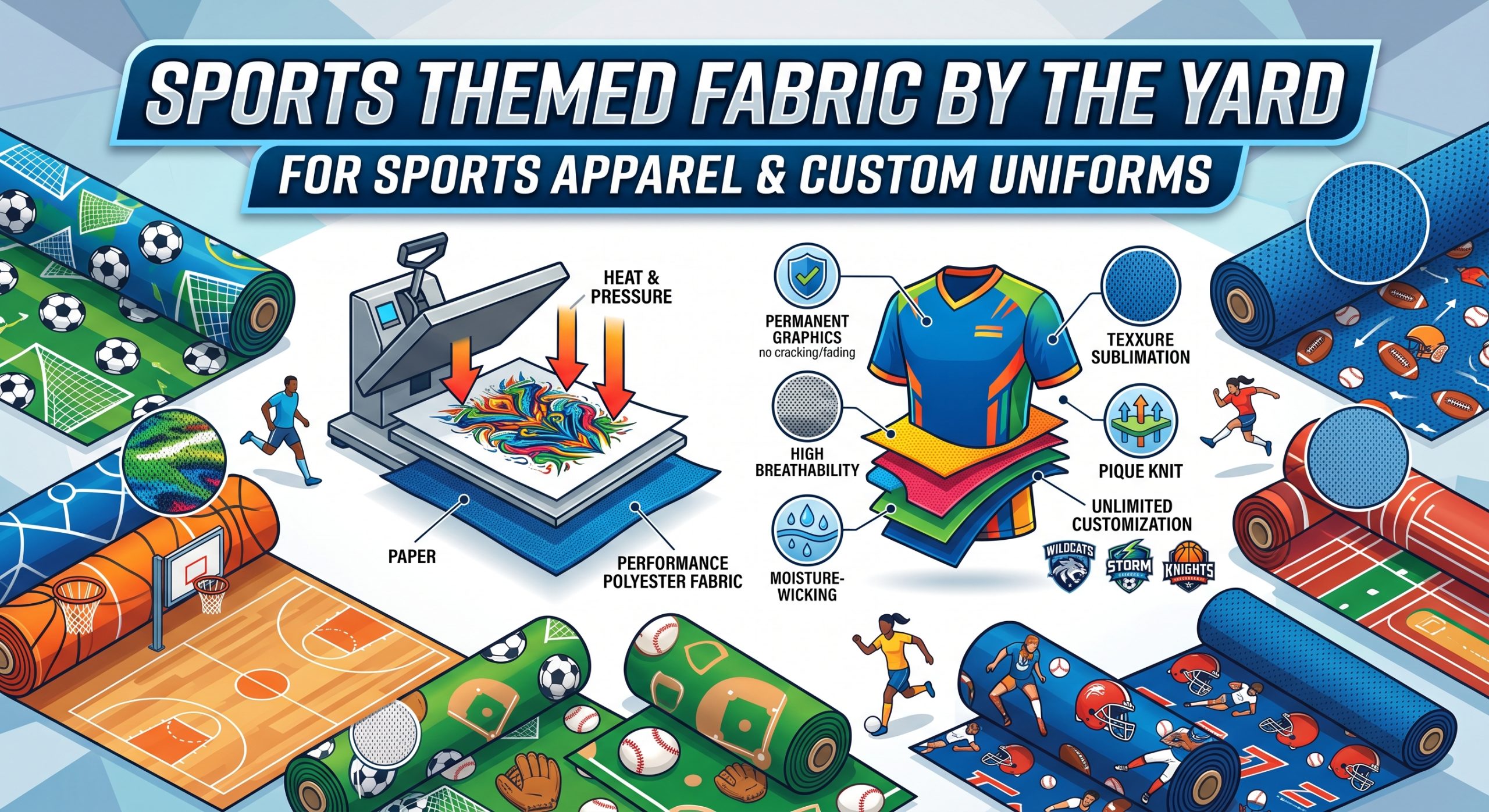
Sports teams choose sublimation fabric because it permanently fuses vibrant custom designs into the synthetic fibers without blocking ventilation or fading over time. Managing inventory for a growing athletic clothing brand often presents severe production hurdles. Ordering beautiful custom apparel samples only to see the complex patterns blur or crack after three washes ruins client trust immediately. Selecting premium sports themed fabric by the yard provides a definitive manufacturing solution that guarantees crisp color boundaries and reliable long-term stretch performance. Product managers rely on advanced technical textile mills to secure consistent dye integration across bulk seasonal apparel shipments.
1. Why Choose Sports Themed Fabric by the Yard for Sublimation?
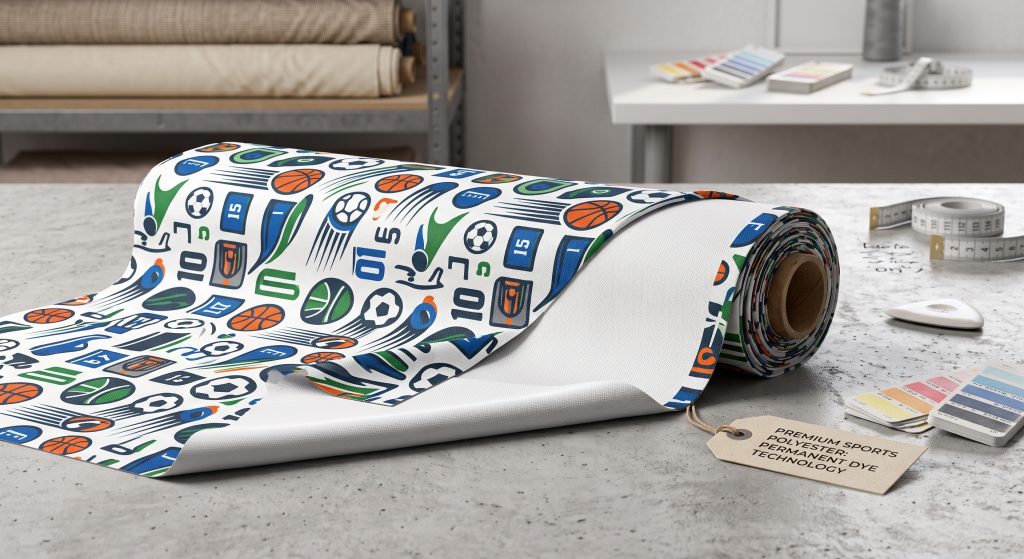
Sports teams prefer sublimation fabric because the specialized heat-transfer process creates permanent graphics that never peel crack or scratch away during intense matches. This advanced decoration method relies on polyester fibers that open their molecular structure under high temperatures to receive vaporized inks. Sourcing premium sports themed fabric by the yard gives athletic brands the exact canvas needed for vibrant complex club logos. Your activewear line stays lightweight and flexible because no heavy plastic layers sit on top of the knit pattern.
Can Sublimation Maintain Maximum Airflow?
High-performance team uniforms require unhindered ventilation to keep athletes cool during intense championship matches. But here’s the kicker… Traditional screen printing glues a thick layer of rubbery ink directly onto the surface which suffocates the textile weave completely.
- Polyester yarns absorb dye gas directly into the core matrix.
- Interstices between the knit paths stay open for air movement.
- Moisture vapor moves freely away from the player skin surface.
Does the Graphic Face Fading Risks?
Sublimated graphics resist fading because the color pigments reside inside the synthetic strands rather than clinging weakly to the exterior. What’s the real story? Laundering these performance garments repeatedly in commercial machines will not degrade the rich visual contrast or shift the team shade boundaries.
Key Takeaway: Choosing heat-sublimated polyester keeps your activewear looking pristine through multiple grueling athletic seasons.
| Customization Method | Graphic Longevity | Air Permeability | Surface Texture |
| Sublimation Transfer | Permanent | High Retention | Smooth and Weightless |
| Screen Printing | Prone to Cracking | Severely Reduced | Thick and Rigid |
This structural comparison clearly indicates that ink-fused fibers outperform surface coatings in grueling field conditions.
2. How Does Birdseye Sports Themed Fabric by the Yard Excel?
Birdseye mesh structural knit excels by creating a patterned geometric matrix of tiny dimples that accelerate moisture evaporation and prevent the fabric from clinging to sweat-drenched skin. This unique pattern resembles a bird eye which naturally elevates the aesthetic value of lightweight training shirts. Utilizing this specialized sports themed fabric by the yard allows apparel designers to construct garments with built-in passive cooling zones. The mechanical arrangement of the loops maximizes surface area to dry fabric rapidly.
What Defines the Geometric Knit Architecture?
The specific circular knitting process creates alternating raised loops and recessed gaps that form a continuous miniature diamond pattern. This is where it gets interesting… These recesses act like tiny exhaust funnels that channel body heat directly away from the athlete torso.
- Tuck stitches create a patterned cellular layout on the face.
- The structured surface reduces direct skin contact by forty percent.
- Capillary action pulls liquid perspiration through the microscopic openings.
Is This Structure Ideal for Daily Training?
The physical spacing within the birdseye knit provides incredible durability alongside its signature elasticity under heavy physical strain. Ready for the good part? You receive a material that resists snagging against velcro or sports equipment while remaining soft against sensitive skin.
Key Takeaway: Selecting birdseye configurations guarantees that your training apparel line delivers superior moisture management during high-intensity workouts.
| Structural Property | Birdseye Mesh Value | Performance Benefit |
| Direct Skin Contact | Reduced by 40% | Prevents Clinging and Chafing |
| Surface Geometry | Miniature Diamond Cell | Speeds Up Evaporative Cooling |
These specific performance metrics show how geometric loop placement transforms basic polyester into an active moisture shield.
3. What Is the Feel of Pique Sports Themed Fabric by the Yard?
Pique fabric delivers a distinctively rich textured handfeel through a specialized weaving or knitting technique that creates raised parallel cords or geometric waffle patterns across the surface. This structural loft gives the textile a substantial body and a crisp professional drape that remains unwrinkled during all-day wear. Selecting this premium sports themed fabric by the yard elevates traditional athletic apparel like classic polo shirts and golf apparel to a premium retail tier. The physical texture prevents the material from feeling slick or plastic-like against your skin.
How Does the Waffle Pattern Feel?
The raised geometric cords create a sophisticated structural feel that offers excellent tactile feedback and a premium look. What’s the real story? You get a substantial weight that hangs perfectly without clinging to body contours or looking flimsy under bright lights.
- Dobby or circular knit mechanisms generate distinct geometric loft.
- The exterior face exhibits a refined honeycomb or corded texture.
- The interior layer feels smooth and comfortable against your skin.
Does Texture Improve Garment Longevity?
The structural thickness of pique knit minimizes visible wear and resists pilling better than completely flat jersey alternatives. But here’s the kicker… This added structural stability means collars and plackets retain their tailored shape through dozens of laundry washings.
Key Takeaway: Utilizing pique structures provides the refined aesthetic and structural integrity required for premium corporate sportswear lines.
| Fabric Attribute | Pique Knit Metric | Garment Design Impact |
| Surface Texture | Raised Waffle / Honeycomb | Crisp Drape and Minimal Wrinkling |
| Fabric Density | Medium to Heavy Weight | Excellent for Structured Technical Polos |
The data demonstrates why upscale activewear brands specify corded textures when designing professional club apparel.
4. Which Sports Themed Fabric by the Yard Breaths the Best?
Birdseye mesh offers superior absolute breathability compared to pique fabric due to its open cellular layout that permits high volumes of air to pass directly through the yarn gaps. While pique relies on a heavier loft that creates an insulating layer of air, birdseye mesh functions as a direct ventilation screen. Sourcing this specific sports themed fabric by the yard ensures your activewear line thrives in hot humid environments. Evaluating these structural differences helps you match the textile precisely to the climate demands of the sport.
How Do Airflow Channels Function?
The structural holes within the birdseye knit act as open windows that facilitate immediate heat dissipation during heavy cardiovascular exertion. This is where it gets interesting… Pique fabric contains tightly packed yarn groups that slow down air movement in favor of retaining a tailored silhouette.
- Birdseye mesh features open micropores for rapid cross-ventilation.
- Pique utilizes layered cells that trap a thin protective thermal layer.
- Air permeability tests rank open mesh substantially higher than tight cords.
Which Option Suits High-Heat Workouts?
Lightweight open mesh serves runners and soccer players best because their high metabolic output demands instantaneous evaporation of liquid sweat. Ready for the good part? You can deploy pique for low-intensity sports like golf where structural elegance takes priority over extreme cooling capacity.
Key Takeaway: Matching the knit geometry to athlete metabolic rates prevents premature fatigue caused by heat accumulation.
| Performance Vector | Birdseye Mesh Structure | Pique Corded Structure |
| Air Flow Rate | Maximum Cross-Ventilation | Moderate Regulated Flow |
| Primary Application | Running and Intense Team Sports | Golf and Luxury Sportswear |
This clear operational divide helps production managers allocate specific knit patterns based on targeted athletic performance profiles.
5. How Does Sports Themed Fabric by the Yard Stop Bleeding?
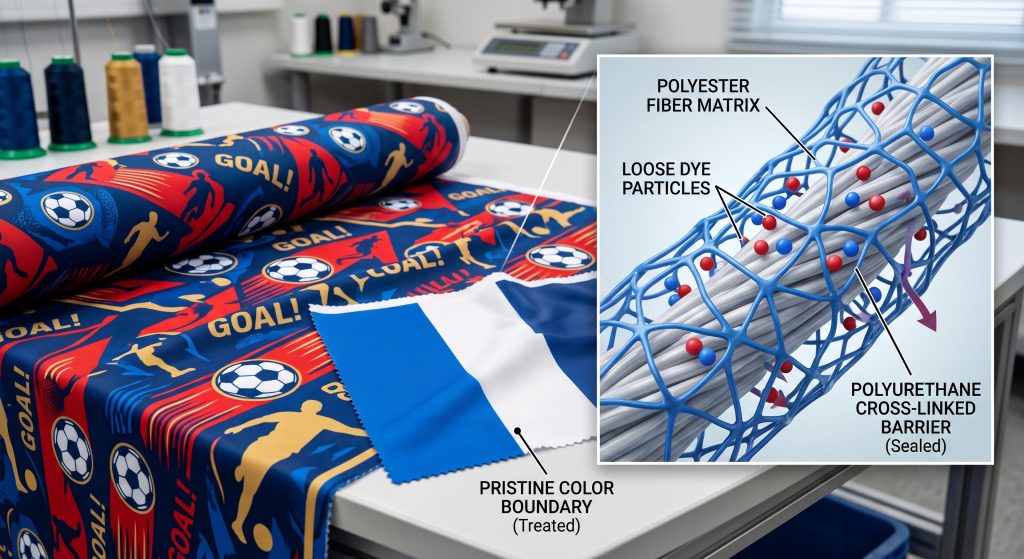
Advanced chemical fixatives stop color bleeding by creating a durable polyurethane cross-linked barrier that encapsulates individual synthetic filaments to seal loose dye particles permanently. This protective barrier blocks the migration of pigments out of the polyester matrix during hot washing machine cycles or heavy perspiration. Utilizing high-grade sports themed fabric by the yard that has undergone this treatment protects white panels from catching adjacent dark dyes. The chemical bond ensures that contrasting color designs retain pristine boundaries over time.
How Do Polyurethane Agents Work?
The specialized polyurethane solution coats the synthetic strands to build an impenetrable shield that blocks anionic dye molecules from escaping. But here’s the kicker… Without this chemical locking step, unbonded pigments migrate freely through water molecules during domestic washing cycles.
- Polymers create a cross-linked protective net over the fiber.
- Hydrophobic qualities block water molecules from dissolving target dyes.
- Color fastness ratings improve by multiple full grade increments.
Does Acid Wash Improve Stability?
Executing an acidic wash cycle neutralizes alkaline processing residues to stabilize the entire synthetic fiber matrix completely. What’s the real story? You receive a fully balanced textile that maintains its chemical integrity under exposure to acidic human sweat.
Key Takeaway: Verifying the application of advanced polymers prevents costly garment returns caused by ruining contrast panels during washing.
| Treatment Phase | Chemical Action | Fastness Outcome |
| Polyurethane Coating | Encapsulates Synthetic Fibers | Zero Pigment Migration |
| Acidic Neutralization | Eliminates Alkaline Residues | Stable pH and Sweat Resistance |
The chemical process parameters verify that post-dye stability depends entirely on rigorous polymer application.
6. How to Heat Dye Sports Themed Fabric by the Yard Safely?
Dyeing requires a precise thermal threshold to open the synthetic fiber crystalline structure and absorb performance pigments uniformly without damaging the loops. Maintaining an exact heat level prevents uneven dye distribution and avoids weakening the structural integrity of the delicate knit paths. Sourcing high-quality sports themed fabric by the yard processed under strict thermal monitoring protects your bulk garments from batch-to-batch color variance. Consistent thermodynamic oversight permits every roll to match your approved master color swatch perfectly.
What Is the Thermal Window?
Polyester dyeing requires a steady environment of one hundred thirty degrees Celsius to unlock the molecular gaps within the fiber. This is where it gets interesting… Dropping even five degrees below this narrow target window restricts dye penetration and causes weak surface coloration.
- High heat expands the intermolecular spacing of synthetic polymers.
- Pigment molecules embed deeply inside the relaxed core strands.
- Controlled cooling locks the fiber structure back around the dye.
How Does Fluctuating Heat Ruin Batches?
Uncontrolled thermal drops cause dyes to aggregate on the outer shell of the yarn rather than penetrating the core completely. Ready for the good part? You avoid surface pooling and subsequent crocking issues by tracking the heating curve with automated sensors.
Key Takeaway: Insisting on automated thermodynamic logging ensures that your custom brand colors look identical across multiple production runs.
| Dyeing Process Stage | Target Temperature | Structural Mechanism |
| Crystalline Expansion | 130°C (266°F) | Opens Polymer Gaps for Dye |
| Thermal Stabilization | Controlled Cooling | Seals Pigment in the Core |
The specific temperature thresholds prove that premium coloration demands strict oversight of manufacturing thermal curves.
7. Does Telemetry Protect Sports Themed Fabric by the Yard?
Telemetry protects production runs by continuously monitoring mechanical needle speeds and cylinder temperatures to maintain a perfectly uniform stitch configuration across millions of meters. This real-time software oversight identifies processing variances instantly and removes human operational errors from the manufacturing floor. Sourcing your sports themed fabric by the yard from a mill utilizing automated tracking systems safeguards your brand against random structural defects. Consistent data logging guarantees every textile roll meets elite athletic performance standards.
How Do Automated Alarms Function?
Sensors instantly flag broken needles or dropped loops to halt the circular knitting machinery before a defect ruins an entire roll. But here’s the kicker… Manual inspection methods often miss these tiny micro-tears until the fabric undergoes final tension testing.
- Optical sensors detect yarn tension drops within milliseconds.
- Digital machine logs record exact operational speeds around the clock.
- Centralized software synchronizes settings across multi-machine lines.
Why Do Digital Logs Matter?
Digital logs record exact operational speed parameters to establish a verifiable blueprint for identical future manufacturing batches. What’s the real story? You get flawless material consistency that allows your design team to execute seamless seasonal product drops.
Key Takeaway: Direct partnerships with telemetry-driven factories protect your textile investment from hidden structural flaws.
| Telemetry Vector | Sensor Function | Quality Assurance Benefit |
| Optical Tension Array | Detects Needle and Loop Breaks | Eliminates Long Fabric Runs with Tears |
| Speed Parameter Logging | Records Rotation Performance | Matches Elasticity Across Batches |
The tracking data proves that automated digital oversight provides a level of structural security that manual labor cannot match.
8. Is Recycled Sports Themed Fabric by the Yard Sustainable?
Recycled polyester delivers exceptional environmental benefits by diverting post-consumer plastic bottles from landfills and reducing carbon emissions by up to fifty percent compared to virgin petroleum sourcing. This eco-friendly alternative matches the tensile strength moisture-wicking capacity and dye affinity of standard synthetic options perfectly. Choosing this premium sports themed fabric by the yard satisfies the growing consumer demand for verifiable corporate sustainability without sacrificing product lifespan. Your brand gains a powerful marketing advantage rooted in genuine resource preservation.
Does Eco-Friendly Yarn Match Performance?
Modern recycling processes purify ocean-bound plastics down to the polymer level to create high-performance filaments that endure extreme athletic stress. This is where it gets interesting… You receive identical performance characteristics including excellent stretch recovery and high thermal stability.
- Post-consumer PET flakes are melted and extruded into fine yarn.
- The resulting fibers achieve Global Recycled Standard certification.
- Moisture transport metrics match virgin polyester values identically.
How Does Green Sourcing Help Brands?
Integrating certified green materials elevates your brand profile among premium retail clients who prioritize responsible manufacturing partnerships. Ready for the good part? You reduce your corporate carbon footprint while building a compliant transparent product line for international markets.
Key Takeaway: Adopting certified recycled synthetics allows your brand to capture the expanding eco-conscious athletic market seamlessly.
| Material Profile | Carbon Footprint | Tensile Strength | Compliance Certification |
| Certified Recycled PET | Reduced by 50% | High Performance | GRS / OEKO-TEX Standard |
| Traditional Virgin Polyester | High Environmental Impact | High Performance | Standard Factory Grade |
The material data confirms that sustainable yarn structures deliver elite athletic utility while drastically reducing ecological overhead.
9. How to Select Your Sports Themed Fabric by the Yard Knit?
Choosing between mesh and pique knits depends on balancing the specific metabolic demands of the sport against the desired aesthetic formality of the finished garment. Open birdseye mesh serves best when maximum evaporative cooling and lightweight flexibility dominate your product design requirements. Selecting either structure as your core sports themed fabric by the yard allows you to optimize your catalog for diverse seasonal environments. Analyzing your target audience activity profiles simplifies this critical manufacturing choice.
When Should You Specify Birdseye Mesh?
Specify birdseye mesh when engineering apparel for intense cardiovascular sports like track soccer or high-intensity interval training where sweating is guaranteed. What’s the real story? The structural micropores prevent heat exhaustion by enabling continuous fresh air passage over damp skin.
- Best for lightweight training singlets and team jerseys.
- Optimized for maximum liquid moisture transportation curves.
- Perfect for humid summer outdoor athletic competitions.
When Is Pique the Smarter Choice?
Pique represents the smarter choice for golf apparel tennis club uniforms and luxury lifestyle athleisure that demands structural polish. But here’s the kicker… The geometric loft hides body imperfections and resists wrinkling far better than ultra-thin mesh alternatives.
Key Takeaway: Aligning fabric architecture with athletic intensity protects your product catalog from performance complaints.
| Design Criteria | Birdseye Mesh Selection | Pique Waffle Selection |
| Moisture Management | Rapid Evaporation Screen | Absorbent Thermal Layer |
| Visual Silhouette | Casual Athletic Uniform | Structured Premium Fit |
The comparative criteria highlight how structural loop design dictates the final commercial utility of athletic garments.
10. Who Mills Quality Sports Themed Fabric by the Yard Direct?
Working directly with a fabric manufacturer eliminates costly middleman markup fees and provides your brand with absolute oversight over material customization quality control and lead times. This unhindered partnership allows you to request specialized performance finishes like customized antimicrobial coatings or specific weight adjustments. Securing your sports themed fabric by the yard straight from the production floor guarantees a transparent supply chain with verifiable compliance certifications. Your operational team gains direct access to technical textile engineers who can troubleshoot issues instantly.
Can Direct Access Speed Up Prototyping?
Direct factory communication cuts sample turnaround times down to a few days rather than waiting weeks for an intermediary broker to pass messages. This is where it gets interesting… You can iterate custom knit structures and test print absorption curves rapidly to beat competitors to market.
- In-house circular knitting lines execute custom swatches quickly.
- Direct lab matching ensures exact color formulation on the first try.
- Low minimum order quantities remain viable for innovative test drops.
How Does Direct Collaboration Control Costs?
Eliminating trading brokers lets you reallocate capital toward premium chemical fixatives or certified sustainable yarn components to elevate product value. Ready for the good part? You gain stable volume pricing agreements that protect your profit margins from sudden global market fluctuations.
Key Takeaway: Bypassing brokers guarantees your brand maintains total structural control over its core textile components.
| Supply Channel | Sampling Velocity | Quality Oversight | Unit Pricing Efficiency |
| Direct Manufacturing Plant | Fast 3-5 Day Turnaround | Absolute Structural Control | Maximum Cost Optimization |
| Third-Party Textile Broker | Extended 14-21 Days | Fragmented Layered View | Inflated Commission Costs |
The channel comparison proves that direct factory integrations yield superior operational agility and robust margin protection.
Final Summary
Selecting the perfect technical textile structure guarantees your athletic apparel line maintains flawless graphic boundaries exceptional breathability and structural integrity across multiple retail seasons. This guide clarified how specialized birdseye mesh delivers unmatched evaporative cooling while corded pique fabrics supply the tailored loft required for upscale corporate athleisure. Our modern mill stands ready to manufacture premium custom-engineered performance fabrics matching your exact weight width and color requirements. Partner with our automated facility to safeguard your upcoming seasonal product drops from color bleeding or structural failures. Please contact us today to request physical counter-samples and discover how our advanced circular knitting technology can upgrade your brand standard. We envision a future where sustainable textile engineering and flawless performance co-exist to power the next generation of global athletes.
FAQs
Q1: Can I use birdseye mesh for high-end golf polo shirts?
No, birdseye mesh is less suited for luxury golf shirts because its open cellular texture looks casual compared to the structured loft of pique knits. Pique supplies a crisp collar drape and heavier weight that aligns perfectly with corporate country club dress codes.
Q2: What’s the best way to prevent color bleeding on bright white panels?
The best approach requires applying premium cross-linked polyurethane fixatives during the post-dye finishing phase to lock pigments in the yarn core. This chemical barrier prevents loose dye particles from breaking free when exposed to water or intense athletic sweat.
Q3: How do I know if a mill utilizes computerized telemetry?
You can verify telemetry integration by requesting real-time machine speed logs and digital error report outputs from their circular knitting floor. Automated factories track every single run digitally to identify tension variations and needle breaks immediately without relying on manual checks.
Q4: Can I sublimate directly onto high-performance pique knits?
Yes, you can sublimate onto pique fabric provided the material composition consists entirely of heat-stable polyester filaments. The dye gas binds perfectly within the textured honeycomb surface to yield vibrant graphics that resist cracking or fading.
Q5: How do I know if recycled polyester matches virgin yarn quality?
You can confirm performance parity by checking if the yarn holds official Global Recycled Standard certification and verifying its tensile strength metrics. Modern extrusion methods create purified recycled filaments that offer identical stretch recovery moisture management and dye affinity.