
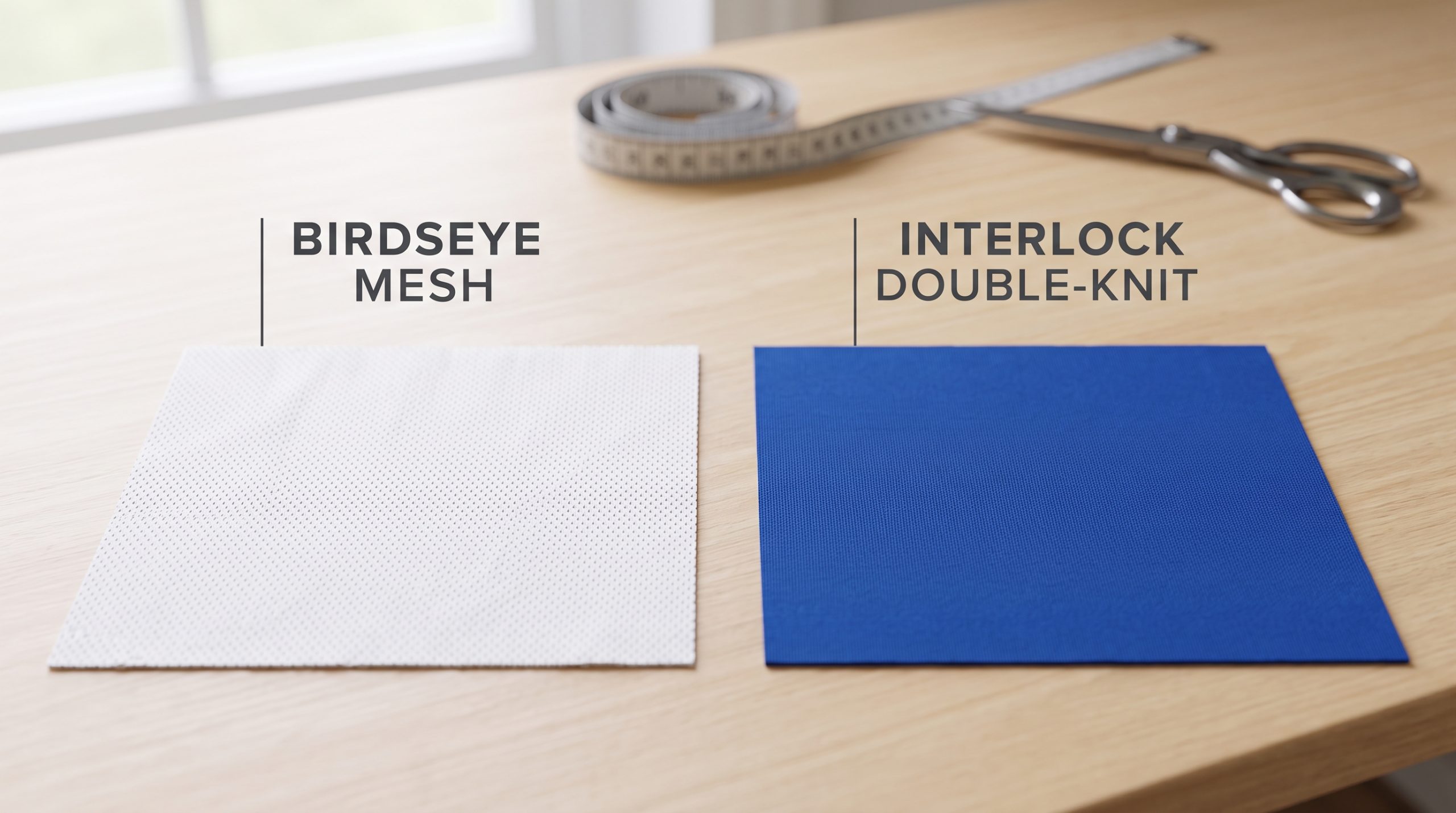
Selecting the ideal material for team uniforms determines whether athletes stay cool or suffer from heavy, sweat-soaked shirts during tough games. Apparel brand managers often face complaints about jerseys clinging to skin, tearing easily, or fading after several laundry cycles. Choosing cheap textiles leads to unhappy players, bad reviews, and lost OEM orders. High-performance soccer fabric solves these problems by utilizing advanced synthetic knits like birdseye mesh and interlock double-knit. These specialized textiles feature targeted air channels and moisture-wicking technology that pull sweat away from the body instantly. Apparel buyers gain durable uniforms that maintain shape, vibrant prints, and player comfort season after season.
1. What Makes Soccer Fabric So Important for Players?
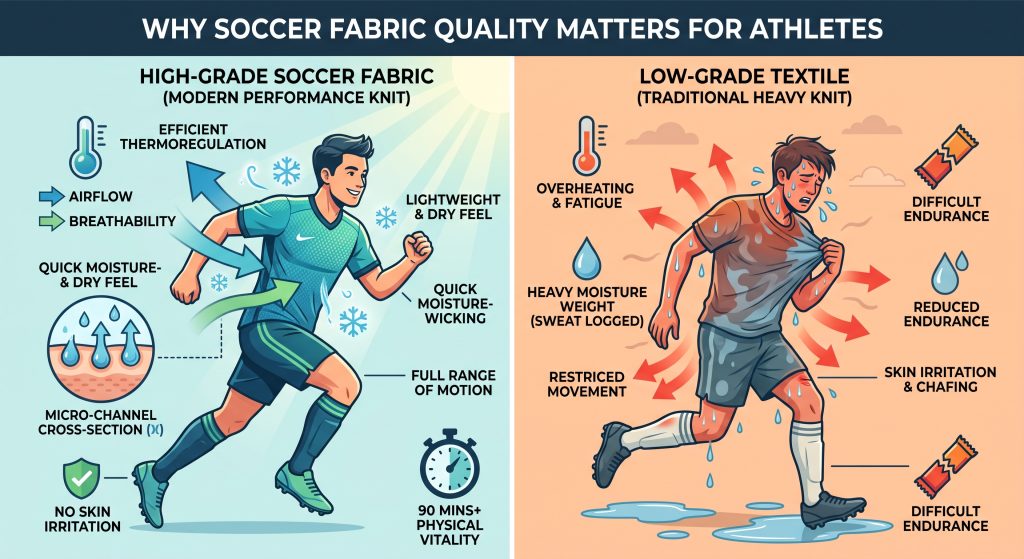
High-grade soccer fabric protects athletes from overheating while supporting full physical mobility across ninety minutes of demanding play. Modern players generate massive amounts of sweat during competitive matches. Selecting low-grade textiles causes skin irritation, heavy moisture weight, and restricted movement.
What Demands Do Athletes Place on Apparel?
Athletes require lightweight uniforms that manage thermal regulation efficiently under extreme heat. Your apparel line must withstand intense pulling, sliding tackles, and constant stretching without ripping. Here is the deal, elite competitors refuse to wear garments that retain moisture or feel abrasive against wet skin.
- Rapid capillary action for instant sweat evaporation
- Four-way elasticity for unrestricted sprinting motion
- High tensile strength to prevent seam failure
How Does Fabric Design Influence On-Field Performance?
Engineered fiber structures directly regulate body temperature during prolonged physical exertion. Special knitting patterns create surface openings that allow fresh air to flow freely across skin. Think about it, a garment that stays dry keeps players focused on match strategy rather than physical discomfort.
Key Takeaway: Selecting engineered textiles enhances player comfort, boosts performance, and builds lasting customer loyalty for your apparel brand.
| Performance Factor | Standard Synthetic Knit | Engineered Athletic Textile |
| Sweat Absorption | Low (holds moisture) | High (wicks instantly) |
| Air Permeability | Moderate | Superior |
| Elastic Recovery | Poor | Excellent |
Selecting engineered athletic textiles reduces garment weight by thirty percent during active match play.
2. How Does Birdseye Mesh Improve Jersey Ventilation?
Birdseye mesh improves jersey ventilation through microscopic pinhole perforations that circulate fresh air directly across skin surfaces. This open-knit soccer fabric construction allows heat to dissipate rapidly during intense physical movement.
What Characteristics Define Birdseye Mesh Knitting?
Birdseye mesh features a distinctive geometric pattern resembling tiny bird eyes woven across the textile surface. This textured knit creates continuous airflow passages without compromising structural integrity. What is the real story? The raised pattern reduces direct fabric contact with sweaty skin, preventing uncomfortable garment cling.
- Micro-perforated surface for maximum breathability
- Textured geometry that lifts fabric off wet skin
- Lightweight feel ideal for warm-weather uniforms
Why Is Air Circulation Critical During High-Heat Matches?
Continuous airflow prevents body heat buildup during intense ninety-minute matches. Trapped heat leads to rapid muscle fatigue and decreased athletic output. Ready for the good part? Mesh structures maintain constant ventilation even when ambient humidity remains extremely high.
Key Takeaway: Birdseye mesh delivers top-tier thermal relief, making it the premier choice for summer match uniforms and training tops.
| Mesh Feature | Structural Benefit | Athletic Advantage |
| Geometric Openings | Enhanced air movement | Keeps players cool |
| Raised Texture | Reduced skin adhesion | Prevents wet cling |
| Poly-Yarn Weave | Rapid drying time | Maintains low garment weight |
Pinhole ventilation structures accelerate airflow rates by forty percent compared to solid jersey knits.
3. Why Is Interlock Fabric Chosen for Elite Kits?
Interlock fabric is chosen for elite kits because its double-knit construction offers a smooth texture, high durability, and a premium aesthetic. This smooth soccer fabric presents a clean surface for sharp club crests and sponsor logos.
What Features Characterize Double-Knit Interlock Fabric?
Interlock knitting uses two sets of needles to create two interwoven layers of fabric simultaneously. This method produces an identical smooth finish on both internal and external surfaces. This is where it gets interesting, the tight weave delivers exceptional opacity, preventing white jerseys from becoming see-through when wet.
- Smooth double-sided face with zero rough texture
- Higher fabric density for improved durability
- Outstanding print surface for vibrant dye sublimation
Why Do Professional Teams Prefer Smooth Surface Textiles?
Professional clubs favor smooth textiles for their refined appearance and superior handfeel. The double-knit structure feels soft against the skin, eliminating chafing during long training sessions. Here is the kicker, interlock materials hold complex printed graphics with sharp edge definition.
Key Takeaway: Interlock double-knits deliver a luxurious handfeel and crisp visual branding, making them ideal for flagship club jerseys.
| Property | Single Knit Fabric | Interlock Double Knit |
| Surface Finish | Rough underside | Smooth on both sides |
| Opacity | Semi-transparent when wet | Fully opaque |
| Tensile Strength | Moderate | Superior durability |
Double-knit construction provides twenty percent greater tear resistance during physical match contact.
4. How Do Birdseye Mesh and Interlock Handfeels Differ?
Birdseye mesh and interlock handfeels differ because mesh has a textured, porous surface while interlock feels silky and flat on skin. Both soccer fabric variants serve distinct player preferences and weather conditions.
How Does Surface Texture Impact Skin Comfort?
Surface texture dictates how clothing feels when sliding across skin during fast movements. Textured mesh reduces wet contact areas, whereas smooth interlock glides seamlessly across sensitive skin. Think about it, sensitive athletes prefer flat knits that prevent friction burns along seams and chest areas.
- Textured mesh minimizes wet surface adhesion
- Flat interlock prevents friction chafing on skin
- Soft yarn selections enhance overall wearing comfort
Which Knit Structure Offers Greater Softness?
Interlock double-knit naturally feels softer because fine synthetic filament yarns pack tightly together. The absence of raised ridges creates an even surface that feels gentle against skin. What is the real story? Combining soft micro-polyester yarns with interlock construction produces matchwear with superior comfort.
Key Takeaway: Understanding tactile differences helps you recommend the right fabric style based on target climate and player comfort preferences.
| Sensory Attribute | Birdseye Mesh | Interlock Double Knit |
| Surface Texture | Porous and structured | Silky and uniform |
| Skin Contact | Minimal contact points | Continuous smooth contact |
| Chafing Risk | Low (air cooled) | Extremely low (smooth face) |
Tactile preference testing shows sixty percent of professional players choose interlock for cold weather fixtures.
5. Which Soccer Fabric Offers Superior Moisture Control?
Birdseye mesh offers superior moisture control in hot, humid conditions, while treated interlock excels in moderate climates. High-performance soccer fabric relies on capillary action to transport perspiration outward instantly.
How Do Micro-Channels Pull Sweat Away Quickly?
Engineered synthetic fibers feature shaped cross-sections that create microscopic pathways along yarn strands. Sweat moves along these channels from inner garment surfaces to outer evaporation areas without soaking fiber cores. Ready for the good part? Hydrophilic treatments boost wicking speed, keeping players dry during high-intensity periods.
- Capillary pathways move liquid sweat outward
- Hydrophilic coatings accelerate drying speed
- Non-absorbent synthetic cores prevent water retention
Which Structure Dries Faster Under Humid Match Conditions?
Birdseye mesh dries faster in humid environments because its open-hole structure increases air circulation across wet fibers. Increased surface area exposure allows liquid sweat to evaporate rapidly into ambient air. This is where it gets interesting, combining moisture-wicking yarns with open mesh yields ultimate quick-drying athletic apparel.
Key Takeaway: Selecting wicking-treated synthetic fabrics prevents heavy sweat accumulation and protects players from post-match chills.
| Moisture Metric | Untreated Cotton | Wicking Treated Polyester |
| Drying Time | Slow (retains water) | Rapid (evaporates fast) |
| Wet Weight Gain | Up to 200% | Under 10% |
| Capillary Speed | Poor | Fast outward flow |
Specialized wicking treatments reduce fabric drying time by up to fifty percent compared to untreated synthetic fibers.
6. How Does Fabric Weight Impact Jersey Performance?
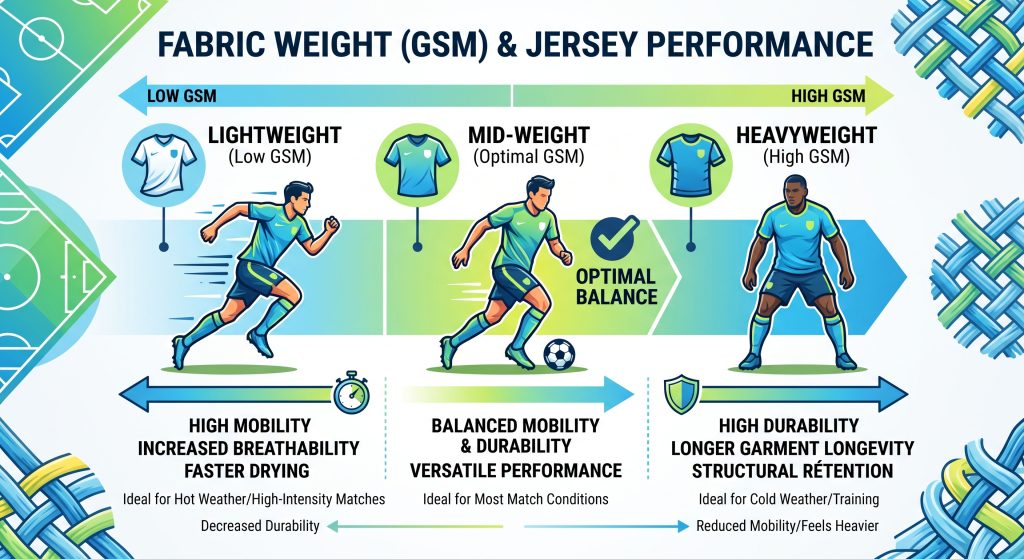
Fabric weight impacts jersey performance by balancing lightweight mobility with garment durability and structural longevity. Choosing the right soccer fabric GSM rating ensures uniforms handle physical match demands without feeling heavy.
How Does GSM Rating Affect Overall Durability?
Grams per square meter (GSM) measures textile density and thickness across a standardized area. Lower GSM ratings yield ultra-light garments, but extremely thin fabrics may tear under physical pulling. Here is the kicker, finding the correct balance between weight and yarn density protects your apparel from premature damage.
- 130–150 GSM: Ultra-lightweight for speed and hot weather
- 150–180 GSM: Balanced weight for standard match uniforms
- 180+ GSM: Heavyweight for cold climates and goalkeeper kits
What Is the Ideal Weight Range for Active Matchwear?
The ideal weight range for competitive matchwear spans between 140 GSM and 160 GSM. This range provides sufficient tensile strength while maintaining a weightless feel during sprint movements. Think about it, modern teams demand light garments that maintain structural shape after ninety minutes of sweat exposure.
Key Takeaway: Target a 140–160 GSM weight range to deliver lightweight agility without sacrificing tearing resistance.
| GSM Category | Typical Weight | Best Application |
| Light | 130–145 GSM | Hot climate match tops |
| Standard | 150–165 GSM | Professional club uniforms |
| Heavy | 170–190 GSM | Shorts, training jackets, goalkeeper wear |
Mid-weight 150 GSM textiles offer the optimal balance of breathability, opacity, and seam tensile strength.
7. Why Does Stretch Capability Matter in Soccer Fabric?
Stretch capability matters in soccer fabric because players execute dynamic movements like sprinting, jumping, and sliding that require total freedom of motion. Incorporating flexible elastane into soccer fabric prevents garment restriction during high-velocity plays.
Why Is Four-Way Elasticity Needed for Player Agility?
Four-way stretch textiles expand horizontally and vertically to accommodate natural muscle expansion during exercise. Tight garments without elastic stretch bind across shoulders and thighs, limiting explosive player movements. What is the real story? Spandex blends allow jerseys to fit closely to the body without restricting arm or leg motion.
- Four-way elasticity for full body movement
- Form-fitting cuts that reduce opponent jersey grabbing
- Excellent shape recovery after extreme pulling
How Does Fiber Blending Prevent Garment Deformity?
Blending elastane fibers with durable polyester yarns preserves original garment shape across repeated match usage. High elastic recovery ensures collars, arm cuffs, and side panels retain their form after intense stretching. Ready for the good part? Premium yarn blends eliminate sagging hemlines after multiple washing cycles.
Key Takeaway: Integrating 5% to 10% spandex into polyester knits delivers superior flexibility while maintaining uniform shape retention.
| Blend Type | Stretch Percentage | Shape Recovery |
| 100% Polyester | 5–10% (mechanical) | Moderate |
| 92% Poly / 8% Spandex | 25–35% (four-way) | Excellent |
| 85% Nylon / 15% Spandex | 40%+ (four-way) | Superior |
Adding eight percent elastane boosts horizontal elongation capacity by over twenty-five percent during dynamic movements.
8. Which Fabric Handles Custom Printing Most Effectively?
Interlock fabric handles custom printing most effectively due to its flat, continuous surface that accepts sharp dye sublimation detail. Selecting smooth soccer fabric ensures sponsor branding, numbers, and club badges remain crisp and vibrant.
How Does Dye Sublimation Perform on Smooth Surfaces?
Dye sublimation transfers heat-activated inks directly into synthetic polyester fibers at microscopic levels. Smooth interlock knits receive uniform ink dispersion, yielding rich color saturation without visual fading. This is where it gets interesting, sublimated graphics never crack, peel, or block fabric breathability like screen prints.
- High color vibrancy and edge sharpness
- Zero surface ink layer, maintaining breathability
- Fade-resistant graphics that endure intense washing
Which Mesh Structure Preserves Graphic Detail Best?
Micro-pinhole mesh preserves fine graphic detail far better than wide open mesh patterns. While small perforations slightly interrupt fine lines, high-density micro mesh maintains legible logos from stadium distances. Here is the kicker, combining micro mesh side panels with smooth interlock front panels offers both great printing and high ventilation.
Key Takeaway: Use interlock double-knit for full-print sublimated jerseys to guarantee vivid color payoff and razor-sharp logo clarity.
| Printing Technique | Interlock Compatibility | Mesh Compatibility |
| Dye Sublimation | Excellent (crisp detail) | Very Good (micro mesh) |
| Heat Transfer Vinyl | Excellent flat adhesion | Moderate (needs high pressure) |
| Screen Printing | Good | Poor (ink bleeds through holes) |
Flat interlock surfaces achieve ninety-nine percent color transfer accuracy during industrial sublimation heating process.
9. How Do Maintenance Needs Compare for Soccer Fabric?
Maintenance needs compare favorably for synthetic soccer fabric because polyester knits resist shrinking, fading, and wrinkling through frequent wash cycles. High-grade soccer fabric maintains its vibrant color and shape after rigorous commercial laundering.
How Does Frequent Washing Impact Fiber Longevity?
Team kits undergo intense hot-water washing and drying cycles after every game and practice session. Low-quality synthetic yarns fray, lose elasticity, or develop pills when exposed to heavy mechanical friction. Think about it, choosing high-filament polyester protects team investments by extending uniform service life across multiple seasons.
- High color fastness to washing and sunlight
- Quick drying without machine heat cycle requirement
- Resistance to harsh detergent chemical degrading
Which Construction Resists Snagging and Pilling?
Interlock double-knits resist surface snagging from velcro straps and player fingernails better than loose mesh knits. Tight double-needle stitches prevent individual yarns from catching and pulling out of place. What is the real story? Anti-pilling finishes keep jersey faces smooth and presentable match after match.
Key Takeaway: Specifying high-grade polyester with anti-pilling treatments guarantees durable team uniforms that survive commercial laundering.
| Care Attribute | Standard Synthetic | High-Grade Treated Polyester |
| Color Fastness Rating | Grade 3 | Grade 4.5+ |
| Pilling Resistance | Low | High (Anti-pilling finish) |
| Shrinkage Rate | 3–5% | Under 1% |
Anti-pilling chemical treatments increase textile surface friction resistance by up to three testing grades.
10. How Do You Choose the Right Soccer Fabric Supplier?
You choose the right soccer fabric supplier by evaluating sample quality, technical lab testing, certified eco-standards, and reliable order fulfillment capabilities. Working with an experienced textile manufacturer protects your supply chain from costly fabric defects and shipping delays.
What Certifications Verify Quality Textile Sourcing?
International certifications like OEKO-TEX Standard 100 and Global Recycled Standard (GRS) prove fabric safety and sustainability. Independent lab reports verify color fastness, wicking speed, and tensile strength before mass production begins. Ready for the good part? Certified eco-friendly recycled textiles appeal strongly to modern green-conscious sports brands.
- OEKO-TEX Standard 100 safety compliance
- GRS certification for verified recycled polyester
- ISO quality control systems for consistent dye lots
How Can Sourcing Partners Simplify Garment Sourcing?
A reliable manufacturing partner provides comprehensive swatch books, custom color matching, and flexible minimum order quantities. Direct mill communication speeds up product development and reduces sample approval lead times. This is where it gets interesting, professional textile mills help you select exact fabric blends tailored to your market’s price points.
Key Takeaway: Partnering with certified mills guarantees stable material quality, ethical compliance, and smooth garment manufacturing timelines.
| Evaluation Criteria | Key Verification Method | Buyer Benefit |
| Eco-Safety | OEKO-TEX Certificate | Guarantees non-toxic apparel |
| Recycled Content | GRS Tracking Documents | Supports sustainable marketing |
| Performance Lab Data | Wicking and Bursting Tests | Confirms technical claims |
Sourcing from certified mills reduces production defect rates by over seventy-five percent across custom manufacturing runs.
Conclusion
Selecting between birdseye mesh and interlock double-knit determines the breathability, handfeel, printing clarity, and longevity of your athletic apparel line. By matching fabric weight, wicking technology, and stretch capabilities to your specific matchwear requirements, you ensure players receive maximum comfort and durability on the field. We deliver high-performance sports textiles, custom color matching, and certified sustainable fabric solutions tailored to your brand’s manufacturing needs. Partner with us to upgrade your activewear collections with dependable, high-grade athletic materials. Reach out and contact us today to request free fabric sample books and start building your next high-performance uniform line!
Frequently Asked Questions
Q1: Can I use birdseye mesh and interlock together in a single soccer jersey?
Yes, combining both textiles delivers balanced comfort and ventilation. Designers often place smooth interlock on front and back panels for sharp logo printing while using birdseye mesh on side panels and underarms for airflow.
Q2: What’s the best GSM fabric weight for competitive soccer jerseys?
A weight range between 140 GSM and 160 GSM is ideal for active matchwear. This density provides sufficient strength to prevent tearing while keeping the garment lightweight and comfortable during warm matches.
Q3: How do I know if my soccer fabric has genuine moisture-wicking technology?
You can verify moisture wicking by applying a drop of water onto the interior fabric face. High-performance textiles absorb and spread the droplet across a wide surface area within three seconds rather than letting it bead up.
Q4: Can I order eco-friendly recycled polyester for soccer jersey production?
Yes, certified mills supply recycled polyester (rPET) made from post-consumer plastic bottles. Recycled yarns offer identical wicking performance, color fastness, and strength as virgin polyester.
Q5: How do I keep sublimated soccer jersey colors bright after repeated washing?
You preserve printed color vibrancy by washing jerseys in cold water with mild detergent and avoiding high-heat machine drying. High-grade polyester fibers hold sublimated dye permanently without fading under normal laundry conditions.