
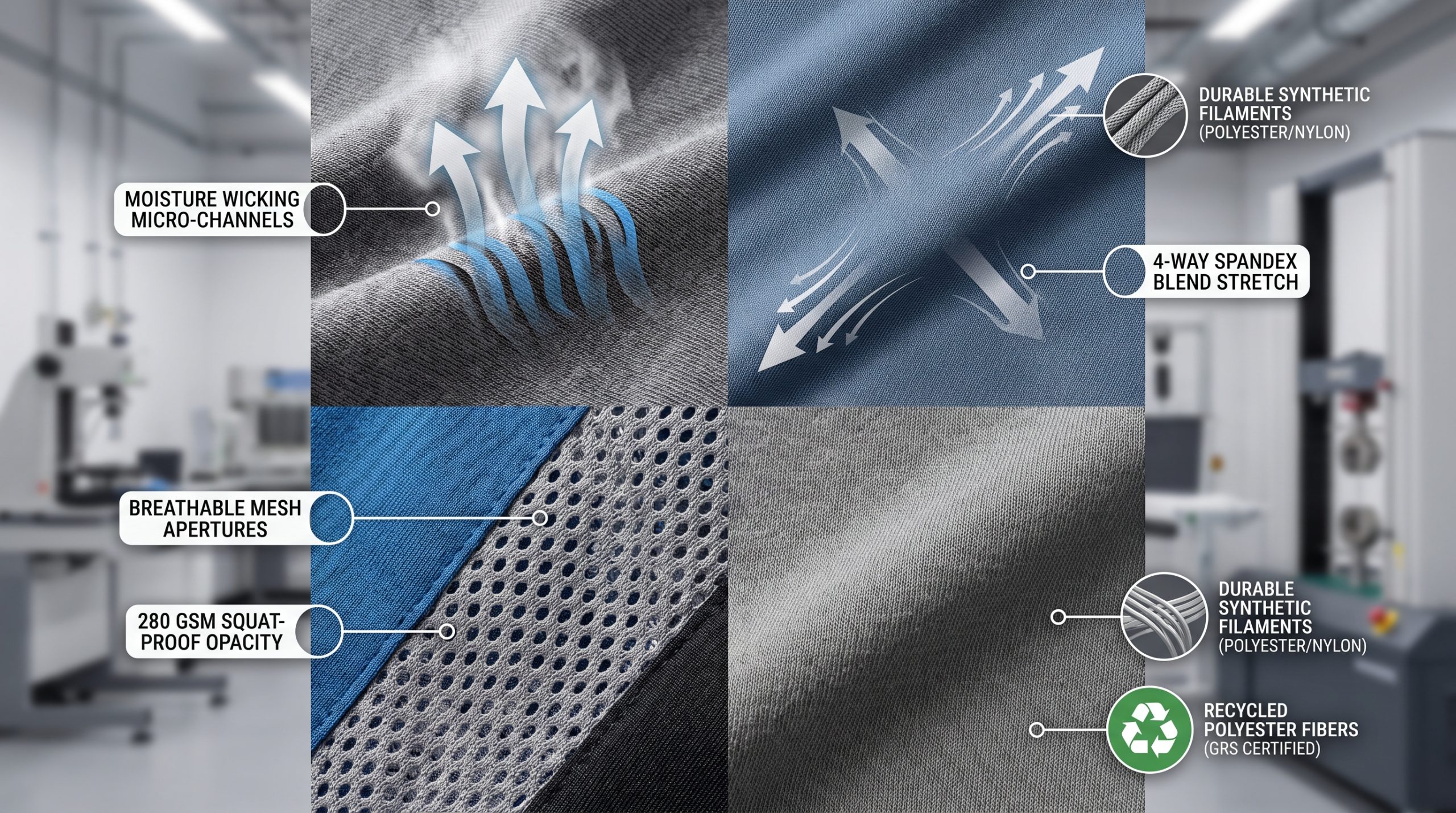
The best activewear fabric combines synthetic polyester filaments with elastane fibers to deliver high moisture wicking rapid drying action and superior four-way elasticity during intense physical workouts. Sourcing poor quality textiles causes athletic garments to trap sweat rapidly against human skin. Squeezed sweat saturates cheap clothes within ten minutes of intense training. Saturated clothes feel heavy sticky and uncomfortable during physical exertion. Uncomfortable apparel degrades athlete performance while creating severe skin chafing during critical competitive moments. Apparel brand owners face rising product return rates when garments lose shape after three washings. Apparel managers need reliable raw materials that maintain structural integrity under heavy physical strain. Working with specialized textile manufacturers provides technical textiles engineered specifically for rigorous athletic demands. Premium synthetic textiles solve these performance issues through advanced fiber engineering and precise knit structures. Modern fabric mills produce specialized textiles engineered for moisture management high elasticity and extreme durability. These specialized textiles keep athletes comfortable while maintaining structural integrity over hundreds of washing cycles.
1. Why Does Choosing the Right Activewear Fabric Matter?
Choosing the right activewear fabric determines garment breathability moisture management durability and stretch recovery during demanding athletic performance. Poor textile selections cause athletic apparel to trap perspiration against skin surface. Trapped moisture increases garment weight while causing painful skin irritation during running workouts. Professional athletes demand specialized technical textiles that pull liquid sweat away instantly. Selecting superior raw materials protects your brand reputation while reducing warranty claims. High quality textiles withstand mechanical friction without tearing or pilling during physical movement. Apparel designers must evaluate fiber strength stretch parameters and weight before entering bulk production. Proper textile selection ensures consistent fit across various body sizes and movement ranges. Investing in premium athletic textiles provides long-term value for competitive activewear brands.
How Does Athletic Textile Quality Impact Performance?
Superior athletic textiles directly enhance physical speed endurance and body temperature regulation during intense athletic competition. High-grade synthetic yarns accelerate perspiration evaporation while maintaining lightweight skin contact. Think about it: body heat management requires specialized fiber channels. Standard cotton absorbs liquid sweat up to eight times its dry weight. Absorbed liquid adds unnecessary bulk that slows down competitive sprinters. Engineered synthetic materials remain featherlight even when players sweat profusely during humid summer matches.
- Synthetic fibers shed liquid water rapidly without swelling or growing heavy.
- Engineered surface channels pull perspiration outward through natural capillary forces.
- Lightweight knit constructions maximize airflow directly across heated skin zones.
Your apparel design team must prioritize functional fiber construction over basic visual appeal. Key performance factors include the following metrics:
Key Takeaway: Selecting high-grade synthetic textiles keeps athletes cool light and dry while protecting garments from shape distortion.
| Performance Metric | Premium Synthetic Textile | Standard Cotton Textile |
| Moisture Absorption Rate | Under 1% Fiber Weight | Up to 8% Fiber Weight |
| Drying Speed | 15 – 20 Minutes | 60 – 90 Minutes |
| Stretch Recovery Rate | 98% After Extension | 75% After Extension |
Selecting appropriate performance textiles ensures garments maintain shape stability and athletic comfort under heavy usage.
WordPress Media Library ALT Metadata (English)
- Image Title: Activewear Fabric Tensile Testing Lab Guide
- Alternative Text: A photorealistic photo of a professional textile testing lab evaluating activewear fabric swatches for tensile strength and elasticity. A technician uses modern testing equipment on gray sportswear textile swatches laid out on a clean workbench with technical instruments.
- Caption: Laboratory quality testing of high-performance activewear fabric swatches for tensile stretch recovery and abrasion resistance.
- Description: A clean photorealistic image depicting a technical textile quality control laboratory. Gray and blue athletic fabric swatches are arranged on a white workbench beside digital stretch testing equipment and precision calipers. Soft bright industrial light highlights fine knit textures and elastic fiber structures.
2. What Makes Synthetic Activewear Fabric So Popular?
Synthetic activewear fabric dominates the athletic apparel market because synthetic polyester and nylon filaments offer unmatched strength moisture resistance and stretch recovery. Natural fibers absorb moisture directly into fiber cores making garments heavy and slow to dry. Synthetic polymers feature hydrophobic properties that force liquid outward toward exterior evaporation surfaces. Here is the secret: synthetic filaments can be extruded into customized shapes. Cross-sections like trilobal or cross shapes create built-in micro-channels along every strand. These micro-channels pull moisture away from human skin through natural capillary forces. Apparel brands rely on synthetic materials to create garments that maintain vibrant colors through repeated washings. Synthetic textiles also resist shrinking tearing and fading better than organic materials. Modern manufacturing techniques allow synthetic fabrics to feel silky soft against human skin.
Why Do Manufacturers Prefer Polyester and Nylon Synthetics?
Polyester and nylon filaments provide exceptional tensile strength abrasion resistance and color fastness for activewear garments. Nylon offers superior softness and abrasion resistance making it ideal for high-impact workout leggings. Polyester provides outstanding moisture transportation and rapid drying speeds at competitive wholesale price points. Both synthetic polymers blend seamlessly with elastane yarns to achieve optimal four-way stretch.
- Nylon filaments deliver superior softness and high resistance against skin friction.
- Polyester yarns offer rapid moisture evaporation and excellent color retention.
- Polymer blends maintain precise compression levels across extended wear periods.
You can customize synthetic fabric weight density and stretch parameters to match specific sport requirements. Consider these material properties when sourcing synthetic textiles:
Key Takeaway: Synthetic polyester and nylon yarns provide the technical foundation for durable quick-drying and flexible activewear apparel.
| Synthetic Fiber Type | Primary Advantage | Typical Activewear Application |
| Nylon 6,6 | Exceptional Abrasion Resistance | Leggings, Compression Wear, Sports Bras |
| Polyester (PET) | Fast Drying and Color Fastness | Running Shirts, Team Jerseys, Jackets |
| Polyester Microfiber | Soft Touch and High Airflow | Lightweight Outer Layers, Linings |
Selecting synthetic yarn blends gives apparel designers full control over moisture handling and fabric durability.
WordPress Media Library ALT Metadata (English)
- Image Title: Synthetic Activewear Fabric Spools and Weave
- Alternative Text: A photorealistic close-up photo showing colorful synthetic activewear fabric rolls stacked on a industrial cutting table. Close-up details show the smooth surface texture of polyester and nylon athletic textiles under bright daylight.
- Caption: Synthetic activewear fabric rolls displaying smooth texture and durable filament construction for sportswear manufacturing.
- Description: A high-definition photorealistic shot showcasing stacked rolls of synthetic activewear fabric in blue gray and black colors. The image highlights the fine weave density and sleek surface texture of polyester and nylon yarns on a modern industrial cutting table.
3. How Does Moisture Wicking Activewear Fabric Work?
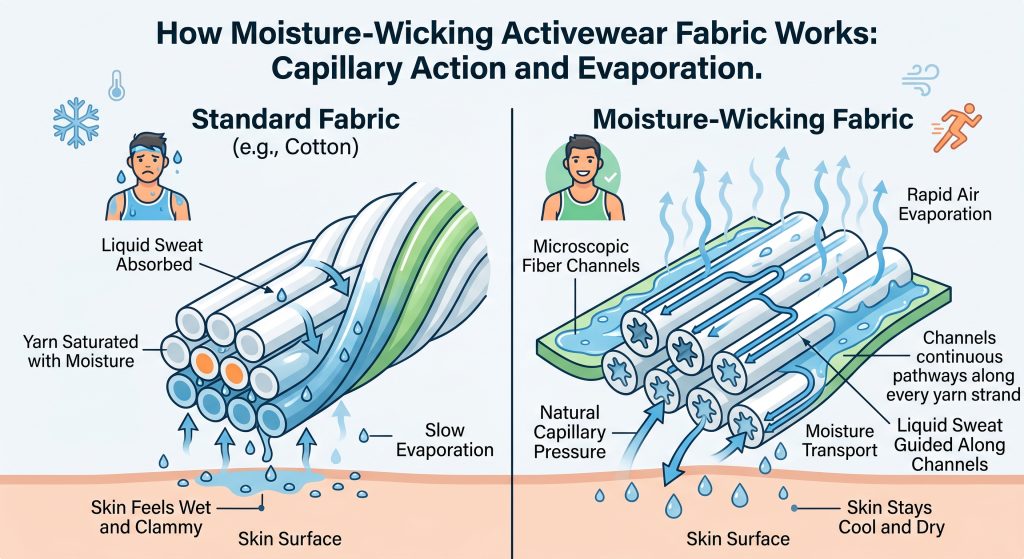
Moisture wicking activewear fabric operates by using natural capillary pressure along microscopic fiber channels to transport sweat away from skin surfaces. Synthetic fibers feature engineered cross-sections that create tiny continuous pathways along every yarn strand. Liquid perspiration enters these microscopic pathways through capillary action without soaking into internal fiber cores. What is the result? Sweat spreads rapidly across a broad outer surface area for instant air evaporation. Standard fabrics without wicking channels hold liquid sweat in thick yarn clusters. Wicking fabrics keep athletes cool and dry during high-intensity training sessions. Apparel manufacturers use mechanical knitting techniques to enhance moisture transport across inner and outer garment faces. High-performance moisture wicking fabrics prevent body temperature drops during rest periods.
How Do Micro-Channels Drive Capillary Moisture Transport?
Microscopic surface channels on non-round synthetic fibers generate continuous capillary suction that draws liquid sweat away from skin. Channeled fibers increase the total surface area available for liquid spreading and evaporation. Here is why it works: narrow channels pull liquid upward against gravity through surface tension. As sweat reaches the exterior fabric face ambient airflow strips moisture away rapidly.
- Trilobal yarn cross-sections form continuous surface channels for rapid fluid movement.
- Hydrophobic polymer interiors prevent liquid absorption into inner fiber cores.
- Expanded exterior surface areas accelerate natural air drying during physical activity.
You should verify wicking performance using standardized vertical wicking laboratory test methods. Key wicking parameters include:
Key Takeaway: Wicking technology relies on microscopic fiber channels and hydrophobic polymers to pull liquid away for rapid surface evaporation.
| Wicking Feature | Technical Function | Athlete Comfort Benefit |
| Channeled Filament | Generates Capillary Pressure | Keeps Skin Surface Dry |
| Hydrophobic Core | Prevents Water Absorption | Prevents Heavy Garment Weight |
| Expanded Outer Face | Maximizes Evaporation Area | Accelerates Natural Air Drying |
Integrating engineered wicking channels ensures activewear garments maintain light comfortable wearability throughout intense training sessions.
WordPress Media Library ALT Metadata (English)
- Image Title: Activewear Fabric Capillary Wicking Infographic
- Alternative Text: A photorealistic technical infographic diagram explaining moisture wicking in activewear fabric. Non-round polyester fiber cross-sections with micro-channels pull liquid droplets away from skin toward an exterior evaporation layer.
- Caption: Technical diagram showing capillary force moisture transport along micro-channels in high-performance activewear fabric.
- Description: A clean scientific infographic illustrating the capillary moisture-wicking mechanism in activewear fabric. The detailed diagram shows sweat droplets moving along trilobal fiber micro-channels from human skin to the outer fabric face, with clear labels for capillary force, hydrophobic core, and rapid evaporation.
4. Is Spandex Essential for Elastic Activewear Fabric?
Spandex elastane fibers are essential for elastic activewear fabric because elastane provides up to five hundred percent stretch with near-perfect shape recovery. Polyester and nylon yarns supply strength and durability but lack high elastic elongation. Adding five to thirty percent elastane into knit structures allows garments to stretch smoothly around moving joints. Look at the facts: elastane fibers stretch without permanent deformation under heavy mechanical strain. Elastic activewear allows athletes to move freely without fabric restriction or binding. High elastane content also provides graduated compression that supports muscle groups during physical exertion. Apparel brand managers must select high-quality elastane yarns that resist degradation from body oils and sweat. Proper elastane integration prevents bagging at knees and elbows after repeated wearing.
What Percentage of Elastane Is Ideal for Activewear?
The ideal elastane percentage depends on the specific sport application ranging from eight percent for loose shirts to thirty percent for compression garments. Higher elastane percentages deliver stronger holding power and targeted muscle support during intense movements. Notice the difference: low elastane blends offer comfortable casual stretch while high elastane blends provide firm athletic compression.
- Eight to twelve percent elastane suits lightweight running tees and casual yoga tops.
- Fifteen to twenty percent elastane provides optimal fit for athletic leggings and sports bras.
- Twenty-two to thirty percent elastane delivers high-density compression for muscle recovery apparel.
You need to balance stretch performance with garment breathability and overall weight. Elastane blending considerations include:
Key Takeaway: Blending elastane with synthetic yarns creates flexible garments that stretch seamlessly with athlete body movements while retaining original shape.
| Elastane Blend Percentage | Stretch Level | Recommended Application |
| 8% – 12% | Light Comfort Stretch | Running Shirts, Training Tops |
| 15% – 20% | Medium Firm Stretch | Yoga Pants, Athletic Leggings |
| 22% – 30% | High Compression Stretch | Recovery Wear, High-Impact Sports Bras |
Choosing correct elastane ratios ensures activewear products deliver appropriate flexibility and structural support for targeted athletic activities.
WordPress Media Library ALT Metadata (English)
- Image Title: Microscopic Elastane Fiber Stretch Analysis
- Alternative Text: A photorealistic close-up image showing elastane and spandex fibers woven into elastic activewear fabric. High detail reveals elastic yarn extension under mechanical tension in a textile testing facility.
- Caption: Close-up examination of elastane fiber elasticity and stretch recovery within high-performance activewear fabric.
- Description: A detailed photorealistic photograph showing elastic spandex fibers interwoven with synthetic polyester yarns. The camera focuses on yarn tension and stretch recovery under laboratory lights, illustrating four-way elasticity in high-grade activewear fabric.
5. Which Activewear Fabric Offers the Best Breathability?
Mesh activewear fabric featuring open eyelet knit structures offers the best breathability by allowing maximum volume airflow directly through garment ventilation pores. Breathability determines how effectively heat and air circulate through textile structures during physical exertion. Standard solid knits rely solely on moisture transport across yarn surfaces. Open mesh knits create physical openings that let trapped heat escape instantly while fresh air enters. Here is the advantage: combining open mesh structures with quick-drying synthetic yarns optimizes thermal comfort. Lightweight birdseye mesh and pinhole mesh fabrics are widely used for summer running gear and athletic jerseys. Apparel designers strategically place breathable mesh panels in high-sweat zones like underarms and upper backs. High-breathability fabrics prevent heat buildup keeping athletes comfortable during hot weather competition.
How Do Open Mesh Knits Maximize Ventilation Airflow?
Open mesh knits incorporate engineered geometrical pores that act as miniature ventilation windows across the garment surface. These structural pores reduce overall fabric weight while maximizing direct air transfer to skin. Think about this: open pores lower fabric density without sacrificing tear strength. Fresh ambient air flushes out warm humid air trapped inside the clothing layer.
- Birdseye knits incorporate small diamond patterns that promote continuous air movement.
- Pinhole mesh features subtle micro-perforations for sleek breathable garment designs.
- Jacquard mesh creates customized breathable patterns with targeted ventilation zones.
You can combine different mesh structures in a single garment to achieve balanced ventilation and opacity. Air permeability comparison details include:
Key Takeaway: Mesh knits maximize airflow and heat dissipation making them ideal for high-sweat zones and warm-weather athletic garments.
| Mesh Structure Type | Air Permeability Level | Ideal Garment Placement |
| Birdseye Mesh | High Airflow | Whole Jersey Body, Summer Shirts |
| Pinhole Mesh | Moderate-High Airflow | Side Panels, Sleeve Inserts |
| Open Jacquard Mesh | Customizable Airflow | Underarm Zones, Back Ventilation |
Strategic integration of breathable mesh structures allows apparel brands to optimize thermal comfort across high-sweat garment zones.
WordPress Media Library ALT Metadata (English)
- Image Title: Breathable Mesh Activewear Fabric Structure
- Alternative Text: A photorealistic studio photo of breathable birdseye mesh activewear fabric held against a soft light source. Geometric ventilation pores are clearly visible showcasing high airflow knit structure.
- Caption: Open eyelet knit structure of breathable mesh activewear fabric designed for maximum ventilation and heat release.
- Description: A sharp photorealistic close-up image showing a swatch of white birdseye mesh activewear fabric backlit by clean studio light. Tiny diamond-shaped ventilation holes create a clean geometric pattern, highlighting fabric breathability for activewear manufacturing.
6. How Do You Test Activewear Fabric Durability?
You test activewear fabric durability using standardized laboratory methods including Martindale abrasion testing pilling resistance evaluations and bursting strength measurements. Activewear garments face severe friction from equipment gym mats and repeated body movements. Low-durability fabrics develop surface fuzz balls or tears after minimal usage cycles. Martindale testing machines rub fabric samples against standard wool abradants under controlled pressure. What is the standard? Quality athletic textiles must endure over twenty thousand abrasion cycles without fiber breakdown. Pilling resistance tests measure how well yarn surfaces resist forming loose fiber tangles. Bursting strength tests evaluate how much pressure a knit fabric can withstand before rupturing. Apparel manufacturers must review certified test reports before selecting bulk fabric rolls.
What Are the Key Laboratory Standards for Athletic Textiles?
Key laboratory standards include ASTM and ISO test protocols that measure abrasion pilling color fastness and seam strength under stress. Passing these standardized tests proves that athletic fabrics will hold up during real-world training conditions. Check the numbers: high-quality compression fabrics should achieve a grade four or five pilling rating. Superior color fastness prevents dye bleeding during intense sweat exposure or warm water laundering.
- Martindale abrasion testing measures surface wear resistance over thousands of friction cycles.
- Random tumble pilling tests evaluate fiber fuzzing under simulated wear conditions.
- Mullen burst testing measures multidirectional hydraulic pressure capacity on knit surfaces.
You should request full laboratory test certificates from fabric suppliers prior to placing purchase orders. Standard durability benchmarks include:
Key Takeaway: Rigorous laboratory testing confirms that athletic fabrics possess required abrasion resistance tensile strength and pilling resistance for heavy athletic use.
| Durability Test | Standard Test Method | Minimum Quality Target |
| Abrasion Resistance | ISO 12947-2 (Martindale) | 20,000+ Cycles Without Rupture |
| Pilling Resistance | ISO 12945-2 | Grade 4 – 5 (Minimal Pilling) |
| Bursting Strength | ASTM D3786 (Mullen Burst) | 250+ kPa Hydraulic Pressure |
Verifying certified test metrics protects your activewear brand against costly quality failures and customer returns.
WordPress Media Library ALT Metadata (English)
- Image Title: Martindale Abrasion Testing for Activewear Fabric
- Alternative Text: A photorealistic image of a Martindale abrasion tester operating in a textile research lab. Circular testing heads rub activewear fabric samples to test friction resistance and fabric durability.
- Caption: Martindale abrasion machine testing activewear fabric durability and surface friction resistance in a laboratory setting.
- Description: A crisp photorealistic photograph of an industrial Martindale textile testing apparatus in operation. Precision metal testing heads press against dark athletic fabric swatches on a stainless steel surface, illustrating quality control procedures for activewear manufacturing.
7. Is Sustainable Activewear Fabric Worth Sourcing?
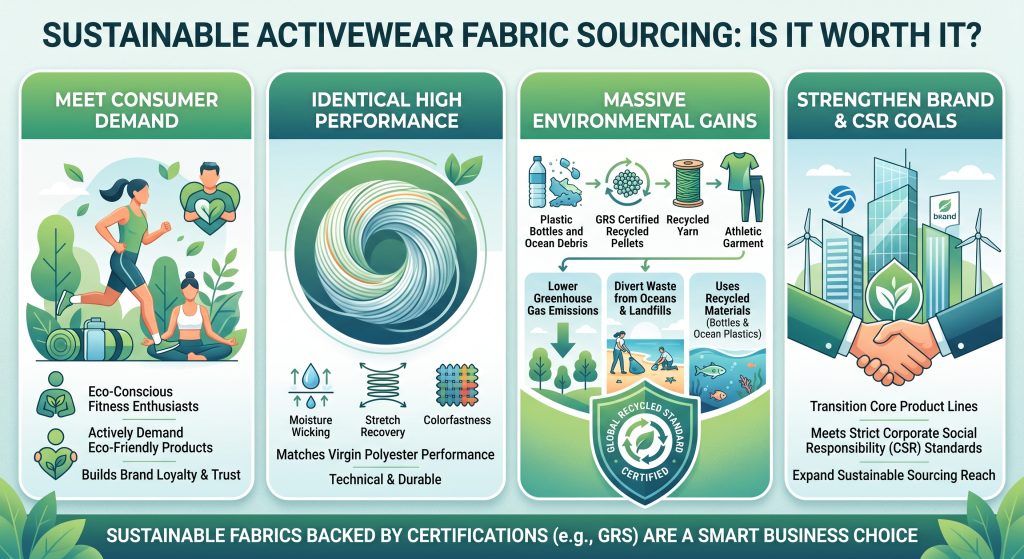
Sustainable activewear fabric made from recycled polyester and ocean plastic yarns is worth sourcing because modern consumers actively demand eco-friendly athletic products. Recycled polyester created from post-consumer plastic bottles offers identical technical performance to virgin polyester yarns. Recycled yarns deliver identical moisture wicking stretch recovery and color fastness while reducing environmental impact. Here is the big gain: using recycled materials lowers greenhouse gas emissions and diverts plastic waste from oceans. Major activewear brands are transitioning their core product lines toward recycled synthetic materials. Sourcing sustainable textiles allows your brand to meet strict corporate social responsibility goals. Fabric mills now offer certified recycled textiles backed by Global Recycled Standard certification. Sustainable options expand your market reach among environmentally conscious fitness enthusiasts.
How Does Recycled Polyester Compare to Virgin Synthetic Yarns?
Recycled polyester matches virgin polyester in tensile strength wicking efficiency dye absorption and overall fabric durability. Polymer recycling processes break down PET bottles into high-purity resin chips for yarn spinning. Notice the quality: modern recycled yarns show zero performance loss compared to petroleum-based virgin fibers.
- Recycled polyester reduces energy consumption during fiber production by over fifty percent.
- GRS certification verifies sustainable origin across the entire supply chain.
- Identical fiber cross-sections ensure high wicking efficiency and rapid drying speeds.
You can market sustainable activewear at premium price points without compromising athletic performance. Environmental impact comparison metrics include:
Key Takeaway: Recycled polyester delivers high technical performance while appealing to environmentally conscious consumers and reducing environmental footprint.
| Sustainability Metric | Recycled Polyester (rPET) | Virgin Polyester (PET) |
| Primary Raw Material | Post-Consumer PET Bottles | Petroleum Fine Chemicals |
| Production Energy Use | ~ 50% Lower Energy | Standard Baseline Energy |
| Carbon Footprint | ~ 30% Lower Emissions | Standard Baseline Emissions |
Adopting certified recycled textiles positions your brand as a modern sustainable leader in the competitive athletic apparel market.
WordPress Media Library ALT Metadata (English)
- Image Title: Recycled Polyester Activewear Fabric Yarn Spools
- Alternative Text: A photorealistic photo showcasing eco-friendly recycled activewear fabric yarn spools alongside clear recycled plastic bottles on a industrial workbench.
- Caption: Sustainable activewear fabric yarn spun from recycled plastic bottles for eco-friendly athletic apparel production.
- Description: A photorealistic shot displaying green and white spools of recycled polyester activewear yarn positioned next to recycled PET plastic chips and water bottles. Bright daylight reveals fine yarn texture and highlights sustainable textile technology.
8. How Do Knits Compare in Activewear Fabric Production?
In activewear fabric production warp knits like tricot provide higher structural stability and compression while circular knits like jersey offer greater elasticity and soft drape. Knitting construction methods dictate how yarns interlock across vertical and horizontal directions. Circular knits create flexible fabrics that stretch easily making them ideal for casual athletic shirts and soft yoga wear. What makes warp knits different? Warp knitting loops yarns zig-zag along the fabric length creating ladder-proof structures. Warp knit tricot fabrics resist running or unraveling even if snagged during rough sports activities. Warp knits also deliver higher modulus compression needed for medical and athletic support garments. Apparel manufacturers select specific knit constructions based on required garment tension fit and durability.
What Is the Difference Between Interlock and Single Jersey Knits?
Interlock knits feature a double-faced structure that provides equal smoothness on both sides while single jersey offers lightweight stretch with a distinct front and back. Interlock fabrics are thicker more stable and opaque making them perfect for squat-proof leggings. Single jersey is thinner lighter and more flexible making it ideal for running tops.
- Interlock knits offer high opacity and excellent shape retention for compression pants.
- Single jersey provides lightweight flexible drape for high-speed athletic shirts.
- Warp knit tricot delivers snag-resistant strength for high-impact sports gear.
You must match knit construction to your garment end-use requirements. Structural knit comparisons include:
Key Takeaway: Understanding warp and circular knit differences enables apparel brands to choose optimal fabric structures for compression opacity or flexibility.
| Knit Construction | Fabric Characteristics | Key Activewear Usage |
| Warp Knit Tricot | Ladder-Proof, High Tension, Firm Support | Compression Gear, Swimwear, Leggings |
| Interlock Double Knit | Smooth Both Sides, Opaque, Double-Faced | Squat-Proof Tights, Jackets, Hoodies |
| Single Jersey Knit | Lightweight, Soft Drape, High Stretch | Running Tees, Training Shirts, Tanks |
Selecting correct knit structures guarantees garments deliver desired opacity drape and mechanical support during intense physical activity.
WordPress Media Library ALT Metadata (English)
- Image Title: Activewear Fabric Knit Structure Comparison
- Alternative Text: A photorealistic photo comparing two activewear fabric swatches: warp knit tricot and circular interlock knit. Close-up lighting reveals surface texture differences between knit patterns.
- Caption: Technical comparison of warp knit tricot and circular interlock activewear fabric structures for athletic garment design.
- Description: A sharp photorealistic photo presenting two distinct athletic fabric samples side by side on a dark wooden table. Detailed macro photography reveals the smooth double-knit face of interlock fabric next to the tight ladder-proof structure of warp knit tricot.
9. Which Activewear Fabric Fits High Impact Sports?
Heavyweight compression activewear fabric with high elastane content fits high impact sports like gymnastics football and weightlifting by offering superior muscle support and abrasion protection. High impact sports subject garments to extreme stretching surface friction and intense sudden movements. Thin lightweight fabrics tear easily or become see-through under heavy extension during these intense activities. Here is what you need: double-knit interlock fabrics weighing over two hundred fifty grams per square meter. Heavyweight synthetic blends keep garments fully opaque during deep squats and lunges. Dense knits absorb impact friction reducing turf burns and skin scrapes during athletic slides. Apparel brands designing high-impact gear rely on dense warp knits to maintain firm targeted compression around key muscle groups.
Why Is Fabric Weight and Opacity Critical for Performance Leggings?
Fabric weight directly controls fabric opacity and holding power ensuring leggings remain non-see-through during deep physical bends. Garments weighing under two hundred grams per square meter often suffer from shear transparency when stretched over hips and knees. Look at the standard: high-performance leggings require heavy interlock fabrics with dense elastane counts. High fabric density prevents embarrassing opacity loss while offering stabilizing muscle compression.
- Heavyweight knits over two hundred sixty GSM ensure reliable squat-proof opacity.
- High elastane percentages provide firm muscle support that reduces muscle vibration fatigue.
- Abrasion-resistant nylon surface fibers withstand friction against athletic equipment.
You should test fabric stretch opacity over contrasting surfaces before finalizing garment specifications. High-impact fabric specifications include:
Key Takeaway: Heavyweight dense knits provide necessary opacity muscle support and sliding protection for demanding high-impact athletic activities.
| Sport Requirement | Recommended Fabric Weight | Preferred Blend Composition |
| Squat-Proof Leggings | 260 – 320 GSM | 75% Nylon / 25% Elastane Interlock |
| High-Impact Sports Bras | 280 – 340 GSM | 70% Polyester / 30% Elastane Warp Knit |
| Contact Sports Gear | 250 – 300 GSM | 80% Nylon / 20% Elastane Double Knit |
Choosing appropriate fabric weights prevents transparency issues while giving athletes confident support during extreme physical movements.
WordPress Media Library ALT Metadata (English)
- Image Title: High-Impact Activewear Fabric Tensile Stretch Test
- Alternative Text: A photorealistic photo showing heavyweight activewear fabric undergoing stretch testing under industrial mechanical clamps in a textile engineering lab.
- Caption: Heavyweight compression activewear fabric undergoing high-tension stretch testing for high-impact sports apparel.
- Description: A photorealistic shot of dense gray athletic compression fabric clamped into automated tensile testing machinery. The image demonstrates high fabric density and four-way stretch capacity engineered for high-impact workout gear.
10. How Can You Source Quality Activewear Fabric Wholesale?
You can source quality activewear fabric wholesale by partnering with established fabric mills that offer certified quality control custom dyeing and low minimum order quantities. Sourcing wholesale raw materials requires thorough supplier evaluation to ensure consistent lot-to-lot quality. Working with inexperienced vendors leads to shade variations inconsistent stretch levels and delayed shipment schedules. What is the best approach? Request sample swatches and lab dips to verify hand feel color accuracy and stretch recovery firsthand. Professional fabric manufacturers maintain strict ISO quality standards and provide detailed physical test certificates. Establishing direct relationships with reliable textile mills helps secure competitive volume pricing and custom fabric development. Clear communication regarding fabric specifications speeds up production timelines while minimizing manufacturing errors.
What Key Factors Should You Evaluate in a Textile Manufacturer?
Key factors include production capacity lab testing capabilities quality certifications lead times and minimum order quantity terms. Evaluating these parameters protects your business from production bottlenecks and unexpected material defects. Remember this: reliable textile partners offer custom color matching and specialized functional finishes.
- ISO 9001 quality management certification ensures consistent manufacturing protocols.
- OEKO-TEX Standard 100 guarantees fabrics are free from harmful chemical residues.
- Flexible minimum order quantities allow manageable inventory control for growing brands.
You should always test sample yardage in actual garment production before issuing bulk purchase orders. Supplier evaluation guidelines include:
Key Takeaway: Partnering with certified experienced fabric suppliers ensures consistent material quality reliable delivery schedules and competitive wholesale pricing.
| Supplier Evaluation Factor | Target Standard | Business Benefit |
| Quality Certifications | OEKO-TEX Standard 100, GRS | Assures Product Safety and Sustainability |
| Minimum Order Quantity | 300 – 500 Meters per Color | Keeps Initial Inventory Investment Manageable |
| Lab Testing Services | In-House Tensile and Wicking Testing | Guarantees Consistent Performance Metrics |
Establishing strict quality criteria for wholesale textile partners ensures seamless garment production and long-term business growth.
WordPress Media Library ALT Metadata (English)
- Image Title: Activewear Fabric Wholesale Warehouse Rolls
- Alternative Text: A photorealistic photo of high-performance activewear fabric rolls stacked neatly on industrial shelving inside a clean textile manufacturing facility.
- Caption: Wholesale activewear fabric rolls stored in a modern textile factory warehouse ready for bulk apparel manufacturing.
- Description: A photorealistic wide-angle shot of a organized textile factory warehouse. Rows of neatly wrapped activewear fabric rolls in gray blue and white sit on high steel shelving under bright overhead industrial lighting.
Activewear garment manufacturing requires high-performance textiles engineered to tackle severe athletic demands. Sourcing low-grade materials leads to severe sweat logging garment stretching and customer dissatisfaction. High-performance synthetic textiles solve these production challenges by delivering rapid moisture transport four-way flexibility and long-lasting abrasion durability. Working with specialized manufacturing partners ensures your product line maintains consistent athletic quality and vibrant style. Our team manufactures high-grade activewear fabrics tailored specifically for performance sportswear leggings and team uniforms. For reliable wholesale sourcing and custom textile development, contact us today to discuss your manufacturing requirements and receive sample swatches. We are committed to empowering global sportswear brands through cutting-edge textile innovation, exceptional quality assurance, and sustainable manufacturing excellence.
Frequently Asked Questions
- Can I use 100% cotton activewear fabric for high-intensity gym workouts?
No, cotton is unsuitable for intense workouts because cotton fibers absorb up to eight times their weight in sweat without drying rapidly. Absorbed liquid makes garments heavy, causes skin chafing, and ruins athletic comfort during physical exercise. - What’s the best activewear fabric blend for non-see-through gym leggings?
A blend of 75% Nylon and 25% Elastane interlock knit with a minimum weight of 260 GSM is best. High nylon density provides complete squat-proof opacity while high elastane content delivers firm muscle support and four-way stretch recovery. - How do I know if an activewear fabric has authentic moisture wicking properties?
You can check by dropping a small water drop directly onto the inner fabric surface. Authentic wicking fabric absorbs and spreads the water drop across a wide surface area within three seconds, whereas non-wicking fabric lets water sit on the surface. - Can recycled polyester activewear fabric match the durability of virgin polyester?
Yes, certified recycled polyester offers identical tensile strength, abrasion resistance, and moisture-wicking speed to virgin polyester. Modern recycling technology produces high-purity polymer fibers that match standard synthetic yarns across all laboratory performance tests. - What’s the best way to care for high-elastane activewear garments to preserve stretch?
Machine washing garments in cold water on a gentle cycle and air drying them flat is best. Avoid using hot water, high-heat tumble dryers, or fabric softeners because high temperatures and chemical additives degrade elastane elasticity over time.