
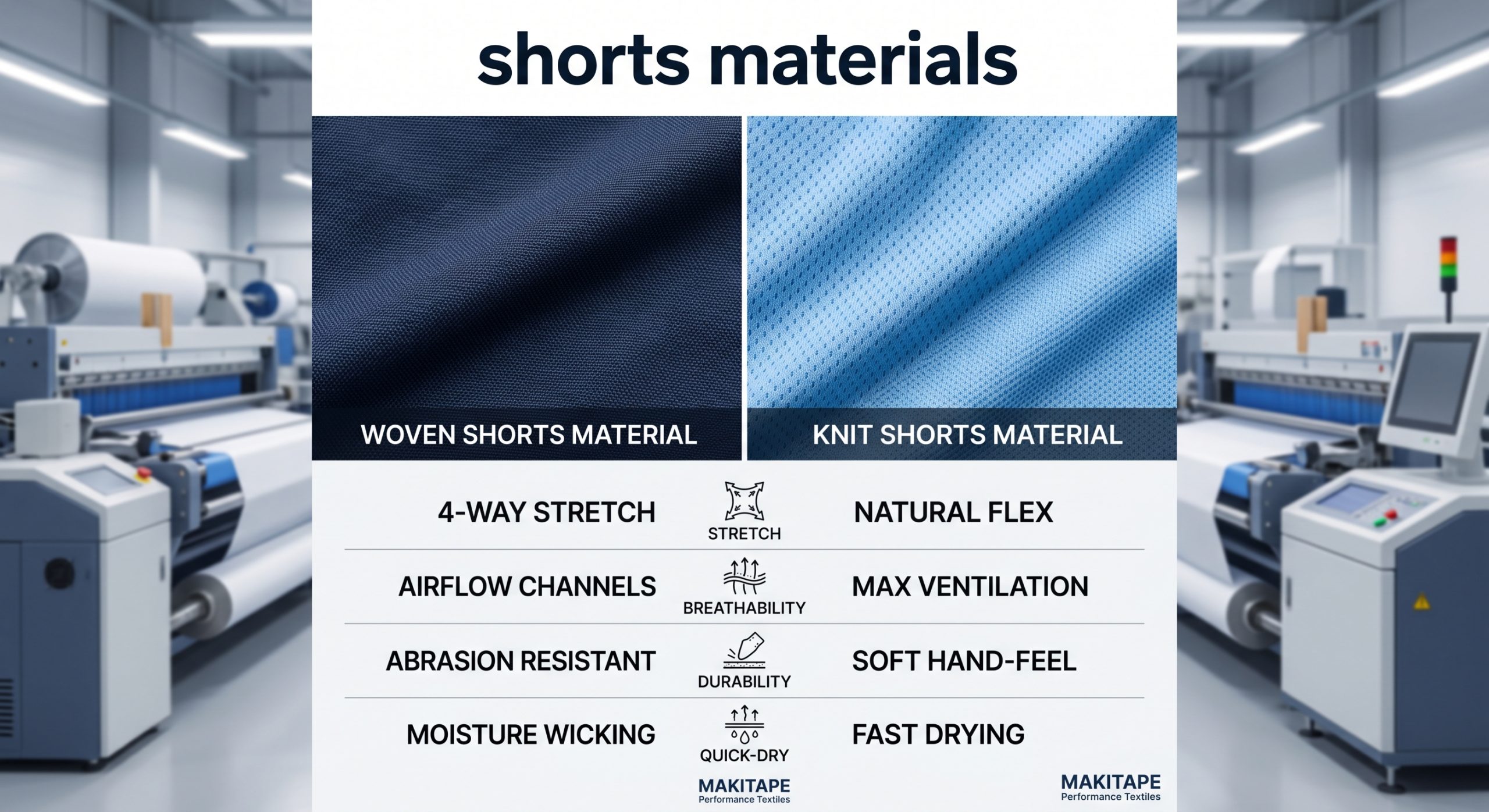
The best shorts materials combine high-stretch woven shells for rugged exterior durability with breathable bird-eye or pique knits for active moisture management. You manufacture sports apparel, yet your active customers frequently report that standard workout shorts rip along crotch seams or trap sweat against thighs during intense training. That constant chafing causes immense athletic frustration and leads directly to costly return shipments for your sportswear brand. Specifying engineered shorts materials resolves movement restrictions by balancing mechanical tensile strength with rapid evaporative airflow.
1. What Are the Core Demands on Modern Shorts Materials?
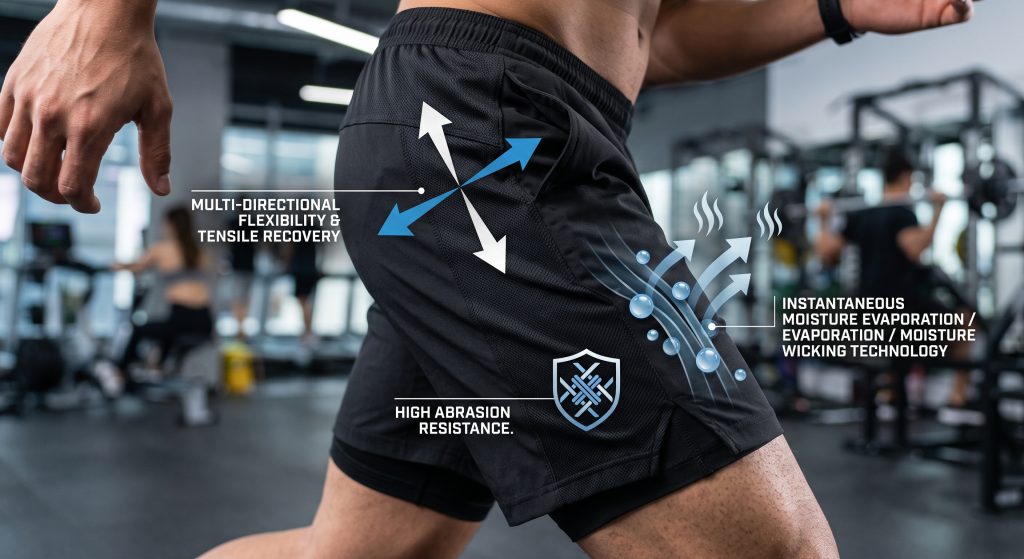
Modern athletic wear demands multi-directional flexibility, high abrasion resistance, and instantaneous moisture evaporation from high-performance shorts materials. Running, lifting, and court sports exert continuous mechanical stress across fabric panels. If your textile lacks proper tensile recovery, sweat builds up along skin contact zones and accelerates painful chafing.
How Does Moisture Management Prevent Athlete Chafing?
Dynamic wicking channels pull perspiration away from friction-heavy zones between the inner thighs. Here is the deal: high-performance yarns transport liquid sweat across a broad surface face to hasten air drying.
- Hydrophobic synthetic microfibers channel sweat outward instantly.
- Fast capillary action keeps skin contact points completely dry.
- Reduced damp friction eliminates painful skin abrasions during sprints.
Why Do Tensile Strength and Elastic Recovery Matter?
Deep squats, lunges, and lateral cuts require fabric to stretch without permanent seam distortion. Think about this: low-quality textiles bag at the knees and blow out along stress points after minimal gym sessions.
- Spandex yarn blends deliver four-way mechanical stretch during training.
- High elastic recovery preserves the original garment silhouette over time.
- Reinforced filament weaving prevents high-stress seam bursting.
| Performance Attribute | Laboratory Test Standard | Target Metric | Athletic Garment Impact |
| Tensile Strength | ASTM D5034 Grab Test | > 450 N Warp / Weft | Eliminates seam blowout during squats |
| Moisture Evaporation | AATCC 195 Liquid Transfer | Grade 4 or Higher | Stops skin chafing in humid weather |
| Elastic Recovery | ASTM D3107 Stretch Test | > 92% Recovery Rate | Prevents fabric sagging after workouts |
These testing metrics show how balanced physical properties protect athletic shorts from premature failure during workouts.
Key Takeaway: You must specify fabric with high tensile recovery and rapid wicking to protect athletes from chafing and prevent blown seams.
2. How Do Woven and Knit Shorts Materials Differ?
Woven textiles provide dimensional stability and wind resistance, whereas knit constructions deliver elastic softness and superior breathability. Selecting the right shorts materials requires matching these manufacturing methods to your garment blueprint. Woven shells protect runners from trail abrasions, while knits adapt naturally to close-fitting compression liners.
What Defines the Mechanical Nature of Woven Textiles?
Woven fabrics interlace warp and weft yarns in rigid perpendicular grid formations. Look closer: this tight mechanical interlace creates a crisp, lightweight barrier that resists external snags and abrasive gym equipment.
- Interlaced yarns provide superior abrasion resistance against rough barbells.
- Low base elasticity requires added elastane filaments for workout flexibility.
- Crisp drape holds tailored silhouettes for casual lifestyle hybrid shorts.
How Do Knit Fabrics Achieve Natural Elastic Softness?
Knitting interloops continuous yarn loops to generate natural multidirectional expansion. What is the secret?: looped geometries expand freely with body movement, providing plush skin contact that prevents irritation.
- Looped stitch construction stretches naturally across active muscle groups.
- Ultra-soft surface texture eliminates friction on sensitive inner thighs.
- Open loop matrix promotes passive thermal regulation during cardio workouts.
| Textile Construction | Structural Configuration | Primary Mechanical Strength | Ideal Sourcing Target |
| Four-Way Stretch Woven | Perpendicular filament weave | High tear and abrasion resistance | Outer running and gym shell |
| Circular Warp Knit | Interlooping continuous yarns | Unrestricted multi-axis stretch | Compression liners and tights |
| Flat Double Knit | Interlocked dual-face loops | Excellent thermal drape | Heavyweight fleece sweat shorts |
This technical breakdown demonstrates how woven fabrics supply exterior toughness while knits offer internal comfort.
Key Takeaway: Pair a rugged four-way stretch woven outer shell with a soft knit interior liner to achieve peak durability and chafe-free comfort.
3. Why Is Bird-Eye Mesh Built for Lightweight Shorts Materials?
Bird-eye mesh utilizes an engineered diamond tuck-stitch pattern that generates microscopic ventilation eyelets across the entire fabric surface. This open geometry makes it a premier choice for endurance sports materials where athletes demand continuous convective airflow. Weighing between 130 and 160 GSM, bird-eye fabric stays featherlight even during heavy sweating.
What Creates the Silky Hand Feel of Bird-Eye Knit?
Fine-gauge micro-polyester filaments form smooth contact points on the inner fabric face. Take a look: the inner side glides smoothly across sweaty thighs without rough texture catching on body hair.
- Fine yarn gauge produces a non-abrasive, silky skin surface.
- Lightweight structure drapes fluidly without adding bulky garment weight.
- Low friction coefficient prevents skin irritation during long marathon runs.
How Does Diamond Eyelet Geometry Boost Airflow?
Continuous micro-perforations act like passive exhaust valves across your athletic shorts panels. Here is the breakdown: moisture vapors pass directly through the open eyelets rather than getting trapped against skin.
- Micro-pores deliver high air permeability exceeding 180 CFM.
- High surface area speeds up moisture evaporation three times over flat jersey.
- The open pattern accepts vibrant dye sublimation for custom team wear.
| Fabric Architecture | Surface Relief Profile | Air Permeability Score | Typical Weight Specification |
| Bird-Eye Mesh | Diamond-shaped micro-eyelets | 185 – 220 CFM | 130 – 160 GSM |
| Plain Single Jersey | Flat uniform surface | 80 – 110 CFM | 140 – 180 GSM |
| Pin-Hole Warp Mesh | Linear vertical slots | 210 – 250 CFM | 110 – 140 GSM |
These performance figures highlight how bird-eye mesh delivers superior ventilation compared to conventional single jersey textiles.
Key Takeaway: You should specify bird-eye mesh for marathon running and basketball shorts where featherlight breathability and silky skin comfort remain paramount.
4. Can Pique Knit Elevate Structured Athletic Shorts Materials?
Pique knit features a geometric double-knit tuck construction that builds raised waffle ridges and recessed surface channels. Sourcing shorts materials in pique knit provides superior dimensional structure, complete opacity, and a dry tactile hand feel. Ranging from 190 to 240 GSM, pique fabric maintains crisp tailoring for golf, tennis, and upscale club athletic wear.
What Generates the Dry Crisp Texture of Pique?
Raised honeycomb stitches hold the fabric slightly elevated away from moist skin. Here is why: this three-dimensional structure prevents damp cloth from clinging to sweaty legs during outdoor country club matches.
- Honeycomb waffle relief prevents wet fabric cling in humid heat.
- Substantial yarn thickness ensures total modesty across white colorways.
- Natural fiber loft provides structural drape for tailored short hemlines.
Where Does Pique Excel in Performance Apparel?
Pique knit bridges the gap between active sports functionality and refined country club apparel standards. Look closer: tennis players and golfers benefit from built-in breathability channels without looking like they wear flimsy gym gear.
- Recessed surface grooves channel air without exposing bare skin.
- Crisp fabric body supports zippered utility pockets without sagging.
- High color fastness resists fading from sun exposure and repeated washing.
| Sourcing Parameter | Pique Knit Characteristic | Production Benefit | Target Garment Style |
| Knit Pattern | Double-knit geometric waffle | Holds crisp tailored lines | Tennis and golf shorts |
| Fabric Density | 190 – 240 GSM | Total opacity in light colors | Country club athleisure |
| Skin Sensation | Dry, elevated honeycomb contact | Stops clinging when sweating | Upscale resort activewear |
This parameter matrix illustrates why pique knit remains the benchmark textile for structured, upscale sportswear shorts.
Key Takeaway: Choose pique knit when your sportswear line requires tailored structure, rich visual texture, and zero fabric cling on hot sunny days.
5. How Do Synthetic Fibers Transform Active Shorts Materials?
Polyester and nylon synthetic filaments provide the foundation for modern moisture-wicking and tear-resistant performance activewear. Selecting the right synthetic blend for your shorts materials determines garment drying speed, yarn tensile strength, and abrasion resistance. Nylon filaments deliver exceptional softness and rugged durability, whereas polyester fibers excel in moisture expulsion and vibrant colorfastness.
Why Is Nylon the Standard for Rugged Gym Shorts?
Polyamide 6,6 filaments feature high tensile strength and a naturally cool hand feel. Make no mistake: nylon resists barbell scraping and outdoor rock friction better than any other standard textile polymer.
- Nylon fibers resist high-friction wear during heavy lifting sessions.
- Smooth polymer surfaces feel naturally cool upon initial skin contact.
- High fiber elasticity complements added elastane for mobility.
How Does Polyester Maximize Moisture Evaporation?
Polyester microfibers possess inherently low moisture regain rates under one percent. Think about this: because polyester refuses to hold water inside its core, sweat evaporates from the fiber surface rapidly.
- Low water absorption prevents workout shorts from growing heavy with sweat.
- Fast drying speeds shorten post-laundry drying times for consumers.
- High thermal stability enables durable sublimation graphic printing.
| Polymer Property | Polyamide (Nylon 6,6) | Polyester (PET) | Apparel Performance Impact |
| Moisture Regain | 4.0% – 4.5% | 0.4% – 0.8% | Polyester dries twice as fast during workouts |
| Abrasion Resistance | Exceptional (Grade 5) | Good (Grade 3.5 – 4) | Nylon resists barbell scraping during deadlifts |
| Tensile Tenacity | 6.0 – 8.5 g/denier | 5.0 – 7.0 g/denier | Nylon prevents seam tearing during intense training |
These property benchmarks demonstrate how choosing between nylon and polyester tailors your garment line to specific sports environments.
Key Takeaway: Specify nylon for abrasion-heavy gym and training shorts, while prioritizing polyester for rapid drying in high-aerobic running gear.
6. What Liner Options Maximize Comfort in Shorts Materials?
Inner liners provide critical muscle support, skin protection, and anatomical modesty in modern athletic sportswear. Sourcing integrated shorts materials for inner liners requires choosing between light mesh briefs and compressive tight shorts. The right liner construction stops leg friction completely while keeping the wearer fresh through demanding training sessions.
How Do Compression Liners Prevent Chafing?
Compression inner shorts fit snugly against the quadriceps to create a frictionless physical barrier. Consider this fact: smooth knit liners move with the thigh muscles rather than sliding back and forth against skin.
- Snug elastane blends stabilize leg muscles during repetitive sprinting.
- Continuous fabric barrier stops thighs from rubbing together uncomfortably.
- Integrated flatlock stitching prevents abrasive pressure ridges along seams.
When Are Lightweight Mesh Briefs the Better Choice?
Ultralight mesh briefs offer minimal weight and maximum airflow for hot weather running. See for yourself: open-hole knit structures provide modesty while keeping the garment featherlight.
- Micro-mesh knits allow air to circulate freely around the groin.
- Minimalist pattern reduces overall short weight down under 100 grams.
- Moisture escapes instantly to prevent sweat pooling during long runs.
| Liner Construction | Fabric Blend Composition | Compression Level | Recommended Sport Use |
| 2-in-1 Tight Liner | 82% Nylon / 18% Spandex | Moderate to high support | CrossFit, HIIT, weightlifting |
| Built-in Mesh Brief | 92% Polyester / 8% Elastane | Lightweight breathable fit | Marathon and road running |
| Linerless Style | Outer Shell Material Only | Zero internal support | Multi-sport gym workouts |
This comparative matrix guides your product development team toward the correct inner liner construction based on workout intensity.
Key Takeaway: Source high-spandex knit liners for high-friction gym training, and choose ultra-breathable mesh briefs for lightweight marathon running gear.
7. How Does GSM Weight Dictate Performance in Shorts Materials?
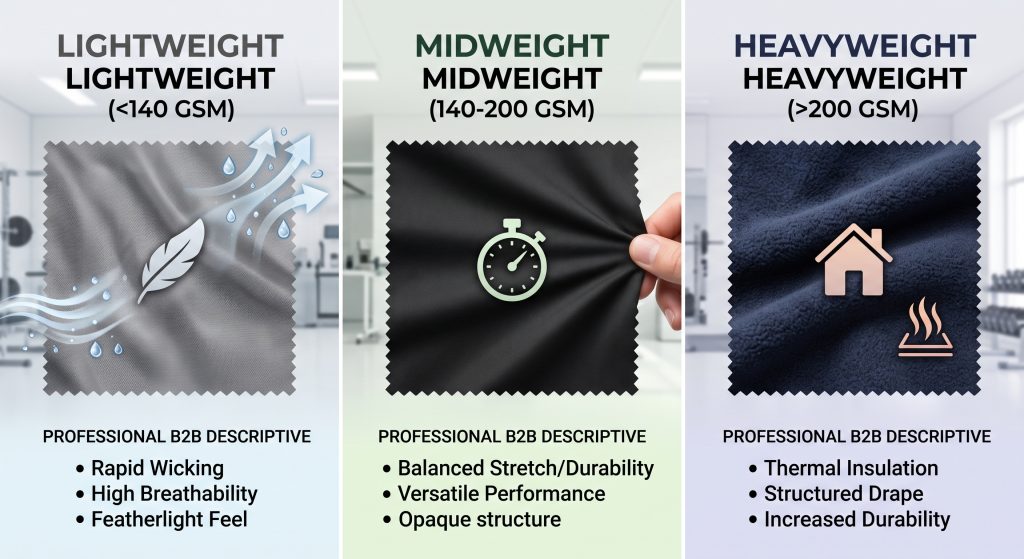
Grams per square meter (GSM) defines fabric thickness, structural weight, durability, and thermal insulation across all shorts materials. Specifying the wrong GSM weight causes activewear to either tear prematurely or trap excessive body heat. Balancing fabric weight against the intended sports discipline ensures that athletes stay agile and comfortable.
What Defines the Featherlight 90 to 140 GSM Category?
Ultralight fabrics maximize speed, mobility, and heat dissipation during endurance competitions. Here is why: runners demand garments that feel virtually weightless when saturated with sweat.
- Micro-ripstop wovens provide surprising strength at featherlight weights.
- Thin bird-eye meshes maximize convective airflow across the pelvis.
- Low fabric mass prevents bulky bunching along the waistband.
When Should You Choose Mid to Heavy GSM Textiles?
Mid-weight (150–200 GSM) and heavy-weight (220–300 GSM) fabrics deliver durability, opacity, and relaxed lifestyle drape. Look closer: cross-training shorts and casual fleece loungewear demand substantial heft to withstand daily abuse.
- 160–180 GSM four-way wovens withstand rugged gym workouts.
- 240–280 GSM pique and French terry deliver cozy, structured athleisure drape.
- Heavier fabric weights support deep pockets filled with heavy smartphones.
| Fabric Weight Class | Target GSM Range | Primary Structural Trait | Target Garment Category |
| Ultralight Performance | 90 – 130 GSM | Featherlight breathability | Marathon racing shorts |
| Midweight All-Rounder | 140 – 180 GSM | Balanced stretch and durability | Gym training and CrossFit |
| Heavyweight Lifestyle | 220 – 300 GSM | Rich drape and total opacity | Fleece sweat shorts & polos |
This categorization shows how fabric weight directly influences garment functionality, helping you match GSM to your apparel line.
Key Takeaway: Choose 90 to 130 GSM for high-heat cardio sports, and shift to 160 to 220 GSM for gym training and casual athleisure.
8. Can Recycled Yarns Create Sustainable Shorts Materials?
Modern textile mills produce GRS-certified recycled polyester and ocean-bound nylon that match the quality of virgin synthetics. Choosing eco-friendly shorts materials allows your apparel brand to meet ambitious sustainability targets without compromising workout performance. Diverting plastic bottles into recycled polyethylene terephthalate (RPET) yarns cuts production carbon emissions significantly.
How Do Recycled Yarns Compare to Virgin Synthetics?
Modern mechanical and chemical recycling purifies polymer chains to match virgin filament tensile properties. Here is the deal: recycled microfibers weave and knit into smooth fabrics with identical stretch and moisture wicking.
- GRS-certified RPET yarns offer identical dye uptake and color fastness.
- Tensile burst strength matches virgin polyester during high-stress tests.
- Eco-friendly yarns accept the same quick-dry and antibacterial finishes.
Why Do Sustainable Fabrics Enhance Brand Equity?
Today’s fitness consumers actively look for verifiable environmental certifications on garment hangtags. What is the real story?: showcasing certified recycled fabrics elevates your brand status and builds consumer loyalty.
- Recycled fabrics reduce dependency on raw petrochemical resources.
- Third-party GRS certificates provide undeniable marketing proof for buyers.
- Lower environmental footprints resonate strongly with modern Gen Z shoppers.
| Environmental Metric | Virgin Polyester Fabric | GRS Recycled Polyester (RPET) | Sustainable Manufacturing Impact |
| Energy Consumption | High crude oil refining | 50% less energy required | Conserves non-renewable grid power |
| Greenhouse Gas Footprint | ~ 9.5 kg CO2e / kg | ~ 5.2 kg CO2e / kg | Cuts carbon emissions by over 45% |
| Landfill Waste Diverted | 0 bottles per garment | 8 – 12 PET bottles per short | Keeps plastic bottles out of oceans |
These environmental metrics highlight the carbon and waste reduction achieved by switching your product line to certified recycled yarns.
Key Takeaway: You can fulfill eco-conscious market demands without sacrificing athletic performance by sourcing certified GRS recycled polyester textiles.
9. How to Test Stretch and Durability in Shorts Materials?
Rigorous laboratory testing validates fabric stretch recovery, seam burst strength, and color fastness before bulk cutting begins. You must verify that your chosen shorts materials satisfy international ASTM and ISO performance thresholds. Quality fabric mills supply certified laboratory test reports confirming that yardage survives intense squat stresses and repeated hot laundry cycles.
What Laboratory Tests Measure Fabric Strength?
Standardized mechanical testing assesses fabric resistance to abrasion, tearing, and surface fuzzing. Think about this: running standardized Martindale abrasion tests ensures gym shorts will not pill when rubbing against rough gym benches.
- ASTM D5034 Grab Tests measure maximum tensile strength before tearing.
- Martindale tests check for surface pilling after 20,000 friction cycles.
- ASTM D3786 Mullen Burst tests evaluate resistance to blowout at high-pressure seams.
How Do You Validate Stretch Recovery and Shrinkage?
Elastic recovery testing verifies that spandex blends snap back into shape after being stretched repeatedly. See for yourself: four-way stretch testing ensures garments do not sag after a strenuous training session.
- ASTM D3107 measures fabric elongation and recovery percentages.
- AATCC 135 validates dimensional stability to keep shrinkage under 3%.
- AATCC 8 Crockmeter tests verify colorfastness against heavy sweat rub.
| Quality Assay Method | Standard Reference | Passing Quality Standard | Manufacturing Protection |
| Pilling Resistance | ISO 12945-2 Martindale | Grade 4.0 after 10,000 cycles | Prevents surface fuzzing from rough gym gear |
| Dimensional Stability | AATCC 135 Wash Test | Less than 3.0% warp/weft change | Guarantees consistent sizing after home laundering |
| Four-Way Stretch Recovery | ASTM D3107 Stretch Test | > 90% elastic recovery rate | Stops knee and seat sagging during workouts |
These quality thresholds provide the baseline criteria necessary to inspect bulk production yardage and prevent factory rework.
Key Takeaway: Always demand certified third-party lab reports confirming over 90% elastic recovery and Grade 4 pilling resistance before approving bulk rolls.
10. How to Choose Factory-Direct Custom Shorts Materials?
Sourcing fabric directly from a vertically integrated mill lowers unit costs and gives you full control over custom colors and functional finishes. Partnering with a reliable manufacturer for custom shorts materials ensures consistent dye lots, flexible minimum order quantities, and rapid strike-off approvals. Establishing precise technical specifications before mass production prevents costly bulk yardage defects.
What Sourcing Criteria Guarantee Manufacturing Success?
Evaluating factory capabilities ensures your mill can deliver consistent quality across multi-thousand-meter orders. Here is why: experienced technical mills maintain strict in-house quality control from raw yarn spinning through final heat-setting.
- Verify the mill operates automated circular knitting and waterjet weaving looms.
- Confirm on-site dye houses utilize precise computer color-matching spectrophotometers.
- Require continuous four-point system fabric inspection on all bulk yardage.
How Do You Customize Functional Chemical Finishes?
Custom finishing baths allow you to combine durable water repellent (DWR) coatings with antibacterial silver-ion technologies. Look closer: combining multiple finishes transforms standard fabric into high-value performance apparel.
- DWR exterior finishes shed rain and dirt during outdoor trail running.
- Antimicrobial silver finishes eliminate odor-causing bacteria on inner liners.
- UPF 50+ treatments block harmful ultraviolet solar rays during outdoor sports.
| Mill Capability Factor | Standard Factory Benchmark | Tier-1 Textile Mill Advantage | Brand Sourcing Benefit |
| Color Accuracy | Delta E < 1.0 vs standard | Computerized Datacolor lab dips | Exact shade matching across production batches |
| Inspection Protocol | Random batch sampling | 100% 4-Point System yardage audit | Zero surprise flaws during garment assembly |
| Custom Finish Options | Basic wicking chemicals | Combined DWR, UPF 50+, & Anti-Odor | Premium multi-functional activewear margins |
This factory benchmark matrix reveals the operational differences between ordinary brokers and professional textile mills.
Key Takeaway: Partner with certified textile mills that offer in-house color lab dip matching, four-point fabric inspection, and multi-functional performance finishes.
Strategic Sourcing for Performance Shorts
This guide detailed how four-way stretch wovens deliver rugged exterior abrasion resistance, examined how bird-eye mesh and pique knits optimize airflow and tailored structure, and highlighted the importance of standardized lab testing. We solve your sportswear production bottlenecks by supplying certified, high-elasticity woven and knit textiles engineered to withstand demanding training regimens without tearing or chafing. If you are developing your next activewear collection or looking to upgrade your fabric specifications, contact us today to order custom functional swatches and receive factory-direct engineering guidance. We are committed to developing high-performance athletic textiles that empower sportswear brands with uncompromising durability, verified moisture control, and manufacturing excellence.
Frequently Asked Questions
Q1: What’s the best shorts material for high-intensity gym training?
A four-way stretch woven blend of 88% nylon and 12% spandex is the best choice for gym workouts. Nylon provides exceptional abrasion resistance against barbells and gym equipment, while spandex allows full flexibility during deep squats and lunges.
Q2: Can I use bird-eye mesh fabric for both the outer shell and inner liner?
Yes, you can use lightweight bird-eye mesh for outer running shells or interior brief liners. Its open diamond micro-perforations maximize airflow and dry three times faster than standard jersey, making it versatile across high-sweat apparel.
Q3: How do I know if a stretch shorts fabric will lose its shape after washing?
You can confirm shape retention by checking the ASTM D3107 stretch and recovery test report from your fabric mill. High-quality performance textiles must demonstrate an elastic recovery rate of at least 90% to avoid sagging around the seat and leg openings.
Q4: What’s the best way to prevent thigh chafing in running shorts?
The most effective way is integrating a snug, high-gauge knit compression liner made from a polyester-spandex blend. The smooth, form-fitting fabric moves with the leg muscles, eliminating friction between the inner thighs during long runs.
Q5: Can recycled polyester shorts materials match the durability of virgin polyester?
Yes, GRS-certified recycled polyester offers identical tensile strength, abrasion resistance, and colorfastness as virgin polyester. Advanced polymer filtration during recycling creates clean filament yarns that perform identically under intense athletic stress.