
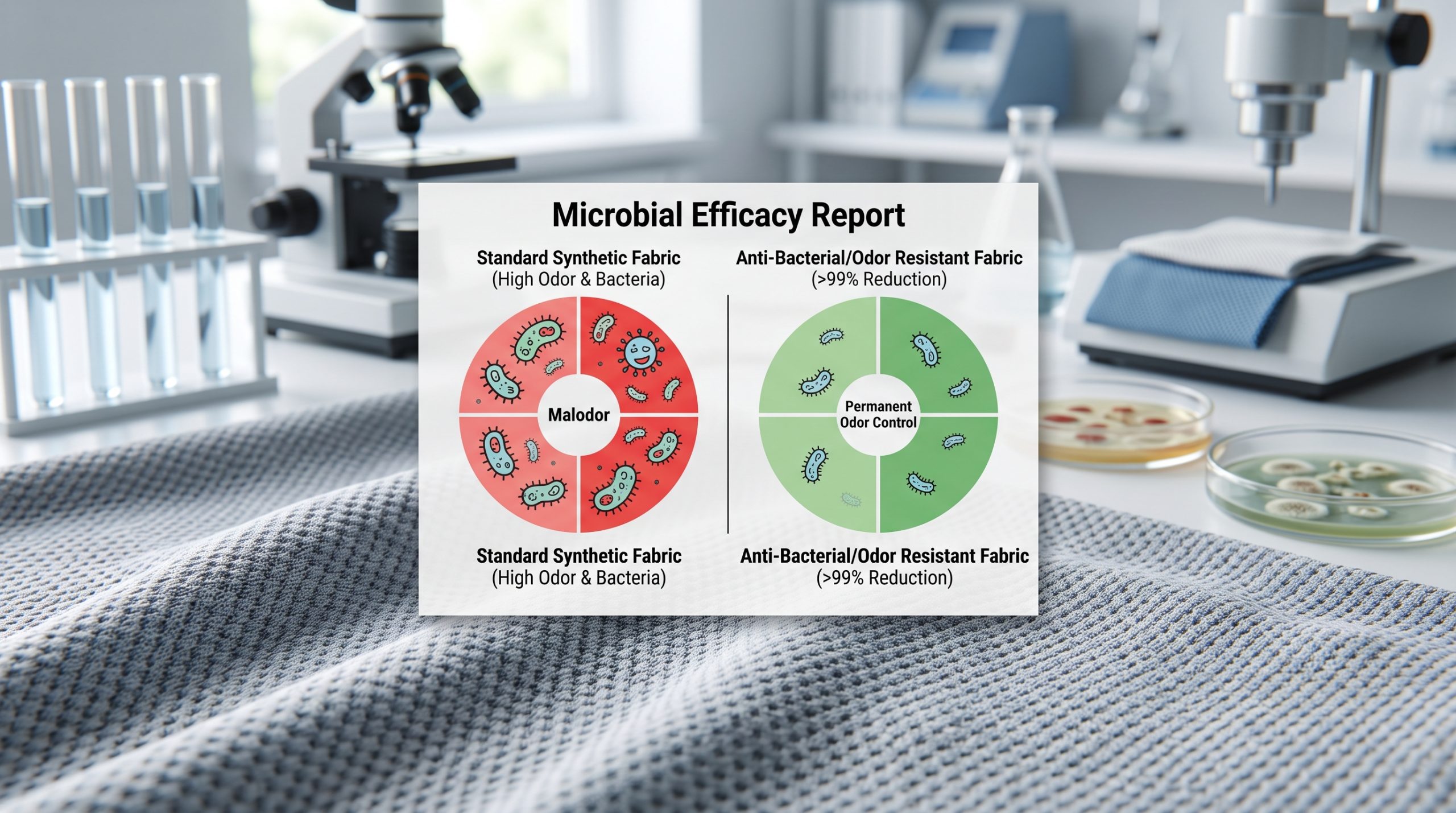
anti-bacterial/odor resistant fabric is a specialized technical textile engineered to eliminate bacterial reproduction and permanently neutralize human sweat malodor. You produce premium sportswear, yet your active customers constantly complain that their favorite polyester shirts retain an unbearable sour stink even after thorough home laundering. That lingering sweat smell degrades customer satisfaction, triggers product returns, and erodes trust in your apparel brand. Integrating high-performance odor control textiles stops volatile organic compounds directly at the fiber surface, protecting your garment reputation across demanding retail markets.
1. What Causes Permastink in Anti-Bacterial/Odor Resistant Fabric?
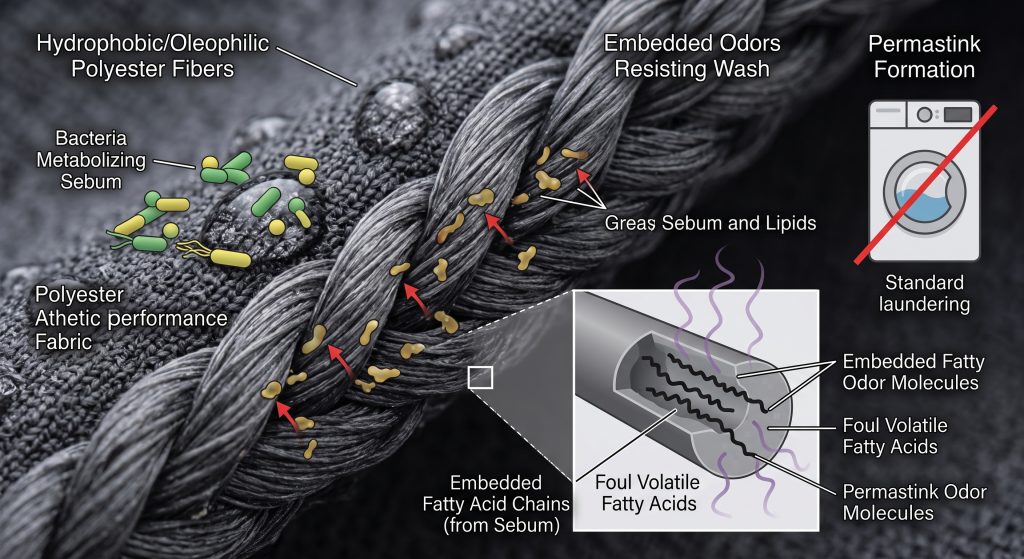
Synthetic workout garments trap body oils and foster bacteria colonies because polyester filaments possess naturally hydrophobic and oleophilic properties. Fresh human perspiration does not smell bad on its own, but skin bacteria quickly metabolize proteins and lipids into foul volatile fatty acids. Without proper anti-bacterial/odor resistant fabric construction, standard synthetic yarns absorb these sebum molecules deep into their polymer matrix. Standard home laundry temperatures cannot dislodge these embedded fatty chains, creating the permanent stink known across the athletic apparel industry as permastink.
Why Do Bacteria Thrive on Synthetic Yarns?
Petroleum-based synthetic fibers like polyester and nylon possess non-polar surfaces that attract body sebum. Here is the deal: when you sweat during high-intensity training, bacterial microbes feed on your lipids and produce pungent butyric and isovaleric acids.
- Hydrophobic synthetic fibers pull sebum deep into micro-grooves.
- Moisture-wicking channels create warm incubation zones for micrococci.
- Repeated standard washing fails to break down trapped hydrophobic lipids.
How Does Sebum Trapping Lead to Permastink?
Standard laundry detergents clean polar hydrophilic soils easily but fail to strip oily sebum from synthetic polymers. Think about this: with each wear cycle, new lipid layers bond with previous residue inside the yarn bundles.
- Trapped fatty acids oxidize and produce continuous stale smells.
- Unprotected polyester garments develop odors within minutes of body warming.
- Traditional fabric softeners coat fibers and worsen the bacterial buildup.
| Odor Mechanism Stage | Microbial Activity | Synthetic Fabric Reaction | Resulting Garment Impact |
| Initial Sweat Secretion | Low activity on fresh moisture | Surface wicking disperses liquid | Neutral scent |
| Microbial Digestion | Micrococci break down sebum | Lipids bond to hydrophobic yarns | Sour odor emergence |
| Post-Wash Residue | Dormant bacteria remain in pores | Trapped lipids resist cold water | Permanent permastink |
This sequence illustrates why standard synthetics require active chemical and structural barriers to prevent lipid oxidation.
Key Takeaway: You must specify engineered yarn treatments to stop lipid bonding before bacteria transform fresh sweat into permanent garment odor.
2. How Does Anti-Bacterial/Odor Resistant Fabric Eliminate Odor?
Odor reduction works through a dual mechanism of cell membrane destruction and physical molecular adsorption across the textile structure. Applying anti-bacterial/odor resistant fabric stops microbial metabolism while capturing any ambient volatile organic compounds before your nose detects them. Active antimicrobial finishes rupture bacterial cell walls on contact to inhibit cellular reproduction. At the same time, microscopic mineral structures integrated into the fiber core trap and break down sulfur and nitrogen molecules.
What Is the Active Antimicrobial Process?
Active antimicrobial agents target the biological root of odor by neutralizing bacteria directly upon contact. Look closer: positively charged metal ions bind to negatively charged bacterial membranes, disrupting cell respiration and halting DNA replication completely.
- Positively charged ions puncture bacterial cell walls.
- Cellular enzyme synthesis stops immediately upon contact.
- Microbes cannot reproduce or metabolize fresh sweat lipids.
What Is the Passive Molecular Trapping Process?
Passive odor resistance relies on microscopic porous minerals embedded into the fiber polymer to capture volatile compounds. What is the secret?: porous mineral particles act like chemical cages that trap malodor molecules until release during laundry washing.
- Mineral cages capture environmental and metabolic sulfur compounds.
- Physical adsorption prevents volatile gases from evaporating into the air.
- Standard detergent surfactants rinse captured odor molecules away cleanly.
| Technology Category | Primary Mode of Action | Longevity Benchmark | Best Garment Application |
| Active Antimicrobial | Cell membrane disruption | 50+ wash cycles | Running tops, yoga wear |
| Passive Mineral Trapping | Molecular vapor adsorption | Lifetime of the fiber | Outdoor jackets, fleece layers |
| Dual Hybrid System | Cell lysis plus vapor capture | 60+ wash cycles | Pro team uniforms, compression |
This functional breakdown clarifies how combining biological suppression with physical entrapment creates reliable odor defenses.
Key Takeaway: Combining active cell disruption with passive mineral trapping gives your apparel complete protection against both bacterial growth and environmental odors.
3. Which Chemistry Powers Anti-Bacterial/Odor Resistant Fabric?
Modern textile chemistry provides diverse options spanning silver ions, non-metal quaternary silanes, and bio-based polymeric finishes. Selecting the right anti-bacterial/odor resistant fabric finish depends on your target market, wash durability requirements, and international chemical regulatory compliance. Silver and zinc ions deliver exceptional broad-spectrum efficacy by releasing controlled trace minerals that eliminate odor-producing pathogens. Non-metallic polymers and plant-based chitosan finishes provide hypoallergenic alternatives that bond covalently to yarn filaments.
How Do Metal Ion Formulations Function?
Silver, zinc, and copper ion formulations remain the industry standard for high-performance athletic gear. Here is why: these micro-encapsulated salts release active ions gradually whenever moisture and warmth activate the textile surface.
- Silver salt particles provide continuous antimicrobial release during workouts.
- Zinc pyrithione offers dual anti-bacterial and anti-fungal defense.
- Encapsulated delivery prevents rapid leaching during repeated washings.
Why Are Non-Metal and Bio-Based Finishes Gaining Ground?
Brands looking for eco-conscious certifications choose non-metal quaternary ammonium organosilanes or marine chitosan. Make no mistake: organosilanes form a durable spike-like molecular layer on fibers that mechanically punctures microbial walls without leaching chemicals.
- Organosilane molecules bond permanently to polyester polymer backbones.
- Mechanical cell puncture prevents bacteria from developing chemical resistance.
- Chitosan finishes offer natural, biodegradable defense for sensitive skin.
| Chemical Agent | Antimicrobial Mechanism | Durability Level | Safety & Eco Profile |
| Silver Ion Salts | Cellular respiration disruption | 50+ standard washes | Safe for skin, regulated discharge |
| Quaternary Organosilane | Mechanical membrane puncture | 40 to 60 washes | Non-leaching, hypoallergenic |
| Bio-Based Chitosan | Natural polymer inhibition | 30 to 40 washes | Biodegradable, non-toxic |
This comparative matrix highlights how different chemical formulations balance antimicrobial potency against environmental criteria.
Key Takeaway: You can match chemical finishes to your brand positioning by choosing between heavy-duty metal ions or eco-friendly non-leaching organosilanes.
4. Why Compare Knits in Anti-Bacterial/Odor Resistant Fabric?
Fabric structure directly governs airflow, surface evaporation rates, and total moisture retention within your athletic garments. Pairing anti-bacterial/odor resistant fabric treatments with the correct knit geometry determines whether sweat evaporates rapidly or stagnates inside yarn crevices. Two dominant circular knit constructions—bird-eye mesh and pique knit—dominate athletic apparel production worldwide. Comparing their tactile hand feel, weight profiles, and breathability dynamics enables you to select the exact textile base for your garment line.
How Does Knit Geometry Influence Moisture Evaporation?
Knitting geometry dictates how quickly sweat moves from skin contact points to the outer evaporation face. Consider this fact: loose open-hole structures pull moisture outward through capillary action faster than dense flat weaves.
- High-porosity knits accelerate air circulation across wet fibers.
- Capillary pull reduces the moisture dwell time needed for bacterial growth.
- Surface textures minimize fabric cling against sweaty skin during exercise.
Why Do Bird-Eye and Pique Dominate Athletic Sourcing?
Both knits utilize alternating tuck and float stitches to create three-dimensional surface reliefs rather than flat planar fabrics. See for yourself: their textured surfaces separate wet yarn from human skin, allowing air channels to ventilate the microclimate.
- Both knits provide mechanical airflow channels across the body.
- Distinctive face textures elevate the perceived visual quality of apparel.
- Three-dimensional loop structures distribute anti-odor finishes uniformly.
| Fabric Architecture | Surface Geometry | Primary Airflow Path | Typical Weight Range |
| Bird-Eye Mesh | Microscopic diamond eyelets | Direct vertical through-holes | 130 to 180 GSM |
| Classic Pique Knit | Geometric waffle honeycomb | Horizontal recessed channels | 180 to 240 GSM |
| Flat Single Jersey | Smooth continuous surface | Limited lateral diffusion | 140 to 200 GSM |
This structural comparison reveals how surface architecture directly controls airflow dynamics and functional performance.
Key Takeaway: Selecting the right geometric knit construction amplifies chemical odor finishes by speeding up sweat evaporation and starving bacteria of moisture.
5. How Does Bird-Eye Fit Anti-Bacterial/Odor Resistant Fabric?
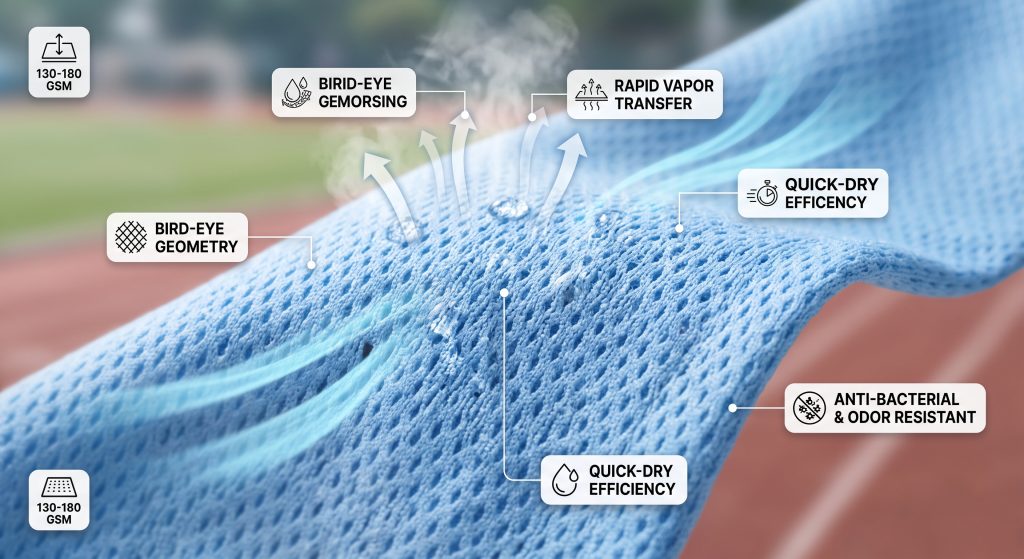
Bird-eye fabric features an engineered pattern of tiny diamond-shaped tuck stitches that create continuous micro-perforations across the cloth. This lightweight knit delivers rapid vapor transfer and an ultra-soft hand feel when manufactured as an anti-bacterial/odor resistant fabric. The open-mesh eyelets disperse perspiration across a wide surface area to dry three times faster than plain single jersey. Because bird-eye fabric weighs between 130 and 180 GSM, it excels in high-sweat endurance sports where athletes demand featherlight garments.
What Creates the Distinctive Hand Feel of Bird-Eye?
Bird-eye fabric delivers a smooth, fluid hand feel because fine-filament polyester yarns form its tiny diamond eyelets. Take a look: the inner fabric face remains silky against delicate skin while the outer surface features subtle technical pores.
- Fine yarn gauge produces a silky, non-abrasive inner contact surface.
- Lightweight structure drapes fluidly over body contours without stiffness.
- Low friction coefficient eliminates nipple chafing during marathon running.
Why Is Bird-Eye the Top Pick for High-Output Training?
The open diamond eyelets act as miniature exhaust vents that accelerate convective heat dissipation during intense workouts. Here is the breakdown: moisture moves instantly through the micro-pores, keeping the wearer dry and cool.
- Continuous vertical porosity delivers maximum cubic-feet-per-minute airflow.
- Rapid drying deprives skin bacteria of the liquid medium needed to multiply.
- The fabric accepts vivid sublimation printing without blocking open eyelets.
| Performance Metric | Bird-Eye Mesh Value | Athlete Benefit | Target Product Category |
| Air Permeability | > 180 CFM | Rapid cooling during cardio | Marathon and trail running |
| Drying Speed | Under 20 minutes | Minimal post-workout chilling | Soccer and basketball jerseys |
| Weight Specification | 130 – 160 GSM | Barely-there wearing comfort | Training singlets and tees |
These technical values show why bird-eye fabric represents the benchmark construction for lightweight endurance activewear.
Key Takeaway: You should specify bird-eye mesh for high-sweat endurance gear that requires silky skin comfort, rapid drying, and featherlight wearing properties.
6. Can Pique Knit Support Anti-Bacterial/Odor Resistant Fabric?
Pique knit uses a specialized double-knit tuck construction that generates raised geometric ridges and deep honeycomb depressions. Choosing anti-bacterial/odor resistant fabric in a pique knit gives performance apparel a structured, sophisticated hand feel with superior opacity. Weighing typically between 180 and 240 GSM, pique fabric provides substantial body that holds crisp collar shapes and tailored silhouettes. Its textured underside prevents the cloth from clinging to sweaty skin, creating comfortable micro-ventilation channels during golf and tennis play.
What Defines the Hand Feel and Structure of Pique?
Pique knit produces a dry, crisp tactile sensation because raised geometric cords keep the fabric elevated above sweaty skin. Here is why: the raised waffle pattern adds dimensional rigidity that resists wrinkling and maintains garment shape throughout active days.
- Textured honeycomb surface provides a firm, structured tactile feel.
- Substantial fabric thickness prevents transparency across light colorways.
- Natural dimensional stability keeps polo collars and plackets crisp.
Where Does Pique Excel in Athletic Sourcing?
Pique knit bridges the gap between active sports performance and sophisticated country club dress codes. Look closer: golf, tennis, and corporate activewear brands rely on pique to combine athletic breathability with refined tailoring.
- Recessed air channels circulate air without exposing skin through holes.
- Heavier fabric weight drapes cleanly for upscale athleisure collections.
- Embedded antimicrobial finishes keep business-casual polos fresh all day.
| Specification Parameter | Pique Knit Property | Sourcing Advantage | Primary Apparel Style |
| Fabric Construction | Double-knit honeycomb tuck | Excellent structural drape | Golf and tennis polos |
| Fabric Weight | 190 – 240 GSM | Full opacity and durability | Corporate athletic uniforms |
| Skin Contact Surface | Raised dry waffle relief | Eliminates wet fabric cling | Upscale lifestyle athleisure |
This parameter profile explains why pique remains the preferred choice for structured athletic and corporate sportswear garments.
Key Takeaway: Specify pique knit when your collection requires tailored structure, rich texture, and total opacity combined with dependable odor elimination.
7. How to Test Quality in Anti-Bacterial/Odor Resistant Fabric?
Verifying antimicrobial efficacy requires standardized international laboratory testing methods to guarantee performance claims after repeated washings. You must ensure your anti-bacterial/odor resistant fabric passes rigorous quantitative microbiological tests like AATCC 100 or ISO 20743. These standardized assays measure bacterial reduction percentages before and after 30 to 50 simulated home laundering cycles. Reliable fabric manufacturers provide certified third-party laboratory documentation demonstrating over 99% bacterial suppression against Staphylococcus aureus and Klebsiella pneumoniae strains.
What Are the Standard Microbiological Test Methods?
Quantitative laboratory testing evaluates the exact percentage of live bacteria destroyed over a 24-hour incubation window. Think about this: reputable testing uses standardized pathogen strains to prove reproducible antimicrobial performance.
- AATCC 100 calculates the quantitative reduction rate of bacterial colonies.
- ISO 20743 measures antimicrobial absorption and inoculation across fibers.
- JIS L 1902 provides Japanese industrial verification for antibacterial activity.
How Do Labs Measure Odor Molecule Reduction?
Direct odor testing evaluates how effectively treated textiles capture and neutralize specific gaseous volatile compounds. See for yourself: gas chromatography and sensory panel sniff tests quantify the reduction of foul odors over time.
- Gas chromatography measures ppm reduction of ammonia and acetic acid.
- Isovaleric acid testing validates specific sweat malodor neutralisation.
- Olfactometer testing scores residual human sensory odor perception.
| Test Standard | Target Microbe or Gas | Minimum Passing Score | Durability Benchmark |
| AATCC 100 | S. aureus / K. pneumoniae | ≥ 99.0% bacterial reduction | After 50 wash cycles |
| ISO 20743 | Gram-positive & negative | Antibacterial value A ≥ 2.0 | After 30 wash cycles |
| GC-MS Gas Test | Isovaleric acid / Ammonia | ≥ 85.0% gas concentration drop | Initial & post-wash |
These testing benchmarks demonstrate the strict quantitative criteria necessary to validate functional marketing claims.
Key Takeaway: Always demand certified third-party lab test reports proving over 99% bacterial reduction after at least 50 standard wash cycles.
8. Can Sustainability Meet Anti-Bacterial/Odor Resistant Fabric?
Modern textile mills successfully blend post-consumer recycled polyester yarns with eco-friendly non-leaching antimicrobial treatments. Choosing anti-bacterial/odor resistant fabric made from GRS-certified recycled fibers allows your apparel brand to meet strict environmental targets without sacrificing durability. Using recycled polyethylene terephthalate (RPET) diverted from ocean-bound plastic bottles cuts carbon emissions by roughly 45% compared to virgin synthetics. Because odor-resistant garments require less frequent laundering, they conserve significant water and electricity over their consumer lifecycle.
How Do Recycled Yarns Perform with Antimicrobial Finishes?
GRS-certified recycled polyester fibers accept antimicrobial chemical finishes with the exact same chemical bonding strength as virgin polymers. Here is the deal: advanced polymer depolymerization removes all impurities, creating pure filament yarns ready for functional finishes.
- RPET fibers feature identical tensile strength and dye uptake as virgin yarn.
- Antimicrobial compounds bond securely to recycled polymer surfaces.
- Recycled fibers maintain functional efficacy through 50+ wash cycles.
Why Does Odor Resistance Support Eco-Friendly Activewear?
Extending the wearable lifespan between washings reduces the environmental footprint of activewear dramatically. Consider this fact: up to 70% of a garment’s carbon impact occurs during consumer washing and machine drying.
- Odor-neutralized clothing can be worn multiple times before laundering.
- Reduced wash frequency decreases microplastic fiber shedding into waterways.
- Lower laundry cycles extend the physical elasticity and lifespan of garments.
| Environmental Metric | Virgin Synthetic Fabric | Recycled Odor-Controlled Fabric | Eco Benefit |
| Carbon Footprint | 9.5 kg CO2e per kg | 5.2 kg CO2e per kg | 45% carbon reduction |
| Wash Frequency Need | Every single workout | Every 2 to 3 workout sessions | 60% water conservation |
| Microplastic Release | High via frequent washing | Significantly reduced over time | Healthier marine ecosystems |
This sustainability comparison highlights how recycled yarns combined with odor control technology multiply ecological benefits throughout the garment lifecycle.
Key Takeaway: You can fulfill eco-conscious market demands by pairing GRS-certified recycled yarns with durable non-leaching odor control technologies.
9. How to Select Your Anti-Bacterial/Odor Resistant Fabric?
Matching garment end-use with the proper fabric weight, knit construction, and chemical treatment ensures maximum athlete comfort and commercial success. Specifying anti-bacterial/odor resistant fabric requires assessing the physical movement patterns and sweat rates of your target sports discipline. High-motion endurance sports demand ultra-lightweight open meshes like bird-eye, whereas country club sports require textured pique knits. Balancing fiber composition, elasticity percentages, and minimum order quantities protects your production budget and ensures smooth factory manufacturing.
How to Match Knit Type with Sports Discipline?
Selecting the optimal knit style begins with mapping athlete perspiration zones and necessary mobility requirements. Here is why: different sports disciplines require specific balances between ventilation, weight, and fabric stretch.
- Running and marathon gear requires 130–150 GSM bird-eye for maximum airflow.
- Yoga and compression activewear demands 200–260 GSM high-elastane interlock.
- Golf, tennis, and coaching staff apparel requires 190–230 GSM structured pique.
What Sourcing Checklist Prevents Manufacturing Defects?
Establishing clear technical specifications before placing bulk factory orders prevents costly fabric rejects. Make no mistake: evaluating physical lab dips and wear-test swatches guarantees consistency across volume production.
- Verify color fastness ratings to wash and sweat achieve Grade 3.5 or higher.
- Check dimensional stability to ensure shrinkage remains under 3% after washing.
- Confirm that integrated antimicrobial treatments do not stiffen fabric hand feel.
| Sport Application | Ideal Knit Construction | Recommended GSM | Target Functional Finish |
| Trail & Road Running | Bird-Eye Mesh | 130 – 150 GSM | Quick-dry wicking + Silver ion |
| Golf & Racket Sports | Textured Pique Knit | 200 – 230 GSM | Anti-odor + UPF 50+ UV guard |
| Gym Fitness & CrossFit | 4-Way Stretch Interlock | 220 – 260 GSM | Antimicrobial + High elasticity |
This matrix matches functional sport requirements with the exact fabric construction and finish specifications needed.
Key Takeaway: Align your knit selection with athlete sweat profiles and always establish clear testing tolerances for shrinkage, color fastness, and odor retention.
10. Where Is the Future of Anti-Bacterial/Odor Resistant Fabric?
Next-generation functional textiles are shifting from topical bath finishes toward permanent yarn-level integration and bio-synthetic fiber polymers. Sourcing anti-bacterial/odor resistant fabric with masterbatch-embedded minerals guarantees permanent performance that never washes out over the garment lifetime. Leading chemical innovators are also refining living probiotic coatings and plant-derived enzyme finishes that actively consume odor molecules. These emerging technologies eliminate chemical runoff during textile dyeing while delivering exceptional freshness for technical athletic apparel.
What Is Yarn-Level Masterbatch Integration?
Masterbatch compounding infuses active antimicrobial sub-micron particles directly into molten polymer chips before extrusion into yarn. Look closer: because the functional additives live inside the fiber core, the fabric cannot lose its odor resistance through friction or laundering.
- Functional minerals become an inseparable physical part of the yarn.
- Durability extends past 100 commercial wash cycles with zero loss of potency.
- Dyeing houses eliminate auxiliary chemical exhaust baths from production.
How Will Bio-Enzymes Transform Odor Control?
Biochemical surface engineering uses harmless probiotic microorganisms and natural enzymes to break down sweat sebum continuously. What is the secret?: microscopic enzymes digest lipid deposits on fibers before bacteria can generate smelly fatty acids.
- Natural enzymes consume sweat lipids directly on the textile surface.
- Self-cleaning fabrics reduce the need for hot-water detergent washings.
- Gentle biological mechanisms preserve skin microflora balance safely.
| Innovation Trend | Manufacturing Technique | Key Advantage | Market Availability |
| Core-Spun Masterbatch | Molten polymer compounding | 100+ wash permanent durability | Commercial mass production |
| Probiotic Micro-Capsules | Surface bio-coating | Living odor breakdown on skin | Emerging market adoption |
| Seaweed & Mineral Blends | Natural plant-mineral extrusion | Zero chemical discharge | Growing boutique luxury segment |
This technological timeline illustrates how fiber-level innovations will replace traditional chemical baths with permanent, eco-safe freshness solutions.
Key Takeaway: Upgrading to yarn-level masterbatch integration future-proofs your brand by providing permanent odor elimination that lasts the entire life of your athletic apparel.
Strategic Sourcing Recommendations
This guide examined the root causes of synthetic permastink, detailed how active ion disruption and passive molecular trapping eradicate sweat malodor, and compared bird-eye mesh against pique knit to streamline your fabric sourcing. We solve your manufacturing bottlenecks by delivering certified technical knits that combine rapid moisture management with verified 50+ wash antimicrobial durability. contact us today to request custom functional swatches and receive factory-direct technical support for your upcoming sportswear collections. We are dedicated to engineering high-performance athletic textiles that empower global sports brands with uncompromising quality, verified freshness, and dependable manufacturing excellence.
Frequently Asked Questions
Q1: Can I wash anti-bacterial fabric with standard household laundry detergent?
Yes, you can wash anti-bacterial garments using regular liquid detergents on a gentle cold-water cycle. Avoid using fabric softeners or chlorine bleach, as silicone coatings clog the open fiber pores and degrade active antimicrobial finishes over time.
Q2: What’s the best knit choice between bird-eye and pique for hot-weather running?
Bird-eye mesh is the superior choice for high-heat running because its open diamond eyelets maximize direct airflow and speed up sweat evaporation. Pique knit is heavier and more structured, making it better suited for golf polos and casual athleisure.
Q3: How do I know if an odor-resistant fabric treatment is safe for sensitive skin?
You can verify skin safety by requesting OEKO-TEX Standard 100 or REACH certification from your textile manufacturer. These independent international certifications guarantee that the antimicrobial chemicals contain no harmful heavy metals or skin-irritating toxins.
Q4: Can recycled polyester fabrics maintain the same antimicrobial lifespan as virgin polyester?
Yes, GRS-certified recycled polyester provides identical antimicrobial bonding performance and wash durability as virgin synthetic yarn. Advanced polymer filtration ensures that recycled fibers accept topical finishes and masterbatch minerals without any loss in functional efficacy.
Q5: What’s the best method to verify antimicrobial claims before placing a bulk order?
You should require your fabric mill to provide third-party laboratory test reports using AATCC 100 or ISO 20743 standards from accredited testing bodies. Make sure the test report documents a bacterial reduction rate of at least 99% after a minimum of 30 to 50 wash cycles.