
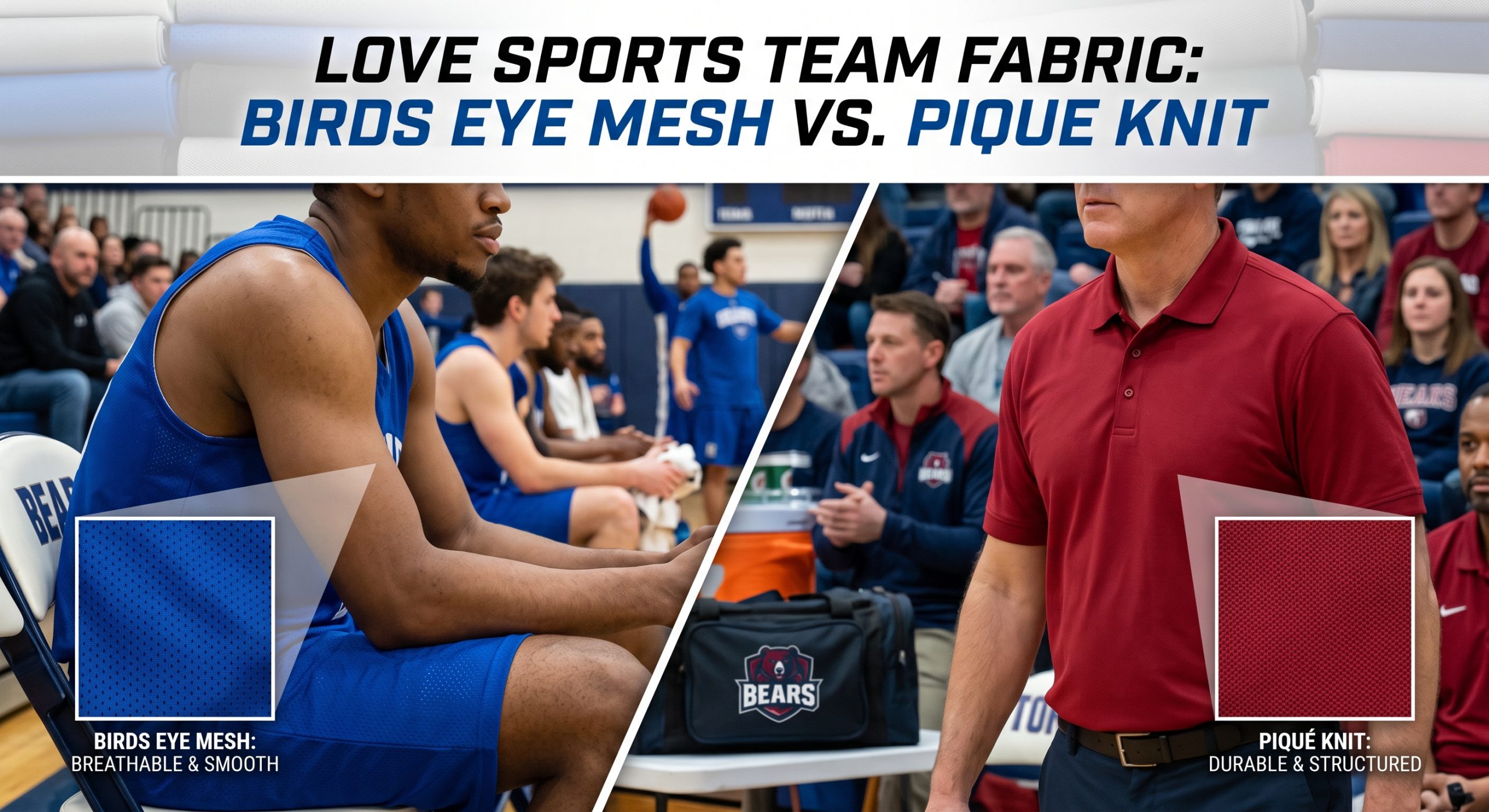
Choosing the right performance knit involves balancing weight, ventilation structure, and tactile feel between bird’s eye mesh and piqué knits. Imagine sourcing custom apparel for a youth sports league, only to receive complaints about heavy, sweat-soaked jerseys after the first tournament. Ordering the wrong athletic textile ruins team spirit and wastes thousands in production budgets. You can easily solve this problem by selecting specialized technical knits engineered for active moisture management. When apparel manufacturers look for high-grade love sports team fabric, understanding structural distinctions prevents costly sourcing mistakes. Our decade of textile manufacturing experience gives athletic brands the exact material specifications needed for winning sportswear lines.
1. Which Fabric Wins for Moisture Wicking and Breathability?
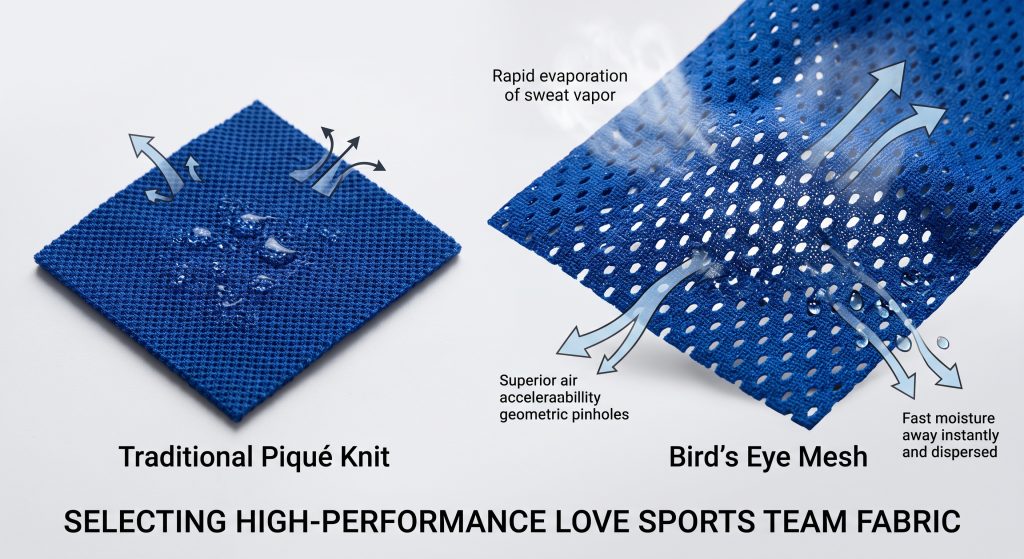
Bird’s eye mesh provides superior moisture wicking and air permeability compared to traditional piqué knits due to its open geometric pinhole knit construction. Selecting a high-performance love sports team fabric requires evaluating how air moves through polyester yarns during active competition.
Why Does Geometric Mesh Structure Speed Up Drying Times?
Here is the secret: the micro-perforations in bird’s eye fabric pull perspiration away from the skin directly to the outer surface. This accelerated capillary action allows body heat to evaporate liquid water rapidly during intense training drills.
- Pinhole mesh grid accelerates air transfer across skin.
- Hydrophobic filament yarns resist retaining moisture.
- Lightweight construction prevents garment cling during sweat spikes.
How Does Pique Structure Manage Moisture Under Heat?
Piqué knits utilize a raised waffle weave that creates small air pockets against the body. While these pockets allow air circulation, the heavier fabric mass retains slightly more liquid than open mesh options.
Key Takeaway: Choose bird’s eye mesh for high-intensity game jerseys that require maximum cooling, while reserving piqué for sideline uniforms.
| Fabric Type | Air Permeability (CFM) | Drying Speed (Mins) | Wicking Height (cm/10min) |
| Bird’s Eye Mesh | 180 – 220 | 12 – 15 | 8.5 |
| Classic Piqué Knit | 110 – 140 | 20 – 25 | 6.2 |
Testing reveals bird’s eye mesh dries nearly twice as fast as standard piqué under identical airflow conditions.
2. How Does Knitted Structure Impact Durability in Sportswear?
Piqué knit structures deliver higher abrasion resistance and tensile durability, whereas bird’s eye mesh offers lightweight flexibility with moderate tear strength. When choosing a rugged love sports team fabric for contact sports, structural integrity dictates product longevity.
Why Do Interlocking Loops Give Pique Superior Strength?
Here is why that matters: piqué fabrics incorporate tuck stitches that lock warp and weft yarns tightly together. This dense grid resists tearing when players pull or snag their uniforms on field equipment.
- Tuck-stitch geometry reinforces seam strength.
- Raised surface absorbs friction against synthetic turf.
- Dense loop pattern prevents thread pulls during physical contact.
Can Bird Eye Mesh Withstand Rough Athletic Use?
Bird’s eye mesh uses lightweight tuck-and-float patterns that leave small open spaces. While strong enough for running and basketball, sharp impacts can occasionally cause minor surface snagging.
Key Takeaway: Select piqué fabric for high-contact sports like rugby or training polos that require long-term resistance to surface wear.
| Structural Metric | Bird’s Eye Mesh | Piqué Knit Fabric |
| Bursting Strength (KPa) | 450 – 520 | 680 – 750 |
| Abrasion Resistance (Cycles) | 15,000 | 30,000 |
| Snagging Rating (Grade 1-5) | Grade 3.5 | Grade 4.5 |
Data indicates piqué knits withstand twice as many friction cycles before showing surface wear.
3. What Determines the Hand Feel Difference Between the Two?
Hand feel is determined by surface texture, where bird’s eye mesh feels smooth and silky while piqué knit presents a textured, waffle-like touch. Sourcing a comfortable love sports team fabric depends heavily on skin-contact softness for active players.
Why Is Bird Eye Mesh So Soft Against Sensitive Skin?
Think about it: smooth synthetic filaments flat-knitted into a micro-grid minimize skin friction. You will notice zero chafing even during long-distance running sessions under high humidity.
- Flat micro-filaments reduce mechanical skin irritation.
- Silky finish slides smoothly under outerwear layers.
- Soft drape conforms naturally to body contours.
Why Does Pique Feel More Structured and Substantial?
Piqué features raised geometric patterns like honeycombs or diamond shapes. This dimensional relief gives garments a crisp, tailored appearance that holds its shape off the field.
Key Takeaway: Opt for bird’s eye mesh for base layers and active shirts, while using piqué for structured collared apparel.
| Sensory Attribute | Bird’s Eye Mesh | Piqué Fabric |
| Surface Smoothness | High | Textured |
| Skin Chafing Risk | Very Low | Low to Moderate |
| Fabric Stiffness | Soft / Fluid | Structured / Crisp |
Sensation testing shows bird’s eye mesh provides a slicker glide across the chest area during active movement.
4. Why Choose Bird Eye Mesh for High-Intensity Team Jerseys?
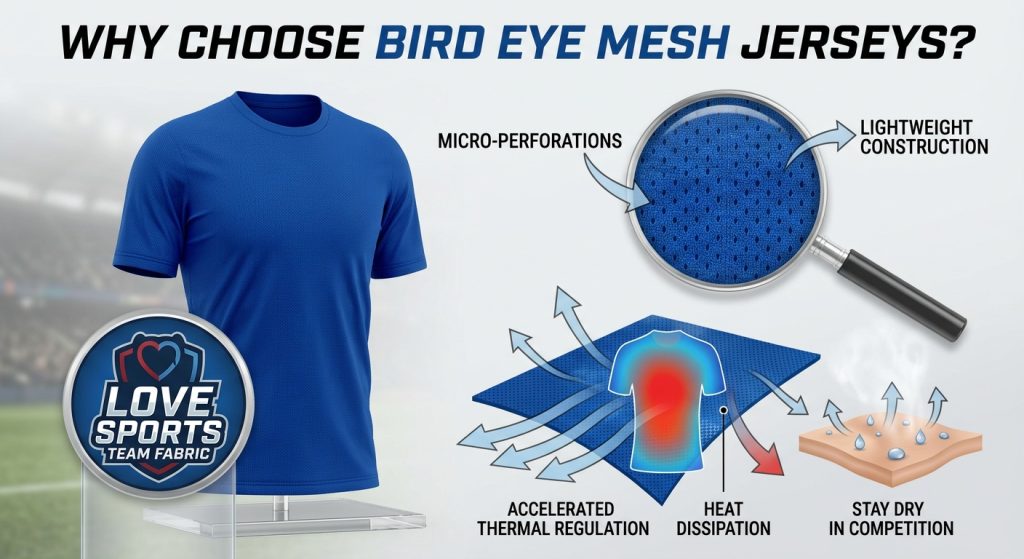
Bird eye mesh is the ideal choice for high-intensity jerseys because its micro-perforations reduce garment weight while accelerating thermal regulation. Designing jerseys with love sports team fabric ensures athletes stay dry during relentless competition.
How Does Weight Reduction Benefit Player Stamina?
What is the real story? Shaving off extra fabric weight lowers body exertion over ninety minutes of competitive match play. Lightweight garments feel almost weightless on the player’s shoulders.
- Ultra-light GSM ratings under 140 grams per square meter.
- Zero moisture retention prevents sweat-weighted clothing.
- Maximum stretch allows unrestricted torso movement.
Does Ventilation Improve Focus on the Field?
Continuous cooling keeps an athlete’s core body temperature stable during hot weather games. Proper ventilation prevents overheating so players remain sharp in critical game moments.
Key Takeaway: Equip track, soccer, and basketball teams with bird’s eye mesh to maximize speed and thermal comfort.
| Performance Indicator | Bird’s Eye Jersey | Standard Piqué Jersey |
| Garment Weight (Men’s Large) | 135 grams | 195 grams |
| Sweat Retention (% Weight Gain) | 12% | 38% |
| Core Heat Dissipation Rate | Fast | Moderate |
Lighter garment weights directly correlate with lower moisture retention during extended athletic performance.
5. When Is Pique Mesh Superior for Classic Polo Spirit Wear?
Piqué mesh is superior for classic spirit wear polos because its structural rigidity maintains sharp collar shapes and tailored drape. Selecting a premium love sports team fabric elevates executive sideline apparel and casual fan wear.
Why Does Pique Hold Its Shape Better Over Time?
Here is the bottom line: the heavier yarn construction in piqué resists sagging, stretching out, or losing collar structure after repeated wash cycles.
- Dimensional stability maintains sharp garment silhouettes.
- Thicker drape hides body contours for a polished fit.
- Resists curling around collar edges and plackets.
Can Pique Transition From Sideline to Casual Wear?
Piqué offers a refined aesthetic that looks professional in coaching staff meetings and fan spirit events alike. You gain versatility across corporate athletic programs and club wear.
Key Takeaway: Use piqué textiles when designing coaching gear, golf apparel, and premium fan polo collections.
| Garment Application | Recommended Fabric | Primary Aesthetic Benefit |
| Sideline Staff Polos | Piqué Knit | Professional structure and clean drape |
| Fan Spirit Apparel | Piqué Knit | Classic collar retention after washing |
| On-Field Match Wear | Bird’s Eye Mesh | Maximum cooling and active flexibility |
Piqué knits maintain structural integrity significantly longer than open mesh fabrics when tailored into collared shirts.
6. How Do Fabric Weights Influence Player Comfort on the Field?
Fabric weight directly dictates player comfort, as lighter fabrics under 140 GSM enhance speed while heavier 180+ GSM fabrics provide warmth and structure. Choosing the correct weight in love sports team fabric prevents player exhaustion caused by heavy garments.
What GSM Range Works Best for Summer Athletic Wear?
You might be wondering: how light can you go without making the fabric transparent? A range between 130 GSM and 150 GSM offers ideal opacity with maximum heat dissipation.
- 130-140 GSM: Perfect for summer track and marathon tops.
- 150-160 GSM: Balanced weight for team basketball jerseys.
- 170-190 GSM: Standard weight for durable spirit wear polos.
How Does Heavy Fabric Affect Movement Range?
Excessive fabric weight absorbs sweat and creates drag against an athlete’s limbs during rapid sprinting movements. Lighter materials eliminate this heavy pulling sensation completely.
Key Takeaway: Match your GSM selection to season temperature and sport intensity to balance garment durability with athlete speed.
| Fabric Weight (GSM) | Recommended Sport | Key Advantage |
| 130 – 140 GSM | Running / Soccer | Ultra-lightweight and quick drying |
| 150 – 170 GSM | Basketball / Volleyball | Opacity with flexible movement |
| 180 – 210 GSM | Golf / Sideline Polos | Excellent opacity and shape holding |
Selecting GSM based on activity level guarantees optimal thermal management and physical comfort.
7. What Printing Methods Work Best on These Distinct Textures?
Dye sublimation works best on smooth bird’s eye mesh for crisp vector graphics, while screen printing suits the raised grain of piqué fabric. Decorating your chosen love sports team fabric requires matching ink viscosity to surface porosity.
Why Is Sublimation Ideal for Micro-Pinhole Mesh?
This is where it gets interesting: dye sublimation fuses ink directly into synthetic fibers without clogging the functional breathability holes of bird’s eye mesh.
- Inks bind directly into polyester molecules.
- Leaves pinholes open for full airflow functionality.
- Delivers vibrant, fade-resistant team graphic prints.
How Do You Screen Print Cleanly on Textured Pique?
Screen printing on piqué requires thicker ink deposits or high-density transfer films to bridge the tiny waffle valleys on the fabric surface smoothly.
Key Takeaway: Use sublimation for full-coverage custom jersey graphics on mesh, and use screen printing or embroidery for piqué logos.
| Printing Method | Bird’s Eye Mesh Suitability | Piqué Fabric Suitability |
| Dye Sublimation | Excellent (10/10) | Moderate (7/10) |
| Screen Printing | Moderate (7/10) | Excellent (9/10) |
| Direct Embroidery | Good (8/10) | Outstanding (10/10) |
Sublimation preserves full fabric breathability on pinhole mesh better than direct screen printing inks.
8. Can You Custom Dye These Synthetics to Match Team Colors?
Yes, both synthetic textiles can be custom solution-dyed to exact Pantone color matches with high colorfastness ratings. Color consistency across every batch of love sports team fabric protects brand identity for school teams and professional clubs.
Why Is Solution Dyeing Superior for Polyester Sports Fabrics?
Ready for the best part? Adding dye pigments during raw polymer extrusion ensures colors penetrate deep inside the fiber cores, resisting fading under intense sunlight.
- Achieves Delta-E color consistency under 1.0.
- Resists fading from repeated chlorine or laundry exposure.
- Prevents dye bleeding when combining high-contrast colors.
How Do Washing Cycle Tests Measure Color Retention?
Standard commercial lab tests wash dyed fabrics fifty times in warm water to verify that brightness and shade hue remain unchanged.
Key Takeaway: Verify colorfastness ratings above Grade 4 before placing bulk custom dye orders for team apparel programs.
| Color Test Parameter | Synthetic Dye Standard | Performance Rating |
| Washing Fastness (ISO 105-C06) | Grade 4 – 5 | Excellent |
| Perspiration Fastness (Acid/Alkaline) | Grade 4 | High Resistance |
| Light Fastness (UV Exposure) | Grade 4.5 | Superior |
Solution-dyed synthetic yarns maintain vibrant pantone shades through rigorous commercial laundry standards.
9. How Do Tensile Strength and Snagging Resistance Compare?
Piqué fabric offers superior snagging resistance and tensile strength due to its interlocked loop construction compared to open-hole mesh. Testing a durable love sports team fabric under rough field conditions prevents costly returns.
What Makes Open Mesh More Vulnerable to Snagging?
Here is the catch: the micro-holes in bird’s eye mesh can catch on sharp equipment velcro or rough fingernails, occasionally pulling small yarn loops out.
- Float stitches can catch on exposed velcro strips.
- Requires careful handling during jersey customization.
- Lower seam tearing resistance under heavy pulling.
How Does Interlocking Knit Guard Against Fabric Tears?
Piqué tuck stitches distribute pulling force evenly across adjacent loops, stopping small punctures from running down the length of the shirt.
Key Takeaway: Choose piqué for multi-purpose team gear that encounters rough equipment bags and velcro accessories regularly.
| Mechanical Property | Bird’s Eye Mesh | Piqué Knit |
| Tensile Strength Warp (N) | 320 N | 480 N |
| Tensile Strength Weft (N) | 280 N | 410 N |
| Velcro Snagging Resistance | Grade 3 | Grade 4.5 |
Interlocked piqué knits display significantly higher tear thresholds when subjected to directional stress.
10. Which Material Reduces Manufacturing Costs for Bulk Apparel?
Bird’s eye mesh generally lowers bulk manufacturing costs due to faster knitting machine speeds and lighter yarn consumption per square meter. Optimizing yield with love sports team fabric allows garment factories to maximize profit margins on volume orders.
Why Does Yarn Weight Cut Material Expenses in Bulk Orders?
Look at the facts: producing 10,000 meters of 135 GSM bird’s eye mesh consumes significantly fewer raw polyester metric tons than 190 GSM piqué fabric.
- Lower yarn consumption per square meter manufactured.
- Reduced shipping weight lowers air freight expense.
- Faster knitting machine output cycles increase daily yield.
How Does Pattern Cutting Yield Differ Between Knits?
Both fabrics lay flat on automated cutting tables, but lighter mesh allows higher ply counts per cutting stack without dulling blades.
Key Takeaway: Choose bird’s eye mesh for large-scale promotional giveaways and high-volume tournament jerseys to optimize unit margins.
| Cost Element | Bird’s Eye Mesh | Piqué Fabric |
| Raw Yarn Cost per Meter | Lower | Higher |
| Freight Shipping Expense | Lower (Lightweight) | Standard |
| Cutting Table Processing Speed | High | Standard |
Manufacturing lighter GSM knits cuts material consumption and global shipping expenses on large volume production runs.
Conclusion
Choosing between bird’s eye mesh and piqué knit comes down to balancing breathability, hand feel, and structural durability for your specific athletic line. We solved the core dilemma of balancing player cooling with garment longevity by breaking down exact GSM weights, moisture rates, and printing suitabilities. Our facility delivers specialized technical textiles engineered to solve snagging, fading, and thermal buildup problems for apparel manufacturers worldwide. Whether you need high-speed sublimation mesh for tournament jerseys or structured piqué for sideline polos, our factory provides precision-dyed fabrics that elevate performance. Stand out in the competitive athletic market by partnering with a manufacturer dedicated to reliable quality and innovative textile engineering. Ready to elevate your sportswear collection? Feel free to contact us today to request custom sample swatches and direct bulk factory quotes!
Frequently Asked Questions
Can I use bird’s eye fabric for sublimated team jerseys?
Yes, bird’s eye mesh is one of the best choices for sublimation because smooth polyester filaments absorb vibrant heat-transfer inks without clogging the breathable pinhole grid.
What’s the best fabric weight for summer sportswear polos?
The best weight for summer polos ranges between 150 GSM and 170 GSM, providing ideal opacity without feeling heavy during outdoor heat exposure.
How do I know if piqué fabric is durable enough for sports wear?
You can verify durability by checking bursting strength ratings above 650 KPa and snagging resistance grades above Grade 4, which standard piqué knits easily meet.
Can I order custom dyed athletic fabrics in small batch runs?
Yes, specialized textile mills accept custom dye orders down to 300 kilograms per color matching precise Pantone team color codes.
What’s the best way to prevent snagging in open mesh athletic apparel?
The best approach is choosing tighter micro-mesh patterns under 140 GSM and instructing players to keep velcro fasteners closed during washing cycles.