
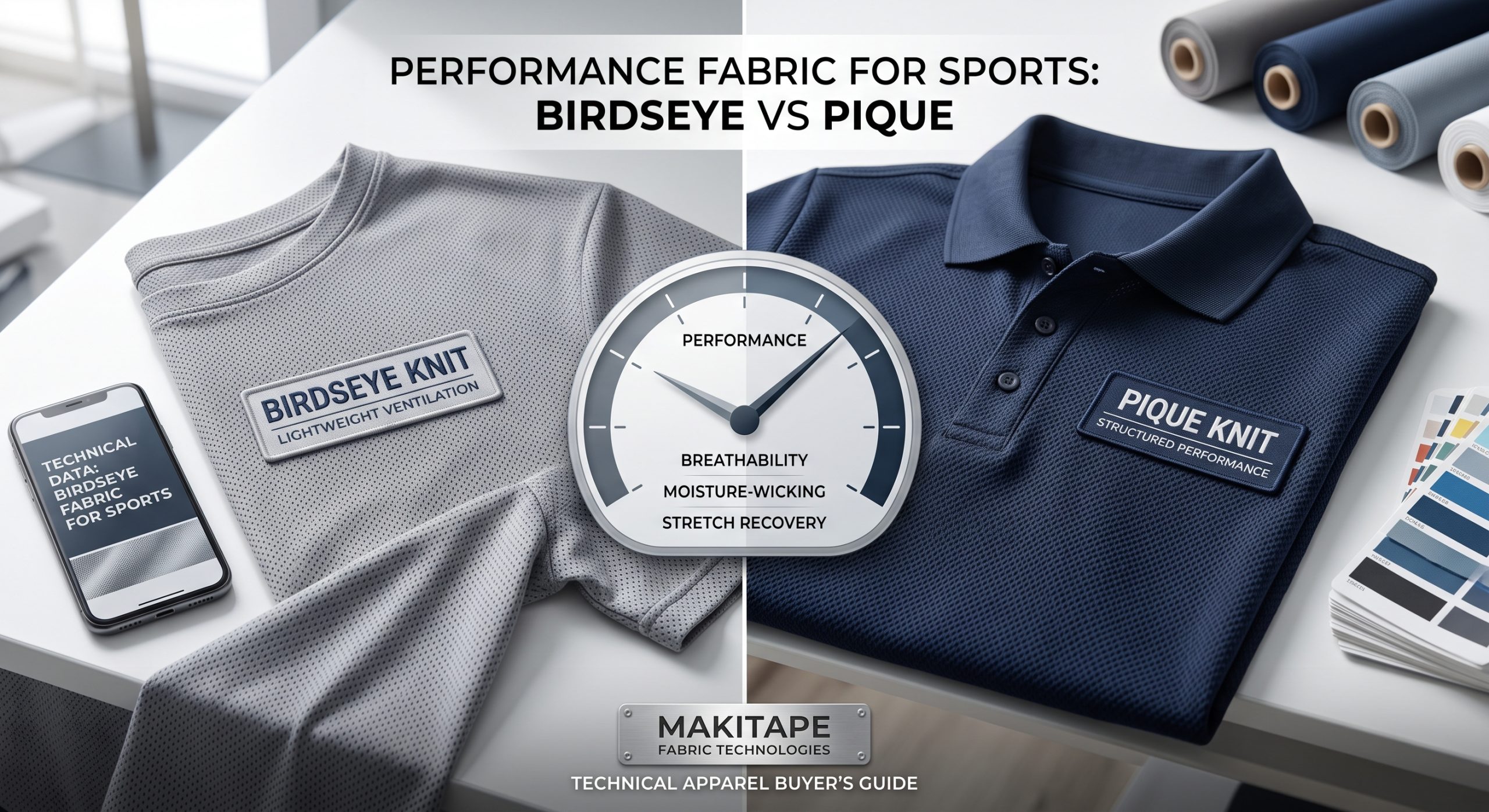
Selecting sports lining fabrics requires matching structural knit patterns with specific athletic performance requirements. Sourcing garment materials that trap moisture or feel harsh against human skin leads directly to poor product reviews and costly buyer returns. Choosing mismatched textile constructions damages overall garment functionality while hurting brand trust among athletes. Matching bird’s eye micro-perforations or piqué honeycomb patterns to exact end-use requirements solves performance issues before production begins. For optimal garment manufacturing, choosing the right fabric for sports guarantees lightweight breathability and dynamic moisture control across training environments.
How Does Birdseye Compare to Pique Fabric for Sports?
Bird’s eye features micro-perforations for active cooling, whereas piqué utilizes a honeycomb structure for structured comfort. Manufacturing high-grade apparel requires choosing a suitable fabric for sports based on exact yarn weight and structural density.
What Defines the Surface Grid?
Bird’s eye knit creates small pinhole openings across the textile surface that look like bird eyes. Here is the deal, you will notice these micro-holes allow immediate air circulation while maintaining a smooth face.
- Open mesh geometry speeds up ventilation.
- Micro-pore distribution reduces total fabric weight.
- Tuck stitch pattern stabilizes diagonal stretch.
When you inspect the face of the material, the subtle pattern provides visually technical appeal without compromising coverage.
Which Structure Suits Active Wear?
Piqué knit uses a double-tuck stitch technique to build raised waffle shapes with distinctive depth. Think about it, you get a firmer structural weight that keeps apparel looking crisp throughout long training sessions.
- Honeycomb geometry holds garment shape.
- Raised ridges reduce direct fabric contact with wet skin.
- Solid structural body yields clean tailoring lines.
You can rely on this dimensional knit when designing polo collars or high-end athletic shirts.
Key Takeaway: Bird’s eye provides lightweight ventilation for high-sweat environments, while piqué delivers structured durability for polished athletic wear.
| Structural Feature | Bird’s Eye Knit | Piqué Knit |
| Surface Pattern | Micro-hole grid | Raised honeycomb |
| Primary Benefit | Maximum ventilation | Garment structure |
| Typical Weight | 110 – 150 GSM | 160 – 220 GSM |
Evaluating these structural properties helps buyers align garment specifications with target athletic demands.
Why Is Knit Structure Critical in Fabric for Sports Selection?
Knit structure determines liquid movement, tensile recovery, and thermal regulation across training conditions. Selecting an engineered fabric for sports alters how garment linings manage heat buildup during intense exercise.
How Does Loop Geometry Direct Moisture?
Yarn loop orientation dictates how liquid moves away from active skin surfaces. Truth be told, you will find that tight vertical channels pull sweat upward faster through capillary action.
- Vertical loop channels accelerate liquid travel.
- Open stitch spaces widen the surface evaporation area.
- Hydrophobic synthetic yarns prevent liquid absorption into fibers.
Your apparel design stays dry because moisture moves straight to the outer surface for rapid evaporation.
How Do Stitches Impact Stretch Recovery?
Stitch spacing defines how far the material expands before pulling back into shape. Notice the difference, you need balanced mechanical stretch to prevent sagging elbow areas or loose waistbands.
- High tuck counts increase dimensional recovery.
- Interlocking loop connections reduce seam stress during movement.
- Controlled yarn tension prevents permanent fabric sagging.
Key Takeaway: Precise stitch geometry balances moisture transportation speed with dynamic shape retention during repeated athletic movement.
| Performance Metric | Channel Loops | Interlock Loops |
| Moisture Wicking Speed | High | Moderate |
| Shape Recovery Force | Moderate | High |
| Abrasion Resistance | Moderate | High |
Understanding loop dynamics lets you select materials that maintain structural integrity during heavy athletic use.
How Does Birdseye Fabric for Sports Manage Sweat?
Bird’s eye fabric disperses liquid rapidly through micro-perforations to speed up evaporation. High-performance activewear demands specialized fabric for sports that keeps athletes cool under extreme physical exertion.
What Surface Mechanics Drive Rapid Drying?
Micro-pinholes in bird’s eye mesh draw sweat from the inner face directly to the exterior. What is the real story? You can watch liquid spread outward in seconds rather than pooling against skin.
- Pinhole vents release trapped body heat.
- Wide surface dispersion speeds up dry times.
- Thin knit profile prevents sweat accumulation inside yarns.
You gain an immediate advantage in hot environments where rapid evaporation protects athlete comfort.
How Does Air Flow Assist Drying?
Air flows through the open grid pattern as the body moves forward. Ready for the good part? You experience passive cooling because external breeze passes straight through micro-cavities.
- Motion-driven airflow strips away trapped humidity.
- Low liquid retention keeps garment weight down when wet.
- Micro-grid gaps prevent material from sticking to wet skin.
Key Takeaway: Bird’s eye micro-vents create an active cooling mechanism that accelerates evaporation and prevents garment cling.
| Property | Bird’s Eye Mesh | Standard Flat Jersey |
| Dry Time (Minutes) | 12 – 15 | 25 – 30 |
| Wicking Height (mm/10min) | 120 | 75 |
| Surface Cling Force | Low | High |
Matching wicking speed to workout intensity ensures your finished garments perform reliably during heavy sweating.
What Makes Pique Fabric for Sports Ideal for Polos?
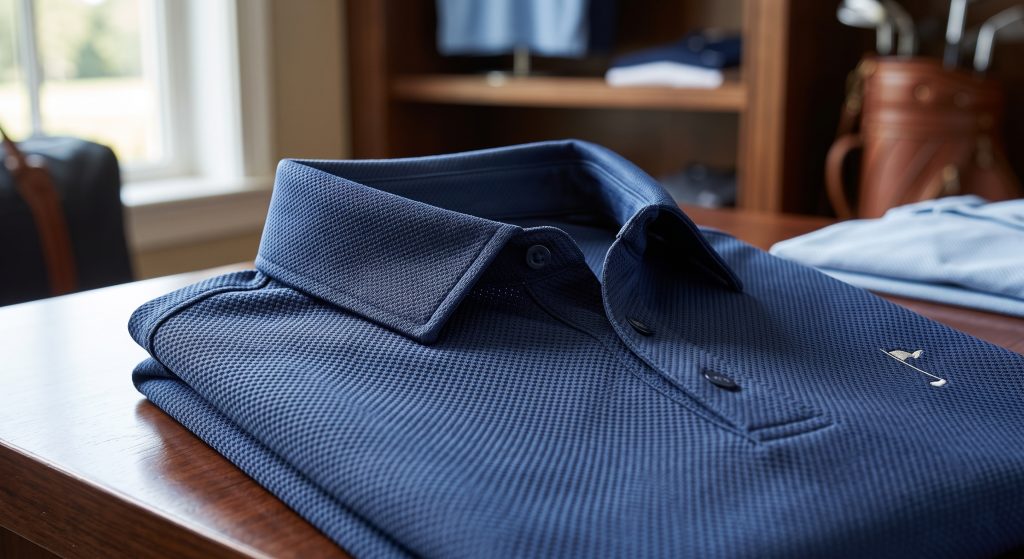
Piqué provides dimensional stability and structured weight that keeps collars and plackets crisp. Choosing premium fabric for sports gives golf shirts and athletic polos a refined look without sacrificing breathability.
Why Does Pique Retain Garment Shape?
The double-tuck honeycomb construction builds horizontal and vertical tension into the weave. This is where it gets interesting, you can wash these garments repeatedly without losing collar stiffness or hem alignment.
- Double tuck construction reinforces fabric stability.
- Heavier yarn counts provide clean drape lines.
- Textured face hides subtle creasing or wrinkles.
You achieve a tailored appearance suitable for golf courses and athletic corporate apparel.
How Does Raised Texture Improve Comfort?
The geometric waffle pattern creates tiny air pockets between the textile and human skin. Make no mistake, you avoid that sticky sensation because only the raised points touch skin.
- Minimal surface contact reduces skin irritation.
- Trapped micro-air pockets assist body thermal regulation.
- Sturdy weight prevents body cling during light perspiration.
Key Takeaway: Piqué offers structural rigidity and reduced skin contact points, making it optimal for premium collared sportswear.
| Metric | Single Piqué | Double Piqué |
| Weight Range | 160 – 180 GSM | 190 – 240 GSM |
| Collar Hold Rating | Good | Excellent |
| Surface Texture Depth | Shallow | Deep |
Selecting appropriate piqué density guarantees long-lasting apparel shape while retaining comfortable airflow.
Which Fabric for Sports Offers Superior Airflow?
Bird’s eye mesh delivers higher CFM air permeability values than structured piqué knits. Specifying functional fabric for sports requires testing air displacement across different yarn weights and knit densities.
How Do Air Passages Function Under Strain?
When activewear stretches during body movement, bird’s eye pinholes expand slightly to release heat. Here is the kicker, you get dynamic air circulation that increases exactly when physical exertion rises.
- Pore expansion boosts ventilation during stretch.
- Low air resistance reduces heat accumulation inside clothing.
- Lightweight yarn grid allows heat to escape continuously.
Your athletic line benefits from functional thermal relief during endurance training or warm weather wear.
What Limits Airflow in Pique Knits?
Piqué knits use denser yarn groupings that restrict open-air displacement compared to mesh. You might be wondering, does that make piqué too hot for training?
- Compact tuck stitches create higher wind resistance.
- Dense yarn layout trade breathability for structural stiffness.
- Air movement relies on ambient convection rather than open pores.
You should reserve heavier piqué options for moderate activity levels or cool weather sports wear.
Key Takeaway: Bird’s eye mesh outperforms piqué in raw air permeability, making it the preferred option for intensive cardio apparel.
| Airflow Parameter | Bird’s Eye Mesh | Heavy Piqué Knit |
| Air Permeability (CFM) | 180 – 240 | 80 – 120 |
| Heat Dissipation Rate | Very Fast | Moderate |
| Wind Resistance | Low | Moderate |
Evaluating air permeability metrics helps garment developers tailor thermal control to specific athletic applications.
How Does Texture in Fabric for Sports Impact Hand-Feel?
Bird’s eye offers a smooth, slick hand-feel while piqué provides a textured, tactile grip. Sourcing comfortable fabric for sports ensures interior apparel linings feel soft during long training sessions.
Can Surface Texture Prevent Chafing?
Smooth filament yarns used in bird’s eye knits slide easily over sensitive skin areas. Believe it or not, you reduce skin friction during repetitive movements like running or rowing.
- Continuous filament yarns eliminate rough fiber ends.
- Flat surface matrix minimizes friction points against skin.
- Soft touch finishes improve lining comfort.
You protect athletes from painful friction chafing during high-mileage training sessions.
How Does Pique Feel Against the Skin?
Piqué presents a firmer, tactile touch that feels substantial and premium. Check this out, you notice a dry-touch feeling because raised ridges hold liquid away from skin contact points.
- Textured waffle face creates a crisp hand-feel.
- Reduced contact area minimizes wet fabric cling.
- Stiffer body provides a clean separation layer.
Key Takeaway: Filament bird’s eye protects against friction chafing during intense motion, whereas textured piqué offers a dry, crisp tactile sensation.
| Sensory Aspect | Bird’s Eye Finish | Piqué Finish |
| Surface Friction | Low | Medium-High |
| Softness Level | High | Firm / Structured |
| Skin Contact Area | Continuous Flat | Discontinuous Raised |
Matching texture preferences with skin sensitivity requirements increases customer comfort and satisfaction.
What Is the Durability of Each Fabric for Sports Type?
Piqué knits resist surface snagging better, while bird’s eye mesh offers higher tensile strength per GSM. Testing high-grade fabric for sports guarantees garments endure repeated wash cycles without pill formation.
How Do Yarns Resist Surface Snagging?
Continuous loop tucks in piqué lock fibers tight against external abrasion sources. As it turns out, you experience fewer pulled threads when garments brush past rough equipment.
- Tightly locked stitches prevent loose loop snags.
- High twist synthetic yarns resist pilling under friction.
- Dense waffle structure protects internal thread paths.
You minimize warranty claims when producing team wear exposed to rough field contact.
How Does Mesh Hold Up to Wear?
Open pinhole structures in bird’s eye can catch on sharp objects if yarn tenacity is low. That is not all, you can avoid snagging issues by selecting high-tenacity filament polyester.
- High-tenacity polyester prevents thread snapping.
- Fine gauge knits reduce individual pore catching size.
- Heat-set finishes lock loop dimensions against washing distortion.
Key Takeaway: Piqué provides superior snag resistance against rough gear, while high-tenacity bird’s eye handles high-stress stretching without tearing.
| Durability Test | Bird’s Eye Mesh | Piqué Knit |
| Martindale Abrasion (Cycles) | 20,000+ | 35,000+ |
| Snagging Resistance (Grade 1-5) | Grade 3.5 | Grade 4.5 |
| Tensile Strength (N) | High (Relative to weight) | Very High |
Selecting durable knit structures extends garment lifespan under rugged athletic conditions.
How Do You Choose Fabric for Sports by Application?
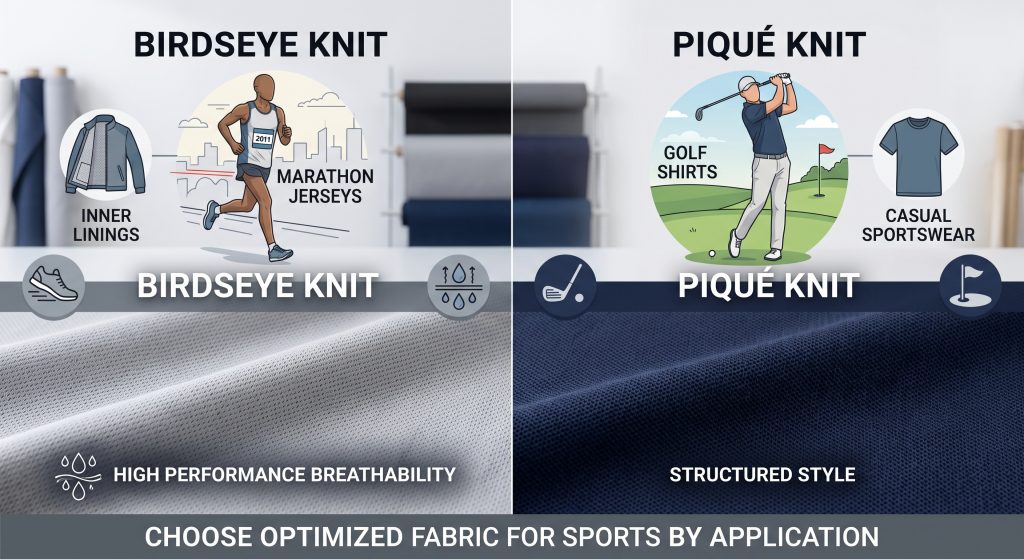
Choose bird’s eye for inner linings and marathon jerseys, but select piqué for golf shirts and casual sportswear. Sourcing optimized fabric for sports requires evaluating garment purpose, target environment, and athlete preferences.
Which Material Fits Running Outerwear?
Ultra-light bird’s eye mesh provides the air movement needed for intense aerobic running workouts. Here is what matters, you keep garment weight minimal while maximizing heat dispersion across endurance runs.
- Ultra-light 110 GSM weight prevents drag.
- Rapid drying keeps runners warm in cold breezes.
- Smooth texture eliminates chest chafing without extra base layers.
Your running collections maintain peak performance metrics when built with light mesh constructions.
When Should You Specify Pique?
Piqué is the gold standard for golf apparel, tennis shirts, and casual sideline team wear. So what is the bottom line? You deliver polished style combined with functional moisture management for active lifestyles.
- Structured drape looks clean in casual settings.
- Sturdy weight supports embroidered logos without puckering.
- Breathable waffle pattern handles moderate physical activity.
Key Takeaway: Match bird’s eye to high-intensity endurance sports and use piqué for structured, lifestyle-focused athletic apparel.
| Sport / Activity | Recommended Fabric | Primary Reason |
| Marathon Running | Bird’s Eye Mesh | Lightweight ventilation |
| Golf & Tennis | Piqué Knit | Collar structure & style |
| Basketball Linings | Bird’s Eye Mesh | Soft, friction-free feel |
Aligning material traits with specific activity needs ensures end users receive optimal comfort and functionality.
What Cost Factors Govern Fabric for Sports Sourcing?
Bird’s eye mesh usually offers higher fabric yield per kilogram due to lower GSM weights. Sourcing commercial fabric for sports requires balancing raw material costs, knitting machine speeds, and dyeing complexities.
How Does Dye Selection Change Cost?
Applying high-fastness disperse dyes or custom functional coatings increases total yardage prices. You might wonder why, you need specialized chemistry to prevent color bleeding during heavy sweat exposure.
- Premium disperse dyes ensure wash fastness under hot water.
- Anti-odor silver ion treatments add functional cost per meter.
- Recycled polyester yarns carry a slight raw material premium.
You protect brand quality by investing in certified colorfast chemistry for active wear.
How Does Weight Yield Affect Budget?
Lighter weight bird’s eye mesh delivers more linear meters per weight ton than heavy piqué. The best part? You reduce total garment production costs while maintaining high performance metrics.
- Lower GSM yields more shirt units per fabric roll.
- Reduced weight lowers international shipping freight expenses.
- Faster circular knitting machine speeds reduce processing labor.
Key Takeaway: Lighter bird’s eye mesh reduces material yield costs per unit, while piqué commands higher pricing due to increased yarn weight.
| Cost Component | Bird’s Eye Mesh | Piqué Knit |
| Raw Material Consumption | Lower (110-140 GSM) | Higher (180-220 GSM) |
| Yield per Kilogram | High (~4 meters/kg) | Moderate (~2.5 meters/kg) |
| Machine Production Speed | Very Fast | Standard |
Calculating yield efficiencies helps apparel brands optimize production budgets without sacrificing garment quality.
How to Inspect Quality in Fabric for Sports Batches?
Quality control requires checking GSM weight tolerances, wicking speed height, and colorfastness grades. Ordering production runs of fabric for sports requires rigorous laboratory verification before cutting and sewing.
What Tests Verify Batch Quality?
Standard lab procedures measure wicking height, bursting strength, and dimensional stability after washing. Here is the secret, you catch potential fabric failures before garments hit retail shelves.
- Hydrostatic wicking tests verify liquid transport speed.
- Pneumatic bursting tests measure loop seam strength under pressure.
- Wash testing confirms shrinkage remains under three percent.
You maintain strict batch consistency across multi-country manufacturing facilities.
How Do You Inspect Surface Flaws?
Four-point system fabric inspection identifies drop stitches, oil stains, and horizontal barre lines. Look closely, you keep cutting room yields high by catching roll defects early.
- Automated optical inspection detects broken knitting needles.
- Tension-free unrolling prevents elastic recovery errors during cutting.
- Color shading checks under D65 light booths ensure batch consistency.
Key Takeaway: Systematic laboratory testing and four-point visual inspections guarantee batch-to-batch reliability and eliminate garment production defects.
| Quality Standard | Acceptable Range | Testing Method |
| GSM Tolerance | +/- 5% | ASTM D3776 |
| Color Fastness to Sweat | Grade 4.0 Minimum | ISO 105-E04 |
| Washing Shrinkage | < 3.0% | ISO 6330 |
Implementing structured inspection protocols protects garment manufacturers from costly material rejections and delivery delays.
Conclusion
Sourcing ideal athletic lining materials requires balancing air permeability, structural weight, and moisture transport speed. Matching bird’s eye micro-perforations to intense cardio applications prevents heat trapping, while specifying piqué knit structure ensures crisp, long-lasting collar retention for casual activewear. Choosing carefully engineered textile constructions solves performance issues, reduces customer returns, and enhances athletic apparel functionality across all training conditions.
Our production facility delivers high-performance knits tailored to your exact weight, width, and functional finish requirements. To discuss your seasonal sourcing needs or request custom fabric sample swatches, contact us today to partner with an industry leader committed to supply chain transparency, reliable quality control, and cutting-edge functional textiles.
FAQ
Q1: Can I use bird’s eye mesh as a main outer body fabric?
Yes, bird’s eye mesh works exceptionally well as a primary outer fabric for athletic jerseys, marathon tops, and training tees. Its micro-perforated grid provides sufficient visual opacity while delivering maximum airflow during intense physical exercise.
Q2: What is the best fabric weight for sports polo shirts?
A double-piqué knit weighing between 180 and 220 GSM is ideal for athletic polo shirts. This weight range provides structural collar support and clean drape while maintaining comfortable skin separation.
Q3: How do I know if a knit fabric will chafe during workouts?
Examine surface friction coefficient and yarn filament type under close magnification. Smooth continuous polyester filaments with low surface friction, such as those in bird’s eye knits, prevent skin irritation better than coarse, short-staple spun yarns.
Q4: Can I add anti-odor or cooling treatments to these fabrics?
Yes, both bird’s eye and piqué knits accept functional chemical finishes like silver-ion anti-odor technology, wicking accelerants, or chemical cooling agents during dyeing. These treatments bind directly to synthetic fibers without altering surface knit texture.
Q5: What’s the best way to prevent color fading in activewear?
Specify high-temperature disperse dyeing processes with colorfastness ratings of Grade 4.0 or higher. Quality disperse dyes penetrate synthetic fiber cores, resisting fading caused by heavy perspiration, repeated hot washing, and UV light exposure.