
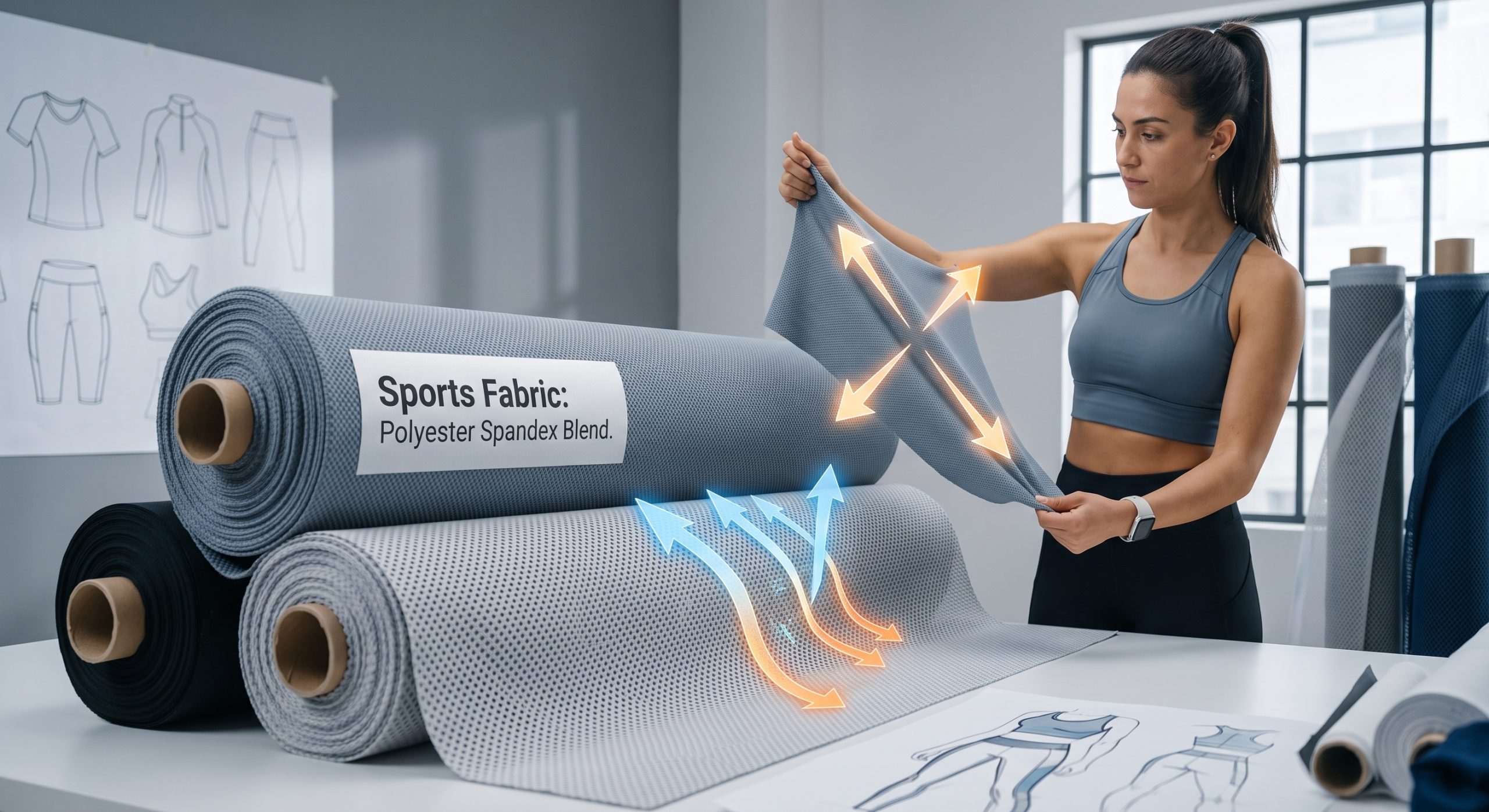
Sports fabric polyester spandex provides the foundation for high-performance athletic apparel by combining durable polyester fibers with elastic spandex yarns. You design a brand-new line of compression apparel anticipating strong sales and positive customer reviews. However sales slump because your previous material lost elasticity after three washes and left athletes drenched in sweat during workouts. Choosing specialized sports fabric polyester spandex materials resolves these production issues by offering four-way stretch, rapid moisture evacuation, and exceptional shape retention across demanding athletic applications.
Why choose sports fabric polyester spandex for activewear?
Sports fabric polyester spandex provides activewear garments with an ideal balance of structural strength and flexible movement. Selecting this synthetic blend allows apparel creators to manufacture form-fitting gear that withstands heavy wear. Synthetic polyester yarns resist tearing while elastane fibers expand smoothly during high-exertion workouts. Building gear with this hybrid material prevents common garment distortion problems over extended wear cycles.
How do synthetic spandex blends improve athletic performance?
Synthetic yarn combinations give athletes unrestricted motion while keeping clothing light. Here is the deal: pure cotton traps sweat and sags while polyester elastane knits retain shape. You deliver reliable workout gear that supports dynamic bodily movement.
- Micro-polyester threads pull moisture away from body surfaces
- Integrated spandex filaments permit full four-way extension
- Synthetic knits resist sagging during prolonged training sessions
Key Takeaway: Combining polyester with spandex gives sportswear the strength and flexibility needed for intense physical training.
What structural advantages keep garments stable?
Double-knit and single-jersey methods lock fibers into stable textile matrix layouts. Look at it this way: tight knit geometries prevent seam pull and fabric thinning under stress. You can rely on stable structural integrity even across high-stress panel seams.
- Interlocking stitch structures reduce thread slippage
- Uniform filament alignment preserves clean fabric surfaces
- Balanced yarn tension prevents edge curling during cutting
Key Takeaway: Engineered structural stability protects active apparel from tearing or warping under severe tension.
| Material Characteristic | Polyester Spandex Blend | Standard Cotton Blend |
| Fiber Elasticity | High 4-way stretch recovery | Limited 2-way stretch |
| Moisture Retention | Low liquid absorption | High liquid retention |
| Tensile Strength | Excellent filament durability | Moderate fiber strength |
Analyzing these core characteristics helps textile buyers select ideal raw materials for technical sportswear lines.
How does sports fabric polyester spandex impact stretch?
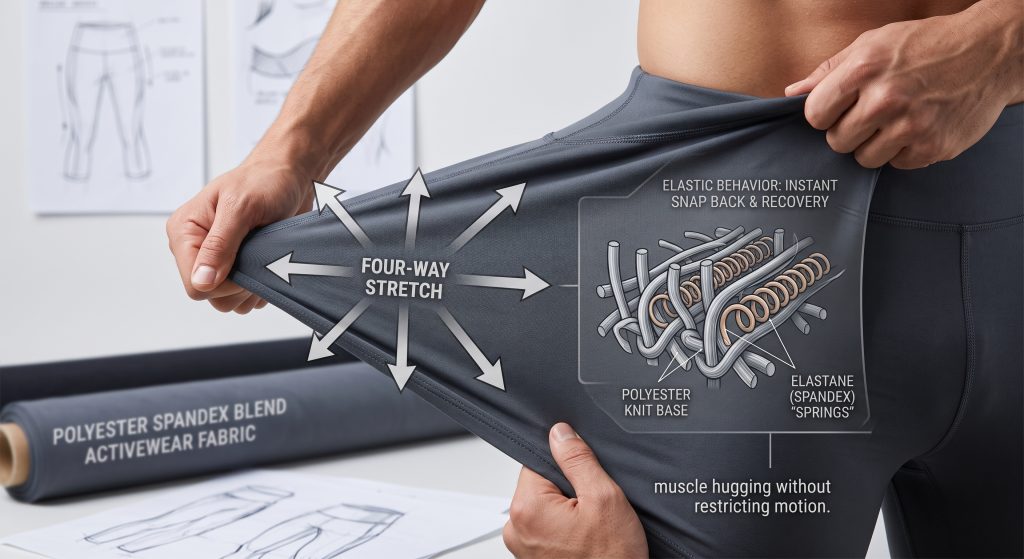
Sports fabric polyester spandex increases fabric elasticity by incorporating flexible elastane channels throughout the polyester base knit. Incorporating sports fabric polyester spandex into your production patterns guarantees smooth four-way movement for athletes. Spandex filaments act like tiny internal springs that stretch outward and snap back instantly. This elastic behavior allows activewear to hug muscle groups without restricting natural motion.
How does four-way elasticity function under movement?
Four-way stretch construction permits equal expansion horizontally and vertically across the garment. Think about it: rigid fabrics pull at joints while omnidirectional stretch moves with your posture. You experience complete freedom whether squatting, sprinting, or jumping.
- Omnidirectional elasticity eliminates restriction around joint areas
- Flexible yarn orientation distributes pulling forces evenly
- Snug surface fit reduces aerodynamic drag during outdoor motion
Key Takeaway: Four-way elasticity allows athletic clothing to expand seamlessly alongside complex body movements.
Why is shape recovery vital for activewear?
Shape recovery determines whether a garment returns to its original dimensions after heavy stretching. What is the real story?: low-quality knits bag out at knees and elbows after two workouts. You guarantee long-lasting garment fit by choosing high-recovery elastane blends.
- High elastane memory restores original pattern dimensions
- Persistent tension maintains supportive compression on muscles
- Elastic resilience prevents fabric bagging after repetitive laundering
Key Takeaway: Superior recovery memory ensures performance apparel retains its tailored fit throughout its lifespan.
| Stretch Parameter | Low-Spandex Blend (3%-5%) | High-Spandex Blend (12%-20%) |
| Extension Percentage | 15% – 30% horizontal stretch | 80% – 150% omnidirectional stretch |
| Recovery Rate | Moderate shape return | Rapid 98%+ elasticity recovery |
| Target Apparel | Casual tees, loose hoodies | Leggings, compression tops |
Comparing stretch parameters enables designers to match elastane percentages to specific athletic movement requirements.
What makes sports fabric polyester spandex ideal for wicking?
Sports fabric polyester spandex excels at moisture management because synthetic polyester fibers naturally repel water while pulling sweat along capillary channels. Sourcing sports fabric polyester spandex options with specialized capillary finishes speeds up surface evaporation. Liquid travels quickly from the skin to the outer textile surface. This engineered wicking process keeps athletes dry during hot weather workouts.
How does capillary action transport body moisture?
Hydrophobic polyester yarns create microscopic channels that draw liquid sweat away from skin contact points. Ready for the good part?: sweat does not soak into the yarn core but slides along surface grooves. You stay comfortable and dry as liquid evaporates into ambient air.
- Micro-channel fibers channel sweat outward via surface tension
- Non-absorbent polyester filaments prevent heavy water retention
- Wide liquid distribution speeds up evaporative surface cooling
Key Takeaway: Microscopic capillary channels transport moisture rapidly outward to keep athletes cool and dry.
Why does quick drying speed enhance athletic comfort?
Fast drying speeds prevent garments from becoming heavy and clinging to wet skin during exercise. Believe it or not: lightweight dry fabrics minimize skin friction and prevent painful chafing. You protect athletes from body chill caused by damp clothing after workouts.
- High air permeability clears trapped moisture vapor rapidly
- Low water retention keeps garment weight consistently light
- Frictionless dry contact prevents skin chafing under repetitive motion
Key Takeaway: Rapid drying performance maintains light garment weight and protects wearers against skin irritation.
| Moisture Metric | Polyester Spandex Mesh | Untreated Cotton Fabric |
| Water Absorption Rate | Under 1% internal absorption | Up to 8% liquid soakage |
| Surface Evaporation Time | 10 – 15 minutes complete dry | 45 – 60 minutes drying time |
| Moisture Transport Mechanism | Capillary action along grooves | Fiber absorption and swelling |
Evaluating moisture transport metrics helps product developers select fabrics that deliver cool dry comfort under exertion.
How does sports fabric polyester spandex compare in durability?
Sports fabric polyester spandex demonstrates high durability due to the tensile strength of continuous polyester filaments mixed with resilient elastane. Synthetic yarn matrixes resist surface abrasion caused by gym equipment friction and repeated laundering. High-grade polyester filaments resist breaking under intense mechanical stress. Selecting quality knits prevents garment wear and fabric pilling over prolonged usage.
How does abrasion resistance protect athletic gear?
Durable synthetic threads resist surface wear when rubbed against rough surfaces or athletic equipment. Here is the bottom line: fragile fabrics tear when contacting barbell knurling while tough polyester stays smooth. You build rugged training apparel that handles demanding fitness routines.
- High-tenacity polyester filaments resist surface snagging
- Compact knit structures prevent thread pulling during exercise
- Tough synthetic surfaces resist abrasion from weightlifting gear
Key Takeaway: Strong synthetic fibers prevent surface damage when sportswear comes into contact with abrasive equipment.
How to prevent pilling on stretchable fabrics?
Pilling occurs when loose surface fibers tangle together into small fuzzy balls during laundering. Look at it this way: long-filament synthetic yarns resist pilling far better than short staple fibers. You maintain a sleek brand-new appearance across dozens of washing cycles.
- Continuous filament yarns minimize loose surface fiber ends
- Singeing and anti-pilling finishes seal smooth thread surfaces
- Tightly twisted yarn configurations lock micro-fibers in place
Key Takeaway: Long-filament yarn selection and special surface treatments keep activewear smooth and pilling-free.
| Durability Test | Performance Standard | Result for Polyester Spandex |
| Martindale Abrasion | ISO 12947 test protocol | Exceeds 40,000 friction cycles |
| Pilling Resistance | ISO 12945 grading scale | Grade 4.5 (Superior smoothness) |
| Color Fastness to Washing | ISO 105-C06 wash standard | Grade 4 – 5 (Zero bleed) |
Standardized durability metrics demonstrate that polyester spandex materials withstand intense mechanical wear and repeated washing.
Which sports fabric polyester spandex blend fits gym gear?
Choosing the correct sports fabric polyester spandex blend depends on whether your gym gear requires high compression, lightweight breathability, or structured drape. Utilizing structured sports fabric polyester spandex knits like Pique or mesh allows developers to balance performance with visual style. High spandex content suits supportive leggings. Lighter polyester blends suit breathable workout shirts.
What fiber ratio works best for athletic leggings?
Athletic leggings demand high spandex percentages to deliver muscle support and non-see-through coverage. Think about it: low elastane content causes leggings to slide down during squatting. You deliver opaque squat-proof coverage by specifying an 80/20 polyester spandex ratio.
- 80% polyester / 20% spandex balances strength with high stretch
- Denser knit structures provide opaque squat-proof coverage
- High elastane content offers mild muscle compression support
Key Takeaway: High-spandex ratios yield supportive squat-proof leggings that hold their position during complex exercises.
What blend suits breathable workout t-shirts?
Lightweight running shirts require higher polyester content paired with lower spandex percentages for rapid ventilation. What is the real story?: excess spandex adds weight and slows drying speed in loose tops. You achieve featherweight comfort with a 92/8 polyester spandex mix.
- 90-95% polyester maintains ultra-light garment weight
- 5-10% spandex adds gentle flex without excessive weight
- Open eyelet mesh structures increase air passage across skin
Key Takeaway: Lower spandex ratios paired with open mesh knits maximize airflow for lightweight cardio apparel.
| Apparel Category | Ideal Fiber Ratio | Key Functional Benefit |
| Compression Leggings | 78% Poly / 22% Spandex | High muscle support & opaque coverage |
| Training Shorts | 88% Poly / 12% Spandex | Flexible stretch with durable body |
| Cardio Running Tees | 92% Poly / 8% Spandex | Featherweight airflow and quick dry |
Matching fiber ratios to specific garment categories guarantees your gym wear balances support, weight, and breathability.
How does sports fabric polyester spandex affect printing quality?
Sports fabric polyester spandex provides an exceptional substrate for dye sublimation printing because polyester fibers absorb disperse dyes at high heat. Synthetic materials lock color pigments directly into the fiber structure rather than printing on top. High heat opens polyester pores to bond dye molecules permanently. This chemical bonding yields brilliant high-resolution graphics that never peel or crack.
Why is dye sublimation ideal for polyester knits?
Dye sublimation converts ink into gas under high heat to penetrate polyester fibers directly. Ready for the good part?: printed graphics become an integral part of the cloth surface. You produce vibrant custom activewear without blocking fabric breathability.
- Heat-activated dyes lock inside synthetic fiber structures
- Sublimated patterns remain fully breathable without heavy ink layers
- Printed graphics never peel, crack, or fade under stretch
Key Takeaway: Sublimation printing fuses vibrant colors directly inside polyester filaments without impairing fabric performance.
How to maintain color fastness on stretch fabrics?
Color fastness guarantees that printed designs retain brightness when stretched or exposed to sweat. Believe it or not: quality polyester yarns hold dye pigment even under extreme dimensional elongation. You offer vibrant activewear that stays bright after intensive summer outdoor workouts.
- High dye affinity prevents color washed-out look under stretch
- UV-resistant polyester yarns prevent sun fading during outdoor use
- Wash-fast synthetic dyes resist bleeding during warm laundering
Key Takeaway: Superior dye bonding ensures custom graphics remain sharp and vivid even when garments stretch fully.
| Printing Method | Polyester Spandex Compatibility | Visual & Functional Result |
| Dye Sublimation | Excellent (100% molecular bond) | Unlimited color range, soft hand feel |
| Screen Printing | Moderate (Requires stretch ink) | Slightly heavier feel, good opacity |
| Direct-to-Garment (DTG) | Low (Requires pre-treatment) | Best suited for natural cotton fibers |
Comparing printing techniques highlights dye sublimation as the premier decoration method for polyester spandex textiles.
What GSM works best for sports fabric polyester spandex knits?
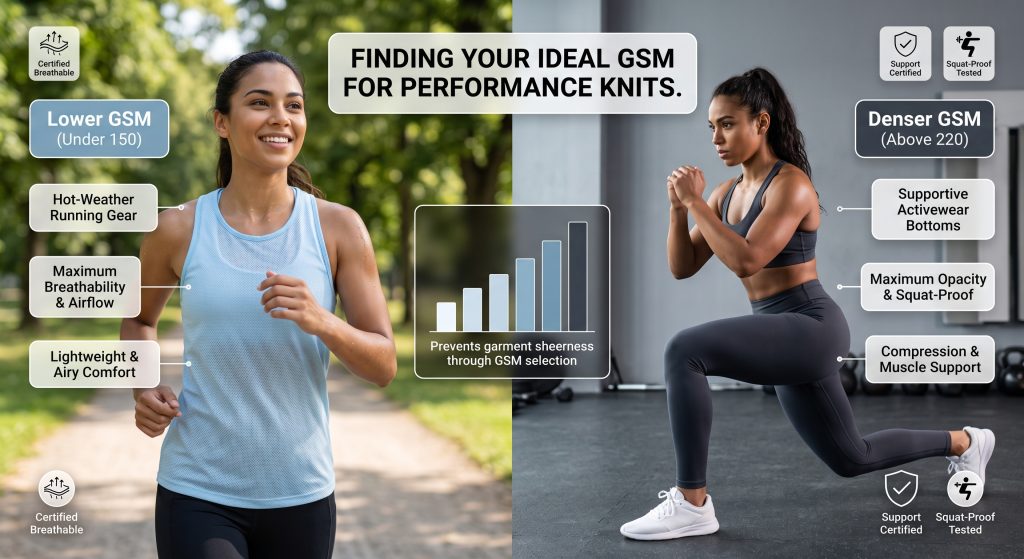
Selecting the right GSM weight for sports fabric polyester spandex knits ensures your apparel achieves the ideal balance of drape, opacity, and heat regulation. Sourcing certified sports fabric polyester spandex materials in appropriate weight classes prevents garment sheer problems. Lower GSM weights under 150 suit hot-weather running gear. Denser GSM weights above 220 suit supportive activewear bottoms.
How do low GSM fabrics perform in hot weather?
Low GSM fabrics between 110 and 150 grams per square meter provide featherweight ventilation for summer apparel. Here is the deal: light knits release body heat instantly to prevent thermal exhaustion. You keep runners cool during intense hot-weather training routines.
- 110 – 150 GSM offers ultra-light skin contact
- Thin knit depth speeds up moisture evaporation cycles
- Low mass reduces total garment weight during marathons
Key Takeaway: Low GSM textiles offer weightless cooling comfort designed for high-heat endurance activities.
Why choose high GSM fabrics for athletic leggings?
High GSM textiles between 220 and 300 grams per square meter deliver muscle support and total squat-proof opacity. Look at it this way: thin materials become translucent when stretched over hips and knees. You eliminate sheer garment failures by specifying dense heavyweight knits.
- 220 – 300 GSM provides complete non-see-through coverage
- Dense yarn packing offers gentle muscle stabilizing support
- Heavier fabric weight increases thermal insulation for winter gear
Key Takeaway: Heavy GSM weights guarantee full coverage opacity and firm shape support for compression garments.
| GSM Weight Range | Fabric Density Category | Recommended Garment Applications |
| 110 – 150 GSM | Ultra-Lightweight | Summer running vests, mesh inserts |
| 160 – 210 GSM | Medium-Weight | Training tees, tennis skirts, polo shirts |
| 220 – 300 GSM | Heavyweight / Dense | Compression tights, sports bras, leggings |
Selecting the correct GSM weight ensures activewear items meet user expectations for thermal comfort and structural opacity.
How to care for sports fabric polyester spandex garments properly?
Caring for sports fabric polyester spandex garments requires low wash temperatures and gentle drying to preserve synthetic elastane elasticity. High thermal exposure degrades spandex fibers over time causing loss of stretch memory. Washing in cold water prevents synthetic fiber breakdown. Proper laundry habits extend activewear life and keep elasticity intact.
Why is heat control critical when washing spandex?
Excessive heat breaks down molecular bonds within polyurethane elastane filaments. Think about it: hot dryer cycles cause spandex fibers to snap and lose elastic tension. You protect garment elasticity by recommending cool wash and air dry settings.
- Water temperatures below 30°C protect elastane integrity
- Tumble drying on low heat prevents thermal fiber degradation
- Air drying preserves original pattern shape and elasticity
Key Takeaway: Avoiding high washing and drying temperatures preserves elastane flexibility and garment longevity.
Why avoid fabric softeners on wicking textiles?
Fabric softeners leave a waxy silicone coating over synthetic fiber grooves. What is the real story?: waxy residues clog capillary channels and destroy moisture wicking performance. You maintain dry functional comfort by washing activewear with mild neutral detergents.
- Softener coatings plug micro-channels and stop moisture flow
- Mild liquid detergents clear sweat salts without clogging fibers
- Avoiding chlorine bleach prevents synthetic fiber yellowing
Key Takeaway: Washing activewear without fabric softeners keeps capillary wicking channels open and fully functional.
| Care Parameter | Recommended Setting | Potential Risk of Incorrect Setting |
| Wash Temperature | Cold water (20°C – 30°C) | High heat degrades elastane stretch |
| Detergent Choice | Mild neutral liquid detergent | Softener residues clog wicking channels |
| Drying Method | Line dry or low-heat tumble | High dryer heat snaps spandex filaments |
Adhering to correct care parameters preserves technical fabric performance and extends garment service life.
What factors drive sports fabric polyester spandex production costs?
Production costs for sports fabric polyester spandex are driven by raw yarn quality, elastane density, knitting gauge complexity, and functional finishing finishes. Sourcing materials from a direct sports fabric polyester spandex manufacturer removes distributor markups and stabilizes unit cost. Recycled polyester yarns carry slight eco-premiums over virgin fibers. Understanding cost drivers helps apparel buyers manage sourcing budgets effectively.
How does elastane percentage impact fabric pricing?
Elastane raw yarn costs significantly more per kilogram than standard polyester filament. Ready for the good part?: increasing spandex content from 5% to 20% increases raw material expense. You balance budget targets by selecting exact elastane ratios required for function.
- Spandex yarn carries higher market pricing than polyester
- Higher elastane density requires specialized knitting tension setups
- Dense stretch knits consume more total yarn weight per yard
Key Takeaway: Higher elastane percentages increase raw material costs but deliver superior stretch performance.
How do functional finishes affect total yardage cost?
Specialized treatments like anti-bacterial coatings and moisture management finishes add processing steps. Believe it or not: chemical finishing applications increase long-term garment value despite minor cost additions. You enhance brand appeal by investing in certified functional coatings.
- Hydrophilic chemical baths add processing material costs
- Anti-microbial silver treatments increase hygienic garment value
- Eco-friendly recycled yarn certifications carry minor supply premiums
Key Takeaway: Functional chemical treatments add nominal yardage costs while delivering significant performance advantages.
| Cost Driver | Lower Cost Option | Higher Value Option |
| Fiber Origin | Virgin Polyester Filament | Recycled GRS Polyester (rPET) |
| Elastane Content | 5% – 10% Spandex ratio | 15% – 25% Spandex ratio |
| Functional Finish | Basic mechanical wicking | Permanent anti-bacterial treatment |
Evaluating material cost drivers allows brand managers to optimize fabric specifications against price targets.
How to source sports fabric polyester spandex from top suppliers?
Sourcing sports fabric polyester spandex from top suppliers requires evaluating mill certifications, sample lead times, minimum order quantities, and batch consistency. Establishing direct supply connections with verified textile factories guarantees reliable yarn quality. You should inspect lab dip color swatches before approving bulk dye lots. Working with proven vendors protects your production schedule against delivery delays.
What textile certifications confirm supplier reliability?
International mill certifications prove chemical safety, yarn quality control, and environmental compliance. Here is the bottom line: certified textile mills guarantee fabrics pass global export safety tests. You protect your brand from chemical compliance issues in international markets.
- OEKO-TEX Standard 100 confirms freedom from harmful chemicals
- Global Recycled Standard (GRS) verifies authentic eco yarn origins
- ISO 9001 certification confirms rigorous factory quality management
Key Takeaway: Verified factory certifications provide documented proof of chemical safety and manufacturing quality.
How to test sample swatches before placing bulk orders?
Testing pre-production swatches allows buyers to verify hand feel, stretch recovery, and color accuracy in person. Look at it this way: inspecting physical yardage prevents costly mistakes before cutting thousands of garments. You lock in quality standards prior to mass garment assembly.
- Request sample yardage to test sewing machine performance
- Conduct in-house wash tests to verify shrinkage and colorfastness
- Compare lab dips against pantone references under standard light
Key Takeaway: Rigorous swatch testing protocols protect garment brands from bulk manufacturing defects and material failures.
| Sourcing Stage | Critical Action Step | Expected Business Outcome |
| Mill Audit | Verify OEKO-TEX and GRS credentials | Regulatory compliance assured |
| Swatch Approval | Test sample wash and stretch limits | Bulk defect risks eliminated |
| Production Tracking | Check batch-to-batch color lot consistency | Uniform garment appearance across runs |
Implementing structured supplier qualification steps guarantees stable activewear manufacturing and reliable delivery.
Final Recommendations for Your Activewear Sourcing
Selecting the ideal sports fabric polyester spandex blend determines your active apparel line’s stretch, breathability, and long-term durability. By understanding how fiber ratios, GSM weights, and knit structures impact athletic performance, apparel brands can select textiles tailored to specific sporting disciplines. Our factory manufactures technical polyester, nylon, and spandex fabrics engineered for rapid moisture wicking, superior four-way elasticity, and lasting shape retention. Whether you require dense squat-proof knits for leggings or lightweight breathable mesh for running tees, feel free to contact us today to request custom fabric sample swatches and bulk wholesale quotes. We remain dedicated to supporting global athletic wear brands with high-precision technical textiles built for athletic excellence.
Frequently Asked Questions
Q1: Can I use sports fabric polyester spandex for sublimation printing?
Yes, sports fabric polyester spandex is ideal for sublimation printing because polyester fibers absorb disperse dyes permanently under heat. The sublimated inks bond directly with the synthetic filaments without fading, cracking, or blocking fabric breathability.
Q2: What’s the best polyester spandex blend ratio for athletic leggings?
An 80% polyester and 20% spandex blend is the top choice for athletic leggings. This fiber ratio provides high four-way stretch, supportive muscle compression, and reliable squat-proof opacity during deep flex movements.
Q3: How do I know if sports fabric polyester spandex will shrink after washing?
You can verify fabric shrinkage by reviewing certified lab test reports or conducting a standardized 30°C wash test on sample swatches. Quality heat-set polyester spandex textiles exhibit less than 3% dimensional change after repeated washing.
Q4: Can sports fabric polyester spandex be made from recycled yarns?
Yes, sports fabric polyester spandex can be produced using GRS-certified recycled polyester (rPET) derived from post-consumer plastic bottles. Recycled polyester offers the exact same tensile strength, wicking speed, and dye affinity as virgin polyester fibers.
Q5: What’s the best way to clean high-spandex activewear without damaging elasticity?
Wash high-spandex sportswear in cold water using a mild liquid detergent and tumble dry on low heat or line dry. Avoid using fabric softeners or hot dryer settings because excess heat and silicone residues degrade elastane elasticity over time.