
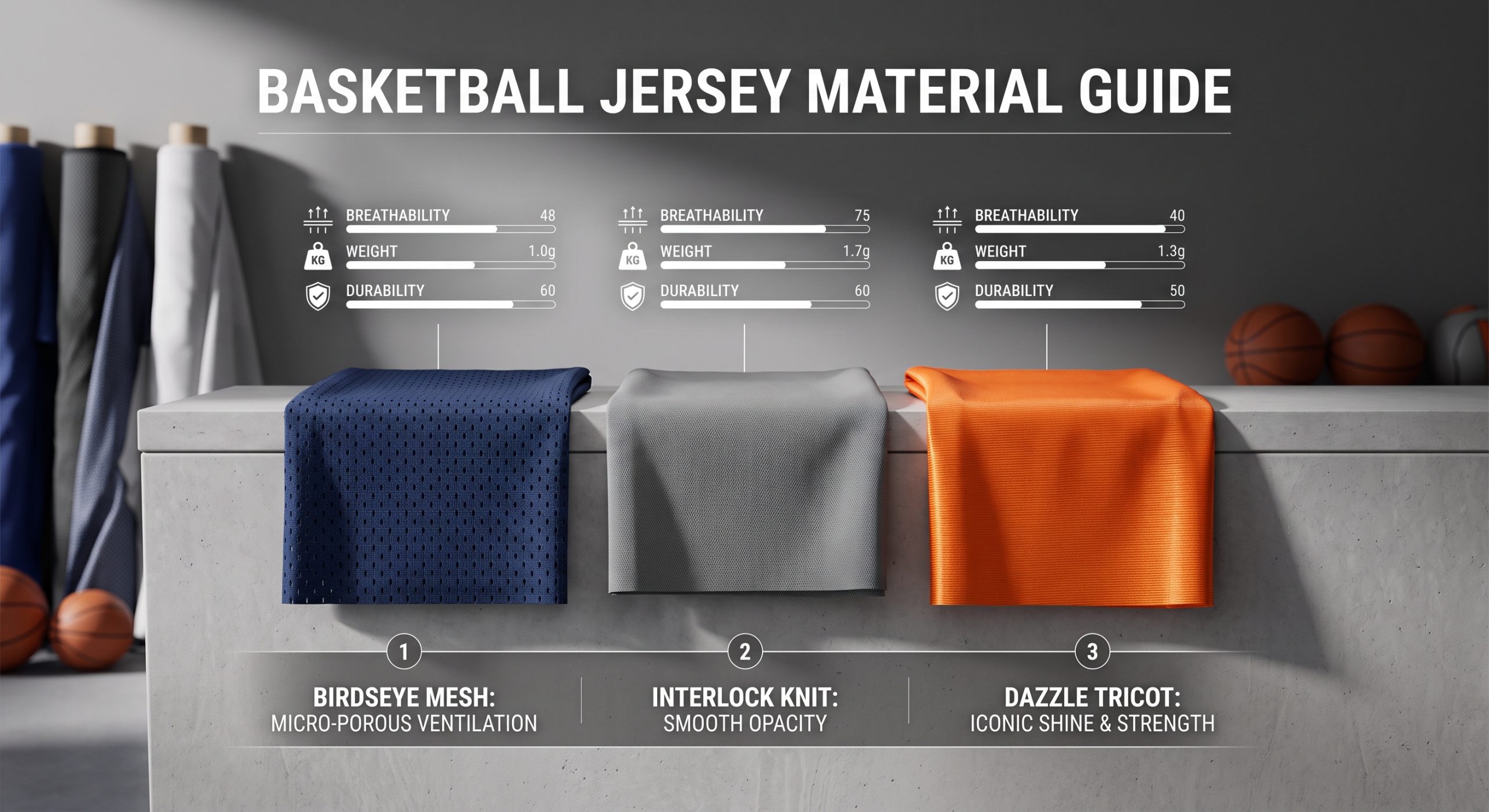
Synthetic polyester knits such as birdseye mesh, flatback mesh, interlock, and dazzle tricot represent the premier fabric choices for athletic basketball uniforms. Imagine launching a new uniform collection only to receive angry complaints from athletic directors about heavy, sweat-soaked jerseys clinging to players during high-stakes games. Soaked garments drag down player velocity and ruin brand reputation among institutional buyers. Sourcing engineered technical textiles solves these performance defects through advanced moisture transport and lightweight durability. Selecting the right basketball jersey material empowers activewear manufacturers to deliver high-performance team wear that excels on court.
1. What Is Primary Basketball Jersey Material Used Today?
Synthetic polyester mesh, interlock double knits, and dazzle tricot form the primary basketball jersey material options in modern sportswear manufacturing. Activewear buyers need fabrics that stretch during quick lateral drives without tearing or losing structural shape. Here is the deal. Synthetic knitted weaves offer superior elastic recovery compared to rigid woven textiles. Sourcing durable synthetic knits guarantees your uniform catalog meets strict league performance standards.
What synthetic polymers form core jersey textiles?
Polyester filaments absorb minimal liquid, forcing sweat toward outer surfaces for rapid air evaporation. This physical property prevents team garments from growing heavy during long athletic tournaments.
- Hydrophobic synthetic fibers reject liquid retention during intense sweat loads.
- High tensile filament strength prevents fabric tearing during physical contact.
- Polyester threads hold vibrant sublimation dye colors through repeated wash cycles.
Think about it. Synthetic yarns outperform natural fibers across every major athletic metric.
Do cotton blends perform during dynamic basketball play?
Pure cotton retains up to twenty times its weight in water, trapping liquid inside garment fibers. Heavy damp apparel causes skin chafing while restricting fast player motion across the court.
- Cotton fibers retain liquid, causing garments to sag and cling.
- Synthetic polyester releases thermal heat quickly to keep players cool.
- Professional sports lines avoid heavy natural fibers for competitive play.
Key Takeaway: Specifying 100% synthetic polyester knits prevents heavy moisture accumulation and preserves player agility on court.
| Fiber Material | Water Retention Rate | Drying Speed | Athletic Suitability |
| Synthetic Polyester | Under 1% Weight | Rapid Air Drying | Competitive Sports |
| Natural Cotton Fiber | Up to 2000% Weight | Slow Liquid Retention | Casual Lifestyle Wear |
Comparing liquid retention rates clarifies why synthetic polymers remain the preferred choice for sportswear manufacturers.
2. Why Is Birdseye Mesh Top Basketball Jersey Material?
Micro-perforated eyelet patterns make birdseye mesh a top basketball jersey material choice because pinhole openings drive constant body cooling. Players produce massive thermal energy during full-court games, requiring constant ventilation to maintain physical comfort. Look. Integrating micro-perforated knitted fabrics into team catalogs gives athletes instant cooling relief without compromising garment strength. Birdseye knits channel heat away while maintaining high tear resistance under physical defense.
How do micro perforations maximize athletic ventilation?
The signature birdseye pattern features tiny eyelets knitted uniformly across fabric surfaces. These miniature pinholes function like cooling vents, pulling ambient air inward while letting body heat escape.
- Geometric pinholes expand surface exposure for faster thermal exchange.
- Ultra-light 140-160 GSM weight keeps total apparel weight low.
- Smooth knitted backing prevents friction against athlete skin.
What is the kicker? Continuous airflow prevents heat buildup during high-intensity games.
Why does birdseye mesh speed up evaporative sweat drying?
Birdseye mesh dries rapidly because liquid spreads across its porous surface structure. Sweat evaporates before pooling into heavy damp patches that pull jerseys downward.
- Micro-channels disperse sweat droplets across wider surface areas.
- Porous knitted holes permit direct airflow through garment layers.
- Lightweight construction prevents jersey sticking during peak physical action.
Key Takeaway: Birdseye mesh provides maximum airflow and rapid heat dissipation for high-intensity athletic competition.
| Mesh Fabric Type | Pinhole Density | Airflow Permeability | Recommended Application |
| Birdseye Knit Mesh | Micro-Eyelet Pattern | High Ventilation Flow | Game Jerseys & Shorts |
| Standard Tricot Mesh | Medium Open Holes | Moderate Air Movement | Practice Scrimmage Vests |
Analyzing air permeability metrics proves why micro-pinhole mesh delivers ventilation for active team uniforms.
3. How Does Pique Compare as Basketball Jersey Material?
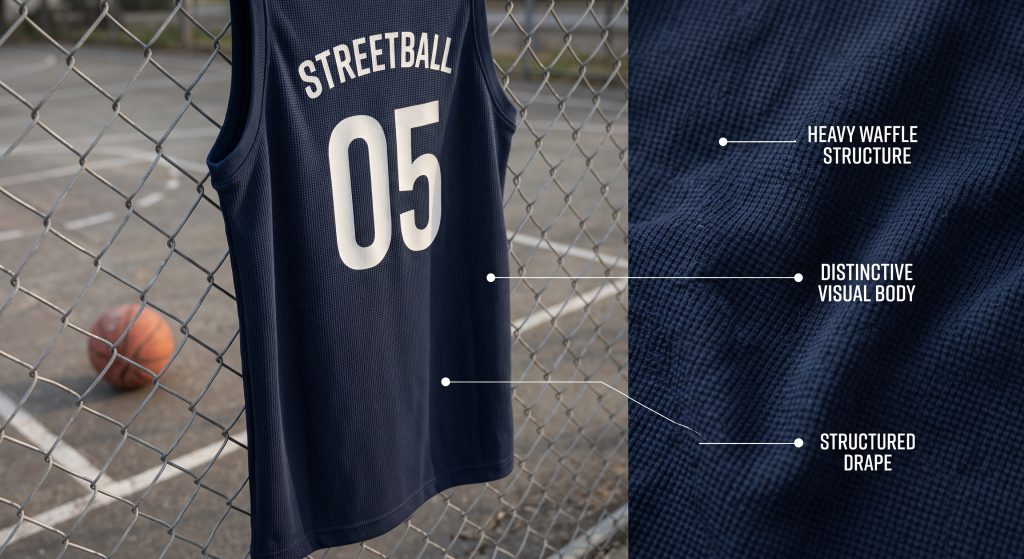
Pique knit provides a heavier waffle structure that creates distinctive visual body, making it a rugged alternative basketball jersey material for travel gear and casual team wear. Outdoor street basketball and coaching apparel require textiles that withstand rough contact while maintaining clean structural lines. Truth is. Selecting pique-structured fabrics allows uniform brands to offer robust, stylish athletic garments. Pique knit delivers excellent drape while maintaining moderate breathability through raised waffle patterns.
How does honeycomb weave build heavy structure?
Pique fabric displays a distinct waffle pattern that builds raised texture across garment surfaces. This geometric construction gives activewear a firm hand-feel and substantial weight that resists surface snagging.
- Raised waffle knits resist surface abrasion against rough outdoor equipment.
- Heavier weight ranges (180-220 GSM) ensure complete fabric opacity.
- Distinctive visual depth lifts basic athletic apparel into premium clothing.
Ready for the good part? Synthetic pique blends merge stylish structure with technical performance.
Can textured pique fabric handle intense court sweat load?
Pique knits absorb sweat effectively, though their thicker structure retains moisture slightly longer than open mesh. Combining synthetic polyester filaments into pique weaves accelerates drying speed while preserving that classic textured feel.
- Synthetic pique blends dry significantly faster than pure cotton knits.
- Raised surface contact points minimize fabric sticking against sweaty skin.
- High structural stability prevents collar curl and garment distortion.
Key Takeaway: Pique fabric provides exceptional structural strength and styled aesthetics for team polos and street basketball collections.
| Structural Feature | Pique Knit Weave | Birdseye Mesh Knit |
| Surface Geometry | Raised Honeycomb Waffle | Flat with Micro-Eyelets |
| Typical Fabric Weight | 180 – 220 GSM | 130 – 160 GSM |
| Primary End Use | Coaching Polos & Travel Gear | Competitive Game Uniforms |
Reviewing structural parameters helps apparel buyers assign pique knits to appropriate lifestyle sportswear categories.
4. How Does Flatback Mesh Rank in Basketball Jersey Material?
Flatback mesh ranks at the top of custom uniform options because its flat exterior face holds detailed sublimation artwork while its porous backing vents heat. Custom team uniforms rely heavily on full sublimation printing to apply vibrant numbers, sponsor logos, and graphics. Here is the secret. Evaluating modern basketball jersey material options requires looking at print surface smoothness alongside wearing breathability. Flatback mesh combines a flat exterior face with an internal mesh grid.
How does smooth outer face improve sublimation print clarity?
A flat knit exterior provides an even canvas for dye heat transfer printing. Colors appear sharper and lines stay cleaner compared to printing over textured open hole meshes.
- Smooth surface prevents dye bleeding during high-temperature print cycles.
- Dense face fibers hold crisp vector detail for team sponsor logos.
- Flat face finish reduces reflection glare under bright arena lights.
Pay attention. Sharp sublimation printing lifts custom team apparel quality.
Why do inner mesh loops increase player wearing comfort?
The interior side of flatback mesh features tiny knitted loops that lift fabric off sweaty skin. This dual-layer design creates small air pockets that speed up moisture transfer away from body zones.
- Internal mesh grid reduces skin contact area to limit friction.
- Dual-layer construction absorbs sweat quickly from body surfaces.
- Balanced 150-170 GSM weight provides smooth drape and durability.
Key Takeaway: Flatback mesh offers the ideal balance of high-definition print quality and internal cooling comfort for customized team jerseys.
| Metric Category | Flatback Mesh Textile | Standard Open Mesh |
| Exterior Smoothness | High Flat Surface | Porous Eyelet Surface |
| Print Detail Holding | Superior Vector Clarity | Moderate Graphic Detail |
| Interior Texture | Micro-Loop Air Grid | Standard Flat Backing |
Studying print surface characteristics confirms why flatback mesh remains a favorite for customized team uniform orders.
5. Is Dazzle Tricot Iconic in Basketball Jersey Material?
Dazzle tricot remains an iconic basketball jersey material because its high-gloss sheen and firm warp-knit construction define classic athletic aesthetic. Retro jersey collections and game shorts often incorporate high-gloss fabrics for visual flair. You might wonder. Can lustrous finishes perform well during high-impact sports action? Specifying specialized fabrics like dazzle tricot guarantees high tensile tear resistance alongside a classic shiny appearance.
Why does glossy tricot weave dominate retro court uniforms?
Flat shiny filament yarns create a smooth mirror-like surface that catches indoor stadium lighting. This distinctive shine defined basketball fashion during past eras and continues to drive retro athletic trends today.
- High-luster polyester filaments deliver eye-catching visual sheen on court.
- Dense warp-knit construction produces a heavy structured drape.
- Bold color vibrancy stands out clearly during televised athletic events.
That is not all. Dazzle tricot adds timeless visual appeal to athletic shorts and side panel accents.
How does warp knit structure resist heavy surface abrasion?
Warp knitting interlocks yarn loops vertically, forming a tight grid that resists snagging against fingernails or equipment. This structural stability prevents runs or tears when players collide during aggressive defensive plays.
- Interlocked vertical loops stop fabric runs if surface threads snag.
- Stiff structure holds crisp side-panel shapes on basketball shorts.
- High abrasion resistance protects garments against floor slides.
Key Takeaway: Dazzle tricot provides retro shiny styling and high tear resistance for classic team shorts and uniform side panels.
| Textile Attribute | Dazzle Tricot Fabric | Flat Knit Polyester |
| Luster Rating | High Surface Gloss | Flat Matte Finish |
| Structural Density | Dense Warp-Knit | Standard Circular Knit |
| Tear Resistance | Superior Vertical Grid | Moderate Multidirectional |
Evaluating warp-knit parameters demonstrates how dazzle tricot maintains structural toughness while providing visual gloss.
6. How Does Interlock Rank as Basketball Jersey Material?
Interlock double-knit fabric ranks as the smoothest basketball jersey material option, offering dual-sided softness and non-transparent coverage for elite activewear. High-end compression undershirts and premium reversible jerseys require fabrics that feel silky against skin while blocking light transmission. Think about it. Quality activewear fabrics must balance weight density with skin comfort. Interlock knits utilize two sets of needles to create a smooth, dense textile structure.
How does double knit interlock provide total fabric opacity?
Interlock knitting constructs two overlapping fabric layers simultaneously, eliminating visible gaps between yarn loops. This thick construction ensures white or light-colored jerseys remain non-transparent even when soaked with sweat.
- Double-knit density prevents fabric transparency during heavy sweating.
- Smooth surface texture accepts high-resolution heat transfer labels.
- Natural stretch elasticity moves comfortably without adding elastane fibers.
What is the kicker? Interlock double knits deliver thick coverage for premium athletic collections.
Why does smooth double face reduce skin chafing on court?
Interlock fabric presents an identical smooth face on both interior and exterior sides, eliminating rough interior loops that rub against skin. This silky tactile feel makes interlock ideal for tight-fitting activewear and base layers.
- Dual smooth faces eliminate friction against sensitive body zones.
- Tight knit structure resists surface pilling after repeated laundry cycles.
- Durable construction holds garment shape through intense athletic seasons.
Key Takeaway: Interlock double knits deliver complete fabric opacity and silky skin comfort for premium basketball apparel lines.
| Fabric Parameter | Double Interlock Knit | Single Jersey Knit |
| Construction Layers | Two Interlocked Sides | Single Knit Surface |
| Opacity Level | Complete Full Coverage | Moderate Light Transmission |
| Skin Touch | Dual Smooth Surfaces | Single Smooth Exterior |
Inspecting double-knit parameters proves why interlock remains the top recommendation for non-transparent team garments.
7. What GSM Defines Quality Basketball Jersey Material?
A fabric density between 140 GSM and 170 GSM defines quality basketball jersey material by balancing lightweight speed with full visual opacity. Choosing an incorrect fabric density causes basketball apparel to feel either paper-thin and flimsy or excessively heavy and hot. Pay attention. Specifying exact fabric weight parameters for your product catalog guarantees appropriate material thickness for target athletic activities.
What GSM density balances light weight with visual opacity?
Fabric weights in the 140 to 170 GSM range deliver structural coverage while preserving high breathability. Materials lighter than 130 GSM risk becoming sheer under bright stadium lights when soaked with sweat.
- 130-145 GSM: Ultra-light mesh for speed jerseys and summer practice wear.
- 150-170 GSM: Standard game weight offering complete opacity and strength.
- 180-220 GSM: Heavyweight knits for casual fan jerseys and warmups.
Look. Matching fabric weight to specific player demands avoids sheerness complaints.
How do heavy weight fabrics support streetwear apparel lines?
Heavyweight fabrics above 200 GSM provide a structured, boxy drape favored in lifestyle fan gear and streetwear collections. These substantial textiles hold crisp garment lines and offer long-lasting durability for daily casual wear.
- Heavy GSM knits deliver a premium tactile feel and structured drape.
- High fiber density offers added warmth during outdoor sports sessions.
- Tough construction withstands frequent washing without losing shape.
Key Takeaway: Target 150-170 GSM for light game uniforms, and choose 180-220 GSM for heavy lifestyle basketball streetwear.
| Weight Range | Air Flow Level | Sheer Resistance | Best Apparel Purpose |
| 130 – 145 GSM | Maximum Flow | Moderate Sheerness | Summer Practice Singlets |
| 150 – 170 GSM | Balanced Flow | Full Opacity Cover | Official Team Game Apparel |
| 180 – 220 GSM | Low Air Flow | Complete Coverage | Streetwear & Fan Jerseys |
Establishing weight benchmarks helps garment buyers match fabric specs with intended end-use applications.
8. Which Recycled Yarn Works for Basketball Jersey Material?
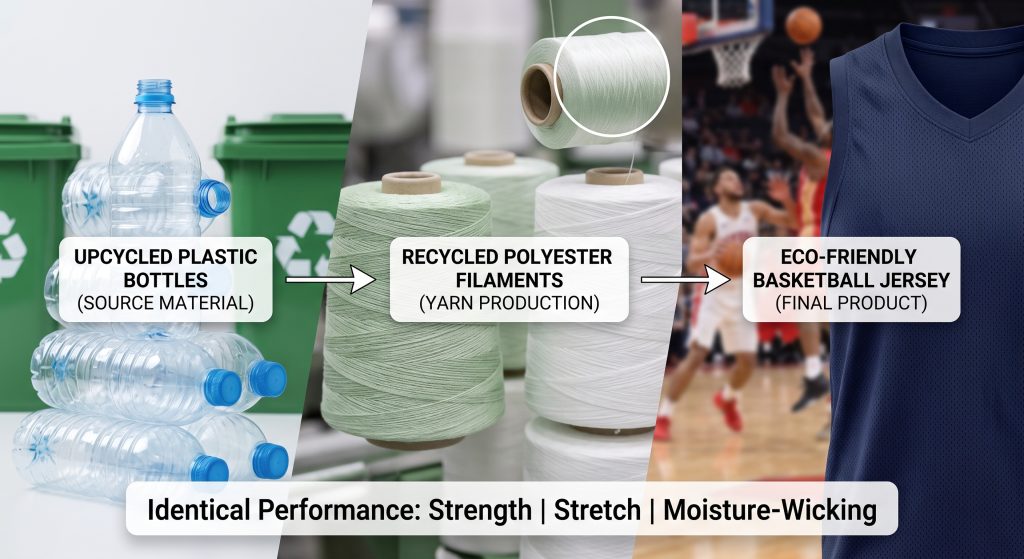
Recycled polyester filaments from upcycled plastic bottles serve as the premier eco-friendly basketball jersey material choice for sustainable sports lines. Global sports brands face rising buyer demand for eco-conscious products that lower carbon emissions without compromising physical athletic performance. Ready for the good part? Integrating sustainable synthetic fabrics into product lines allows apparel companies to fulfill corporate environmental targets cleanly. Recycled polyester offers identical strength, stretch, and moisture-wicking capabilities as virgin synthetic fibers.
Can recycled polyester filaments match virgin yarn strength?
Mechanical recycling processes purify post-consumer plastic waste into clean polymer chips that spin into high-tenacity filament yarns. These sustainable threads match virgin polyester across tensile strength, color absorption, and moisture management tests.
- Recycled polyester diverts plastic bottle waste from oceans and landfills.
- Manufacturing recycled filaments consumes less energy than virgin synthesis.
- Certified eco knits appeal directly to environmentally conscious sports teams.
Truth is. Eco-certified yarns deliver professional athletic performance while reducing environmental impact.
How does sustainable sourcing build global apparel brand value?
Presenting verified eco-certifications establishes trust with commercial retail buyers and school athletic directors. Sourcing certified sustainable textiles allows sportswear brands to differentiate their catalogs in competitive bidding processes.
- Global Recycled Standard certification validates authentic green supply chains.
- Sustainable materials give activewear brands a compelling marketing story.
- Eco-friendly products attract loyal institutional buyers seeking green gear.
Key Takeaway: Recycled polyester delivers top-tier athletic performance while helping your activewear brand meet sustainability goals.
| Fiber Origin | Carbon Emissions Impact | Physical Performance |
| Recycled Polyester | Low Environmental Impact | Matches Virgin Standards |
| Virgin Polyester | Standard Baseline Impact | Baseline Athletic Metric |
Comparing environmental impact metrics demonstrates how recycled polyester matches traditional synthetic performance benchmarks.
9. How Do Buyers Test Basketball Jersey Material Quality?
Professional buyers verify basketball jersey material quality by requesting lab test reports for color fastness, seam tensile strength, and dimensional wash shrinkage. Unverified textile batches risk color bleeding under sweat exposure, shrinking during wash cycles, or tearing during physical play. What is the kicker? Requesting lab verification on performance textiles protects your clothing brand against costly bulk manufacturing defects.
Which lab tests confirm color fastness and wash stability?
Color fastness testing measures how securely dye remains bound inside synthetic fibers under washing, sweat contact, and light exposure. Demanding Grade 4.0 fastness ensures bright uniform colors will not bleed onto white accents during laundry.
- Wash fastness tests prevent color bleeding during repeated team washings.
- Perspiration fastness tests verify color stability against acidic athlete sweat.
- Rubbing fastness tests confirm dye durability against physical friction.
Here is the deal. Certified lab tests protect clothing brands against unexpected quality failures.
How to verify roll shrinkage limits before bulk garment sewing?
Standardized wash testing measures fabric dimensional stability to confirm garments retain accurate size specs post-washing. Checking stretch recovery percentages ensures waistbands and necklines remain snug after full season use.
- Dimensional stability testing keeps team sizing consistent after laundering.
- Stretch recovery testing prevents neckband bagging after heavy pull stress.
- Abrasion resistance testing confirms fabric surfaces resist pilling.
Key Takeaway: Demanding certified laboratory test results for color fastness and shrinkage prevents expensive bulk textile rejections.
| Lab Performance Test | Target Quality Grade | International Test Standard |
| Washing Color Fastness | Grade 4.0 Minimum Rating | ISO 105-C06 Standard |
| Washing Shrinkage Limit | Under 3.0% Dimensional Change | ISO 6330 Standard |
| Surface Pilling Grade | Grade 4.0 (No Fuzzing) | ISO 12945-2 Standard |
Reviewing lab test standards equips procurement managers to verify bulk fabric quality before signing production orders.
10. Which Choice Secures Good Basketball Jersey Material?
Securing good basketball jersey material requires matching specific athletic demands like breathability, printability, and fabric weight directly with your garment design goals. High-intensity competitive game jerseys require lightweight micro-porous meshes like birdseye or flatback mesh, while lifestyle collections benefit from structured pique or dazzle knits. That is not all. Aligning your textile selection with specific player needs creates high-value garments that stand out in competitive retail markets.
How to choose between birdseye mesh and structured pique?
Choose birdseye mesh when your uniform line prioritizes high-speed athletic cooling, rapid drying, and minimal weight. Select pique fabric when designing structured coaching polos, fan apparel, or heavy-duty warmups.
- Birdseye mesh: Optimal for game jerseys, shorts, and intense practice singlets.
- Pique knit: Ideal for coaching polos, travel gear, and casual athletic tops.
- Hybrid garments: Utilize birdseye mesh for underarm breathability inserts in pique garments.
Think about it. Smart fabric selection aligns material properties with actual player movement demands.
What procurement steps ensure steady mill textile supply?
Establishing clear technical specifications with your fabric mill eliminates quality variations between sample yardage and bulk production rolls. Direct factory partnerships give you access to custom dyeing, custom GSM targets, and dependable delivery schedules.
- Clear technical spec sheets prevent roll-to-roll weight variations.
- Direct factory communication guarantees precise Pantone color matching.
- Long-term supplier agreements protect bulk fabric pricing during peak seasons.
Key Takeaway: Matching birdseye mesh to game uniforms and pique knits to lifestyle activewear maximizes garment performance and client satisfaction.
| Decision Factor | Birdseye Mesh Selection | Pique Knit Selection |
| Core Design Purpose | Maximum Airflow & Speed | Structure & Style Drape |
| Surface Texture Profile | Silky Smooth Eyelet Grid | Raised Honeycomb Surface |
| Target Apparel Item | Official Game Uniforms | Coaching Polos & Streetwear |
Summarizing key selection factors helps garment buyers choose the perfect fabric structure for every basketball apparel line.
Strategic Procurement Advice for Activewear Brands
Selecting among birdseye mesh, flatback mesh, interlock double knits, dazzle tricot, and structured pique determines your basketball apparel line’s market success. We addressed your textile procurement challenges by breaking down knit structures, breathability mechanics, GSM weights, and laboratory testing standards. Our manufacturing mill produces custom-engineered technical fabrics crafted specifically for high-performance activewear brands across global markets. Partner with our mill to upgrade your team uniform catalogs with certified athletic textiles. To request fabric swatch books, lab test reports, or wholesale roll pricing for your activewear brand, contact us today.
Frequently Asked Questions
Q1: Can I use pique knit fabric for competitive basketball game jerseys?
No, pique knit is not recommended for intense game jerseys because its heavier waffle construction retains moisture longer than lightweight micro-mesh.
Q2: What’s the best basketball jersey material for full sublimation printing?
Flatback mesh is the optimal choice for sublimation printing because its smooth outer face holds crisp vector graphics while its inner mesh grid maintains breathability.
Q3: How do I know if recycled polyester matches virgin synthetic fabric quality?
Recycled polyester matches virgin quality because recycled polymer chips are refined to meet identical fiber strength and moisture-wicking standards.
Q4: Can I customize fabric GSM weight and colors for my wholesale apparel line?
Yes, direct mill sourcing allows you to specify custom GSM weights, custom Pantone color dyeing, and specialized surface finishes for your orders.
Q5: What’s the best way to prevent fabric shrinkage in custom team uniforms?
Pre-shrunk synthetic knits with certified lab test reports showing under three percent dimensional change keep garments true to size after laundry.