
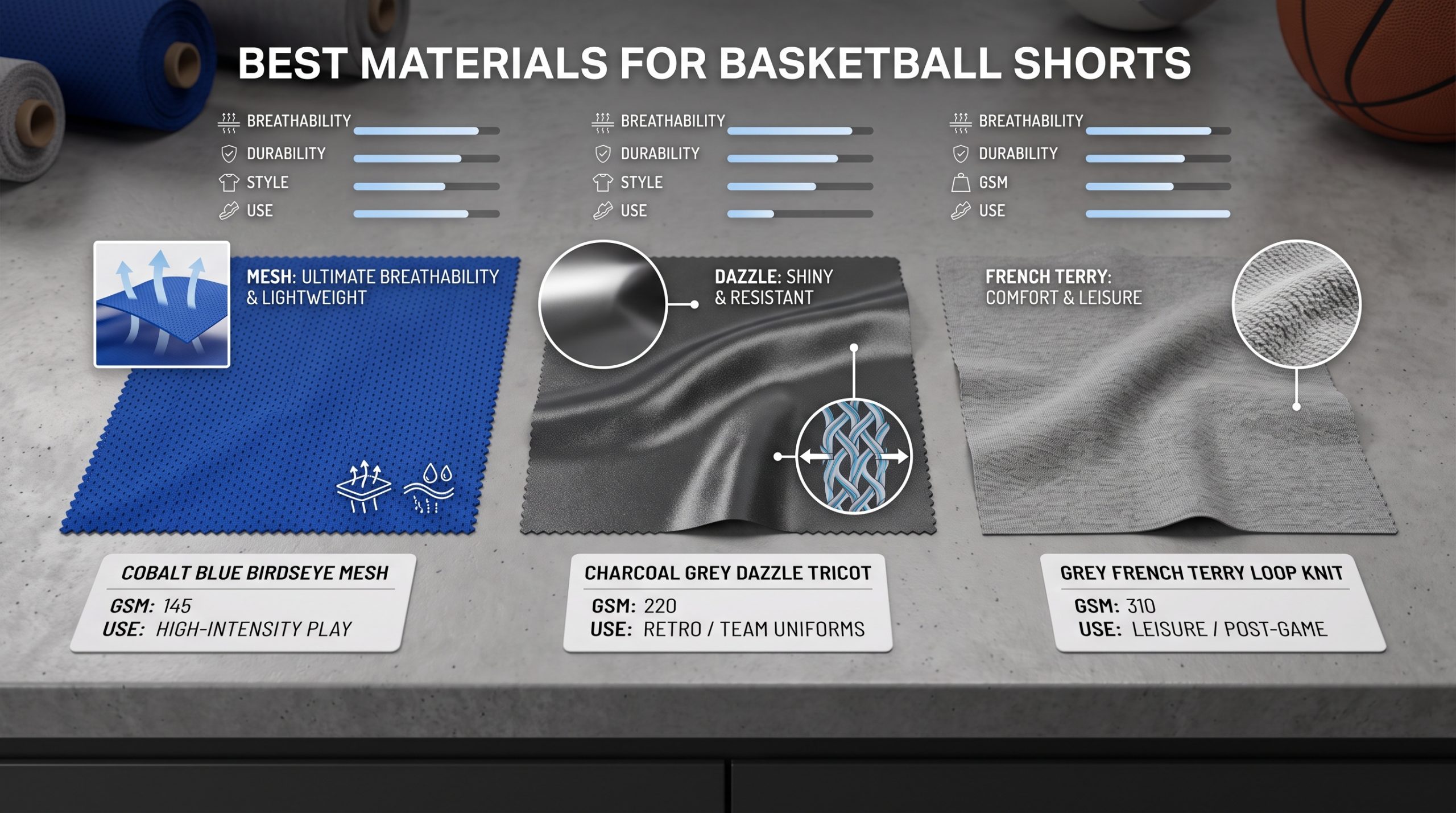
Synthetic polyester double-layer mesh, high-density dazzle tricot, and flexible polyester-spandex blends represent the finest fabric selections for basketball shorts. Picture a championship basketball game where players push through intense fourth-quarter action under heavy stadium lighting. Player uniforms become heavy, wet rags that cling to thighs and restrict swift lateral moves on defense when manufactured with inferior materials. Brands face constant customer complaints, product returns, and lost sales when sportswear catalogs rely on cheap textiles that sag or tear under stress. Sourcing certified performance fabrics resolves these manufacturing flaws by delivering superior moisture management, opacity, and stretch recovery. Selecting the best material for basketball shorts empowers activewear manufacturers to produce high-value athletic apparel that stands up to severe court friction.
1. What Is the Best Material for Basketball Shorts Today?
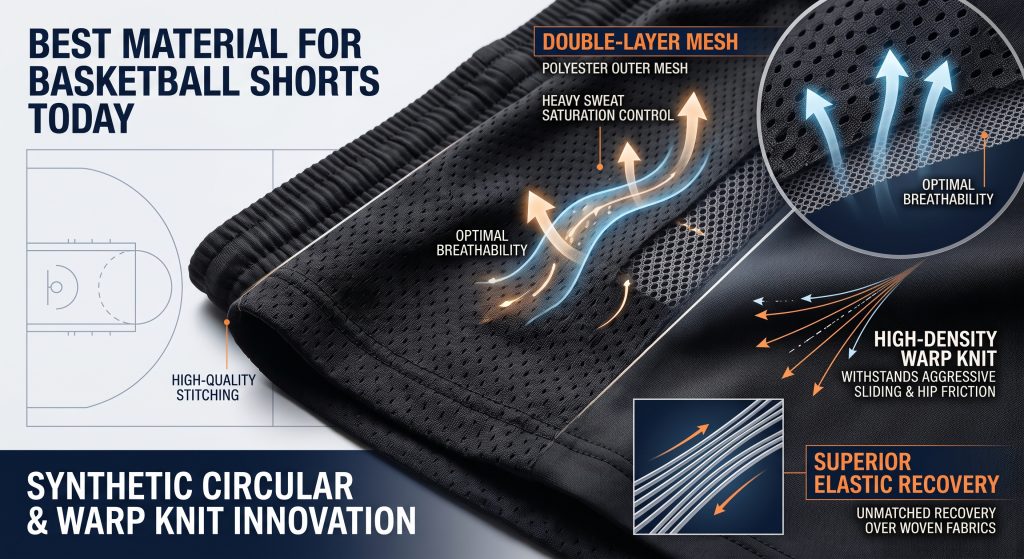
Double-layer polyester mesh and high-density warp-knits represent the industry standard when choosing the best material for basketball shorts. Activewear buyers need textiles that withstand aggressive sliding, hip friction, and heavy sweat saturation without tearing. Here is the deal. Synthetic circular and warp knits offer significantly greater elastic recovery than rigid woven fabrics.
How do synthetic knits compare against woven fabrics?
Knitted synthetic textiles expand smoothly along body contours during explosive jumping and lunging maneuvers. Woven materials lack multidirectional elasticity, causing garments to restrict thigh extension during intense athletic plays.
- Knitted loops absorb physical tension without ripping along stress seams.
- Hydrophobic polyester threads push liquid outward for rapid surface evaporation.
- Synthetic polymers resist permanent wrinkling through demanding tournament travel.
Why does double-layer mesh dominate team shorts?
Double-layer mesh construction prevents garment transparency while allowing continuous airflow between fabric layers. Think about it. Single-layer fabrics often turn sheer under bright arena lights when soaked with sweat. Outer mesh layers dissipate body heat while smooth inner liners protect skin from abrasive friction.
Key Takeaway: Specifying double-layer synthetic knits guarantees total opacity, flexible multidirectional mobility, and long-lasting seam strength for competitive team shorts.
| Material Structure | Stretch Elasticity | Opacity Rating | Primary Apparel Use |
| Double-Layer Mesh | High Knitted Stretch | 100% Full Coverage | Official Team Game Shorts |
| Single Jersey Knit | Moderate Stretch | Partial When Wet | Lightweight Practice Vests |
| Rigid Woven Fabric | Low/No Elasticity | High Opacity | Non-Active Utility Shorts |
Reviewing structural performance metrics highlights why knitted synthetic fabrics remain superior for athletic movement.
2. Why Is Birdseye Mesh the Best Material for Basketball Shorts?
Micro-perforated birdseye mesh serves as the best material for basketball shorts due to its lightweight eyelet construction that maximizes air circulation. Athletes generate intense body heat during fast-break plays, requiring instant thermal release across lower body zones. Look. Integrating micro-eyelet knitted fabrics into athletic catalogs provides players with continuous cooling without lowering fabric tear strength.
How does micro-pinhole weave maximize breathability?
Birdseye mesh features tiny geometric eyelet holes knitted uniformly across the entire textile surface. These micro-perforations function like miniature ventilation ports, drawing cool air inside while exhausting trapped thermal heat.
- Geometric pinhole patterns increase air passage by up to forty percent.
- Ultra-light 140 to 160 GSM weights prevent garment dragging during play.
- Micro-channels spread sweat across wide surface zones for quick drying.
Why does soft hand-feel prevent skin chafing?
The knitted surface of birdseye mesh undergoes fine mechanical finishing that creates an extraordinarily soft texture against raw skin. Pay attention. Continuous skin friction during forty minutes of running causes painful irritation if fabric surfaces are coarse. Birdseye mesh slides smoothly against thighs, allowing unrestricted movement without raw rubbing.
Key Takeaway: Birdseye mesh offers unmatched thermal ventilation and an ultra-soft hand-feel that protects players from sweat-induced skin chafing.
| Fabric Feature | Birdseye Micro-Mesh | Standard Open Mesh |
| Pinhole Pattern | Fine Geometric Eyelets | Large Open Holes |
| Tactile Hand-Feel | Silky and Ultra-Soft | Coarse and Textured |
| Moisture Evaporation | Rapid Surface Dispersion | Moderate Pooling |
Analyzing tactile and ventilation parameters proves why birdseye mesh delivers superior skin comfort during active competition.
3. How Does Pique Compare as Best Material for Basketball Shorts?
Pique knit provides a heavier honeycomb structure that offers exceptional shape retention, making it a distinctive option when selecting the best material for basketball shorts. Streetwear apparel lines and sideline coaching gear require fabrics that feel substantial and maintain crisp tailored lines. Truth is. Pique knits balance raised waffle textures with durable synthetic performance.
How does honeycomb weave build heavy structure?
Pique textiles feature a unique three-dimensional waffle weave that adds visual depth and physical heft to shorts. This geometric construction gives garments a firm, structured drape that holds clean silhouettes even after long wearing sessions.
- Raised waffle texture provides a classic, premium appearance for lifestyle apparel.
- Substantial weights between 180 and 230 GSM eliminate all risk of fabric sheerness.
- Thick knitted construction resists surface snagging against rough outdoor court gear.
Does pique fabric offer superior durability?
The tight interlocking threads of pique knit deliver high resistance against physical friction and surface pilling. Ready for the good part? Combining polyester filaments into pique weaves accelerates drying speed while preserving its signature textured touch.
- High thread density prevents tearing along pocket openings and side seams.
- Structured waffle loops maintain dimensional shape through repeated industrial laundering.
Key Takeaway: Pique fabric delivers heavy structural body and refined waffle aesthetics ideal for lifestyle basketball shorts and sideline apparel.
| Structural Characteristic | Pique Waffle Knit | Birdseye Eyelet Mesh |
| Surface Texture | Raised Three-Dimensional Waffle | Flat Smooth Micro-Pinhole |
| Typical Fabric Density | 180 – 230 GSM Heavy Weight | 140 – 160 GSM Light Weight |
| Primary Application | Lifestyle & Sideline Shorts | High-Speed Game Uniforms |
Comparing structural properties clarifies why pique knits are preferred for heavy lifestyle gear rather than lightweight game shorts.
4. Is Dazzle Tricot the Best Material for Basketball Shorts?
Dazzle tricot remains a celebrated choice for the best material for basketball shorts because its glossy sheen and firm warp-knit build create iconic retro game shorts. Vintage uniform styles and high-profile team gear utilize high-luster fabrics for visual impact under arena lights. You might wonder. Can glossy decorative textiles handle severe athletic stress during physical games? Dazzle tricot delivers high tensile tear resistance along with its signature reflective finish.
Why does high-gloss sheen define retro shorts?
Flat polyester filament yarns reflect direct stadium lighting to produce an unmistakable metallic surface luster. This vibrant shine established the visual identity of classic basketball uniforms and continues to drive retro sportswear trends.
- Lustrous surface finish maximizes team color vibrancy and visual contrast.
- High warp-knit density creates a stiff, dramatic garment drape on court.
- Reflective yarns retain brilliant shine through dozens of wash cycles.
How does warp-knit structure resist abrasion?
Warp knitting loops threads vertically in a dense interlocking grid that resists snagging and surface runs. That is not all. If a player slides across hardwood floors, the interlocked vertical loops prevent friction tears from spreading across garment panels.
- Vertical thread grid absorbs extreme pulling forces without seam failure.
- Dense surface construction shields players from floor burn abrasions.
Key Takeaway: Dazzle tricot supplies classic shiny aesthetics paired with exceptional vertical tear resistance for retro uniform lines.
| Performance Metric | Dazzle Warp Tricot | Standard Circular Knit |
| Surface Reflectivity | High Specular Gloss | Low Matte Finish |
| Tear Resistance | Superior Vertical Grid | Moderate Multidirectional |
| Aesthetic Style | Retro Athletic Sheen | Modern Technical Look |
Reviewing performance metrics illustrates how dazzle tricot combines vintage visual appeal with robust structural protection.
5. Is Polyester Spandex the Best Material for Basketball Shorts?
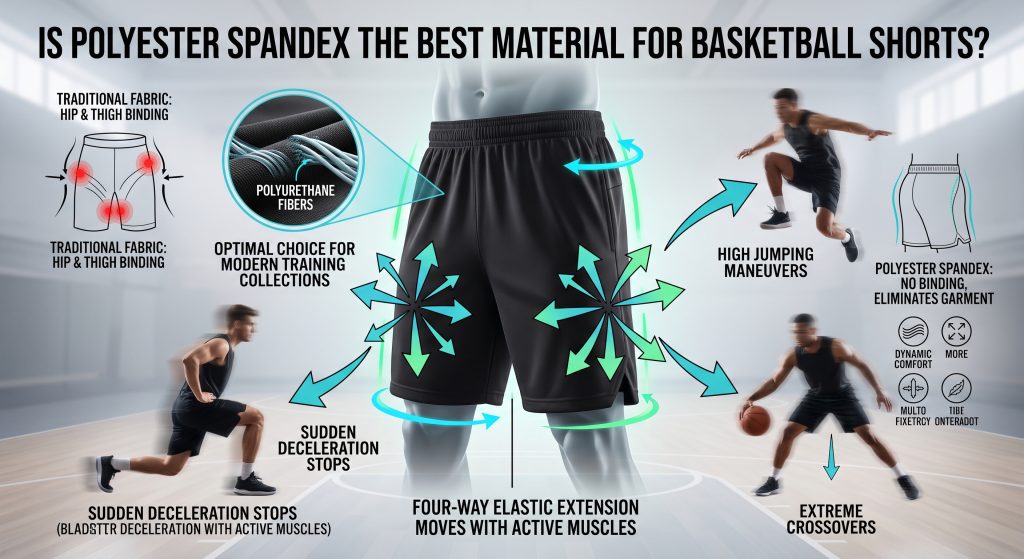
Polyester spandex blends represent the best material for basketball shorts in modern training collections due to four-way elastic extension that moves with active muscles. Fast-moving players perform extreme crossovers, sudden deceleration stops, and high jumping maneuvers that demand total freedom of movement. What is the kicker? Adding elastic polyurethane fibers into synthetic knits eliminates garment binding around hips and thighs.
How does four-way stretch support player mobility?
Four-way stretch textiles expand horizontally and vertically simultaneously, matching natural muscle expansion during sprinting. Standard rigid fabrics pull against kneecaps and quad muscles, stealing athletic power during explosive movements.
- 8% to 15% spandex content provides unrestricted leg extension.
- Immediate elastic recovery prevents baggy knees and deformed leg openings.
- Smooth synthetic surface reduces friction between overlapping garment layers.
Why does compression liner increase performance?
Modern two-in-one basketball shorts incorporate an internal polyester spandex compression short directly beneath an outer mesh shell. Think about it. Compression inner liners stabilize thigh muscles, reduce muscle vibration fatigue, and eliminate painful groin chafing.
- Integrated liners hold cell phones securely during workout training sessions.
- Moisture-wicking compression fabric pulls sweat directly off muscle zones.
Key Takeaway: Polyester spandex blends provide four-way athletic stretch and muscle-supporting compression options for elite modern training shorts.
| Blend Composition | Elasticity Range | Recovery Rate | Target Garment Type |
| 88% Poly / 12% Spandex | 4-Way High Stretch | 98% Instant Snap-Back | Compression Under-Liners |
| 95% Poly / 5% Spandex | 2-Way Moderate Stretch | 95% Shape Retention | Modern Hybrid Game Shorts |
| 100% Rigid Polyester | Mechanical Flex Only | Baseline Shape | Traditional Loose Team Shorts |
Examining spandex percentages demonstrates how elastomeric blends deliver superior athletic flex compared to rigid synthetic knits.
6. What GSM Defines the Best Material for Basketball Shorts?
A weight range between 180 GSM and 240 GSM represents the benchmark when specifying the best material for basketball shorts to ensure complete opacity and proper garment drape. Basketball shorts require substantially higher fabric density than lightweight upper jerseys to withstand body weight friction, heavy pocket contents, and waist pulling forces. Here is the deal. Selecting inappropriate fabric weight leads directly to sheer garments or excessively hot, heavy shorts.
Why do basketball shorts require higher GSM than tops?
Lower body athletic garments undergo intense bending and stretching across the buttocks and thighs that thins out lightweight textiles. Jersey tops often utilize 130 to 150 GSM materials for extreme heat release, but shorts crafted at those low weights become see-through when wet.
- 180 to 200 GSM: Ideal weight for double-layer competitive team game shorts.
- 210 to 240 GSM: Premium density for heavy retro shorts, street gear, and pockets.
- Substantial weight creates a clean vertical drape that resists riding up thighs.
How to choose between 180 GSM and 240 GSM shorts?
Selecting between medium and heavy GSM depends entirely on target player climate and retail market positioning. Pay attention. High-speed competitive players demand 180 GSM breathability, whereas fashion-focused streetwear buyers prefer 240 GSM heavy structure.
Key Takeaway: Target 180-200 GSM for agile game uniforms, and choose 210-240 GSM for heavy streetwear collections and lined shorts.
| GSM Density Range | Fabric Thickness | Opacity Protection | Ideal Market Segment |
| 140 – 160 GSM | Light Single Layer | Moderate (Needs Lining) | Lightweight Inner Liners |
| 180 – 200 GSM | Medium Double Layer | 100% Non-See-Through | Official League Game Gear |
| 210 – 240 GSM | Heavy Dense Build | Complete Structural Cover | Premium Streetwear Collections |
Studying density benchmarks enables buyers to match precise fabric weights to specific garment functional requirements.
7. Is Recycled Yarn the Best Material for Basketball Shorts?
Recycled polyester manufactured from upcycled plastic bottles serves as the best material for basketball shorts in eco-conscious activewear lines by delivering virgin-grade strength with lower carbon footprints. Global sports organizations and institutional buyers demand sustainable uniform options that reduce environmental waste. Look. Integrating certified recycled yarns into sportswear catalogs fulfills environmental sustainability goals without sacrificing physical athletic durability.
Can upcycled filament yarns match virgin strength?
Modern mechanical recycling processes melt cleaned post-consumer plastic bottles into high-purity polymer pellets before extruding fine synthetic threads. These recycled filament yarns exhibit identical tensile breaking strength, dye absorption, and moisture-wicking speeds as conventional virgin polyester.
- Recycled yarns divert plastic waste from landfills and marine ecosystems.
- Polymer extrusion consumes up to fifty percent less energy than virgin production.
- Eco-friendly threads maintain high color fastness through industrial washing.
How does sustainable sourcing build brand value?
Sourcing certified sustainable textiles allows activewear brands to win lucrative institutional contracts and corporate apparel bids. Ready for the good part? Displaying verified green certifications creates strong brand trust among environmentally aware young athletes.
- Global Recycled Standard certification verifies authentic eco-friendly supply chains.
- Green product lines command higher retail profit margins in activewear markets.
Key Takeaway: Recycled polyester delivers high-level athletic performance while establishing eco-conscious brand leadership in sportswear manufacturing.
| Fiber Origin | Energy Consumption | Tensile Yarn Strength | Environmental Impact |
| Recycled Polymer Yarns | Low Manufacturing Energy | High Virgin Match | Reduced Plastic Waste |
| Virgin Petroleum Yarns | Standard Baseline Energy | Baseline Standard | Standard Fossil Usage |
Comparing environmental parameters proves that recycled polyester delivers equal physical strength while dramatically reducing carbon emissions.
8. Does French Terry Serve as Best Material for Basketball Shorts?
French terry offers plush interior loop backing that makes it a comfortable candidate for the best material for basketball shorts in post-game travel and casual lounge collections. Off-court lifestyle apparel requires warm, absorbent textiles that feel incredibly soft against skin during rest periods. Truth is. French terry excels in casual sportswear even though it lacks the high-speed drying of technical mesh.
Why do lounge collections favor cotton-poly loops?
French terry features smooth jersey knitting on its exterior face paired with unbrushed soft yarn loops across its interior surface. This plush loop construction traps comfortable body warmth while absorbing surface moisture after intense gym workouts.
- Soft cotton-polyester loops offer cozy skin comfort during rest days.
- Heavy weight ranges (280 to 350 GSM) deliver a substantial relaxed drape.
- Cozy aesthetic appeals strongly to lifestyle streetwear consumers.
Can heavy French terry manage court moisture?
French terry absorbs sweat effectively, but its high cotton content holds liquid longer than pure synthetic mesh fabrics. You might wonder. Can players wear French terry during active competitive games? Heavier loop textiles grow heavy when soaked, making them better suited for travel wear, warmups, and casual lounging.
Key Takeaway: French terry delivers cozy interior loop comfort and substantial weight ideal for post-game travel shorts and casual lifestyle wear.
| Textile Property | French Terry Loop Knit | Synthetic Birdseye Mesh |
| Interior Structure | Soft Unbrushed Yarn Loops | Smooth Micro-Pinhole Surface |
| Drying Velocity | Moderate Moisture Absorption | Ultra-Fast Air Evaporation |
| Recommended Setting | Post-Game Travel & Lounging | On-Court Competitive Play |
Evaluating performance properties confirms why French terry is optimal for cozy travel gear rather than fast-paced court action.
9. How to Test Quality in the Best Material for Basketball Shorts?
Demanding certified laboratory test reports for waistband seam pull strength, color fastness, and wash shrinkage ensures you receive the best material for basketball shorts. Bulk textile orders that bypass laboratory testing risk severe defects like color bleeding onto white panels, seam popping, or pilling. Here is the secret. Verifying technical test data before issuing production deposits protects your activewear brand from costly product recalls.
Which lab tests confirm waistband seam strength?
Basketball shorts waistbands experience intense pulling forces when players pull drawstring cords tight or adjust garments on court. Tensile strength testing subjects fabric seams to extreme pull forces to measure the exact kilogram weight required to burst stitching.
- Tensile seam testing prevents waistband cracking under heavy pulling stress.
- Elastic recovery testing verifies waistbands return to original sizing after stretching.
- Pocket attachment strength testing prevents pocket tearing under load.
How to verify pilling resistance and wash stability?
Martindale abrasion tests rub fabric samples against abrasive surfaces for thousands of cycles to rate pilling resistance. Pay attention. Demanding Grade 4.0 pilling ratings ensures shorts resist fuzzing caused by friction against chairs and basketballs.
- ISO wash fastness testing prevents color bleeding during laundering.
- Dimensional stability tests ensure shrinkage remains below three percent.
Key Takeaway: Requiring verified lab reports for seam strength, pilling, and wash shrinkage prevents costly manufacturing defects in bulk orders.
| Laboratory Quality Test | International Standard | Target Quality Benchmark |
| Seam Tensile Strength | ISO 13935-2 Standard | > 250 Newtons Burst Resistance |
| Martindale Pilling Test | ISO 12945-2 Standard | Grade 4.0 Minimum (No Fuzzing) |
| Wash Dimensional Stability | ISO 6330 Standard | Less Than 3.0% Length Shrinkage |
Reviewing lab test benchmarks equips procurement officers to verify bulk fabric quality before approving factory production runs.
10. How to Source the Best Material for Basketball Shorts?
Sourcing the best material for basketball shorts requires matching specific athletic application demands with direct textile mill capabilities that offer custom dyeing, precise GSM weight control, and low minimum order quantities. Activewear brands must balance lightweight breathability for game uniforms with structured durability for lifestyle apparel. Think about it. Partnering directly with experienced sports fabric manufacturers secures steady wholesale roll deliveries and consistent quality across production seasons.
How to balance birdseye breathability with pique structure?
Select birdseye mesh when designing high-speed game shorts where rapid sweat evaporation and lightweight comfort are top priorities. Choose pique knits or double-layer mesh when manufacturing structured streetwear, pocketed travel shorts, or team warmups.
- Birdseye Mesh: Best for light competitive game shorts and active practice gear.
- Double-Layer Mesh: Best for official league shorts requiring 100% opacity.
- Pique Knit: Best for structured lifestyle shorts, sideline apparel, and polos.
What factory specs guarantee steady wholesale delivery?
Establishing precise technical specification sheets with your fabric mill eliminates batch-to-batch color variations and weight discrepancies. That is not all. Direct factory communication guarantees precise Pantone color matching and reliable delivery timelines during peak sports manufacturing seasons.
Key Takeaway: Aligning fabric selection with specific end-use requirements and partnering directly with custom mills guarantees high garment performance.
| Selection Criteria | Birdseye Mesh Focus | Pique Knit Focus |
| Primary Functional Goal | Maximum Ventilation & Speed | Heavy Structure & Shape |
| Surface Texture Profile | Ultra-Soft Micro-Pinhole | Raised Honeycomb Waffle |
| Ideal Garment Line | Competitive Team Game Gear | Lifestyle Gear & Warmups |
Summarizing core selection parameters helps apparel buyers choose optimal fabric structures for every activewear line.
Strategic Procurement Advice for Activewear Brands
Selecting among double-layer birdseye mesh, high-density dazzle tricot, flexible polyester spandex, and structured pique knits determines the commercial success of your basketball shorts collection. We addressed your textile manufacturing challenges by providing technical comparisons of knit structures, breathability mechanics, GSM densities, and laboratory quality testing standards. Our manufacturing mill produces custom-engineered technical textiles crafted specifically for global high-performance activewear brands. Partner with our team to upgrade your athletic uniform catalogs with certified sports fabrics. To request fabric swatch books, certified laboratory test reports, or wholesale roll pricing for your brand, contact us today.
Frequently Asked Questions
Q1: Can I use single-layer birdseye mesh for white basketball game shorts? No, single-layer white mesh becomes translucent when soaked with sweat, so double-layer construction or an internal liner is required for full opacity.
Q2: What’s the best GSM weight for high-performance team basketball shorts? A density between 180 GSM and 200 GSM provides the ideal balance of complete opacity, vertical drape, and breathability for competitive team shorts.
Q3: How do I know if recycled polyester performs as well as virgin polyester? Certified recycled polyester exhibits identical tensile strength, moisture-wicking speed, and color fastness because recycled polymer pellets match virgin filament specs.
Q4: Can I order custom Pantone colors and specific GSM weights from your mill? Yes, direct factory sourcing enables you to specify custom Pantone color dyeing, custom GSM weights, and specialized moisture-wicking finishes for your wholesale orders.
Q5: What’s the best material for retro-styled basketball shorts with high shine? Dazzle tricot is the ideal choice for retro shorts because its warp-knit build reflects stadium lights while providing high vertical tear resistance.