
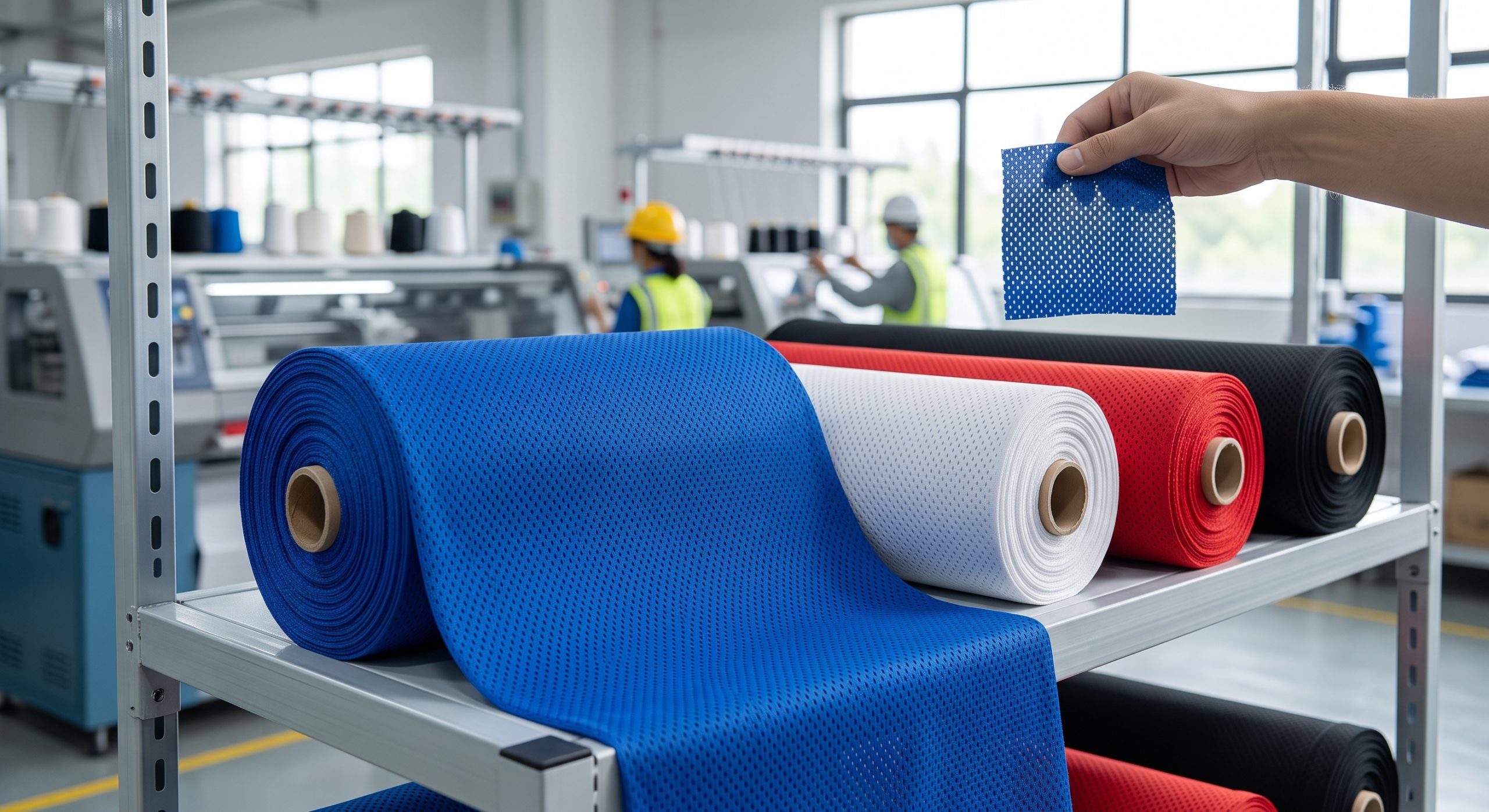
The best basketball jersey cloth combines lightweight synthetic polyester filaments with high-porosity knitted architectures for rapid sweat evaporation. Sourcing athletic apparel fabrics often leaves production managers dealing with heavy sweat retention and premature garment tearing during intense game seasons. Poor yarn selection ruins player endurance on the court while driving up costly customer returns for your sportswear brand. Selecting engineered basketball jersey cloth provides the balance of tear resistance and moisture dissipation needed for pro-level team kits.
1. What Makes Basketball Jersey Cloth Perform on Court?
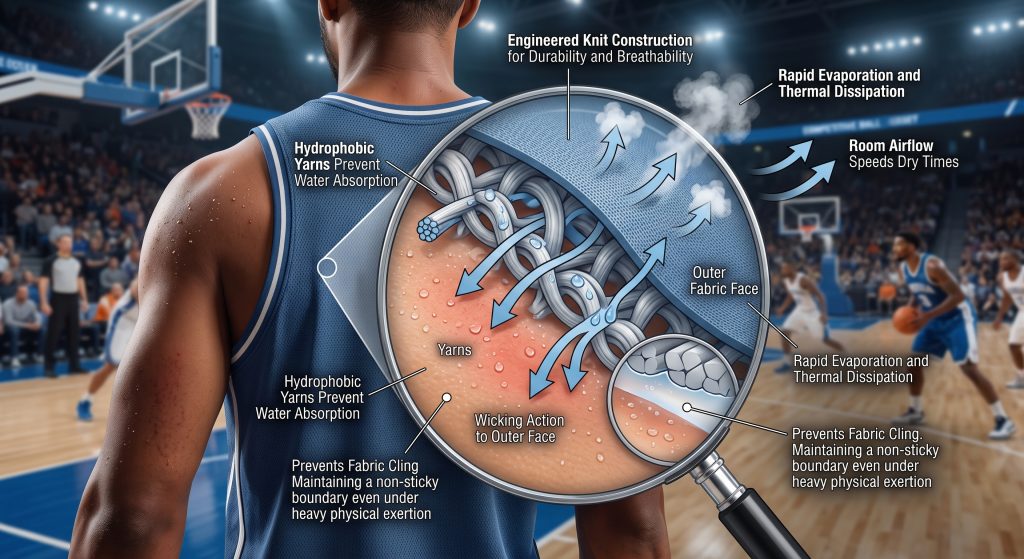
Superior on-court behavior stems from yarn cross-sections that move liquid perspiration away from warm skin instantly. Engineered basketball jersey cloth relies on hydrophobic polyester yarns that reject water absorption during intense matches. This mechanical action pulls dampness toward outer fabric faces where room airflow speeds dry times.
Player comfort depends directly on rapid thermal dissipation across four continuous quarters. High-grade knit construction prevents fabric cling even under heavy physical exertion.
What Drives Rapid Capillary Moisture Movement?
Liquid moves across fiber channels through surface tension and specialized cross-sections. Here is the deal: standard round fibers trap moisture, whereas grooved multi-channel filaments pull sweat outward rapidly.
- Micro-grooved polyester filaments accelerate wicking velocity by 40%.
- Hydrophobic synthetic cores prevent yarn swelling and water weight gain.
- Exterior evaporation zones disperse dampness across wide surface areas.
When you specify engineered yarn cross-sections, players stay dry through fast-break transitions.
How Does Open Knit Architecture Improve Airflow?
Structural air permeability determines how quickly body heat vents during active play. Look closely at the mechanical knit gaps that create natural ventilation funnels.
- Diamond and honeycomb openings allow continuous convection currents.
- Porous fabric matrices reduce skin contact points by over 30%.
- Heat dispersion lowers core skin temperature during intense play.
Key Takeaway: Choosing micro-grooved filaments paired with open-loop knits guarantees rapid drying and prevents fabric stickiness during tournament play.
| Performance Metric | Standard Flat Knit | Engineered Micro-Knit | Benefit to Player |
| Wicking Rate (mm/min) | 25 | 65+ | Rapid skin moisture clearance |
| Air Permeability (cfm) | 120 | 280+ | Continuous core heat release |
| Wet Cling Factor | High | Low | Full freedom of movement |
These metrics confirm why micro-knit channels remain mandatory for high-tier basketball apparel lines.
2. Why Choose Polyester for Basketball Jersey Cloth Lines?
Polyester remains the premier raw material because it combines tensile durability with zero water absorption properties. Modern basketball jersey cloth manufactured from synthetic polymers resists intense pulling and defensive clutching without losing structural memory.
Low moisture regain values allow synthetic jerseys to remain light throughout entire games. Garment manufacturers rely on these durable polymers to withstand heavy industrial wash cycles.
Why Do Synthetic Polymers Outperform Raw Cotton?
Cotton fibers absorb up to 8% of their dry weight in liquid sweat, turning jerseys into heavy sponges. What is the real story? Polyester holds less than 0.4% moisture, keeping apparel featherlight during double-overtime games.
- Hydrophobic synthetic chains refuse internal water absorption.
- High tensile strength prevents seam blowouts during aggressive drives.
- Polyester fibers dry roughly three times faster than natural plant yarns.
You protect your brand reputation by avoiding heavy cotton blends in competitive teamwear lines.
Can Recycled Microfiber Handle Heavy Match Abrasion?
Post-consumer recycled polyethylene terephthalate delivers identical mechanical strength compared to virgin polyester yarns. Think about this: recycled microfibers maintain the exact molecular chain strength required for contact sports.
- Tensile breaking strength matches virgin yarn within a 2% margin.
- Microfiber spinning creates supple hands without weakening abrasion ratings.
- Sustainable yarn sourcing appeals directly to modern school athletic programs.
Key Takeaway: 100% polyester fabric constructions eliminate water weight buildup while offering the tensile durability needed for pro basketball.
| Property Comparison | Pure Cotton Knit | Virgin Polyester | Recycled Micro-Poly |
| Moisture Regain (%) | 7.0 – 8.5 | 0.2 – 0.4 | 0.2 – 0.4 |
| Tensile Strength (cN/dtex) | 2.5 – 3.5 | 4.5 – 5.5 | 4.4 – 5.3 |
| Dry Time Index (min) | 75 | 22 | 24 |
The low moisture absorption of polyester guarantees consistent garment weight under peak athletic conditions.
3. How Does Bird Eye Mesh Shape Basketball Jersey Cloth?
Bird eye mesh uses a unique tuck-stitch pattern that generates miniature eyelet perforations across the fabric face. This specific basketball jersey cloth structure produces a smooth inner surface against bare skin while maintaining exterior porosity.
Sportswear brands favor this textured knit because it delivers mechanical breathability without exposing the player’s undergarments. The three-dimensional surface also adds visual depth to finished sports uniforms.
What Creates the Distinctive Bird Eye Pinhole Pattern?
Knitting machines use alternating tuck and miss stitches to generate regular, eyelet-shaped depressions. Here is why that structural choice matters: the raised dots lift the bulk of the cloth off the athlete’s skin.
- Geometric eyelet arrays provide mechanical draft points for air circulation.
- Two-layer knit architecture pairs a flat backing with a textured face.
- Pinholes stay structurally stable under lateral fabric tension.
This mechanical construction allows you to deliver high ventilation without adding chemical finishes.
How Does Bird Eye Fabric Deliver Superior Hand Feel?
The dense grouping of fine-denier yarn prevents rough friction burns when players dive for loose balls. Ready for the good part? The micro-textured surface glides smoothly across the torso during sharp lateral cuts.
- Soft-filament texturizing prevents skin irritation across sensitive body zones.
- Reduced surface friction stops jersey binding against base layers.
- Smooth yarn loops give jerseys a premium retail appearance.
Key Takeaway: Bird eye mesh provides built-in mechanical breathability and a silky hand feel, making it a reliable standard for custom team jerseys.
| Characteristic | Bird Eye Mesh | Standard Pinhole Mesh | Open Dazzle Mesh |
| Texture Definition | Micro-Eyelet Dobby | Perforated Holes | Glossy Flat Rib |
| Skin Contact Friction | Very Low | Moderate | Low |
| Opacity Rating | 92% (High) | 78% (Medium) | 85% (Medium-High) |
High opacity combined with mechanical airflow makes bird eye mesh a dependable option for single-layer team jerseys.
4. Why Compare Pique to Bird Eye Basketball Jersey Cloth?
Pique fabric features a geometric honeycomb or waffle knit that creates a stiffer, more structured drape. When evaluating basketball jersey cloth, pique provides a firmer hand feel compared to the softer, more fluid bird eye mesh.
Choosing between these two knits comes down to your desired uniform silhouette and tactile preference. Pique delivers a tailored, classic polo-like body, while bird eye focuses on high-speed ventilation and drape.
How Does Pique Weave Differ in Surface Structure?
Pique utilizes fine parallel ribs and geometric waffle textures generated by specialized double-jersey knitting setups. Check this out: the raised ridges give pique fabrics extra vertical stability.
- Honeycomb waffle geometries increase overall fabric thickness and body.
- Dual-face knitting creates distinct exterior texture with clean interior backing.
- Firmer structural drape prevents clinging around player midsections.
If you manufacture vintage-inspired uniforms, pique delivers the crisp look your clients want.
Which Fabric Offers Better Breathability and Grip?
Bird eye mesh provides superior airflow velocity, while pique offers greater resistance against defensive jersey tugs. Notice the difference in how each textile behaves during high-contact moments.
- Bird eye mesh vents heat 25% faster due to open-knit eyelet cavities.
- Pique knits resist snags and surface abrasion from velcro gear.
- Bird eye contours closer to the body during rapid athletic sprints.
Key Takeaway: Select bird eye mesh for lightweight, fast-drying competition kits, and specify pique knit when you need structured, retro-style uniforms with high snag resistance.
| Feature Comparison | Bird Eye Mesh | Performance Pique Knit |
| Knit Pattern | Micro Tuck Eyelet | Honeycomb / Waffle Rib |
| Hand Feel | Silky, Fluid, Soft | Textured, Crisp, Firm |
| Air Permeability | Exceptional | Moderate to High |
| Structural Rigidity | Low to Medium | High |
Reviewing these physical differences will guide you toward the right fabric texture for your teamwear project.
5. Which GSM Weight Fits Custom Basketball Jersey Cloth?
Selecting fabric weight between 140 GSM and 180 GSM determines garment opacity, durability, and court comfort. Specifying the right weight for your basketball jersey cloth prevents thin white uniforms from becoming sheer under bright arena lights.
Heavier fabrics provide long-lasting durability for full-contact competitive leagues. Lighter weights reduce thermal load for youth and summer tournament leagues.
What Are the Standards for Pro Match 180 GSM Fabric?
Professional basketball leagues demand 160 to 180 GSM knits to endure relentless defensive contact and regular laundering. Here is the breakdown: this specific weight range provides opacity without adding unnecessary bulk.
- 180 GSM fabric provides 98% opacity even on white base garments.
- Heavy-duty yarn matrices hold twill lettering and embroidery securely.
- High fiber density resists tearing during aggressive lane rebounds.
This weight class gives your custom jerseys the substantial feel expected by competitive athletes.
Can Lightweight 140 GSM Material Prevent Opacity Issues?
Modern micro-denier spinning packs more individual filaments into a 140 GSM knit to block light penetration. Keep this in mind: filament count matters far more than raw fabric thickness for preventing see-through jerseys.
- Micro-denier yarns increase yarn surface coverage by 35%.
- 140 GSM jersey weights maximize heat venting in hot outdoor leagues.
- Lighter uniform kits lower athletic fatigue over long tournament weekends.
Key Takeaway: Use 180 GSM knits for embroidered, professional-tier game uniforms, while reserving 140 to 150 GSM fabrics for heat-transfer youth and travel kits.
| Fabric Weight Class | Target Market | Key Strengths | Decoration Suitability |
| 135 – 145 GSM | Youth / Summer League | Featherlight, Ultra-Cool | Heat Transfer / Sublimation |
| 150 – 165 GSM | High School / College | Balanced Weight, Durable | Sublimation / Screen Print |
| 170 – 185 GSM | Pro League / Club Teams | Maximum Opacity, Robust | Tackle Twill / Heavy Stitches |
Matching fabric weight to decorating techniques ensures clean garment production and long-term durability.
6. How Does Spandex Blend Into Basketball Jersey Cloth?
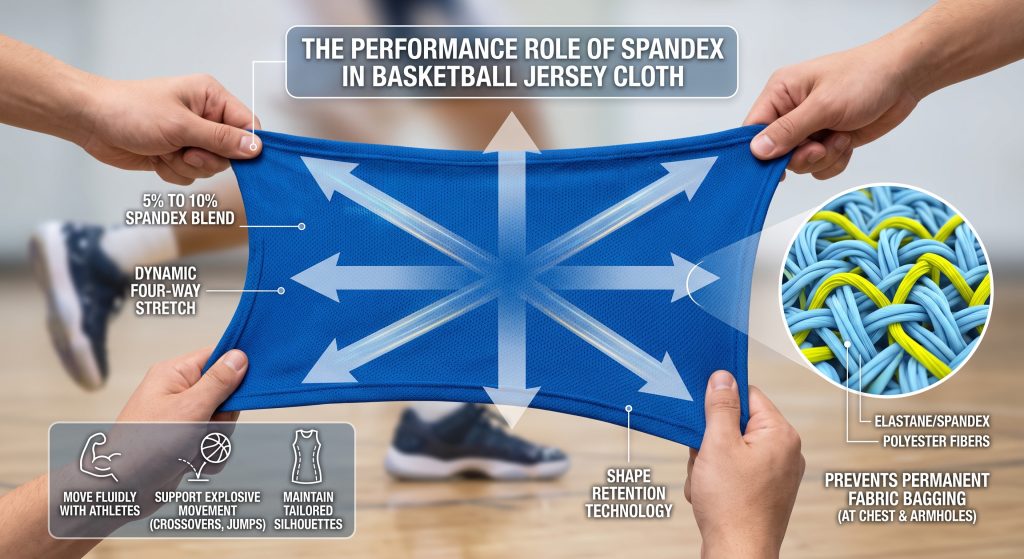
Adding 5% to 10% elastane fibers gives jersey fabric dynamic four-way stretch and shape retention. High-performance basketball jersey cloth uses spandex blends to move fluidly with athletes during explosive crossovers and vertical jumps.
Pure polyester knits provide mechanical stretch, but elastane prevents permanent fabric bagging at the chest and armholes. This elasticity supports the modern, tailored athletic silhouettes favored by elite teams.
What Is the Balance Between Stretch and Shape Recovery?
Too much elastane makes garments cling uncomfortably, while too little restricts player shoulder rotation. Here is the secret: an 8% spandex and 92% polyester ratio provides full mobility without losing shape.
- Four-way elasticity allows unrestricted defensive arm extension.
- 98% elastic recovery eliminates sagging around necklines and armholes.
- Targeted stretch accommodates modern, fitted athletic cuts.
You can deliver aerodynamic jerseys that fit cleanly without hindering player agility.
How Do Elastane Blends Influence Finished Garment Drape?
Spandex adds weight and fluid drape to synthetic fabrics, keeping jerseys close to the body during physical movements. Look at the movement: the garment stays in place instead of billowing when players run.
- Enhanced fabric drape prevents excess loose cloth from snagging.
- Clean contours give players a fast, athletic court appearance.
- Balanced stretch keeps jerseys securely tucked into shorts.
Key Takeaway: Incorporating a 5% to 8% spandex blend provides four-way stretch and clean recovery, creating a modern, tailored athletic fit.
| Yarn Composition | Stretch Type | Elastic Recovery | Garment Silhouette |
| 100% Polyester | 2-Way Mechanical | 88% – 92% | Traditional Loose Fit |
| 95% Poly / 5% Spandex | 4-Way Dynamic | 95% – 97% | Modern Athletic Fit |
| 90% Poly / 10% Spandex | 4-Way High-Stretch | 98% – 99% | Pro-Cut Form Fitting |
Choosing the right elastane percentage helps you match your apparel cut to current market expectations.
7. Why Does Sublimation Suit Basketball Jersey Cloth?
Dye sublimation turns disperse inks directly into gas under heat, bonding the pigments directly with synthetic fibers. Applying sublimation to basketball jersey cloth keeps the fabric breathable because it leaves zero rubbery ink layers on the surface.
This decoration method yields brilliant team graphics, sharp player numbers, and complex gradient designs that never crack. The printing process remains budget-friendly for small custom team rosters and club leagues.
Why Does Disperse Dye Bond Firmly With Poly Fibers?
Heat opens the molecular pores of polyester filaments, allowing gasified dyes to lock inside the fiber core. What happens next? As the textile cools, the dye becomes an inseparable part of the yarn structure.
- Sublimated colors resist cracking, peeling, and chipping completely.
- Zero surface ink buildup preserves the open pores of bird eye mesh.
- Complex gradient patterns render with sharp photo-grade clarity.
This permanent coloration protects uniform designs across seasons of aggressive laundering.
Can Heat Press Temperatures Distort Mesh Fabric Density?
Operating heat presses above 210°C can melt delicate micro-polyester knits if dwell times are not calibrated. Watch out for this: excessive press pressure can flatten the open eyelets of textured fabrics.
- Calibrated 200°C press temperatures protect synthetic yarn crimp.
- Controlled dwell times prevent fabric shrinkage and edge yellowing.
- Correct pressure settings keep mesh micro-pores fully open.
Key Takeaway: Dye sublimation locks custom colors inside polyester fibers permanently without blocking the open mesh pores that keep players cool.
| Printing Technique | Breathability Retention | Color Fastness | Complex Graphic Setup |
| Dye Sublimation | 100% (No Clogged Pores) | Class 5 (Zero Fade) | Instant Digital Setup |
| Screen Printing | 45% (Solid Ink Layer) | Class 3 – 4 (Cracks) | Expensive Film Screens |
| Heat Transfer Vinyl | 30% (Blocks Airflow) | Class 3 (Peels) | High Labor Weeding |
Reviewing print methods shows why sublimation remains the top choice for lightweight, breathable team kits.
8. How to Verify Quality in Basketball Jersey Cloth Bales?
Testing raw fabric yardage for colorfastness, pilling resistance, and tensile strength prevents costly factory production errors. Reliable basketball jersey cloth must pass international textile quality checks before moving to cutting and sewing tables.
Setting clear laboratory benchmarks guarantees your factory receives consistent fabric rolls across every batch. Proactive testing prevents batch rejections and ensures uniform color matching across your apparel line.
How Do You Test Colorfastness Under Harsh Match Rubbing?
Laboratory crocking tests check whether dark team dyes rub off on lighter trim fabrics during sweaty play. Do not overlook this: wet rub fastness must achieve at least a Grade 4 rating on the grey scale.
- Wet crock testing simulates friction under heavy sweat conditions.
- Perspiration fastness tests expose dyes to acidic and alkaline solutions.
- High-temp wash fastness ensures vibrant team colors do not bleed.
Demanding verified lab dip test reports protects your brand against embarrassing on-court dye bleeds.
What Are the Key Checks for Pilling and Tensile Strength?
Martindale abrasion machines rub fabric swatches through thousands of cycles to simulate jersey friction against player padding. Here is your test plan: always specify strict testing thresholds before signing bulk purchase contracts.
- Martindale test targets should exceed 20,000 abrasion cycles.
- ASTM D5034 grab tests measure warp and weft fabric break strength.
- Bursting tests ensure mesh eyelets resist tearing when pulled hard.
Key Takeaway: Verifying colorfastness and Martindale abrasion ratings before mass production stops dye bleeding and surface pilling in bulk orders.
| Quality Standard | Minimum Target | Test Method | Defect Prevented |
| Wet Color Crocking | Grade 4.0+ | ISO 105-X12 | Dye transfer during sweaty play |
| Martindale Pilling | 20,000+ Revs | ISO 12945-2 | Fuzzy surface wear and pilling |
| Bursting Strength | > 250 kPa | ISO 13938-1 | Seam blowout and cloth puncture |
Setting measurable lab targets protects your profit margins and guarantees reliable fabric deliveries.
9. What Cost Factors Drive Basketball Jersey Cloth Orders?
Raw polyester filament pricing, fabric weight specifications, and total order volume determine your cost per yard. Sourcing high-grade basketball jersey cloth directly from primary knitting mills eliminates trading markups and lowers landed manufacturing costs.
Understanding how yarn grade, finishing treatments, and freight packing affect unit pricing helps you plan better budgets. Streamlining fabric choices lets you protect your bottom-line profit margins.
How Do Raw Filament Grades Impact Factory Yardage Costs?
Microfiber and specialized moisture-wicking yarns cost slightly more per kilogram than basic flat filament fibers. Follow the money: this modest raw material investment pays off by eliminating expensive aftermarket chemical finishes.
- Inherent micro-channel yarns maintain wicking forever without costly top finishes.
- Virgin polymer pricing tracks global petrochemical feedstock rates.
- Recycled certified yarns carry a modest 5% to 10% raw material premium.
Selecting yarn with built-in wicking performance reduces overall factory processing time and cost.
What Volume Tiers Maximize Container Shipment Budgets?
Ordering fabric in full container loads (FCL) lowers ocean freight costs compared to less-than-container shipments (LCL). Here is the bottom line reality: smart freight planning protects your unit margins from unexpected price spikes.
- Ordering 2,000+ kg lots unlocks direct factory tier pricing.
- Standardized roll widths minimize cut waste during garment marker nesting.
- Vacuum-sealed roll packing increases container yardage capacity by 20%.
Key Takeaway: Ordering high-yield, inherently functional yarns in container volumes lowers unit yardage costs while keeping quality high.
| Order Volume Tier | Average Cost / Meter | Typical MOQ | Shipping Strategy |
| Sample Sampling Tier | $3.50 – $4.80 | 10 – 100 m | Air Courier / Express |
| Production LCL Tier | $2.20 – $2.90 | 500 – 1,500 kg | Consolidated Sea Freight |
| Bulk FCL Tier | $1.60 – $2.10 | 5,000+ kg | Full Container Ocean Line |
Planning around volume pricing breaks helps you secure favorable fabric terms from overseas mills.
10. How to Pick the Right Basketball Jersey Cloth Supply?
Choosing a dependable textile supplier requires evaluating knitting equipment, dye house capacity, and export quality certifications. Reliable basketball jersey cloth manufacturers offer full lot-to-lot color matching and consistent physical specifications.
Working with an experienced knitting partner prevents unexpected delays during tight sports season rollouts. Building solid mill relationships gives your company stable pricing and priority manufacturing schedules.
What Mill Certifications Assure Consistent Batch Output?
International textile certifications confirm that your supplier follows consistent quality control and environmental standards. Verify before buying: checking these credentials safeguards your brand against hazardous dyestuffs and uneven lots.
- OEKO-TEX Standard 100 verifies the absence of harmful process chemicals.
- ISO 9001 certification ensures consistent knitting and dye house controls.
- GRS (Global Recycled Standard) validates authentic recycled yarn sourcing.
These official quality verifications give your retail clients complete product peace of mind.
How Do You Establish Reliable Bulk Lead Times?
Clarifying lead times for lab dips, greige yarn knitting, and final dyeing keeps seasonal apparel launches on schedule. Plan ahead: always add a buffer for ocean shipping when setting wholesale delivery dates.
- Standard lab dip color approvals take 3 to 5 working days.
- Greige knit fabric dyeing runs on 15 to 20-day production windows.
- Direct mill relationships eliminate middleman communication delays.
Key Takeaway: Partnering with certified knitting mills guarantees consistent fabric performance, stable dyeing batches, and on-time garment shipments.
| Supplier Evaluation Factor | Red Flag Indicator | Preferred Mill Standard |
| Batch Shade Variation | Delta E > 1.5 | Delta E < 0.8 (Spectrophotometer) |
| Chemical Compliance | No Documentation | OEKO-TEX Standard 100 Certified |
| Production Transparency | Hidden Mill Locations | Direct Facility Audits & Traceability |
Checking these operational standards will help you build a reliable and resilient fabric supply chain.
Strategic Sourcing Summary for Teamwear Brands
Selecting the right performance fabric balances rapid sweat evaporation, light athletic weight, and reliable tear resistance. This guide covered how engineered micro-groove yarns drive capillary action, why bird eye mesh outperforms standard pique for court cooling, and how exact 140 to 180 GSM specifications protect opacity. Choosing certified polyester knits prevents on-court failures, lowers warranty claims, and preserves your custom sublimation print quality across heavy match play.
Our manufacturing facilities produce high-grade sportswear textiles tailored to exact teamwear specifications. We help athletic brands and apparel factories source consistent, lab-tested knits at competitive wholesale volume pricing. If you need reliable production runs with strict quality control and lot-to-lot color matching, contact us today to request custom swatch headers and laboratory test data. We provide the material performance foundation that helps sportswear brands lead on every court.
Frequently Asked Questions
Q1: Can I use 100% cotton for competitive basketball jerseys?
No, cotton absorbs sweat quickly, becoming heavy and clinging uncomfortably to players during games. Polyester knits dry much faster and withstand rigorous match contact.
Q2: What is the best GSM weight for high school basketball uniforms?
A 150 to 160 GSM bird eye mesh offers the best balance of opacity, light weight, and snag resistance for high school players. This medium weight keeps uniforms durable while allowing clean sublimation graphics.
Q3: How do I know if a jersey fabric will become see-through under bright court lights?
Check the fabric opacity rating and filament count; high-filament micro-polyester knits over 150 GSM block light even in white colorways. You should always review physical lab samples against backlighting before placing bulk orders.
Q4: Can I sublimate directly onto dark polyester basketball fabrics?
No, dye sublimation requires white or light-colored polyester bases because the disperse inks are transparent. Dark fabrics should be decorated using tackle twill embroidery or screen print transfers.
Q5: What is the main difference between bird eye mesh and pique knit?
Bird eye mesh features small eyelet perforations that maximize ventilation, while pique uses a geometric honeycomb weave for a firmer, more structured drape. Bird eye remains the top choice for modern performance kits, while pique suits retro teamwear.